BYUN is the first film in a series called This Must Be the Place by Lost & Found. The series explores the idea of home — what makes them, how they represent us, and why we need them. I can’t wait to see the rest of the series…
(via Coudal)
1 CommentBooks, Design and Culture
BYUN is the first film in a series called This Must Be the Place by Lost & Found. The series explores the idea of home — what makes them, how they represent us, and why we need them. I can’t wait to see the rest of the series…
(via Coudal)
1 CommentThanks for the CBC Books blog for including The Casual Optimist in their list of 10 ‘Book Blogs We Appreciate’ earlier this week. It is always nice to be appreciated — I only hope I can live up to the billing… :-)


 The Story of Eames Furniture — Written and designed by Marilyn Neuhart together with her husband John, who both worked with the Eames Office from the 1950’s until 1978, the year Charles Eames’s died. Published later this month by Gestalten, the book comes in two full-colour volumes with a slipcase.
The Future of the Future — William Gibson interviewed in The Atlantic:
I think that our future has lost that capital F we used to spell it with. The science fiction future of my childhood has had a capital F—it was assumed to be an American Future because America was the future. The Future was assumed to be inherently heroic, and a lot of other things, as well… I’m not going all Sex Pistols, shouting No Future!—I’m suggesting that we’re becoming more like Europeans, who have always retrofitted their ruins, who’ve always known that everyone lives in someone else’s future and someone else’s past.
Respect for the Users — Jay Rosen‘s inaugural lecture to incoming students at Sciences Po école du journalisme in Paris earlier this month:
The Web effortlessly records what people do with it. Therefore it is easy to measure user behavior: what people are interested in, what they are searching for, clicking on, turning to… right now. What should a smart journalists do with this “live” information?… [Y]ou should listen to demand, but also give people what they have no way to demand because they don’t know about it yet. In fact, there is a relationship between these things. The better you are at listening to demand, the more likely it is that the users will listen to you when you say to them: you may not think this is important or interesting, but trust me… it matters. Or: “this is good.” Ignoring what the users want is dumb in one way; editing by click rate is dumb in a different way. Respect for the users lies in between these two.
And finally…
Graphic designer James Patrick Gibson talks to Babelgum about his photoblog New Type York , an archive of images of typographic artifacts — signs, directions and building inscriptions — around New York City (via DesignRelated):
Comments closed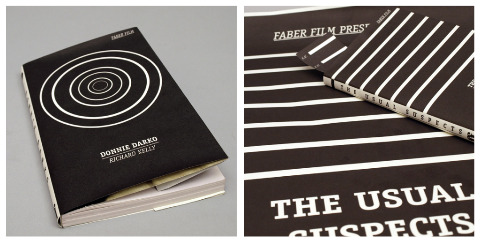
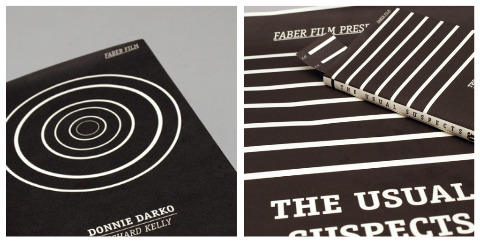
Another great set of designs for the 2009 D&AD student award brief for typography sponsored by Faber and Faber, this time by Rinse Design (via Cosa Visuales). See also: Ed Cornish’s designs for the brief.
Phaidon have relaunched their website and it is really rather nice (via FormFiftyFive).
The Imaginary Present — Mike Doherty interviews William Gibson about his new novel Zero History for The National Post:
In his earlier books, Gibson says, he aimed to devise “futures that felt as though they were filled with designed artifacts, as indeed they would be. I can’t think of too many science fiction writers who’d bother trying to do that.” In the [new] series, his devotion to design has gone into overdrive, reflecting the idea that “everything is ‘designer,’ ” even though “with most things, you’ll never know the name of a designer.”
PopMatters also spoke to the author about the new book.
Code — Jennifer Egan, author of A Visit From the Goon Squad, reviews Tom McCarthy’s C for The New York Times:
[McCarthy] aligns disparate things into larger patterns full of recurring images: analogies between the human body and earth, and machinery; hums and whirs; film screens; bowels and tunnels; electric circuits; cauls and other silken membranes. These repetitions come to feel like the articulation of a larger code — as if, were readers to plot their exact positions throughout the novel, they would discover a hidden message.
What Ever Happened to Reading Properly? — ReadySteadyBlog’s Mark Thwaite on critics misreading of Gabriel Josipovici’s What Ever Happened to Modernism?:
It’s interesting that Josipovici’s book which, in many ways, is both a call to read more carefully and an enquiry into why reading carefully is beyond so many cultural gatekeepers, has been read so sloppily by so many of its critics… Josipovici doesn’t invoke marginal or avant-garde writers, nor praise typographical or narrative playfulness over stale traditionalism, but rather brings us back to canonical writers (a good part of his essay is taken up with Wordsworth) and allows us to see what was at stake for those artists in their work, and what is at stake for us as readers.
And finally… It’s Vignelli week at Design Observer:
 Debbie Millman’s 2007 interview with Massimo Vignelli (excerpted from her book How To Think Like a Graphic Designer):
I’m interested in “essence” — my major aim is really to get to the essence of the problem. And just throw away everything that’s not pertinent to it. At the end of a project, my work should be the projection of that experience, the essence of effect. It’s a habit that you get into… The essence is what is left when there’s nothing else that you can throw away.
Michel Bierut profiles Lella Vignelli:
Massimo has often defined their working relationship like this: “I’m the engine, and Lella is the brakes.” The first time I heard this as a young designer, it was clear to me which was more important. If you were a designer, wouldn’t you want to be the engine, powerful, propulsive, driving forward? It was only years later that I remembered something my high school driving instructor once said: “You don’t get killed in a car accident because the car won’t start. You get killed because the breaks fail.”
And, there is an interesting, beautifully shot, video interview with Massimo Vignelli by photographer John Madere here.
There will surely be more good stuff as the week progresses…
Comments closed A series of book cover design concepts for The Infamous Press by Norwegian graphic designer Morten Iveland (via IS050).
Paid by the Joke — The enduring appeal of Keith Waterhouse’s Billy Liar in The Guardian:
Billy Liar’s longevity is not an example of a tale that is told and told again with a dulling faithfulness; rather, the long life of Billy Liar is a story of reincarnation, of each new generation seizing upon the tale afresh and making the story its own. Its influence may be felt in half a century of creative endeavour, in drama and literature and film, and, perhaps most keenly, in popular music: referenced, for instance, in the video for the Oasis single The Importance of Being Idle, and in a song by the Decemberists, and popping up, too, in many of Morrissey’s lyrics, including the Smiths’ 1984 hit William, It Was Really Nothing.
And if anyone at Penguin is reading, please, please reissue Billy Liar with the Tony Meeuwissen Woodbine cover from the 1970’s (come on, you know you want to):
 (image via David The Designer)
If Covers Could Talk — A nice satirical book cover blog, kind of like Unhappy Hipsters for books.
And finally…

W. W. Norton, who have done great job with their Flickr — particularly their book design archive where the above stunner by Gray318 comes from — now have a Tumblr as well. The latest post, at the time of writing, is an animated scene from Stitches, the graphic memoir by David Small. Nice work.
5 Comments The mighty George Lois at home in New York City at The Selby.
Start the Press — Robert Pinsky reviews The Book in the Renaissance by Andrew Pettegree for the New York Times:
The story begins with money. Johannes Gutenberg did not find a way to profit from his technical achievements. The Gutenberg Bible, a gigantic project, required large amounts of capital that needed replenishing over time, long before there was any hope of profit. The finished product inspired awe, but the print run was 180 copies. Gutenberg “died bankrupt and disappointed.”
Nor was he alone. Apparently, it took decades before some people figured out how to make money from this remarkable invention. For decades after Gutenberg, it was not even clear that print would become a success. How do you market books? How many should you run off at one time? Piracy was a problem, as were texts changed, mutilated or combined in unauthorized editions. Many printers were ruined, trying to exploit the new medium.
And at the other end of the spectrum (or, at least, the other side of the Atlantic)…
Seeing Things Flat — Jenny Turner reviews Tom McCarthy’s C for the London Review of Books:
Remainder works as an allegory of a certain flâneurish model of artistic production, in which a gentleman’s independence of income and education loom pretty big. That, we might say, is Remainder’s material remainder; and it is that of C also, though C moves the argument on a little, investigating the conditions, as it were, of its own existence: family inheritance, war, imperialism, technology; spreading information, spreading death. It’s this core of historical and philosophical seriousness that separates McCarthy’s work completely from the current fashion for baroque narratological cleverness in fiction… There are differences between cleverness and intellect. McCarthy has many things he’s trying to do in his novels, none of which have much to do with pleasing producers or publishers or even an audience, unless by pleasing one means leaving purged.
The Googleable Future — Author William Gibson, whose new novel Zero History is published next week, on Google for the New York Times (via MDash):
We never imagined that artificial intelligence would be like this. We imagined discrete entities. Genies. We also seldom imagined (in spite of ample evidence) that emergent technologies would leave legislation in the dust, yet they do. In a world characterized by technologically driven change, we necessarily legislate after the fact, perpetually scrambling to catch up, while the core architectures of the future, increasingly, are erected by entities like Google.
Cyberspace, not so long ago, was a specific elsewhere, one we visited periodically, peering into it from the familiar physical world. Now cyberspace has everted. Turned itself inside out. Colonized the physical. Making Google a central and evolving structural unit not only of the architecture of cyberspace, but of the world.
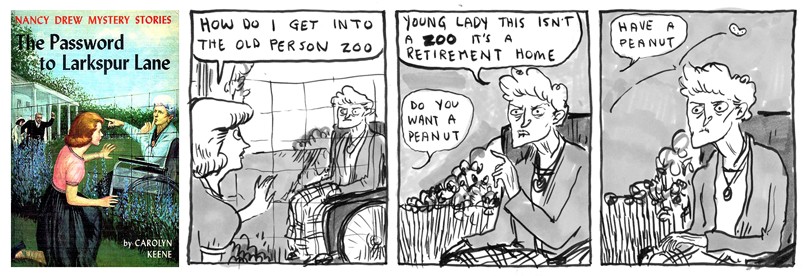 Kate Beaton interprets Nancy Drew book covers in her own unique way at Hark! A Vagrant.
And finally…
 Kevin Huizenga has posted his head-spinning Glenn Ganges comic ‘Time Travelling’ at What Things Do.


Hornby Cover Versions — Some rather beautiful student work by Barcelona-based graphic designer Lucía Castro (although my inner-bookseller gets very twitchy at the thought of those soft off-white covers!). (via Cosa Visuales)
Full of Refusals — Tom McCarthy interviewed for More Intelligent Life:
[C]ontemporary literature has to deal with the challenges laid down by modernism. The most exhilarating and unsettling upheavals took place in the early 20th century, and to ignore them and go back to writing some kitsch version of the 19th-century novel is ostrich-like… I’m suspicious of the term ‘avant-garde’. I think it should be restricted to its strict historical designation: Futurists, Dadaists, Surrealists etc. “Tristram Shandy” and “Motherless Brooklyn” aren’t avant-garde novels; they’re novels.
C by Tom McCarthy will finally available in the US and Canada on September 7th.
 A stunningly simple Malevich-like book cover design by Jason Booher and Helen Yentus for the paperback edition Inside the Stalin Archives by Jonathan Brent. First seen at the Book Cover Archive who have just posted a slew of Jason’s covers.
On the subject of the BCA, co-curator Ben Pieratt has recently updated his own design portfolio.
Agile Content — Marny Smith interviews Brian O’Leary of publishing consultants Magellan Media Partners:
[P]ublishers are competing against both established players and new entrants at the same time. The newer players often have much lower costs than we’re used to, making them potentially tough competitors… I’ve been thinking lately that publishers need to work more aggressively on creating agile content that can be discovered and easily reused or recombined. Creating content that is sold in one format just won’t be cost-effective in the future.
And finally…
The cute book trailer for OH NO! Or How My Science Project Destroyed the World written by Mac Barnett illustrated by Dan Santat:
You can find more of Dan’s awesome illustrations on his Flickr:
 (via The Ward-O-Matic)
 Jardin de la Connaissance — Berlin-based landscape architect Thilo Folkerts and artist Rodney Latourelle used 40,000 reclaimed books to create a ‘Garden of Knowledge’ for the 11th International Garden Festival in Grand-Métis, Quebec (via Kitsune Noir).
A History of Print Culture — Assistant Professor of Media Culture, C.W. Anderson, provides his annotated syllabus for a print history course at CUNY in The Atlantic (thx Jamie):
The primary goal of this class is to teach students about the culture of “print media” in an era when that culture is being joined (and in some cases, overtaken) by a culture that we might variously call digital culture, online culture, or the culture of the web. What does “print” mean in our digital age? And what does “culture,” mean, for that matter? By culture I mean something that is not reducible to “economics,” “technology,” “politics,” or “organizations” — although culture emerges out of the nexus of these different factors, and others. In other words, I want to disabuse my students of the notion that new technologies or new economic arrangements can create digital or print culture in the same way that a cue ball hits a billiard ball on a pool table.
Also in The Atlantic… 10 Reading Revolutions Before E-Books by Timothy Carmody.
Knowledgeable Criticism — An interesting interview with Fred Brooks, computer scientist and author of The Mythical Man-Month, for Wired magazine:
Great design does not come from great processes; it comes from great designers… The critical thing about the design process is to identify your scarcest resource. Despite what you may think, that very often is not money.
And finally…
When You Don’t Know You Are Breaking the Rules… Eli Horowitz, managing editor of McSweeney’s, interviewed for Scotland on Sunday (via the indefatigable Largehearted Boy):
Comments closedAt the heart of McSweeney’s success is the huge amount of care and attention which goes into producing each book, ensuring that the jacket design and layout complement the words inside the covers. Though Horowitz believes there is a McSweeney’s aesthetic he is struggling to put into words what it is. “There’s a notion of old-fashioned story-telling and a compelling plot combined with an innovative literary impulse – when we’ve had those ingredients that’s when we’ve done our best works.”
 Psycho Cover — Penguin art director Paul Buckley discusses his new book Penguin 75 with Imprint:
I am very aware of how much product gets put out there that is completely unnecessary, be it music, movies, books, whatever—it seems that for every good piece of culture we experience, we are bombarded with 99 pieces of redundant crap. I’ve been in the industry for awhile, and of course want to show off the great work we do here, but was not going to put out yet another design book and take your money—you can get that in any annual. To me, often more interesting than the covers are the stories, the psychology that created all the variables that led to this cover over the 20 other proposed covers.
Paul has recently updated his Flickr with new covers from the Penguin Ink series, which utilizes art by tattoo artists, as well as the latest additions to the excellent Penguin Graphic Classics series, which have art by contemporary cartoonists.
My interview with Paul and Penguin 75 designer Christopher Brand is here.

Also at Imprint… Thurston Moore of Sonic Youth and book editor Eva Prinz (formerly of Abrams and Rizzoli) talk about their new publishing venture Ecstatic Peace Library.
Writing on the Wall — Andrew Franklin, publisher and managing director of Profile Books, offers an overview of the current state of the book business in the UK (via Dan Mogford):
Bookshops enliven high streets, create communities of readers and stage author events, while good booksellers encourage reading and shape taste. For most readers, browsing is a key part of deciding what to read, and publishers put huge effort into packaging and presenting their books. Of course many of these activities can migrate online with Facebook groups, online forums, feeds and websites helping to steer readers to the books they will most enjoy. For some online shoppers bookshops are part of this process: they browse in bookshops, write shopping lists and then buy (perhaps more cheaply) online. But no bookshop can be in business as a shop window for other retailers. You don’t have to be hopelessly nostalgic or sentimental to believe something very precious is lost with every bookshop that closes.
And at the other of the spectrum…
Another Reading Revolution — Historian Andrew Pettegree talks about his new book The Book in the Renaissance with The Atlantic (via Shelf Awareness):
Comments closedThe situation really is that the first generation of printers, encouraged by scholars, naturally produced the sort of books these people wanted. But it’s hard to apply this sort of commercial model—this small, bespoke model used for manuscripts—to a new process that produces 300 or more identical items. The irony is that there were plenty of other readers out there. The first printers ignored the groups that we might call pragmatic readers. Literacy was already widely-disseminated in the fifteenth century. There were lots of people who could read but did not habitually buy books, so the trick was to discover how to reach them.

The Eyes Have It — An interview with gentleman book cover designer and advertising copywriter David Gee about his design for Jim Hanas’s e-book short story collection Why They Cried. You can find my interview with David here.
Writers on Process — Writers of every stripe talking about how they write (via Largehearted Boy).
In Their Own Words — A BBC archive of television and radio interviews with modern British novelists including Virginia Woolf, Daphne du Maurier, Anthony Burgess, J.G. Ballard, and Muriel Spark. One could quibble about about selection of some of contemporary novelists, but otherwise this is pretty amazing collection.
And speaking of archives…
 Design is History is an expanding reference for graphic design history created by designer Dominic Flask.
And finally…
 The only page of Jason’s silent and sadly aborted adaptation of Edgar Allan Poe’s The Black Cat.
 Illustrator and designer Dale Edwin Murray’s proposed cover for the Reservoir Dogs Original Screenplay. Is it just me, or is there something of artist and erstwhile Penguin designer Alan Aldridge about this?
You can see more of Dale Edwin Murray’s work on his blog and his Flickr (via Cosas Visuales).

The Library Project — A photographic installation by Swiss artist Nicolas Grospierre inspired by the infinite library in Jorge Luis Borges’ novel short story The Library of Babel (via This Isn’t Happiness).
And finally…
Author David Mitchell talks to Michael Silverblatt about his new novel The Thousand Autumns of Jacob de Zoet on this week’s KCRW’s Bookworm.
I have a truly bad track record with David Mitchell novels, but I should probably give him another go (although that title isn’t doing a lot to encourage me).
The BBC World Service also interviewed David Mitchell recently about his earlier novel Cloud Atlas.
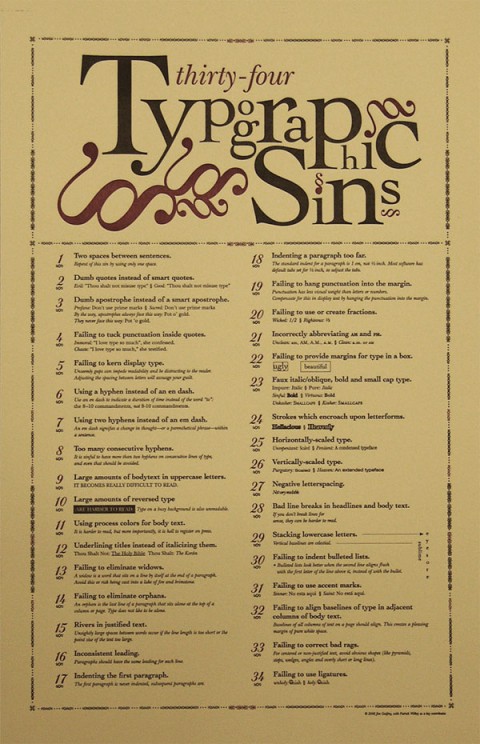
2 Comments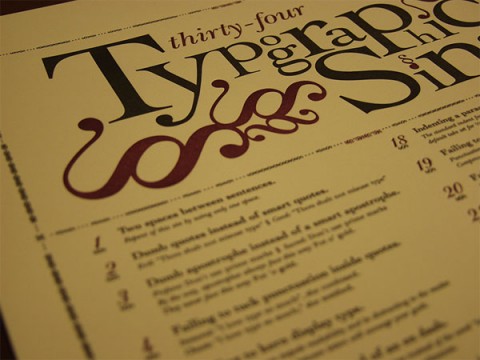 Typographic Sins Poster designed by Jim Godfrey (seen at For Print Only).
And on the subject of graphic design crimes…
Angry Paul Rand on Twitter (via @thebookdesigner):
My advice for designers & design students: fuck the rules, if your work is good enough to get away with it.
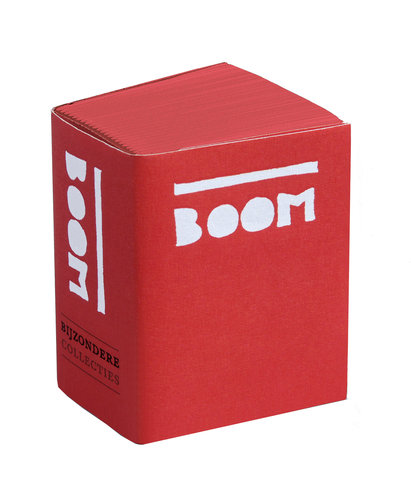 Boom — Alice Rawsthorn profiles Dutch book designer Irma Boom for the New York Times:
Ms. Boom, 49, has designed most of her books just as she has wanted. Typically, a book designer works with the text and images selected by the editor and art director, but Ms. Boom prefers to combine all three roles by deciding on the book’s structure and choosing the themes and visual material herself. She then obsesses over every element — not just how the book will look, but how it will feel and smell — and invents ingenious ways of achieving the desired effects.
One of her books was printed on coffee filter paper. Another was scented to smell of soup. A monograph of the work of the Dutch artist Steven Aalders was made in the exact dimensions of one of his paintings. The page edges of a book on the American textile designer Sheila Hicks were hacked with a circular saw to evoke the fraying edges of her work. The title on the white linen cover of a history of the Dutch company SHV only becomes visible after frequent use. There are 2,136 pages in that book, but no page numbers, to encourage readers to dip in and out.
An exhibition of Boom’s work, ‘Irma Boom: Biography in Books’ runs until Oct. 3 at the University of Amsterdam Library. The book accompanying the exhibition, designed by Boom and pictured above, is only 2 inches high, 1.5 inches wide and 1 inch thick.
And finally…
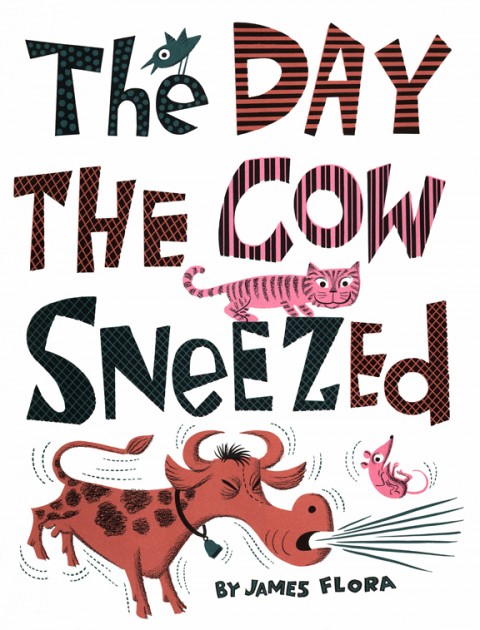 Enchanted Lion are reprinting Jim Flora’s kids books starting with The Day The Cow Sneezed in Fall 2010. Flora was best known his incredible jazz and classical album covers for Columbia Records and RCA Victor, and is officially awesome.