Skip to content

Tag: Miscellany

Something for the Weekend

Patrick Cramsie, author of The Story of Graphic Design, chooses his top 10 graphic design books for The Guardian. The list includes Notes on Book Design by Derek Birdsall.

Type Education — FontShop have released a handful of free typography primers designed for downloading and printing, including ‘Seven Rules for Better Typography’ by Erik Spiekermann.

Frost — Sifting through the Penguin archive in Bristol, writer Gaby Wood profiles the late Eunice Frost, who became an editor at Penguin in the 1930’s and went on to become its first female director, for The Telegraph:

Frost was sharp and, for all her youth and inexperience, in many ways more culturally engaged than the Lane brothers… It was to a large extent thanks to her that Penguin began to publish original work – not just reprinted fiction but the Pelican series of new non-fiction, and the Penguin ‘Specials’ series – quickly produced tracts on various subjects of urgent import. Three weeks after war was declared, for instance, Harold Nicolson was commissioned to write a 50,000-word book entitled Why Britain Is at War, which he delivered two weeks later and which was published a fortnight after that.

Secrets of Life and Death — Artist Jaime Hernandez, co-creator of Love & Rockets, and comics scholar Todd Hignite discuss their new book The Art of Jaime Hernandez with Eric J. Lawrence on KCRW.

Comments closed

Midweek Miscellany

The typographical cover for Oscar Guardiola-Rivera’s What If Latin America Ruled the World designed by Sarah Greeno at Bloomsbury UK.

The Gall — The inimitable  John Gall, VP and Art Director of Vintage / Anchor Books, interviewed for a rather super looking new magazine called Design Bureau:

[O]nce you have a nice solid concept, the rest of the process can almost seem effortless; enjoyable, even. And these, of course, are usually the best ones.” Gall describes his creative process as threefold: research, concept and execute. “Read the books, come up with some ideas, flesh them out, see what is sticking,” he says. However, it’s the process of getting a book’s cover approved that poses the greatest challenge for Gall and his team. “If the publisher comes back and says, well, ‘This needs really big type with a chicken on it’, that obviously means they think this is kind of important,” he says. “The re-working, dealing with all the feedback (some warranted, some moronic) ‘make this bigger’, ‘make this smaller’, ‘my psychic thinks it should be blue’—that is what separates the men from the boys,” he says.

John Gall by Noah Kalina

The article is accompanied by photographs by Noah Kalina, and includes John’s tips for lunch in New York. What more could you ask for? An interview with designer Abbott Miller you say? Well, Design Bureau have one of those as well.

Exit Interview — Former New York Times Design Director Khoi Vinh on designing the newspaper’s paywall, and his decision to walk away, in the New York Observer:

One way of trying to make logical design decisions is through research. Mr. Vinh’s team has been studying traffic patterns on the site and watching test subjects, real readers, in a lab to see how their eyes move across the page when they are reading The Times online.

“I take it all with a grain of salt,” he said. “Everything is so measurable now, theoretically. But the truth of the matter is, there’s never enough data to substitute for raw decision-making abilities. At the end of the day, you still need to make the decision.”

Designing Madison Avenue The New York Review of Books blog on the look of TV show Mad Men:

Among many things that make Mad Men so intriguing is its broad definition of what constitutes design. For example, its cunningly detailed, not-quite-couture female costuming—the B.H. Wragge-style coat-and-dress ensembles, the Koret handbags, the Coro costume jewelry—makes the female characters … seem as if they have stepped straight out of the Sunday New York Times during the twilight of Lester Markel… Equally fanatical attention is paid to interior design. The offices of Sterling Cooper were done up in the spacious, late International Style corporate mode epitomized by the boxy glass-and-steel skyscrapers that rose along Park Avenue after World War II.

And on a somwhat related note, Eleanor Wachtel interviews legendary designer Milton Glaser for CBC Radio. Good stuff.

1 Comment

Something for the Weekend

Today is Penguin’s 75th Birthday! Happy Birthday Penguin.

Tony Lacey, Publishing Director of Penguin, discusses the Penguin Decades series:

And The Guardian interviews Penguin Chief Executive John Makinson, who sounds pretty pleased with himself (Penguin just announced record-breaking half year results):

“[E-books] redefine what we do as publishers and I feel, compared with most of my counterparts, more optimistic about what this means for us,” he says. “Of course there are issues around copyright protection and there are worries around pricing and around piracy, royalty rates and so on, but there is also this huge opportunity to do more as publishers.” Publishing, he says, must embrace innovation: “I am keen on the idea that every book that we put on to an iPad has an author interview, a video interview, at the beginning. I have no idea whether this is a good idea or not. There has to be a culture of experimentation, which doesn’t come naturally to book publishers.

In other news…

Copy Writer from the Dark Side — Author Will Self (Liver) discusses advertising with Gordon Comstock for an interview the Creative Review:

I straighten my dog collar and point out some of the things we might have in common, the novelist and the adman. The love of epigrams, the twisting of cliché, the use of animals behaving uncannily – all Self tropes, all things that a copywriter might well have in his book.

It’s a notion I can imagine certain writers would bridle at, but Self only nods philosophically, “Well, maybe I am a copywriter that’s gone to the dark side, I don’t know.”

Wonder Woman Returns — Kate Beaton goes all superhero and shit at Hark! A Vagrant. Kate is now also selling prints directly from her site and from TopatoCo.

And finally, on a related note and because it’s Friday,…

Lady Gaga Kidnaps Commissioner Gordon:

Supervillain Lady Gaga brazenly abducted Commissioner James Gordon from a charity fundraiser Tuesday, leaving police baffled and the citizens of Gotham fearing for their safety. Known for her outlandish costumes and geometric polygon hair, the criminal madwoman made a daring escape from Arkham Asylum last week and has been taunting authorities by interrupting television broadcasts ever since… While the kidnapping occurred at stately Wayne Manor, home of playboy jet-setter Bruce Wayne, the eccentric billionaire was not available for comment.

Comments closed

Midweek Miscellany

The elegant new cover design for The Secret of Contentment by William B. Barclay, designed by Christopher Tobias.

Melancholy Technology — Tom McCarthy, whose novel C is on the long-list for the Man Booker Prize, on technology and the novel:

Technology and melancholia: an odd coupling, you might think. Yet it’s one that has deep conceptual roots. For Freud, all technology is a prosthesis: the telephone (originally conceived as a hearing aid) an artificial ear, the camera an artificial eye, and so on. Strapping his prosthetic organs on, as Freud writes in Civilisation and its Discontents, man becomes magnificent, “a kind of god with artificial limbs” – “but” (he continues) “those organs have not grown on to him and they still give him much trouble at times”. To put it another way: each technological appendage, to a large degree, embodies an absence, a loss.

There Might Be Typos On The Internet — Lori Fradkin on life as a copy editor for The Awl :

Once you train yourself to spot errors, you can’t not spot them. You can’t simply shut off the careful reading when you leave the office. You notice typos in novels, missing words in other magazines, incorrect punctuation on billboards… Another downside of the job is that only your mistakes are apparent. The catches are basically invisible. No one will look at an edited article and think, I am certain that, once upon a time, there was a double quote where there should have been a single, and a wise person fixed the issue for my benefit. But if you let a “their” slip through in the place of a “there,” you are a complete moron. And if you are working online, commenters will let you know so.

For Sur — The folks at We Made This on their contribution to the Penguin Great Ideas V series:

We did a bit of research into Borges’ writings, and learnt that he’d been one of the founding contributors to the Argentine literary journal Sur, which was published regularly from 1931 until around 1966… he magazine has a very distinctive (and typographically bonkers) masthead, and fortunately the name ‘Sur’ isn’t a million miles from the name ‘Borges’, so basing our design on it felt like a rather tasty solution.

Design Space — Design consultant Theo Rosendorf, author of  The Typographic Desk Reference, talks about his work and his office space with Herman Miller:

Typography plays a major role in the practice beyond simply picking a font or knowing a particular brand’s guidelines. Every typeface has unique requirements in that it has to be set just so. It’s up to the graphic designer to understand what a particular typeface wants. We work within those bounds to let type communicate as it was intended. Everything else follows.

And speaking of typography…

Brockmann in Motion —  Vít Zemčík animates a print design masterpiece. Zemčík made this beautiful 12 second short during the International Typography Workshop in Czieszyn.

Comments closed

Something for the Weekend

The cover for The Disappearing Spoon designed by the amazing Will Staehle. To quote Tal Goretsky at Book Covers Anonymous:  “Holy Mother God!”. Apparently it’s printed on uncoated paper.

You can see some of Tal’s own rather nice design work here.

And speaking of designer’s blogs… Designer Joanna Rieke has started a new blog called UnCovered about book and magazine covers. She recently interviewed illustrator (and Casual Op. hero) Tom Gauld:

I think most literature works perfectly well without illustrations and I have seen some truly awful images put on the cover (used as illustrations) of great books. As for comics, I’m more often frustrated by comics which are too wordy than too visual. I think the balance between words and pictures is very important in a comic and though the ratio doesn’t always have to be the same, my heart sinks when I see a page which is filled with writing.

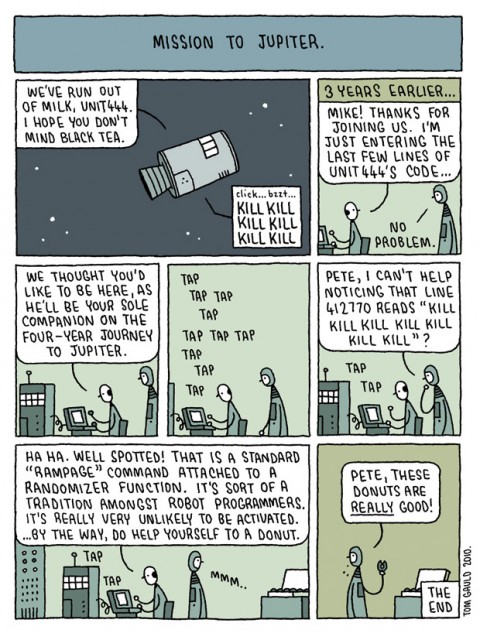
Taking a summer break from his regular illustration gig at The Guardian, Tom is currently producing a weekly comic and posting it to Flickr:

Real Editors Ship — I linked this on Twitter already, but it’s kind of great so what the hell… Paul Ford on getting stuff out the door and the value of editors (and I would suggest Production Managers):

People often think that editors are there to read things and tell people “no.” Saying “no” is a tiny part of the job. Editors are first and foremost there to ship the product without getting sued… This is not to imply that you hit every sub-deadline, that certain projects don’t fail, that things don’t suck. I failed plenty, myself. It just means that you ship…

Editors are really valuable, and, the way things are going, undervalued. These are people who are good at process. They think about calendars, schedules, checklists, and get freaked out when schedules slip. Their jobs are to aggregate information, parse it, restructure it, and make sure it meets standards. They are basically QA for language and meaning.

The Fine art of Recommending Books — Laura Miller at Salon:

Amazon and other online merchants have harnessed mighty algorithms to run their “If you enjoyed that, you might like this…” suggestion engines, but these are still crude instruments. Practically any novel you plug into Amazon’s search engines at the moment returns the robotic announcement that people who bought it also bought one of Stieg Larsson’s “Girl” thrillers — because seemingly everybody in America is buying those books. It’s not like you need the world’s most sophisticate e-commerce servers to tell you that.

And finally…

Steranko! — Jonathan Ross interviews comics legend Jim Steranko, inspiration for Josef Kavalier in Michael Chabon’s The Amazing Adventures of Kavalier and Clay,  for The Guardian:

Spend an hour with Jim Steranko and, if he’s in the mood, he’ll regale you with the most extraordinary tales. Are they true, I have asked myself more than once, or is he a fantasist? Has his love of storytelling and the creation of modern myths bled into his own life story until he can no longer tell the two apart? Well, now that I’ve met him, I believe them all to be true, just as I believe it when he tells me he still runs miles every day, pumps iron, and fornicates blissfully like a man a third his age. He is unique. He is Steranko. He is the greatest.

A slideshow of Steranko’s work is here.

Have a good weekend…

1 Comment

Something for the Weekend

The Trouble With Amazon — Colin Robinson, co-publisher at OR Books (so perhaps not entirely neutral), on the internet retailer for The Nation:

The accumulated effect of Amazon’s pricing policy, its massive volume and its metric-based recommendations system is, in fact, to diminish real choice for the consumer. Though the overall number of titles published each year has risen sharply, the under-resourcing of mid-list books is producing a pattern that joins an enormously attenuated tail (a tiny number of customers buying from a huge range of titles) to a Brobdingnagian head (an increasing number of purchasers buying the same few lead titles), with less and less in between.

And, on a not unrelated note…

What’s Wrong With Music Business — A fascinating  interview with Tom Silverman, founder of Tommy Boy Records, at Wired. I’m usually really skeptical about comparisons between the music industry and book publishing, but there’s lots of good stuff here for book folks:

[T]he premise of technology being the great democratizer and allowing more artists to break through than before — actually, we’ve seen the opposite effect. Fewer artists are breaking than ever before, and fewer artists who are doing it themselves are breaking through than ever before. Back in the early ’80s, when the cellphone was first invented, there were more artists breaking on their own, with no technology, than they are now, with technology. Why is that the case? And what can change to open the gates again, to allow artists to break through, whether on their own or with help?… [S]ocial networks have been a really big disappointment in terms of moving the needle in either exposure or sales in any meaningful way. There are a lot of myths in technology that everybody wants to believe, because everybody wants things to get better.

The Little Coincidence That Haunt Your Life — An interview with Alan Moore, author of From Hell, V for Vendetta, Watchmen et al,  at The Quietus:

One of the academics at this conference was saying that he was working on a book which was about Watchmen as a post-9/11 text. I can see what he means to a degree. One of my friends over there… said he’d been talking to some people on Ground Zero on September 12, 2001 and he was asking them if they were alright and what it had been like. Two of them, independently of each other, said that they were just waiting for the authorities to find a giant alien sticking half way out of a wall…

…There was that atmosphere of a cataclysmic event happening in New York, which I don’t think had been depicted previously… even in science fiction terms it was perhaps unimaginable! Yes, you do find that a lot of odd, little coincidences like that haunt your life.

Double Take — Tom McCarthy, author of Remainder, Tintin and the Secret of Literature, and C, discusses Hitchcock, his preoccupation with doubles and the exact meaning of “MacGuffin”, with BBC Radio 4’s The Film Programme (via Lee Rourke).

And finally…

Blogs are dying says The Economist. Oh no they’re not, says Cory Doctorow in The Guardian.

The real question, however, is whether Publishers Weekly starting their own blog, PWxyz, is evidence for the prosecution or the defense… (Sorry, that’s a little mean-spirited. It’s great PW have started a blog even if it feels a somewhat belated)…

Have a great weekend.

2 Comments

The Creativity Crisis

Newsweek reports on research that shows, for the first time ever, American creativity is declining:

With intelligence, there is a phenomenon called the Flynn effect—each generation, scores go up about 10 points. Enriched environments are making kids smarter. With creativity, a reverse trend has just been identified and is being reported for the first time here: American creativity scores are falling…

The potential consequences are sweeping. The necessity of human ingenuity is undisputed. A recent IBM poll of 1,500 CEOs identified creativity as the No. 1 “leadership competency” of the future. Yet it’s not just about sustaining our nation’s economic growth. All around us are matters of national and international importance that are crying out for creative solutions, from saving the Gulf of Mexico to bringing peace to Afghanistan to delivering health care. Such solutions emerge from a healthy marketplace of ideas, sustained by a populace constantly contributing original ideas and receptive to the ideas of others.

(via More Intelligent Life)

1 Comment

Midweek Miscellany

The portfolio of Julia Hastings, Art Director of Phaidon Press (via It’s Nice That).

Rarefied Content — Alan Rapp on the future of photography books at Imprint:

[A]rguably the independently published photo book is flourishing. You can see this from the increasing popularity of on-demand printing services such as Blurb, Lulu, and MagCloud , as well as the number of successful and well-published photographers who have launched their own publishing ventures, such as Alec Soth, Richard Renaldi, and Shane Lavalette (a practice which itself has a long pedigree, from Alfred Stieglitz to Ralph Gibson). Yet this kind of kaleidoscopic output creates another issue—who but the most ardent follower can keep abreast of this vast dispersion of small-scale publishing?

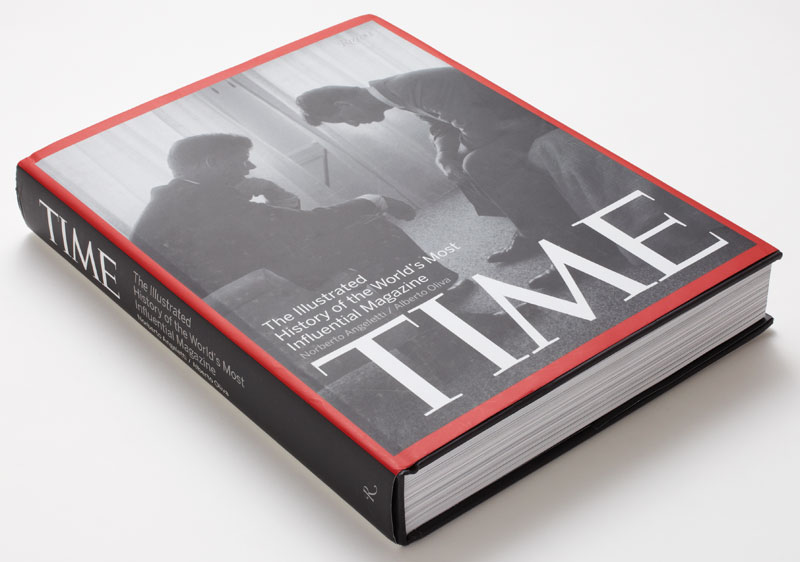
The Illustrated History of Time designed by Luke Hayman at Pentagram:

And finally…

The trailer for the animated adaptation of Shaun Tan‘s The Lost Thing (via The Art Department | Irene Gallo):

I’ve posted this before, but here’s a short documentary about making the film:

The Lost Thing website.

Comments closed

Somthing for the Weekend

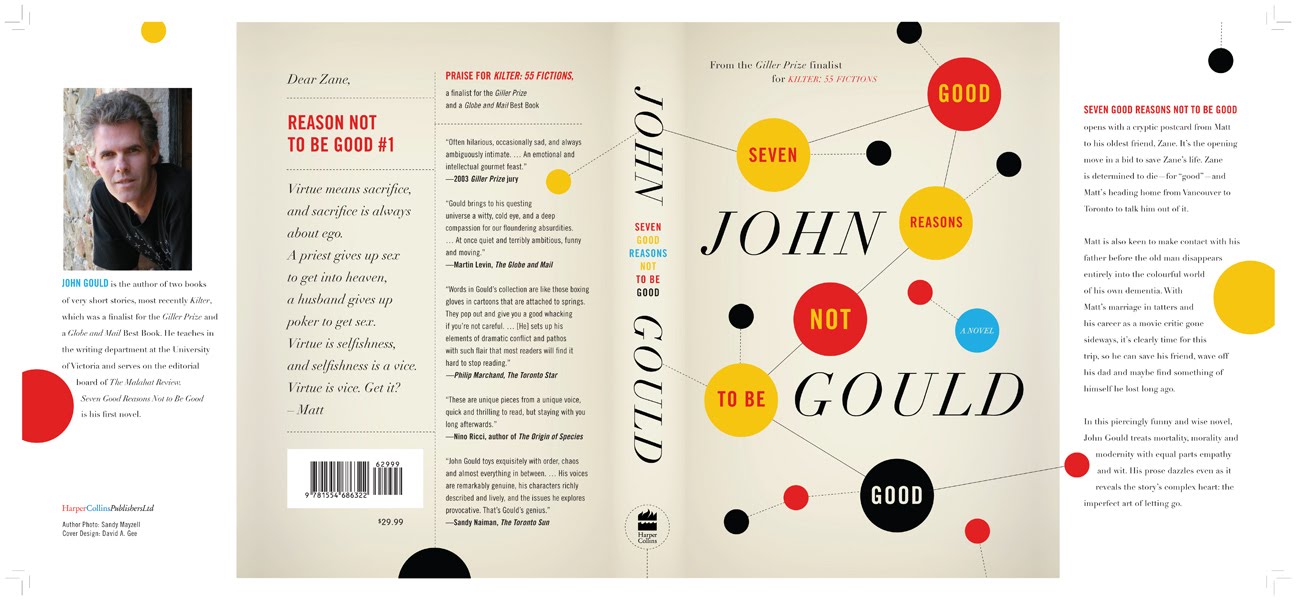
“Spot gloss on the molecules” — David Gee’s cover for 7 Good Reasons Not To Be Good by John Gould.

Going Back — Artistic Director Michael Salu on the creating the cover of the new issue of Granta magazine:

For this concept to work, we needed to strive for authenticity – to create the physical object ourselves. The typefaces would need to be sourced, traditionally hand-set and photographed to give the cover the depth that the issue deserves. For this I approached St Bride Printing Library, which has long been a place of fascination and wonder for me. My first visit to the library – with its oil, wood and metal, its smell of history – made a huge impression on me.

The Connoisseurs — Peter and Charlotte Fiell, who recently ended their 15-year tenure as heads of the design branch of Taschen, talk about their new publishing venture Fiell at More Intelligent Life:

What is design? It’s the forethought that goes into the making of man-made things. It’s films, pharmaceuticals, airplanes, chairs, tape recorders … it’s the world of stuff. It’s huge, so everybody should have a big interest. It’s not some avant-garde, highly expensive niche. We want to make money by publishing books that sell, but we’re in the business of promoting ideas, culture, taste, connoisseurship. If you want to make a difference you want to get into as many people’s heads as you can and change their opinion. The secret is to strike this balance between making your books appealing to learned type readers, while at the same time, making them useful and interesting to novice readers. Our aim is to make books as appealing to teenagers in Tokyo as architects in Amsterdam.

(Above: Spreads from Tools for Living: A Sourcebook of Iconic Designs for the Home by Charlotte and Peter Fiell)

Designing In Order To  Eat — Chris Ware’s introduction to Penguin 75 excerpted at GQ magazine:

Book designers, you should know, have to be ready to create something new, exciting, and original almost every day in order to eat, and a certain degree of burnout smokes out the weaker specimens; I can’t imagine coming up with cover after cover without at some point resorting to an out-of-breath take, intentional or not, on someone else’s great idea. This urge toward ever-freshness brings the profession perilously close to that of fashion, and the worst examples of such greet us at the grocery store checkout among the tabloids, gum, and ring pops. But the best of it, those that last, have recently been appearing from Penguin (yes, Penguin, not just the bearer of boring spring break assignments anymore!), following a path led by designer Paul Buckley into beautiful new ways of graphically proffering the written word.

The excerpt is accompanied by a slideshow of covers from the book. My interview with Paul Buckley and designer Christopher Brand about Penguin 75 will be up early next week.

And Finally… The book cover design Tumblr (via Alan Trotter’s ≥ notes)

1 Comment

Midweek Miscellany

The Good, The Bad…design:related‘s Karen Horton (also Art Director at Little, Brown and Co.) interviews Paul Buckley, Creative Director of Penguin US, about his new book Penguin 75: Designers, Authors, Commentary (The Good, The Bad…):

Everyone was asked to keep their comments to 100 words or less, and though there are a few exceptions that I let run long, my own included, most contributors stuck to my request. As to the sarcasm, there are plenty of good natured jabs throughout the book as I was very clear with the participants that this was a true opportunity to let it all out – if you hate your cover, please by all means tell us about it; that is the point of this book.

You can read my interview with Paul from September last year here, and I’m hoping to chat with him and designer Christopher Brand about Penguin 75 soon. Fingers crossed.

Rewound and Remixed — Tom McCarthy, author of Remainder and C, interviewed in The Times:

If McCarthy… presents a radically fresh prospect for the future of the novel, it is probably, paradoxically, because he has instinctively ignored contemporary literature almost completely. He would argue, in fact, that it is only by immersing oneself in all that has gone before that any contemporary novelist has even the faintest chance of coming up with something new. “I don’t think most writers, most commercial middlebrow writers, are doing that,” he says. “I think they’ve become too aligned with mainstream media culture and its underlying aesthetic of ‘self-expression’. I see what I’m doing as simply plugging literature into other literature. For me, that’s what literature’s always done. If Shakespeare finds a good speech in an older version of Macbeth or Pliny, he just rips it and mixes it.”

See also: My Q & A with Peter Mendelsund and Tom McCarthy about the cover design of C.

Paywalls vs. Potential — Clay Shirky interviewed in The Guardian. This has been much linked to elsewhere because of Shirky’s comments about the online “paywall” at the aforementioned The Times, but I actually Michael Wolff’s Vanity Fair article on Rupert Murdoch from October last year is more interesting on this point. See also: John Gapper’s op-ed “Murdoch must become an elitist” in the Financial Times (registration required).

Necessary Agent — Jofie Ferrari-Adler, senior editor at Grove/Atlantic, on literary agents and their relationship with book editors in Poets & Writers Magazine. It’s an interesting article, although — just for the record — not everything that goes pear-shaped in the publishing process is the fault of the Sales & Marketing department…

And finally…

Cats Without Dogs — At some point I will shut up about Jason… Until then, you might be interested to know he has just started a blog…

Comments closed

Something for the Weekend

Dieter Rams book by graphic design graduate Daniel Bartha:

This project was a book I created around the ten most important principles for what Dieter Rams considered was good design. Taking on board these elements myself, I took away as much as I could from his unique designs but to still leave them instantly recognisable.

And since I seem to be on a German theme this week…

Nabokov in Berlin — An essay by Lesley Chamberlain in Standpoint magazine:

As consumerism and Hitler rose together so Nabokov treated totalitarian politics principally as aesthetically repugnant. It was “another beastliness starting to megaphone” in Germany which in 1937 drove him and his half-Jewish wife Vera to leave Berlin for France and the US. It was almost too late. Berlin suited him. The anti-totalitarian novels Bend Sinister (1947) and Invitation to a Beheading (1938) which followed were remarkable, particularly the latter, for not insisting that totalitarianism’s victims were moral heroes, only men of taste. Nabokov, who saw in art the possibility of redemption, was tempted to think taste ruled out evil.

And from Germany, to France (via Norway)…

Master of Understatement — Douglas Wolk, author of Reading Comics, on Jason’s Werewolves of Montpellier:

[I]t’s possible to describe [Werewolves of Montpellier] by saying it’s a low-key domestic drama, with a Harold Pinter play’s worth of portentous silences, about a bored, disenchanted young man who’s in hopelessly in love with his lesbian best friend. Or you can say it’s about a jewel thief who discovers a secret cabal of werewolves. It’s true that you have to pay attention to catch the details: the fact that Jason draws everyone with animal heads makes it a little bit harder to read some of the characters’ interactions. But maybe Jason’s central joke is that you have to take extreme measures to create certain kinds of drama when a lot of the time people aren’t feeling anything in particular.

Techland also have  an exclusive preview of the book.

See also: The Beat’s review of Werewolves of Montpellier

Werewolves of Montpellier is about an art student/thief who dresses up as a werewolf before he goes out to break into people’s homes at night, which a society of actual werewolves is not amused about.

What that boils down to on the page, though, are scenes of people sitting next to each other at the laundromat, looking at each other in silence or talking about French actresses while playing chess—and each time, it’s utterly fascinating, and the scene draws you in almost immediately and you don’t want to stop.

Jason tells stories with comics in ways that never occur to a lot of people who make comics.

From Europe to Asia…

An Obsolete Practice — idsgn considers the end of movable type in China. Fascinating stuff:

The invention of movable type in China developed with Gutenberg’s mechanical press and hot type-metal, proved to have widespread and lasting success in Europe. But in practice, it was not suitable for Chinese—a language with over 45,000 unique characters. Typesetting in Chinese took “minding p’s and q’s” to a whole new level, and accuracy was challenging when characters were essentially compounds of many radicals and ideograms. Running a Chinese letterpress shop required an enormous storage space and basic literacy of at least 4,000 commonly used characters.

And on a strangely similar note…

Rudy Lehman’s Incredible Linotype Letterpress (via Coudal).

Have a great weekend!

Rudy Lehman’s Incredible Linotype LetterpressRudy Lehman’s Incredible Linotype Letterpress

Comments closed

Midweek Miscellany

Edward Gorey book cover set on Flickr (via This Isn’t Happiness).

15% of Immortality — Literary agent Andrew Wylie profiled in Harvard Magazine:

“The music industry did itself in by taking its profitability and allocating it to device holders. Manufacturing and distribution accounted for roughly 30 percent of the music industry’s profit. These were conveyed to Apple in the deal for iTunes. But why should someone who makes a machine—the iPod, which is the contemporary equivalent of a jukebox—take all the profit?… [Apple] couldn’t have sold the device without the music that was on it. Instead, why didn’t the music industry say to Apple, ‘We want 30 percent of your iPod sales?’ Or ‘How about paying us 100 percent of your music revenues—you keep your device profits, and give us our music profits?’ That’s not the deal that was made. And that is why the music industry hit the wall.”

“You just can’t kill us”Publisher’s Weekly looks at the future of sales reps, “the roaches of the business”:

[T]he key to the rep business may no longer be synonymous with the key to the car. Independent reps continue to call on as many stores in their territory as possible, but they also tweet, blog, e-mail, Constant Contact, and GoToMeeting, as well as phone, to stay in touch with their accounts. “If there’s a rep who can call on an account in person, it usually benefits the account,” says Kurtis Lowe, head of group for Book Travelers West, who until last year was the only rep traveling to Alaska. Now he uses what he calls “a hybridization of personalization and electronic contact”… Reps now provide stores with a mix of sales, marketing, customer service, and pretty much whatever else is needed.

“We all have our fates” — Berlin-based Bookslut Jessa Crispin talks to Ulrich Ditzen about his late father, the author Hans Fallada, and the posthumous success of his novel Every Man Dies Alone:

It was the fashion designer Diane von Furstenberg who first approached Dennis Loy Johnson at the publisher Melville House, saying it was a shame the book had never been translated into English. “She talked to the American publisher, why didn’t he publish this book, it was a fantastic book,” Ulrich said. “She was very surprised that it had never been translated. Dennis Johnson then read it and shared her opinion and proceeded to get it translated. And it was a runaway success, to my great surprise.”

And speaking of Berlin…

Because who doesn’t want a remote-controlled mountaineer’s harness to peruse their bookshelf? Dwell features the Berlin home of typographer Erik Spiekermann and his wife, designer Susanna Dulkinys:

Inside, the house has a strikingly modern look… Which is not to say that there are no luxurious touches… [E]xtras include an ingenious, if terrifying, remote-controlled mountaineer’s harness that lifts browsers to the books on the two-story-high bookshelf (though they have to be careful not to run into the Ingo Maurer Zettel’z light). To avoid clutter, almost everything is built in, with cleverly designed zippered fabric panels on the walls working to hide plugs and cords. “It’s like creating white space,” says Dulkinys, “so you can free your mind and be creative.”

2 Comments