Skip to content

Tag: Miscellany

Something for the Weekend, Dec. 12th, 2008

The 10 Commandments of Book Giving by Michael Dirda, Pulitzer Prize-winning critic and Senior Editor of the Washington Post‘s Book World (via Right-Reading):

Over the years I’ve gone through all kinds of Christmas presents, and nearly all of them quickly broke or have been long forgotten. Not so the gift books, whether Edgar Rice Burroughs’s Tarzan and the Golden Lion, a paperback copy of Ovid’s Metamorphoses or the Pléiade edition of Stendhal’s Oeuvres Intimes. Given to me by relatives, teachers and friends, they helped to make the season bright — and they also helped to make me who I am.

“Book apps for the iPhone keep getting better” according to Maud Newton (via DesignNotes)

Lying Liars: “Nearly half of all men and one-third of women have lied about what they have read to try to impress friends or potential partners”, the BBC reports.

Nintendo launches ‘great books’ package:

The creator of Donkey Kong and Super Mario is hoping that Austen and Dickens will prove as great a pull to computer game fanatics. It has worked with HarperCollins to select 100 titles – from 20,000 Leagues Under the Sea to Gulliver’s Travels, Pride and Prejudice, A Tale of Two Cities and Treasure Island – which will be available in a single software package for the Nintendo DS

Mwa ha ha! Chip Kidd discusses Bat-Manga! (via Books Covered)

The Age of Mass Intelligence — Are we actually smarter than we think we are? John Parker thinks so (via kottke):

One of the commonest complaints by cultural doomsayers is that nobody reads good books any more. Yet in the past two years, the Oprah Book Club in America recommended Tolstoy’s “Anna Karenina” and three novels by William Faulkner–good by any standard, and they all made the bestseller lists. This year, Waterstone’s, which owns over 300 bookshops in Britain, asked two celebrated novelists, Sebastian Faulks and Philip Pullman, each to choose 40 titles and write a few words of recommendation. The chain then piled copies of the books on tables next to the entrances of its main shops and waited to see what would happen. Faulks and Pullman hardly dumbed down their choices: they included Fernando Pessoa’s “Book of Disquiet”, Rudyard Kipling’s “Kim”, and Raymond Queneau’s “Exercises in Style”. The sales increases for these books over the same period the year before were, respectively, 1,350%, 1,420% and 1,800%–clear evidence of latent demand. If you offer it, they will come.

In this brief interview at inFrame.tv, award-winning Australian artist and author Shaun Tan discusses his work and the adaptation of his book The Lost Thing into an animated movie (via drawn):

And on a similar note, stills of the 25 minute animated adaptation of Oliver Jeffers’ book Lost and Found (to be broadcast on Channel 4 in the UK on Christmas Eve) can be seen on the STUDIOaka website. Looks lovely.

And this is probably my last regular post for the next couple of weeks. In the extremely unlikely instance you get withdrawal symptoms, you can always check out the links in the sidebar and/or send me an email!

See you in the New Year!

1 Comment

Midweek Miscellany, Dec. 10th, 2008

NPR’s Best Graphic Novels of 2008 include Josh Cotter’s Skyscrapers of the Midwest, Local by Brian Wood and Ryan Kelly, Yoshihiro Tatsumi’s Goodbye, and Alan’s War by Emmanuel Guibert (pictured). There’s an excerpt available of each book selected. Nice. (Thanks Ehren!)

A new way to express an old idea – An interesting interview with Canadian designer David Drummond at Books Covered (via Design Observer):

I tend to start with a list of words. For example I am working on a cover now that is about a dog but can’t show the dog on the cover. I like those kind of problems. How do you show this without showing it?

Amazon’s Jeff Bezo is PW‘s Person of the Year.

“Suburban surrender”: James Wood revisits Richard Yates’ blistering novel Revolutionary Road in the latest The New Yorker.

Little to do with booksThe New York Times looks at the infighting and the politics of book groups:

Yes, it’s a nice, high-minded idea to join a book group, a way to make friends and read books that might otherwise sit untouched. But what happens when you wind up hating all the literary selections — or the other members? Breaking up isn’t so hard to do when it means freedom from inane critical commentary, political maneuvering, hurt feelings, bad chick lit and even worse chardonnay.

Russell Davies on “analogue natives”:

So much joyful digital stuff is only a pleasure because it’s hugely convenient; quick, free, indoors, no heavy lifting. That’s enabled lovely little thoughts to get out there. But as ‘digital natives’ get more interested in the real world; embedding in it, augmenting it, connecting it, weaponising it, arduinoing it, printing it out, then those thoughts/things need to get better. And we might all need to acquire some analogue native skills.

Comments closed

Monday Miscellany

“I have always enjoyed photographing loners” — A lovely BBC audio slideshow of “Writers’ Rooms” narrated by award winning photographer Eamonn McCabe. The project, appearing weekly in The Guardian and currently on show Madison Contemporary Art in London, captures the working environments of novelists, biographers and poets.

Book Industry Enters Shaky Chapter: NPR’s Lynn Neary looks at last week’s horrorshow.

The 10 Best Books of 2008 according to The New York Times Book Review. Interesting that they’ve also created a mini-site which has promotional material for the top 10 books, including shelf talkers, bookmarks, and posters for bookstores to download . There are also web banners and a video with author Toni Morrison. This is has to be a good idea.

“The news is still big. It’s the newspapers that got small”: A spectacular Roger Ebert rant about the death of criticism :

The celebrity culture is infantilizing us. We are being trained not to think. It is not about the disappearance of film critics. We are the canaries. It is about the death of an intelligent and curious, readership, interested in significant things and able to think critically. It is about the failure of our educational system. It is not about dumbing-down. It is about snuffing out.

Spot. On.  I actually met Roger Ebert a few years back in Pages bookstore. The Toronto International Film Festival must have been on. I had no idea who he was at the time (a colleague told me later), but he was very nice about it.

“The Most Dangerous Man in Publishing”:  A profile of publisher Barney Rosset in Newsweek:

Before Rosset challenged federal and state obscenity laws, censorship (and self-censorship) was an accepted feature of publishing. His victories in high courts helped to change that. Rosset believed that it was impossible to represent life in the streets and in the dark recesses of the heart and mind honestly without using language that in the mid-20th century was considered “obscene”—and therefore illegal to sell or mail. To a significant extent, the books he published convinced others that this was true.

The Well-Tended Bookshelf— Laura Miller on culling one’s book collection:

There are two general schools of thought on which books to keep, as I learned once I began swapping stories with friends and acquaintances. The first views the bookshelf as a self-portrait, a reflection of the owner’s intellect, imagination, taste and accomplishments… The other approach views a book collection less as a testimony to the past than as a repository for the future; it’s where you put the books you intend to read.

Which leads me rather nicely to…

Books At Home: A blog about bookshelves. It is possible that this just too nerdy. Even for me.

Relevance: Brian at daxle.net interviews author Tim Manners , editor and publisher of The Hub and Reveries.com. It’s a fascinating discussion that covers innovation, brands, and the consequences of overabundant advertising (amongst other things).

3 Comments

Midweek Miscellany, Nov 26th, 2008

The Royal Mail British Design Classics: A set of first class stamps issued in January 2009 will commemorate ten icons of British design  including the Penguin paperback (pictured above).

“I wanted to put my money where my mouth is”booktwo’s James Bridle discusses Bookkake at 3:AM Magazine:

“I’m a huge fan of ebooks, and read this way regularly, but I don’t feel the reading experience they offer is yet on a sufficient par with traditional books to offer them at any great price, and I also don’t feel there’s much overlap between those looking for ebooks and those who’d pay for the paper edition.”

Risk has its rewards: Barney Rosset — US publisher of Beckett and Chekhov — discusses Grove Press and his struggles against censorship in a rebroadcast interview from 1991 on NPR’s Fresh Air. Rosset received the Literarian Award for his service to the literary community at the National Book Awards ceremony last week.

“The Best Business Books of 2008” — A slideshow of Fast Company‘s picks of the year:

“The titles that follow run the gamut of what Fast Company covers: Innovation, creativity, design, sustainability, technology, advertising and marketing, global business, and entertainment.”

It’s a cutely eclectic list for sure — including travel books and a novel (and mercifully there’s no Godin or Gladwell) — but it’s not, perhaps, quite as imaginative as they think it is…

30 Inspiring Flickr Groups on Typography: A wonderful list for type geeks compiled by designer David Airey (pictured: “Big Yellow Bookshop” by ultrasparky seen in the Typography and Lettering Flickr pool).

Comments closed

Midweek Miscellany, Nov 19th, 2008

“We’re from Kodak, Apple, Google, Yahoo”: The Guardian profiles Blurb — a publishing company with nobody from mainstream publishing — that specialises in high-quality, print-on-demand, photography books. Very, very, cool.

Good news and bad news for online retailers: Statcan found that more Canadians are shopping on the internet, placing almost $12.8 billion worth of orders in 2007, up 61% from 2005. ComScore, on the other hand, have just released their monthly retail e-commerce sales estimates, showing that online spending in October 2008 grew by only 1 percent over October 2007–the lowest monthly growth rate since they began tracking e-commerce in 2001.

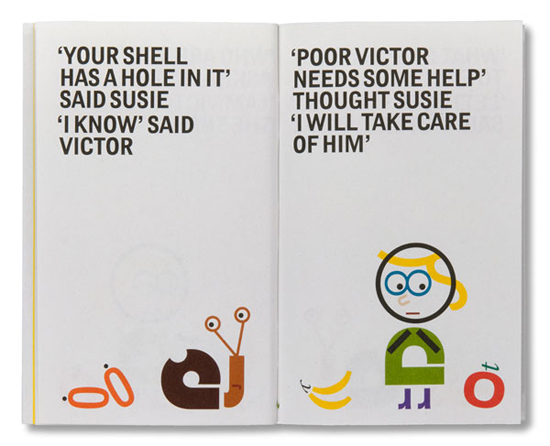
Victor & Susie: A brightly coloured “children’s book for adults” about Susie and Victor the snail, all drawn with letters and punctuation marks, published by Brighten The Corners (pictured). (via drawn)

“A kind of slow-motion suicide”: David Carr’s column for the New York Times looks at why firing their the most talented, experienced employees to cut costs backfired for Circuit City and will do the same for newspapers too:

“Right now, the consumer has all manner of text to choose from on platforms that range from a cellphone to broadsheet. The critical point of difference journalism offers is that it can reduce the signal-to-noise ratio and provide trusted, branded information. That will be a business into the future, perhaps less paper-bound and smaller, but a very real business.”

My take on this for book publishers (as it normally is): Publish less, publish better — quality matters. (via reveries)

Comments closed

Monday Miscellany

A bolt of electricity: PW polls publishers on the challenges and opportunities facing their digital publishing programs. It’s a fascinating glimpse of where the likes of Random House, Simon & Schuster, and Penguin are heading… A must read I would say…

Narrative medicine: Exposure to literature can influence how young doctors approach their clinical work according to the New York Times (via Guy Kawasaki):

“The idea of combining literature and medicine — or narrative medicine as it is sometimes called — has played a part in medical education for over 40 years. Studies have repeatedly shown that such literary training can strengthen and support the compassionate instincts of doctors.”

In need of a good editor: Book Lover Cynthia Crossen laments the decline of editorial rigour in the WSJ:

“Editors are the invisible heroes of the publishing industry, and as publishing companies cut corners, they cut editors… But without strong editors, writers are like cars with accelerators but no brakes”

Comments closed

Something for the Weekend

After a week of feeling gloomy about publishing, here are a few links to some less apocalyptic book-related stories that I’ve been reading:

“Your…fucking…book” : Author Michael Lewis, who just happened to chronicle Wall Street’s excess in the 80’s in his book Liar’s Poker, tries to figure out what the hell just happened for Portfolio magazine (via kottke):

“This was what they had been waiting for: total collapse… Lehman Brothers had vanished, Merrill had surrendered, and Goldman Sachs and Morgan Stanley were just a week away from ceasing to be investment banks. The investment banks were not just fucked; they were extinct.”

Did someone just say ‘Schadenfreude’? Well, I guess it is reassuring that there’s an industry more fucked than publishing… Anyway, Lewis is apparently writing a book about the whole financial crisis…

Contempt for the beautiful losers: Slate‘s Ron Rosenbaum goes to town on BuzzMachine’s Jeff Jarvis (author of the forthcoming book What Would Google Do?) taking in journalism, new media, publishing, the Frankfurt Book Fair, and “New Age boilerplate mysticism” of Paulo Coelho on the way:

“If Jarvis values books (and I can’t help think that despite all the digital bluster, he’s an intelligent guy who likes reading), do we just listen to the market and focus-group what we should print and give away, which is likely to result in all Coelho, all the time, with maybe a little bit of Jarvis thrown in?”

Inevitably you can already read Jarvis’ response on his blog. Despite all the overblown cattiness, it’s actually an interesting argument. (via fimoculous)

More Information Than You Require: Former literary agent turned author John Hodgman, best known for playing PC in those increasingly misfiring Apple commercials, interviewed by The Book Bench blog:

“I believe that by releasing ‘passing interest/low keepsake-value literature’ from the burden of physicality, you are actually releasing the words from their worst liability: the price and inconvenience of actual bookness.”

“Lord Death Man”: PowellsBooks.Blog previews  Chip Kidd’s latest pet project Bat-Manga! (pictured).

Comments closed

Monday Miscellany, Nov 3rd, 2008

The extraordinarily cool binding for Alfred Jarry’s Ubu Roi (Ubu the King), a collaboration between bookbinder Mary Reynolds and Marcel Duchamp, as seen at blog.rightreading (pictured).

Editor Chuck Adams interviewed in the November Poets & Writers Magazine. A very interesting–albeit very commercial–perspective:

“For too long, in New York, we’ve been in this culture of publishing what we like and not what readers want. Hopefully, we’ll come around to trying to understand what people really want to read so we can interest them in reading in the first place.

He also makes a very telling point about the problem of homogeneity of publishing:

“We don’t encourage a diversity of people in the business. We don’t. We just want more of the same because they’re the ones who can afford to work in it.”

I couldn’t agree more…

Not content with Bastards With Bookshops , Bastards With Bookshops 2,  and Yet More Bastards With Bookshops , Bookride has gleefully provided guidelines to help aspiring bastard-booksellers achieve their dream. Like they need the help… My personal favourite:

“Greet the customer with a glower, a scowl or a look of deep mistrust. If you are feeling generous a frosty ‘Good Morning! will suffice.”

Following Chapters-Indigo in Canada, Barnes and Noble have launched a social networking site ‘My B&N’ in the US.

Agent Kate Lee interviewed at HarperStudio’s 26th Story:

“I think the building or seeding of buzz online is important–as with film, music or TV, word of mouth is invaluable.  That buzz can come through building relationships with bloggers, writing posts that you then try to get linked to, starting up a social network or “fan” group, and/or creating original online content.  The main thing is just to be out there–be writing, be posting, be Twittering, be engaging in conversation with other people in the blogosphere.”

A fascinating half-hour interview with novelist John Le Carre from BBC Radio 4’s Front Row.

Comments closed

Midweek Miscellany, Oct 22th, 2008

Having skipped Monday (thanks Amazon grid!), here’s a bumper Midweek Miscellany for your (digested) reading pleasure…

Publishers put on a brave face on the economic downturn in Frankfurt according to the Washington Post (thanks for link Stephanie!):

“While luxuries are increasingly unaffordable, most people still have enough money to buy a book, and booksellers could even use the opportunity to stage a resurgence”

Traditional book binders John and Ardis Mankin featured in the San Diego Union Tribune (via Shelf Awareness):

“Our main machinery is our hands,” said Ardis, 74. “Technology can’t do what we do.”

The Serif Fairy (pictured) for the junior typographer in all of us (via Design Observer).

The Legendary Mr. Typewriter: Reveries on Martin K. Tytell the owner of the Tytell Typewriter Company, in Lower Manhattan who died, age 94, on September 11th, 2008. If I could  type for tuppence and wasn’t a pathological re-writer, I would definitely use a typewriter…

Books for Bibilophiles’   in The Observer:

“At a time when bibliophiles are an endangered species, these books about books tell us why it’s reading that makes us human”

Literary agent Pat Kavanagh, “doyenne of the London literary scene”, has died:

“She had the values of an earlier generation. People like Kingsley Amis loved Pat. She was old school but she never seemed jaded. We all thought she would always be there, that she would never retire.”

Jonathan Ross revisits Watchmen by Alan Moore and Dave Gibbons for The Times (via LinkMachineGo):

“But what makes this a genre-transcending bona fide masterpiece is that… Moore and Gibbons… manage to deliver a devastating critique that cuts to the very heart of the pitiful, timid male fantasy that is the superhero genre at its purest and worst: muscular men and busty women in tight costumes solving all the world’s problems with a well-placed punch”

Over and out…

2 Comments

Midweek Miscellany Oct 15th, 2008

Are New York publishers going through some kind of existential crisis?

A chill wind is blowing through publishing according to Leon Neyfakh in the New York Observer. He’s marginally less apocalyptic than some, but he’s still pretty gloomy:

“A frost is coming to publishing. And while the much ballyhooed death of the industry this is not, the ecosystem to which our book makers are accustomed is about to be unmistakably disrupted. At hand is the twilight of an era most did not expect to miss, but will.”

On the other hand…

Old-fashioned publishing is booming for Marvel according to Fortune Magazine:

“There’s a few interesting messages in this, not least of which is the reminder that new formats of media don’t necessarily replace old, and that some habits don’t change as quickly as people think.”

Former CEO Peter Olson  discusses his exit from Random House in Portfolio magazine:

“I think concerns about the book business dying are overdone. Storytelling—the generating of content for all kinds of media—is essential. Books play a key role.”

On a more cheery note…

Children’s Books That Designers Love: Kids books with “insanely cool typography” by  Bruni Munari and Cas. Opt. favourite Paul Rand (pictured).

Liz Thomson and Nicholas Clee, former editors of Publishing News and The Bookseller respectively, have launched BookBrunch an “information site and daily news service for the book industry.” (via Me And My Big Mouth)

Designer Stephen Bayley interviewed by his son Bruno for Vice Magazine. I rather liked this line:

“Heritage is important but you must also build the heritage of the future. The best idea ever on history was in an Italian novel The Leopard by Giuseppe Tomasi di Lampedusa, which was published posthumously. It had this line about the decline of a Sicilian dynasty: “If you want things to stay the same, they are going to have to change”. That is entirely my view. Without change everything is stultified.”

2 Comments

Monday Miscellany, Oct 13th, 2008

A belated Happy (Canadian) Thanksgiving and a belated Monday Miscellany (on Tuesday)…

An interesting  Q & A with George Jones, President and Chief Executive Officer of Borders Group, on HarperStudio’s The 26th Story Blog:

“I do not agree that it’s all doom and gloom in the book business… I think people are always going to want books…they will always want to be entertained and informed by books and I do not see that changing.  It’s true that the format books take may change over time and evolve, and the places where people buy books and how they access them have changed over time and will change further, but books themselves will always be part of our culture and our world in my opinion.”

Marketing in Tough Times. The American Booksellers Association ask successful booksellers to share their advice on marketing  during the economic downturn.

Book-lined stairs (pictured) designed by Levitate Architects for a space-challenged London apartment, as seen on the lovely Apartment Therapy (via image bookmarking site FFFFound).

50 of your favourite words on the BBC online magazine (as inspired by Ammon Shea’s book READING THE OED). I’m rather partial to ‘metanoia’ – “the act or process of changing one’s mind or way of life” – myself…

Comments closed

Midweek Miscellany Oct 1, 08

Great book covers and  design by pioneering graphic designer Erik Nitsche on Flickr  . (Via Ace Jet 170 who has more Nitsche images).

On the subject of Flickr , the San Francisco Chronicle visits the offices of the popular photo site and talks to Director of Community Heather Champ:

“I can’t think of any successful online community where the nice, quiet, reasonable voices defeat the loud, angry ones on their own.”

Photo District News considers the market for limited edition photography books.

10 Things Epublishers Should Do For Readers : a nice wish list from Dear Reader.

And Kassia Krozser has further thoughts on moving from Print to E on Booksquare:

“eBooks are not going to be the next big thing; they’re going to be a thing. A part of a complex mix of reading choices. With that in mind, let’s think about ways we can blend ebooks into the publishing culture without pain.”

Publishing is Dead, Long Live Publishing:  Hugh McGuire  responds to that New York Magazine article on the Huffington Post:

“There’s been much teeth gnashing and lamenting over the impending collapse of the publishing business… Well, the traditional publishing business might be in for a rough ride, but I think we’re poised to see a flowering of a new kind of independent writing, book-making and reading, driven by the web but rooted in the old-fashioned book.”

Comments closed