Skip to content

Tag: literature

Student Editions by Ákos Polgárdi

DK-Jokai-KEF

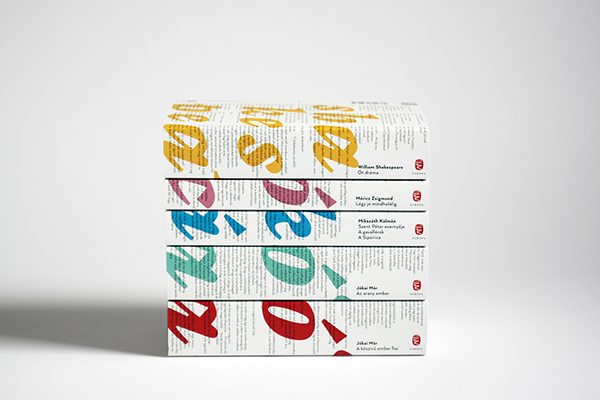
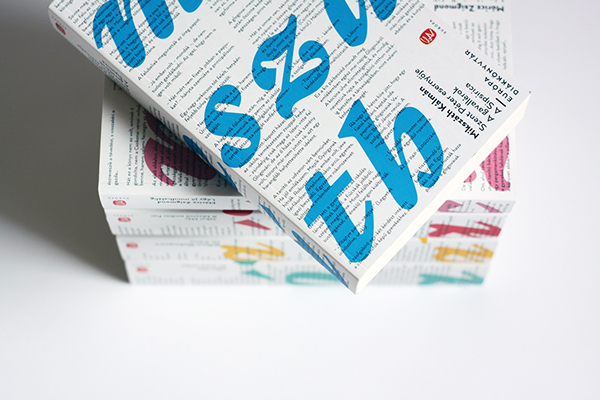
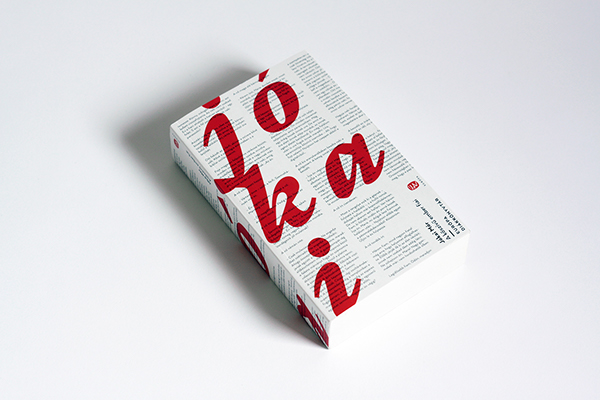
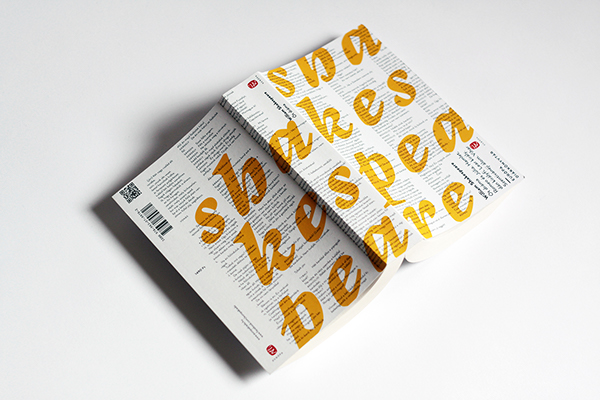
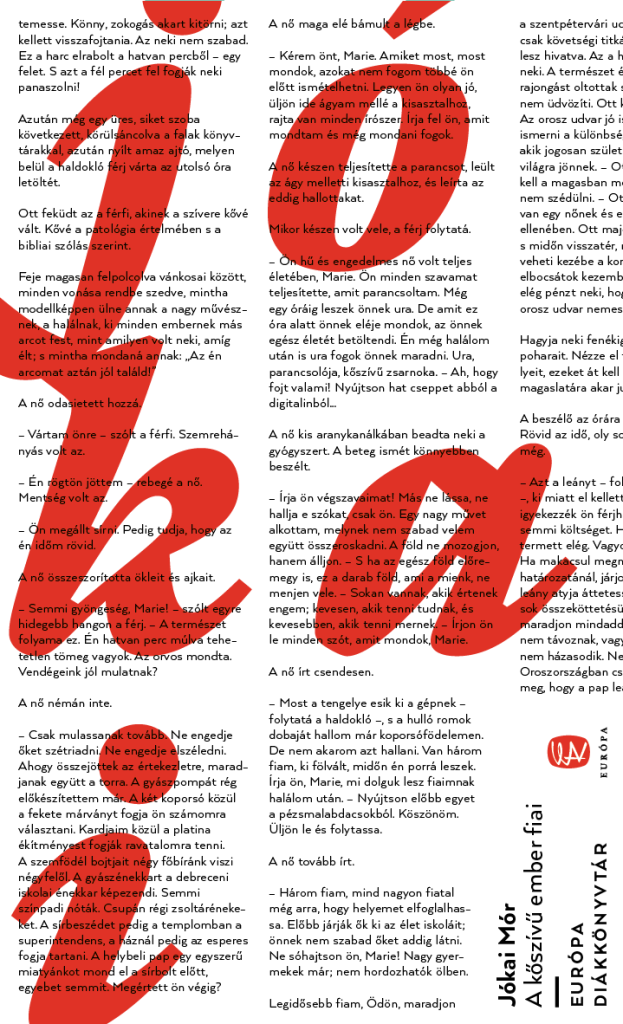
These rather fabulous typographic covers were designed by Ákos Polgárdi for Európa Könyvkiadó‘s Student Editions series. Works of classic literature from Hungary and around the world, each cover features text from the book as a background pattern.

student-editions-1 student-editions-2student-editions-4 student-editions-3

You can see more of Ákos’ book covers on his website.

Comments closed

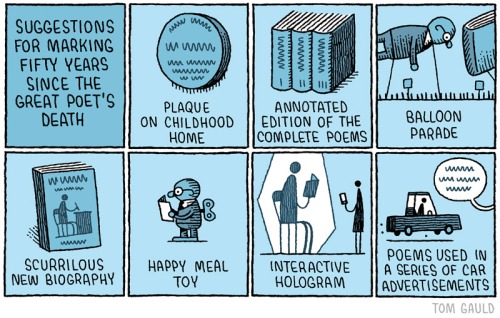
50 Years Since the Great Poet’s Death

50-years

Tom Gauld‘s weekly strip is back in The Guardian.

Comments closed

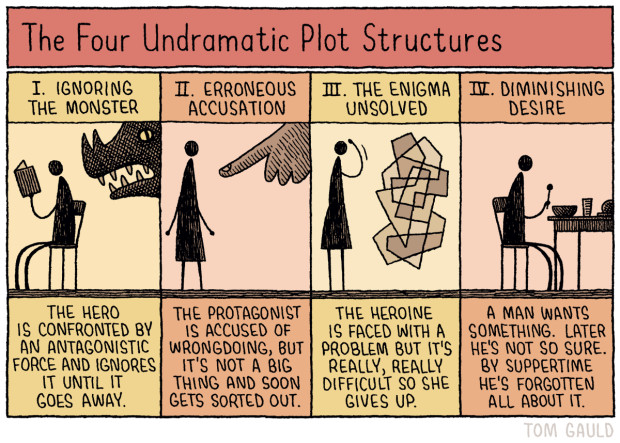
The Four Undramatic Plot Structures by Tom Gauld

gauld-four-undramatic-plot-structures-1200

Tom Gauld for The New Yorker.

Comments closed

Ulysses by Stephen Collins

Stephen Collins, who is the author of The Gigantic Beard That Was Evil, wrote about the agonizing process of drawing his weekly comic strip for The Guardian newspaper here:

When I think about making comics, I think of deep vein thrombosis. I don’t think I’ve ever actually *had* DVT, but whenever I embark on my weekly trip to What-The-Actual-XXXXing-XXXX-Am-I-Going-To-Put-In-The-Guardian-This-Week-Land, I can often feel its friendly fingers digging their way into my merrily atrophying leg muscles while I sit, and sit, and sit, and sit, and sit, trying for hours to think of an idea. It feels sort of cold, and tingly. I get cold legs. Cold, cold legs. Are you feeling the inspiration yet?

You can buy prints of the Ulysses strip from the cartoonist’s online shop.

Comments closed

Hilary Mantel: Speaking with the Dead

I’m finally, finally reading Wolf Hall (I know, I know…). It is excellent of course, and I’m looking forward to reading Hilary Mantel’s new collection of stories The Assassination of Margaret Thatcher just as soon as I’ve finished it (and Bring Up the Bodies). Mantel was recently profiled by Olivia Laing, author of A Trip to Echo Spring (one of my favourite books of the year), for the November issue of Elle magazine:

there’s an unmistakably eerie element to what Mantel does: a summoning of and speaking with the dead. Although she insists that she has “a very constrained imagination” and is happiest working within a scaffolding of fact, she is nonetheless adept at the act of mediumship that fiction requires. More than any other historical novelist I can think of, she also has a knack for conveying the slipperiness of time, the way it sloshes backward and forward, changing even as you watch. “History and memory is the theme,” she agrees, “how experience is transmuted into history, and how memory goes to work and works it over. It’s the impurity, the flawed nature of history, its transience—that’s really what fascinates me.”

Comments closed

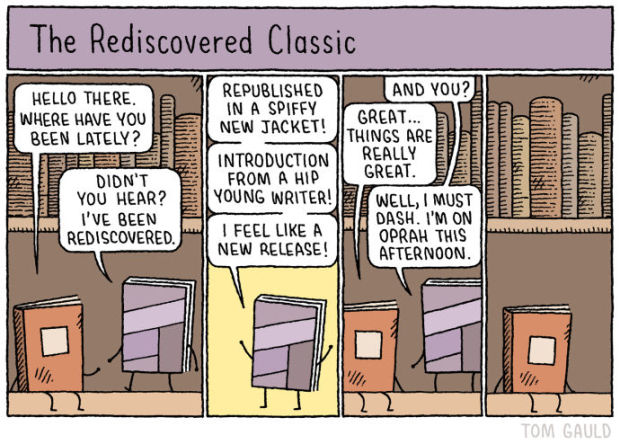
The Rediscovered Classic

Rediscovered-Classic-Gauld

Tom Gauld for The New Yorker.

Comments closed

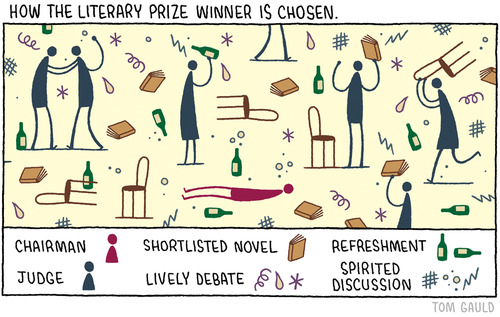
How the Literary Prize Winner is Chosen

literary-prizes-tom-gauld
Tom Gauld gets to the heart of the matter once again. (Although if Edward St. Aubyn’s recent satire Lost For Words is anything to go by, I would have expected more cock-ups, backstabbing, and adultery!)

Comments closed

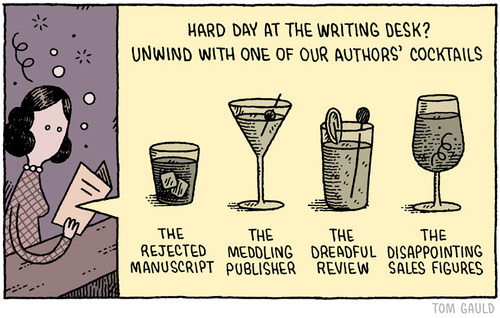
Authors’ Cocktails

hard-day

I didn’t see this weekend’s Guardian, but I assume Tom‘s cartoon is in reference to Olivia Laing’s article about 20th century female writers who drank, a follow-up to her excellent book The Trip to Echo Spring, which examines the link between creativity and alcohol through the lives F. Scott Fitzgerald, Ernest Hemingway, Tennessee Williams, John Berryman, John Cheever, and Raymond Carver:

Female writers haven’t been immune to the lure of the bottle, nor to getting into the kinds of trouble – the fights and arrests, the humiliating escapades, the slow poisoning of friendships and familial relations – that have dogged their male colleagues. Jean Rhys was briefly in Holloway prison for assault; Elizabeth Bishop more than once drank eau de cologne, having exhausted the possibilities of the liquor cabinet. But are their reasons for drinking different? And how about society’s responses, particularly in the lubricated, tipsy 20th century; the golden age, if one can call it that, of alcohol and the writer?

Comments closed

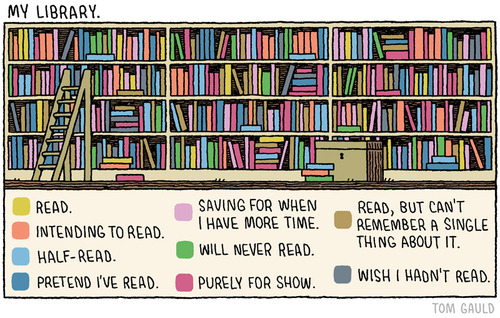
Tom Gauld’s Library

my-library

Tom Gauld.

Comments closed

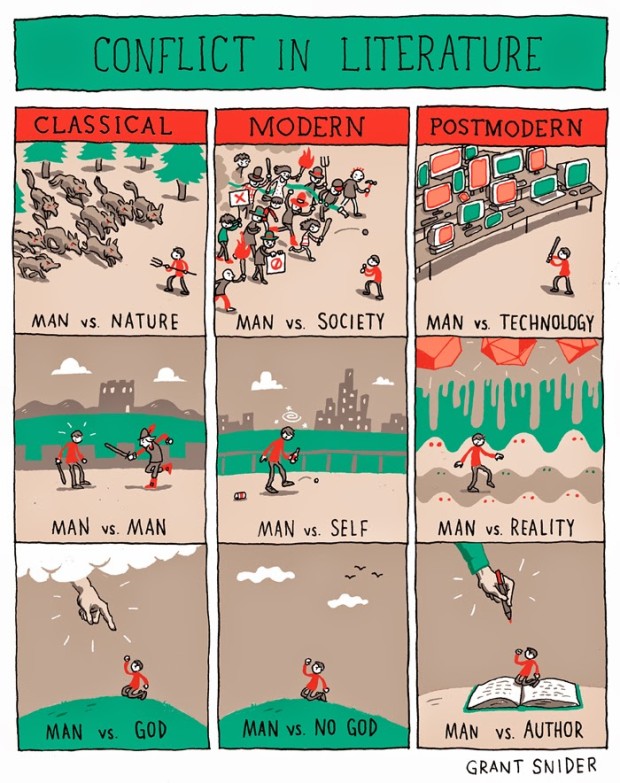
Conflict in Literature

conflict-blog

Grant Snider.

Comments closed

Tremble Before Me, For I Am the Novel!

tremble

Oh, go on then…

(Tom Gauld)


Comments closed

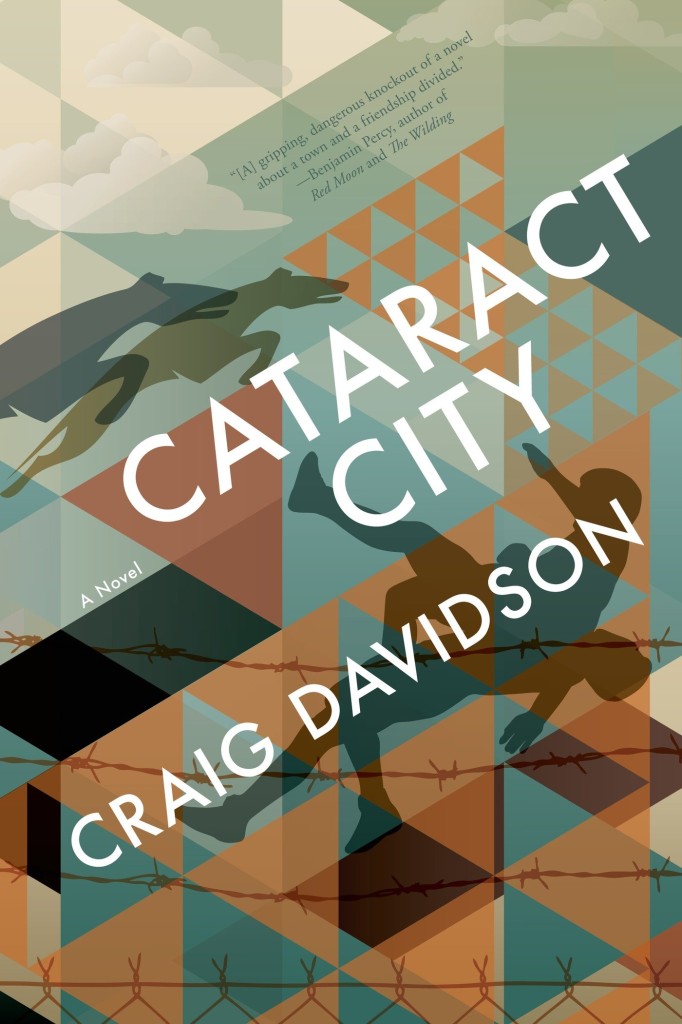
Graywolf and the Art of Independent Publishing

cataract-city

At Guernica Magazine, Jonathan Lee interviews Fiona McCrae, the publisher at American independent press Graywolf:

Any day of the week you can see that the big publishers are publishing some great books… But I think sometimes the context they’re working in involves the wrong kind of economic stress—or at least, a focus on economics and commerce that is not always conducive to interesting literary dialogue, or finding the new things that are happening at the edges of the literary culture. A very big publisher is unlikely to publish poetry unless the poets have already proven themselves—made it. And they are unlikely to go anywhere near essays, or hybrid books that fall between genres or play with conventions. Translation. Short stories. Criticism. We’re able to publish all these things, but someone who is required to hit X financial target each year is unlikely to go anywhere near those areas of literature…

There are dozens of obstacles to any given book succeeding. If a book succeeds it always does so against the odds. The odds in one generation might relate to the fact that people would rather be watching television than reading your book. The odds in the next generation might be that they’d rather be on their computer than reading your book. Once it was that people would rather be riding a bicycle than reading your book. It doesn’t do any good to be talking, as an author or publisher, about the obstacles. There are better uses of energy, I think. Yes, we can all feel helpless and wary in this industry sometimes, but it’s better, as a publisher, to look at the ways in which e-books and Twitter and so on can help us reach new readers, rather than treating social media as an enemy to literature.

Just last Friday, Publishers Weekly ran a short piece about the surprise success of Leslie Jamison’s The Empathy Exams, winner of the Graywolf Press Nonfiction Prize:

The Empathy Exams has already gone through five print runs, and a sixth print run of 10,000 copies has been scheduled, bringing the total number of copies in print to 25,500.

Graywolf, the small literary press in Minneapolis that published The Empathy Exams, is no stranger to media attention, having published books that have won National Book Awards and Pulitzer Prizes. While the publisher expected that the collection, which won the 2011 Graywolf Nonfiction Prize on the basis of a partial manuscript, would receive positive media attention, it is still a bit taken aback at the degree of acclaim. The buzz began months ago, when the key independent booksellers who received early galleys started talking it up on social media and recommending it to their colleagues. The bookseller chatter picked up steam at Winter Institute, which Jamison attended. It has continued through this past month, when Jamison launched her book tour at Yale University in New Haven, where she is pursuing a Ph.D in literature, followed by a more formal launch at Common Good Books in St. Paul, Minn. She has been speaking before standing-room-only crowds at indies around the country since then.

Well played.

(Disclosure: Graywolf Press are distributed in Canada by my employer Raincoast Books)
Comments closed