Skip to content

Tag: illustration

Chris Ware, The New Yorker

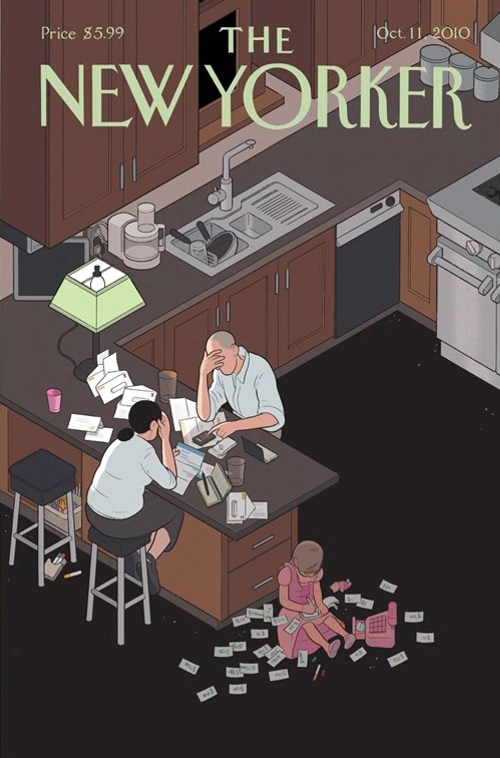
Another heart-rending, all too relatable, illustration by Chris Ware for the October 11th issue of The New Yorker:

After last year’s killer Halloween cover, Ware is fast becoming one of the most incisive commentators on modern parenting.

Acme Novelty Library #20 by Chris Ware is available from Drawn & Quarterly next month. (Full disclosure: D+Q are distributed in Canada by Raincoast Books)

(via The Ephemerist)

5 Comments

Midweek Miscellany

Lost Libraries — With the personal book collection of David Markson ending up at The Strand bookstore in New York, Craig Fehrman examines the fate authors’ libraries for The Boston Globe (via The Second Pass):

Most people might imagine that authors’ libraries matter — that scholars and readers should care what books authors read, what they thought about them, what they scribbled in the margins. But far more libraries get dispersed than saved. In fact, David Markson can now take his place in a long and distinguished line of writers whose personal libraries were quickly, casually broken down. Herman Melville’s books? One bookstore bought an assortment for $120, then scrapped the theological titles for paper. Stephen Crane’s? His widow died a brothel madam, and her estate (and his books) were auctioned off on the steps of a Florida courthouse. Ernest Hemingway’s? To this day, all 9,000 titles remain trapped in his Cuban villa.

Fehrman expands on this article — and the reasons we should not have been surprised that Markson’s books found their way to The Strand — at his blog.

Eating Each Other is Wrong — Evan Scnittman, Managing and Director of Sales and Marketing at Bloomsbury, argues that e-books don’t cannibalize print:

The most important lesson I can convey to book publishing professionals is that they must understand that those of us who have made the transition to ebooks, buy ebooks, not print books. Ebook reading device users don’t shop in bookstores and then decide what edition they want; ebook device readers buy what is available in ebookstores. Search an ebookstore for a title and if it doesn’t come up, it doesn’t exist – no matter how many versions are available in print.

Ebooks aren’t a better value, ebooks aren’t more attractive nor are they a threat to the print version of any immersive reading book. This isn’t the same as paperback versions vs hardcover – where the platform and convenience are the same – the timing and pricing are the key ingredients. Books that aren’t in ebook form are do not exist to ebook reading consumers. There is no cannibalization if in the mind of the buyer if there is no version available to them.

The Forgotten Mimics — In the 11th installment of The National Post’s ‘Ecology of Books’ series, Mark Medley talks to to some of Canada’s foremost literary translators:

“We’re not robots,” says [Lazer] Lederhendler, 59, who won the Governor General’s Literary Award for his translation of Dickner’s last novel, Nikolski. “We have a way of reading a book. We have a way of using the language. We have our own vocabulary, our likes and dislikes in terms of this phrase or that phrase. It’s a kind of balancing act between observing the fact that you’re at the service of someone else’s work, but at the same time it’s an artistic mission.”

Four Decades of Art — A mini-documentary about illustration in The New York Times Op-Ed page, featuring interviews with art directors and illustrators.

And finally…

Type designer Matthew Carter and writer David Simon (creator of The Wire) were recently named MacArthur Fellows. The Fellowship is a $500,000 (US), no-strings-attached grant for people who have shown exceptional creativity in their work and promise to do more (via How Magazine):

Comments closed

Chance Favours the Connected Mind

A clever book trailer for Steven Johnson’s new book Where Good Ideas Come From :

(via Kottke)

2 Comments

Once Upon a Time

An amazing book trailer for an amazing pop-up book by illustrator Benjamin Lacombe:

(via Daily Design Discoveries)

3 Comments

Spirit City Toronto

Combining  illustration and photography to depict homeless nature spirits who inhabit the forgotten corners of the city, there are shades of Hayao Miyazaki and Studio Ghibli in freelance illustrator Aaron Leighton’s lovely debut book Spirit City Toronto:

Spirit City Toronto is published by Koyama Press, and Books@Torontoist have just posted a two part interview with Aaron about the book.

(via Drawn!)

Comments closed

Midweek Miscellany


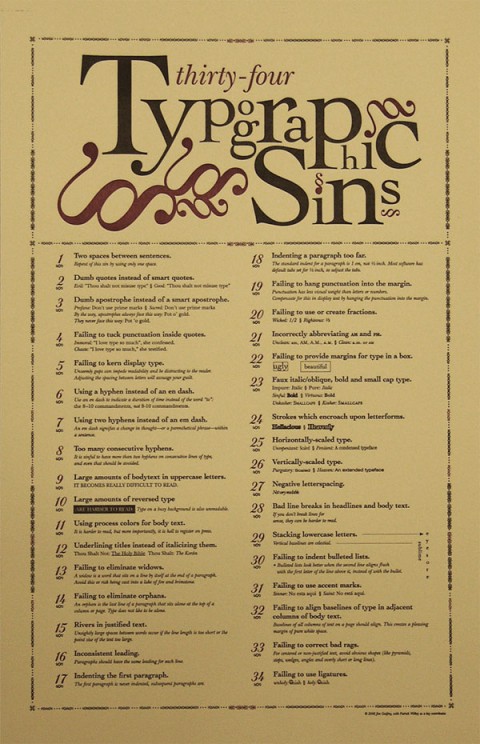
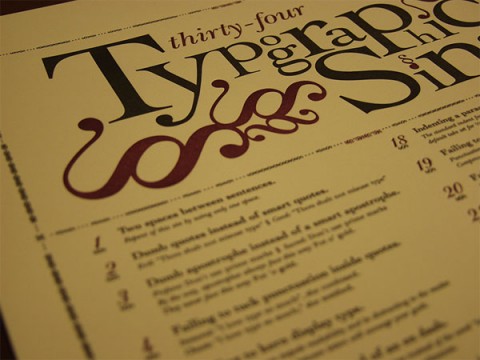
Typographic Sins Poster designed by Jim Godfrey (seen at For Print Only).

And on the subject of graphic design crimes…

Angry Paul Rand on Twitter (via @thebookdesigner):

My advice for designers & design students: fuck the rules, if your work is good enough to get away with it.

Boom — Alice Rawsthorn profiles Dutch book designer Irma Boom for the New York Times:

Ms. Boom, 49, has designed most of her books just as she has wanted. Typically, a book designer works with the text and images selected by the editor and art director, but Ms. Boom prefers to combine all three roles by deciding on the book’s structure and choosing the themes and visual material herself. She then obsesses over every element — not just how the book will look, but how it will feel and smell — and invents ingenious ways of achieving the desired effects.

One of her books was printed on coffee filter paper. Another was scented to smell of soup. A monograph of the work of the Dutch artist Steven Aalders was made in the exact dimensions of one of his paintings. The page edges of a book on the American textile designer Sheila Hicks were hacked with a circular saw to evoke the fraying edges of her work. The title on the white linen cover of a history of the Dutch company SHV only becomes visible after frequent use. There are 2,136 pages in that book, but no page numbers, to encourage readers to dip in and out.

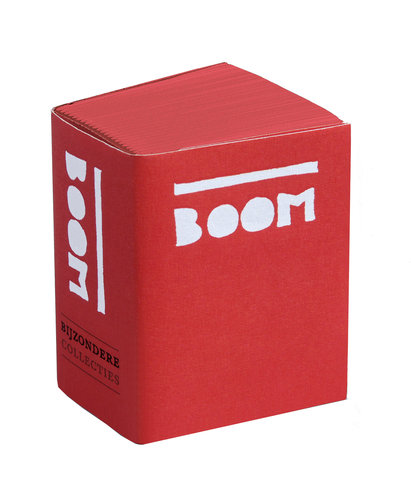
An exhibition of Boom’s work, ‘Irma Boom: Biography in Books’ runs until Oct. 3 at the University of Amsterdam Library. The book accompanying the exhibition, designed by Boom and pictured above, is only 2 inches high, 1.5 inches wide and 1 inch thick.

And finally…

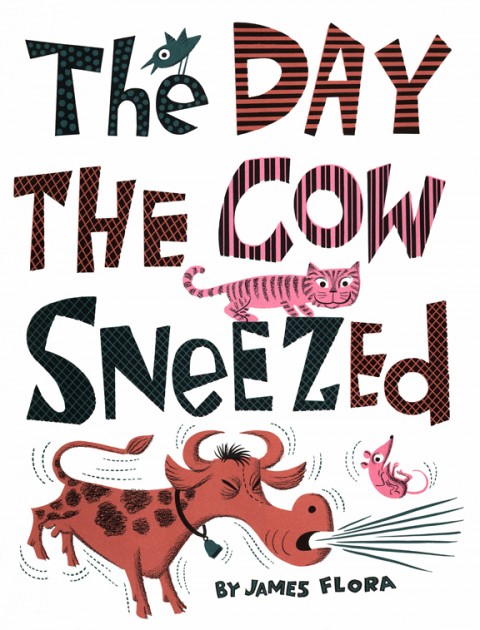
Enchanted Lion are reprinting Jim Flora’s kids books starting with The Day The Cow Sneezed in Fall 2010. Flora was best known his incredible jazz and classical album covers for Columbia Records and RCA Victor, and is officially awesome.

Comments closed

Jason, Mon Amore

A few years ago when I still worked at Pages, one of the creative/media executives who frequented the bookstore sent his assistant to exchange a copy of comic book by award-winning Norwegian cartoonist Jason that he’d bought from us earlier that day. The book, she said, was faulty. Apparently there were pages missing so the story didn’t make sense and her boss wanted a new copy. She had a receipt so I swapped the book without much thought. It wasn’t until after she’d left and I looked through the returned book that I realised there was nothing wrong with it. The pages were all there, her boss just hadn’t got it. She would be back later for a refund.

In a sense, the confusion was understandable: Jason’s anthropomorphic comics are surreal and require concentration to follow.

In another sense, the dude was simply an idiot because Jason is awesome.

Jason is perhaps the most unique visual stylists working in comics today. Each individual panel is a work of ligne claire pop art: flat, beautifully coloured and amplified for effect.

The deceptively simple stories — often thrillers and off-beat romances — feature anti-heroes, guns, girls, historical figures, b-movie monsters, robots, and aliens. They’re a brilliant mix of silent pictures, film noir, La Nouvelle Vague, classic literature, crime fiction, sci-fi and pulp magazines. There are obvious elements of Hergé, but strange, deadpan, and imbued with ennui and loneliness, Jason’s comics also evoke Hitchcock, Godard, Jarmusch, and Lynch.

In I Killed Adolf Hitler a hit man goes back in time to assassinate Adolf Hitler with unexpected personal consequences. In The Left Bank Gang Fitzgerald, Hemingway, Pound, and Joyce are graphic novelists planning a heist in 1920’s Paris. In Why Are You Doing This? Alex is framed for the murder of his best-friend.

Published in North America by Fantagraphics, Jason’s most recent book, Werewolves of Montpellier, features a thief who disguises himself as a werewolf. A 6 page preview is available on the Fantagraphics blog. If you haven’t checked out Jason’s work already, now’s a great time…

More of Jason’s artwork can be seen on the Fantagraphics’ on Flickr photostream.
6 Comments

Midweek Miscellany

Michael Cho‘s cover for the Best American Comics annual 2010 published by Houghton Mifflin Harcourt. Fantastic.

Undefined — The Caustic Cover Critic interviews illustrator and designer Alice Smith:

After sketching ideas, I make compositions using inks and pens to bring collages together, the pen marks might have disappeared in the finished composition, but it’s the pen marks and the rough sketch that helps bring it together. I use old imagery for ethereal effect, playing with visual alchemy and nostalgia. And the quality of printing pre 1950s, photoengravre and proper litho is so much nicer than the pixel fuzz and dots of newer digital printing.

Alice’s portfolio is here.

Scraps of Paper — An interview with superstar designer Rodrigo Corral in Metropolis magazine:

[T]he parts of the process that are unique and special really come from the individual designer’s experience. I think about the people who might read this article, and assuming some will be design students or younger people just getting into book design, I have to say that in order to come up with ideas—which, aside from a solid understanding of typography and typographical context is the most important part of all of this—you have to have an understanding of what has come before and what is current. I’ve spent years in used bookstores and magazine shops looking, admiring, and collecting, and this is all a part of the “design process.” The things I have stored in my brain and all that is still out there to see and learn are all part of the process.

Bought and Discarded — Simon Akam explores the sidewalk booksellers of New York for More Intelligent Life:

What wasn’t clear was what it meant to have a big presence on secondhand stalls. Was it an honour for a book, or a slur on its author’s reputation? Which was more significant—the fact that so many copies had been bought by someone, or the fact that they had since been offloaded again? To add insult to injury, were the titles I encountered in droves lying on the stalls because today’s reading public chose not to pick them up, even at a much reduced price? I needed to find out whether the champions of my survey were much loved, or doubly scorned.

And finally…

The Road: Scenes From the Post-Print Apocalypse by Peter Kuper for the New York Times (via The Ephemerist).

2 Comments

Something for the Weekend

An illustration by Pascal Blanchet, author of the charming White Rapids*, for the National Post’s Spring Books Quarterly.

Text Without Context An interesting article on reading and the web by Michiko Kakutani in the New York Times, which discusses books by David Shields, Jaron Lanier, Cass Sunstein, Farhad Manjoo and others (and yes, I appreciate the irony of me of linking an article about the fragmentary nature of reading online and only quoting one paragraph):

THESE NEW BOOKS share a concern with how digital media are reshaping our political and social landscape, molding art and entertainment, even affecting the methodology of scholarship and research. They examine the consequences of the fragmentation of data that the Web produces, as news articles, novels and record albums are broken down into bits and bytes; the growing emphasis on immediacy and real-time responses; the rising tide of data and information that permeates our lives; and the emphasis that blogging and partisan political Web sites place on subjectivity.

The Bkkeepr — Book Oven’s Hugh McGuire interviews James Bridle of BookTwo and Bookkake:

We can berate publishers for making what we think are bad decisions about digital, but to accuse them of cluelessness just inflates a very dangerous animosity. Publishers love books as much, if not more, than most readers. It’s one of the very few industries where this is true almost all the way up. And we should be working together for the best of all possible futures for books and authors and readers.

(And you can read Hugh’s response to the Michiko Kakutani article — which he takes issue with — here)

Route One — Sarah Weinman at Daily Finance looks at indie publishers experimenting subscription models that reach readers directly.

And finally…

Designer Matt Avery talks about his beautiful design for Chicago by Dominic Pacyga (University of Chicago Press) at Faceout Books.

* White Rapids is published by D+Q and distributed in Canada by my employer, Raincoast Books.

Comments closed

Nobody Knows Anything

Book Qupte by Brandon Schaefer

Anyone who has spent 5 minutes discussing publishing with me knows that William Goldman’s line “nobody knows anything” from Adventures in the Screen Trade is one on my mantras, so I was thrilled that designer Brandon Schaefer (whose awesome The Dark Knight illustration buzzed around the internet last summer) decided to use it for as part of his Book Quotes poster series.

You can see the rest of the series (and more of Brandon’s lovely design) on Flickr.

Comments closed

Midweek Miscellany

EndGrain — A “directory and aggregator for wood type and letterpress works and information on the web.” Lovely.

Crash — Iain Sinclair (author, most recently, of Hackney, That Rose-Red Empire — just out in paperback by the way) on JG Ballard’s artistic legacy:

A late moralist, he practised undeceived reportage, not prophecy: closer to Orwell than HG Wells. Closer to Orson Welles than to either. Closer to Hitchcock. Take out the moving ­figures on staircases that go nowhere and stick with hollow architecture that co-authors subversive drama

Picture Book Report — 15 artists create illustrations inspired by their favourite books. Pictured below: Kali Ciesemier‘s take on Sabriel by Garth Nix. I’m also looking forward to Robot Johnny‘s take on The Hitchhiker’s Guide to the Galaxy (via The Art Department).

Indigo 2.0Canadian Business magazine on Indigo and their digital book division Kobo:

“Kobo has been across the smartphone space from the beginning,” says Lisa Charters, senior vice-president and director of digital for Random House Canada. “And that unique offering is really important to us as publishers, because we want consumers to have all options to read e-books, and not necessarily have to purchase a $300 device.”

What’s more, says New York publishing consultant Mike Shatzkin, “they beat Google into the cloud.” Kobo’s library system is based in cloud computing. When you buy a Kobo book, it resides on Kobo’s servers and you access it via your device of choice. So when you squeeze in 20 pages of The Lost Symbol on your laptop in the morning, and later that day open the Kobo application on your BlackBerry, Kobo automatically plops you down on page 21.

Interesting stuff, although I do wish journalists could stay away from the Gutenberg clichés (and Dan Brown. Barf).

And finally…

Reserve Window Design — “We hired our good friend John Downer, who is a professional sign painter & typographer, to fly to LA to do gold leaf lettering on our store window & transom. Glass gilding is becoming a lost art that only a few dozen people in the United States still know how perform” (via We Love Typography):

4 Comments

Charley Harper: An Illustrated Life

Charley Harper: An Illustrated Life. Thank you Mrs Casual Optimist.

(Charley Harper: An Illustrated Life by Todd Oldham is published by Ammo Books).

Comments closed