Skip to content

Tag: illustration

Monday Miscellany

Kitsune Noir Poster Club — Artists Frank Chimero, Mark Weaver, Jez Burrows, Cody Hoyt and Garrett Vander Leun reinterpret their favourite books as prints for Kitsune Noir . (Frank Chimero’s Slaughterhouse Five is pictured above).

And on the subject of posters…

Penguin US have made the jacket art from Graphic Classic Editions of Moby Dick and White Noise, designed by Tony Millionaire and Michael Cho respectively, available as posters.

From Trolls to Truth — Author Ursula K Le Guin reviews Tove Jansson’s The True Deceivers (available in the US from NYRB Books) for The Guardian:

On the patronising assumption that books for children are nice, ie morally bland and stylistically infantile, critics, reviewers and prize juries often dismiss those who write them as incapable of writing seriously for adults… Anyone familiar with Jansson knows it would be unwise to dismiss her or patronise her work on any grounds. Her books for children are complex, subtle, psychologically tricky, funny and unnerving; their morality, though never compromised, is never simple. Thus her transition to adult fiction involved no great change. Her everyday Swedes are quite as strange as trolls…

Quote/Unquote Bookends designed by Eric Janssen (via SwissMiss).

And lastly…

In my total blogging tardiness, Bookslut (inevitably) beat to the punch on this, but Simon Reynolds column on the music of the decade for The Guardian has so much resonance for books and the book industry:

“The fragmentation of rock/pop has been going on as long as I can remember, but it seemed to cross a threshold this decade. There was just so much music to be into and check out. No genres faded away, they all just carried on, pumping out product, proliferating offshoot sounds. Nor did musicians, seemingly, cease and desist as they grew older; those that didn’t die kept churning stuff out, jostling alongside younger artists thrusting forward to the light. It’s tempting to compare noughties music to a garden choked with weeds. Except it’s more like a flower bed choked with too many flowers, because so much of the output was good. The problem wasn’t just quantity, it was quantity x quality. Then there was the past too, available like never before, competing for our attention and affection. The cheapness of home studio and digital audio workstation recording, combined with the wealth of history that musicians can draw on and recombine, fuelled a mushrooming of quality music-making. But the result of all this overproduction was that “we” were spread thin across a vast terrain of sound.”

(Update: links to Tove Jansson’s The True Deceiver added)

Comments closed

Rime

Jimmy Turrell‘s book cover illustration for Beat IV: The Rime of the Ancient Mariner, a fully illustrated edition of the Samuel Taylor Coleridge poem published by the Heart Agency to showcase the work of their illustrators. The book, designed by Pentagram, won a D&AD Award for illustration and book design.

(via We Made This)

Comments closed

Something for the Weekend, November 13th, 2009

Is this a new cover for J G Ballard’s Crash? HarperCollins Canada have a release date of November 2nd, so I guess so. And I would assume The design/illustration is by the immensely talented David Wardle who did the previous covers in this seriesCan anyone confirm?

In any case, I think the Warhol/Banksy Elizabeth Taylor illustration fits the book pretty well and it’s a nice counterpart to the Marilyn Monroe on the cover of Atrocity Exhibition.

Moving the Needle — Literary agent Nathan Bransford on the challenges facing publishers in the HuffPo:

One of the big recent surprises in the industry… is a newfound difficulty making a splash… with adult nonfiction. Now, to get an idea of what a huge problem… this is, bear in mind that for many years adult nonfiction was the bread and butter workhorse of the industry. Fiction, except for very very established authors, has always been regarded as something of a crapshoot. Nonfiction, on the other hand, was a source of relative stability, and… healthy margins.

Not so much anymore. Everything is difficult to break out.

Artists’ eBooks — a new project from James Bridle and booktwo.org (now, James, if you could only get my bkkeepr badge work properly…)

I Don’t Know WhyUnderConsideration‘s FPO (For Print Only) looks at the quirky and deliciously creepy There Was An Old Lady by Jeremy Holmes, published by Chronicle Books (and — full disclosure alert — distributed by Raincoast in Canada)

And finally…

The (slightly bonkers) illustrator and musician mcbess has a new book (and vinyl record!) called Malevolent Melody coming out from Nobrow:

(If you haven’t seen the insane mcbess/The Dead Pirates Dirty Melody/Wood animated video, you can find that here if you are so inclined).

Update: Thanks to Deanna McFadden of the Tragic Right Hip and HarperCollins Canada for confirming with her UK counterparts that the Ballard cover was designed by David Wardle.

2 Comments

Missed Things: Tuesday

Thesis Project — Mikey Burton’s illustrative reinterpretations of classic book covers for junior-high-school students. Mikey’s more recent work, including gig posters for Wilco, is also awesome.

The Writer’s Reader — Michael Silverblatt, the endlessly enthusiastic host of KCRW radioshow Bookworm, profiled in O, The Oprah Magazine (via TEV).

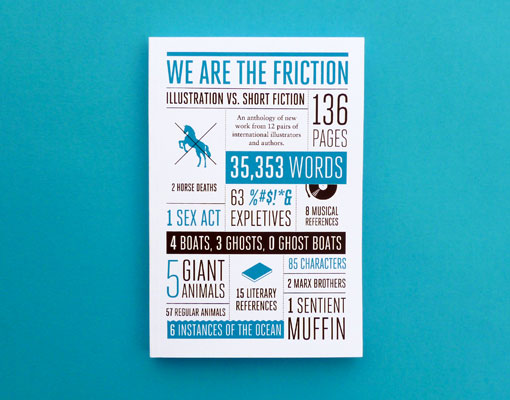
We Are The Friction seen at The BCA, Design Work LifeSwissMiss and others. Sing Statistics, the “collaborative concern” of designer Jez Burrows and illustrator Lizzy Stewart, and publisher of We Are The Friction, also has a great Flickr photostream (and there are images of the book launch at Edinburgh’s Analogue Books on the shop’s Flickr photostream).

It Isn’t Rocket Science — Makenna Goodman, formerly an assistant to an unpleasant sounding literary agent in New York, talks about her move to rural Vermont and happier times with publisher Chelsea Green in the Huffington Post.

Intelligent Eclecticism — Steven Heller on the groundbreaking illustrated covers used for Time‘s “soft-cover book club” throughout the 1960’s:

Eclecticism was a viable and intelligent decision. While consistent design for a series of related books makes good strategic sense, these books were bound together by the editors’ judgment. Designing them as separate entities — avoiding the impression of formulaic repetition — made the most sense for the book club but also for the artists and designers who created them. Each cover (indeed each book) had a unique integrity that raised the standard of the genre while showcasing the creators’ artistic strengths.

And finally…

On the subject of vintage book design and great illustrations, be sure to take a look at Martin Klasch blogger P-E Fronning’s set of Swedish book covers on Flickr.

Comments closed

Q & A with Paul Buckley, Penguin US

Photo by Erika Larsen. Design by Paul Buckley

It is not every day that I get an email from the Vice President Executive Creative Director of Penguin US, so it was something of a surprise when Paul Buckley sent me a note a few weeks ago about a book cover design mentioned in my interview with his wife Ingsu Liu.

I had been conspicuously unable to locate the image online and Paul was able to help. But it seemed like too good an opportunity to miss, so I asked the Brooklyn-based designer if he would be willing to do a Q & A about his work as well. Again, much to my surprise, not only did Paul say yes, he managed get his answers back to me in record time (with annotations and links included!)…

Of Mice and Men

How did you come to book design?

I went to SVA on an illustration scholarship, and was very intent on becoming an illustrator. While other parents were giving their kids children’s books, my father was giving me illustration annuals. But I supported myself during my college years working for various NYC design studios as a designer, learning through those around me… and at the same time pursuing freelance illustration assignments as well – basically learning both crafts simultaneously through different venues. Right after graduation I took a 3 month road trip spending my savings, and thus came home to Greenpoint needing an income. A studio manager at one of the studios I worked in during my early college years suggested me to her sister who was working at NAL/Plume/Dutton, as they needed a Junior Designer… I landed the position with a portfolio that was equal parts design and illustration. Though in the beginning I was very hardcore about becoming the best painter I could be, I quickly fell in love with designing book covers and never looked back… within two years we merged with Penguin. Though I’ve become far too busy (and lazy!) to pull out the oils and actually paint something, I did manage to get a few simple ink drawings in the Society of Illustrators this year. I realize these will pale in comparison to 99% of everything else done by the true working pros in the annual, but it was still a kick and an honor to have my work chosen for inclusion.
The World According to Garp

Can you describe your role at Penguin?

I act as a Creative Director overseeing a sizeable staff and many many projects. My Penguin publishing team is very open to me and my guys pitching ideas and we nicely act as an overall creative team, in a way that editorial and art together collaborate to create nice projects — most recently I’m directing a cover design book where we have the authors commenting on their covers, and a new series named Penguin Ink, where the world’s leading tattoo artist’s do covers for me. Recently in the stores is the gorgeous collaboration of Roseanne Serra with Ruben Toledo… this was all Roseanne’s brilliant art direction, and I had nothing to do with it — but it is gorgeous Penguin project that is very much worth checking out.
Art by Duke Riley
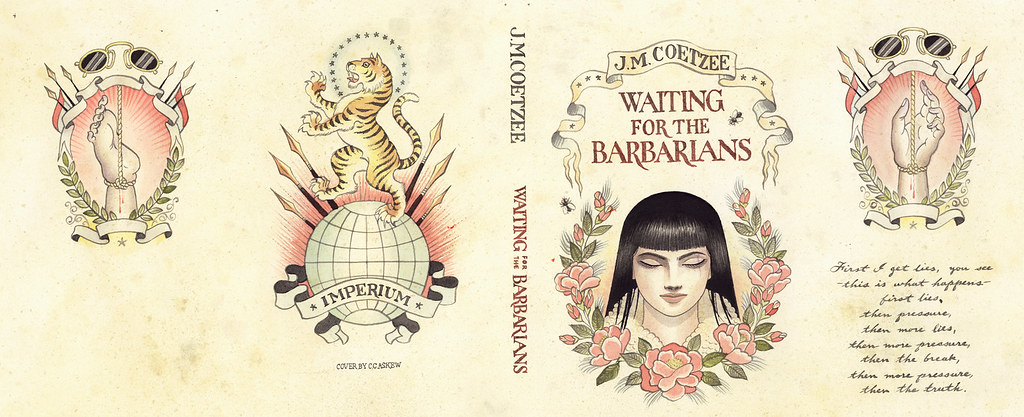
Waiting for the BarbariansArt by Chris Conn

How many imprints do you oversee?

Six

Does each imprint have a particular design style?

Yes, each imprint is very unique unto itself, as each Publisher/Editorial team brings their own style, as does each Art Director. In my group, Roseanne Serra and I collaborate on Penguin paperbacks, and to a lesser degree, with the Viking imprint as well. Roseanne art directs Pam Dorman books. Joe Perez smartly art directs Portfolio and Sentinel, which are brilliant business and political imprints. Darren Haggar art directs Penguin Press overseeing the packaging for literary giants like Thomas Pynchon and Zadie Smith… and while not it’s own imprint per se, Maggie Payette Art Directs our gorgeous poetry series.

The Jan Tschichold Penguin paperbacks are design icons in the UK. Is there a sense of that legacy within Penguin Group USA?

Very much so. We all have quite a few Tschichold books on our shelves. The UK Penguin art department, under the Art Direction of Jim Stoddart and John Hamilton, does an incredibly beautiful job of keeping that legacy alive.

How is American book cover design different from the UK?

I don’t know that it is all that different. In fact, Art Directors over here, and Art Directors over there, are hiring the same art and design talents on each side of the Atlantic.

Do you discern any current trends in American book cover design? Yes… very nicely a resurgence of designers and illustrators who do both the design and illustration; the whole package. Jaya Miceli, Chris Brand, Jon Gray, Gregg Kulick, Jamie Keenan, Rodrigo Corral, Ben Wiseman, Jennifer Wang, Tal Goretsky, etc – these are the folks creating the personally unique covers of today that will be the design icons of tomorrow.
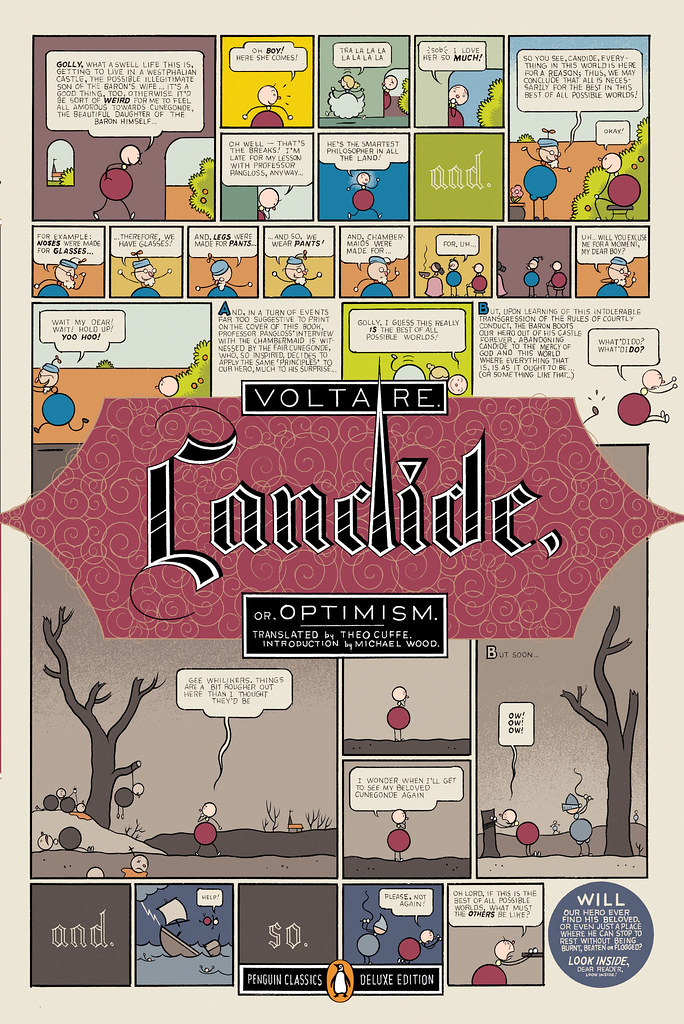
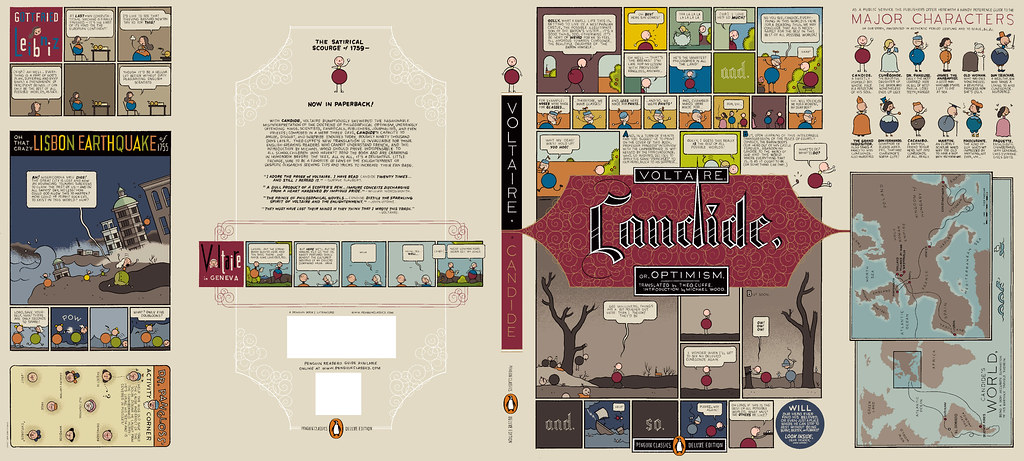
Art by Chris Ware

How did the Penguin Graphic Classics come about?

We do a handful of what we call Penguin Graphic Classics Deluxe packages every list, and when it was time do one for Voltaire’s Candide, I handed it off to Helen Yentus who was in my group at the time. Helen wanted to work with Chris Ware on it, and off it went with us all happy that he accepted the assignment. When Chris’s sketch came in, it just sort of blew everyone away… Up to that point we’d never had anyone grab editorial control of a cover that way… Chris had gone hog wild and wrote all his own copy and illustrated and designed the living hell out of every square inch of this cover from flap to flap. It took forever to make its way around the packaging meeting table with everyone grabbing hold of it, reading it and laughing out loud. A short time later, our Penguin Publisher Kathryn Court declared that we needed to do more of these. Kathryn really nurtures good art and design and is one of the reasons I’ve been here so long.
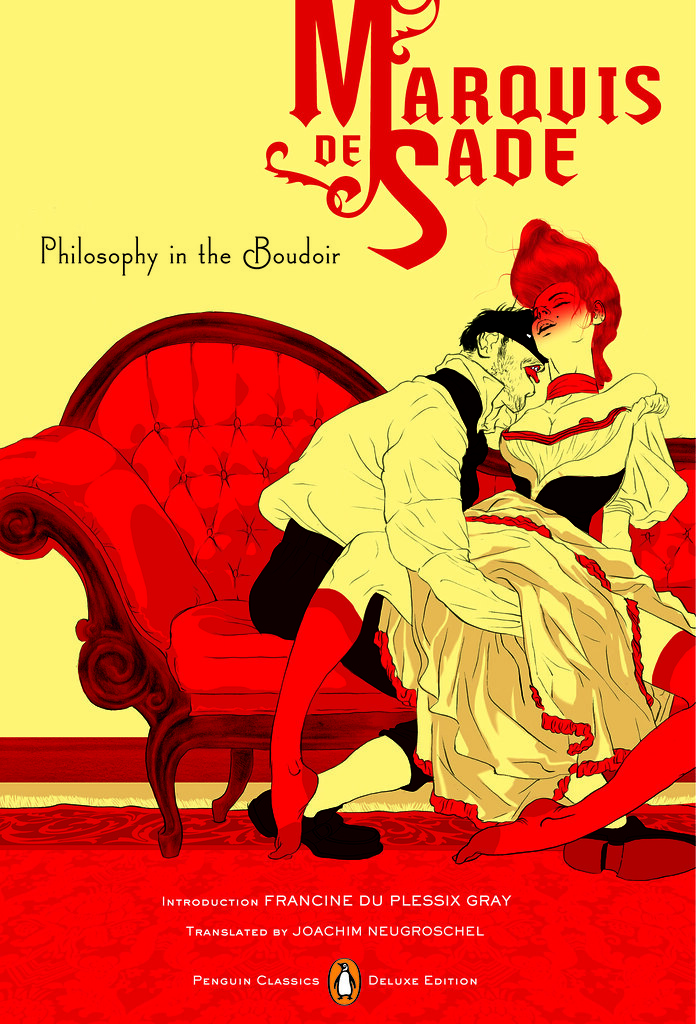
Cover by Tomer Hanuka with design by Paul Buckley and Tomer Hanuka
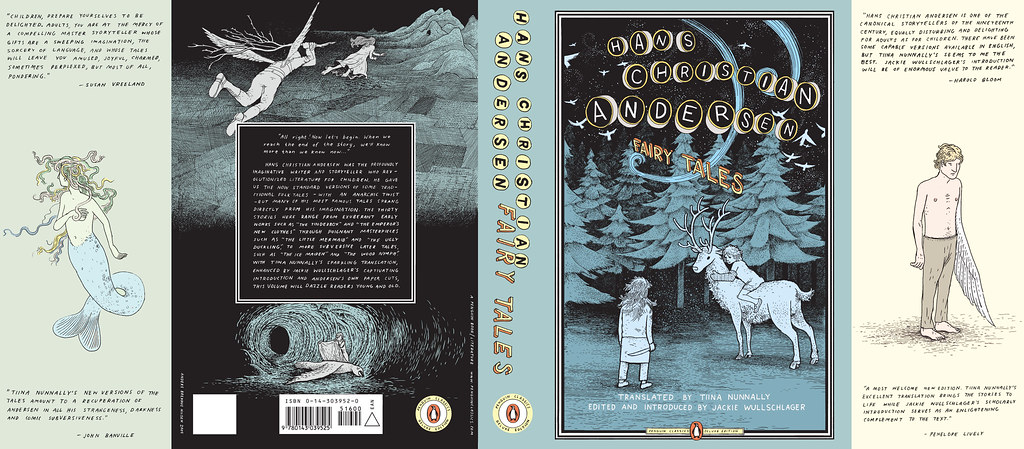

Art by Anders Nilsen
Art by Charles Burns
Art by Roz Chast

How did you match the artists with the titles?

The titles were given to us by the Penguin Classics editorial team, and Helen and I would sit in my office surrounded by comic books and simply have fun matching this artist with that title.
Art by Michael Cho. Design by Paul Buckley

Are their plans to expand the series? What new covers can we look forward to in the future?

We do about 6 a year and I think we are all comfortable with that number at the moment. I just finished White Noise with Michael ChoMoby Dick by Tony Millionaire just came out, as did Huck Finn by Lilli Carré, and Ethan Frome by Jeffrey Brown. In the near future, I’d really love to do something with Jim Rugg, Jeff Lemire, Mike Mignola, David Small, and I still hold out hope that one day Crumb will actually say to me “damnit you pesky bastard… ok, ok, I’ll do it”.
Art by Tony Millionaire


Art by Lilli Carre. Design by Paul Buckley

Do you still design yourself?

All the time… mostly in the evenings after everyone has gone home and I can focus without the constant distractions of the work day. My greatest hits are posted on my website.

 
Art by David Byrne. Design by Paul Buckley. 
Pigmented foil stamped on linen cloth
Art by Will Eisner. Design by Paul Buckley. 
Art direction by Ingsu Liu & Albert Tang
 Photo by Fredrik Broden. Design by Paul Buckley

Could you describe your design process?

I start each project with the hope that I’m going to do something unusual; and then I try my best to do just that — read the material and find a visually unique way to interpret it. I tend to go either very loud, or very subdued and moody. I do a ton of comps for every cover I work on — sometimes, 20 or more to explore what I’m thinking and all the tangents that come along during the process — I get nuts when freelancers send me two or three comps. I’ll show 3-5 of what I think are the best and receive comments and direction on those from editorial… when discussing why a designer did this or that, I think what people commenting on book covers seem to gloss over is that the publishers and editors have far more at stake than the cover designer — they have committed sums of money and must answer to the house and the author to make this book a success — so they are very strong about what they think the cover should be and nothing is being printed without their full consent.

Here are a few rejects from the pile… I’m not saying these covers are better for the individual book, than what got printed… maybe the books would have tanked with these covers… but they do illustrate how in-house visions do not always sync:
Upper left: art by Paul Buckley. Upper right: various stock.
Lower Left: art by Amy Bennett with descending placards by Paul Buckley.
Lower Right: painting by Keniche Hoshine with added stock image.
(see final cover here)
Various antique endpapers combined with altered ebay images
and antique portrait of feral child.
(see final cover here)

Do you approach fiction and non-fiction differently?

Often, yes. Fiction needs a more peripheral approach where I’m looking to capture a mood to reflect the book’s tone, whereas non-fiction often needs you to stare it directly face on and state precisely what the topic is.

What are your favourite books to work on?

Any title where the Editor and Publisher are open.

What are the most challenging?

Any title where the Editor and Publisher are nervous.

Where do you look for inspiration?

Everywhere. My staff blows me away daily. My wife shows me beautiful work constantly. Editors show me stuff. Blogs like yours so nicely showcase how much great work is out there. Friends deluge my inbox with artist links. Illustrators. Photographers. Fine Artists. Music. Furniture. All talent is inspiring. Cruising Flickr and the web in general has me bookmarking new people daily, and I can spend hours google imaging the most absurd things that always tangent me to the greatest places. I found and purchased an image for a difficult book cover project recently just because I decided to google “leucistic squirrel” after I noticed a few in Prospect Park. I have no idea how we all existed before the internet.

What do you look for in a designer’s portfolio?

A unique talent. Distinction.

Front cover art by Frank Miller. Design by Paul Buckley

What does the future hold for book cover design?

There will be a market that just wants/needs to download the material for reading purposes, and there will be a market that is looking for an object. What Penguin does with the Graphic Classics is a great example– some student will download Gravity’s Rainbow cheaply, while an older Thomas Pynchon or Frank Miller fan with a little more cash in their pocket will want the beautiful book/object. So I believe the cover design market will shrink in that way. Textbooks and travel guides will go digital first as there is no real reason to carry all that in your backpack or pay for all that book production. For digital readers, big budget fiction and non fiction titles will have moving covers, more like mini movie trailers. If Grisham were still with us, his future digital reader cover would be something akin to us looking at a murky black screen… the reader would hear running footsteps and ragged breathing… then a loud shot rings out, and a big red splotch hits your screen and drips to form the title type. Then one blurb after another flies across the screen and after a moment Grisham himself pops up in the corner thanking you for purchasing his new book and asking if you’d like to peruse his backlist titles… and click this link if you’d like to pay an extra dollar to help our troops in North Korea, Iran, Afghanistan or Iraq. Interior-wise, there will be tons of product placement… not necessarily for gratuitous reasons; but because people, places and things are mentioned on every page in every book be it fiction or non fiction; and if folks desire a more interactive read that really helps them get into the book in a different way, then it’s possible there will be quick jump links to everything – for instance… if in this book, the character is having lunch in Balthazar and then running off to the Standard Hotel for an ongoing affair… then why not have Balthazar and The Standard pay a small fee to the publisher to provide these links; this seemingly free advertising? Big money to had there. I reserve judgement as to whether any of this is a good thing or a bad thing… but as publishing goes more digital, I think it’s naive to think these things wont happen to books just as they happen everywhere else.

Thank you very much!

You bet.

9 Comments

Q & A with Lincoln Agnew, Harry and Horsie

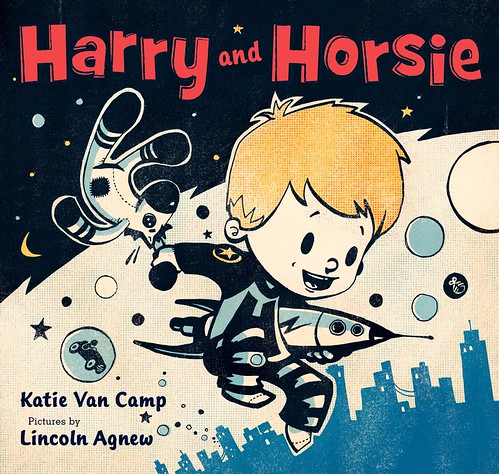
Children’s picture book Harry and Horsie by Katie Van Camp has mostly been in the news because the eponymous Harry happens to be the very real son of TV host and comedian David Letterman (who also provides the foreword to the book).

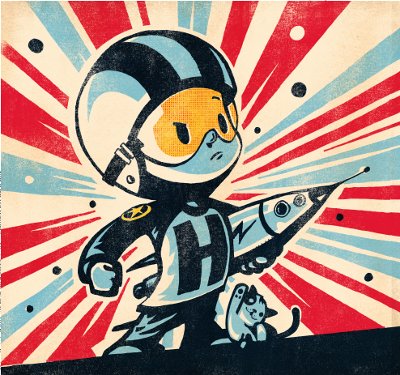
But what caught my eye were the illustrations by Calgary artist Lincoln Agnew. The illustrations, which bring to mind 1950’s advertising, cereal boxes, comics, vintage toys, pop art, and Bill Watterson’s Calvin & Hobbes, give the book a distinctive retro look.

I managed to catch up with Lincoln by email and ask him a few questions about his work.

Briefly, could you tell me a little about yourself?

No.

Hahahahaha…. I kid….. apparently I think I’m funny.

I’m just an artist trying to find my way with as little compromise as possible.  I go to sleep when I am tired, get up when I’m awake and work on any project i deem “fun” during the hours in between.  I’ve gone into debt trying to maintain my “artistic integrity” and on the days that I become too hungry to care i give in to my belly and use a steel scrub brush to bathe off the guilt…. after i finish my steak dinner.

Is Harry and Horsie the first children’s book you’ve illustrated?

Yes, the first of many i hope…. i really enjoyed the process.  I had no idea what i was doing but was inspired by the challenge.

How did you become involved in the book?

A great friend of mine, Alan Rosales introduced me to Katie at a New Years party in Montreal long before she decided to write a book.  We spoke for about ten minutes before she grew tired of my jibber jabber and moved on.  Years later he heard that she was looking for an  illustrator and recommended me for the job.  Katie and I then started tossing ideas around over email for the next few years but we didn’t reunite face to face until we both arrived in New York to celebrate with our publishers.  She was taller than I remembered.

How did you create the images? Could you describe your process?

My process is clumsy at best, I fumble around with rough outlines, scanners, photocopiers, pencil crayons, ink pens, sandpaper and computers. It’s a struggle, nothing really comes easy and there’s only a small window of time before the love turns to hate.

The illustrations have a wonderful retro feel. Where did you look for inspiration?

It all started with the toys, while I was doing up some rough sketches for the story I figured the rocket ship should look like a vintage tin toy from the 50’s.  That initial research inspired the look of everything to follow.

Where else can we see your work?

It’s around. I do freelance design, illustration and photography for magazines, studios, bands and clothing companies.  I vary my medium and style to fit the project…. so very little of it looks like the book.


Can we expect more children’s book illustrations from you in future?

Absolutely! Katie and I learned a lot during the initial process so we are eager to apply our new found knowledge to create something bigger and better than the first!  We are currently working on a second Harry and Horsie adventure with the lovely people over at Balzer and Bray/Harper Collins.

Thanks Lincoln!

And special thanks to Melissa Zilberberg, Marketing and Publicity Coordinator at HarperCollins Canada, for helping arrange the interview.

All illustrations copyright (c) 2009 by Lincoln Agnew

3 Comments

Megan Abbott Noir Covers

For all my love of clean lines and Swiss modernism, I’m also a total sucker for trashy pulp paperback covers and film-noir movie posters, so when I stumbled across these covers illustrated by Richie Fahey for Megan Abbott‘s crime novels, I thought I should post the series:

Meg Abbott interviewed in 3:AM Magazine.

7 Comments

Something for the Weekend, July 10th, 2009

Shute — JRSM, the Caustic Cover Critic, has a great post on the work of book designer and illustrator Mick Wiggins, whose evocative illustrations (which look a bit like dark interpretations of vintage Tube posters) adorn the Penguin Classics US editions of John Steinbeck and the new Vintage Classics editions of Nevil Shute.  JRSM will have an interview with Mick Wiggins soon. Can’t wait…

The Revenge of PrintEric Obenauf, publisher at Two-Dollar Radio on the state of print and publishing for The Brooklyn Rail:

The goal for book publishers, most simply put, should not be to undertake a virtual arms race of developing technology with both the Internet and media, or to try to compete on a bloated scale with music and film, or even to translate a work to conform to an undetermined potential future model. The mission for book publishers and print media at large should be to create a product that is irreplaceable and indispensable.

And I will just add for the umpteenth time that it’s not about e-books, DRM, pricing, or devices — it’s about making better books.

Big BluePhilip Hoare, author of Leviathan or, The Whale winner of this year’s Samuel Johnson Prize (and one the books I’m currently reading), chooses his Top 10 Whale Tales in The Guardian. You can also hear Claire Armitstead’s interview with Philip for The Guardian here and read PD Smith‘s TLS review here. And, for the record, Philip is a Southampton boy like myself…

Top 10 Comic Book Cities as chosen by Architects Journal. Gotham is only number 6 (via Book Oven on Twitter).

And lastly…

Up We Go! Up We Go! — The wonderful BibliOdyssey has posted a number of E. H. Shepard’s lovely illustrations for The Wind in the Willows.

Have a great weekend.

1 Comment

Meanwhile, Elsewhere…

As is probably obvious, I spend a lot of time online clicking on stuff.

The things I bookmark, tag, and mentally store away that are (vaguely) about books end up here in one form or another.

But because I have eclectic interests, I bookmark a lot of photographs, illustrations, videos, and other things that just don’t have place on The Casual Optimist.

I’ve been mostly collecting these together in a digital scrapbook at Image Spark.

Image Spark has a really useful bookmarking plugin for Firefox so it’s easy to use and I really like it — despite it’s occasional  slowness.

But whilst Image Spark is great for me, I don’t think it’s so good for sharing.

I tried Tumblr and discovered I didn’t particularly like it (no offensive Tumblr — it’s not you, it’s me… Well, it’s a little bit you…), and so I have switched (at Ehren‘s suggestion) to Posterous which has a neat bookmarklet that makes it incredibly easy to post things when you see them.

So The Accidental Optimist is up and running. It’s just images and videos that I’ve stumbled upon. There’s links and tags but no commentary.

Inevitably there is some overlap with my Image Spark stuff but I don’t post everything to both, and I think the new blog will take on a personality of its own.

Anyway, like The Casual Optimist, it’s a work in progress, only it’s not about books (or anything really — which breaks about a bazillion rules of blogging).

Recent posts include a photograph of World War II airplanes in Texas, a bonkers animated music video by Mcbess and an Eric Gill quotation, so — as I say – eclectic. But maybe you’re interested? OK, maybe not…

(You can also find me — grumpy and misanthropic — on the Twitter if you care to)

Comments closed

Naïve: Modernism and Folklore in Contemporary Graphic Design

Published this month by Gestalten (thanks Siobhan!):

A minimalist design vocabulary is currently being reinvented by a troop of young graphic designers who are rediscovering the stylistic elements reminiscent of classic graphic design such as silkscreen printing, classical typography, hand lettering, woodcutting and folk art and integrating them into their work. Naïve documents this extraordinary renaissance of Classic Modernism, from the 1940s to 1960s, in contemporary graphic design.

1 Comment

Something For The Weekend, April 3rd, 2009

On a very wet and miserable day in Toronto, it only seems appropriate to start with a couple of books about the rain and then move on to some steaming hot coffee before all the usual book miscellany…

Stickers and Stuff lauds Helen Borten’s lovely illustrations for Franklyn M. Branley’s book Rain and Hail (pictured above). And  Andy Smith shares some of his illustrations for his silkscreen book The Rainy Season on his blog (pictured below).

And, while were on the subject of Andy Smith, he’s posted some of his book jacket work  on Flickr (via Beyond the Covers).

The Daily Grind — Benjamin Obler, author of Javascotia, on his 5 Favourite Cups of Coffee in a Day at the Penguin blog:

It’s so obvious, I know, but the morning cup — the first — morning cup — is like the pioneer. The self-sacrificer. Without it, there would be no others… Even on a regular day, it’s a workhorse.

Head On — Indie heartthrob Richard Nash talks to Interview Magazine (via Booksquare):

It is very complicated for an unknown writer to reach an audience of readers given the vast numbers of unknown writers out there. How do people find out about it? So I believe in the role of intermediaries. People always look to trusted friends who might be more expert or knowledgeable in a given area for advice about things… The question is, who are going to be those people. The model is going to shift from kind of a gatekeeper model to an advisor/service model.

Mr. Nash was also interviewed by BookSlut back in March.

I watch you read — Julie Wilson,  AKA Seen Reading and publicist for Canadian publisher Anansi,  is now blogging for Walrus magazine.

Atomized — Mark Coker, CEO of e-publishing service Smashwords, talks about e-books and iPhones with Maria Schneider at  Editor Unleashed.

Bite-Size Edits — The Book Oven launches “a tool that makes proofreading easy and might just be the most fun you’ve ever had spotting typos with your clothes on.” The Book Oven blog has more. (NB Bite-Size Edits is still in private alpha, but  I have a couple of invitations so email/DM me or leave a comment below if you would like to be involved).

And finally, Carny Kill as seen at Pop Sensation (words fail):

Comments closed

Monday Miscellany, March 30th, 2009

Oh. My. GoshJon Klassen’s lovely illustrations and designs for the movie adaptation of Coraline.

Schadenfreude — Literary agent Nathan Bransford on the “death” of the publishing business:

There are definitely problems with the business… But the industry is not stupid. Like any massive industry that is comprised of tens of thousands of individuals, it is a human institution with some institutional problems and weaknesses. But despite a reading public whose appetite for books is not growing at a particularly fast rate, despite tremendous competition from other media, we’re still here, and we’re doing way better than a lot of industries, including ones comprised of supposed geniuses and masters of the universe.

Japan’s 21st Century Cultural AmbassadorRoland Kelts, author of Japanamerica, profiles Haruki Murakami for 3:AM Magazine.

Isolating the CommonplaceThe New York Times Book Review‘s photography editor Jeffery Scales discusses the William Eggleston photograph used illustrate Edmund White’s review of  Everything Ravaged, Everything Burned by (the improbably — yet charmingly — named) Wells Tower.

Give me Twitter or give me deathThe Globe and Mail‘s Ian Brown possibly overthinks things…

1 Comment