Skip to content

Tag: history

Cruel Britannia

An astonishing short film for what looks to be a very important book:

Ian Cobain’s exposure of Britain’s secret history of torture Cruel Britannia is published by Portobello Books. The starkly brilliant cover (on which the video is based) was designed by FUEL.

Comments closed

Q & A with P. D. Smith

City A Guidebook for the Urban Age is the fascinating new book by British writer and reviewer by Peter D. Smith. Published by Bloomsbury, it is a wonderfully meandering collection of essays on cultural history of the world’s cities and an exploration of architecture and urban life from the earliest cities in Mesopotamia to the future dystopias of The Sleeper Awakes and Blade Runner.

I first came across Peter via his reviews for The Guardian newspaper and his lively Twitter feed which, if you are interested, provides the curious with steady stream links about books, history, science and architecture of the kind one might expect from another cultural magpie, William GibsonCity was still a work in progress at that point and having followed it’s development over the past couple of years, I was glad to finally have the opportunity to read it last month. It didn’t disappoint.

Peter and I talked by email…

When did you first become interested in writing?

As a child I was always writing stories, usually fantasy or science fiction. When I was about thirteen we had to write a story for school during the summer holiday. Mine was a space opera about bug-eyed aliens on a distant world. By the end of the holidays I had filled a whole exercise book and even designed a cover for it. I doubt my poor teacher read it all. But I got top marks for effort at least.Afterwards the other kids in my class started reading it and passing it around. Then this boy from another class got hold of it. He had close-cropped hair and wore Doc Martens boots. Weedy bookworms like me generally tried to keep out of his way, but one day he stopped me outside the school gates. I thought he was going to hit me. Instead he started talking about my story. He liked it! I was astonished and I’ve never forgotten that moment. It taught me something about writing and its ability to connect with people.

Your previous books are about superweapons and Albert Einstein. Why did you decide to write a book about cities?

My doctorate was about scientific ideas in German literature, from Goethe to Brecht. The biography of Einstein and the cultural history of doomsday weapons grew directly out of my interest in the way science and culture influence each other. But for my next book I wanted to do something a bit different, from the point of view of both subject and style. I like subjects that cross boundaries and, right from the start, I loved the idea of writing a history of cities. It allowed me to explore everything from the technology of cities to the invention of writing and theatre. It also gave me the opportunity to experiment with different narrative structures. The vast scale of the subject meant it was impossible to explore in a straightforward narrative. Eventually I decided to write it as a guidebook to an imaginary Everycity. Of course, this brought its own challenges, but it was also fun. Most importantly, it made the whole project – which is in a sense a survey of civilisation – manageable as well as opening up the idea of the city, both as an idea and as a physical reality.

Is learning more about the subject you’re interested in part of the impulse for your writing?

Absolutely. I love researching a new idea. Writing a book is a bit like juggling with different bits of information, ideas, places, and characters. You have to keep them all up in the air, then gradually bring them down to the ground in some kind of order. It’s always an immense challenge and sometimes you feel you’re not up to it. But it’s a great thrill when you find something new – an idea, a fact, a juxtaposition. That’s what makes it all worthwhile.

Which books most influenced your thinking about cities?

Lewis Mumford’s The City in History was one of the books that inspired me initially. It’s an immensely impressive survey. Similarly impressive in both scale and erudition is Peter Hall’s Cities in Civilisation. The sheer imaginative range of Geoff Manaugh’s writing on architecture and urbanism on BLDGBLOG is also a constant source of inspiration. And, of course, Italo Calvino’s wonderful Invisible Cities was always there in the background. It’s such an evocative piece of writing about cities and the urban experience.

Why do you think there has been renewed interest in urban living in recent years?

In the US, the 2011 census showed that more young people are choosing to live in cities. For the first time in a century, big cities in America are growing at a faster rate than the suburbs. That’s happening elsewhere too. Perhaps this is because, after the recession, people are less inclined, or able, to buy homes and prefer to rent instead. Or it could be that a new, wired generation has rediscovered the joys of urban life: of living somewhere with public transport, where you can experience diverse cultures and lifestyles, and where you can tap into the creative buzz of city life. In the developing world cities are also growing at an unprecedented rate, morphing into megacities of 20 or even 30 million people. They are the largest artificial structures ever built. People are drawn to them as they have always been – to find work, education, health care, or to escape the confined world of the village. As the medieval German saying goes: Stadtluft macht frei – city air sets you free.

The book covers a lot of different topics, but the idea of ‘the city’ is a vast, open-ended subject. Were there things you were sorry to leave out?

Yes, certainly. There were many topics that had to be dropped. They included urban myths, street painters, and secret cities, like the ones built during the cold war. Even without these, the first draft was too long and more material had to be cut. But I’m very happy with the finished text. Sometimes in a book like this, less is more.

One of the more sobering part of the book addresses climate change. But you see cities as part of the solution. Why is that?

The population of the world is rising inexorably and cities are growing larger. We need to reduce the ecological footprint of our cities. This can be done with good planning and the use of cutting-edge technologies to reduce greenhouse gas emissions. Cities can be green: they can generate their own energy, they can provide bicycle lanes and efficient public transport, they can even grow some of their food in rooftop greenhouses. Concentrating people in cities is a highly efficient way of supplying large numbers of people with clean water, healthcare and energy. By contrast, suburban living, where everyone drives cars and lives in detachedhouses, is wasteful of scarce resources and is unsustainable as a model for the world as a whole. Although New Yorkers produce many times more greenhouse gasses than those who live in Mumbai, New Yorkers are responsible for only a third of the carbon dioxide of the typical American. City living can certainly be part of the solution to the environmental challenges of the future.

Has new technology changed how we live in cities?

Yes, new technologies are always changing the shape of cities. Think of the automobile. The internal combustion engine has had a huge impact on cities and how we live in them, as did railways and subways. In the future, cities will be more aware of their inhabitants. Surveillance technologies and electronic chips and sensors will pervade the structures and spaces of the city. Buildings and streets will respond to your presence, automatically adjusting things like air temperature and lighting. But no matter how advanced our technology becomes, cities will still have to satisfy the same kind of demands that city dwellers have had for millennia. We are social animals and our greatest cities will always be dynamic centres of work, culture, entertainment, and shopping.

Why do you think Blade Runner’s dystopian portrayal of Los Angeles has become the prevalent cinematic vision of the city of the future? 

It’s true – in modern fiction and film, future cities are usually depicted as dystopias. Blade Runner – one of my favourite films – draws on a rich fictional tradition, including HG Wells’ The Sleeper Awakes and Fritz Lang’s Metropolis. But this has not always been the case. In the Renaissance, dreaming up ideal cities seems to have been something of a philosophical game among intellectuals and artists. They wanted to reform society and they believed people could be improved by creating perfect cities. The quest for ideal cities continued among architects and city planners into the twentieth century. But writers and filmmakers became more pessimistic about the urban future. Today these dystopian visions have become something of a cliché. People are no longer fleeing the city as they were in the second half of the twentieth century. Maybe the time is ripe for a new idealism about the urban future. As Calvino said, ‘With cities, it is as with dreams: everything imaginable can be dreamed…’.

Do listen to music while you write? What did you listen to writing City?

Yes, I do usually listen to music, both while reading and writing. If I’m writing non-fiction it tends to be classical music, such as Mozart or Bach, especially the cello suites played by Paul Tortelier, which I really love. But it depends on my mood. Sometimes I’ll choose something by Michael Nyman, Keith Jarrett or Brian Eno’s Apollo soundtrack, which is one of my favourites. If I’m writing fiction then it can be anything from Radiohead or Bjork, to Pink Floyd or Talking Heads.

What books have you read recently?

Fiction: Balzac’s Old Man Goriot, Dashiell Hammett’s Red Harvest, Nick Harkaway’s Angelmaker, and Sam Thompson’s Communion Town. Non-fiction: Taras Grescoe’s Straphanger, Roger Crowley’s City of Fortune, and Man Ray’s Self-Portrait.

Do you have a favourite book?

Mervyn Peake’s Titus Groan. Gormenghast is such a powerful imaginary architectural space – a kind of Gothic megastructure. It’s a remarkable creation.

What are you working on right now?

A new non-fiction book about the city of crime. It’s still in its early stages but I’m enjoying it immensely. It’s a wonderful excuse to watch film noir and to read lots of great crime fiction.

Are you concerned about the future of books and book reviews?

Not really. The world of publishing – both of books and newspapers – is certainly changing. I’m writing this on my new iPad which I’ve bought mostly in order to be able to read e-books. I’ve run out of shelf space in my house, so I’m going to expand my library into the digital realm. I’ll always love paper books, just because that’s the technology I’ve grown up with. But a new generation will grow up using e-readers and they’ll see (and read) things differently. I think people will always want to read book reviews in newspapers, whether they are on paper or online. But now book lovers also read and write book blogs and they want to discuss what they’re reading on Twitter. Once if your book didn’t get reviewed in the press that was probably the end of the story. Now a book can become a bestseller because enough people rave about it online. Clearly there are major challenges facing publishers, especially regarding piracy and the pricing of books in an age when many people seem to think they should be free. There’s no doubt it’s a tough time to be making a living as a writer! Plus ça change…

Thanks Peter!

Comments closed

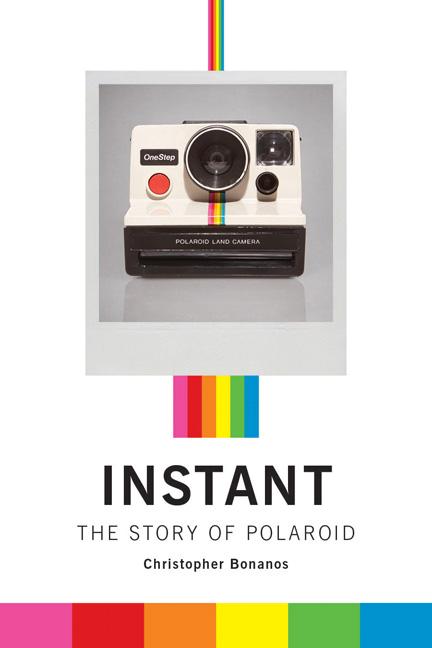
Instant: The Story of Polaroid

Led by the visionary Edwin Land, Polaroid grew from a 1937 garage start-up into a billion-dollar pop-culture phenomenon. Instant by New York magazine editor Christopher Bonanos tells the story of Land’s unique invention, Polaroid’s first instant camera, its meteoric rise in popularity and adoption by artists such as Andy Warhol, and the company’s eventual decline into bankruptcy and its unlikely resurrection in the digital age:

(I should, of course, make clear that as much as I am fascinated by Polaroid cameras, Instant is published by Princeton Architectural Press, who are also distributed in Canada by my employer Raincoast Books. But while I am on the shill, I might as well mention Balthazar Korab: Architect of Photography another P A Press titlewhich was published this earlier month. Korab was Eero Saarinen’s on-staff photographer. Fast Company has a slideshow of some of the stunning images from the book. You should take a look).

Comments closed

Midweek Miscellany

Paul Gravett on piecing together the early history of comics:

You’d think by now that the history of a medium as global and influential as comics would be fully researched and written, but this is not the case. In contrast to the more varied and international perspectives available on film or literature, the majority of English-language reference books on comics plough through the well-worn furrows of the 20th century American newspaper strip and comic book, re-affirming old “truths” and historical “facts”. Objectivity and lack of bias are practically impossible, because by putting into print your history, your version of the “facts,” your inclusions and omissions determine who and what are significant. In the process, almost inevitably, supposedly “minor” or “peripheral” figures and events can be overlooked.

Wading Through the Rubbish — Boyd Tonkin, literary editor for The Independent, on the need for taste-makers:

a healthy publishing landscape… should still leave room for strong-minded indies who publish a few books a year simply because a couple of committed individuals love them. Whether one mind or many makes the choice, what matters is that they pick the brightest and boldest in their field rather than drift with the current and follow the herd. This isn’t “elitism” but exactly the contrary: a respect for your readers, and a determination that they should not have to waste time by wading through industrial volumes of rubbish.

And finally…

Dead Oxonians — Adrian Wooldridge on the posthumous publishing careers of political philosopher Isaiah Berlin and historian Hugh Trevor-Roper, for Intelligent Life:

[The] mix of worldliness and unworldliness—familiarity with affairs of state coupled with philosophical detachment—holds the key to the continued appeal of both men. They chose to address big subjects rather than solve academic crossword puzzles. They wrote for the educated public, not just cloistered scholars. Berlin produced a stream of essays on great political thinkers ranging from German nationalists to Russian novelists. Trevor-Roper roamed across the centuries: though his first love was the 17th century, he also wrote about Hitler’s Germany, the rise of medieval Europe, and, in one of his liveliest books, an Edwardian fantasist, forger and sex maniac, Sir Edmund Backhouse.


Comments closed

Something for the Weekend

Short and sweet today…

“All they do is show you’ve been to college” — Ben Dolnick on his love of the semicolon, at the New York Times:

And so, far from being pretentious, semicolons can be positively democratic. To use a semicolon properly can be an act of faith. It’s a way of saying to the reader, who is already holding one bag of groceries, here, I know it’s a lot, but can you take another? And then (in the case of William James) another? And another? And one more? Which sounds, of course, dreadful, and like just the sort of discourtesy a writer ought strenuously to avoid. But the truth is that there can be something wonderful in being festooned in carefully balanced bags; there’s a kind of exquisite tension, a feeling of delicious responsibility, in being so loaded up that you seem to have half a grocery store suspended from your body.

(You’ve surely read this by now, but…) Also in the NYT Tim Kreider on the ‘Busy’ trap:

Busyness serves as a kind of existential reassurance, a hedge against emptiness; obviously your life cannot possibly be silly or trivial or meaningless if you are so busy, completely booked, in demand every hour of the day… More and more people in this country no longer make or do anything tangible; if your job wasn’t performed by a cat or a boa constrictor in a Richard Scarry book I’m not sure I believe it’s necessary. I can’t help but wonder whether all this histrionic exhaustion isn’t a way of covering up the fact that most of what we do doesn’t matter.

And finally…

Busted — Leah Price, author of How to Do Things with Books in Victorian Britain, on the history of reading at The Browser:

Ernest Hemingway had this to say about James Joyce: “I like him very much as a friend and think no one can write better, technically. I learned much from him.” But if you look at Hemingway’s copy of Ulysses, which is kept today in a library in Boston, you see that the first and last pages are the only ones that have been cut. So you can’t always trust people to tell the truth about their own reading. What makes it fascinating and also frustrating to study is that reading is one of the most private things we do.

1 Comment

Midweek Miscellany

City Air Sets You Free — Mark Lamster interviews P.D. Smith about his new book City: A Guidebook for the Urban Age, for Design Observer:

It was never my intention to write an architectural history. Cities are much more than the sum of their architecture or infrastructure. A city is made great by its people. Nevertheless, you cannot ignore the structures and spaces of a city. Winston Churchill once famously said: “We shape our buildings and afterwards our buildings shape us.” Our urban environments undoubtedly shape us as people. That’s why between each of the eight sections in the book there are essays on more concrete features of the urban landscape, such as the Central Station, the City Wall, the Skyscraper or even the Ruins. But I hope that even here I don’t lose sight of the people who use these architectural spaces. After all, they are the life-blood of the city.

Pop Detritus — Peter Paphides reviews When Ziggy Played Guitar by Dylan Jones, for The Observer:

For many critics, Ziggy was the last desperate act of a craven opportunist. A New Yorker writer flown to see the Ziggy shows fretted that “Bowie doesn’t seem quite real”. But, as long as music journalism has existed, performers – be it Bowie in 1972 or Lana Del Rey in 2012 – have been docked points for their apparent lack of authenticity.

And, besides, it was those very notions of authenticity with which Bowie was playing when he created Ziggy. After several hapless reinventions, the only hit he had to show for his efforts was Space Oddity, but, as Jones points out, Ziggy Stardust was the result of a decade spent sifting through pop cultural detritus and working out which bits he could use to turn him into a pop star.

Don’t Believe the Type — Estimable Jon Gray on the recently revealed cover design for J.K. Rowling’s new novel:

JD Salinger famously had a clause written into his contract stating that no imagery could appear on his covers. Günter Grass will only allow his own drawings. The classic orange Penguins, the poetry covers of Faber: they tell us nothing other than this is a book of note, a book of importance. JK Rowling’s name is the important piece of information, the quality assurance mark, and it is stated very simply and boldly in the brightest and clearest way possible.

(Needless to say, Jon’s thoughts are more interesting that the cover itself).

Material World — An interview with mighty Coralie Bickford-Smith:

I always start by asking myself ‘what is the most effective set of book covers I can produce using just standard materials which are simple but incredibly effective to be within the usual budget constraints?’ To marry design with materials in the most considered and best way possible. So in a way it always starts with the materials so I can make my design suit that method of printing. With the cloth classics its was all about creating a book that would be loved and cherished and not throw away. The materials were the starting point. The foiling was a real struggle at first, the detail of the design cant be too intricate. So the patterns were all designed with this in mind so that the printers could reproduce the design easily. Every material has its limits and its all about getting to grips with those limits to produce an end product that looks effortless and deceptively simple.

My interview with Coralie is here.

And finally…

The Long History of the Espresso Machine

In the 19th century, coffee was a huge business in Europe with cafes flourishing across the continent. But coffee brewing was a slow process and, as is still the case today, customers often had to wait for their brew. Seeing an opportunity, inventors across Europe began to explore ways of using steam machines to reduce brewing time – this was, after all, the age of steam. Though there were surely innumerable patents and prototypes, the invention of the machine and the method that would lead to espresso is usually attributed to Angelo Moriondo of Turin, Italy, who was granted a patent in 1884 for “new steam machinery for the economic and instantaneous confection of coffee beverage.”

Great stuff… (see also: The Once and Future Coffeehouses of Vienna)

Comments closed

Midweek Miscellany

I really enjoyed Naïve: Modernism and Folklore in Contemporary Graphic Design, so I really think I have to pick up  Echoes of the Future: Rational Graphic Design and Illustration, also published by Gestalten. A “compilation of recent graphic design and illustration that is inspired by our collective visual memory”,  the book includes work by Gianmarco Magnani, AKA Silence Television, who (calling all enterprising art directors) ought to be doing book covers (if he isn’t already):

But moving on…

“The only thing left on the high street that doesn’t want either your soul or your wallet” — Zadie Smith on libraries at the NYRB:

What kind of a problem is a library? It’s clear that for many people it is not a problem at all, only a kind of obsolescence. At the extreme pole of this view is the technocrat’s total faith: with every book in the world online, what need could there be for the physical reality? This kind of argument thinks of the library as a function rather than a plurality of individual spaces. But each library is a different kind of problem and “the Internet” is no more a solution for all of them than it is their universal death knell.

And on a sort of related note…

The Disease-Carrying Book — John Sutherland reviews How To Do Things With Books in Victorian Britain by Leah Price for the Literary Review:

The public library, introduced in Manchester with much municipal self-congratulation in the early 1850s, was ‘free’, unlike ‘leviathan’ circulating libraries such as Mudie’s and W H Smith’s that catered to the middle classes. The lower classes lick their index fingers to turn the page. A quaint ‘fumigator’ in which Victorian public libraries could decontaminate their stock is illustrated in Leah Price’s discussion of the disease-carrying book. Victorians were wedded to the ‘miasmic’ theory of disease. Yet it wasn’t air but spittle that was the vector of the dreaded consumption.

Reality is Elsewhere — Steve Wasserman on Amazon at The Nation:

For many of us, the notion that bricks-and-mortar bookstores might one day disappear was unthinkable. Jason Epstein put it best in Book Business, his incisive 2001 book on publishing’s past, present and future, when he offered what now looks to be, given his characteristic unsentimental sobriety, an atypical dollop of unwarranted optimism: “A civilization without retail bookstores is unimaginable. Like shrines and other sacred meeting places, bookstores are essential artifacts of human nature. The feel of a book taken from the shelf and held in the hand is a magical experience, linking writer to reader.” That sentiment is likely to strike today’s younger readers as nostalgia bordering on fetish. Reality is elsewhere.

Also at The Nation Michael Naumann on Germany’s bookstores and literary culture:

Since the late 1840s in Germany, the ambiguous character of books—simultaneously a commodity and a cultural work—has defined internal discussions in the publishing business. Putting aside the implicit hubris of German nationalism, the country’s self-aggrandizement as a veritable Kulturnation, the fact remains that in Germany the cultural definition of the “book” as a major source of intellectual, scientific, economic and aesthetic self-improvement has carried the day over the capitalist notion that a book is a commodity and therefore deserving of no special considerations. The book as such is sacred. One does not throw books away.

And finally…

The Graphic Modern: USA, Italy and Switzerland 1934–66 exhibition curated by Patricia Belen and Greg D’Onofrio of Kind Co. is on display at Fordham University at Lincoln Center, should you happen to be in New York between now and July 26th.

Comments closed

Design Matters with Steven Heller

In a fascinating and wide-ranging conversation, design historian Steven Heller talks about design and his recent book 100 Ideas That Changed Graphic Design with Debbie Millman on Design Matters:

Design Matters: Steven Heller mp3

Heller really is an astonishingly prolific author.

(Full disclosure: 100 Ideas That Changed Graphic Design is published by Laurence King and is distributed in Canada by my employer Raincoast Books)

Comments closed

Midweek Miscellany

The Forger — Tom McCarthy (whose novel Men in Space has finally been published by Vintage in the US) at Interview Magazine.

People in Business — An interview with Dennis Johnson, publisher of Melville House, at The Economist:

I think it’s very obvious to people that we care about the packaging of our books. I think people know that if we care about the outside of our books then we probably care about the inside of them, too. I recently read a survey that said 39% or 40% of people who bought books on Amazon looked at them in a bookstore first. They could know everything about the book online short of having seen it, but still the physical object had enough meaning to them to want to see it first. That resonates, happily, with the fact that Valerie [Merians] and I came into this not as publishers but as artists. The object means a lot to us.

Parallels — Authors Geoff Dyer (Zona) and John Jeremiah Sullivan (Pulphead) in conversation at Work in Progress.

And finally…

Britain’s Original Information Revolution — Adam Nicolson, author of The Gentry, on a collection of English books dating back to the 17th century:

 We may think we are in the middle of a communications revolution: Flickr, Twitter, Facebook, YouTube, Hulu, iTunes… But all of them are, in their ways, secondary phenomena. Some of them are image-based, post-literate, but none would work without the foundations of a much deeper communications revolution which swept across Europe 400 years ago.

The 17th century is when the Europeans started to write: letters, diaries, journals, notebooks, account books, commonplace books, business correspondence, pamphlets, posters, chapbooks, newspapers. It was the first communications revolution, which both spawned and reflected the most revolutionary century we have ever had.

Comments closed

TED Talks: Neil MacGregor

Neil MacGregor, Director of the British Museum and author of A History of the World in 100 Objects, traces 2600 years of Middle Eastern history through a single object:

Comments closed

Something for the Weekend

James Victore shares his workspace with From The Desk Of.

Burn Unit — At the New York Times ‘Bits’ blog, David Streitfeld writes on Amazon’s recent image problems:

[Take] the cover of Bloomberg Businessweek two weeks ago. It shows a book in flames with the headline, “Amazon wants to burn the book business.” What was remarkable was not just the overt Nazi iconography but the fact that it did not cause any particular uproar. In the struggle over the future of intellectual commerce in the United States, apparently even evocations of Joseph Goebbels and the Brown Shirts are considered fair game.

Witheringly Obscure — Wired Magazine talks to William Gibson about Distrust That Particular Flavor and collecting antique watches:

[It] was really about pursuing a totally unnecessary and gratuitous body of really, really esoteric knowledge. It wasn’t about accumulating a bunch of objects. It was about getting into something utterly, witheringly obscure, but getting into it at the level of, like, an extreme sport. I met some extraordinarily weird people. I met guys who could say, “Well, I’ve got this really rare watch, and it’s missing this little piece. Where might I find one?” Then the guy would kind of stare into space for a while, and then he’d say this address in Cairo, and he’d say, “It’s in the back room. The guy’s name is Alif, and he won’t sell, but he would trade it to you if you had this or this.” And it wasn’t bullshit. It was kind of like a magical universe. It was very interesting. But once I’d gotten that far … I got to a certain point, and there was just nowhere else to go with it. The journey was complete.

Magic Journalism — Writer Geoff Dyer chooses five unusual histories for The Browser:

[T]ypically, I guess, you read history books for the content – that sounds an unbelievably stupid comment – and you’re drawn to certain works of history rather than others because you’re interested in the period. You read Stalingrad by Antony Beevor because you’re interested in the Second World War, or Russia or whatever. Whereas it seemed to me that the thing about these books was that you might be interested in the subject, but it’s the way that the subject is dealt with that is the distinguishing feature of each one.

And finally…

A long article for Intelligent Life  on ceramicist Edmund de Waal and the double-edged success of his memoir The Hare with Amber Eyes:

In the 18 months since the book came out, de Waal has completed six overseas book tours, given dozens of talks, answered hundreds if not thousands of questions. He has also kept his porcelain-making studio busy and has plans for a subsequent book, about the history of porcelain around the world, which will take him from 18th-century Plymouth to the hillsides outside Jingdezhen where porcelain was first made in China, via Dresden, Marco Polo’s Venice, Istanbul and Yemen. “Porcelain”, he says, “is light when most things are heavy. It rings clear when you tap it. You can see the sunlight shine through. It is in the category of materials that turn objects into something else. It is alchemy. Porcelain starts elsewhere, takes you elsewhere. Who could not be obsessed?”

Comments closed

Stéphane Hessel | The Current

Ninety-Four year-old resistance fighter, concentration camp survivor and former UN speechwriter Stéphane Hessel talks to Anna Maria Tremonti about human rights and his bestselling book Time for Outrage! on CBC Radio’s The Current:

CBC RADIO THE CURRENT: Resistance Fighter Stephane Hessel

Comments closed