
The Economist’s international editor, Edward Lucas, discusses the work of Vasily Grossman and the BBC adaptation of his novel Life and Fate:
The Economist: The Beauty and Horror of War
The Economist reviews the BBC adaptation here.
Comments closedBooks, Design and Culture
The Economist’s international editor, Edward Lucas, discusses the work of Vasily Grossman and the BBC adaptation of his novel Life and Fate:
The Economist: The Beauty and Horror of War
The Economist reviews the BBC adaptation here.
Comments closed
Writer and music critic Tom Piazza discusses his new collection of essays, Devil Sent the Rain: Music and Writing in Desperate America, on NPR’s Weekend Edition:
NPR WEEKEND EDITION: Tom Piazza Devil Sent the Rain mp3
(via Largehearted Boy)
Comments closed Continuing today’s theme of being late to everything, I just finished reading Moving Pictures by Kathryn and Stuart Immonen.
Published in 2010 by Top Shelf, the book was heralded on a lot of best of the year lists and it’s been sitting in my ‘to read’ pile for months.
I’m sorry I waited so long. It is wonderful…
Dave Howard interviewed Kathryn and Stuart Immonen about the book for The Torontoist last year.
1 Comment
Terry O’Reilly’s radio show Age of Persuasion is always a fascinating half-hour of social history regardless of whether you are interested in advertising or not.
In this recent episode, O’Reilly looks at the great women of the advertising world, including the first advertising woman ever, the woman who created the first images of wives as “Happy Homemakers”, the woman who revolutionized the retail business, and the female creative director who inspired the “I Love New York” campaign.
Comments closed
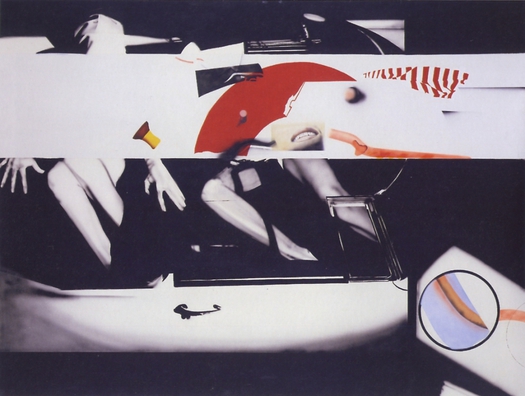
The Analytical Eye — Rick Poyner’s second essay for Design Observer on the visual interpretation of J.G. Ballard examines the work of French artist Peter Klasen:
What both Ballard and Klasen share… is a cold, appraising, analytical eye. It’s impossible to tell how they feel about what they show, or to know what they want us to feel, if anything at all. Their findings are disturbing and perhaps even repellent from a humanist perspective, yet the new aesthetic forms they use to embody them are, even today, exciting, provocative and tantalizingly difficult to resolve.
Any Colour — So Long As It Is Black — The WSJ profiles Massimo Vignelli:
“The greatest design has to provide a little pleasure,” he explained, producing the straightforward black bag he carries; Mr. Vignelli wears nothing but black. Proudly reporting that he’d bought the bag from a local street vendor, he pulled out a black Leica camera…, a pair of black Ray Bans and a tape measure—alas, bright yellow, not black.
“This is my dictionary,” Mr. Vignelli said of the tape measure. He explained that even as a child he had such fascination with the dimensions of things that he would challenge his friends to guess their size. He believes that subtleties of shape conjure emotion. “Is that three centimeters or four centimeters?”
All Forest, No Trees — David L. Ulin reviews The Information by James Gleick for The LA Times:
Over the course of human culture, there have been a number of significant transformations, beginning with the alphabet, which Gleick calls “a founding technology of information. The telephone, the fax machine, the calculator, and, ultimately, the computer are only the latest innovations devised for saving, manipulating, and communicating knowledge.” It is his idea that all these technologies exist as part of a continuum, with each developing from the last.
The key to such an argument is perspective, which is often in short supply when it comes to the information culture, with its tendency to inspire either paeans or jeremiads. Gleick, however, is too smart for that; he’s all about the forest, not the trees.
And finally…
Breaking Machines — Richard Conniff, author of The Species Seekers, on what the Luddites really fought against:
Comments closedDespite their modern reputation, the original Luddites were neither opposed to technology nor inept at using it. Many were highly skilled machine operators in the textile industry. Nor was the technology they attacked particularly new. Moreover, the idea of smashing machines as a form of industrial protest did not begin or end with them. In truth, the secret of their enduring reputation depends less on what they did than on the name under which they did it. You could say they were good at branding.
Earlier this week I posted the 1947 documentary Making Books. As follow up, here’s the 1961 documentary Bookbinders from the AFL-CIO series “Americans at Work”:
1 CommentHere’s a fascinating 1947 documentary produced by Encyclopedia Britannica Films about the mass production of books:
(via Brain Pickings)
1 Comment
The Hare with Amber Eyes: A Hidden Inheritance, Edmund de Waal’s memoir about his extraordinary Jewish family and an inherited collection of ornamental Japanese carvings called netsuke, was on many of last year’s “best-of” lists and is high on my current ‘to-read’ list. The author talks about the book with Eleanor Wachtel on CBC Radio’s Writers & Company:
CBC Radio Writer’s & Co: Edmund de Waal Mp3
Edmund de Waal, who is also a successful ceramicist, is also profiled in The Guardian:
Comments closedDe Waal and his netsuke have been much discussed over the past seven or eight months, but even now he is “completely taken aback” by the success of a book which is an “odd matrix of personal obsessions”. (We talk in the upstairs room of his south London studio – downstairs are three kilns, his wheel and a bag of clay, ready for him to get to work in the afternoon.) Yet that it is so personal and springs from these obsessions (Japan, objects, memory), drawing on his expertise as a potter, is surely a clue to its enormous appeal. How things are made and handled, he writes, and what happens to them “has been central to my life for more than 30 years”.

Steven Heller, editor of I Heart Design and author/editor of countless other books about design, at 10 Answers.
And Steven Heller is one of the designers featured in BBC Radio documentary I Heart Milton Glaser about the iconic I (Heart) NY logo and the designer who created it (go listen now because it’s only available for a few more days).
Print and the City –a fascinating look at whether movable type printing presses were the drivers of economic growth in cities by Jeremiah Dittmar (via The Browser):
[C]ities in which printing presses were established 1450-1500 had no prior growth advantage, but subsequently grew far faster than similar cities without printing presses… Cities that adopted print media benefitted from positive spillovers in human capital accumulation and technological change broadly defined. These spillovers exerted an upward pressure on the returns to labour, made cities culturally dynamic, and attracted migrants.
In the pre-industrial era, commerce was a more important source of urban wealth and income than tradable industrial production. Print media played a key role in the development of skills that were valuable to merchants. Following the invention printing, European presses produced a stream of math textbooks used by students preparing for careers in business.
The Savage Marketplace — A really interesting and thoughtful survey of the current state of book editing in the UK by Alex Clark , with contributions from Diana Athill, Blake Morrison, Jeannette Winterson and others, for The Guardian:
[W]hat saps the spirit are the manuscripts that leave you with the question: why did no one sit down with the writer and point out where this isn’t working? Why didn’t a red pen mark the hackneyed phrase, or the stock character, or the creaky dialogue? And, sometimes, why didn’t someone deliver the unfortunate verdict: this simply isn’t ready yet, and may never be?
And finally, if you’re in London… Kemistry Gallery have an exhibition of film posters by Saul Bass from the BFI archive, February 17th to March 17th:

 Jardin de la Connaissance — Berlin-based landscape architect Thilo Folkerts and artist Rodney Latourelle used 40,000 reclaimed books to create a ‘Garden of Knowledge’ for the 11th International Garden Festival in Grand-Métis, Quebec (via Kitsune Noir).
A History of Print Culture — Assistant Professor of Media Culture, C.W. Anderson, provides his annotated syllabus for a print history course at CUNY in The Atlantic (thx Jamie):
The primary goal of this class is to teach students about the culture of “print media” in an era when that culture is being joined (and in some cases, overtaken) by a culture that we might variously call digital culture, online culture, or the culture of the web. What does “print” mean in our digital age? And what does “culture,” mean, for that matter? By culture I mean something that is not reducible to “economics,” “technology,” “politics,” or “organizations” — although culture emerges out of the nexus of these different factors, and others. In other words, I want to disabuse my students of the notion that new technologies or new economic arrangements can create digital or print culture in the same way that a cue ball hits a billiard ball on a pool table.
Also in The Atlantic… 10 Reading Revolutions Before E-Books by Timothy Carmody.
Knowledgeable Criticism — An interesting interview with Fred Brooks, computer scientist and author of The Mythical Man-Month, for Wired magazine:
Great design does not come from great processes; it comes from great designers… The critical thing about the design process is to identify your scarcest resource. Despite what you may think, that very often is not money.
And finally…
When You Don’t Know You Are Breaking the Rules… Eli Horowitz, managing editor of McSweeney’s, interviewed for Scotland on Sunday (via the indefatigable Largehearted Boy):
Comments closedAt the heart of McSweeney’s success is the huge amount of care and attention which goes into producing each book, ensuring that the jacket design and layout complement the words inside the covers. Though Horowitz believes there is a McSweeney’s aesthetic he is struggling to put into words what it is. “There’s a notion of old-fashioned story-telling and a compelling plot combined with an innovative literary impulse – when we’ve had those ingredients that’s when we’ve done our best works.”
 Psycho Cover — Penguin art director Paul Buckley discusses his new book Penguin 75 with Imprint:
I am very aware of how much product gets put out there that is completely unnecessary, be it music, movies, books, whatever—it seems that for every good piece of culture we experience, we are bombarded with 99 pieces of redundant crap. I’ve been in the industry for awhile, and of course want to show off the great work we do here, but was not going to put out yet another design book and take your money—you can get that in any annual. To me, often more interesting than the covers are the stories, the psychology that created all the variables that led to this cover over the 20 other proposed covers.
Paul has recently updated his Flickr with new covers from the Penguin Ink series, which utilizes art by tattoo artists, as well as the latest additions to the excellent Penguin Graphic Classics series, which have art by contemporary cartoonists.
My interview with Paul and Penguin 75 designer Christopher Brand is here.

Also at Imprint… Thurston Moore of Sonic Youth and book editor Eva Prinz (formerly of Abrams and Rizzoli) talk about their new publishing venture Ecstatic Peace Library.
Writing on the Wall — Andrew Franklin, publisher and managing director of Profile Books, offers an overview of the current state of the book business in the UK (via Dan Mogford):
Bookshops enliven high streets, create communities of readers and stage author events, while good booksellers encourage reading and shape taste. For most readers, browsing is a key part of deciding what to read, and publishers put huge effort into packaging and presenting their books. Of course many of these activities can migrate online with Facebook groups, online forums, feeds and websites helping to steer readers to the books they will most enjoy. For some online shoppers bookshops are part of this process: they browse in bookshops, write shopping lists and then buy (perhaps more cheaply) online. But no bookshop can be in business as a shop window for other retailers. You don’t have to be hopelessly nostalgic or sentimental to believe something very precious is lost with every bookshop that closes.
And at the other of the spectrum…
Another Reading Revolution — Historian Andrew Pettegree talks about his new book The Book in the Renaissance with The Atlantic (via Shelf Awareness):
Comments closedThe situation really is that the first generation of printers, encouraged by scholars, naturally produced the sort of books these people wanted. But it’s hard to apply this sort of commercial model—this small, bespoke model used for manuscripts—to a new process that produces 300 or more identical items. The irony is that there were plenty of other readers out there. The first printers ignored the groups that we might call pragmatic readers. Literacy was already widely-disseminated in the fifteenth century. There were lots of people who could read but did not habitually buy books, so the trick was to discover how to reach them.
