Skip to content

Tag: history

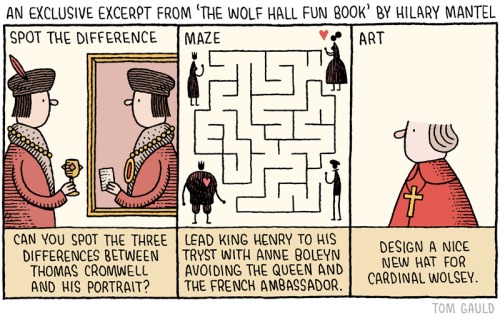
The Wolf Hall Fun Book

wolf-hall-fun-book

Tom Gauld.

Comments closed

Hilary Mantel: Speaking with the Dead

I’m finally, finally reading Wolf Hall (I know, I know…). It is excellent of course, and I’m looking forward to reading Hilary Mantel’s new collection of stories The Assassination of Margaret Thatcher just as soon as I’ve finished it (and Bring Up the Bodies). Mantel was recently profiled by Olivia Laing, author of A Trip to Echo Spring (one of my favourite books of the year), for the November issue of Elle magazine:

there’s an unmistakably eerie element to what Mantel does: a summoning of and speaking with the dead. Although she insists that she has “a very constrained imagination” and is happiest working within a scaffolding of fact, she is nonetheless adept at the act of mediumship that fiction requires. More than any other historical novelist I can think of, she also has a knack for conveying the slipperiness of time, the way it sloshes backward and forward, changing even as you watch. “History and memory is the theme,” she agrees, “how experience is transmuted into history, and how memory goes to work and works it over. It’s the impurity, the flawed nature of history, its transience—that’s really what fascinates me.”

Comments closed

The Chelsea Hotel: Dream Palace or Trauma Ward?

Peter Conrad reviews Inside the Dream Palace: The Life and Times of New York’s Legendary Chelsea Hotel by Sherill Tippins for The Observer:

In the seething, druggy summer of 1969, a room in the Chelsea hotel gave me my first view of New York. The establishment – a Queen Anne folly with a rooftop pyramid on West 23rd Street, opened in 1884 – was not quite the dream palace of Sherill Tippins’s title: it struck me more as a trauma ward. Pimps and pushers loitered in the lobby; a transvestite dispensed room keys behind a shield of bulletproof glass; a trip upstairs in the elevator could get you high in more ways than one, given the captive cloud of pot fumes in the clanking box. The marble stairwell resounded to the ululations of resident rock bands, and once in a corridor I collided with shaggy Janis Joplin, awash in a swill of Librium, tranquillisers and heroin topped up by Southern Comfort, as she staggered towards the overdose that killed her a year later. I had never felt so grubby, so at risk, or so excited.

Comments closed

Tove Jansson and the Postwar World

James Lovegrove reviews Tove Jansson, Life, Art, Words by Boel Westin, the first authorised biography of artist and writer, and Jansson’s own childhood memoir, Sculptor’s Daughter, first published in 1968 and now available in English for the first time, for The Financial Times:

The stories have… exerted an influence on many modern writers, for adults as well as children. Ali Smith, Jeanette Winterson and Maggie O’Farrell are self-professed Moomin fans. Philip Pullman has called Jansson a “genius”, while Frank Cottrell Boyce drew important life lessons from the Moomins at an impressionable age. “Jansson valorised coffee and pancakes and reticence and the mystery of others,” he wrote in a review of Moomin picture book The Dangerous Journey. “But more to the point she showed me how it might be just those small pleasures that keep us together when we start to grow apart.”

The young Boyce, however, was also drawn to the Moomins because he sensed an existential darkness at the heart of the books. Jansson wrote in the dominant mode of 20th-century children’s literature, fantasy, but hers was fantasy shot through with a quiet anguish. Apocalypse through natural disaster – flood, volcano, potentially earth-shattering comet – looms in the background of her stories. Characters are solitary, lonely, sometimes on the brink of despair, and acknowledge the fragility of things with an accommodating liberal shrug.

Kate Kellaway also reviews both books for The Observer:

[T]he greatest revelation, reading the memoir, is that what drove Jansson’s imagination was fear. This is a book of perils. The dark is a faceless monster with “distinct hands”. Snow is like “grey hands with a hundred fingers”. An eiderdown behaves like a fist. Ice breathes. Snakes in the carpet are almost real. The words “safety” and “dangerous” repeat themselves. The external world was always an internal landscape for Jansson. Reading her is like a return to childhood: things happen that are inexplicable when adults are in charge. It’s unwise to pretend to know what is coming next. Life, she indicates, is best approached gingerly, with respectful regard.

1 Comment

Society is Nix: The Quotidian Chaos of the Urban Scene

J. Hoberman reviews the oversize comics collection Society is Nix: Gleeful Anarchy at the Dawn of the American Comic Strip, 1895–1915, edited by Peter Maresca and published by Sunday Press Books, for the New York Review of Books:

Society is Nix focuses on the depiction of then-contemporary metropolitan life. In addition to Hogan’s Alley and other metropolitan jungles, the comics reveled in the quotidian chaos of the urban scene: the pushcart madness of “Familiar Sights of a Great City—No. 1, The Cop is Coming” is rendered as a mock-classical frieze. Genuine monuments are regarded with derision; several strips in Society is Nix satirize the rapid transit system then under construction in New York. As the twentieth century approached, cartoonists extrapolated a city of the future, replete with snow-capped office buildings, floating real-estate agents, and colliding single-person dirigibles, or ponder “the possibilities of wireless telegraphy” which, save for predicting communication with Mars, seems much like the Internet…

…In his introduction, Maresca refers to these comic strips as “the birth of modern popular culture”—perhaps “mass media” would be a better term. These strips were not only all over the page, they were in big cities all over the country—the most successful supplements reached hundreds of thousands of readers in New York alone. Yet at the same time, they were wildly experimental… [The] first newspaper comic strips were not so much an extension of vaudeville as precursors of the equally déclassé and temperamentally anti-authoritarian motion picture. The early strips thrived on choreographed violence, including runaway horse carts, baroque streetcar collisions, and a panoply of what Hearst might have termed polychromous explosions.

Comments closed

Joe Sacco and Journalism

In this bonus footage from the W.W. Norton’s documentary short on The Great War, Joe Sacco explains his relationship to journalism:

1 Comment

Design is Fine


Design is Fine. History is Mine, an eclectic design history blog compiled by Rea Riegel, a copy writer and lecturer from Germany, is one of my favourite new Tumblrs. Go take a look.

(Pictured above: Pierre Reverdy and Pablo Picasso Le chants des morts, 1948)

2 Comments

Joe Sacco: Putting the Reader in the Picture

Cartoonist Joe Sacco discusses his new illustration/book The Great War in an interview at Salon:

I think every medium has its strengths. But I think illustrated work puts the reader directly into a picture. You open up, let’s say, a comic book, and I’ve drawn a Palestinian refugee camp — you’re inside it, and with the multiple images, you’ll hopefully get an idea of the atmosphere. As a cartoonist, you’re concentrating on giving visual information — especially in the background — that can be conveyed by multiple images. And things follow the reader around. You know, the architecture will follow the reader from one panel to another, so it becomes part of the atmosphere that the reader is imbibing. With the written word, you can describe the architecture, but you’re not going to keep mentioning it as a figure is walking down the street, you’re not going to keep mentioning what the background is. With comics you can do that.

Comments closed

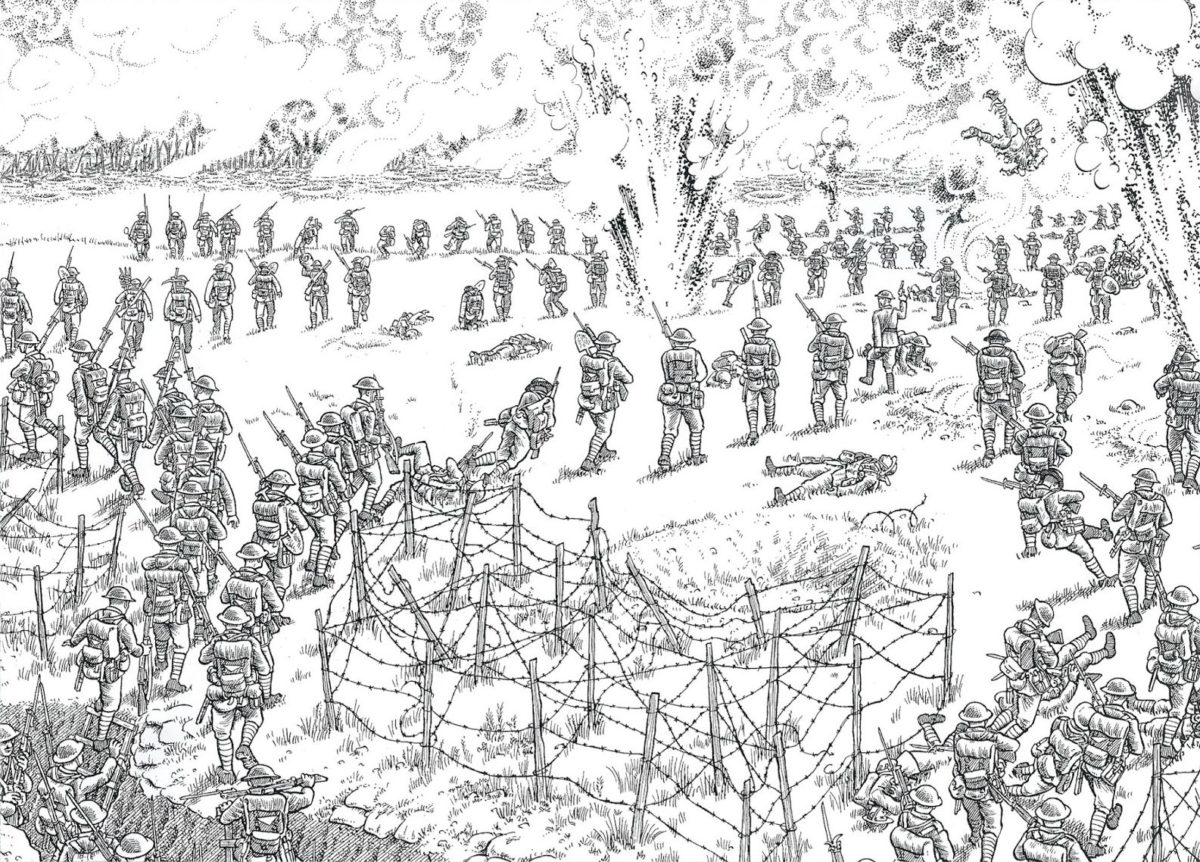
The Great War by Joe Sacco

Joe Sacco talks to The New Yorker about his new accordion book The Great War, which folds out to create a twenty-four-foot-long panorama of the Battle of the Somme:

When we first talked about my drawing a panorama of the Western front, the idea seemed static. But immediately I thought of the Bayeux Tapestry… which has a narrative. William the Conqueror in France is getting ready for the invasion; they’re building the boats; they’re crossing the English Channel; then there’s the Battle of Hastings, and you basically read it left to right. It just came to my mind that I could show soldiers marching up to the front, going to the trenches, going over the top, and then returning after they’ve been wounded, back through the lines to the casualty-clearing station behind the front. So it seemed like a very simple idea, and to be honest, I just wanted to draw. On a visceral level, it was just a pleasure to think only in terms of drawing.

It was a relief not to think about words, and to do a different kind of research. I did a lot of image research and I actually had to read a lot of books, because sometimes prose takes you where photography never went. I would read and get images in my head, and it was just a matter of putting them down. I’ve spent a lot of time doing journalism, and I still am interested in it, but I think the artist side of me wants to sort of come out now. And that’s what the Great War was to me, letting myself go in that direction.

Sacco talks more about the work in this video for publisher W. W. Norton:

1 Comment

Graphic Horrors

I missed this during Banned Books Week, but with Halloween and Bonfire Night around the corner, it still seems somewhat timely…

At Print magazine Michael Dooley looks back at the comic books featured in Fredric Wertham’s infamous 1954 book The Seduction of the Innocent: The Influence of Comic Books on Today’s Youth.

Part one deals with “subliminal nudity, women’s ‘headlights,’ and the fascism and homosexuality of DC superheroes.” Part two, as Dooley gleefully notes, delivers “pages of eye injuries, Nazi vampires and teenage dope fiends.”

Dooley makes it clear he wants to “bury Dr. Fredric Wertham,” so don’t expect a lot of context (if you want more to read more about it, pick up The Ten Cent Plague by David Hadju), but hell, it’s fun anyway.

‘An Uncensored Look at Banned Comics’, a full-length story on banned comics, will appear in Print‘s February 2014 issue.

Comments closed

Something for the Weekend

Excitingly Wrong — An interview with Peter Mendelsund at Porter Square Books:

I am always interested by anything graphical that strikes me as (this is difficult to put into words) excitingly wrong. There is a cool-factor to certain images that lie just on this side of disagreeable…pictorial effects that make me think “this will bother a lot of unimaginative people.” Whenever I see something like that, a piece of art or graphic design that has that special kind of wrongness about it, I think “I need to do something like this myself.” Attendant to this is always the feeling of “in the future, this will be done a lot.” In other words, today’s ugly is tomorrow’s beautiful.

Lurking Menace — Ostensibly reviewing David Bowie Is, the catalogue for the current V & A exhibition, and Bowie’s new album, The Next Day, Ian Buruma looks back at the performer’s career at the NYRB:

[Bowie] drew his inspiration from anything that happened to catch his fancy: Christopher Isherwood’s Berlin of the 1930s, Hollywood divas of the 1940s, Kabuki theater, William Burroughs, English mummers, Jean Cocteau, Andy Warhol, French chansons, Buñuel’s surrealism, and Stanley Kubrick’s movies, especially A Clockwork Orange, whose mixture of high culture, science fiction, and lurking menace suited Bowie to the ground. Artists and filmmakers have often created interesting results by refining popular culture into high art. Bowie did the opposite: he would, as he once explained in an interview, plunder high art and take it down to the street; that was his brand of rock-and-roll theater.

This Movie is About Hope — Film Comment has a transcript of Steven Soderbergh’s San Francisco International Film Festival ‘State of Cinema Address’:

 The simplest way that I can describe it is that a movie is something you see, and cinema is something that’s made. It has nothing to do with the captured medium, it doesn’t have anything to do with where the screen is, if it’s in your bedroom, your iPad, it doesn’t even really have to be a movie. It could be a commercial, it could be something on YouTube. Cinema is a specificity of vision. It’s an approach in which everything matters. It’s the polar opposite of generic or arbitrary and the result is as unique as a signature or a fingerprint. It isn’t made by a committee, and it isn’t made by a company, and it isn’t made by the audience. It means that if this filmmaker didn’t do it, it either wouldn’t exist at all, or it wouldn’t exist in anything like this form.

Read the whole thing. It reminded me of William Goldman’s famous comment about Hollywood in Adventures in the Screen Trade: “nobody knows anything.”

See also: At the New York Times film critic A. O. Scott looks at Soderbergh’s ‘Twitter narrativeGlue.

And finally…

Just to the Right of Karl Marx — At the Financial Times, Julia Hobsbawn remembers her father, the historian Eric Hobsbawn:

The cemetery plot, situated as my husband Alaric wryly pointed out later “just to the right of Karl Marx”, had been freshly dug…  My mum Marlene had bought the plot in an expensive and expansive act of love several years earlier. She is 81 and was my father’s unsung muse for 50 years, dealing constantly with demands on his time from students, publishers, editors and broadcasters while acting as his general reader…

My dad was pleased knowing that he would end up there. Highgate Cemetery’s east wing is full of iconoclasts from the intelligentsia. I can picture him, glasses pushed up over his high forehead, peering longsightedly at the guide produced by the Friends of Highgate Cemetery Trust about its history, hoovering up the text and filleting it for us in an exact and pithy way. “Ah yes,” he might say, energised like a freshly charged battery by what he had just read, “you see what is really interesting about this is…”
Comments closed

Midweek Miscellany

Ruined… For Life — Yuka Igarashi on the consequences of copy-editing at Granta:

There is a danger to copy-editing. You start to read in a different way. You start to see the sentence as machinery. You focus on the gears and levers that connect words to one another; you hunt for the wayward semicolon, the unintentionally ambiguous phrase, the clunky repeated word. You even hope they appear, so you can kill them. You see them when they’re not even there, because you relish slashing your pen across the paper. It gets a little twisted.

As with any kind of technical knowledge or specialization, it is possible to take copy-editing too far, to be ruled by it, to not quite be able to shut it off when it ought to be shut off.

(As if to prove the point, the article itself is copy-edited in the comments)

The Undercoat of Modernity — Mathias Schreiber on Berlin in the ‘Golden Twenties’ for Der Spiegel:

Looking back on the period, playwright Carl Zuckmayer… who lived in Berlin from 1924 to 1933, wrote: “The arts blossomed like a meadow just before being mowed. This explains the tragic yet brilliant charm that is associated with this era, often seen in the images of poets and artists who died prematurely.”

The realization that this euphoria could not last undercoats the best works of art of these years with the metallic tone that soon became the trademark of artistic modernity. This applied, quite literally, to the refined simplicity of the anti-plush, steel-tube furniture of Bauhaus designer Marcel Breuer and the architecture of the same movement, fashioned from strictly functional steel skeletons… Metaphorically speaking, the tendency toward metallic, unadorned expression also applied to the literature of the period, and certainly to the objectivist collage technique employed by Alfred Döblin in his novel “Berlin Alexanderplatz” (1929). Döblin blends together the sound of wind, the rhythmic thud of the steam pile-driver, quotations from newspaper advertisements, stock market reports, soldiers’ songs, nursery rhymes and prostitutes’ patois with expressive, poetic flights of fancy, and injects all of these noises and fragments of language into the protagonist’s stream of consciousness… This first important big-city novel in the German language was also the first great 20th-century novel about the working classes.

And finally…

Purpose in the Wreckage — Simon Hattenstone’s endlessly quotable interview of media-shy musician Scott Walker, for The Guardian:

When [Walker] returned in 1995, it was as a fully fledged modernist composer. On the surface, there couldn’t have been a more unlikely transformation – imagine Andy Williams reinventing himself as Stockhausen. Yet in a way it was all of a piece. His latest album, Bish Bosch, is only his third in 17 years, all of them elaborate, epic and inaccessible. It is a post-apocalyptic opera of sorts, with blasts of rams’ horn, dog barks, scraping swords, machetes. The music nods at Gregorian chant, doffs its cap to Shostakovich, gives a thumbs up to industrial metal, and is uniquely Scott Walker. The lyrics reference sexual disease, brown dwarf stars, court jesters and dictators, all delivered in a strangulated baritone, as if Walker’s testicles were being squeezed. At times there’s a terrible beauty to his poetry (“Earth’s hoary/fontanelle/weeps softly/for a/thumb thrust”) while at others there’s a bloodthirstiness that could be straight out of Jacobean tragedy (“I’ve severed my reeking gonads, fed them to your shrunken face”). It’s brilliant and bonkers. The opposite of a guilty pleasure: a guilty torture.

And why not?

Comments closed