Just to quickly follow up my post about Wes Anderson and The Grand Budapest Hotelearlier this week, there is an interesting interview with art director Adam Stockhausen about working with on the film at The Dissolve:
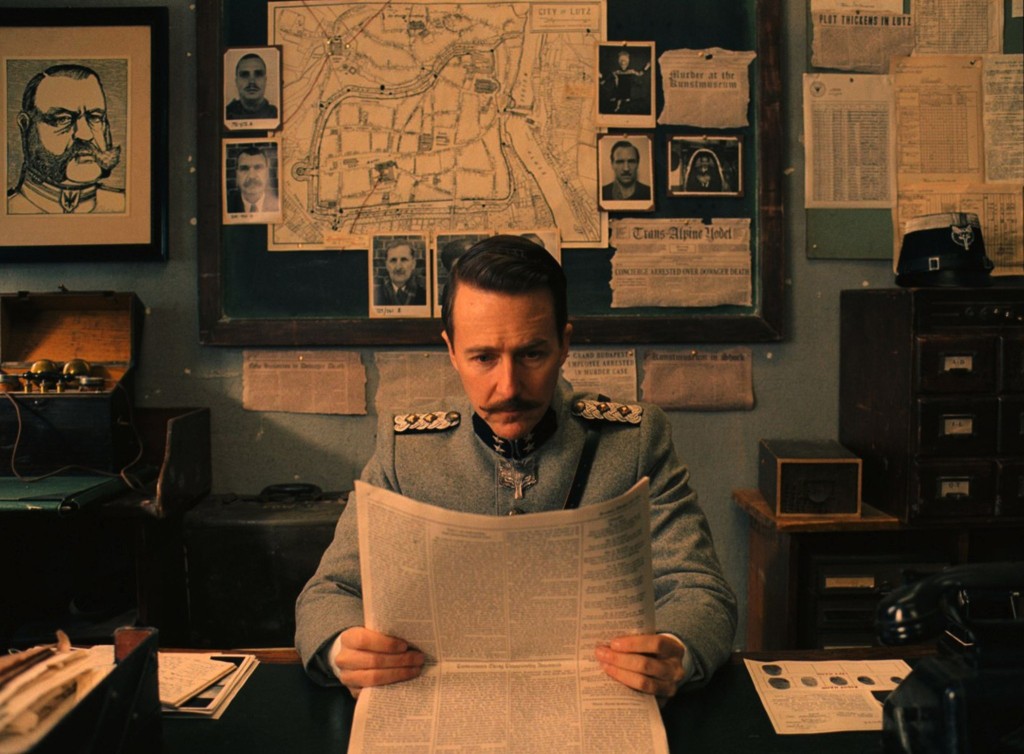
[The references] come from all over the place. They’re very specific, but they can come from any place. They can come from a story, they can come from a painting, they can come from a movie. In this movie, there’s a Bergman film called The Silence, with the boy wandering around the hallways, we modeled our hallways on that. If you look at the hotel doors in that film, ours are a carbon copy. There’s a sequence in a Hitchcock movie called Torn Curtain where he comes out of his hotel and he gets on the bus and he goes to the museum; we have a bit of an homage to that sequence when Deputy Kovacs goes from his office to the art museum and he’s being chased by Willem Dafoe’s character. For the palm court we looked at Rousseau paintings. For the command tent in Moonrise Kingdom, we looked at Churchill’s war room. The references can be very wide, but they’re all pretty different.
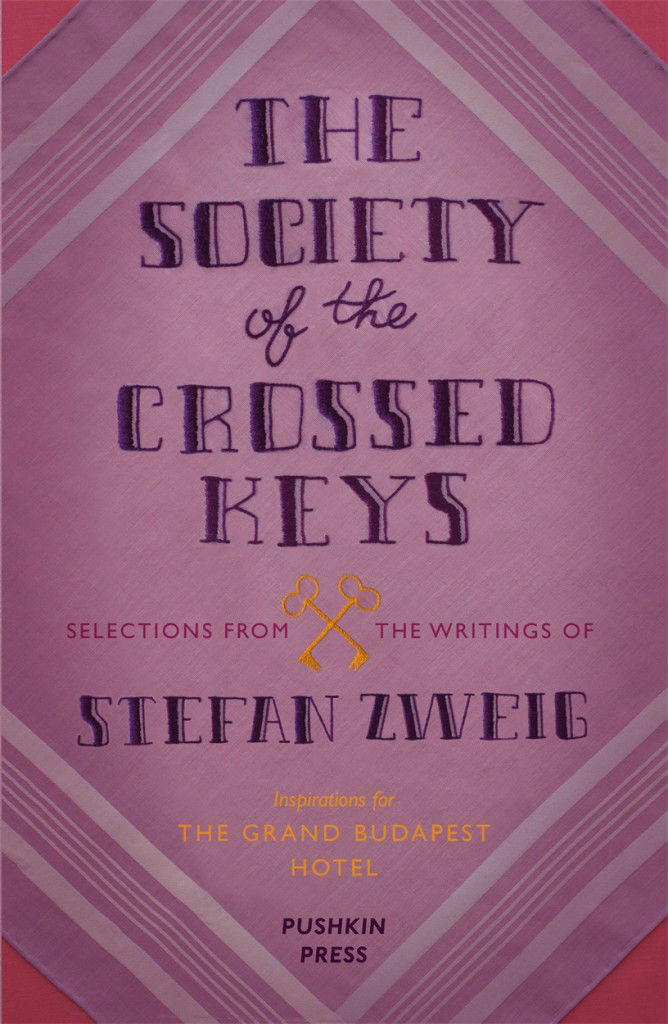
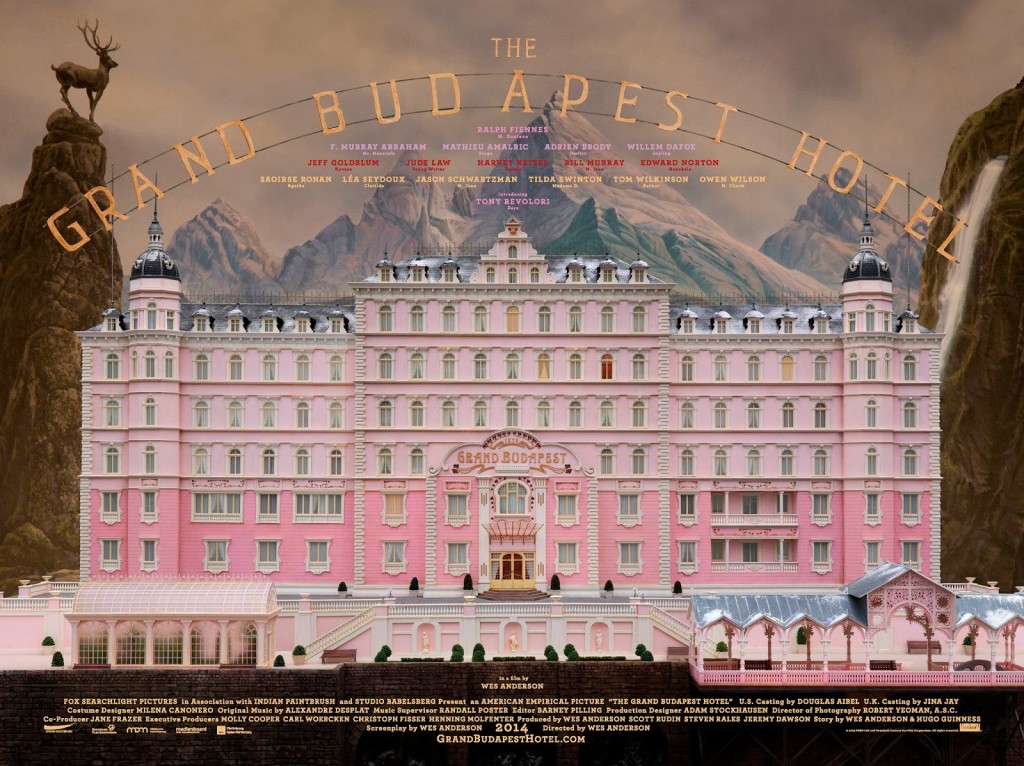
There’s a wonderful photochrom of the hotel that I always thought of as sort of the model for our hotel, which is the Hotel Pupp in Karlovy Vary, which was in Carlsbad. The thing we learned when we visited all sorts of places that we found on this collection of pictures was that none of them were enough like what they once were to work for us. But the photochrom images seemed to tap into a truth about Zweig’s vision of the world that I was able to draw on in developing a visual aura for the film.
In The Post Office Girl, Zweig’s description of the grand hotel in Switzerland is so evocative. The protagonist is a girl who works in the post office. She’s invited to stay in this hotel as a gift from her rich aunt, and when she arrives in this place, the management thinks she’s there to make a delivery. Her suitcase is a basket. Finally they realise she’s actually going to be a guest in the hotel, which is unlike anywhere she’s ever been. Her point of view about this treatment she receives, and her experience of walking in and realising, “This is where I’m going to sleep”, is so powerful. But also that by the time her holiday abruptly ends, she is already addicted to this other way of life, and her existence is so dramatically changed, and a sort of desperation comes over her — and then a connection she makes with someone who is in his own desperate state. The idea of that work being something that had been out of print for that long is sort of surreal.
At a recent event at the New York Public Library, Anderson similarly discussed Zweig’s work with Paul Holdengräber:
The movie itself was reviewed all over place the last week, but I quite enjoyed Richard Brody’s review for The New Yorker:
Perhaps more than ever, Anderson takes a joyful yet aching delight in recreating the styles of bygone days. The hotel is like a majestically confected cake on the outside and a jewel box on the inside, adorned with staff and guests whose uniforms and fashions are nuanced to the buttons, and whose behavior is self-controlled to the glance. Yet also, more than in any of his other films, that very recreation is his subject. “The Grand Budapest Hotel” is about the spiritual heritage and the political force of those long-vanished styles—about the substance of style, not just the style of his Old World characters but also, crucially, Anderson’s own. This isn’t Anderson’s most personal film, in the strict sense, but it is, alongside “The Life Aquatic with Steve Zissou,” his most reflexive one—even more so because the new film exposes the inner workings not just of his practice of filmmaking but of his sensibility.
UPDATE:Creative Review talks to the film’s lead graphic designer Annie Atkins about her work:
We actually used comparatively few typefaces in the movie, as most lettering was created by hand. Wes and Adam had been on location recces all around Eastern Europe and had references of all kinds of hand-made signage from the last 100 years or so. The beautiful thing about period filmmaking is that you’re creating graphic design for a time before graphic designers existed, per sé. It was really the craftsmen who were the designers: the blacksmith designed the lettering in the cast iron gates; the glazier sculpted the lettering in the stained glass; the sign-painter drew the lettering for the shopfronts; the printer chose the type blocks for the stationery…
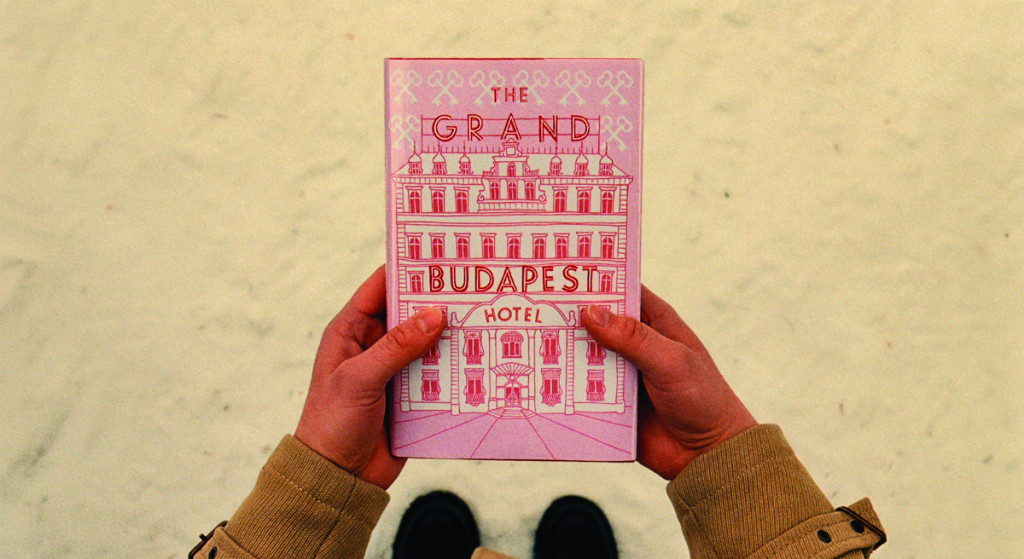
… My absolute favourite piece is the book itself that opens the story. It’s a modern pink hardback with a drawing of the hotel on the front, and the name of the movie as the hotel sign. It’s a relatively simple piece, but it’s really special having a prop that you made with the movie’s name on it like that. I remember Wes had sent me a quick sketch showing his idea for the book, and I really loved being able to help make that work for him. I treasure that piece, actually – we made three for the shoot, in case one got dropped in the snow, and so I brought one home with me.
Way Too Indie explores the visual themes of American film director Wes Anderson:
for all his towering success as an American auteur, the look and feeling behind each Anderson film finds its influences more rooted in foreign cinema. The tracking camera, moving from room to room, examining the bourgeoisie and upper class in the films of Luis Buñuel (e.g. El Angel Exterminador) laid the groundwork for the dolly and tracking shots in Anderson’s Rushmore, The Royal Tenenbaums and early sections of The Life Aquatic with Steve Zissou. The frenetic energy and overall zeal found in François Truffaut’s Jules et Jim serves also as the celluloid backbone of most of Anderson’s works, specifically Bottle Rocket, The Royal Tenenbaums, and Fantastic Mr. Fox. The melancholic swoons of the silver screen’s longing romantics permeate Moonrise Kingdom, Hotel Chevalier/The Darjeeling Limited and in the romance subplot of Bottle Rocket. These films share the same sort of beautiful yet honest moments found in Jean-Luc Godard’s Pierrot Le Fou.
Writing at The Guardian, Michael Newton looks at paranoid fiction and conspiracy on film:
The conspiracy film is not quite a genre. And if conspiracy is simply two or more people engaging in criminal or nefarious plots, the more you think about it, the more any film can start to seem to a conspiracy film – from Double Indemnity (1944) to The Wings of the Dove (1997). No movie is to be trusted.
Yet there is a discernible kind of conspiracy fiction out there, both criminal or political, fantastic or close to documentary. It would embrace Edge of Darkness (1985), as well as Rosemary’s Baby (1968), The 39 Steps (1935) and Capricorn One (1978), The Manchurian Candidate (1962) as much as Francis Ford Coppola’s The Conversation (1974). Such works might be better termed “paranoid fictions”, characterised by uncertainty, suspicion, a mood of disquiet, the sense that nothing is as we perceive it. The camera intensifies the unease with shots that reveal someone else is watching, as we share for a moment their malign, inquisitive gaze. Suspicion and curiosity are the motivating forces. In All the President’s Men, the journalists’ great mantra is the phrase, “We know that”, always spoken when pushing further into what they do not yet know.
Llewyn is the solitary fame seeker, doomed to be disappointed. Perhaps the Coens think he needs a brother to accompany him or be his manager, rather than his critical sister? Always he sings alone… and glares when the audience or even a friend tries to join in. For a story about the folk scene of the 1950s, there is little sense of the unconfined energies of the period, the sense of bonding and belonging that someone like Seeger, Dave Van Ronk, Ramblin’ Jack Elliott, Joan Baez, Phil Ochs, or a host of others could elicit in their audiences. Nor is there anything in Inside Llewyn Davis about the politics that the folk movement wore so explicitly on its sleeve.
Pete Seeger was nothing like Llewyn Davis. He was an emissary from the Popular Front of the 1930s, when leftwing politics was merged with American history and ideals through theater, art, and song. He had a long, rich life, long enough to see changes in American culture unimaginable in the 1950s, and he kept singing. And we, whenever we weren’t too cool to do so, sang along with him.
“Supercut Genius” Nelson Carvajal has put together a seven-minute tribute to the late Philip Seymour Hoffman who died on Sunday, aged 46. Surely one of the greatest actors of his generation, Hoffman’s extraordinary range and versatility are on full display in the video.
See also: Lynn Hirschberg’s 2008 New York Times Magazine profile of Philip Seymour Hoffman and June Stein’s interview with the actor for BOMB Magazine from the same year.
At RogerEbert.com, Alexander Hul has an interesting piece on self-indulgent movie directors and the degeneration of blockbusters:
Artists certainly are allowed to make films that only satisfy their own creative pursuits. But blockbusters—more than any other kind of film—are conceived of as a way to entertain and satisfy audiences (so they can make money). Modern spectacles feel like they’re built to entertain and satisfy their filmmakers instead. They’re not considering who their destruction is actually for anymore. They’re just doing it. Or, as Vulture wrote, when it comes to destruction porn, “No one necessarily asks for it; it just kind of happens.” Bless his honesty, but [Damon] Lindelof’s assessment of the climactic destruction he penned for “Star Trek Into Darkness” only reinforces how embedded and unconscious this has all become for the moviemakers: “Did ‘Star Trek Into Darkness’ need to have a gigantic starship crashing into San Francisco? I’ll never know. But it sure felt like it did.” All of this makes me recall “Jurassic Park”‘s Ian Malcolm sentiment when he lectures Hammond for blindly realizing his dinosaur fantasies with the technology he has access to. Filmmakers are now so preoccupied with how much they can (and are encouraged to) destroy digitally, they don’t stop to think if they really should. They don’t stop to ask “Who is this really for?”
“I hate to say it… but after waiting so long for really good superhero movies—all my life, almost—and now they’re here, I’m almost getting bored of them. There are so many now. And they’re always basically the same story, which is not much story: bad guy versus good guy, good guy wins in the end.”
Almost getting bored of them? I think I’m already well passed that point. And much as it pains me, I’m beginning to think Alan Moore may have a point:
[Superheroes] don’t mean what they used to mean. They were originally in the hands of writers who would actively expand the imagination of their nine- to 13-year-old audience. That was completely what they were meant to do and they were doing it excellently. These days, superhero comics think the audience is certainly not nine to 13, it’s nothing to do with them. It’s an audience largely of 30-, 40-, 50-, 60-year old men, usually men. Someone came up with the term graphic novel. These readers latched on to it; they were simply interested in a way that could validate their continued love of Green Lantern or Spider-Man without appearing in some way emotionally subnormal. This is a significant rump of the superhero-addicted, mainstream-addicted audience. I don’t think the superhero stands for anything good. I think it’s a rather alarming sign if we’ve got audiences of adults going to see the Avengers movie and delighting in concepts and characters meant to entertain the 12-year-old boys of the 1950s.”
At The Dissolve, Noel Murray considers Jack Kirby’s comic book adaptation of the movie 2001: A Space Odyssey directed by Stanley Kubrick:
It’s not essential to know how Kubrick’s fascinations with avant-garde film and music influenced 2001, or to focus on how a mid-1960s conception of computers and technology affected the character of HAL, who’s like an elaborate version of one of those early chess-playing robots. But it does recontextualize 2001 to think of it as the product of an individual, working in concert with other individuals, none of them delivering messages from on high. And for all the angry letters Marvel received (and, to its credit, published) from 2001 fans who felt Kirby was besmirching their favorite film, it helps to remember the pressures that Kirby was under at the time, internally and externally, and to see the 10 issues and one tabloid edition of his 2001 as the product of a scatterbrained genius grappling with his own relevance. Kubrick and Kirby—these were both just people, grasping at something just beyond them, while planting guideposts for others to follow.
Then again, it could be said that historical fiction, like science fiction, is really always about the present. Llewyn Davis is a creature of the here and now, not of 1961. He has none of the communitarian goodwill, the erudite passion, or the optimistic idealism that marked the period. He is a confused, irascible striver who isn’t sure what he is striving for, apparently seeking a career when folk music was about the last place you’d look for one. It is suggested that he has been flopping on friends’ floors for months, when, at the time, people generally only did that when they first hit town, since it wasn’t hard to scratch up the twenty or thirty bucks a month it took to rent a tenement flat fifty years ago.
But if you excise the period details, he makes sense. Whereas in a better time he would spend five or ten years woodshedding and developing a soul, he has no choice but to enter some kind of race right away or die on the vine. He is consistently crass because he feels threatened by people and ideas he can’t dominate—and he can’t dominate very much because he feels threatened. (How else to explain his heckling an Appalachian singer, complete with autoharp and authentically awkward?) Somehow he has made a connection to something that is genuine and profound—the haunting music—but circumstances force him to treat it as a card to play rather than as a path to explore.
As Sante notes in the review, while the film is based on musician Dave Van Ronk’s memoir The Mayor of MacDougal Street, it isn’t really about Van Ronk at all:
The impression is that of a young man who has a great many more mistakes to make in life before he wises up, if indeed such a thing is ever to happen, but who channels the accrued wisdom of the ages when he enters the folk-lyric continuum, becoming an entirely different person. This suggests a description not so much of Van Ronk—or Paxton, or Ochs, or Elliott—as of the man who upset the apple cart: Bob Dylan.
Created by photographer Joseph O. Holmes, this charming (if occasionally grisly!) 12-minute super-cut features clips of projection booths from 46 different films, from Buster Keaton’s Sherlock, Jr. to Quentin Tarantino’s Inglorious Basterds:
The film debuted at New York’s The Museum of the Moving Image in October as part of the opening reception for Holmes’s The Booth: The Final Days of Film Projection, an exhibition of photographs which runs until January 2014.
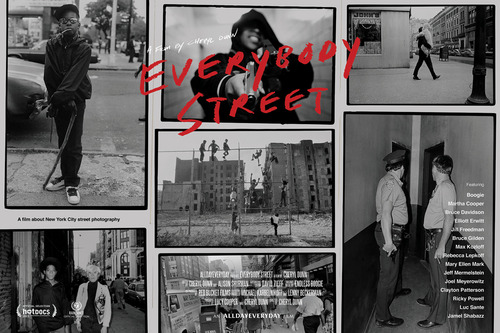
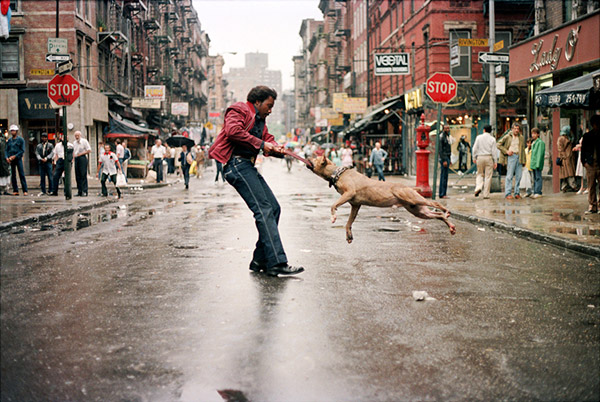
Everybody Street is a new documentary about the lives and work of New York’s street photographers and the city that inspires them. The film features photographer Bruce Davidson, Elliott Erwitt, Jill Freedman, Bruce Gilden, Joel Meyerowitz, Rebecca Lepkoff, Mary Ellen Mark, Jeff Mermelstein, Clayton Patterson, Ricky Powell, Jamel Shabazz, Martha Cooper, and Boogie, as well as historians Max Kozloff and Luc Sante. It looks amazing:
Alan Moore discusses his short films, crowd-funding, the Occupy movement, The Prisoner, and zombies (amongst other things) at Salon:
While the revolution will be certainly televised, it strikes me that there is a strong possibility that the revolution will also be crowd-funded. If Kickstarter and other enterprises are giving projects like Occupy Comics a chance, then it does suggest there are imaginative ideas out there with incredible use and application across the board. Not just in the arts, but in the sciences as well. It’s an exciting concept, and I look forward to seeing what emerges from it.
Moore talks more about his Lynchian short film Jimmy’s End — created with Mitch Jenkins — in this short ‘behind-the-scenes’ documentary for Motherboard TV (worth watching just for the interior of the actual Jimmy’s End Working Men’s Club around the 10 minute mark):
He also discusses crowd-funding and ‘The Jimmy’s End Cycle’ of films — the last of which, Heavy Heart, you can still support on Kickstarter — in an interview with Bleeding Cool from earlier this month.