Skip to content

Tag: film

Midweek Miscellany

Curate, Curate, Curate — An interview with James Daunt, the new managing director of Waterstone’s, in The Independent:

“You have to let the booksellers decide how to curate their own stock,” he says. “The skill of a good bookseller is how you juxtapose your titles, and create interesting displays, and reflect what your community wants… The computer screen is a terrible environment in which to select books. All that ‘If you read this, you’ll like that’ – it’s a dismal way to recommend books. A physical bookshop in which you browse, see, hold, touch and feel books is the environment you want.”

An epic threepart interview with the ever-quotable Alan Moore at Honest Publishing:

[T]he people actually producing technology, such as Kindle and iPad, these are always the people who are telling us that we have to have these things. And being the type of creatures that we are, a fair number of us will naturally fall into that, will perhaps assume that as a status symbol it’s much better to be seen reading a Kindle than a dog-eared paperback. Although I will note that the last two or three times I’ve taken train journeys, everybody around me was sitting round reading a dog-eared paperback. I tend to think that for most people the idea of the book, with its easy portability, where you can turn the corner of a page down, where you are basically working with ordinary, reflected light rather than screen radiance, I think that the book will end up as the reading method of choice.

See also: A full, unabridged version of Laura Sneddon’s interview with Moore for The Independent.

And on the subject of authors with beards…

Neal Stephenson, author most recently of REAMDE, talks to The New York Times about the future:

What I’m kind of hoping is that this is just kind of a pause, while we assimilate this gigantic new thing, ubiquitous computing and the Internet. And that at some point we’ll turn around and say, ‘Well, that was interesting — we have a whole set of new tools and capabilities that we didn’t have before the whole computer/Internet thing came along…Now let’s get back to work doing interesting and useful things.’

And finally…

Terry Gilliam talks movies with the LA Times:

“The thing is, some really good scripts come my way, but there’s nothing in them for me to come to grips with, they are complete in themselves,” Gilliam said. “There’s no uncertainty. I don’t look for answers; I look for questions. I like when people leave the cinema and feel like the world has been altered for them somewhat. On ‘Brazil,’ I know a woman who said she saw the film, went home and later that night she just started weeping. I also heard about an attorney who saw the film and then locked himself in his office for three days. Fantastic.”

Comments closed

Midweek Miscellany

And The Moral Is Don’t Fuck William Faulkner… A really great post by Glen David Gold, author of Sunnyside and Carter Beats the Devil, at the LA Review Books:

The world after publication is — beyond its many joys — an evaporating and ruinous goldfish bowl of thwarted ambition. If you write long enough, you will know editors and agents. You will have dinner with people who give interesting fellowships to weeklong retreats in the south of France. You will teach at good programs and you might know when a publisher’s child is having a birthday and what his favorite Transformer is, and these facts more than the quality of your humanity might be what makes you a chess piece when another writer slaps you on the back and asks you if you might read something he wrote.

Very Long, Very Tricky, Very Strange — Adam Gopnik in The New Yorker on the appeal of Tolkien and fantasy novels:

Of all the unexpected things in contemporary literature, this is among the oddest: that kids have an inordinate appetite for very long, very tricky, very strange books about places that don’t exist, fights that never happened, all set against the sort of medieval background that Mark Twain thought he had discredited with “A Connecticut Yankee in King Arthur’s Court.”

Against Bigness — Mark Edmundson on the movies of Robert Altman and Woody Allen at The American Scholar:

Altman was against bigness. He always wanted to turn the carpet over. He wanted you to see the signs of strain and stress that went into the making of what looked like a serene, well-balanced thing. But he didn’t want to debunk the whole construction; he simply wanted to marvel at the quirky congestion of threads. It was probably tough for the players who acted prominently in his movies to redeem their Hollywood standing. He turned stars into hand-held sparklers. He waved them around. But he did it without resentment, without meanness: he simply liked them better that way.

Meanwhile in the comics corner…

Alan Moore talks to Fast Company about  a Kickstarter project to build a memorial to the late Harvey Pekar in Cleveland Heights public library, and to The Guardian about the Occupy Movement wearing V for Vendetta masks at protests.

And at The Daily TelegraphKasia Boddy reviews MetaMaus by Art Spiegelman:

The effect of this great assemblage is complicated. On the one hand, it consolidates Maus’s status as a canonical work, about which we need to know everything, and emphasises its claim to historical testimony (Spiegelman complained to The New York Times when Maus was included on the fiction bestseller list.) On the other hand, however, the almost overwhelming presence of all this stuff emphasises that history is far from a straightforward retrieval of “facts”, but rather involves a complex process of accumulation, sifting and construction.

And finally…

Martin Filler reviews the documentary Eames: The Architect and the Painter for NYRB:

The last time I saw Ray Eames, a few months before her death, I mentioned the high prices that the couple’s original furniture was fetching in New York galleries. “Oh, no,” she cried, and held her hands to her ears in genuine dismay. “We wanted our things be available to everyone, not just rich people.” Yet although the Eameses’ molded plywood LCW chair of 1946 at first retailed for $20.95, their rosewood-and-leather lounge and ottoman of 1956 cost a not-inconsiderable $578 when first introduced, and now, still in production by Herman Miller, sells for $4,499. This luxurious seating became a familiar component of upscale psychiatrists’ consultation rooms, as much an emblem of mid-century professional attainment as pairs of Ludwig Mies van der Rohe’e chrome-and-leather Barcelona chairs were in the reception areas of Fortune 500 companies.

Comments closed

Midweek Miscellany

On Record — Rick Poynor at Design Obsever waxes all lyrical about Continuum’s 33 1/3 music series:

The best 33 1/3 titles… have an urgent personal mission, even obsession, and they tunnel deep down into an album’s defining moment and milieu: dark sixties Los Angeles in Forever Changes, isolated seventies Berlin in Low, creative nineties Athens, Georgia in In the Aeroplane over the Sea… Usually around 30,000 words, these detailed studies are hugely challenging to research and write. Continuum has let it be known that a batch of previously announced titles has been canceled after initial high hopes: the authors just couldn’t deliver.

Movies on Paper — Tom McCarthy, author of Tintin and the Secret of Literature (as well as Remainder and C), reviews Steven Spielberg’s The Adventures of Tintin: The Secret of the Unicorn:

Tintin was always premised on a set of implicit borrowings and relocations from one medium to another. Hergé’s earliest strip-cartoons were billed as “movies” on paper; creatively, he was as indebted to the films of Buster Keaton and Harold Lloyd as to the novels of Jules Verne or the illustrated poems of Benjamin Rabier (which, long forgotten now, featured a tuft-headed boy called Tintin-Lutin and his dog). Hergé’s remarkable achievement with the Tintin series was to pluck all these elements from their original contexts and join them together, holding them in perfect equilibrium, in a new, hybrid format whose conventions (speech-bubbles joined with left-to-right action, for example) he established in the very act of assembly.

McCarthy loathes the movie by the way.

See also: Nicholas Lezard getting really quite upset about it.

(If you’re wondering why the British are so bothered by the Speilberg’s movie, my take on it is that we view Tintin as an eccentric, quintessentially British hero — not unlike T.E. Lawrence — rather than a Belgium one, and Spielberg is well… just so American. Or it might just be a shit movie.)

And finally…

Gum-Chewers of the World (Unite and Take Over) — Canadian cartoonist Seth on being awarded the Harbourfront Festival Prize at the International Festival of Authors in Toronto:

I’ve always believed the comics medium was capable of genuine subtly and grace and complexity… and of telling stories that would appeal to an adult mind. Stories that reflect real human experience. That said, it didn’t look too likely that the literary world or the art world…or even the mainstream pop culture was likely to cut the comic book much slack. Comics were considered entertainment for the gum-chewers of the world. Kid junk at worst – nerd culture at best.

Comments closed

Q & A with Jason

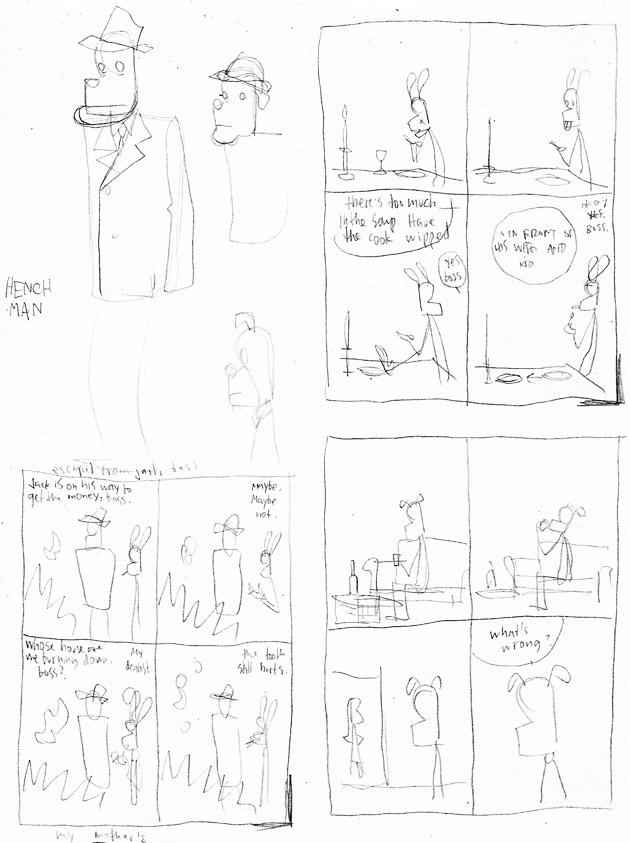
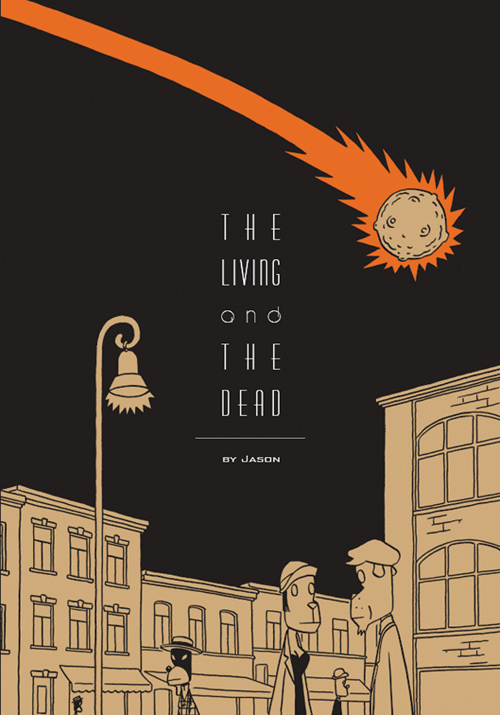
I’ve written about Norwegian cartoonist Jason for The Casual Optimist before and his work appears here with unerring regularity — if you are a frequent reader you are no doubt already familiar with it.

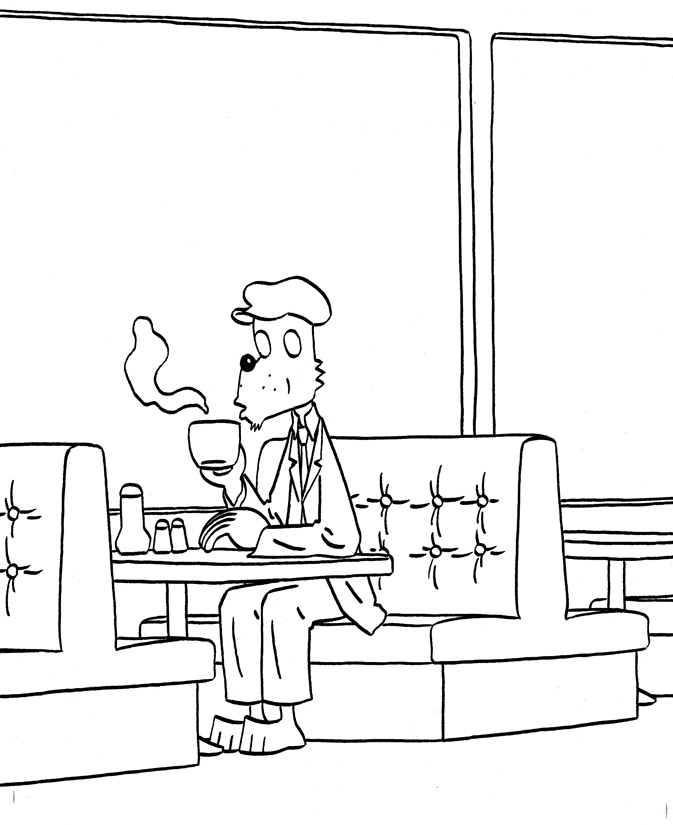
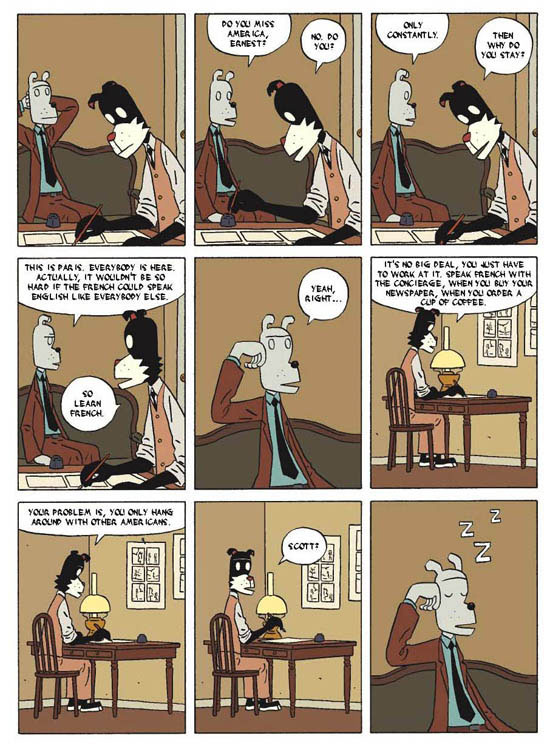
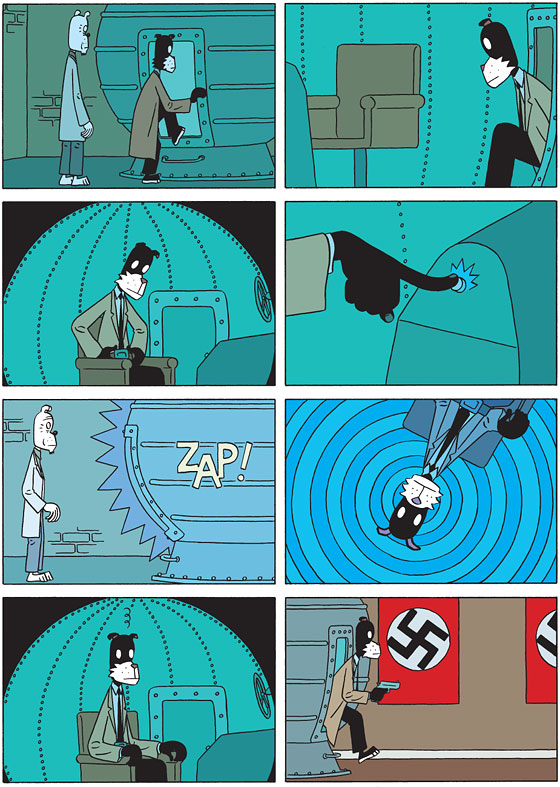
Like British cartoonist Tom Gauld who I interviewed early this year, Jason’s comics are immediately identifiable. You cannot mistake them for the work of someone else. And again, like Tom, Jason’s work references both the pop and the high-brow: zombies and werewolves on the one hand; Hemingway and the Beats on the other. The result is both original and off-beat. His protagonists are like renegades from a Max Fleischer cartoon who’ve inadvertently wandered into a Jim Jarmusch movie… Anthropomorphic animals smoking cigarettes, drinking coffee, talking about French actresses. Action and slapstick wrestle with ennui and loneliness.
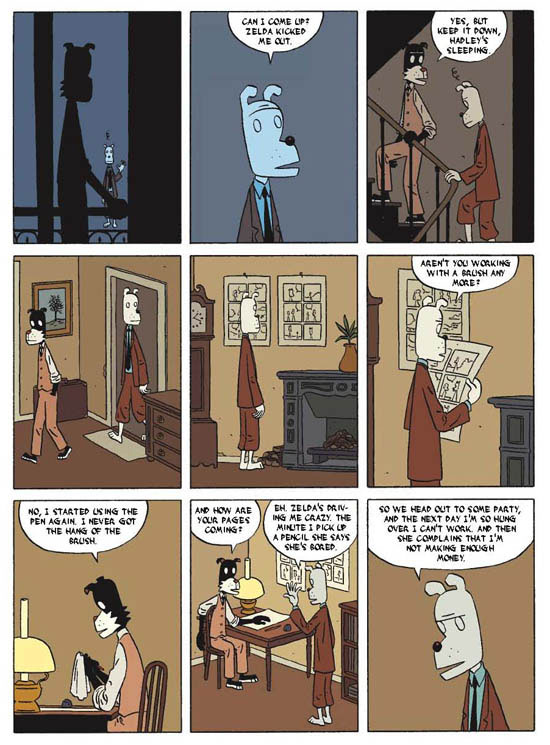
Jason, whose work has been translated into Swedish, Spanish, German, Italian and French, currently lives in Montpellier, France. He was kind enough to talk to me in English. His new short story collection Athos in America will be published in December by Fantagraphics.
 

When did you first start drawing cartoons?

Around age 13, I guess. And then at age 16 I started selling cartoons and one page strips to a Norwegian humour magazine. I did that through high school.

Did you always want to be a professional cartoonist?

No, it was a hobby. To become a cartoonist in Norway was not much of an option. I went to art school to become an illustrator, but my career never took off, so I kept doing comics. I met other cartoonists in Oslo, there was sort of a little scene. And then I moved to France to be closer to the French comic book industry. I did books that were translated into English, French plus some other languages, and the last seven or eight years I’ve been able to have an income almost exclusively from doing comics.
How did you become involved with your US publisher Fantagraphics?

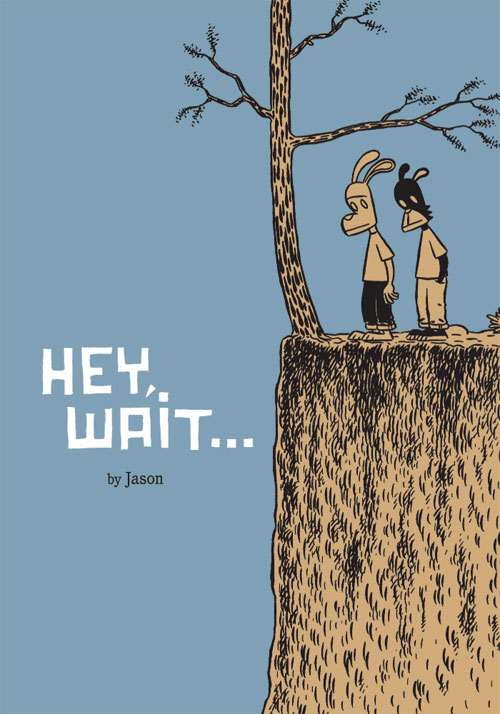
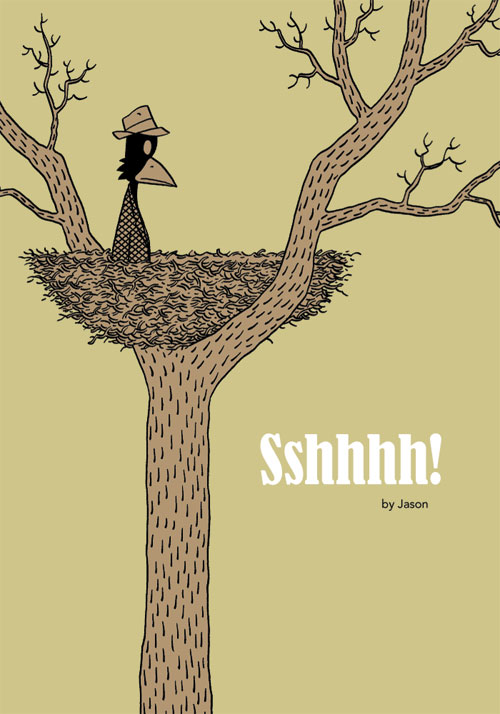
We sent — that is me and my Norwegian publisher, Jippi — we sent Hey, Wait… to Fantagraphics. I’m still not quite sure if Kim Thompson read our submission or if he had already read the French version, but anyhow, they decided to publish the book, and then later Shhh! And The Iron Wagon. And for some strange reason, the books seem to sell okay, so I’m still published by them. [Hey, Wait…, Shhh! and The Iron Wagon are collected in the book What I Did]
Briefly, could you describe your working process?

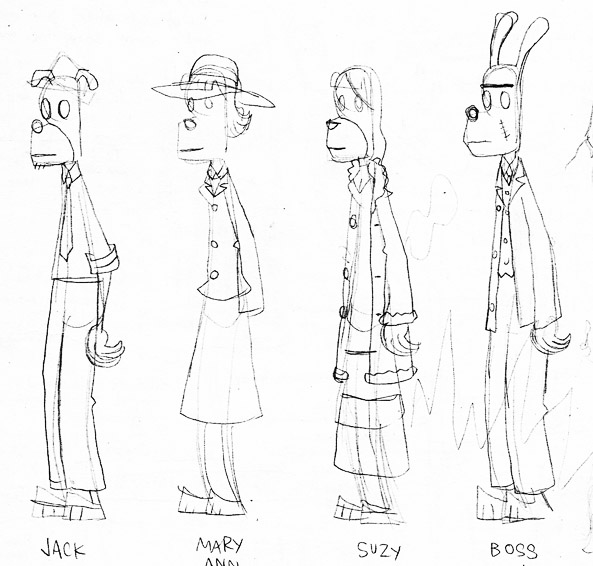
I have ideas in my brain, just lying there, that I sometimes think about. This can last years. Then suddenly I can get ideas for dialogues. I write this down. It’s maybe four or five pages. I can start working on those, and at the same time think about what’s going to happen next. I don’t write a full script. It’s based on improvisation. I write pieces of dialogue. Or sometimes I sketch out the pages first, the images, and write the dialogue after. I usually work on nine or ten pages at the same time, pencil a bit here , then ink it, and then pencil a bit there and ink that. It’s the completely wrong way of doing it, by the way, but it seems to be the only way I can work.
Your work often references classic movies. What are some of your favourite films?

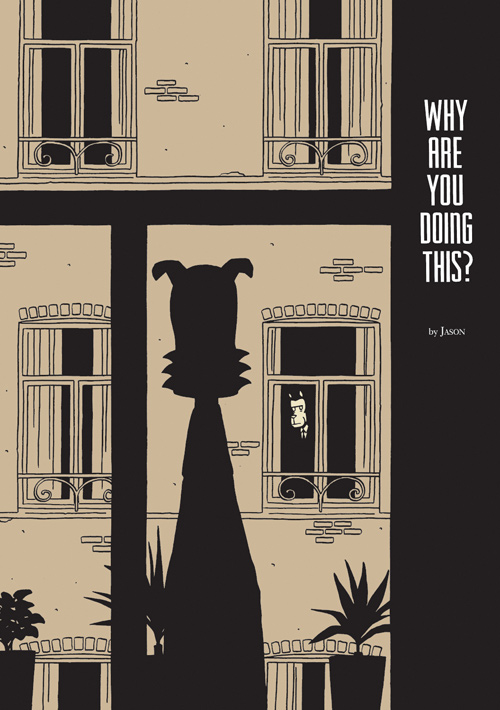
How much room do you have? I like Fred Astaire and Ginger Rogers films, film noir, Brian De Palma, John Ford, especially The Searchers and Howard Hawks, especially Rio Bravo, Buster Keaton, Laurel and Hardy. Paris, Texas, Down by Law, Animal House, Blues Brothers, Fanny and Alexander, Five Easy Pieces, The Last Picture Show, Miller’s Crossing, Roman Holiday, On The Waterfront, Life of Brian. Days of Heaven by Terrence Malick is probably my favourite film.
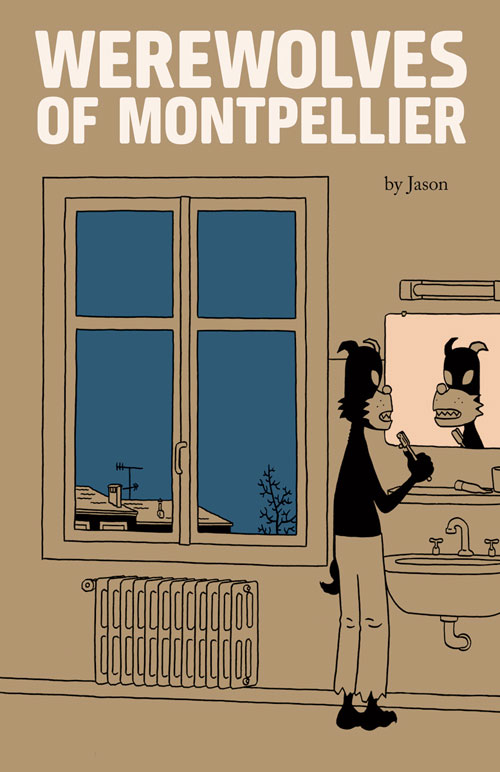
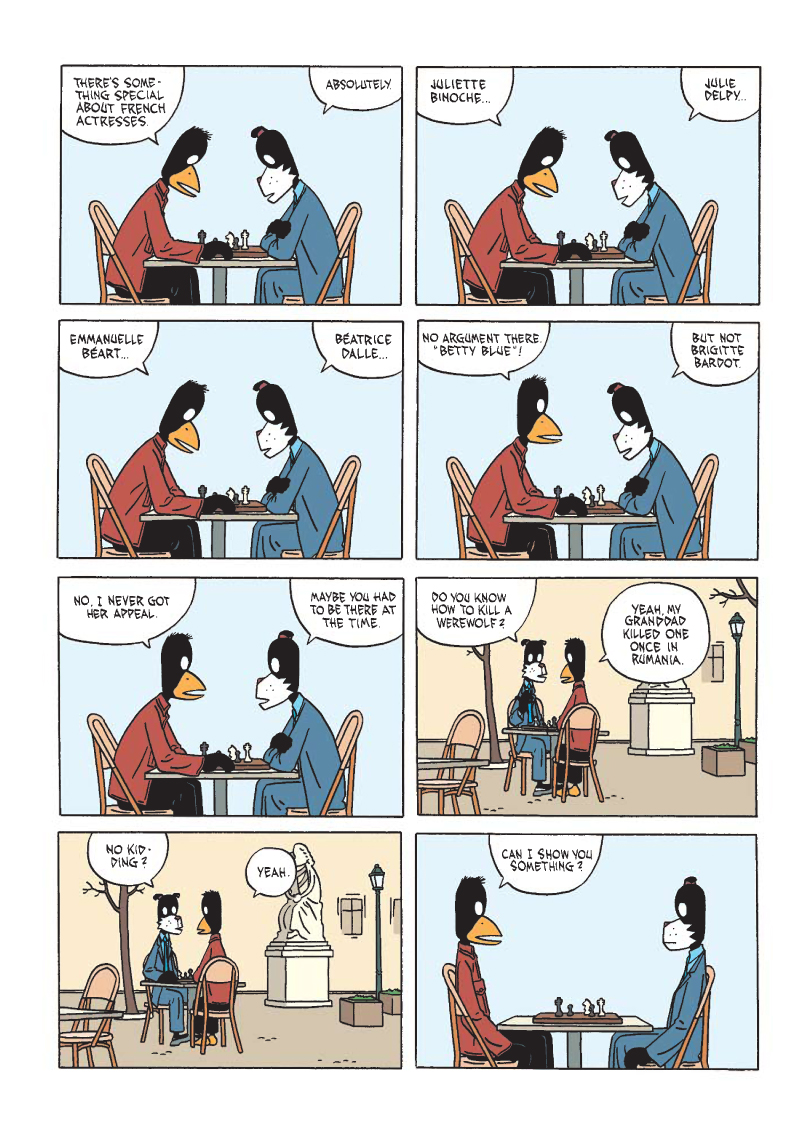
In your recent book Werewolves of Montpellier, one of the characters says they don’t understand the appeal of Brigitte Bardot. Really?

Yes, really! What, you like her? She just looked a little stupid to me. I find Catherine Deneuve a lot more appealing, or Emmanuelle Beart and Julie Delpy to stick with French actresses.
You recently post a list of your 5 favourite Tintin books. Has Hergé been an influence on your work?

Yes, very much so. It was one of the first cartoonists that appealed to me. I borrowed his albums at the library as a kid. I started drawing my own cartoons. And I think you can have a much worse teacher than Hergé. It’s not really the clear line that is the most important thing, even if that is part of what I like with him, it’s more the very clear storytelling that you find in his books. On page three you’re hooked. I think you can read his books in a foreign language, in Russian, and still understand the story and enjoy it. I don’t re-read the books that often, but I often take them out, my favourite albums like The Broken Ear and The Shooting Star, and just look at the drawings.

What do think about the new Steven Spielberg adaptation?

I’ve only seen the trailer. It doesn’t look that bad. I don’t want to just completely rule it out, like its a sacrilege and that Spielberg has no right to adapt Hergé. Not sure about the computer animation, but the original plan was apparently live action with a computer animated Terry [Milou/Snowy], and I think I really would have hated that. And the European animation films, based on each album, are just terrible. Everything that is exciting and funny in the albums are completely lost in the animation films. So I don’t think the Spielberg film can be any worse.
Who are some of your other creative heroes?

Jim Jarmusch, Hal Hartley, Wes Anderson, Aki Kaurismäki. Jaime Hernandez, Jim Woodring, Daniel Clowes, Chester Brown.

Who else do you think is doing interesting work right now?

There are two Argentinian cartoonists I like, Liniers and Pablo Holmberg. The French cartoonist Christophe Blain. Calef Brown’s children books. I like the Mutts books by Patrick McDonnell. I’m not sure if it’s necessarily «interesting», but I find them appealing. It’s like the last, good newspaper strip. I like the old newspaper strip collections: Captain Easy, Prince Valiant, Little Orphan Annie, Gasoline Alley.
What books have you read recently?

This summer I read The Selected Letters by Jack Kerouac, Off The Road by Carolyn Cassady. I tried to read The Subterraneans by Kerouac, but gave up. I read Chronicles by Bob Dylan, Positively 4th Street by David Hadju and A Freewheelin’ Time by Suze Rotolo. I also read Dave Van Ronk’s memoirs, The Mayor of MacDougal Street, so I look forward to the new film by the Coen brothers, based on his life. What else? Blood Meridian by Cormac McCarthy, Last Night in Twisted River by John Irving and Freedom by Jonathan Franzen. I’m currently reading Volume 1 in The Letters of Ernest Hemingway.
What are a few of your favourites books?

Well, Hemingway. The Sun Also Rises and A Farewell to Arms, his short stories. Bukowski, mostly his novels, but I’ve also started reading his poetry. Raymond Carver and Tobias Wolff. Lorrie Moore, her short stories. Kelly Link. There’s a British writer I like, Rupert Thomson. John Fante, especially Ask The Dust, John Steinbeck, especially East of Eden and Grapes of Wrath, Cormac McCarthy, especially The Road and No Country for Old Men. Raymond Chandler and other old pulp writers like Charles Willeford and David Goodis. I like Elmore Leonard. Paul Auster. John Irving. Every four or five years I re-read Cider House Rules, Garp and Hotel New Hampshire.

Are there any stories you would like to illustrate?

Yes, there are one or two books I’d like to adapt to comics. But I’ll probably wait until I’ve run out of ideas myself.
Do you worry about the future of books and print?

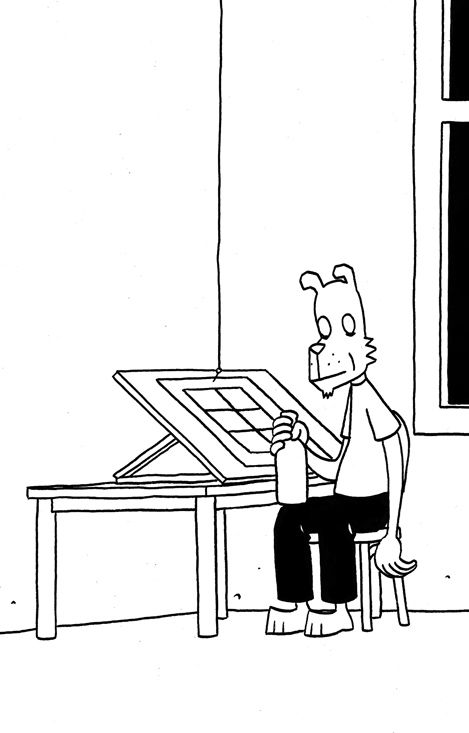
No. I don’t know. The bike didn’t disappear when the car came. There are hopefully room for both books and electronic media. Personally I’ll stick with paper. I’ve no interest in reading on a screen. And I’ll be dead in 40 years anyhow. How much can they screw it up by then?

Thanks Jason!
 

6 Comments

Midweek Miscellany

An Expressionist Newsreel of a Bad Dream — Guardian film critic Peter Bradshaw on the classic Martin Scorsese movie Raging Bull:

The effect is to combine stunning scenes of brutality and self-destruction with a lethal, even outrageous sentimentalism and self-pity. It’s all captured in dreamlike, pin-sharp monochrome cinematography, stark images reproduced like a Weegee crime scene. The result is operatic and mad and compelling.

The fight sequences themselves, with the camera swirling and swooping around the ring, and the soundtrack sometimes gulping out into silence and sometimes moaning with weird half-heard animal noises, are unforgettable: an inspired reportage recreation in the manner of a Life magazine shoot, which also looks like expressionist newsreel footage of a bad dream.

Also at The Guardian, Justin McGuirk reviews Gary Hustwit’s new documentary Urbanized:

Urbanized is a brave and timely movie that manages to strike almost exactly the right tone. For a sense of the scale of the urban problem, simply look at Mumbai, a city of 12 million people that is set to be the world’s biggest by 2050. Already, 60% of its population lives in slums with such poor sanitation that there is only one toilet seat for every 600 people. The municipality is reluctant to build toilets for fear that it will encourage more migrants to come. “As if people come to shit,” retorts the activist Sheela Patel in the movie. Quite.

The 10% — CNN looks at the business of women in comics and Womanthology, a comics anthology funded by Kickstarter:

“Think about it from the publisher’s point of view,” [former DC associate editor] Asselin said. “Say you sell 90% of your comics to men between 18 and 35, and 10% of your comics to women in the same age group.  Are you going to a) try to grow that 90% of your audience because you feel you already have the hook they want and you just need to get word out about it, or b) are you going to try to figure out what women want in their comics and do that to grow your line?”

(My advice: go with “b”)

And on the subject of comics… Art Spiegelman talks about MetaMaus (what else?) with The Observer:

In his ramshackle SoHo studio – a sort of comics library with a membership of just one, it consists of a dingy bathroom, a kitchenette, a drawing board, the odd dusty plant and about eight million quietly groaning books – Spiegelman lights yet another cigarette… He then gives himself over to crowing delightedly. “I’ve met a number of editors over the years,” he says, eyes rolling. “And all of them claim to have discovered Maus, when all they really have the right to claim is that they rejected it.”

And finally… While Toronto is busy drawing Tintin, Simon Kuper looks back at the life and work of Hergé for the Financial Times:

The war seems to have forced Hergé inward into his own imagination, and Haddock is one of the best things he found there. The captain’s alcoholism and swearing would be staple jokes of all subsequent Tintin books. Pretty much all writers on Tintin note that the main character is a cipher, a humourless two-dimensional boy scout. “A blank domino,” Hergé’s friend, the philosopher Michel Serres, called him. Tintin therefore requires company. Prewar, he only had his dog, Snowy. Haddock… was much more interesting. Even Hergé seems to have come to prefer him to Tintin.

Comments closed

Something for the Weekend

Words and Pictures — An interview with cartoonist Tom Gauld at The Rumpus:

Format, words and pictures all work together to make a good comic. I started at college doing pure illustration and only gradually got into making stories and using words. I’m still more comfortable with pictures than words: I’m happy doodling away on drawings for hours, but putting words together is always more of a struggle. I  usually like to keep things as simple as I can so it’s interesting seeing what I can remove and still keep the story: you don’t want to say something in words which is better said in the pictures (and vice versa).

There is also a preview of Tom’s new book, Goliath, on the D+Q blog and you can read my interview with Tom here.*

A General Contempt for Small Talk — Edward Docx, author most recently of The Devil’s Garden, on Tolstoy, Russia, and literary prizes. So much good stuff here:

[I]f there’s one thing that novelists love to talk about, it’s how to make things real when, obviously, they are not. This in turn leads naturally into something novelists like to talk about even more: the terrible struggle of writing itself. (My favourite line about writers: “Writers are people who find writing more difficult than other people.”)… Metaphors rise from the table like disturbed lepidoptera. Writing a novel is like attempting to solve an extremely complicated maths equation, which seeks to represent reality, and through which you are trying to lead the public without them ever getting wind that said equation is, in fact, impossible to solve or that, actually, it might not represent reality at all. We are getting carried away. Deciding to write a novel is like visiting an obscure, half-forgotten and slowly-evaporating planet entirely comprised of swimming pools and deciding that what is needed is… yes, another swimming pool! But, for obscure reasons, a swimming pool that must be built single-handedly from scratch and then filled using only a syringe.

And finally…

Critical Authority — New York Times film critics A. O. Scott and Manohla Dargis discuss Brian Kellow’s new book Pauline Kael: A Life in the Dark and the ongoing legacy of the (in)famous New Yorker film critic. Here’s A.O. Scott:

[T]he idea of critical authority has always struck me as slippery, even chimerical. Authority over whom? Power to do what? The importance of particular critics can’t be quantified in lumens of fame, circulation numbers or box office returns, though by all of these measures Kael, in her heyday, certainly enjoyed unusual prominence. But like every other critic, she was above all a writer, and a writer only really ever has — or cares about — one kind of power, which is the power to engage readers.

I think Kael is remembered not for her particular judgments or ideas, but rather for her voice, for an outsized literary personality that could be enthralling and infuriating, often both. A lot of people read her for the pleasure of disagreement, and the resentment she was able to provoke — in critical targets and rival critics — is surely evidence of power. An awful lot of our colleagues are still, in both senses, mad about her. To reread her is to understand why.

*Just so you know: D+Q are distributed in Canada by my employer Raincoast Books.

Comments closed

Midweek Miscellany

Buzzwords of the Incurious — Evgeny Morozov, author of The Net Delusion: The Dark Side of Internet Freedom, delivers a searing review of Public Parts: How Sharing in the Digital Age Improves the Way We Work and Live by Jeff Jarvis.  A must-read:

The ubiquitous references to Gutenberg are designed to lend some historical gravitas to wildly ahistorical notions. The failure of Internet intellectuals actually to grapple with the intervening centuries of momentous technological, social, and cultural development is glaring. For all their grandiosity about technology as the key to all of life’s riddles, they cannot see further than their iPads. And even their iPad is of interest to them only as a “platform”—another buzzword of the incurious—and not as an artifact that is assembled in dubious conditions somewhere in East Asian workshops so as to produce cultic devotion in its more fortunate owners. This lack of elementary intellectual curiosity is the defining feature of the Internet intellectual. History, after all, is about details, but no Internet intellectual wants to be accused of thinking small. And so they think big—sloppily, ignorantly, pretentiously, and without the slightest appreciation of the difference between critical thought and market propaganda.

Swimming Out of Guilt — David Ulin talks to Art Spiegelman about MetaMaus at the LA Times:

“I didn’t predict this for myself,” Spiegelman admits, firing up another cigarette. “I thought ‘Maus’ was going to take two years and I’d move on with my life. But it’s an ongoing wrestling match. Basically ‘Breakdowns’ ” — the 2008 collection that recontextualized his early work, including the first three-page “Maus” strip, from 1972 — “and ‘MetaMaus’ are the great retrospections, the period of my life I’m still swimming out of. Then I get to find out if there’s any other stuff in my pockets to make bets with.”

The World We Live In — Author William Gibson interviewed at the A.V. Club:

I don’t actually think of science fiction as primarily a predictive form. That’s its cultural reputation and that’s what lots of people believe it is, but my approach has always been that it’s invariably about the day it was written in. Regardless of what the author tells us, it can’t really be anything else. There’s no way it can be about the future, except it pretends to be the future. It’s like reading 1984. What it’s actually about is 1948, the year it was written. You see Orwell responding to various aspects of the world he lived in, which was changing, since the world always is.

See also: Margaret Atwood talks about speculative fiction and her new collection of essays Other Worlds with CBC Radio (audio) and The Globe and Mail.

And finally…

Trash — Nathan Heller on film critic Pauline Kael, a new collection of her work, The Age of Movies: Selected Writings of Pauline Kael, and Brian Kellow’s new biography Pauline Kael: A Life in the Dark:

Kael realized that the pictures had a chance to succeed where classic books, painting, and art music had been shunted from the mainstream; she thought a tolerance for “trash” was key to maintaining this openness and innovation. Still, she was no fugitive from the old arts. Kael once said that she’d rather live in a world without movies than in a world without books, and she resented the decline of public literary dialogue. She saw the movies as American art’s second chance.

Also at The New Yorker, Richard Brody looks back Kael’s book 5001 Nights at the Movies.


Comments closed

Something for the Weekend

The Dark Room — Filmmaker Grant Gee talks to BookForum about his new film Patience, which explores the work of author W.G. Sebald and his book Rings of Saturn:

There is one reference in an essay he wrote about Kings of the Road by Wim Wenders. He opens the essay with an interesting recollection of watching the film. He’s that generation; he’s absolutely of Wenders’ generation. Once you know that, you can feel the similarities between Wenders and Sebald, but Sebald willfully took himself away from that culture. I think of Sebald more as a photographer. There’s a quote I read somewhere where says he wasn’t very interested in school and he spent most of his time in the darkroom of the school’s photography lab. And there is something—I’m not sure if I’ve made this up or imagined it—about the way images work in his book: it feels to me like a black-and-white print developed under a red light, like it comes up out of whiteness, and if you leave it there it will black out in the tray.

Baggage — David Cronenberg talks to FilmComment  about A Dangerous Method, his film on Freud, Jung and Sabina Spielrein:

I don’t care what baggage people think I will bring to the movie. I don’t have that baggage. Once I decide on a project, I am honorable about how I treat it. I am not trying to put some false Cronenbergian imprint on it. Let’s just do the movie. Part of the project was the resurrection of the people and the era. That means it has to be as accurate as possible. I want the people to be as alive as they can be. I want to be able to smell them and hear them in a way that we can’t. It’s a matter of affection. I would like to have known them. That’s the only agenda I have—to honor the accuracy of these people and what they said.

And on the subject of Freud… Comic book creators discuss how mainstream comics portray women and how things can be improved at Comics Alliance. An interesting read.

And finally…

SUPERTYPE! — A collection of vintage comic book mastheads from the man who brought you 4CP and Comic Book Cartography (via Subtraction).

Comments closed

Midweek Miscellany

Art or Death — Art Spiegelman on books, comics and technology at Publishers Weekly:

I would say that, in the future, the book will be reserved for things that function best as a book. So, if I need a textbook that’s going to be out of date because of new technological inventions, you’re better off having it where you can download the supplements or the update. If you’re going to read a quick mystery novel to keep you amused while you’re traveling, it’s fine.
None of this is about the business model. It has to do with the boutique nature of a book, the idea that, as McLuhan put it, when a technology is replaced by another technology, the previous technology either becomes art or it dies.

See also: Jeet Heer reviews MetaMaus for the Globe and Mail:

One way to explain the achievement of MetaMaus is to imagine a great architect like Frank Gehry offering a guided tour to one of his classic buildings, opening up the original plans, explaining the solutions he came up with for each problem. Such an act of self-exegesis is immensely rewarding, even if the creator’s genius is as enigmatic as ever.

And, on the subject of comics… A short interview with Alan Moore in Metro:

At the moment I feel an awful lot of my comic career is behind me, particularly all of the superhero stuff – the stuff that’s owned by American corporations. I want to distance myself from that, so the stuff I’m proudest of is what I own: From Hell, Lost Girls, The League Of Extraordinary Gentlemen. I don’t read my earlier work because there are too many unpleasant associations with it. I don’t have a copy of Watchmen in the house. I’m glad the work is out there in the world, having an effect, but it’s like I’ve gone through a messy divorce.

Immersion — Author Neal Stephenson talks about writing and his new novel REAMDE at Full Stop:

I would say that people who like to engage with the details of the historical era or the technical concepts might find [my] books especially rewarding to read. For me it’s a pretty straightforward thing—you know, what readers are paying for, what they’re buying and what I’m selling is a particular kind of experience: essentially one of getting immersed in another world. And it could be a very different world (as in a science fiction book), it could be the history of our world, or it could just be a story that takes place today, like Reamde. And a way to do that — a way to create that feeling of immersion and get the reader feeling like they’re really there — is to supply a lot of details that convey a feeling of immediacy.

See also: REAMDE reviewed by Laura Miller for The Guardian.

And finally…

Filmmaker Gary Hustwit talks about his latest design documentary, Urbanized, with Print Magazine:

I love all the interviews in all the films, that’s why they are in the film. But there are definitely some that people respond to when they watch the film. Most of all Enrique Peñalosa, who is the former mayor of Bogota. He’s got some great lines in the film, like “There’s no constitutional right to parking.” He’s really charismatic and has some really common sense ideas about using the city as a tool to create equality, democracy and social equity. I also got to interview Oscar Niemeyer, the legendary Brazilian modernist architect. He’s about to turn 104 and is the oldest living architect in the world. He’s got his grandchildren working in his office. That was a big honor for sure.

Comments closed

Something for the Weekend

Innovation Starvation— SF author Neal Stephenson at World Policy Journal on why the big stuff doesn’t get done:

SF has changed… from the 1950s (the era of the development of nuclear power, jet airplanes, the space race, and the computer) to now. Speaking broadly, the techno-optimism of the Golden Age of SF has given way to fiction written in a generally darker, more skeptical and ambiguous tone. I myself have tended to write a lot about hackers—trickster archetypes who exploit the arcane capabilities of complex systems devised by faceless others.

Believing we have all the technology we’ll ever need, we seek to draw attention to its destructive side effects. This seems foolish now that we find ourselves saddled with technologies like Japan’s ramshackle 1960’s-vintage reactors at Fukushima when we have the possibility of clean nuclear fusion on the horizon. The imperative to develop new technologies and implement them on a heroic scale no longer seems like the childish preoccupation of a few nerds with slide rules. It’s the only way for the human race to escape from its current predicaments. Too bad we’ve forgotten how to do it.

See also:  Stephenson’s new book REAMDE reviewed by The A.V. Club and the NY Times.

Stealing from Dr. Strange — Lev Grossman, author of The Magicians and The Magician King, talks to Graphic Novel Reporter about comics:

Watchmen (and, just as much, Miracleman) changed everything for me. [Alan] Moore attacked and undermined everything that was sacred about the superhero story, and in the process he wrote the greatest superhero story that had ever been written. I never forgot that. A lot of those lessons show up in The Magicians: When you question the basic assumptions of a genre, you make that genre stronger, not weaker.

Also, I steal a lot from Dr. Strange.

And on the subject of comics… Ruth Franklin reviews MetaMaus by Art Spiegelman for The New Republic:

This writer is not Elie Wiesel or Primo Levi, though his work, like theirs, is based in testimony. He is not Piotr Rawicz or H.G. Adler, though he shares their interest in viewing real events through a filter of surrealism. He is not Thomas Keneally, though his work has a quality of the “nonfiction novel” about it; nor is he W.G. Sebald, though his books, like Sebald’s, have been described as a mix of fiction, documentary, and memoir. He is Art Spiegelman, and he has done more than any other writer of the last few decades to change our understanding of the way stories about the Holocaust can be written.

Edges — Nicholas Carr, author of The Shallows, on what remains of books:

One of the essential characteristics of the printed book, as of the scribal codex that preceded it, is its edges. Those edges, as John Updike pointed out not long before he died, manifest themselves in the physical form of bound books – “some are rough-cut, some are smooth-cut, and a few, at least at my extravagant publishing house, are even top-stained” — but they are also there aesthetically and even metaphysically, giving each book integrity as a work in itself. That doesn’t mean that a book exists in isolation — its words, as written and as read, form rich connections with other books as well as with the worlds of nature and of men — but rather that a book offers a self-contained experience. The sense of self-containment is what makes a good book so satisfying to its readers, and the requirement of self-containment is what spurs the writer to the highest levels of literary achievement. The book must feel complete between its edges.

And finally…

In The Wall Street JournalLee Marshall looks for Fellini’s Rome:

Sometimes Fellini’s Rome and Felliniesque Rome live in close proximity. The apartment that Federico and Giulietta shared (Via Margutta, 110) is on a small, charming street where Truman Capote once lived and Puccini composed. There’s not much to see except a plaque on the building with caricatures of the pair and a commemorative poem in Roman dialect. But notice the number on the door of the palazzo: above the 110, it says “Già 113″—formerly 113—a very Felliniesque address.

Comments closed

Marjane Satrapi | Ideas

Iranian cartoonist and filmmaker Marjane Satrapi, best known for her memoir Persepolis, talks to CBC Radio’s Eleanor Wachtel about her life, her work and a new film adaptation of her book Chicken with Plums:

CBC Radio Ideas: Wachtel on the Arts with Marjane Satrapi

1 Comment

Midweek Miscellany

A profile of calligrapher DeAnn Singh at The LA Times:

When the producers of “Mad Men” needed a note in cursive and a signature from Don Draper, they turned to Singh. “Something masculine and from the 1950s” was the request, though they eventually decided that the missive be typed…

Ask her about computers, and she’ll tell the story of Steve Jobs.

Before the founding of Apple and the development of the Macintosh, Jobs dropped out of Reed College and studied calligraphy with artist Lloyd Reynolds. If he hadn’t taken that class, he has said, personal computers might not have come with a variety of fonts.

Fantasy Modernism — Lev Grossman talks to the A.V. Club about The Magician King, the sequel to his 2009 novel The Magicians:

I have this theory about modernism and fantasy, which I’ll do in 30 seconds.

They came into being at the same time, which is very interesting. They were both reactions to the disasters of World War I and the electrification of cities, and urbanization, and the rise of the automobile, the end of that twilight world of the Victorians. They both are reactions to that in different ways. Modernism went very inside and delved into the interior lives of people. Fantasy externalized all that in these fantastical, magical, metaphorical landscapes. I thought, “Well, what if you did both the inside and the outside at once?” I tried to combine those foci of fantasy and modernism into one kind of writing. It sounds like I’m writing a dissertation on my own work, but, you know, you end up thinking about what you’re doing. That’s the kind of thing I thought.

See also: Alexander Chee reviews the book for NPR.

Prussian Pedantry — Susie Harries’ new biography of scholar Nikolaus Pevsner, best known for his 46-volume series The Buildings of England, reviewed by George Walden for The Observer:

For us at least the conflict of national intellectual styles he represented was hugely beneficial. The irony of a “Prussian pedant” lecturing the English on Englishness, for which he was mocked, resolves itself in the fact that, together with Gombrich in art history and Weidenfeld in publishing, Pevsner was one of a golden generation of German/Austrian Jewish refugees who did much to give their adopted country the bottom it prided itself on already possessing.

And for those of you not interested in a county-by-county guide to the wonders of English architecture (what’s wrong with you?), Pevsner also wrote the seminal Pioneers of Modern Design: From William Morris to Walter Gropius. First published in 1936, a revised and expanded edition will be available (in the UK at least) in September.

And finally…

Everyone is an AuteurGuardian correspondent Fiachra Gibbons meets Jean-Luc Godard:

“I am not an auteur, well, not now anyway,” he says as casually, as if it was like giving up smoking. “We once believed we were auteurs but we weren’t. We had no idea, really. Film is over. It’s sad nobody is really exploring it. But what to do? And anyway, with mobile phones and everything, everyone is now an auteur.”

Oh Jean-Luc…

Comments closed