Skip to content

Tag: film

Something for the Weekend

The Art of Daniel Clowes: Modern Cartoonist is out next week.

Ware’s World — Seth Kushner’s photos of cartoonist Chris Ware in his Chicago home.  Leaping Tall Buildings: The Origins of American Comics by Christopher Irving and Seth Kushner is published by Powerhouse Books in May.

Redefining ‘Contrarian’ — Armond White on film critic Pauline Kael, and her reputation as a ‘contrarian’, in the CJR (via Bookslut):

Since the advent of the Internet and the rise of review aggregators like Rotten Tomatoes, the illusion of consensus opinion now dominates the culture’s perception of criticism. Individual critics’ voices matter less than the roar of the crowd, which judges films as “fresh” or “rotten” and drowns out anyone who begs to differ. Outlying critics are isolated and deprecated, their deviations from the consensus seen as proof of their eccentricity or ineptitude. As an icon of mainstream critical influence, and as someone who had little use for group hugs, Kael’s independent stance presents a real challenge to the current critical order.

Addressing this change is more urgent than simply championing Kael; it’s a matter of defending the endangered voice of independent criticism that Kael represented so well. Now is a good time to redefine “contrarian” as autonomous, uncoerced journalism. Kael’s writing—and the new, ongoing controversy she engenders—makes this absolutely necessary.

(I’m not at all sure White accurately reflects readers’ expectations of critics, but it makes for a fun article).

And finally…

Nobody’s Perfect — Noah Isenberg reviews Masters of Cinema: Billy Wilder by Noël Simsolo for the LA Review of Books:

A writer by nature, Wilder was a man of uncommon wit and unforgiving sarcasm who made his martinis with the same verve as he made his movies… His was a raconteur’s cinema, long on smart, snappy dialogue, short on visual acrobatics. And though his dizzyingly prolific, half-century-long career brought us everything from romantic comedy masterpieces Some Like it Hot (1959) and Sabrina (1954) to such acerbic gems as Double Indemnity (1944), Sunset Boulevard (1950), Ace in the Hole (1951) and The Apartment (1960), Wilder remained forever reluctant to embrace the notion of director as artist; he saw himself merely as a trafficker in mass entertainment.

Comments closed

Midweek Miscellany

Everybody Thinks Their an Auteur” — Film director and critic Peter Bogdanovich at New York Daily News book blog Page Views:

Auteurism today? Well, everybody thinks they’re an auteur. But nobody seems to understand what the whole auteur thing was. It wasn’t a theory as far as the French were concerned. It was a political statement called la politique des auteurs. Truffaut and Godard were attacking the old-fashioned, well-made film, Franch or American. They thought Howard Hawks was an infinitely better director than Fred Zinnemann. They thought Alfred Hitchcock was a greater director than David Lean. They were against Marcel Carné  and for Jean Renoir. Personal films were what they looking for, where a director’s personality dominated despite who wrote it or who was in it or who photographed it.

Nothing But a Number — An interview with Gary Shteyngart, author of Super Sad True Love Story, at CultureMap Austin:

“There’s a kind of anxiety, I think. When you’re ranked you sort of know who you are and where you stand, and people become obsessed in their rankings. The quantitative takes the place of qualitative.”

Does this mean we are starting to reject the belief that we will never be just a number? “That’s the big generational shift from the ’60s of ‘I am not a number’ to 2012, where ‘I am a number but hopefully I’m a good number. I’m a high number,’” he laughs.

A Slow Books Manifesto: “Read books. As often as you can. Mostly classics.”

Not Your Conventional Hell — British horror writer Ramsey Campbell (The Darkest Part of the Woods) on the mighty H. P. Lovecraft for the BBC:

Lovecraft developed his own invented mythology, at least as influential on fantastic fiction as Tolkien’s work. Most of it is set in a New England steeped in history and in hidden occult influences, although the monstrous creatures glimpsed by his characters are frequently from outer space rather than from any conventional hell.

And finally…

Do We Need Stories? — Tim Parks continues his one-man argument with everything Jonathan Franzen has ever said ever:

Of course as a novelist it is convenient to think that by the nature of the job one is on the side of the good, supplying an urgent and general need. I can also imagine readers drawing comfort from the idea that their fiction habit is essential sustenance and not a luxury. But what is the nature of this need? What would happen if it wasn’t met? We might also ask: why does Franzen refer to complex stories? And why is it important not to be interrupted by Twitter and Facebook? Are such interruptions any worse than an old land line phone call, or simply friends and family buzzing around your writing table? Jane Austen, we recall, loved to write in domestic spaces where she was open to constant interruption.

Comments closed

Midweek Miscellany

The Forger — Tom McCarthy (whose novel Men in Space has finally been published by Vintage in the US) at Interview Magazine.

People in Business — An interview with Dennis Johnson, publisher of Melville House, at The Economist:

I think it’s very obvious to people that we care about the packaging of our books. I think people know that if we care about the outside of our books then we probably care about the inside of them, too. I recently read a survey that said 39% or 40% of people who bought books on Amazon looked at them in a bookstore first. They could know everything about the book online short of having seen it, but still the physical object had enough meaning to them to want to see it first. That resonates, happily, with the fact that Valerie [Merians] and I came into this not as publishers but as artists. The object means a lot to us.

Parallels — Authors Geoff Dyer (Zona) and John Jeremiah Sullivan (Pulphead) in conversation at Work in Progress.

And finally…

Britain’s Original Information Revolution — Adam Nicolson, author of The Gentry, on a collection of English books dating back to the 17th century:

 We may think we are in the middle of a communications revolution: Flickr, Twitter, Facebook, YouTube, Hulu, iTunes… But all of them are, in their ways, secondary phenomena. Some of them are image-based, post-literate, but none would work without the foundations of a much deeper communications revolution which swept across Europe 400 years ago.

The 17th century is when the Europeans started to write: letters, diaries, journals, notebooks, account books, commonplace books, business correspondence, pamphlets, posters, chapbooks, newspapers. It was the first communications revolution, which both spawned and reflected the most revolutionary century we have ever had.

Comments closed

Something for the Weekend

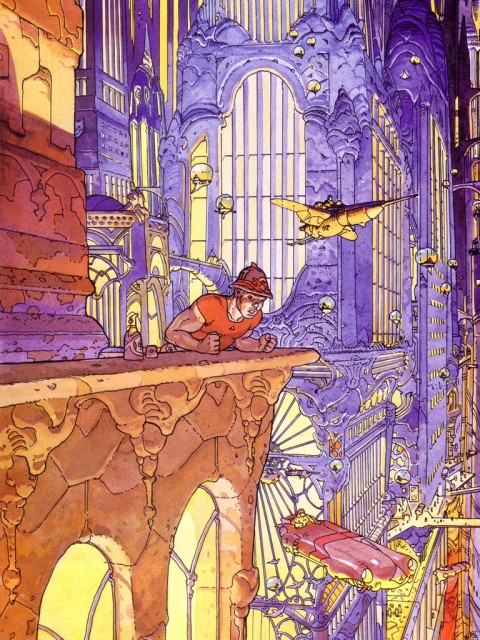
Tim Maughan on the influence of  the Jean Giraud on science fiction for Tor.com:

[The] combination of neon-lit noir streets, cramped towering city blocks, airborne traffic jams and scruffy characters seems almost a cliche today. But this was the first time anything like this had been drawn; and the first time science fiction had embraced the visual chaos of realistic urban environments. And the groundbreaking work is not just there in the architecture and mechanical designs; it’s apparent in the fashions and clothes of the city’s inhabitants. Although fantastic, exaggerated and other-worldy the city of The Long Tomorrow comes alive from the page because it feels so real, so layered and built — it is the urban paradise and nightmare of every industrial city from Tokyo to London.

The Catharsis of Exhaustion — Tim Parks on when to finish a book for the NYRB:

Other writers deploy what I would call a catharsis of exhaustion: their books present themselves as rich and extremely taxing experiences that simply come to an end at some point where writer, reader and indeed characters, all feel they’ve had enough… [These] writers it seems to me, by suggesting that beyond a certain point a book might end anywhere, legitimize the notion that the reader may choose for him or herself, without detracting anything from the experience, where to bow out.

Detachment — Edward St. Aubyn, Patrick Melrose Novels and At Last, profiled in the New York Times:

 “[There] is something morally condescending about forgiveness… Detachment is what interests me, seeing how people couldn’t have been any other way, how they were the product of forces that they had no control over… I was in the downstream of my father’s unhappiness, but it must have been hell to be him.”

And finally…

The Beat Hotel — A new documentary about the cheap no-name hotel at 9 rue Git le Coeur in Paris that harboured the likes of Allen Ginsberg and William Burroughs:

1 Comment

Midweek Miscellany

Obituary for artist Jean Giraud, AKA Moebius, in The Guardian:
Giraud… had an impact on the visual arts that went beyond comics. He was seen as a figurehead linking bandes dessinées with modernism and nouveau réalisme. As the co-creator of Métal Hurlant magazine, he took comics to an older, more literate audience. In cinema, his fans ranged from Federico Fellini to Hayao Miyazaki and his style influenced dozens of others, including Ridley Scott, George Lucas, James Cameron and Luc Besson.

Tom Spurgeon also has an in-depth obituary at The Comics Reporter:

Giraud would… describe the revolution driven by his work and others as one of creative choice rather than content, that the feeling of the artist inhabiting the work was more important than the kind of work being done. He drew a connection to the undergrounds and cartoonists like Robert Crumb, although he felt that the work of he and his peers existed in an entirely different cultural context.

See also: The comics industry remembers Moebius at Robot 6.

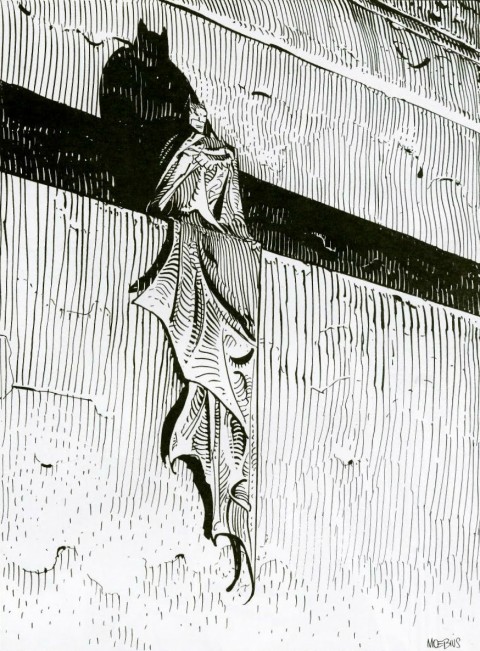
(I remember being very disappointed when I discovered that the drawing above was a standalone piece, and not a panel from a complete Batman story illustrated by Moebius. Heartbreak.)

Material Conversations — An interview with Jonathan Ive, Apple’s Senior Vice President of Industrial Design, in The Evening Standard:

What I love about the creative process, and this may sound naive, but it is this idea that one day there is no idea, and no solution, but then the next day there is an idea. I find that incredibly exciting and conceptually actually remarkable. The nature of having ideas and creativity is incredibly inspiring. There is an idea which is solitary, fragile and tentative and doesn’t have form. What we’ve found here is that it then becomes a conversation, although remains very fragile. When you see the most dramatic shift is when you transition from an abstract idea to a slightly more material conversation. But when you made a 3D model, however crude, you bring form to a nebulous idea, and everything changes – the entire process shifts. It galvanises and brings focus from a broad group of people. It’s a remarkable process.

And finally…

Boredom — Geoff Dyer, author Zona: A Book About a Film About a Journey to a Room, in conversation with Ethan Nosowsky at The Believer:

Boredom is often a side effect of something else. The apparent boredom inflicted by Stalker is actually the friction between the pace of the film and one’s expectations of how a film should proceed, so you just need to give yourself over to it. But then I think some so-called art films are irredeemably and inherently boring. As soon as I say that, though, I realize that the most boring films are the big, moronic action-blockbusters. They really bore the crap out of me. There’s an essential relationship between boring art films and moronic blockbusters because, as Ernst Fischer pointed out, any art form that glories in being understood only by a few—that worships at the altar of its own tedium, as it were—opens the floodgates for trash for the masses. At a certain point, as filmmakers got serious, they willingly took on a slowness that could easily become boring. But there was a long period before that when boredom was just inconceivable, not part of the equation.

Comments closed

Midweek Miscellany

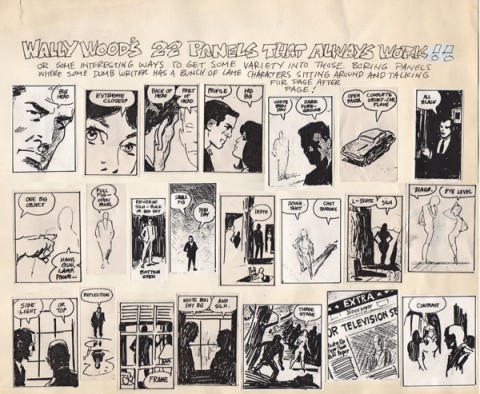
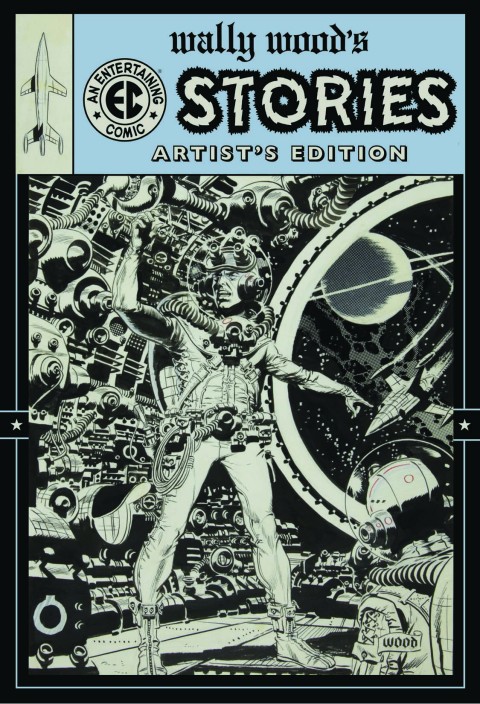
J. David Spurlock on the great Wally Wood at Imprint:

In nearly all of his work – no matter how overworked he was – even when he did risque material, there was always a charm, and he imbued the work with a purity of love for the medium.

And he was a master of every genre. That is one of the things that make him unique. Whether horror for EC, humor for Mad or Plop, war comics for DC or Gold Key, science fiction magazine illustrations, his Wizard King trilogy of fantasy graphic novels, superheroes for Marvel, cheesecake, romance, or westerns, whatever genre one picks, Wood’s contribution is among the finest ever.

Meditations — Dana Stevens on reading Zona, Geoff Dyer’s book about Andrei Tarkovsky’s 1979 film Stalker, while watching the movie:

[If] Zona goes off in a few too many directions, most of them are fascinating enough that we’re happy to zigzag along in the author’s wake. In addition to being a real-time explication of a single movie, Zona is a meditation on movies and time: the way movies change us, and change for us, as we return to them through our lives. Dyer reminisces about seeing Stalker in different decades, in different cities, with different girlfriends, as a young and then a middle-aged man… As he makes his way through Stalker scene by scene, Dyer’s account of what’s happening on screen is constantly being interrupted and informed by associations with the past as well as the present.

See also: Zona reviewed in the New York Times.

Also in the New York Times, author China Miéville on “Apocalyptic London“:

It used to be startling to see a fox in London — impossible not to feel that the city had slipped into a fable. Now you spot them on any late-night jog. In 2011, one of these agents of animal chaos infiltrated the Shard — at 32 London Bridge, the city’s unfinished tallest building — and climbed a thousand feet above the streets to live on builders’ scraps.

At dusk and dawn, green bolts shoot low, as flocks of feral parakeets set about bird business. Walking at dawn in the mud of Wormwood Scrubs, a rough, wild common next to the prison of the same name, we approach a screaming copse. Incredible flocks of these nonnatives preen and screechingly bicker, overlooking the glow of waking London.

And finally… A lovely piece the in The Daily Telegraph on Word on the Water, a Dutch barge selling second-hand books in London:

“We live in times where young people have Debussy moustaches, and listen to Sixties and Seventies music. They are interested in the past. I don’t remember there being a youth cult before where the past was so fascinating. There’s a hunger for authenticity … Younger people are becoming interested in things that machines can’t do: talent.”

1 Comment

Midweek Miscellany

Elegant Simplicity — A nice profile of book designer David Pearson at Spitalfields Life:

On the basis of “Penguin By Design,” David was given the job to design the covers for Penguin Great Ideas, an experimental series of low-budget books with two-colour covers. “I’m not an illustrator and I can’t take photographs, so I decided to do all the covers with type,” explained David, almost apologetically. Yet David’s famous landmark designs for these books, derived from his knowledge of the history of Penguin covers, were a model of elegant simplicity that stood out in bookshops and sold over three million copies. “I saw people picking them up and they didn’t want to put them down!” he confided to me, rolling his eyes in delight, “They were a phenomenon.” Then he placed a hand affectionately upon a stack of copies of this series for which he has now designed one hundred covers.

My interview with David is here.

Books MatteredDavid L. Ulin on the late Barney Rosset for The LA Times:

For Rosset, the mission was simple: Books mattered, they could be dangerous, they could change your life. Writers were heroes, “cosmonauts of inner space,” to borrow a phrase from “Cain’s Book” author Alexander Trocchi, their function less to reassure than to destabilize, to challenge the assumptions by which society was made.

This could happen in all sorts of ways — Beckett’s unflinching absurdism (“Ever tried. Ever failed. No matter. Try Again. Fail again. Fail better”), Burroughs’ scabrous cynicism (“A functioning police state needs no police”), Miller’s sense of living at the end of history, when all the so-called verities had collapsed beneath their own sanctimonious lies.

See also: Barney Rosset obituary in The Guardian.

Sprawling Tentacles — Alexandra Manglis reviews Alan Moore: Storyteller by Gary Spencer Millidge for the Oxonian:

The work and the man have morphed together resulting in a giant Moore myth that fans and comic creators alike have difficulty surmounting, its tentacles sprawled out far beyond his small Northamptonshire home. The infamous Guy Fawkes mask, for one, created in Moore’s anarchist comic V for Vendetta, has been worn by protesters from Tahrir Square to Occupy Wall Street, and Moore is indubitably proud of the anarchist symbol’s use in real civil unrest. Yet the symbol’s popularisation is largely due to the comic’s adaptation into a Hollywood blockbuster, from which Moore removed his name and refused to take royalties. Moore’s stories have become bigger than the man himself; the images he has authored have grown beyond him and often, as in the case of V for Vendetta, in spite of him.

See also: Paul Gravett’s review for The IndependentThe Guardian celebrates 35 years of British comic 2000AD

And finally…

Geoff Dyer, author of Zona, interviewed at Bookforum:

Failure is quite interesting, and it’s something I have a certain amount of experience with. I wasn’t a failure in the way lots of people are failures—I could always get published, that was pretty straightforward. Literary failure is funny because it’s not like you get this massive slap in the face and become a figure of ridicule. It’s more that you do this thing, you write this book, and then this big thing is poised to happen on publication. And nothing happens. It’s just a weird non-event. The literary Richter scale doesn’t register any kind of tremor. That was happening to me for a very long while, and then I managed to persuade myself that these serial failures were perhaps a kind of liberation in that it meant I was free from any kind of pressure from publishers. The stakes were so low that it didn’t really make any kind of difference to anybody that I went from writing a novel to writing a book about the First World War. So I’ve certainly known what it’s like for a book to simply, well, disappear.

Comments closed

Something for the Weekend

ZonaGeoff Dyer’s book about Andrei Tarkovsky’s 1979 film Stalker,  reviewed at The Daily Telegraph:

Zona’s subheading insists it’s “a book about a film about a journey to a room”. Literally speaking it is. Tarkovsky’s Stalker forms the foundations. Dyer retraces the cinematography faithfully and beautifully. So beautifully, in fact, that I found it difficult not to start falling again for Tarkovsky. But Zona is also about an author on the verge of a nervous breakdown. “I mean, do you think I would be spending my time summarising the action of a film almost devoid of action if I was capable of writing about anything else?” Dyer writes, as if about to explode.

See also: The Guardian. And in a lovely twist, Dyer, a nominee for Hatchet Job of the Year, reviewed by the eventual winner Adam Mars-Jones at The Spectator.

Meanwhile, an interview with the man himself at Guernica Magazine:

I’m most interested in the book which is completely un-sellable on the basis of a proposal or contract. One of the reasons so many nonfiction books are so boring is because what they’ve done, very diligently, is fulfill the terms of their proposals—they’ve written up their proposal, long-form, and often what this does is then set up a sort of serial deal, where the whole book can essentially be reduced back to the size of the original proposal! What I really like about this book is that the proposal would be turned down instantly: there’s nothing to propose. Nicholson Baker talks about the way in which the most successful nonfiction books are those that can be boiled down into an argument so that everybody can wade in with an opinion without having to undergo the inconvenience of having to read the book itself. The more you can condense it, the better. Malcolm Gladwell is the supreme exponent of this: Blink—oh yeah, I get it! “Blink.” That’s all you need to know.

(pictured above, the UK edition of Zona published by Canongate. Design: Rafaela Romaya / Canongate Art Dept. Photograph: Mosfilm. The book is published by Pantheon in the US)

And in non-Geoff Dyer related news…

A remarkable set of the Paris Review covers at social media site of the moment Pinterest.

And finally…

At The GuardianSukhdev Sandhu charts the rise of radical alternative publishers, and talks to some of the contributors to the Zero Books imprint, including Nina Power:

The book still retains a curiously weighty status in comparison to blogs. A book is a snapshot of whatever it was you felt was interesting at that moment, and it’s fixed in aspic, which can have its drawbacks.

There’s an appeal to physical books, particularly short books like most of the Zer0 catalogue, at the moment: the physical form provides some relief from the relentless pressure of the online environment. It’s very difficult to keep one’s attention on online content – the temptation to click away is always there. In conditions where your attention is besieged in that way, short essayistic books, which you can read in one afternoon, come into their own.

Comments closed

Tops

I finally saw  EAMES: The Architect and The Painter at the weekend. One of the many things that grabbed my attention watching it was a clip of mesmerizing short film called Tops made by the Eames studio in 1969. In the film, all manner of spinning tops and toys are wound and released. It is beautiful and hypnotic (thanks partially at least to the score by Elmer Bernstein). But there is also a moment about halfway through when a thumb tack is spun across an architectural drawing. It is a wonderfully understated metaphor for the creative process and it changes the whole tone of what you are watching. Lovely.

Here Tops in its entirety:

Comments closed

Midweek Miscellany

Psycho-Drama — Pat Kirkham reassesses the collaboration between Saul Bass and Alfred Hitchcock for Design Observer:

The entire Bass/Hitchcock collaboration deserves to be better known, partly because of the sheer quality of the work, partly because it offers an interesting case study of the complex interchange between film and design, and partly because of the controversy surrounding Bass’s contribution to what is arguably the most famous scene in U.S. cinema — the shower scene in Psycho. Serious discussion of Bass’s contribution to the shower scene — a fascinating collaboration, from novel and script to musical score — remains problematic, not least because issues of authorship are far from dead in many academic disciplines, design history and film studies included.

Portmanteau — William Gibson’s new collection of non-fiction, Distrust That Particular Flavorreviewed in The New York Times:

Everything he notices seems to be a this grafted onto a that. In these essays, we see a man fascinated by objects and places containing their own contradictions. It makes sense, then, that Gibson’s novels have helped promote several portmanteau words and neologisms, like “cyberspace,” into widespread English use. This is the essence of Gibson-think — anything can be a kind of portmanteau, a glued-­together paradox.

See also: Gibson interviewed in The National Post (who get bonus points for their “Neuromantic” headline) and The Globe and Mail.

And finally…

What You Want, But Not What You Need — An interesting article by Ian Leslie, author of Born Liars, on serendipity:

[T]here is a reason why Amazon is successful and bookshops are closing: in a world of infinite choice, efficiency is hard to resist. The pleasures of the bookshop or the library are easily outgunned by the knowledge that we can order or download a book instantly, or find the information we’re looking for within seconds. Serendipity, on the other hand, is, as Zuckerman says,  “necessarily inefficient”. It is a fragile quality, vulnerable to our desire for convenience and speed. It also requires a kind of planned vagueness. Digital systems don’t do vagueness very well, and our patience with it seems to be fading.

Comments closed

Midweek Miscellany

An interview with Jason Cohn, director of the documentary Eames: The Architect and The Painter, at Imprint:

Charles was extremely ambitious and maybe a little bit cut throat in his career. I do think that it was important to him to build a strong brand. The way that he used the image of them as a couple to publicize and self-promote was far thinking. I think that he and Ray intuited that when you are selling a mass-produced item like a chair or an iPod, it’s not quite enough to have something that is beautiful, works well and at the right price point. It helps when you can buy a tiny piece of the designer as well. Just like Steve Jobs did that with Apple, Ray and Charles did that with their furniture. When you were buying a piece of Eames furniture, you were buying a little bit of that joie de vivre, the free and easy California lifestyle, that Charles and Ray represented to a generation of people.

Jason Epstein reviews Richard Seaver’s memoir The Tender Hour of Twilight: Paris in the ’50s, New York in the ’60s: A Memoir of Publishing’s Golden Age for The New York Times:

In the spring of 1953 Seaver opened a letter from Barney Rosset, who had just acquired for a few thousand dollars the assets of Grove Press, a stillborn Greenwich Village publishing firm. Rosset said he was coming to France, and could Mr. Sea­ver introduce him to Beckett? Dick replied that Beckett was reclusive, but he should approach Beckett’s publisher, M. Jérôme Lindon at Les Éditions de Minuit. Rosset replied that he was now in touch with Minuit and had made an offer for Beckett in America. Rosset later asked Seaver to join him at Grove, and Dick, now married to the beautiful Jeannette Medina, a concert violinist who had recently won a scholarship to Juilliard, accepted. The ’60s would be a time of triumph and tragedy for Dick and Barney.

And on a not entirely unrelated note…

An obituary for George Whitman, owner of Shakespeare & Company, in The Telegraph:

Whitman displayed a blithe disregard for money, often informing customers that the book they were perusing was not for sale and remaining philosophical when the cash box disappeared — a regular occurrence. Yet while more commercially minded bookshops were being taken over or going to the wall, Whitman weathered the depredations of beat poets and hippies, and survived the 1968 student riots and numerous tax audits by the French authorities. Quite how he did it remained something of a mystery.

See also: The Guardian, The New York TimesThe Economist and many more…

And finally…

Outsider Art — Alexander Chee interviews cartoonist Daniel Clowes for the BOMBlog:

I think the so-called acceptance of comics is all in the minds of journalists and desperate booksellers. My comics sold fairly well when it was a completely unknown underground thing and they seem to sell vaguely the same numbers now as they did then, it’s just a different audience. Back then it was only people involved in the underground culture and now it’s a general audience at bookstores… If you looked at the number of people who buy books there it would be a very small percentage of the population, far less than those who’d buy an indie movie. I mean, probably several million people saw the Ghost World movie, for example, but it’s in the hundreds of thousands for the book—a small percentage.

Comments closed

Ink & Paper

‘Ink & Paper’ is a bitter-sweet short film directed by Ben Proudfoot about Los Angeles paper company McManus & Morgan Paper and their next-door neighbour Aardvark Letterpress:

(Happy New Year)

Comments closed