Skip to content

Tag: E-books

Midweek Miscellany

Mode of Transportation by VSA Partners for Mohawk Fine Papers, seen at For Print Only.

Convergence — Richard Nash on the Frankfurt Book Fair, the book business, and enhanced e-books:

The reality is that the lack of audio and video in book is a feature, not a bug. All art forms are defined as much by what they exclude as by what they include, by what is left out as much as what is put in, by performing addition by subtraction, by less being more. The rules of haiku, of villanelle, of science fiction all exist to describe what is disallowed so as to give the freedom of not-everything-being-possible to the artist. Which, again, is not to say artists ought not create transmedia works. They should, and will. It is instead to say that when frightened publishers start scheming to create them in cahoots with third-party vendors we can safely say that this is a policy designed not to create desirable consumer products nor to create art but to create a survival pod for the publisher. What problem does the enhanced eBook solve?

(While not exactly a fan of enhanced e-books myself, I have no doubt that some people would be equally critical if publishers weren’t experimenting in this area).

Daniel Justi’s new font Ataxia is now available from You Work from and MyFonts. My interview with Daniel is here.

And finally…

A neat book trailer for John Lanchester’s Whoops! Why Everyone Owes Everyone and No One Can Pay (I.O.U. in Canada and the US) with animated segments by Yum Yum London (who made the wonderful short Parallel Parking):

(h/t the funniest man who-used-to-work-at-Penguin, Alan Trotter)

Comments closed

Something for the Weekend

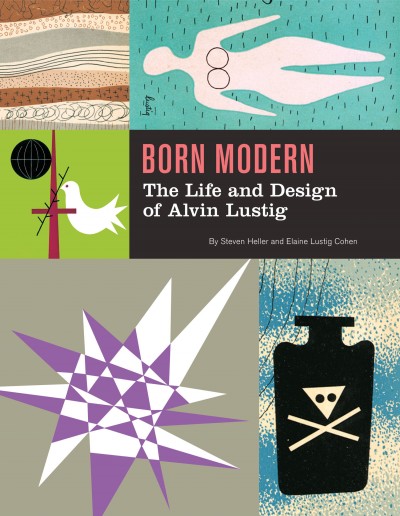
There are two new books about designer Alvin Lustig available this month — Born Modern: The Life and Design of Alvin Lustig by Steven Heller and Elaine Lustig Cohen (Chronicle Books*) and Purity of Aim: The Book Jacket Designs of Alvin Lustig by Ned Drew and Paul Sternberger (RIT Cary Graphic Arts Press).

The Death of the Book has Been Greatly Exaggerated — Tech columnist Christopher Mims on the “irrational exuberance” around e-books (via MobyLives):

Tech pundits recently moved up the date for the death of the book, to sometime around 2015, inspired largely by the rapid adoption of the iPad and the success of Amazon’s Kindle e-reader. But in their rush to christen a new era of media consumption, have the pundits overreached?

I’m calling the peak of inflated expectations now. Get ready for the next phase of the hype cycle – the trough of disillusionment.

The Secret Life of Shepperton — A photo essay on Shepperton, the suburban town south west of London where author J. G. Ballard spent most of his adult life. The photographs are accompanied by text from Ballard’s own novels, autobiography, interviews as well as observations about the town and its history (via 3:AM).

And finally…

The Wonderful 36 Pages features This is Silly! by Toronto-based artist/illustrator Gary Taxali:

* Chronicle Books is distributed in Canada by my employer Raincoast Books.

Comments closed

Midweek Miscellany

Lost Libraries — With the personal book collection of David Markson ending up at The Strand bookstore in New York, Craig Fehrman examines the fate authors’ libraries for The Boston Globe (via The Second Pass):

Most people might imagine that authors’ libraries matter — that scholars and readers should care what books authors read, what they thought about them, what they scribbled in the margins. But far more libraries get dispersed than saved. In fact, David Markson can now take his place in a long and distinguished line of writers whose personal libraries were quickly, casually broken down. Herman Melville’s books? One bookstore bought an assortment for $120, then scrapped the theological titles for paper. Stephen Crane’s? His widow died a brothel madam, and her estate (and his books) were auctioned off on the steps of a Florida courthouse. Ernest Hemingway’s? To this day, all 9,000 titles remain trapped in his Cuban villa.

Fehrman expands on this article — and the reasons we should not have been surprised that Markson’s books found their way to The Strand — at his blog.

Eating Each Other is Wrong — Evan Scnittman, Managing and Director of Sales and Marketing at Bloomsbury, argues that e-books don’t cannibalize print:

The most important lesson I can convey to book publishing professionals is that they must understand that those of us who have made the transition to ebooks, buy ebooks, not print books. Ebook reading device users don’t shop in bookstores and then decide what edition they want; ebook device readers buy what is available in ebookstores. Search an ebookstore for a title and if it doesn’t come up, it doesn’t exist – no matter how many versions are available in print.

Ebooks aren’t a better value, ebooks aren’t more attractive nor are they a threat to the print version of any immersive reading book. This isn’t the same as paperback versions vs hardcover – where the platform and convenience are the same – the timing and pricing are the key ingredients. Books that aren’t in ebook form are do not exist to ebook reading consumers. There is no cannibalization if in the mind of the buyer if there is no version available to them.

The Forgotten Mimics — In the 11th installment of The National Post’s ‘Ecology of Books’ series, Mark Medley talks to to some of Canada’s foremost literary translators:

“We’re not robots,” says [Lazer] Lederhendler, 59, who won the Governor General’s Literary Award for his translation of Dickner’s last novel, Nikolski. “We have a way of reading a book. We have a way of using the language. We have our own vocabulary, our likes and dislikes in terms of this phrase or that phrase. It’s a kind of balancing act between observing the fact that you’re at the service of someone else’s work, but at the same time it’s an artistic mission.”

Four Decades of Art — A mini-documentary about illustration in The New York Times Op-Ed page, featuring interviews with art directors and illustrators.

And finally…

Type designer Matthew Carter and writer David Simon (creator of The Wire) were recently named MacArthur Fellows. The Fellowship is a $500,000 (US), no-strings-attached grant for people who have shown exceptional creativity in their work and promise to do more (via How Magazine):

Comments closed

IDEO’s Future of the Book

Design consultancy IDEO present three visions for the “future of the book” (none of which include print of course):

Any thoughts?

7 Comments

Opportunities and Charm

In a recent op-ed for The Financial Times (registration required), John Makinson, CEO of the Penguin Group, outlined the opportunities e-books offer to publishers:

What is being missed in the debate about the division of digital spoils is the opportunity offered by e-books to authors and readers, as well as to publishers who have the specialist skills to exploit it… [W]e should not forget that the growth of the book market has always been driven not by changes in consumer demand but by the availability of new channels of supply. It was true of supermarkets and book clubs, and it will be true of digital platforms and formats.

While e-books mean that publishers can develop new products that expand on the traditional book, says Makinson, digital technology will also provide them with “rich consumer data” that can inform decisions about pricing and content. Furthermore, social networks and online communities  will allow for greater reader engagement in the publishing process.

According to Makinson, technology will redefine the industry but, so long as publishers are adept at learning new skills, it will enhance their role rather than diminish it. And even with the “explosive growth” of e-books, Makinson is optimistic about print:

Perhaps the charm of the physical book will be lost one day. But I doubt it. Readers of all ages retain a remarkable emotional attachment to the thing. It is portable, convenient and a pleasure to own… There’s life in the old book yet.

(link)

Comments closed

Tintin and the Secret of Literature

A neat animated digital book cover by Charlie Orr for Tom McCarthy’s Tintin and the Secret of Literature:

[I have removed the video — for the time being at least — at the request of my web hosting service due to a complaint from Citel Video. The video is still available at Vimeo]

Does anyone have any more information on this? There’s more information about Charlie’s digital book cover project at The Hypothetical Library.

(via @HughMcGuire)

Comments closed

Something for the Weekend

Today is Penguin’s 75th Birthday! Happy Birthday Penguin.

Tony Lacey, Publishing Director of Penguin, discusses the Penguin Decades series:

And The Guardian interviews Penguin Chief Executive John Makinson, who sounds pretty pleased with himself (Penguin just announced record-breaking half year results):

“[E-books] redefine what we do as publishers and I feel, compared with most of my counterparts, more optimistic about what this means for us,” he says. “Of course there are issues around copyright protection and there are worries around pricing and around piracy, royalty rates and so on, but there is also this huge opportunity to do more as publishers.” Publishing, he says, must embrace innovation: “I am keen on the idea that every book that we put on to an iPad has an author interview, a video interview, at the beginning. I have no idea whether this is a good idea or not. There has to be a culture of experimentation, which doesn’t come naturally to book publishers.

In other news…

Copy Writer from the Dark Side — Author Will Self (Liver) discusses advertising with Gordon Comstock for an interview the Creative Review:

I straighten my dog collar and point out some of the things we might have in common, the novelist and the adman. The love of epigrams, the twisting of cliché, the use of animals behaving uncannily – all Self tropes, all things that a copywriter might well have in his book.

It’s a notion I can imagine certain writers would bridle at, but Self only nods philosophically, “Well, maybe I am a copywriter that’s gone to the dark side, I don’t know.”

Wonder Woman Returns — Kate Beaton goes all superhero and shit at Hark! A Vagrant. Kate is now also selling prints directly from her site and from TopatoCo.

And finally, on a related note and because it’s Friday,…

Lady Gaga Kidnaps Commissioner Gordon:

Supervillain Lady Gaga brazenly abducted Commissioner James Gordon from a charity fundraiser Tuesday, leaving police baffled and the citizens of Gotham fearing for their safety. Known for her outlandish costumes and geometric polygon hair, the criminal madwoman made a daring escape from Arkham Asylum last week and has been taunting authorities by interrupting television broadcasts ever since… While the kidnapping occurred at stately Wayne Manor, home of playboy jet-setter Bruce Wayne, the eccentric billionaire was not available for comment.

Comments closed

Pass the Gestalt, Please

An interesting post by the whip-smart Evan Schnittman, Managing Director of Group Sales and Marketing at Bloomsbury, about e-book rights and royalties at his blog Black Plastic Glasses:

[A] successful and coherent publishing is not the sum of individual publishing rights, but rather the gestalt work presented coherently to a global audience. Viewing the ebook out of the context of the rest of the work gets us nowhere. We must understand how ebooks fit into the publishing ecosphere and only then can we determine what the right royalty should be… The whole work has FAR greater value than the sum of the individual rights. Allowing each individual part, or right, to be disaggregated and auctioned to the highest bidder serves only those who make profit from short-term gain.

(via MobyLives)

Comments closed

Agents of Change

There’s a great op-ed by Stephen Page, chief executive of Faber & Faber, in today’s Guardian about the iPad and publishing:

It’s clear that publishers must move faster to establish our compelling and useful role in the modern life of reading. While acquiring new expertise, we must assert the best of our traditional strengths; providing capital (in the form of advance payments), offering editorial expertise, and creating a readership by designing, creating, storing, promoting and selling the works of writers. But that’s not enough. Publishers also have to explain what value they are bringing to the relationship between writers and readers, a conversation that is made far more transparent through digital media and digital texts.

Page goes on to list what he sees as guiding principles for publishing going forward. These include retaining print and digital rights, reviewing royalties, flexible pricing, connecting to readers, and excellent metadata. He concludes:

The iPad launch is not the moment, but that’s because the moment has passed. We need to work with authors in new ways, and keep pace with reading’s evolution, or better still become agents of change ourselves.

It’s a must-read. If you work in publishing, send it to your CEO.

1 Comment

Midweek Miscellany

90 Covers — David McCandless talks about the protracted cover design process for his new book Information is Beautiful (via This Isn’t Happiness):

Engage — Online literary magazine and short fiction hub Joyland — founded by authors Brian Joseph Davis and Emily Schultz — is launching an e-book imprint.

Graphic Novels for Booksellers — A core list compiled by Graphic Novel Reporter.

And if that’s not nerdcore enough for you, take a look at The Periodic Table Of Super-Powers.  “Orphan” is atomic number 1.

Absurdity and Tragedy — Author Jonathan Lethem on Philip K. Dick and his own novel Chronic City at 21C Magazine (via Maud Newton):

I’ve always agreed with the view that – with science fiction – its predictive powers were the least important or least relevant aspect of its public profile. I always loved stuff like Orwell’s 1984, where he explicitly said “It’s 1948, reversed.” I liked writers that were doing allegorical, satirical, fantastical versions of everyday life.

That suggests that Dick’s work is dated to the ’60s and ’70s. And I thought of him very much in this framework, and not as an extrapolative writer… But I think that Dick saw the makings of the contemporary reality we experience so profoundly.

As I’ve mentioned previously, I wanted to like Chronic City more than I did. Dan Green has a comprehensive critique of the book (and Lethem’s post-modernism) at his blog The Reading Experience. Dan is, perhaps, less forgiving than I would be, but definitely smarter…

[W]hile Lethem’s work is consistent with much postmodern fiction in that it is essentially comic, the comedy of a novel like Chronic City is indeed much too gentle, too shy of the more corrosive humor of much postmodern comedy. It isn’t so much that the novel is short on “satiric bite” as that ultimately it is merely satire, a relatively mild critique of post-9/11 New York under Bloomberg, which has become inhospitable to its misfits and nonconformists.

Lethem reads from Chronic City and discusses the book in this video interview with The Guardian.

2 Comments

Midweek Miscellany

McGraw-Hill paperbacks designed by Rudolph De Harak — A nice Flickr set of vintage covers from Joe Kral, who apparently has an amazing book collection (via Words & Eggs).

Free Libraries Are Full of Books That No One Reads — Author Paul Theroux talks to The Atlantic about e-books (via The Second Pass):

I don’t think people will read more fiction than they have in the past… but something certainly is lost—the physicality of a book, how one makes a book one’s own by reading it (scribbling in it, dog-earing pages, spilling coffee on it) and living with it as an object… I can’t predict how reading habits will change. But I will say that the greatest loss is the paper archive—no more a great stack of manuscripts, letters, and notebooks from a writer’s life, but only a tiny pile of disks, little plastic cookies where once were calligraphic marvels.

Not Dead Yet — An interesting post at Personanondata on what the resilience of the CD format means for books:

Many believe the physical book will disappear within in the next ten years yet the example of the music CD suggests the future of the book may be more nuanced. The availability of electronic versions of trade content will approach 100% in less than ten years… Despite the availability however, electronic content is likely to represent only one of a number of ways consumers will engage with book content…  Rather than disappear, the lowly print book may retain a position of wide distribution… and become the focal point of a facilitated interaction with numerous content acquisition options for consumers.

The information on CD sales in the post comes from a recent report in The Economist, which also ran an interesting article about the future of copyright on the same day:

The lawmakers intended… to balance the incentive to create with the interest that society has in free access to knowledge and art… Over the past 50 years, however, that balance has shifted. Largely thanks to the entertainment industry’s lawyers and lobbyists, copyright’s scope and duration have vastly increased… They are now calling for even greater protection, and there have been efforts to introduce similar terms in Europe. Such arguments should be resisted: it is time to tip the balance back.

The New York Times obituary for publishing executive and copywriter Nina Bourne:

The campaign she created for “Catch-22” is now regarded as a classic. Ms. Bourne was the most passionate in-house champion of the book, a darkly comic tale of World War II by a first-time novelist. Pleading for an increase in the initial print run, she turned to her colleagues during a production meeting, tears in her eyes, and asked, “If I can’t get this, why am I here?”

And finally…

Architecture Under Construction — a beautiful set of photographs by Stanley Greenberg from a new book published by the University of Chicago Press. Pictured: Untitled, Toronto, Ontario, 2005 — Royal Ontario Museum, Studio Daniel Libeskind (via PD Smith).

Comments closed

#Failure

It probably hasn’t escaped your notice that following the departure of founder and publisher Bob Miller to Workman Publishing last month, HarperCollins imprint HarperStudio is going to close after just 2 years in business.

As a publisher, HarperStudio garnered a remarkable amount of media attention for offering authors lower advances in exchange for a greater share of profits, their plans to sell book to booksellers on a non-returnable basis, and an early and comprehensive embrace of social media.

There was, however, a general feeling — particularly within the industry itself — that despite (or because of) their marketing-savvy, the imprint didn’t quite live up to the hype (even if not everyone felt quite as strongly about it as Dennis Johnson).

In the end they unable to keep author advances down, or their books non-returnable. Yet, as writer Mark Barrett who blogs at Ditchwalk notes, these problems are hardly unique to HarperStudio and, in a sense, their failure is a collective one for publishing.

Perhaps we simply expected (or hoped for) too much?

Nevertheless, I was disappointed by HarperStudio for the more basic reason that their books always seemed to be less innovative than the company itself. When people talked about HarperStudio it was rarely about what they actually published. The books were — for all their audacious marketing — eminently forgettable. They were kind of things that traditional small-to-medium sized trade publishers have a tendency to churn out with alarming regularity (with perhaps the notable exception of Crush It! for which HarperStudio reputedly paid a rather large advance), and it was never clear to me who their core readership was intended to be. Their innovations seemed to do little to improve the kind of books being the published.

In this sense, HarperStudio’s closure has echoes of Quartet Press.

Like many people, I had unrealistically high expectations for Quartet, and I still admire the fact that the people involved put their money where their mouths were (and mostly still are). But my heart sank when it became clear that for all their innovative plans for e-books, they launched with nothing ready to publish. The eventual announcement that they would be publishing romance fiction meant that, unlike HarperStudio, they at least planned to publish to a recognised (and potentially profitable) niche, but somehow this felt like an afterthought. The digital medium was more important than the message.

I was reminded of all this by Brett Sandusky‘s recent announcement that his project Publishr is soliciting for material to publish:

Publishr is proud to announce a new project: Publishr will bring an eBook, which has yet to be created, to market. We will do this in an atmosphere of complete transparency.

Publishr currently seeks proposals from motivated authors (particularly those with works of unpublished fiction and narrative non-fiction) as well as support from contributors who are interested in innovation and building a superior native-digital eBook product or suite of products that will be sold in the real world.

In many ways this is great idea, and there are definitely lessons to be learnt from this kind of experimentation. But Publishr seems to be following in the footsteps of HarperStudio and Quartet (albeit on a smaller scale). Based on the erroneous belief that there is a large reservoir of quality material that can be easily and quickly tapped, the focus is on revolutionizing how to publish rather than what or who to publish.

There is, of course, wisdom to innovating the process rather than the product. Toyota’s success was built on innovative factories, not innovative and original products (at least until the Prius came along). And yet the Toyota process was geared (again until recently) to producing certain kinds of consistently good, inexpensive cars (which, I would guess, was all the consumer actually cared about).

My point is not that we should not stop experimenting with new author contracts, transparency, formats, trade terms, or marketing — we need to try new things and be allowed to fail. But this should not come at the expense of consistently good, interesting (and inexpensive) books.

Perhaps a model for start-ups is to be found in James Bridle’s modestly immodest print-on-demand publishing effort Bookkake. Although Bookkake is not publishing new material (and who knows whether it is making money), it seems a more sustainable kind of venture, not least because James has published books that he cares about. They have an sense of coherence and quality that one might expect from a successful small press.

Another alternative is demonstrated by Toronto small press ChiZine Publications (CZP) who established a ‘dark genre’ webzine long before they moved into print. Founders Brett Alexander Savory and Sandra Kasturi knew what the kind of stories they liked — “weird, subtle, surreal, disturbing dark fiction and fantasy” — and built a community around it. The books (available in multiple formats) came later.

The CZP story in particular seems to be the polar opposite of HarperStudio, Quartet, and Publishr. CZP was launched because they had stories they wanted to publish, not because they wanted to ‘fix’ the system. I’m not saying that improving the process isn’t important, it’s just that we need to find new, interesting, consistently good content as wellmeaningful stuff that matters (if only to us). If we don’t, the new books will just be glowing versions of the old books (with better PR)… Plus ça change…

8 Comments