Skip to content

Tag: david pearson

Favourite Covers of 2011

After posting my long overdue picks for 2010 last week, here are my selections for my favourite book covers of 2011.

I’m currently reading Where The Stress Falls a collection of writing by Susan Sontag published in 2001. In an essay about art she quotes Paul Valéry on the painter Corot. “One must always apologize for talking about painting” he says. I know just what he means. I feel the same way about book design. Perhaps even more than a painting, what you see is what you get with a book jacket. If you have to explain why it works, it probably doesn’t. Or you’re talking to the wrong crowd. But there’s something else too. I also feel like I need to apologize for not knowing more; for producing reductive lists like this one; for being, well, so presumptuous…

The 2011 list has changed a few times in the last few days and would likely be different again if you asked me tomorrow — not for lack of quality you understand, but simply because narrowing the list down to a manageable number and deciding which should be in the final ‘top 10’ was just plain hard. This isn’t a definitive survey of book covers in 2011 by any means (sorry!) it’s simply a list of the book jackets that caught my eye this year — designs I thought that were beautiful, a bit different, audacious, a bit out of the ordinary, a bit worthwhile…  I’m grateful to all the designers who created these covers, who gave me suggestions and helped me source the images. Once again, I’ve been struck by their generosity. Nevertheless I have surely I’ve missed some great covers. Tell me what they are in the comments.

10 Comments

My Favourite Covers of 2010

At the end of last year, Joseph Sullivan, curator of the late lamented The Book Design Review, asked me to write about my favourite covers of 2010. I’d always stayed away from such posts in the past because it was Joseph’s thing (his 2009 list is here). But since it was Joe who was doing the asking and The BDR was on “indefinite hiatus,” how could I not?

For various reasons, the list I compiled didn’t get used in the end, and it has sat in my drafts folder for about year now. I now have a list of my favourite covers of 2011, but before I post it I thought I would share that original list from 2010, if only for a bit of context.

I’ve made a few minor alterations to the list I sent to Joe — mostly to better accommodate the series designs and to fully utilise 12 months of regret and hindsight — but it is more or less intact, in spirit at least.

I’ve included the short introduction I wrote for the original piece to explain my process (or lack thereof…).

(Hindsight = 20/20: Apparently I like negative space. A LOT).

The Top 10 Book Covers of 2010

Selecting an annual top 10 of anything — film, music, books — is fraught with difficulty. Not only do you have to sift through all things you have seen, heard, and read over the course of a year (assuming you can remember them all), you must somehow take into account all the things you meant to get to and didn’t (where does one even start?). Worse, you are haunted by the awful, inevitable realization that there were any number of incredible things so outside your usual cultural range that they didn’t even register on your consciousness — the “unknown unknowns,” to borrow Donald Rumsfeld’s immortal phrase. Fate usually decides that you will discover at least one previously unknown work of brilliance exactly 24-hours after you publicly declare your favourites…

Then, having grappled with (ignored) all those thorny issues (and plunged on regardless), there is further problem of what actually constitutes good (let alone “great”) book cover design. Part science, part art (part pleasing interested parties), good book cover design is slippery and alchemical. How does one judge? Using what criteria? Ask 10 designers and you will surely get 10 differently nuanced answers.

I have not read all the books on this list, so I cannot claim authority on appropriateness of every cover to its subject (surely an significant consideration, and yet who would want to limit their list only to the books they had read?), so my criteria, such as they were, included the quality of the overall design — the composition, image selection and typography — as well as originality, swagger and the indefinable  je ne sais quoi essential in my opinion to really great covers.

And with that complete abdication from any claim to comprehensiveness or authority, I introduce my picks for the top 10 book covers of the last year with apologies to all the designers — particularly outside of North America and the UK — whose amazing work I have missed, forgotten, or otherwise neglected.

The covers are presented in alphabetically by title.

3 Comments

Midweek Miscellany

Book designer and all-round good chap David Pearson on phillumeny at We Made This:

It’s no coincidence that a book designer should be drawn to matchbox labels. Their shape is intrinsically book-like, their method of communication instantaneous and spare, and they provide a dizzying range of illustrative styles. Their uncluttered compositions ensure communication across language barriers, and designs appear cohesive as a result of type and image being rendered by the same hand. But perhaps most alluring of all is their uncompromised clarity of purpose, an attribute that most modern designers can only dream about.

You can see more of David’s ephemera collection on Flickr, there’s another amazing collection of match-box covers here.

An Invisible Rightness — Six graphic designers, including Derek Birdsall and Peter Saville, discuss designers they admire in The Guardian.

A Repurposeful Life — Author William Gibson on cities and fiction in The Scientific American:

Necessity being one of invention’s many mothers, I have a certain faith in our ability to repurpose almost anything, provided it becomes sufficiently necessary. Then again, I suspect we’ve abandoned cities in the past because they were too thoroughly built to do some specific something that’s no longer required.

Let Us Tweet! — An epic-length rant by Jared Lanier, author of You Are Not a Gadget, at Edge:

I’m astonished at how readily a great many people I know, young people, have accepted a reduced economic prospect and limited freedoms in any substantial sense, and basically traded them for being able to screw around online… What that leads to is the world that Wells and Kurt Vonnegut and many others wrote about, where there just is enough virtual bread and circuses, just barely enough to keep the poor in check, and perhaps somehow not breeding, and they just kind of either wither away through attrition or something.

The A.V. Club offer a nice primer on newspaper comics.

Meanwhile… Robot 6 lists six great superhero comics from unlikely sources.

And finally…

An Act of Vengeance Against Former PleasuresThe Comics Journal reviews The League of Extraordinary Gentlemen: Century 1969, neatly summing up my own reservations about the direction of the series:

What’s disconcerting about 1969 is how joyless the exercise has become, and how wan and stretched the story feels. Like its predecessor, 1969 comes off as glum and a bit rancid. It feels like the story of characters who have outlived their time, which may indeed be the point… I don’t need to itemize the various bits of cleverness in 1969, or to point out the screamingly obvious, that 1969 is more intelligent and insinuating than most comic books. It is, after all, a book by Alan Moore and Kevin O’Neill. But the taste of it sits like battery acid on the tongue, and, like 1910 before it, it reads like an act of vengeance against former pleasures.

Comments closed

Something for the Weekend

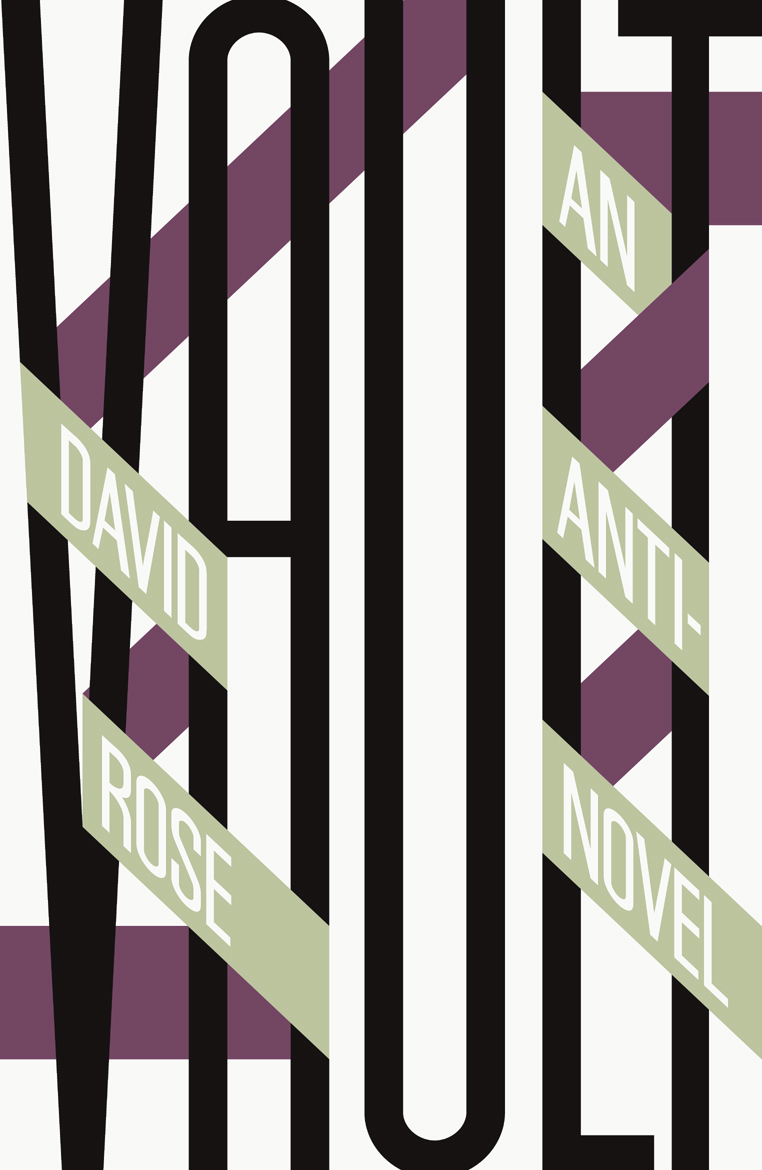
A distinctively typographic cover by David Pearson for Vault by David Rose, new from Salt Publishing.

Giving Up Irony — John Self reviews Edward St. Aubyn’s At Last:

The author’s background, like Patrick’s, is of inherited wealth; perhaps it is this which enables him to treat his characters mockingly and sympathetically at the same time. His brittle, witty prose evokes comparisons with Evelyn Waugh, whose snobbish attraction to the upper classes, looking in on them from without, contrasts with St Aubyn’s cool-eyed appraisal. The phrase “a handful of dust”, quietly slipped into At Last, could be an acknowledgement of the similarities and contrasts.

Patrick is like his creator, not just in his background, but in his stylistic weaknesses:

“It’s the hardest addiction of all. Forget heroin. Just try giving up irony, that deep down need to mean two things at once, to be in two places at once, not to be there for the catastrophe of a fixed meaning.”

The Architecture of the Secret Lair — Mark Lamster for Design Observer:

The Bin Laden compound makes an interesting contrast with the secret modern lairs created for Bond villains by the legendary production designer Ken Adam. These have routinely been described as unrealistic, insofar as they could never be built without drawing attention. It’s curious now, in retrospect, to think that it was fear that kept the local population from Dr. No’s island hideaway (which was just off British and American territory). Though Bond films make us think of visual extravagance, the most visually arresting set from the film was the rather raw interrogation room, with its cross-beam, ocular ceiling. What was in Osama’s basement?

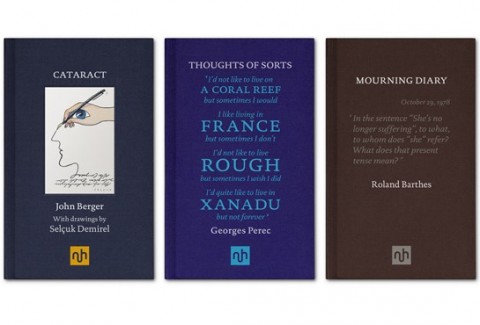
Notting Hill Editions, a new publishing imprint devoted to the essay, launches this month with books by from John Berger, Georges Perec and Roland Barthes among others. The typographic covers were designed by Garvin Hirst at Berlin-based design consultancy Flok.

And finally…

The Burden of Entertainment — Woody Allen discusses five books that still resonate with him:

The Catcher in the Rye has always had special meaning for me because I read it when I was young – eighteen or so. It resonated with my fantasies about Manhattan, the Upper East Side and New York City in general.

It was such a relief from the other books I was reading at the time, which all had a quality of homework to them. For me, reading Middlemarch or Sentimental Education was work, whereas reading The Catcher in the Rye was pure pleasure. The burden of entertainment is on the author. Salinger fulfils that obligation from the first sentence on.

Reading and pleasure didn’t go together for me when I was younger. Reading was something you did for school, something you did for obligation, something you did if you wanted to take out a certain kind of woman. It wasn’t something I did for fun. But Catcher in the Rye was different. It was amusing, it was in my vernacular, and the atmosphere held great emotional resonance for me. I reread it on a few occasions and I always get a kick out of it.

new publishing imprint launching in May, which is dedicated to revitalising and celebrating the essay.
1 Comment

Great Ideas Volume V

Penguin Great Ideas V David Pearson is posting the covers for the new Penguin Great Ideas series to Flickr. As you can see, they are stunning.

You can read my interview with David Pearson here.

1 Comment

Something for the Weekend

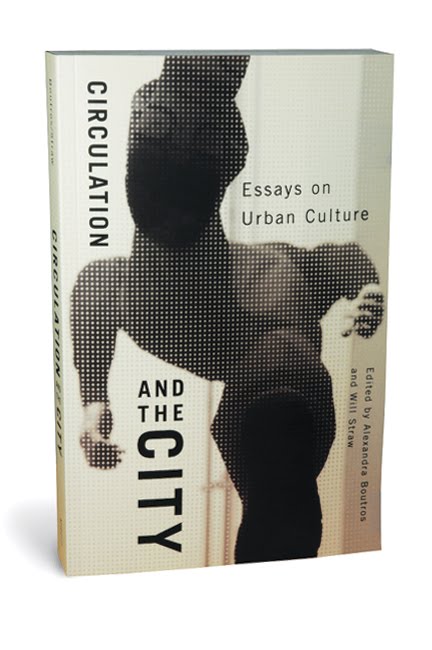
Circulation and the City design by David Drummond

New from David Drummond

The Original Spirit — Toronto indie institution This Ain’t The Rosedale Library (one of the 10 best bookshops in the world according to The Guardian) featured at Books@Torontoist, with some nice quotes from owner Charlie Huisken:

“creative knowledge [is] accumulative and comes from many sources… Being an autodidact has served me well”

Books in the Age of the iPad — Craig Mod’s article on printed books and digital publishing caused much of a flutter on Twitter yesterday. I’m not sure that I entirely agree with his thesis — which seems to imply that some kinds of content can be completely divorced from their media — but his website is beautifully designed, and more importantly he makes some interesting points. I especially like his conclusion:

I propose the following to be considered whenever we think of printing a book:

  • The Books We Make embrace their physicality — working in concert with the content to illuminate the narrative.
  • The Books We Make are confident in form and usage of material.
  • The Books We Make exploit the advantages of print.
  • The Books We Make are built to last

In that vein, more on David Pearson‘s beautiful book cover designs for Cormac McCarthy at We Made This. I love that he used rubber stamps…

And finally… Jaron Lanier, author of You Are Not A Gadget, talks about the failure of Web2.0 with Aleks Krotoski of The Guardian:

3 Comments

Midweek Miscellany (Paul Auster Edition), November 25th, 2009

The award-winning Folio Society edition of The New York Trilogy by Paul Auster and illustrated by Tom Burns has just about blown my mind. MUST. HAVE.

James Wood on the novels of Paul Auster in the The New Yorker:

Auster is a compelling storyteller, but his stories are assertions rather than persuasions. They declare themselves; they hound the next revelation. Because nothing is persuasively assembled, the inevitable postmodern disassembly leaves one largely untouched. (The disassembly is also grindingly explicit, spelled out in billboard-size type.) Presence fails to turn into significant absence, because presence was not present enough. This is the crevasse that divides Auster from novelists like José Saramago, or the Philip Roth of “The Ghost Writer.”

(Personally speaking I think I prefer Auster’s interesting awkward failures over the portentous bludgeon prose of Philip Roth, but that’s just me…)

And, if you haven’t had enough Auster for one post, he’s also interviewed in New York Magazine.

The Making of Fantastic Mr. Fox designed by Angus Hyland — New work from Pentagram for Rizzoli.

Covers from Cleethorpes — A brief, but funny, interview with designer David Pearson at It’s Nice That.

“We Like Lists Because We Don’t Want to Die” — Umberto Eco interviewed in Der Spiegel:

The list is the origin of culture. It’s part of the history of art and literature. What does culture want? To make infinity comprehensible. It also wants to create order — not always, but often. And how, as a human being, does one face infinity? How does one attempt to grasp the incomprehensible? Through lists, through catalogs, through collections in museums and through encyclopedias and dictionaries.

An Innocent Abroad — Journalist and cartoonist Joe Sacco (Palestine, Safe Area Gorazde) interviewed about his new book Footnotes in Gaza in The Observer:

I’m a nondescript figure; on some level, I’m a cipher. The thing is: I don’t want to emote too much when I draw myself. The stories are about other people, not me. I’d rather emphasise their feelings. If I do show mine – let’s say I’m shaking [with fear] more than the people I’m with – it’s only ever to throw their situation into starker relief.

And on the speaking of comics…

Paul Gravett, author of multiple books on the art form, interviewed by Dazed & Confused:

I like the control I have when reading a comic. I’ve grown impatient and disenchanted with the tropes of a lot of movies and TV, their conventional angles and cuts, their manipulation through music, lighting, special effects and above all, the efforts of acting to make me emote. Comics struggle to make us feel anything at all… They often don’t work that brilliantly, but when they do, the impact of fixed, unephemeral, often hand-drawn images can really surprise me. It’s a primal, even primitive medium, as old as our first cave paintings, and it is still being invented and discovered.

2 Comments

Q & A with David Pearson, Type As Image

Penguin Great Ideas

Does British designer David Pearson really need an introduction?

Even if you don’t recognise the name immediately — and perhaps it is less familiar on this side of the Atlantic — then you will almost certainly recognise David’s type-driven design work: Penguin by Design by Phil Baines, Pocket Penguins, Penguin Great Loves, Penguin Great Journeys, Penguin Reference, and, of course, the astonishing Penguin Great Ideas series.

When the first set of Great Ideas titles arrived they looked like nothing else in the bookstore. Each cover was unique and yet they all fitted perfectly within the series. Their thick paper covers, limited colour palette and bold typography were clearly a wink to the design history of Penguin books (and perhaps the Arts & Craft movement) but also imaginative, playful, and starkly modern.

Since then, there have been three more sets in the Great Ideas series with a fifth on the way. David still works with Penguin, but has set up his own firm. He has designed covers for Éditions Zulma, and somehow found the time to help launch White’s Books.

David and I chatted over email…
Illustration by Michael Kirkham; design by David Pearson

How did you get into book design?

Whilst at college I was lucky enough to be offered a work placement by my Typography tutor, Phil Baines. The job was to design a large-scale art monograph for Phaidon Press and Phil walked me through every stage of the book’s production, from styling the edited manuscript through to the final layouts. I even got to run my designs past Alan Fletcher, who at the time was responsible for overseeing Phaidon’s visual output. This seemed like an absurdly privileged position for a student to be in. The first time I went to Phil’s studio he told me off for not aligning the letters on his hot and cold taps so you can imagine how fastidiously constructed my pages became under his tutelage. Before long I began to laugh at Phil’s funny ways and he in turn mocked my special design slippers. A friendship was born, nicknames were awarded and my first experience with books turned out to be an entirely lovely one. Moving into my third year, I knew that book design was for me and began to check Penguin’s website every week for job vacancies. For all sorts of obvious reasons I knew that I wanted to work for the company and made sure that I checked throughout my final year at college, desperate as I was to remain in London afterwards. I got lucky and landed a job as text designer (setting the insides of books) the day after I graduated.
This is a terrible question, but I’m curious: Which came first, your interest in Penguin’s design history, or designing books about Penguin’s design history?

Oh, absolutely the former. I was already an avid collector and the idea for a design retrospective was one that I’d run past my Art Director before it was eventually tagged onto the company’s 70-year anniversary celebrations. I’d always wanted to get into the archives and have a really good poke around and fortunately for me, this gave me the perfect excuse. If I was unaware of the magnitude of the company’s past achievements they very quickly became apparent as I worked my way through the vast isles of books.

The Penguin archive
Experimental layout from the Penguin archive

What was it like working with designer and typographer Phil Baines on Penguin By Design?

Having been given an enormous amount of freedom by the company (to personally manage the project) I found myself in a position where I could enlist an author. Phil seemed like the perfect choice because of his analytical and objective writing style. The last thing I wanted was a blinkered, frothing account of the company’s history because even a cursory glance round the archive revealed some decidedly dark periods. Phil and I keep very similar hours so the book took shape very naturally and it felt strangely normal to work through the night before heading to a pub together the following morning. Indeed, because there was no framework in place for our department to produce books of this kind, I had to rely on the goodwill of my Art Director, Jim Stoddart as I would design covers during the day and then the design book at night. The lines often became blurred and I was once asked to be escorted from the building as it was judged that I had not left for over two days. Phil is currently working on Puffin by Design, a partnering edition to Penguin by Design and as much as I would’ve liked to have been asked to work on it I suspect that we’re both better off that I wasn’t!
Artwork by Phil Baines; design by David Pearson

Your work on Penguin’s Great Ideas series won you a D&AD Yellow Pencil. What was the design brief for books?

Like all the good ones it was a happy blend of strict parameters (most notably in terms of budget) and creative freedom (there being no existing blueprint to adhere to or living authors to appease). The series’ success should be attributed to many different factors: Editor Simon Winder’s original idea was a great one, implying that world-changing thought and writing equates to Penguin, while the finished books seemed to fit a model of what people wanted from the company, a reaffirmation of Allen Lane’s original philosophy; but above all the publisher displayed an unfaltering level of confidence in the project and allowed us to break some fairly established rules in the process.
Artwork and design by David Pearson
The fourth series of Great Ideas has just been released. Was it difficult to create interesting new designs that were consistent with the previous two series?

Speaking from my own perspective I’d say that I’ve loosened up as a designer. Looking at my earlier efforts I think I was rather inhibited and it wasn’t until I brought in Phil that I could see the true size of the project’s potential. Phil added pace and variety through his very bold, expressive cover designs and this made me realise that I too could let my hair down a little.
Artwork by Joe McLaren; design David Pearson
Artwork and design by David Pearson

How is running your own studio different from working at Penguin?

There are certainly negative sides to being ‘out of house’. For example, I am no longer in a position to affect the approval of my work. Instead it has to very much stand up for itself, without the highly-sensitive designer attached. That said, I feel much calmer as a result. I may well still be in a honeymoon period but I’m enjoying managing every facet of my business – from doing the accounts to cleaning the windows. The rewards seem so much more tangible as a result.

Could you describe your design process for book covers?

Since the vast majority of what I do is type-driven, a fair amount of time is given over to researching letterforms. I am lucky enough to work just down the road from one of the world’s best typographic resources and thankfully they don’t mind me popping over to waste their time. Typophiles – in particular – can be a particularly unforgiving bunch and so time spent researching is never wasted.

Design by David Pearson

Design by David Pearson
What are your favourite books to work on?

Working within tight constraints is a blessing. There’s nothing quite so daunting as a completely open brief as you never get the feeling that you’re solving a problem, rather just satisfying your own whims. I always feel much more creative when my palette has been limited, either by the client or by myself.
Illustration and design by David Pearson

What are the most challenging?

Very simply, the ones that attempt to house more than one idea or repeat a sentiment. I think that book covers communicate quicker if they are boiled down to their most essential elements or rather, they have the best chance to communicate if they do one thing and do one thing purposefully. Confidence and a clarity of purpose are not found in abundance in trade publishing.
Illustration by Victoria Sawdon; design by David Pearson

Massimo Vignelli says that designers just need 6 typefaces. Should designers limit the number of typefaces they use?

Not at all. I am completely opposed to this view. While I appreciate that it takes time to fully understand and competently utilise a typeface I suspect that they all have a use for something. And doesn’t the use of such a limited palette suggest an unwillingness to shift from a preconceived agenda? This is all well and good if the client is buying into your look and trading from it but I would question whether this is a healthy starting point for someone working in the communications industry. Or, perhaps I’m just not enough of a Modernist to understand such an approach.

What are your favourite typefaces to work with?

I absolutely love Vendôme by François Ganeau and Roger Excoffon. Its over-emphasised, angular serifs brilliantly support its sensuous, bulking forms. I wasn’t in Paris in the Fifties, but Vendôme feels to me very much like Paris in the Fifties. Anything by the peerless Matthew Carter is a joy to use and I recently saved up to buy Martin Majoor’s Nexus family which I seem to be consistently delighted with.
From David Pearson's ephemera collection

Where do look for inspiration and who are some of your design heroes?

Like most book designers I have a healthy collection of ephemera; matchbox and travel labels being my favourite, and a huge chunk of my salary is redirected towards book buying. My design heroes are rather predictable, but for good reason I think. Jamie Keenan’s covers always seem so fresh and live long in the memory because they require a level of decoding. Jamie is also one of those rare designers whose work is just as effective on either side of the Atlantic. Hans Schmoller’s meticulous and elegant typography reassures me on a great many levels and I can’t quite manufacture enough situations where I am working with the immensely talented Joe McLaren. Then there’s the Penguin roll call: Curtis, Miles, Gentleman, Games, Marber, Birdsall, Robertson, Aldridge, Pelham and of course, Tschichold.
Design by David Pearson (not yet published/work in progress)

What does the future hold for book cover design?

It feels like this has been pretty well covered by people who are much more future literate than myself. All I can do, as a simple print designer, is live from day-to-day.
Design by David Pearson (not yet published/work in progress)

Thanks David!

You can see more of David’s work at his Flickr page and the David Pearson Design site.

27 Comments

Something for the Weekend, September 25th, 2009

Great Ideas — Art director and designer David Pearson discusses his publishing venture White’s Books with Peter Terzian in Print Magazine (above: cover for Emma, published by White’s Books; illustrated by Amy Gibson):

Due to the arrival of eBooks, many prophesied the death of the printed word, but we see it as an opportunity to turn the spotlight back on the traditional methods of book production and to luxuriate in the craft and tactility of the physical book and the printed page. It’s lovely to be designing with longevity in mind as we aim to create objects that will be retained and cherished by their readers.

David Pearson also discusses his work for Éditions Zulma and Penguin. I’m hoping to post a Q & A with David on The Casual Optimist later this fall.

Questions Should Be Answered — Dutch type designer Jos Buivenga, whose quality free typefaces (including personal favourite Fontin Sans) are available from his one-man font foundry exljbris, interviewed in the MyFonts newsletter. Jos’ new typeface Calluna (shown above) looks rather lovely.

The Future of Publishing? — Patrick at the Vroman’s Bookstore blog looks at what publishers do and how they might do it (or something different) in the future. While there is nothing especially new here, it’s an interesting post in part because it’s written from the perspective of a bookstore. The comments are worth reading too, if only for Ann Kingman‘s contributions and hilarity of a certain self-styled “agent of change” having the audacity to accuse someone else of oversimplifying (pot introducing kettle). All of which is a good, solid reminder that I have a related post in my drafts folder than needs dusting off… *Sigh*

And on a related note…

Reimagining the Book — Mark of index//mb is looking for people to help organise a conference on authorship in Toronto.

And just FYI: There is a good chance that this will be the last post for a couple of weeks. Work stuff + Life Stuff + Internet Fatigue means that I need a break from even the gentle rigours of irregularly posting here. Hopefully normal service will resume in October (for what it’s worth…).

Out.

2 Comments

David Pearson’s Flickr

Print designer David Pearson‘s Flickr stream has all the new additions to Penguin’s Great Ideas series, but also his abstract covers for Éditions Zulma, including this one for Pierre Albert-Birot’s Mon Ami Kronos (via the BCA).

Comments closed

Monday Miscellany, Oct 27th, 2008

A day at the International Festival of Authors in Toronto and I’m running a wee bit behind, but–better late than never–here’s an evening edition of Monday Miscellany…

Ex-Penguin designer David Pearson  hopes to “reaffirm traditional methods of book production” with his new venture White Books according the Creative Review:
“Working on the premise that the ‘classics’ are usually the books that are treasured most, we’re aiming to create a package that stands a chance of ageing as gracefully as the writing within. Owing to the arrival of eBooks, many have prophesied the death of the printed word but we see this simply as an opportunity to turn the spotlight back on the traditional methods and to luxuriate in the craft and tactility of the physical book and the printed page.”

More on White Books at The Bookseller.

David Ulin sees a silver lining in the economic downturn (when am I allowed to start calling it a recession?) in the LA Times:

No more will publishers or writers have time or money for ephemera. During the Great Depression, even popular literature got serious: The 1930s saw the birth of noir. As the money dries up, so too, one hopes, does the gadabout nature of literary culture, the breathless gossip, all the endless hue and cry… [W]ith hard times upon us, it doesn’t seem too much to ask that this signal the start of a more stripped down, less self-absorbed period, in which we set aside the sound and fury and focus on the writing rather than the noise.

But this was the money quote for me:

“Don’t get me wrong: I’m all in favor of new technology, new delivery systems, new venues where the conversation about literature might take place. But the unrelenting insistence on newness has led down any number of blind alleys, perhaps most distressingly the ridiculous (and ongoing) print-versus-Web non-controversy, which has been promulgated almost exclusively by the least insightful people on both sides.”

Yes. Yes indeed.

Agent and former publisher Larry Kirshbaum at the HarperStudio’s The 26th Story:

“I would like to see publishers doing more marginal titles electronically — with creative Internet promotion —  as their test market, then go to print if there’s a sufficient response. This is not just a matter of ecology (e.g. avoiding waste), it’s promoting the idea that every book that is published physically will get significant attention by the publisher, the retailer and hopefully the consumer.”

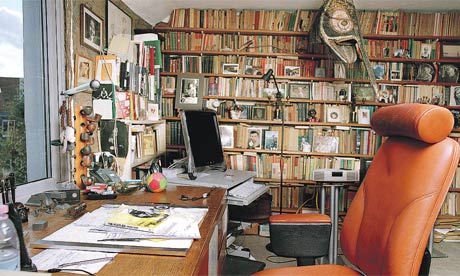
Writer Al Alvarez’s awesome looking chair (pictured).

Author and controversial critic James Wood talks about his recent book How Fiction Works on KCRW’s Bookworm:

Comments closed