Skip to content

Tag: Comics

Something for the Weekend, July 3rd, 2009

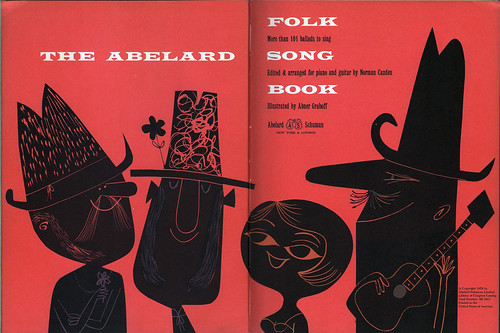
Who Was Abner Graboff? —  Frustrated with the lack information available online about artist, designer and illustrator Abner Graboff, Ward “Ward-O-Matic” Jenkins decided to do some digging himself. His research — now available in a three part series —  includes a host of great images of Graboff’s children’s books and book cover designs, as well as a nice interview with Graboff’s son Jon:

Throughout my father’s career, he did hundreds of book jacket designs and I once asked him, in a slightly condescending way, if he enjoyed that kind of work? He said he loved it because he had to nail the vibe of the book in a single illustration and when he got it right, that it was very satisfying. There was a long period of time when I could walk into a bookstore, look around, pick up a book and look at the jacket design credit… and more often than not, find his name. Later on, I started to get fooled. Other designers were either copying or being heavily influenced by his style.

Calling Bullshit on Social Media — Scott Berkun, O’Reilly author of The Myths of Innovation and Making Things Happen (via — irony alert — Mark Bertils on Twitter):

TV forced radio to change and in some ways improve. The web forced TV, newspapers and magazines to change, and they will likely survive forever in some form, focusing on things the web can not do well.  Its unusual for new thing to completely replace the old ones and when they do it takes years. Anyone who claims social media will eliminate standard PR or mass media is engaging in hype, as odds are better those things will change and learn, but never die. It’s wise to ask what each kind of media / marketing is good and bad for and work from there.

Berkun’s definitely onto something here and it probably deserves a whole post (maybe later!)… Certainly, he’s right to point out (earlier in the essay) that there have always been social networks. But he doesn’t note that for many city dwellers traditional social and familial networks have been breaking down in the post-war period, which I suspect is part of the seductive appeal of connecting online for us slightly older urban types whose use Twitter and Facebook a lot… Anyway, it’s interesting that some of Berkun’s points about technology probably also apply to e-books.

Berkun’s essay also reminded me of an article I read in Fast Company earlier in the week, Our Kids Aren’t Web-Addicted… Are We?:

It’s only we adults that are at PC workstations all day, looking for ways to avoid doing work or trolling the boundaries of our IT-installed browser filters. And we’re the only ones who have social networks big enough to require a tool like Twitter. Imagine how absurd Twitter seems when you only have 10 or 12 friends, not a network of 300+ coworkers, college buddies and colleagues?

And finally…

Krazy — Bill Watterson, creator of Calvin & Hobbes, on George Herriman’s seminal comic strip Krazy Kat, reproduced at This Recording (via Bookslut):

Krazy Kat gains its momentum less from the personalities of its characters than from their obsessions. Ignatz Mouse demonstrates his contempt for Krazy by throwing bricks at her; Krazy reinterprets the bricks as signs of love; and Offissa Pupp is obliged by duty (and regard for Krazy) to thwart and punish Ignatz’s “sin,” thereby interefering with a process that’s satisfying to everyone for all the wrong reasons. Some 30 years of strips were wrung out of that amalgam of cross-purposes. The action can be read as a metaphor for love or politics, or just enjoyed for its lunatic inner logic and physical comedy.
Comments closed

Midweek Miscellany, June 24th, 2009

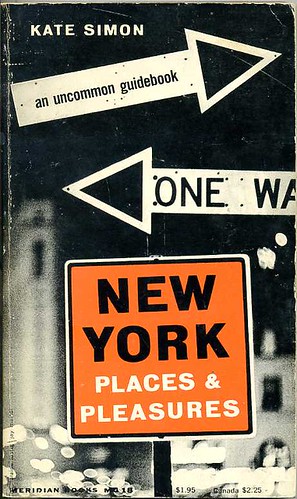
New York Places and Pleasures — Cover design by Elaine Lustig and Jay Maisel from Kyle Katz’s amazing Flickr photostream (via Design Observer).

A Very Bad Man — Douglas Wolk, author of Reading Comics: How Graphic Novels Work and What They Mean, reviews the forthcoming Darwyn Cooke comic book adaptation of The Hunter by Richard Stark (AKA Donald Westlake) — which I can’t wait to get my hands on — for the Washington Post:

Cooke has a particular gift for the space-age designs and stripped-down chiaroscuro that were in vogue a half-century ago — he previously explored them in his “DC: The New Frontier” comics — and his loose, ragged slashes of black and cobalt blue evoke the ascendancy of Hugh Hefner so powerfully you can almost hear a walking jazz bass. At times, he seems to be demonstrating how few brushstrokes it can take to communicate a precise degree of amoral machismo. Parker’s a very bad man, but it’s hard to take your eyes off him.

More stuff about  Darwyn Cooke and his Parker adaptation can be found at Almost Darwyn Cooke’s Blog (but not quite).

Buy Your Own ChainsThe New Yorker’s Willing Davidson painfully accurate observation that low industry pay and unpaid internships skew what is published (via GalleyCat):

Tiny salaries in the low ranks of publishing are miserable for the young workers, but they’re probably worse for literature… It’s a truism of the industry that most of these jobs are held by people who can afford them—people with some parental support and no student loans. Often they’ve had unpaid internships, that most pernicious example of class privilege. Their superiors are the same people, ten years later. They—we!—are smart, cultured people with good intentions, but it’s easy to see how this narrow range could lead to a blinkered view of literature.

Which leads rather nicely to…

The Intern —  Dark (and darkly funny) secrets from the lowest rung of this business we call publishing. See also Editorial Ass.

Gotham — I started with New York (and linked to The New Yorker somewhere in the middle), so I thought I’d wrap up with New York too. I came across The Mythic City: Photographs of New York by Samuel H. Gottscho, 1925-1940 a couple of weeks ago while looking for something completely different. It’s not new (it was published in 2005 to coincide with an exhibition at Museum of the City of New York), but the cover has stuck with me (something to do with the chunky cinematic type I think) and, by a happy coincidence, a copy of the book landed on my desk this week. It is beautiful. (Full disclosure: The Mythic City is published by Princeton Architectural Press who are distributed in Canada by the people who pay me).

Comments closed

Midweek Miscellany, June 17th, 2009

Claustrophobic and Irrational — I love these elegantly understated designs by Rodrigo Corral and Christopher Brand Jason Ramirez for Patricia Highsmith’s Ripley books published by W.W. Norton.

A Strategy For Authenticity — Don Linn, prolific Twitterer and publisher at The Taunton Press, on O’Reilly’s Twitter Boot Camp and Twitter as a marketing channel:

I’m relatively new to twitter, but what I’ve loved about it since discovering it is its immediacy and its spontaneity. That’s where the joy is and, in my opinion, that’s where the power is (witness #iranelection and related topics). My fear is that the suits will “Clear Channel” (yes, that’s a new verb) this simple little application into nothing but a giant vanilla message board filled with thinly-disguised spam, planned spontaneity.

Cars and Books Sean Rogers discusses Dutch cartoonist (and cover artist) Joost Swarte at The Walrus:

Swarte has some mild fun, on the Walrus cover, with the nutty rush out of the city that clogs our highways every summer. But the assignment also offers Swarte the opportunity to clear-line the hell out of some cars and books, a couple preoccupations that crop up all over his work.

Why Ulysses? — To coincide with Bloomsday , Gary Dexter explains how Joyce’s masterpiece got its title:

The paradox of Ulysses is that one needs to read it to understand twentieth-century literature, but one needs to read twentieth-century literature to build up the stamina to read Ulysses.

The problem starts with the title. Early readers of Ulysses, exhilarated and appalled after 800 pages, were often still left thinking ‘Why Ulysses?’ Ulysses is barely mentioned.

And lastly… I can’t thank the chaps at the BCA enough for the link love . You are gentlemen and scholars.

And thanks to the scarily talented Nate for creating the Paradox of Awesome album cover yesterday afternoon and sharing on Twitter. Hilarious. Or maybe you just had to be there… It made my day anyway…

5 Comments

Something for the Weekend, June 12th, 2009

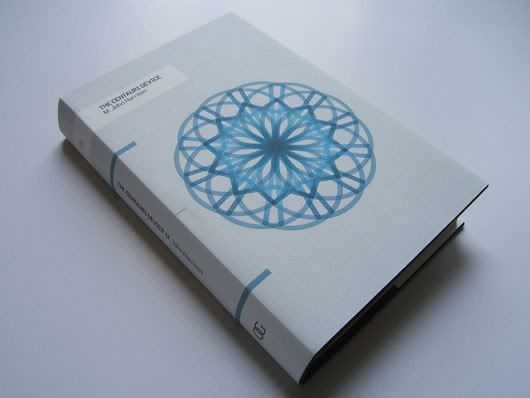
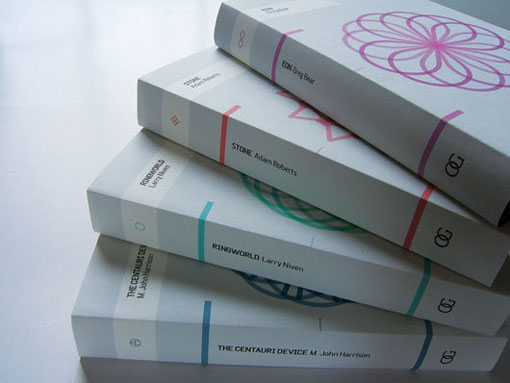
Jamie Conkleton‘s book cover designs for Gollancz’s Space Opera series, as featured in the D&AD Student Annual 2008. Great stuff. (via designworklife).

Are any other publishers pursuing similar initiatives with student designers to repackage their backlist?

Wordnik — More curious word information than dictionary, Wordnik provides definitions, examples, related words, pronunciation, related images, statistics, and tweets for the word searched.  Neat.

The Curse of Maus — cartoonist Art Spiegelman profiled in The Guardian:

Will he ever escape the shadow of Maus? “It’s even worse than that,” he says, lighting a cigarette. “Most other cartoonists are afraid of the same thing.” He means that every graphic novel is compared to Maus. “As a result, it’s sort of a curse on me and all other cartoonists I know.”

Toothy Uncoated Stock — The chaps at The Book Cover Archive pointed me to the design:related portfolio of Alex Camlin, Creative Director at Da Capo Press. His design’s for the Harvard Review are beautiful.

2 Comments

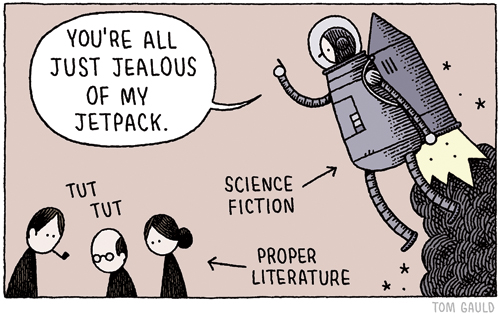
Jetpack

jetpack

Tom Gauld of course…

Comments closed

Something for the Weekend

Das Boot — David Drummond’s cover for Canadian Water Politics Edited by Mark Sproule-Jones, Carolyn Johns, and B. Timothy Heinmiller has been selected for the AIGA 50 Books/50 Covers this year. The book is published by McGill-Queens University Press who clearly take pride in the look of their books and have some other rather nice cover designs on their site.

The Long Goodbye — Another long, hard — and somewhat cynical look — at the state of the book industry. This time it’s the turn of Elisabeth Sifton, senior vice president of Farrar, Straus & Giroux, in The Nation.

W. W. Norton Book Design Archive — Publisher W. W. Norton have started posting their book cover designs to designated Flickr set (Crime by Irvine Welsh, designed by Darren Haggar pictured above) . I’d love to see more publishers do this (via The Book Cover Archive Blog).

Bird Brained or Brilliant — The contentious issue live-tweeting conferences. I only mention this because it tallies with my own recent experience of live-tweeting Raincoast’s Fall 09 Sales Conference. And because I’m a nerd (via Kate Trgovac on Twitter).

Gigantic Robot — the awesome Tom Gauld is publishing a new 32-page comic called The Gigantic Robot this summer. According to the Creative Review blog it’s “a fable concerning the production of a secret weapon whose promise apparently goes unfulfilled”. Can’t wait.

And finally (on a completely un-book related note)…

Redux — Muxtape is dead! Long live Muxtape! Whereas the late, lamented Muxtape was a place to upload mp3 ‘mixtapes’ (that fell foul of the music industry lawyers), Justin Ouellette’s new site is a platform for bands to share their music. Nice (via ISO50).

Comments closed

Midweek Miscellany, May 20th, 2009

Cut It Out — Dioramas made from the covers of pulp novels by Thomas Allen, seen at We Made This (via Ingrid Paulson on Twitter).

You Can’t Be SeriousThe Guardian takes a gloomy look at fate of  non-fiction and bookselling in the UK, managing to summon up  some half-hearted optimism towards the end:

Despite decades of predictions to the contrary, the appetite for demanding non-fiction has survived the advent of newspapers, radio and television – and, in Britain, a popular culture with a particular ability to absorb talent and themes that in other countries would be channelled into grand state-of-the-nation volumes. In fact, many publishers think the noise and immediacy of the web will make slow, quiet immersion in a book seem more, not less, appealing. And books, unlike most digital media, are not directly dependent on recession-affected advertising revenues.

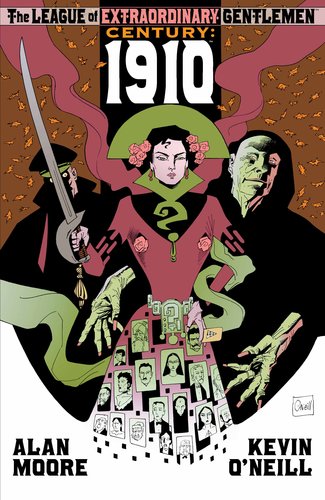
Boy’s Own Misadventure3:AM Magazine’s Mat Colgate gets to the heart of why volume 3 of The League of Extraordinary Gentleman Century: 1910 (published by Top Shelf)  is mildly disappointing (by Alan Moore standards). Could it really be that Moore writes better when subverting restrictions of form and genre than when he has free reign?

It’s Not Just Your Type — Priya Ganapati talks to designers, including Henry Sene Yee, about the problems of  e-book design at Gadget Lab.  (And Joshua Tallent’s commentary at TeleRead about the problems of formatting for ePub is also worth reading).

Restraint — I mentioned Marian Bantjes’ gorgeous new typeface at the weekend, and now you can download a rather lovely Restraint desktop from the folks at Typenuts (via I Love Typography on Twitter).

1 Comment

Parker

Darwyn Cooke (author of one of my favourite superhero comics of recent years, the award-winning The New Frontier) talks about his comic book adaptation of The Hunter by Richard Stark (AKA Donald E. Westlake) — also the inspiration for John Boorman’s film Point Blank starring Lee Marvin — with Tom Spurgeon and writer Ed Brubaker at The Comics Reporter:

The first chapter of that book is so well written it makes me want to puke, but it was like there’s nothing visual left if you put the prose down. It’s all there. It’s an external description, people’s reaction to the guy. So it’s like, “You know what? Let’s take a good chunk of space here and see if we can achieve the feeling of that chapter purely through the visuals that he’s directing. Right down to the holes in his shoe.

Publisher IDW has a preview of the first chapter here.

Am I excited? Yes. Yes, I am.

Link

Comments closed

Something For The Weekend, April 25th,2009

Comic Shelves by Oscar Nunez for Fusca Design (via The Ephemerist)

Goodnight Mechanical Dinosaur — Neil Gaiman on Batman in Wired (via LinkMachineGo):

[T]he great thing about Batman and Superman, in truth, is that they are literally transcendent. They are better than most of the stories they are in. That’s just Sturgeon’s Law: “90 percent of everything is crap.” Can you imagine how many thousands, or millions, of words have been written on Batman? Try to read them and you’re looking at 100,000 pages, perhaps a million, and you can assume that 90 percent of it is crap. Yet the 10 percent, and even better the 1 percent of that 10 perfect, is absolutely glorious. That pays for everything.

Tea and Cake — Louise Tucker chats to colleague Scott Pack about The Friday Project on HarperCollins’ 5th Estate blog:

It is still the only imprint to specialise in taking great web content and making books from it. That gives us a much wider brief than most people think…

Our future plans are very exciting. Our author deals will now all be profit-share arrangements with us splitting the profits of the books 50/50 with the authors. We are soon to announce some bold eBook initiatives and there is more to come.

Figuring it Out — Type legend Erik Spiekermann, co-author of Stop Stealing Sheep, on the basics of typography.  Not new, but still a great primer/reminder.


Will it sell in Moosejaw? — Book designers Bill Douglas (The Bang), Ingrid Paulson, (Ingrid Paulson Design), Angel Guerra (Archetype Design), Terri Nimmo, (Random House), and Kelly Hill, (Random House), discuss their craft in The National Post (Ingrid Paulson’s cover design for Kate Ausptiz’s The War Memoir of HRH Wallis Duchess of Windsor pictured above).

Wrapper’s Delight — A librarian at the Bodleian Library has found the earliest-known book dust jacket in an archive of book-trade ephemera:

Unlike today’s dust jackets, wrappers of the early 19th century were used to enfold the book completely, like a parcel. Traces of sealing wax where the paper was secured can still be seen on the Bodleian’s discovery, along with pointed creases at the edges where the paper had been folded, showing the shape of the book it had enclosed.

Comments closed

Something for the Weekend, March 27th 2009

Alternative MangaEric Skillman on designing a template for Top Shelf’s AX: Alternative Manga series at his blog Cozy Lummox.

FiledBy — a social network for authors and their readers, co-founded by Peter Clifton and Mike Shatzkin.

Extended Grey Skies — Henry Sene Yee on designing the cover of David Cullen’s  Columbine:

In the end, I didn’t want to say anything or felt the need to frame the book in any Point-of-View. What really needs to be said? The Publisher had already set the tone for me. As far as the cover copy, there was no author’s name, no descriptive subtitle, no high school, just the word COLUMBINE on the front cover. That said it all.

Router — Jeremy Mickel on the year-and-a-half process of designing his first typeface at I Love Typography:

Several designers have told me how important it is to have a specific use and point size in mind. The idea is that if you try and design a font that’s good for everything, it might not be REALLY good at anything. But if the font works really well for one specific use, then it can probably work well for lots of others.

In search of Chandler — Editorial Assistant Anna Kelly recounts her search for the original jackets of Raymond Chandler’s The Big Sleep, Farewell, My Lovely, The Little Sister, The Lady in the Lake, and The Long Good-bye for Hamish Hamilton’s new reissued editions. Chandler died 50 years ago this week.

And finally, I’ve mentioned Tom Gauld’s Flickr page previously but,  honestly, it’s so good who cares? Tom’s just uploaded some of his sketchbooks and needless to say they’re genius. You can see Tom’s books at Cabanon Press.

2 Comments

Monday Miscellany, March 23rd, 2009

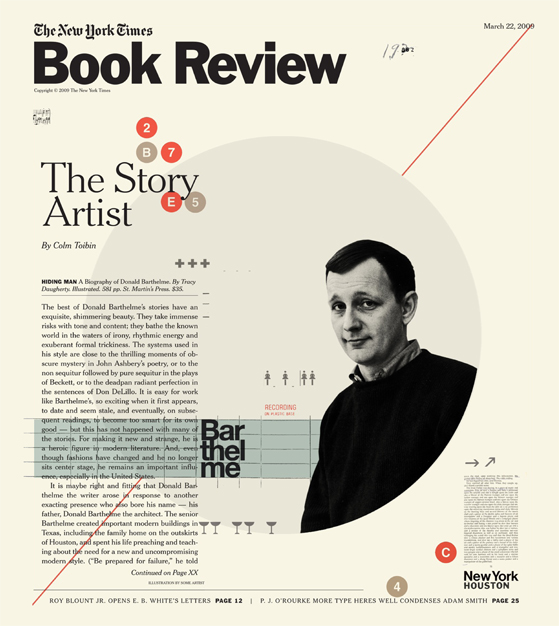
The Story Artist — Stand back and admire Cristiana Couceira’s cover for the New York Times Book Review (pictured above) illustrating Colm Toibin’s review of Hiding Man: A Biography of Donald Barthelme by Tracy Daugherty (St. Martin’s Press).  You can see more of Cristiana’s fabulous work at her blog Sete Dias.

ma collection de boîtes de conserves — Cartoonist Guy Delisle, author of Shenzhen, Pyongyang, and Burma Chronicles, displays his charming recycled pen-holders. Guy also has some great sketches of Jerusalem on his blog (an experience that is probably even better if your French is not rubbish like mine). (Via the D+Q blog and full disclosure etc: Raincoast Books distribute D+Q in Canada).

And speaking of D+Q,  John Wray’s much-praised novel Lowboy features a cover  by the very talented Adrian Tomine (pictured above). And über-critic James Wood reviews Lowboy in the latest New Yorker.

Paper Egg — Tobias Carroll has posted an interesting interview with Jonathan Messinger, co-publisher at  Featherproof Books:

[T]he line we’ve been delivering for a while now is that printed books will, eventually, go the way of vinyl. At some point, digital distribution will be the predominant method, but there will still be those who value and collect print, as people do records now (a fact that, it seems, has created a strong niche market for cool vinyl releases). But I’m not so sure that I completely buy that analogy, as fun as it is to repeat. Really, the debate seems pointless to me. What it always devolves to is one person clinging to what they’ve grown up with and accustomed to—the printed book, this classic, vaunted, untouchable commodity—and self-appointed visionaries who see digital distro as the obvious wave of the future, plowing down the fogies and fuddy-duddies.

If we de-politicize it, it becomes a much more open, interesting discussion. My feeling is that both media offer something that the other doesn’t. So why should one replace the other? … I’d rather just think about how best to use print creatively—what can it do that nothing else can, what are its limits and how do we test them?

Information revolution, c. 1455 — Murray Whyte looks at the “Gutenberg moment” in the Toronto Star:

as we appear finally to face the end, or partial end, of the Gutenberg era … it’s worth noting that sometimes, those things we view in hindsight as revolution are, in their own time, little more than a pebble in the pond, the resulting ripples needing generations, if not centuries, to be fully felt.

Comments closed

Midweek Miscellany, March 11th, 2009

Rare (and not so rare)Joel Kral‘s fabulous collection of book covers on  Flickr (via Monoscope):

These are some of the rare (and not so rare) books that I have collected over the past 13 years. They range from graphic design, architecture, art, typography, illustration, skateboarding, graffiti, etc.

Literary Fibs“Miserable writerist” Charlie Brooker responds  to the claim that 65% of us lie about the novels we’ve read in a bid to impress people:

The… irony is that while people lie about having read highbrow novels in order to impress each other, a massive percentage of highbrow novels aren’t worth reading anyway because the authors are too busy trying to impress the reader (who, we now know, probably hasn’t bothered turning up)

Shelved Books — “A blog dedicated to the cover that never happened” by designer Kimberly Glyder.

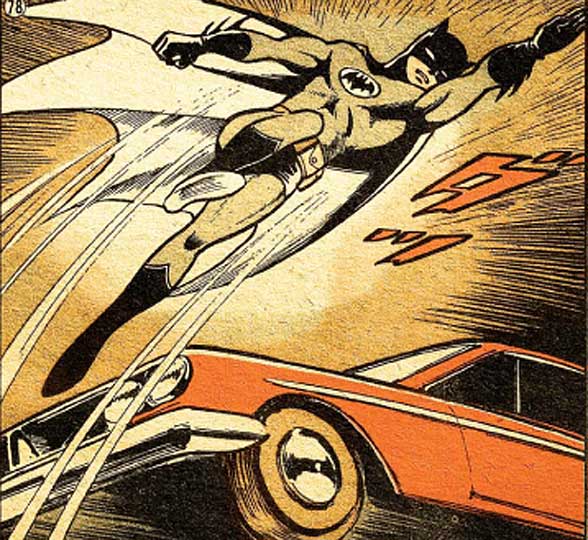
Day to Day Batman — Chip Kidd, the self-described “Indiana Jones of Forgotten Japanese Batman Comics”,  talks about Bat-Manga! on NPR (pictured above).

Isn’t that enough?Jeff Gordiner, Editor-at-Large at Details magazine and author of X Saves the World, interviewed at The Raleigh Quarterly (via@RonHogan):

Other than Philip Roth, though, almost everybody’s writing too much. Blogs, chat rooms, Twitter, Facebook status updates —there’s a wordy data glut going on, and it’s made me more reverent than ever of strategic silence. I’m fond of the J.D. Salinger approach — just evaporating from public view. Is it wrong that Salinger hasn’t left us with 30 or 40 books?

Snooty British traditions and  New York brashness — the National Post talks to Nicole Winstanley about Penguin Canada’s new imprint Hamish Hamilton Canada. This is the 4th installment of the Post‘s  ‘The Ecology of Books’ series. Part one is about literary agents, part two looks at literary journals, part three is a fascinating profile of McClelland & Stewart’s Ellen Seligman.

The Periodic Table of Typefaces —  (pictured above)

And finally, Alan Taylor has launched  ‘meta-blog’ Big Picture Notes to accompany the Boston Globe‘s brilliant photo blog The Big Picture.  Great stuff.

Comments closed