Skip to content

Tag: Comics

Something for the Weekend, March 6th, 2009

Abecediary — Steven Heller on alphabet books (Die Flucht Nach ABECEDERIA by the French comic artist Blexbolex pictured above).

Imprints in the 21st Century — Admittedly HarperCollins new Imprint It Books is an easy target (NB use of “tap into the zeitgeist” in a sentence = fail), but Mike Shatzkin does a good job of explaining why their strategy is past its sell by date (and beginning to smell):

General trade publishers need to see, and apparently don’t,  that their legacy brands are B2B [business-to-business]. They should be exploited that way. They need brands that can work B2C [business-to-consumer], but it will require discipline, focus, and an audience-first picture of what to publish to accomplish that.

Writing for a Living — Luminaries such as Will Self, Joyce Carol Oates, and AL Kennedy (quoted below) discuss whether writing is a joy or a chore in The Guardian:

“The joy of writing for a living is that you get to do it all the time. The misery is that you have to, whether you’re in the mood or not.”

Hugh at BookOven is angry this week.  He wants to know why publishers are not selling directly to customers from their website and why they make e-books so complicated. I think Hugh underestimates the time/money/skill-deficit obstacles publishers face in regard to both problems. I suspect Hugh thinks I’m an apologist and will be first up against the wall when the revolution comes.


Book Design Made Easy — cartoonist Tom Gauld is making his genius cartoons from The Guardian available on Flickr (via Drawn!, source of so many life-improving things).

4 Comments
Monday Miscellany, March 2nd, 2009

Apologies for a delayed entry in the Monday Miscellany category, but here we go (better late than never)…

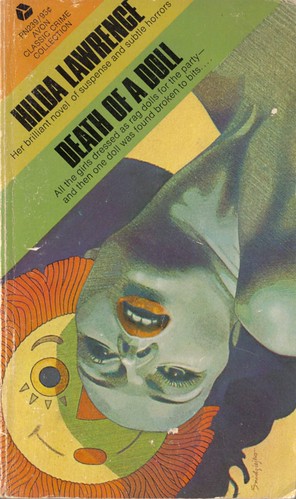
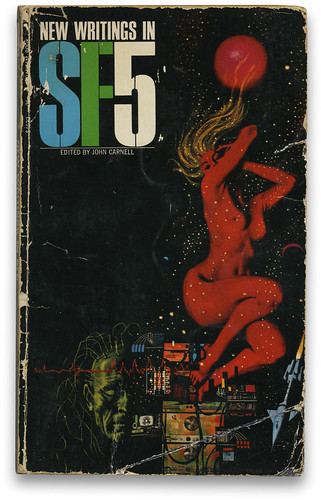
Eric Carl‘s Flickr photostream has some nice classic sci-fi and fantasy book covers (the rather fine looking Death of a Doll and New Writings in SF 5 pictured above). (via but does it float)

Re-envisioning the American small press — Fiona McCrae, director and publisher of Minneapolis independent Graywolf Press, profiled in PW (via @sarahw):

McCrae believes the publishing business is changing in favor of smaller presses, which can have close contact with their audiences and realistically support the smaller sales that typify many literary books: “I think that’s been true for a long time, and it’s just getting truer and truer and truer. There’s still obviously a layer in which we don’t compete, and it’s not our job to”

Rearrange, Rewrite, Redefine and ReimagineChicago-based indie Featherproof Books would like you to “remix” parts of their forthcoming titles, starting with Tour of the Drowned Neighborhood a short story taken from Blake Butler’s Scorch Atlas (via @R_Nash).

Overdue! The Central Library in Atlanta, the last building by “Modernist master” Marcel Breuer, is under threat according to Jonathan Lerner in Metropolis Magazine (pictured above).

A fair share — In the final installment of a 3-part series for the Globe and Mail on the publishing industry in Canada, James Adams looks at the thorny issue of digital rights.

Wild Hair, Wilder Ideas —  The Guardian profiles Alan Moore (and — on a related note — novelist Lydia Millet’s somewhat ill-considered assessment of Watchmen for the WSJ)

From Caveman to Spray Can: A Graphic Journey — Mike Dempsey’s gently meandering history of graphic design which not only features one or two books, but also the lovely Gill Sans typeface (picture above) which was used on the early Penguin paperbacks (via Noisy Decent Graphics).

Comments closed

Midweek Miscellany, Feb 25th, 2009

“Facts are stranger than fiction”The Toronto Star profiles  The Monkey’s Paw bookshop and owner Stephen Fowler (pictured):

“Books have been totally superseded by digital. A generation ago, books were not only the primary, but the only way we stored and transmitted culture. Books were culture. And they’re not any more. They’re these odd anachronisms,” Fowler says. “But that doesn’t mean they don’t contain all sorts of treasures. They’re beautiful and interesting and they have fascinating content and startling stuff in them.”

The serendipity of accidental discovery — Allison Arieff profiles William Stout, publisher and owner of the eponymous architecture and design bookstore in San Francisco, for the New York Times:

I love the tangents an afternoon spent searching the Internet can generate… But I realize as well that it’s contributing to a sort of collective ADD that makes ambling through aisles of a place like Stout Books feel that much more special, requiring an altogether different commitment of time, care and attention.

A Publisher’s Decalogue — 10 (+1) good rules for publishers from Alma Books (via The Book Depository Blog).

The E-Book Difference — The Book Oven’s Hugh McGuire on why publishers need to get to grips with e-books and mobile devices:

The reason digital and ebooks are going to become more important is that’s where the eyeballs are going to be. And if you can’t find more ways to get eyeballs on digital books, then I do fear for the future of (traditional) book publishing.

Making Magic — A sprawling interview with the brilliant (and possibly quite bonkers) Alan Moore in Wired:

I thought that a book like Watchmen would perhaps unlock a lot of potential creativity… I was hoping naively for a great rash of individual comic books that were exploring different storytelling ideas and trying to break new ground… That isn’t really what happened. Instead it seemed that the existence of Watchmen had pretty much doomed the mainstream comic industry

Borderless thinking —  Graham Vickers looks at how digital is rewriting the rules for publishers and distributors in The Guardian:

The most creative ideas are still to be found outside the orbit of the traditional media… in places where there were no predefined models, and no pre-existing ground rules to impede borderless thinking.

Daily Routines — A blog about how writers, artists, and other interesting people organize their days. For someone who endlessly struggles with their daily routine, I find this fascinating.

2 Comments

Midweek Miscellany, Jan 28th 2009


John Updike (pictured) has died at 76The Guardian and the New York Times look back at his life and career in pictures. Designer Observer points to ‘Deceptively Conceptual’ Updike’s astute 2005 essay on book covers for the New Yorker:

Publishing forms a minor branch of the entertainment industry, and book design is increasingly a matter of fashion—that is, of attention-getting. In the visual clamor of a bookstore, the important thing is to be different; a whisper becomes a shout, and the ugly becomes beautiful if it attracts attention. Yet an utter flaunting of conventional expectations may baffle and repel the public; when the title and the author’s name are left off the front of the book… it sends a subliminal message of contempt for the written word, the product being packaged.

Batman as jazz– Brad Mackay wins top prize for funniest headline of the week for his look at the reinvention of the Dark Knight and the genius of BatManga! in the Globe and Mail.

“Content is Free… But Curation is Sacred” — Peter Collingridge at Times Emit considers the implications of the Google settlement and what happens if/when we are flooded with unmediated free “stuff”:

[A]s the amount of content we are exposed to increases, without any discernible gauge of quality, it is the trusted curators of that content to whom we will choose to give our attention, time or money, rather then trying to filter it all out personally… the curator may be the bloke in the record shop who knows my music collection and recommends something new, the staff in my local wine merchant, or a particularly good blog I follow, my newspaper – anything. However, it is not Amazon’s recommendation algorithm; it is decidedly human, and, over time, a relationship of trust is built up. If it works, that trust leads to action, purchase, attention, refinement and more trust.

See the Web Site, Buy the Book: J. Courtney Sullivan looks at author web sites and book trailers for the New York Times.

Sara Nelson, editor in chief of Publisher Weekly has been fired is “leaving as part of a companywide restructuring”. The indefatigable Sarah Weiman has a extensive round-up of the reactions in the blogosphere.

The fabulous Book Cover Archive have recently add a couple of lovely minimalist cover designs by Gabriele Wilson (pictured above). Nice.

Comments closed

Something for the Weekend, Jan 16th, 2009

David Mirvish Books, the best fine art bookstore in Toronto, is to close. Damn. At least the Art Gallery of Ontario’s bookstore has re-opened with a decent selection of art books.

“It’s not something you should really do unless you feel really compelled to do it” — An interesting interview with Doug Seibold about founding Chicago-based publisher Agate over at Slate’s Bizbox:

As in a lot of other businesses, there’s a bunch of giant multinational conglomerates that are the big players, and they leave a lot of waste behind them. My feeling was a company that functioned efficiently at the appropriate scale could do a lot of business by being cost-effective and opportunistic. Not too little, but not too grandiose: growing at a careful, natural pace.

Attack of the “renegade cybergeeks”: New York magazine meets the team behind the New York Times’ online operation:

[T]here is something exhilarating about watching web innovation finally explode at the Times, with its KICK ME sign and burden of authority… Despite the effectiveness of blogs, the majority still mainly provide links and commentary. The Times Online suggests what might happen when technology fuels in-depth reportage

A little up it’s own arse and not short on hyperbole (“the New York Times is less a newspaper and more an informative virus”? Really?), it’s still definitely worth a read. Gawker’s predictably acerbic response can be found here.

“Poetry is both flourishing and floundering” — Neil Astley, editor of Bloodaxe Books, argues poetry must be responsive to readers not academic cliques, in the New Statesman:

The producers of poetry aren’t in tune with the lovers of poetry. Many poets and publishers are actually hostile to the promotion of poetry… They see marketing as a dirty word instead of simply the means by which their books are made available to more readers.

“Publishers… lost control of their industry” — a somewhat melodramatic (and therefore much-linked to) “autopsy” of the book business by Jason Epstein in the Daily Beast. I have a lot respect for Epstein, who is indeed a “publishing legend”, but it is worth keeping in mind that he said most of this in Book Business, published in 2001, and in an article for  Technology Review from January 2005. He’s also the man behind the futuristic-yet-seemingly-redundant (is there a word for that? Apart from ‘segway’?) Espresso Book Machine, so he’s not an entirely dispassionate observer.

Grant Morrison talks Batman with Publishers Weekly:

I wanted to assemble all the classical tropes of the pulp noir crime genre: the diabolical mastermind, the femme fatale, the inescapable traps, the secret societies of evil…and push them beyond all reasonable limits to a kind of screaming Death Metal crescendo.

Nice.

The Pelican Project: A collection of Pelican Book covers from the 1930’s through to the 1980’s (pictured). (I was reminded of this wonderful project by the eclectically brilliant FFFFound)

1 Comment

Midweek Miscellany, Oct 22th, 2008

Having skipped Monday (thanks Amazon grid!), here’s a bumper Midweek Miscellany for your (digested) reading pleasure…

Publishers put on a brave face on the economic downturn in Frankfurt according to the Washington Post (thanks for link Stephanie!):

“While luxuries are increasingly unaffordable, most people still have enough money to buy a book, and booksellers could even use the opportunity to stage a resurgence”

Traditional book binders John and Ardis Mankin featured in the San Diego Union Tribune (via Shelf Awareness):

“Our main machinery is our hands,” said Ardis, 74. “Technology can’t do what we do.”

The Serif Fairy (pictured) for the junior typographer in all of us (via Design Observer).

The Legendary Mr. Typewriter: Reveries on Martin K. Tytell the owner of the Tytell Typewriter Company, in Lower Manhattan who died, age 94, on September 11th, 2008. If I could  type for tuppence and wasn’t a pathological re-writer, I would definitely use a typewriter…

Books for Bibilophiles’   in The Observer:

“At a time when bibliophiles are an endangered species, these books about books tell us why it’s reading that makes us human”

Literary agent Pat Kavanagh, “doyenne of the London literary scene”, has died:

“She had the values of an earlier generation. People like Kingsley Amis loved Pat. She was old school but she never seemed jaded. We all thought she would always be there, that she would never retire.”

Jonathan Ross revisits Watchmen by Alan Moore and Dave Gibbons for The Times (via LinkMachineGo):

“But what makes this a genre-transcending bona fide masterpiece is that… Moore and Gibbons… manage to deliver a devastating critique that cuts to the very heart of the pitiful, timid male fantasy that is the superhero genre at its purest and worst: muscular men and busty women in tight costumes solving all the world’s problems with a well-placed punch”

Over and out…

2 Comments

Midweek Miscellany Oct 15th, 2008

Are New York publishers going through some kind of existential crisis?

A chill wind is blowing through publishing according to Leon Neyfakh in the New York Observer. He’s marginally less apocalyptic than some, but he’s still pretty gloomy:

“A frost is coming to publishing. And while the much ballyhooed death of the industry this is not, the ecosystem to which our book makers are accustomed is about to be unmistakably disrupted. At hand is the twilight of an era most did not expect to miss, but will.”

On the other hand…

Old-fashioned publishing is booming for Marvel according to Fortune Magazine:

“There’s a few interesting messages in this, not least of which is the reminder that new formats of media don’t necessarily replace old, and that some habits don’t change as quickly as people think.”

Former CEO Peter Olson  discusses his exit from Random House in Portfolio magazine:

“I think concerns about the book business dying are overdone. Storytelling—the generating of content for all kinds of media—is essential. Books play a key role.”

On a more cheery note…

Children’s Books That Designers Love: Kids books with “insanely cool typography” by  Bruni Munari and Cas. Opt. favourite Paul Rand (pictured).

Liz Thomson and Nicholas Clee, former editors of Publishing News and The Bookseller respectively, have launched BookBrunch an “information site and daily news service for the book industry.” (via Me And My Big Mouth)

Designer Stephen Bayley interviewed by his son Bruno for Vice Magazine. I rather liked this line:

“Heritage is important but you must also build the heritage of the future. The best idea ever on history was in an Italian novel The Leopard by Giuseppe Tomasi di Lampedusa, which was published posthumously. It had this line about the decline of a Sicilian dynasty: “If you want things to stay the same, they are going to have to change”. That is entirely my view. Without change everything is stultified.”

2 Comments