Skip to content

Tag: Comics

Something for the Weekend

Limits and Boundaries — Peter Mendelsund, associate art director at Knopf, discusses his cover design for Jo Nesbø’s The Snowman with The New Yorker’s ‘The Book Bench’:

[O]ften my favorite jackets are the ones done after repeated rounds of failure and rejection. There’s something to be said for the desperation that rejection engenders in me. Sometimes, when the process feels most intractable and hopeless, a kind of last-ditch clarity appears. That being said, it’s also nice when you get it on the first stab.

And on the subject of super-talented book designers… A short Q &A with Coralie Bickford-Smith, Penguin senior cover designer, at 10 Answers.

I, Reader — Alexander Chee on e-books and life spent reading for The Morning News:

Many ponderables remain regarding the e-book. At a personal level, I am someone who has read books in poor light for decades without hurting my vision (despite what my mother claimed), and I’m keeping, well, an eye on that—the iPad gives me headaches in ways reading on paper never did. As a writer and former bookseller, I understand the e-book’s imperfections and limits, and monitor the arguments that it will end publishing or save it, and potentially kill bookstores, which would kill something in me, if it were to happen. But I also believe that the book as we know it was only a delivery system, and that much of what I love about books, and about the novel in particular, exists no matter the format. I’ve lately been against what I see as the useless, overly expensive hardcover, and I admit I enjoy the e-book pricing over hardcover pricing. Still, I’ll never replace the books on those shelves, and there’ll always be books I want only as books, not as e-books, like the new Chris Ware, for example, which would be pointless on an e-reader. This really is just a way for me to have more.

Rage Against the Machine — Onnesha Roychoudhuri’s long and much talked about article on Amazon for the Boston Review:

What happens when an industry concerned with the production of culture is beholden to a company with the sole goal of underselling competitors?…

The conceit is that that $9.99 price tag is what the market demands. But in this case Amazon is the market, having—with no input from its suppliers—already dictated the price and preempted the standard fluctuations that competition and improved efficiency impose on prices…

Cheap books are easy on our wallets, but behind the scenes publishers large and small have been deeply undercut by the rise of large retailers and predatory pricing schemes. Unless publishers push back, Amazon will take the logic of the chains to its conclusion. Then publishers and readers will finally know what happens when you sell a book like it’s a can of soup.

Talking About My Generation — The LA Times’ David L. Ulin on Gary Trudeau’s 40: A Doonesbury Retrospective:

[T]he trick, the secret of “Doonesbury,” that, in its topicality, its ongoing dailiness, it is really about something more profound. Trudeau highlights that in his introduction: “It’s not about Watergate,” he writes of the collection, “gas lines, cardigans, Reaganomics, a thousand points of light, Monica, New Orleans, or even Dubya.” No, indeed, although such elements do show up here, more important are the people, the dance of generations, their humanity. This is where “Doonesbury” is at its most compelling…

And finally…

Andrew Kuo, who creates off-beat music infographics for The New York Times,  talks about his new book of personal work,  What Me Worry (published by The Standard), at Interview Magazine (thx PMac!).

2 Comments

Midweek Miscellany

I’m something of skeptic when it comes to Nick Hornby (to put it politely) but the “Ministry of Stories” is, despite its Orwellian moniker, clearly a well intentioned venture, and the design of its Hoxton Street Monster Supplies storefront by We Made This is pretty stellar.

There is more on the Ministry of Stories, which is based on David Eggers 826 project, at The Guardian.

Elsewhere…

Largehearted Boy is doing everyone a favour by aggregating every online “Best of 2010” book list he can find.

AND Design Observer’s contributing writers recommend books for the holidays. While The Bygone Bureau asks some stellar bloggers for their Best BLOGS of 2010.

The Daily Cross Hatch has a four-part interview with Love & Rockets cartoonist Jaime Hernandez:

There are teachers and there are doers—I’m a doer. I don’t know how this stuff happens, it just spills out of me, it’s that kind of thing.

After a while, I’ll think about it and say, “oh, that’s how I do it.” But I couldn’t stand in front of a class and tell them how to do it.

[part one] [part two] [part three] and [part four]

And finally…

A fantastic animated Batman short by Spanish illustrator Javier Olivares:

(via The Ephemerist)

Comments closed

Midweek Miscellany

An excerpt from Jay McInerney’s introduction to Joy Division (published by Rizzoli), accompanied by a slideshow of Kevin Cummins’ photographs of the band, in Vanity Fair.

Sandwiches with Ginsberg — Patti Smith reads from Just Kids, the story of her friendship with Robert Mapplethorpe, at National Book Awards in New York.

“It’s not all pristine snow and leather goggles”The Guardian reviews I.N.J. Culbard’s adaptation of At the Mountains of Madness by H.P. Lovecraft. Culbard talks about illustrating and adapting Lovecraft at the SelfMadeHero blog.

Also at The Guardian: A 26 letter slideshow from David Sacks’ new book, Alphabets: A Miscellany of Letters (pictured below: illustration by Jonathan Lander, 2009):

Slow Down — An interview with Pushcart Prize editor Bill Henderson at Kirkus Reviews:

My friends in commercial publishing tell me that indeed times are terrifying. Nobody knows where the commercial world is headed as it tries to make a profit. The villains are those who attempt to corner the e-book market and announce that they have hundreds of thousands of titles available instantly… Why is this speed of any interest to anybody? Serious readers take their time in savoring a book. But suddenly we’ve all turned into speed freaks. Those who will suffer most from this, interestingly, are the big-box superstores that can only stock a mere 100,000 titles in their walls… The independent bookstores may, on the other hand, do very well because they can treat customers as human beings.

And finally…

Interviews with typographer Erik Spiekermann and book maven Sarah Weinman at From the Desks Of

Comments closed

Midweek Miscellany

Pattern covers by Ray Fenwick for Houghton Mifflin Harcourt (thx Sio).

A look inside Graphic: Inside the Sketchbooks of the World’s Great Graphic Designers by Steven Heller and Lita Talarico at Fast Company.

Link Drop — A nice list of design blogs to sink your teeth into compiled by David Airey, author of Logo Design Love.

Photographs from Kevin Cumminsbook about Joy Division at Flavorwire.

Show Me The Money — Kevin Kelly, author of What Technology Wants and co-founder of Wired, talks to PW:

For readers, this is the best time in history. There’s never been more selection, more media types, or quality books. There’s never been more backlist books available. This is a high point for readers. For publishers, though, it is a low point, as their businesses are in transition. But I’m very optimistic, because in my research, money follows attention. Wherever attention flows, money follows.

And finally…

Telling Stories About Superweapons — In an awesome  (if slightly sprawling clearly-has-too-much-time-on-his-hands-and-might-be-bonkers) post, Christian Thorne, associate professor of English at Williams College, discusses Godzilla, Iron Man II and weapons of mass destruction (via Coudal):

Tony Stark is the Japanese scientist of the American Empire, the inventor who will not share his invention, the engineer who withholds the newest technology of death so that only he can command it: “You can’t have the suit. … I’m not giving you the suit. … You’re not getting the suit.” What the new movie shares with Godzilla is the notion that the perfect and ethical weapon would have to be entirely singular—there would literally only be one of them—and so would not be available for manufacture: a permanent prototype, forever in beta. By investing the killer armor with artisanal qualities, as though ICBMs could be blacksmithed, they suggest that the weapon’s uniqueness could be maintained into the future, since it is the hallmark of any handcrafted object that it is in some strict sense unrepeatable. That’s a fantasy, yes, but it’s an unsettled one; unease is simply built into its scenario. The conceit of an unshareable weapon comes with a worry automatically attached, which is simply that one will become two. Arms proliferate, and then so do anxieties, in their wake.

3 Comments

His Face All Red

A bit late in the day on this — it would have been a perfect post for Halloween — but Emily Carroll’s chilling short-story comic His Face All Red is still pretty darn great.

(via The Ephemerist)

1 Comment

Midweek Miscellany

Bespoke — Richard Weston, AKA Ace Jet 170, on the book designs for the soon-to-be-launched Bespoke Editions:

Bespoke Editions is a one-off edition press; offering beautiful custom-made classic books, printed on demand and hand-finished to order. Personalised and unique, each edition will be made using specially selected cover papers and finishes… The editions will be in a Demy format and the page layouts will be based on the Van de Graaf Canon. After a set of tests, we’ve settled on the beautiful Hoefler Text for the typesetting and each title page will feature a carefully chosen typographic ornament that has some relevance to the particular book.

All Programs Considered — Bill McKibben on the new public radio for The New York Review of Books (via the always astute Edward Nawotka at Publishing Perspectives):

[I]n one sense this is the perfect moment to be a young radiohead. It’s like 1960s and 1970s cinema, with auteurs rewriting the rules. New technology lets you make radio programs cheaply: Pro Tools sound-editing software has now replaced much of the equipment used in big, expensive studios. Listening is even cheaper: the iTunes store has thousands of podcasts… available for free download in a matter of seconds. “It’s a transformative and exciting moment, a huge revolution,” says Sue Schardt, executive director of the Association of Independents in Radio.

But there’s one problem, and that’s the economics of this new world. Radio is now cheap to make, true, but the people who make it still need to live. And it’s very hard to get paid anything at all…

Sounds awfully familiar…

The beautiful Ligature Loop and Stem poster at For Print Only:

Aside from being a purely creative outlet devoid of typical restrictions… one of the goals for anything produced under the Ligature, Loop & Stem moniker is that it educates as well as inspires. This piece scratched an itch for us in wanting to have a quick reference for letterform characteristics — in essence, so we can all speak the same language when talking about type.

A Pointy Tool — David Carr  talks to the founders of The Awl for The New York Times (via Kottke):

“My friends keep talking to me about how they want to start a Web site, but they need to get some backing, and I look at them and ask them what they are waiting for,” Mr. Sicha said. “All it takes is some WordPress and a lot of typing. Sure, I went broke trying to start it, it trashed my life and I work all the time, but other than that, it wasn’t that hard to figure out.”

And finally…

Tintin Gets Scalped — An annotated page from Charles Burn’s new graphic novel X’ed Out at New York Magazine (via Bookslut):

Nitnit’s name—and shock of hair—betray his origins. “Golden Books put out six of the Tintin books in English. This was before I could read, but I was looking at them very carefully. The books’ endpapers were filled with images from other Tintin stories that hadn’t been translated. I studied these endlessly. There was a little sentence on the back of each book that said, ‘Look for future titles.’ I kept looking but they never came.”

Comments closed

Midweek Miscellany

The Man With the Getaway Face — Cartoonist Darwyn Cooke talks The LA Times’ Hero Complex blog about his latest Richard Stark (AKA Donald Westlake) adaptation, The Outfit, released this month:

With the first book, I was really trying to get Don Westlake’s worldview across to people. The story had already been told several times in films… and what-have-you, but it had never been told down the line, so it was really important for me to do that. With “The Outfit,”  I was able to sort of step back and say, ‘OK, the plan is we’re doing four books here; are there ways I can make this one stronger in terms of how it relates to the three other books?’ We don’t have, say, 20 books to get our readers acquainted with this entire world, so are there things that I can do here to help in that regard? So I changed a few things. And to be honest, I fixed a couple  of tiny problems with the story that I think Donald would have giggled about if I had brought them up. ‘Oh, geez, good point…

And on the subject of Richard Stark, David Drummond recently posted the final 3 covers (there are 18 in total) for the University of Chicago Press’ Parker reissues  (mentioned previously here):

Where the Wind Blows — Stephen Page, CEO of Faber & Faber, outlines the challenges facing existing book publishers at The Guardian:

Publishers perform roles that writers need. The question now is whether writers will continue to turn to existing publishers to perform these tasks, and whether they believe they offer value. Some authors will bypass publishers (some always have) but among most authors and agents I deal with, there is no appetite to do so, because publishers continue to perform essential roles for writers in both the physical and digital worlds (editorial, marketing, distribution, and so on). However, urgent questions are rising about how a successful 21st-century publisher ought to look and function, and whether existing publishers can adapt quickly enough…

A Hipster Never Teaches  a Square Anything — Over at Good, Lexicographer Mark Peters looks at the origins of the word “hipster” and why, these days, nobody admits to being one:

“Hipster” first popped up in 1940, and The Historical Dictionary of American Slang’s first use includes the statement that “A hipster never teaches a square anything.” The OED’s early examples include semi-definitions such as “know-it-all” (1941) and “man who’s in the know, grasps everything, is alert” (1946). Those descriptions sound groovy, but in the HDAS’s definition of “hipster,” we can find the seed that grew into today’s widespread hipster-phobia: “A person who is or attempts to be hip, esp. a fan of swing or bebop music.” It’s that attempting—especially in clumsy, transparent ways—that make the hipster horrible.

And finally…

What Batman Taught Me About Being a Good Dad — The headline tells you just about all you need to know about Adam Rogers post for The Atlantic (what dad doesn’t secretly believes that Batman is full of very important life lessons?), but hey…

I am trying to build a good human being here, someone who will make the world better for his presence. Because I don’t know any other way to do it, that means I’m building a little geek… I want him to think that these stories have weight, that they mean something; they are our myths. I give my son comics and cartoons and episodes of Thunderbirds because I want him to understand right and wrong, and why it’s important to fight the dark side of the Force. The mantras spoken in this corner of pop culture are immature, but they have power: With great power comes great responsibility. Truth, justice, and the American Way. The weed of crime bears bitter fruit. No evil shall escape my sight.

secretly
Comments closed

Chris Ware, The New Yorker

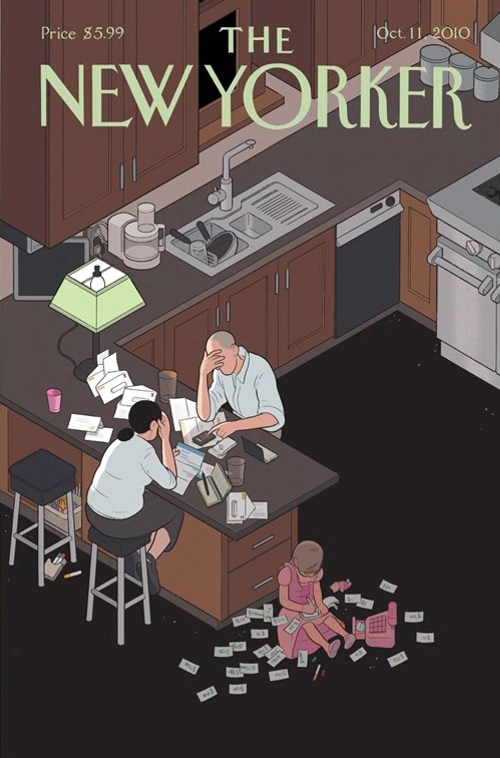
Another heart-rending, all too relatable, illustration by Chris Ware for the October 11th issue of The New Yorker:

After last year’s killer Halloween cover, Ware is fast becoming one of the most incisive commentators on modern parenting.

Acme Novelty Library #20 by Chris Ware is available from Drawn & Quarterly next month. (Full disclosure: D+Q are distributed in Canada by Raincoast Books)

(via The Ephemerist)

5 Comments

Spirit City Toronto

Combining  illustration and photography to depict homeless nature spirits who inhabit the forgotten corners of the city, there are shades of Hayao Miyazaki and Studio Ghibli in freelance illustrator Aaron Leighton’s lovely debut book Spirit City Toronto:

Spirit City Toronto is published by Koyama Press, and Books@Torontoist have just posted a two part interview with Aaron about the book.

(via Drawn!)

Comments closed

Midweek Miscellany

The mighty George Lois at home in New York City at The Selby.

Start the Press — Robert Pinsky reviews The Book in the Renaissance by Andrew Pettegree for the New York Times:

The story begins with money. Johannes Gutenberg did not find a way to profit from his technical achievements. The Gutenberg Bible, a gigantic project, required large amounts of capital that needed replenishing over time, long before there was any hope of profit. The finished product inspired awe, but the print run was 180 copies. Gutenberg “died bankrupt and disappointed.”

Nor was he alone. Apparently, it took decades before some people figured out how to make money from this remarkable invention. For decades after Gutenberg, it was not even clear that print would become a success. How do you market books? How many should you run off at one time? Piracy was a problem, as were texts changed, mutilated or combined in unauthorized editions. Many printers were ruined, trying to exploit the new medium.

And at the other end of the spectrum (or, at least, the other side of the Atlantic)…

Seeing Things Flat — Jenny Turner reviews Tom McCarthy’s C for the London Review of Books:

Remainder works as an allegory of a certain flâneurish model of artistic production, in which a gentleman’s independence of income and education loom pretty big. That, we might say, is Remainder’s material remainder; and it is that of C also, though C moves the argument on a little, investigating the conditions, as it were, of its own existence: family inheritance, war, imperialism, technology; spreading information, spreading death. It’s this core of historical and philosophical seriousness that separates McCarthy’s work completely from the current fashion for baroque narratological cleverness in fiction… There are differences between cleverness and intellect. McCarthy has many things he’s trying to do in his novels, none of which have much to do with pleasing producers or publishers or even an audience, unless by pleasing one means leaving purged.

The Googleable Future — Author William Gibson, whose new novel Zero History is published next week, on Google for the New York Times (via MDash):

We never imagined that artificial intelligence would be like this. We imagined discrete entities. Genies. We also seldom imagined (in spite of ample evidence) that emergent technologies would leave legislation in the dust, yet they do. In a world characterized by technologically driven change, we necessarily legislate after the fact, perpetually scrambling to catch up, while the core architectures of the future, increasingly, are erected by entities like Google.

Cyberspace, not so long ago, was a specific elsewhere, one we visited periodically, peering into it from the familiar physical world. Now cyberspace has everted. Turned itself inside out. Colonized the physical. Making Google a central and evolving structural unit not only of the architecture of cyberspace, but of the world.

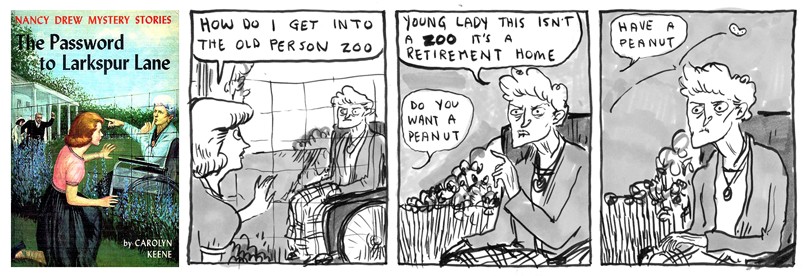
Kate Beaton interprets Nancy Drew book covers in her own unique way at Hark! A Vagrant.

And finally…

Kevin Huizenga has posted his head-spinning Glenn Ganges comic ‘Time Travelling’ at What Things Do.

1 Comment

The Typographical Terror

A great new Wondermark comic by David Malki. You really need to see it full size to appreciate the horror…

Comments closed

Midweek Miscellany

The Eyes Have It — An interview with gentleman book cover designer and advertising copywriter David Gee about his design for Jim Hanas’s e-book short story collection Why They Cried. You can find my interview with David here.

Writers on Process — Writers of every stripe talking about how they write (via Largehearted Boy).

In Their Own Words — A BBC archive of television and radio interviews with modern British novelists including Virginia Woolf, Daphne du Maurier, Anthony Burgess, J.G. Ballard,  and Muriel Spark. One could quibble about about selection of some of  contemporary novelists, but otherwise this is pretty amazing collection.

And speaking of archives…

Design is History is an expanding reference for graphic design history created by designer Dominic Flask.

And finally…

The only page of Jason’s silent and sadly aborted adaptation of Edgar Allan Poe’s The Black Cat.

e-book short story collection, Why They Cried

3 Comments