Skip to content

Tag: Comics

Midweek Miscellany

There’s been much speculation online about who designed the wonderful hand-drawn cover for Big Machine by Victor LaValle (pictured above). Thanks to the nice folks at UK publisher No Exit, I can finally identify the designer as Lynn Buckley, who originally designed the cover for the US publisher Spiegel & Grau.

Collected — Gary Groth, co-founder of alternative comics publisher Fantagraphics, talks about the state of the industry with the Comic Book Reporter (via Robot 6):

By and large, nobody publishes alternative comic books anymore. The reason is fairly obvious; since the reader knows it’s going to be collected in a graphic novel, there’s very little reason for them to buy a twenty-four page comic of something he’s going to get a year or two down the line as a graphic novel, and in the way it probably ought to be published anyway, collected in a single work. I think it’s just an inevitability of the rise of the graphic novel as the dominant form of alternative comics. I don’t know how accelerated that’s going to be for mainstream comics. It feels like it’s headed that way.

Lingua Franca — Tim Parks on translation and international literature for the NYRB:

[N]either readers nor writers are happy any longer with the idea that a literary text’s nation or language of origin should in any way define or limit the area in which it moves, or indeed that a national audience be the first and perhaps only arbiter of a book’s destiny. We feel far too linked, and linked in the immediate present, not to want to see immediately what books are changing or at least entertaining the whole world. And if we are writers, of course, we want our own books to travel as widely as possible.

And finally…

Chisel Away — An interview with designer Christopher Brian King, art director at Melville House, at Slated Magazine:

On a conceptual level, [designing for book covers] actually isn’t much different from designing a logo, for example. After all, a logo has to give you a glimpse into the whole story of a company, so it comes down to the same challenge: how do I chisel away at this big, complicated story until it becomes a single elegant image which explains what the whole thing is about? Where book covers differ is that you have a much larger toolkit to work with—typography, color, illustration photography, production tricks, or anything else. Since it’s so open-ended, the real challenge starts to become figuring out which tool is best to use on any given project.

3 Comments

New Genres by Tom Gauld

I love these new illustrations by the super-talented Tom Gauld for an article in The Washington Post Book Review about genre fiction:

You can see more of Tom’s work and his regular literary cartoons for The Guardian on Flickr.

Comments closed

Something for the Weekend

Simplicity and Economy — Mike Dempsey profiles Keith Cunningham, who designed book covers for Peter Owen, for the Foyles bookshop blog:

A tight discipline can galvanise a creative designer’s mind and Cunningham rose to the occasion with his very first cover for Peter Owen.

This sparse graphic approach was to become the visual hallmark of Peter Owen covers in the 60s and 70s. Over a relatively short period Cunningham quickly created a highly individual ‘brand’ (before the term was used) via the houses jackets distinguished by their utter simplicity and economy.

There is a much longer profile of Cunningham on Dempsey’s own (and excellent) blog Graphic Journey.

Movement and Sound — Marjane Satrapi, author of Persepolis, offers advice on how to film comics:

Animation and comics are false siblings. They resemble one another but they’re two completely different things. The relationship a reader has with a comic is nothing like the one a viewer has with a film. When you read a comic, you’re always active, because you have to imagine all the movements that happen between the frames. In a film, you are passive: all the information is there. And when you make a comic it never happens that you have 500 or 1,000 people reading it in the same place at the same time, all reacting. The language of cinema and comics is different, even though they both use images. In comics, you write with images; they’re like pictograms. And in a movie you think about movement and sound and music, all those things that are not considerations when making comics.

Cutting to the Chase — Alan Moore discusses his new novel Jerusalem with Helen Lewis Hasteley of The New Statesman:

[W]hile his first prose novel, Voice of the Fire (published in the mid-1990s), took 300 pages to cover the county of Northamptonshire, Jerusalem uses 750,000 words to explore an area of Northampton about half a square mile across. “So the next one will be several million words and it’ll just be about this end of the living room.”

Moore says he hopes never to write anything as long as Jerusalem again but he won’t countenance scaling it back. “Any editor worth their salt would tell me to cut two-thirds of this book but that’s not going to happen. I doubt that Herman Melville had an editor — if he had, that editor would have told him to get rid of all that boring stuff about whaling: ‘Cut to the chase, Herman.'”

And finally…

Manual Labour — Peter Foge profiles philosopher Simone Weil, who work for a time in a steel plant and died of self-induced starvation in wartime London, for Lapham’s Quarterly:

Part philosopher, part activist, part mystic, Weil is almost impossible to classify. A youthful Marxist who abandoned the faith in favor of liberal pluralism. A lover of all things ancient Greek who equated the Roman Empire with Nazi Germany and Hitler with Caesa, she was a mass of contradictions. Yet her reputation has grown over time as one of the most original and uncomfortable thinkers of the twentieth century. T.S. Eliot, a great admirer, considered her “a woman of genius, a kind of genius akin to that of the saints.” “A genius,” added one of her many anthologists, “of immense revolutionary range.”

Comments closed

Midweek Miscellany

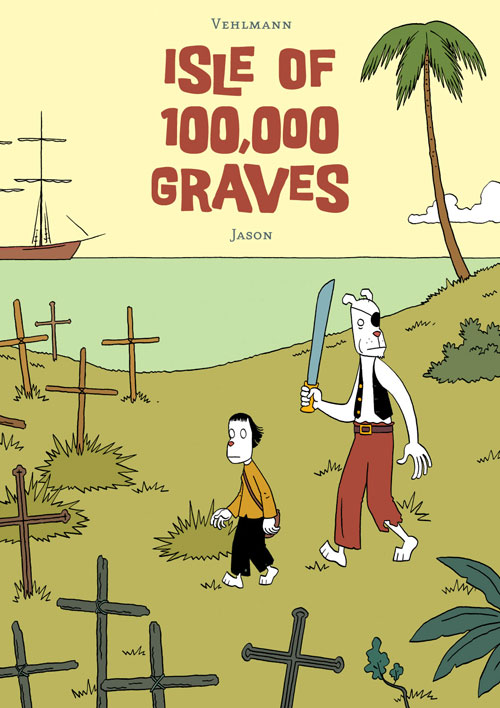
An introductory reading guide to the work of Norwegian cartoonist Jason from Robot 6:

Since his U.S. debut in 2001, Jason has produced 15 books, with nary a drop in quality. More to the point, he’s been able to use and play with a lot of familiar genre cliches — movie monsters, the big heist, the man accused of a crime he didn’t commit — and make them seem fresh and inviting.

That’s largely because his characters are usually grounded in a strong emotional reality. What often drives them are not simplistic ideals about right and wrong but love, longing, guilt and anxiety, the same stuff that drives most of us. What’s especially fascinating about his work, though, is how he’s able to convey all these roiling emotions with such a… minimalist style… Anyone interested in learning about timing and tempo… should be studying Jason’s comics.

Jason’s latest book Isle of 100,000 Graves is released this month.

Let’s Put It This Way — Cartoonist Ivan Brunetti profiled in The Chicago Tribune:

When people talk about Brunetti, they often couch it with a “Let’s put it this way.” Francoise Mouly, the longtime art director of the New Yorker, said, “Let’s put it this way — Ivan will never be comforted in life.” She said it in her native French lilt, with the breeziness of tone and the bluntness of meaning we associate with the French. But without malice or sarcasm, only lament and concern. There is no comforting Ivan Brunetti.

(I am still slightly traumatized by Brunetti’s Misery Loves Comedy)

The Poverty of Abundance — Sukhdev Sandhu, author of London Calling: How Black and Asian Writers Imagined a City, reviews Retromania: Pop Culture’s Addiction to its Own Past by Simon Reynolds for The Observer:

Retromania is a book about the poverty of abundance. At malls, on mobile-phone ads, in the background as we work at our computers: pop, usually in the form of anorexically thin MP3 sound, is everywhere these days. Perhaps that ubiquity puts a brake on its ability to astound or shape-shift. Perhaps the process of circulating and accessing music has become more exciting than the practice of listening to it.

Future Classics — Agent Andrew Wylie in The WSJ:

[T]he business we’re in is to identify and capture and anticipate the value of books that are inherently classics, future classics… Sure, writers these days can go directly to readers, without publishers or agents. But there needs to be a chain of people who have authority and can help convey what is essential. We spend most of our time strongly supporting work that we believe is significant.

And finally…

Peter Saville discusses his favourite designs for Joy Division and New Order with The Guardian.

Comments closed

Something for the Weekend

Canadian book designer Bill Douglas annotates one of his favourite covers for the newly launched Toronto weekly The Grid.

Tools of the TradeJonathon Green, author of the three volume Green’s Dictionary of Slang and the somewhat more compact and affordable Chambers Slang Dictionary, on the life of a lexicographer:

What I do is to sit alone in a room with a screen in front of me, a book more than likely to my left, held open by the weight of a discarded piece of chain, and within reach walls full of more books which are not just books but also tools and at the same time both extensions of and bastions for my existence. Some of them I have even made myself. With this screen and books and book-shaped tools I chase down words. And by placing these words in alphabetical order and by naming and defining and providing a word-based background for their existence and more words that illustrate examples of their use I create yet another book which is designated more than any other type to be a tool in its turn.

A Nostalgic Baseline — Harvard English Professor Leah Price, author of The Anthology and the Rise of the Novel and the forthcoming Unpacking My Library: Writers and Their Books, on books as objects:

“In thinking about new media, we measure what we do now against a nostalgic baseline. We compare the way we really do use digital media to the way we imagine we once used printed media, so that we take the reading of printed books to stand for all sorts of values we think we used to have, like sustained attention, linear thinking, noninstrumental appreciation,” Price said. “But if you just count how many pages came off of the printing press at any moment, never in any historical period have books, let alone literary works, been the majority of printed production.”

What Are You? — A wonderful essay by Alexander Chee, author of the novel Edinburgh, on comics, identity and American culture at The Morning News:

At the supermarket when people asked my white mom, “Whose little boy is this?” sometimes I would defiantly insist I was hers, sometimes say nothing, but I’d glare each time as if I had eyebeams that could vaporize them… No one else was like me, except my sister and brother… In the bathroom I sometimes imagined myself as I would have been with either a white face or an Asian one, looking into the hazel part of my eye and seeing the green extend across all the way, or watch it shrink back, covered by brown. The freckles would blanch away or extend until they met and my face turned darker.

It would have been easier to be a mutant, I decided. I sometimes told myself I was one, that it was the only explanation for the reason so many people asked me “What are you?”

The Ludovico Treatment — Steve Rose on Stanley Kubrick’s film adaptation of A Clockwork Orange, released 40 years ago, for The Guardian:

Beyond the UK, the movie has never been out of currency, particularly in the US, and particularly among the young. Its sci-fi stylings have aged remarkably well, and its almost abstract portrayal of out-of-control youth and paternalistic society have made it something of a teenage rite of passage, the movie equivalent of The Catcher in the Rye. Remarkably, it has been a style guide for pretty much every subsequent musical genre… On the big screen, meanwhile, every time you see a gang walking along in slow-motion, a speeded-up party scene, a slow pan out from a closeup of a face, a torture scene set to cheerful music, the chances are it was plundered from Kubrick’s original.

There Are Enough Chairs — A short interview with designer Dieter Rams in the New York Times:

Most of the things are done already — you can’t make it better. Look at chairs: there are enough chairs. There are bad chairs, some good ones, mostly bad ones. But there are, even with a chair, possibilities to make it more comfortable or, from the economic point, you can make it cheaper, save some material or you can try new materials.

And finally…

Because it’s Friday, and because I can, The Velvet Underground Oh! Sweet Nuthin’:

You can thank me later.

Comments closed

Chip Kidd at The Comic Archive

Last week I linked to a short video of Chip Kidd talking about growing up with comics. Now, The Comic Archive have posted a few more segments from that interview in which Chip discusses his book design and work in comics.

In this first clip, Chip talks about his decision to pursue graphic design in college and the influence of comic books on his work:

In this longer segment, he discusses coming to New York, being hired by Knopf as a cover designer, and returning to comics through DC Comics and Pantheon:

And this may just be for the fan-boys, but in this final clip Chip shows off his specially commissioned one-of-a-kind collections of original artwork:

#Envy

Comments closed

Midweek Miscellany

Scripts: Elegant Lettering from Design’s Golden Age — new from Steven Heller and Louise Fili, published by Thames & Hudson.

50/50 — Designer Andrew Henderson, curator of Lovely Book Covers, is going to spend 50 days designing 50 covers based on the 50 most influential books of the last 50 years.

See also: Matt Roeser’s New Cover project.

Why She Fell — An interesting article by Daniel Mendelsohn on Spider-Man and Julie Taymor’s ill-fated musical Spider-Man: Turn Off the Dark, in the NYRB:

What made Spider-Man unusual among superheroes when he debuted wasn’t so much the arachnid powers he derived from the radioactive spider…, but his very ordinariness. Bullied at school, worried about girls and money, fussing at and fussed at by his foster parents, the kindly Aunt May and Uncle Ben, Peter Parker is a regular lower-middle-class Joe with pretty average teenager problems… It’s not hard to see how all this made Spider-Man popular among teenaged comic book readers in the 1960s, that decade of the teenager. Indeed, the series marked the beginning of what one historian of the genre called a “revolution” — a newfound interest on the part of comic book creators in emphasizing the protagonist’s “everyday problems” rather than the glamour of being a superhero… The emphasis on Spidey’s ordinary humanness explains why this series, as opposed to a number of other superhero comics, is laden with “heavy doses of soap-opera and elements of melodrama.”

Sheep — Philosopher Simon Blackwell reviews How to Write a Sentence: And How to Read One by Stanley Fish for The New Republic:

It is wrong to think that the sentence is a mere slave, whose function is to bear content, which, while being the really important thing, is also something that could equally have been borne by another. Change the shape and ring, and you change everything. The balance, the alliterations, the variation, the melody, the lights glimmering in the words, can work together to transform even an ugly thought into something iridescent, as when Eli Wallach in The Magnificent Seven expressed his character’s indifference to the suffering he brings the peasants in one perfect, albeit perfectly brutal, sentence: “If God didn’t want them sheared, he would not have made them sheep.” As Fish says in his analysis of this example, here the “air of finality and certainty” is clinched by “the parallelism of clauses that also feature the patterned repetition of consonants and vowels” and then, of course the inevitability of that last dismissive word. If the devil has the best tunes, sometimes the bandits have the best sentences.

And finally…

The aforementioned Steven Heller on the paintings of Paul Rand at Design Observer:

[He] proceeded to tell me how he liked working in all media, including photography and painting and how it influences what he does and how rarely these “other things” are seen in print or elsewhere. Actually, he used excellent judgment insofar as the paintings and watercolors were appealing for their humor and craft, but they were paeans to Klee (and even Cezanne). They were not his true métier (pardon my French). They showed his interests and represented his eye, but painting was not his signature work…

What is there to say about these paintings and watercolors? Are they building blocks or respites from the rigors of graphic design? When I said, “Paul, one of the things I like about you, is that you don’t pretend to be a painter” he had a knowing look. I don’t think he wanted to be a painter, but he wanted to integrate art into graphic design, which he did so very well.

Comments closed

Midweek Miscellany

How Much Is It Worth? — Ivan Brunetti on teaching, and his book Cartooning: Philosophy and Practice, at The Comics Journal:

To me, art is not about talent, it’s about hard work. It’s about developing one’s intelligence, thoughtfulness, and sensitivity. To some degree, the potential for these things seems to vary, implying they are perhaps innate, but I think anything can be nurtured (or neglected). Something might not come easy, but it can be learned. It’s matter of will, desire, determination, and hard work. How much is it worth to you? The definition of what is considered “talent” or “skill” keeps changing. I say if one develops him or herself as a human being, then art can follow. If no adequate form exists, the artist will create a new one.

The Attention Age — More from Peter Osnos at The Atlantic, this time on book reviews:

The challenge for authors and publishers — as with so much else in our information and entertainment environment — is to catch the attention of the people at all these enterprises who choose among the cascade of books that arrive every day. I am reminded of hearing Esther Dyson observe over a decade ago that we no longer live in the information age, we live in the attention age. The notion that merit alone assures acclaim was never really valid, especially in non-fiction, but it is certainly not true today.

Getting Pregnant — Film critic Roger Ebert on being “well-read”:

At the end of the day, some authors will endure and most, including some very good ones, will not. Why do I think reading is important? It is such an effective medium between mind and mind. We think largely in words. A medium made only of words doesn’t impose the barrier of any other medium. It is naked and unprotected communication. That’s how you get pregnant. May you always be so.

Contempt — David Simon, creator of The Wire, interviewed by Bill Moyers for Guernica:

[T]he guys who are running newspapers over the last twenty or thirty years have to be singular in the manner in which they destroyed their own industry. It’s even more profound than Detroit in 1973 making Chevy Vegas and Pacers and Gremlins and believing that no self-respecting American would buy a Japanese car. Except it’s not analogous, in that a Nissan is a pretty good car and a Toyota is a pretty good car. The Internet, while it’s great for commentary and froth, doesn’t do very much first-generation reporting at all. The economic model can’t sustain that kind of reporting. They had contempt for their own product, these people… [F]or twenty years, they looked upon the copy as being the stuff that went around the ads. The ads were God. And then all of a sudden the ads were not there, and the copy they had contempt for. They had actually marginalized themselves.

And I love this response to being called “the angriest man in television”:

It doesn’t really mean much. The second-angriest guy is, you know, by a kidney-shaped pool in L.A. screaming into his cell phone because his DVD points aren’t enough. But I don’t mind being called that. I just don’t think it means anything. How can you have lived through the last ten years in American culture and not be? How can you not look at what happened on Wall Street, at this gamesmanship that was the mortgage bubble, that was just selling crap and calling it gold? Or watch a city school system suffer for twenty, twenty-five years? Isn’t anger the appropriate response? What is the appropriate response? Ennui? Alienation? Buying into the great-man theory of history—that if we only elect the right guy? This stuff is systemic. This is how an empire is eaten from within.

Comments closed

Chip Kidd: A Drinker and a Crier

Chip Kidd, book designer and associate art director at A.A. Knopf, profiled at Stodgy is Sexy:

Comments closed

Midweek Miscellany

The Death Ray by Daniel Clowes

The new cover for Daniel Clowes’ The Death Ray available this fall from Drawn + Quarterly. (The usual disclosure: D+Q is distributed in Canada by my employer Raincoast Books).

The Enemy of Creativity — Jim Holt reviews Nicholas Carr’s The Shallows for London Review of Books:

It’s not that the web is making us less intelligent; if anything, the evidence suggests it sharpens more cognitive skills than it dulls. It’s not that the web is making us less happy, although there are certainly those who, like Carr, feel enslaved by its rhythms and cheated by the quality of its pleasures. It’s that the web may be an enemy of creativity. Which is why Woody Allen might be wise in avoiding it altogether.

A Machine To Think With — Paul Duguid reviews Merchants of Culture by John B. Thompson, Publishing as a Vocation by Irving Louis Horowitz and The Phantoms on the Bookshelves by Jacques Bonnet  for the TLS:

I. A. Richards called the book “a machine to think with”, yet it is curiously resistant to technological standardization. That point escapes many digitizing technologists, who are not perhaps the anti-book boors as sometimes portrayed… Rather they may be the last romantics, idealizing the book as a simple carrier of information and so one that submits unproblematically to their computer algorithms.

Unsolving the City — BLDGBLOG talks to author China Miéville about architecture and his recent novels The City and The City and Kraken. Fantastic stuff:

My intent with The City and The City was… to derive something hyperbolic and fictional through an exaggeration of the logic of borders, rather than to invent my own magical logic of how borders could be. It was an extrapolation of really quite everyday, quite quotidian, juridical and social aspects of nation-state borders… But I’m always slightly nervous when people make analogies to things like Palestine because I think there can be a danger of a kind of sympathetic magic: you see two things that are about divided cities and so you think that they must therefore be similar in some way.

The new covers for Miéville’s forthcoming book Embassytown, and his entire back catalogue with Pan Macmillan UK, were designed by Crush Creative.

And finally…

Handsome Boy Modeling School — A profile Lorin Stein, editor of The Paris Review, in The New York Times’ Fashion and Style section:

Mr. Stein, an unabashed bon vivant who favors bespoke shirts and tailor-made suits by Kirk Miller, appears indifferent to accusations of pretension or dandyism… He has already cemented his status as a somewhat unlikely sex symbol (though among New York’s literary crowd, being pale, thin and occasionally bespectacled doesn’t count against you) with a practiced charm and habit of leaning in close and locking eyes intensely in conversation.

There is hope for us all yet… I just wish I could afford the bespoke shirts and tailor-made suits…

Comments closed

Midweek Miscellany

The reluctant Daniel Clowes has a website. What the hell?

The Day The Movies Died — Mark Harris, author of the fantastic Pictures at the Revolution, on Hollywood blockbusters and the death of the great American movie. A really good read:

Which brings us to the embarrassing part. Blaming the studios for everything lets another culprit off too easily: us. We can complain until we’re hoarse that Hollywood abandoned us by ceasing to make the kinds of movies we want to see, but it’s just as true that we abandoned Hollywood. Studios make movies for people who go to the movies, and the fact is, we don’t go anymore—and by we, I mean the complaining class, of which, if you’ve read this far, you are absolutely a member. We stay home, and we do it for countless reasons… The urgency of seeing movies the way they’re presumably intended to be seen has given way to the primacy of privacy and the security of knowing that there’s really almost no risk of missing a movie you want to see and never having another opportunity to see it. Put simply, we’d rather stay home, and movies are made for people who’d rather go out.

You Can’t Learn Taste — A profile of Richard Russell, boss of London-based independent record label XL Recordings,  in The Guardian:

This, after all, is a label that is thriving in an industry that is supposed to be dying.

“It’s not dying . . . it’s changing,” says Russell. “But then it always has been, as is the whole world. I just don’t think about the future at all. It’s not my responsibility.”

Really? He doesn’t have a strategy?

“Yeah – put good records out. That’s it. I’m sure there are people thinking about stuff like copyright and downloading, but . . . you don’t want an author to be thinking about Kindles and shit like that, do you? I mean, we do our best, but we definitely don’t offer any solutions for the music industry.”

And there’s the problem. You can’t learn taste.

Also in The Guardian, Barry Miles, author of London Calling: A Countercultural History of London Since 1945, chooses his top 10 books about London’s counterculture.

And finally…

Alan Arkin’s video for his new book, An Improvised Life, published next month by Da Capo:

Nice.

(via Jacket Copy)

Comments closed

Edward Gorey

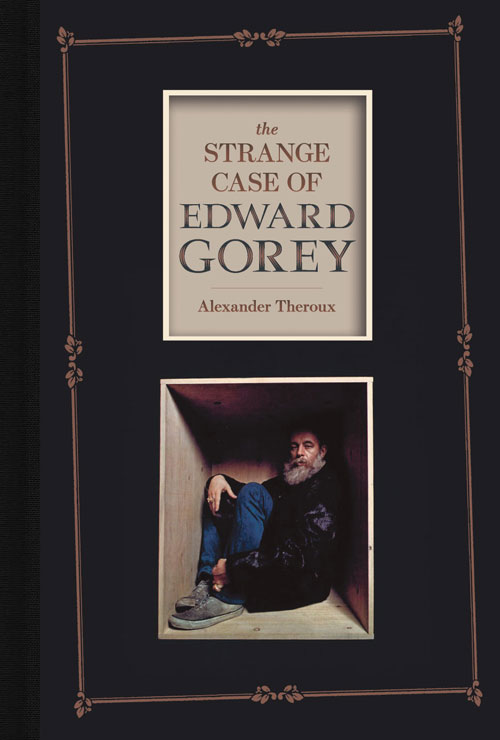
Alexander Theroux, author of The Strange Case of Edward Gorey (recently revised and republished by Fantagraphics), talks to NPR’s Weekend Edition Sunday about the writer and illustrator Edward Gorey, who would have been 86 years old today:

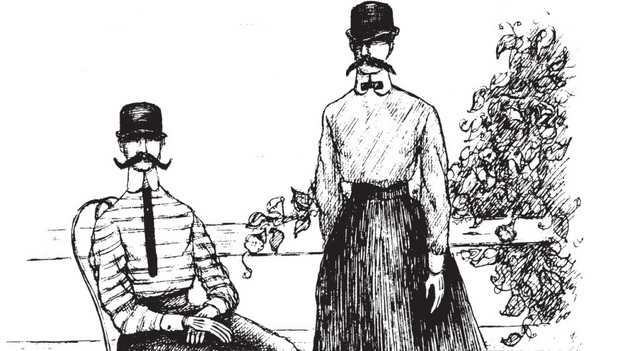
Violence is the essential Gorey ingredient. It is used in his books with such off-hand wit and inevitability that, having become his signature, if it were suddenly missing, you would begin to worry or at least feel you are being fobbed off by work not of the master’s hand.

NPR THE WEEKEND EDITION: THE LIFE OF EDWARD GOREY

Theroux also talks about his peculiar friend with Tom Spurgeon at The Comics Reporter:

I was telling someone the other day, there a division in the 20s and post WWI era, especially growing up in England. I think Gorey inherited this. There were the athletes, the muscular types — on one side of the tennis court, as it were. Then there were these kind of fey, bright young things on the other side of the tennis court. There has always been a kind of mocking, derisive look that they took regarding each other. I think Gorey grew out of that kind of gay interest, that fascination with ’20s movies, ’20s styles; there’s a tradition, I think. He was unhappy in the military and when he was at Harvard he was always in an artsy world. He went to the ballet every night in New York. He was almost a caricature of that Ronald Firbank type of character. He was very fey. He didn’t hide any of that.

Comments closed