Skip to content

Tag: Comics

Midweek Miscellany

An interview with Jason Cohn, director of the documentary Eames: The Architect and The Painter, at Imprint:

Charles was extremely ambitious and maybe a little bit cut throat in his career. I do think that it was important to him to build a strong brand. The way that he used the image of them as a couple to publicize and self-promote was far thinking. I think that he and Ray intuited that when you are selling a mass-produced item like a chair or an iPod, it’s not quite enough to have something that is beautiful, works well and at the right price point. It helps when you can buy a tiny piece of the designer as well. Just like Steve Jobs did that with Apple, Ray and Charles did that with their furniture. When you were buying a piece of Eames furniture, you were buying a little bit of that joie de vivre, the free and easy California lifestyle, that Charles and Ray represented to a generation of people.

Jason Epstein reviews Richard Seaver’s memoir The Tender Hour of Twilight: Paris in the ’50s, New York in the ’60s: A Memoir of Publishing’s Golden Age for The New York Times:

In the spring of 1953 Seaver opened a letter from Barney Rosset, who had just acquired for a few thousand dollars the assets of Grove Press, a stillborn Greenwich Village publishing firm. Rosset said he was coming to France, and could Mr. Sea­ver introduce him to Beckett? Dick replied that Beckett was reclusive, but he should approach Beckett’s publisher, M. Jérôme Lindon at Les Éditions de Minuit. Rosset replied that he was now in touch with Minuit and had made an offer for Beckett in America. Rosset later asked Seaver to join him at Grove, and Dick, now married to the beautiful Jeannette Medina, a concert violinist who had recently won a scholarship to Juilliard, accepted. The ’60s would be a time of triumph and tragedy for Dick and Barney.

And on a not entirely unrelated note…

An obituary for George Whitman, owner of Shakespeare & Company, in The Telegraph:

Whitman displayed a blithe disregard for money, often informing customers that the book they were perusing was not for sale and remaining philosophical when the cash box disappeared — a regular occurrence. Yet while more commercially minded bookshops were being taken over or going to the wall, Whitman weathered the depredations of beat poets and hippies, and survived the 1968 student riots and numerous tax audits by the French authorities. Quite how he did it remained something of a mystery.

See also: The Guardian, The New York TimesThe Economist and many more…

And finally…

Outsider Art — Alexander Chee interviews cartoonist Daniel Clowes for the BOMBlog:

I think the so-called acceptance of comics is all in the minds of journalists and desperate booksellers. My comics sold fairly well when it was a completely unknown underground thing and they seem to sell vaguely the same numbers now as they did then, it’s just a different audience. Back then it was only people involved in the underground culture and now it’s a general audience at bookstores… If you looked at the number of people who buy books there it would be a very small percentage of the population, far less than those who’d buy an indie movie. I mean, probably several million people saw the Ghost World movie, for example, but it’s in the hundreds of thousands for the book—a small percentage.

Comments closed

Midweek Miscellany

Kate Beaton’s Wonder Woman returns.

Five-Pointed Stars of Pain — An excellent post on Dan Clowes and his latest book The Death- Ray at The Brooklyn Rail:

Clowes engaged themes consistent with those of literary fiction in visual terms and in bookstore-friendly formats, and he was not alone. By the turn of the millennium there emerged a critical mass of graphic novels ready to join Maus on the shelves of bookstores and libraries, and some far-sighted publishing insiders took notice. Chief among them was Chip Kidd, the acclaimed book designer for Knopf who also consulted on a handful of comics projects at Pantheon… Kidd perceptively encouraged Pantheon to make a stronger commitment to the comics form, and in late 2000 the publisher debuted two books: Chris Ware’s Jimmy Corrigan: The Smartest Kid on Earth and Clowes’s David Boring.

Ware’s critically lauded book, originally serialized in his Acme Novelty Library series, somewhat overshadowed Clowes’s deadpan investigation into lust and obsession. But the simultaneous publication of these two works by a major publisher made an unmistakable statement: a generation of cartoonists laboring in obscurity had come of age.

A Complicated Life — Los Angeles Times television critic Robert Lloyd on Tintin creator Hergé:

Hergé had left orders that, after his death, Tintin would go no more a-roving. That is not how it is with many fictional characters — or “properties” as they are sometimes called, perpetually prey to the whims of whoever holds the deed. James Bond has long outlived every thing Ian Fleming ever thought to do with him; a single comic-book hero may be the work of any number of cooks, prepared for a range of readers in a variety of flavors, from plain vanilla to something laced with rum, coke or Lithium. But Tintin without Hergé is as unthinkable — or if thinkable, still as wrong — as Charlie Brown without Charles Schulz.

Good Manners — Lorien Kite, the Financial Times’s books editor, has lunch with bookseller (and now managing director of Waterstone’s) James Daunt:

He was recently quoted as having referred to Amazon as “a ruthless money-making devil” that did not operate in the consumer’s interest – comments that generated an angry response in some quarters. Playing devil’s advocate, I ask: isn’t it up to consumers to decide what is more important, the price or a congenial experience? “I wouldn’t disagree with that at all,” he says. “Oddly enough, completely contrary to that headline, I genuinely don’t feel sorry for myself. As long as I deliver something that people enjoy, I’ll be fine.”

And finally…

Alice Rawsthorn on graphic designer Robert Brownjohn for The New York Times:

Talented though he was, Brownjohn’s contemporaries knew him as much for his decadent lifestyle as for his work. Charming and gregarious with a flair for grand gestures, he was haunted by drug addiction. As his friend, the British graphic designer Alan Fletcher, once wrote: “He had real charisma rather than character. You always knew he was about five jumps ahead of whatever you were thinking…”

A few years after his arrival in London, Fletcher arranged for him to talk to a group of designers. Brownjohn spoke lucidly but looked fragile and, at times, struggled to stay awake. An architect in the audience asked: “What is graphic design?” Brownjohn replied: “I am.”

(NB: Posting will probably be a bit sparse here from now until mid-January, so just reminder that there’s also The Accidental Optimist, The Casual Optimist Tumblr and Facebook which will be updated more frequently).

Comments closed

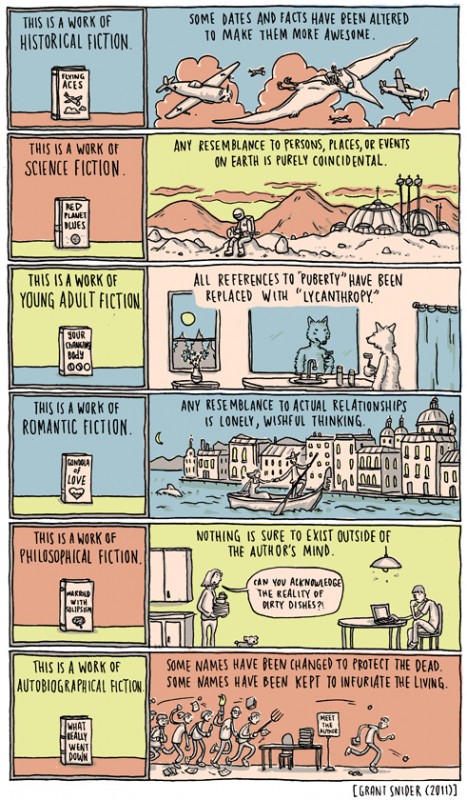
Works of Fiction by Grant Snider

Here’s a nice way to follow my post about covers:  a new literary comic by Grant Snider:

Comments closed

Midweek Miscellany

Curate, Curate, Curate — An interview with James Daunt, the new managing director of Waterstone’s, in The Independent:

“You have to let the booksellers decide how to curate their own stock,” he says. “The skill of a good bookseller is how you juxtapose your titles, and create interesting displays, and reflect what your community wants… The computer screen is a terrible environment in which to select books. All that ‘If you read this, you’ll like that’ – it’s a dismal way to recommend books. A physical bookshop in which you browse, see, hold, touch and feel books is the environment you want.”

An epic threepart interview with the ever-quotable Alan Moore at Honest Publishing:

[T]he people actually producing technology, such as Kindle and iPad, these are always the people who are telling us that we have to have these things. And being the type of creatures that we are, a fair number of us will naturally fall into that, will perhaps assume that as a status symbol it’s much better to be seen reading a Kindle than a dog-eared paperback. Although I will note that the last two or three times I’ve taken train journeys, everybody around me was sitting round reading a dog-eared paperback. I tend to think that for most people the idea of the book, with its easy portability, where you can turn the corner of a page down, where you are basically working with ordinary, reflected light rather than screen radiance, I think that the book will end up as the reading method of choice.

See also: A full, unabridged version of Laura Sneddon’s interview with Moore for The Independent.

And on the subject of authors with beards…

Neal Stephenson, author most recently of REAMDE, talks to The New York Times about the future:

What I’m kind of hoping is that this is just kind of a pause, while we assimilate this gigantic new thing, ubiquitous computing and the Internet. And that at some point we’ll turn around and say, ‘Well, that was interesting — we have a whole set of new tools and capabilities that we didn’t have before the whole computer/Internet thing came along…Now let’s get back to work doing interesting and useful things.’

And finally…

Terry Gilliam talks movies with the LA Times:

“The thing is, some really good scripts come my way, but there’s nothing in them for me to come to grips with, they are complete in themselves,” Gilliam said. “There’s no uncertainty. I don’t look for answers; I look for questions. I like when people leave the cinema and feel like the world has been altered for them somewhat. On ‘Brazil,’ I know a woman who said she saw the film, went home and later that night she just started weeping. I also heard about an attorney who saw the film and then locked himself in his office for three days. Fantastic.”

Comments closed

Monday Miscellany

As mentioned earlier, I was in Vancouver last week and I wasn’t able to post as regularly as I would have liked to. So to make up for Friday’s missing links, here are a few things of interest to start the week off…

Adrian Tomine (Shortcomings) discusses his latest work, Optic Nerve #12, and an unfinished graphic novel with Comic Book Resources:

When I finally sat down to work on my next comics project, I felt obligated to attempt a real “graphic novel.” I was looking at these giant tomes that some of my peers were working on, and I felt really envious of that kind of achievement. It also just seemed like that was the direction everything was moving in, and my old habit of publishing short stories in the comic book format was already an anachronism. So I pursued that for awhile, doing a lot of the kind of preparatory work which is actually the hardest part for me, and the whole time I had these nagging thoughts like, “Do I really want to work on this for ten years? Do I want to draw and write in the same way for that long? Does the material really merit that much of an investment?”

Hard Won — Yet another review for MetaMaus in The New York Times:

Spiegelman recalls the struggles of researching “Maus” at a time before scholarship was widely available to a mass audience. Pre-Internet, he depended on his parents’ collection of pamphlets written and drawn by survivors, and on research visits to Poland. On his second trip to Birkenau, in 1987, Spiegelman was baffled to find a perfectly preserved barracks where once there had been only rubble; it turned out to be a re-creation built for a Holocaust movie, left standing by Polish authorities because it looked accurate. He admits he was jealous of the moviemakers’ unlimited resources, when “every scrap of information I needed for ‘Maus’ was so hard-won.”

With It — Michael Farr, author of Tintin: The Complete Companion, talks about Tintin and discusses five books related to Herge and his creation at The Browser:

If you didn’t meet Hergé, you wouldn’t realise how funny he was – he saw the humorous side of almost everything. He was visually terribly aware, he didn’t miss anything which he saw. He was in his seventies then and I was in my mid-twenties, and I think that’s the reason why he agreed to see me. Younger, a French-speaking British journalist, I was slightly exotic and that intrigued him. Hergé was terribly young for his age. To use an expression that was used more then than now, he was very “with it”. When we got talking about music, he asked me what my favourite Pink Floyd songs were.

You see all this in the books. In many respects, Hergé is Tintin himself.

See also: Hal Foster, art critic and author of The First Pop Age (i.e. not THAT Hal Foster), on pop art at The Browser.

And finally…

Art critic Robert Hughes on his first visit to Rome, excerpted from his new book about the city, in The WSJ:

It was being gradually borne in on me by Rome that one of the vital things that make a great city great is not mere raw size, but the amount of care, detail, observation and love precipitated in its contents, including, but not only, its buildings. And it goes without saying, or ought to, that one cannot pay that kind of attention to detail until one understands quite a bit about substance, about different stones, different metals, the variety of woods and other substances—ceramic, glass, brick, plaster and the rest—that go to make up the innards and outer skin of a building, how they age, how they wear: in sum, how they live, if they do live.

Comments closed

Raincoast Spring Books

I was out west for the Raincoast Books spring 2012 sales conference last week. Sadly I didn’t get to see much of Vancouver or catch up with half the people I meant to, but I did get to hear about a lot of great new books including one about building (and losing) an android Philip K. Dick. It’s non-fiction. Thanks Henry Holt!

Henry Holt also have a new novel by Herta Mueller, winner of the Nobel Prize in 2009, called The Hunger Angel, and the latest from John Banville’s alter-ego Benjamin Black, Vengeance.

Picador are publishing a collected edition of Edward St. Aubyn’s Patrick Melrose trilogy in January — the first time they’ve all been properly available in the US I believe — to coincide with the US edition of his new book At Last (Farrar, Strauss & Giroux). They also have a collection of essays by Siri Hustvedt, Living, Thinking, Looking.

While there was nothing on the list quite of the magnitude of this season’s long-awaited Saul Bass: A Life in Film and Design, there are a few art and design titles that caught my eye. Princeton Architectural Press are publishing Woodcut, a book of beautiful prints by artist Bryan Nash Gill (you have surely have seen his work even if you don’t recognise the name immediately) and Up on the Roof, a collection of photographs by Alex MacLean of New York’s hidden rooftop spaces. They are also publishing a long overdue paperback edition of Michael Bierut’s Seventy-Nine Short Essays on Design, and a paperback edition of the beautiful, if overlooked, Typography Sketchbooks by Steven Heller and Lita Talarico. Lawrence King are publishing a new book on the history of picture books, Children’s Picturebooks: The Art of Visual Storytelling by Martin Salisbury and Morag Styles,  and a new edition of The End of Print by David Carson.

On the comics side, Drawn & Quarterly are publishing Jerusalem: Chronicle from the Holy City, the latest travelogue from Guy Delisle who previous books include The Burma Chronicles, Pyongyang and Shenzhen. D+Q are also publishing a new edition of Chester Brown’s controversial, scatological and long out-of-print comic Ed The Happy Clown.

I’m also looking forward to finally seeing more of Baby’s in Black: Astrid Kirchherr, Stuart Sutcliffe, and The Beatles in Hamburg by Arne Bellstorf which is being published by First Second in April (I just wish they’d gone in a different direction with the typography on the cover — the German and UK edition’s  have lovely swooping hand-drawn lettering).

And lastly — because I am big nerd and recently finished his earlier book Batman Unmasked — I’m excited about Will Brooker’s Hunting the Dark Knight: Twenty-First Century Batmanwhich is being published by I. B. Tauris in July.

Now, back to the Toronto grindstone…

Comments closed

Midweek Miscellany

And The Moral Is Don’t Fuck William Faulkner… A really great post by Glen David Gold, author of Sunnyside and Carter Beats the Devil, at the LA Review Books:

The world after publication is — beyond its many joys — an evaporating and ruinous goldfish bowl of thwarted ambition. If you write long enough, you will know editors and agents. You will have dinner with people who give interesting fellowships to weeklong retreats in the south of France. You will teach at good programs and you might know when a publisher’s child is having a birthday and what his favorite Transformer is, and these facts more than the quality of your humanity might be what makes you a chess piece when another writer slaps you on the back and asks you if you might read something he wrote.

Very Long, Very Tricky, Very Strange — Adam Gopnik in The New Yorker on the appeal of Tolkien and fantasy novels:

Of all the unexpected things in contemporary literature, this is among the oddest: that kids have an inordinate appetite for very long, very tricky, very strange books about places that don’t exist, fights that never happened, all set against the sort of medieval background that Mark Twain thought he had discredited with “A Connecticut Yankee in King Arthur’s Court.”

Against Bigness — Mark Edmundson on the movies of Robert Altman and Woody Allen at The American Scholar:

Altman was against bigness. He always wanted to turn the carpet over. He wanted you to see the signs of strain and stress that went into the making of what looked like a serene, well-balanced thing. But he didn’t want to debunk the whole construction; he simply wanted to marvel at the quirky congestion of threads. It was probably tough for the players who acted prominently in his movies to redeem their Hollywood standing. He turned stars into hand-held sparklers. He waved them around. But he did it without resentment, without meanness: he simply liked them better that way.

Meanwhile in the comics corner…

Alan Moore talks to Fast Company about  a Kickstarter project to build a memorial to the late Harvey Pekar in Cleveland Heights public library, and to The Guardian about the Occupy Movement wearing V for Vendetta masks at protests.

And at The Daily TelegraphKasia Boddy reviews MetaMaus by Art Spiegelman:

The effect of this great assemblage is complicated. On the one hand, it consolidates Maus’s status as a canonical work, about which we need to know everything, and emphasises its claim to historical testimony (Spiegelman complained to The New York Times when Maus was included on the fiction bestseller list.) On the other hand, however, the almost overwhelming presence of all this stuff emphasises that history is far from a straightforward retrieval of “facts”, but rather involves a complex process of accumulation, sifting and construction.

And finally…

Martin Filler reviews the documentary Eames: The Architect and the Painter for NYRB:

The last time I saw Ray Eames, a few months before her death, I mentioned the high prices that the couple’s original furniture was fetching in New York galleries. “Oh, no,” she cried, and held her hands to her ears in genuine dismay. “We wanted our things be available to everyone, not just rich people.” Yet although the Eameses’ molded plywood LCW chair of 1946 at first retailed for $20.95, their rosewood-and-leather lounge and ottoman of 1956 cost a not-inconsiderable $578 when first introduced, and now, still in production by Herman Miller, sells for $4,499. This luxurious seating became a familiar component of upscale psychiatrists’ consultation rooms, as much an emblem of mid-century professional attainment as pairs of Ludwig Mies van der Rohe’e chrome-and-leather Barcelona chairs were in the reception areas of Fortune 500 companies.

Comments closed

Something for the Weekend

Jacob Covey’s stunning cover for Nancy Is Happy: Complete Dailies 1943-1945 due in March 2012 from Fantagraphics.

Anxiety and Time — Adam Roberts, author of By Light Alone, on science fiction at The Browser:

The common belief that SF is in some sense “about” the future isn’t wholly wrongheaded. One feature of 19th and 20th century science fiction is that it is fascinated with time in a deep way. Time only opens up, as a wholly new dimension to be imaginatively explored, at the very end of the 18th century. It’s a puzzle, actually, why this should be. [The critic] Darko Suvin thinks it has something to do with the French Revolution. But before about 1800 people almost never wrote stories set in the future, and then after 1800 lots of people did just that. SF as a mode of projecting oneself into the to-come connects powerfully with human concerns in the way that specific prophesy – pedantic, fiddly, bound to be wrong – doesn’t.

Writing Machines — Tom McCarthy on technology in The Guardian:

I must belong to the only generation of writers who’ve written with all three of inkpen, typewriter and computer. It definitely matters: the technology colours not only the rhythm but the whole logic of what you write. Think of Kafka’s obsession with writing machines: the harrow that inscribes the law onto the skin in In the Penal Colony or the mysterious writing desk in Amerika: writing technologies themselves are imbued with terrifying and sacred dimensions, and become the subject, not just the medium, of the story. I used to have a beautiful old German typewriter, that you had to throw your fingers at and the keys would smash into the roller. It felt like a machine-gun or something.

And finally…

Brian Appleyard on Andy Warhol for Intelligent Life magazine:

Warhol now endorses a way of life. One simple technology—silk-screen printing—dominated his career. But it was enough to show today’s technology-laden, hyper-connected youth that they could do it too. With the instant publication of digital pictures and videos, anybody can become a cyber-Warhol, swimming in the great ocean that pop imagery has become. Apple’s Photo Booth software reduces the whole thing to a single click—just by selecting “pop art” under “effects” you can change your face into a very credible Warhol multiple self-portrait. Andy, in death, is a generation’s mentor.

Comments closed

Midweek Miscellany

Design Auteur — Steven Heller on Erik Nitsche for Print Magazine:

For some, book publishing was akin to the Internet of the sixties and seventies, a means of communicating information to large numbers in large volumes. In this milieu Nitsche practiced design auteurship before it was given a name, and the body of work he produced is extraordinary even by today’s standards. After moving to Geneva in the early 1960s Nitsche Founded ENI, S.A. (Erik Nitsche International) to produce some of the finest illustrated history books ever designed. The first series, a twelve volume The New Illustrated Library of Science and Invention, with a multilingual print run of over two million copies, covered the histories of communication, transport, photography, architecture, astronomy, and the machine, and flight… The second ENI series on the History of Music was even more ambitious — twenty volumes — that covered an expansive range of musical experience from composition to instrumentation, from classical to jazz.

Our Dreams of Ourselves — An interview with Alan Moore in The Independent:

Moore was always ahead of the times with respect to female fans – unlike much of the comics industry, – and was the creator of the revolutionary The Ballad of Halo Jones, a sci-fi strip to run alongside Judge Dredd in the UK comic 2000AD. First appearing in 1984, Halo was one of the first non-superhero women to headline her own series, at a time when most girls’ comics had folded.

“There wasn’t a single – I mean, I was annoyed – there wasn’t a single girls’ comic in Britain,” Moore remembers. “I thought, well if you do more stories that are aimed at women, you’ll get more women reading the comics. It would seem fairly simple and straightforward, but there was a lot of resistance [to the idea].”

Insane, Not Crazy — Chip Kidd, book designing Bat-thusiast, reviews The Joker: A Visual History of the Clown Prince of Crime by Daniel Wallace:

Created by artist Jerry Robinson and writer Bill Finger in 1940 for “Batman” issue #1—though Batman himself first appeared in “Detective Comics” #27 the previous year—the Joker, with his garish purple suit, ashen skin and emerald hair, was imagined as the maniacally taunting yang to Batman’s unrelentingly stern yin. Thus was born perhaps the single most classic pair of adversaries in comics history. Really, does it get any better than the Dark Knight Detective and the Harlequin of Hate matching wits and ultimately duking it out? I don’t think so.

Step by Step — Umberto Eco talks about his new book The Prague Cemetery at The Paris Review:

For me, the process of writing usually takes six years. In those years I collect material, I write, I rewrite. I am in a sort of a private world of myself with my characters. I don’t know what will happen. I discover it step by step. And I become very sad when the novel is finished because there is no more pleasure, no more surprise.

And finally…

Melvyn Bragg on John Steinbeck’s The Grapes of Wrath for The Guardian:

It was the bestselling book in America in 1939. A film version starring Henry Fonda and directed by John Ford followed, itself a classic. Arthur Miller wrote of Steinbeck, “I can’t think of another American writer, with the possible exception of Mark Twain, who so deeply penetrated the political life of the country.” And yet Steinbeck was also called “a liar”, “a communist” and “a Jew acting for Zionist-Communist interests”. The book was burned in the streets; it was banned in schools and libraries, with its explicit sexuality given as the excuse. It was virulently attacked in Congress, and Steinbeck’s subsequent success in Russia eroded his reputation from the cold war onwards. He bought himself a revolver for self-defence and had good reason to fear for his life. The book has sold about 14m copies and still sells steadily.

Comments closed

Something for the Weekend

Terror! — Amis on Don DeLillo and his new book The Angel Esmeralda: Nine Stories in The New Yorker:

DeLillo is the laureate of terror, of modern or postmodern terror, and the way it hovers and shimmers in our subliminal minds. As Eric Hobsbawm has said, terrorism is a new kind of urban pollution, and the pollutant is an insidious and chronic disquiet. Such is the air DeLillo breathes.

It’s Only One Book — A great interview with Art Spiegelman about his new book MetaMaus at The Comics Journal:

[Maus] took me thirteen years to do without any map of how to do it. No matter what somebody says now about graphic novels, this was made without any instruction manual. I didn’t know how to make a comic that was built to be reread, and that held up as it got reread, and be built over such a large span of time. There wasn’t something for me to look at. I guess there were long mangas out there, but I wasn’t that into them. They weren’t translated back when Maus was made. So I didn’t have any way to structure this, and structure is so basic to how I perceive. So I’m stuck with something that took a lot of me to make. So what can one do after it without either betraying it or capitulating to it? It’s an ongoing struggle.

Optimistic — An interview with Toronto’s indie comics heroine Annie Koyama at Comic Books Resources:

I was never under the impression that anyone was getting rich publishing the kinds of books and comics I chose to do but hopefully by staying a certain size, you can at least sustain the business and continue to break out new artists. I’m still figuring out what works and what doesn’t, but it’s nice to see others out there taking risks on new talent too.

Because I wasn’t saddled with preconceived notions of how things worked, I of course made some mistakes but I was also freer to carve my own road. In Toronto, where I’m located, most of the art bookstores have closed but we have one of the best and most supportive comic stores anyway, The Beguiling. I would still personally rather read a book that I hold in my hands, but you cannot ignore the digital content that’s available to anyone now. So, for now, I remain optimistic.

And while we’re on the subject of comics:

An obituary of comics historian Les Daniels, author of Comix: History of Comic Books In America, in the New York Times:

 Mark Evanier, a comic-book writer and historian, said that before Mr. Daniels, “nobody thought to write the history of the industry,” adding that “back then, it was a sloppily run, disposable business that no one thought would exist for long.”

“He was a guy that publishers hired to come in and figure out the histories of their own companies,” Mr. Evanier continued, “and he produced major works upon which all future histories will be built.”

See also: Tom Spurgeon’s more expansive obituary at The Comics Reporter.

And finally…

The Creative Review previews Polish Cold War Neon, a new book by photographer Ilona Karwinska. Putting it on the Christmas list…


Comments closed

Midweek Miscellany

On Record — Rick Poynor at Design Obsever waxes all lyrical about Continuum’s 33 1/3 music series:

The best 33 1/3 titles… have an urgent personal mission, even obsession, and they tunnel deep down into an album’s defining moment and milieu: dark sixties Los Angeles in Forever Changes, isolated seventies Berlin in Low, creative nineties Athens, Georgia in In the Aeroplane over the Sea… Usually around 30,000 words, these detailed studies are hugely challenging to research and write. Continuum has let it be known that a batch of previously announced titles has been canceled after initial high hopes: the authors just couldn’t deliver.

Movies on Paper — Tom McCarthy, author of Tintin and the Secret of Literature (as well as Remainder and C), reviews Steven Spielberg’s The Adventures of Tintin: The Secret of the Unicorn:

Tintin was always premised on a set of implicit borrowings and relocations from one medium to another. Hergé’s earliest strip-cartoons were billed as “movies” on paper; creatively, he was as indebted to the films of Buster Keaton and Harold Lloyd as to the novels of Jules Verne or the illustrated poems of Benjamin Rabier (which, long forgotten now, featured a tuft-headed boy called Tintin-Lutin and his dog). Hergé’s remarkable achievement with the Tintin series was to pluck all these elements from their original contexts and join them together, holding them in perfect equilibrium, in a new, hybrid format whose conventions (speech-bubbles joined with left-to-right action, for example) he established in the very act of assembly.

McCarthy loathes the movie by the way.

See also: Nicholas Lezard getting really quite upset about it.

(If you’re wondering why the British are so bothered by the Speilberg’s movie, my take on it is that we view Tintin as an eccentric, quintessentially British hero — not unlike T.E. Lawrence — rather than a Belgium one, and Spielberg is well… just so American. Or it might just be a shit movie.)

And finally…

Gum-Chewers of the World (Unite and Take Over) — Canadian cartoonist Seth on being awarded the Harbourfront Festival Prize at the International Festival of Authors in Toronto:

I’ve always believed the comics medium was capable of genuine subtly and grace and complexity… and of telling stories that would appeal to an adult mind. Stories that reflect real human experience. That said, it didn’t look too likely that the literary world or the art world…or even the mainstream pop culture was likely to cut the comic book much slack. Comics were considered entertainment for the gum-chewers of the world. Kid junk at worst – nerd culture at best.

Comments closed

Something for the Weekend

Issue #56 — Jessica Abel and Matt Madden discuss the latest volume of The Best American Comics at Comic Book Resources:

The problem with superheroes is it’s not a personal taste so much as it just requires so much insider knowledge to read these things. They don’t stand on their own. There have been about three superhero comics, maybe two, in the past five years that stand on their own. That you can just read and not have to know what happened in issue #56 and ever since. It’s a real problem, I think, and it’s a problem for the industry. How do you get into this stuff if you’re not into it already?

The Highs and Lows — Steven Heller, author of bazillion books on design, profiled in the Village Voice:

“The worst design writer is one who doesn’t tell a story,” Heller tells his students. “Facts are nice, but it’d be better to have the facts telling you some tale of highs, lows, and woes.”

Remaining Solvent — Bert Archer interviews Brooke Gladstone, author of The Influencing Machine, for the Toronto Standard:

“I see new structures already emerging, we are in the midst of a big, big change; it’s so obvious it’s pathetic to even say. We have to form new business models, modulate the ones that are already there; we need to acknowledge the role of the news consumer in the creation of news now, and acknowledge… that the precepts and principles that dominated during the time of television and mass media are beginning to disintegrate and fall back to the precepts and principles that guided journalism back when it was not a mass medium, back when you didn’t need to amass audiences at unprecedented size in order to remain solvent.”

Antisocial Behaviour — Gary Shteyngart on his novel Super Sad True Love Story and the effects of social media:

I know professors who can’t read an entire book–professors of English literature, mind you. So everyone’s attention span has been shot. We’re no longer used to processing long strings of information. When a book is no longer a book but yet another text file, it’s very hard to say, “OK, I’m gonna devote myself to the 300 pages of text on my screen” when I have all this other stuff that I need to do.

That’s why channels like HBO and Showtime have taken over to a big extent. The kind of stuff that used to appear in novel form now appears in “The Wire” or “Breaking Bad.” They deliver the narrative thrust that we need. They teach us about different worlds and different ways of living. But at the same time, they don’t require textual immersion. You just passively sit there and let these things happen on the screen.

And finally…

PJ Harvey on writing her award-winning album Let England Shake at GQ Magazine:

As I was doing my research to write this record I realized quite quickly I needed to gather a lot of historical information in order to understand more about our current-day wars, in Afghanistan and Iraq, for example. So I started going through my history books and became so interested in the Gallipoli campaign. It really resonated in me. I felt like I could relate it in a way to some of our contemporary wars and I learned a lot by looking at it, but also just the sheer scale of the mismanagement of that campaign and the scale of the loss of life affected me very deeply. And I really wanted to write about it.

I have played Let England Shake a lot this fall.

Comments closed