Skip to content

Tag: Comics

Something for the Weekend

You Can’t Keep a Good Creator Down — An interesting piece by Noelene Clark on women in comics for the LA Times ‘Hero Complex’ blog:

a broader look at the world of comics and the women who work there reveals the industry is far more gender-balanced than the superhero fare suggests. Though women still make up a minority of creative talent at Marvel and DC, their influence is growing. And in comics at large, women are on even footing and gaining ground… the frequently spotlighted superhero genre is just a tide pool in an ocean of work — a tide pool that has somehow managed to delay the sea change undergone by the rest of the industry.

See also: Why DC and Marvel Will Never Truly Target Female Readers by Heidi Macdonald, for Comics Beat, and author Belinda Jack on the history of women readers at The Browser.

And finally…

A brief history of Olympic pictograms, at The Smithsonian design blog:

In 1972, a German designer named Otl Aicher refined Olympic pictograms into the concise, clean system that most people think of today as the symbols of the games… Slightly modified versions (and in some cases exact replicas) of the Aicher designs were used at subsequent Olympics as the standard of universal visual language, though in the early 1990s, some designers began moving away from the simplified standard, adding embellishments that referenced the culture of the city where the games were taking place.

You can read about the pictograms for London 2012 (about which, I will say nothing) at The Creative Review, and here’s a great short history of Olympic pictograms by Steven Heller for the New York Times:

Comments closed
Midweek Miscellany

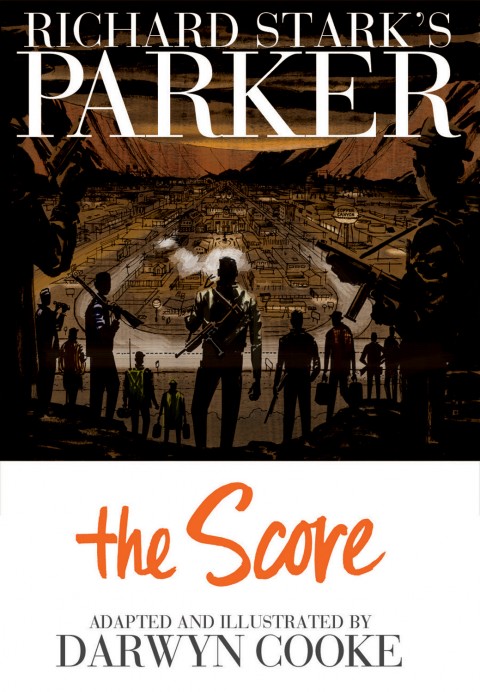
A long interview with Darwyn Cooke about his latest Donald Westlake/Richard Stark adaptation, The Score (out this week if you’re interested).

Shadows and Fog — Jimmy Stamp on Batman and architecture, for ArchDaily:

Since its inception, Gotham City has been presented as the embodiment of the urban fears that helped give rise to the American suburbs, the safe havens from the city that they are. Gotham City has always been a dark place, full of steam and rats and crime. A city of graveyards and gargoyles; alleys and asylums. Gotham is a nightmare, a distorted metropolis that corrupts the souls of good men. In the excellent book, Woody Allen on Woody Allen, the famously nebbish auteur discusses his moody, Brechtian comedy Shadows and Fog, which takes place over the course of a single night in a vaguely European village. “Once you get out in the night, there is a sense that civilization is gone…You start to realize that the city is just a superimposed man-made convention… All the civilization that protects you and enables you to lie to yourself about life is all man-made and superimposed.”

In other words, civilization ends at night. And in Gotham City, it is always night.

Home of the Free — Mark Lamster on the role of the modern library, for Metropolis magazine:

The pressure to accommodate “other needs” is especially strong at public libraries, which are increasingly taking on civic functions that far exceed the historical mission of serving books to readers. “Libraries are the new cathedrals of our society. They’re very important sanctuaries,” says the architect Bing Thom, whose new public library in Surrey, British Columbia, a suburb of Vancouver, was designed as a space of communal engagement. “People are living in smaller and smaller spaces, so the library becomes the place you escape to for socialization, for solitude, to take a breath. It’s the last space in society that’s free. Even for the homeless. There is a sense of democracy; it is a common space we all share.”

The Worm Eaten Book — Jennifer Schuessler visits the summer Rare Book School at University of Virginia in Charlottesville, for The New York Times:

Rare Book School isn’t just about pondering jaw-dropping masterpieces of printing. What makes the experience unique, students say, is the chance to see — and touch — a huge variety of objects from the school’s own 80,000-item teaching collection, including many that have been folded, stained, waterlogged, written in, worm-eaten or sometimes completely disemboweled.

And finally…

Filthy Lucre — Tim Parks on the complicated relationship between money and writing, for the NYRB:

Writers can deal with a modest income if they feel they are writing toward a body of readers who are aware of their work and buy enough of it to keep the publisher happy. But the nature of contemporary globalization, with its tendency to unify markets for literature, is such that local literary communities are beginning to weaken, while the divide between those selling vast quantities of books worldwide and those selling very few and mainly on home territory is growing all the time.


Comments closed

Midweek Miscellany

Literary prints by Evan Robertson, AKA Obvious State.

Chairman of the Bored — Bruce Handy on collecting boring books:

My hobby has two rules: I buy books only on the street. (Uniquely boring books must present themselves willingly; you can’t hunt them down.) And the titles must meet a standard of boring intrigue that I have a hard time putting into words, beyond “I know it when I see it.” This is where — if I may shed any pretense of modesty — taste and connoisseurship come into play.

Niche — Will Brooker, author of Hunting the Dark Knight, on comic books at The Browser:

[Comics] are a unique storytelling medium. They can tell a story in a way that no other medium can. But I’m not evangelical about comics, and I don’t have a problem if they’re a niche interest. There was a time in the eighties when everyone thought comics were going to break through. They were sold in bookshops. “Sequential art”, “post-textual literature” and all kinds of other pretentious terms were bandied about. I don’t think that’s necessary. Comics are their own thing, and work on their own terms, in different ways to novels and films.

See also: Superman: The High-Flying History of America’s Most Enduring Hero by Larry Tye reviewed for The New York Times.

And finally…

Steven Hyden on My Bloody Valentine album Loveless at Grantland:

Listening to Loveless is not unlike the sensation of having just endured a two-hour sonic hurricane, then feeling an intense yet melodic pounding in your eardrums for the next week. And I mean that in the most pleasant way imaginable. What took so long for Shields to find in the studio was the ecstatic pleasure point buried in the suffocating psychic evisceration caused by pure unadulterated volume. On most rock records, the music drowns out the lyrics; on Loveless, the music drowns out the music.

2 Comments

New On Your E-Reader…

Used book simulation…

By Tom Gauld of course…

Comments closed

Something for the Weekend

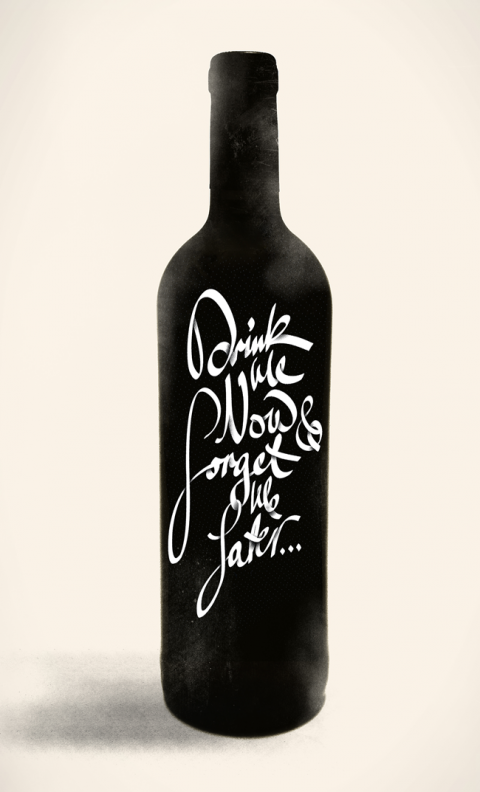
Letter Cult’s epic selection of the best custom lettering of 2011 (don’t click on the link if you have things to do today — and this is only part one!). Pictured above ‘Drink Me Now, Forget Me Later…’ by Michael Spitz.

Rank Amateurs — Design critic Justin McGuirk reviews Home-Made Europe: Contemporary Folk Artifacts for The Guardian:

The makers’ motives are not always need or thrift; sometimes it’s pleasure or obstinacy, or serendipity – a road sign that happens to make a perfect tabletop. This kind of uncelebrated creativity brings to mind artist Jeremy Deller’s Folk Archive, which catalogues everything from protest banners to pizza kiosks. Deller has written a short foreword here, in which he makes a distinction between these objects and DIY, “a hobby that seems so pleased with itself”. The difference is that the DIYer seeks to emulate the professional, whereas these objects all share the nonchalance of the amateur.

Also in The Guardian, Anthony Quinn on cricket and the novel:

Sport in novels is seldom just sport. It’s a way of talking about something else – fellowship, ambition, jealousy, honour. With cricket it’s clearly a way of writing about failure. Lately we’ve been hearing a lot about players who, at the end of their careers, succumb to insecurity and depression; some cannot handle the post-career blues and choose to end it all. As David Frith’s excellent book Silence of the Heart (2001) made clear, cricket has the highest proportion of suicides in any sport. Why? It might be because it is, of all sports, the loneliest.

Repressed Energy — An interview with Daniel Clowes about The Art of Daniel Clowes: Modern Cartoonist at the A.V. Club:

I can look at my early work and see what a pained struggle it was to draw what I was drawing. I was trying so hard to get this specific look that was in my head, and always falling short. I could see the frustration in the lines, and I remember my hand being tensed and redrawing things a thousand times until I finally inked it, and just having this general tense anxiety about every drawing. I think that comes through in the artwork, and gives it this certain kind of manic energy, this kind of repressed energy, so you feel like it’s sort of bursting at the seams or something.

And finally…

Sara Goldsmith on the history of the paper clip at Slate magazine:

The paper clip we think of most readily is an elegant loop within a loop of springy steel wire. In 1899, a patent was issued to William Middlebrook for the design, not of the clip, but of the machinery that made it. He sold the patent to the American office-supply manufacturer Cushman & Denison, who trademarked it as the Gem clip, in 1904. Middlebrook’s rather beautiful patent drawing shows the clip not as an invention but as the outcome of an invention: the best solution to an old problem, using a new material and new manufacturing processes. Coiled in this form, the steel wire was pliant enough to open, allowing papers to nestle between its loops, but springy enough to press those papers back together. When the loops part too far from each other and the steel reaches its elastic limit, the clip breaks.


Comments closed

Something for the Weekend

You’re All Just Jealous of My Jetpack — Tom Gauld has a Tumblr (The title is a reference to this of course).

Legacy Issues — Stephen Page, chief executive of Faber & Faber, writing at The Guardian:

Let’s deal with technological obsolescence. Media businesses are not technology businesses, but they can be particularly affected by technology shifts. I run a so-called legacy publishing house, Faber & Faber. Most of our business is based on licensing copyrights from writers and pursuing every avenue to find readers and create value for those writers. We are agnostic about how we do this. For our first 80 years, we could only do it through print formats (books); now we can do it through books, ebooks, online learning (through our Academy courses), digital publishing (such as the Waste Land app) and the web. Technology shifts have tended to result in greater opportunity, not less.

Bibliophiles in London — The Economist on The London International Antiquarian Book Fair:

Most interesting, perhaps, is the air of optimism—there is not the slightest whiff of gloom at the state of the book world. The internet, paradoxically, has made books “à la mode”, says Claude Blaizot of the Librarie August Blaizot in Paris, purveyor of first editions of “Tintin” and fantastically bound livres d’artiste. “It has brought people to books, and shown them booksellers they never would have known existed before,” he says. Clive Farahar, the Antiques Roadshow’s book specialist, agrees that technology has opened up the book trade, and made the world of books much more accessible to all. “It’s not just the dim little shop on the high street anymore,” he said. “We can learn so much now we never would have known before.”

Simplicity — A two-part interview with Apple designer Jonathan Ive at The Telegraph:

“Simplicity is not the absence of clutter, that’s a consequence of simplicity. Simplicity is somehow essentially describing the purpose and place of an object and product. The absence of clutter is just a clutter-free product. That’s not simple.”

(part two)

And finally…

Daniel Clowes at wired.com:

“Digital seems like such a step back from a printed book… For me, the whole process involves envisioning this book in my head as I’m working. That is what I’m trying to create. That’s the work of art. That’s the sculpture I’m chipping away at, and when I’m finally done, I will arrive at that perfect 3-D object. The iPad version would be like a picture of the book, which doesn’t hold any interest at all for me. Even if I only had 10 readers, I’d rather do the book for them than for a million readers online.”

Comments closed

Midweek Miscellany

Krazy Kriticism — Sarah Boxer on George Herriman’s long-running newspaper comic strip Krazy Kat, at the LA Review of Books:

[E]ven 95 years ago the truth was as loud and clear as a pair of clapping mitten rocks rising up out of the mesa encantada: Krazy Kat is perfect and Herriman is a genius — linguistically, graphically, poetically, onomatopoetically, every which way. Confronted with such perfection, most of Herriman’s critics, once they finish reciting plot, affecting accents, and making comparisons to classics, have always thrown up their hands and said, “Behold!” But does it have to be that way? The genius label, after all, has never kept Shakespeare or Picasso scholars from finding something to say.

A Natural End — An interview with Tom Gauld at The Comics Journal:

I never draw things big. Even if something needs to be big, I’d still draw it small and scale it up. I like to draw small (my drawings are not much bigger than the finished, printed comics) as it reigns in perfectionism, and I get a bit of natural wobble and error into the drawings. One problem with digital is that you can zoom in and in forever: but with a pen, the width of the line gives a natural end.

Canaries — Nick Harkaway, author of The Blind Giant, talks about books on the digital age at The Browser:

Our environment seems to be constantly filled with moral panics. When you open the newspaper, there’s always a piece about how the digital environment is making us stupid or paranoid, but so little of it has any basis. There was a piece in The Guardian the other day about how behaviour on Facebook was linked to socially aggressive narcissism. You had to go six paragraphs into the story to find out that the link wasn’t causal. It was just as possible that Facebook was the canary in our coal mine, telling us that our society was aggressively narcissistic in general – which I don’t find terribly difficult to believe.

And finally…

Little Glories —  Sam Taylor, who translated HHhH by Laurent Binet, on the art (and perils) of translation, at the Financial Times:

There is… something else slightly troubling about the relationship between authors and translators. It can, I suppose, be reduced almost to a hierarchical relationship: the author is primary, the translator secondary. We notice when a translation is bad, but when it is good we forget that what we are reading is a trans­lation at all. However, while there is little glory in translation, and although I began doing it only for financial reasons, I wouldn’t want to give it up now – even were I able to make a living from writing novels.

Comments closed

Something for the Weekend

Chris Ware’s astonishing cover for Crockett Johnson and Ruth Krauss: How an Unlikely Couple Found Love, Dodged the FBI, and Transformed Children’s Literature by Philip Nel. See the full thing in detail here.

A free interactive e-book about British artist Francis Bacon created by the estate of the artist and Katharina Günther is available from iTunes (via A Piece of Monologue).

Page 1: Great Expectations, the first book by GraphicDesign&, “collects the responses of 70 international graphic designers when posed with the same brief – to design and lay out the first page of Great Expectations by Charles Dickens.” The Creative Review and We Made This have more on the project.

And finally…

Jon Contino’s beautiful cover  illustration for The Marlowe Papers by Ros Barber. You can’t really tell from the image above, but the apple is actually brown foil, the grub and stalk in are in gold on finished book. You can see better in these pictures Contino posted to Instagram:

Comments closed

Something for the Weekend

It Will All Be Over Before You Know It… — A six-page, six-chapter comic by the brilliant Richard Sala (a must for fans of Edward Gorey, I’d say).

Something Lost — Edmund de Waal, ceramicist and author of The Hare with Amber Eyes, on inspiration for writing and art at The Browser:

[T]here is still something extraordinary about art which comes out of an encounter between a person and a material. The further you get away from that, the more you get into something which is commodified and reduced to a series of other people’s interactions with it. There is something extraordinary which is lost.

Talking Covers — A new blog, edited by writer Sean Manning, where authors, designers, and artists discuss book covers. The cover to Sean’s own book, The Things That Need Doing is discussed here.

The Solitary World — Ellen Handler Spitz, author of Illuminating Childhood, on the late Maurice Sendak:

Sendak knew from within the profound sense in which every child, from time to time, perceives himself or herself to be alone—an outsider—and feels the need to retreat into some private space, some nook or secret hiding place. Sendak’s books are themselves such places; they can so function even when being read aloud by an adult. Sendak’s supreme gift, as visual artist as well as author, was to discover pictorial as well as verbal and narrative means to portray the existential separateness of childhood.

And finally…

Championship Hoarding — Steven Heller on “stuff”:

It is one thing to have stuff and another to collect it. It is one thing to accumulate stuff and another to exhibit it. What’s the point in just keeping stuff in drawers, out of view? Stuff is/are trophies, evidence of championship hoarding — finding the perfect rarity that no one else has found. Collecting stuff can be competitive, even if only in the mind. Therefore, showing one’s bounty is essential to having stuff. So the vehicle for display is just as essential as the objects themselves.

Have a great weekend.

Comments closed

Something for the Weekend

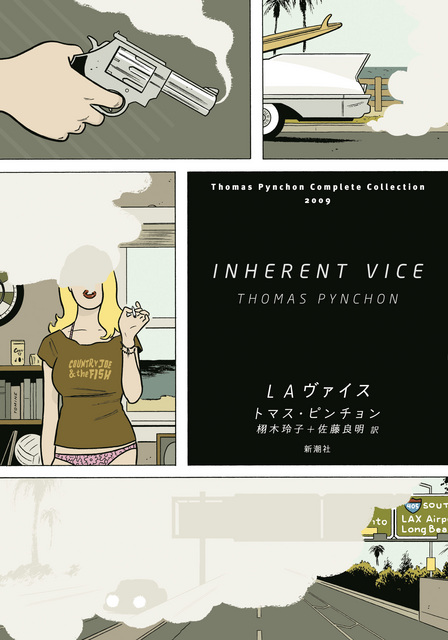
Cover illustration by Adrian Tomine for the Japanese edition of Inherent Vice by Thomas Pynchon, published by Shinchosha Publishing.

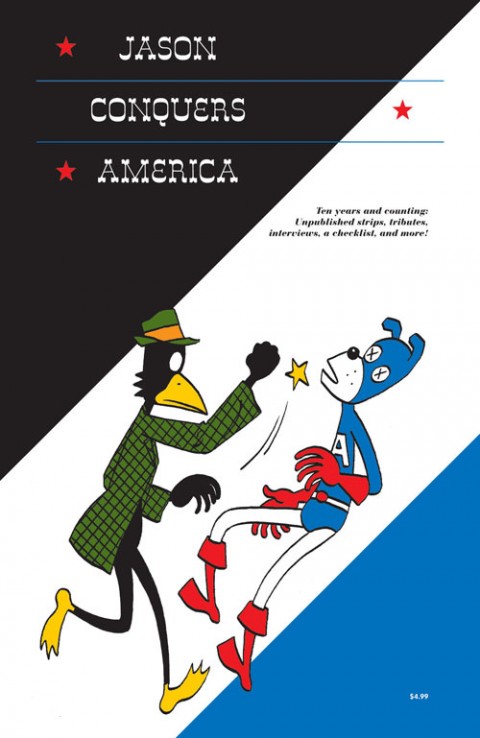
The Darkness — Norwegian cartoonist Jason profiled in The National Post:

“A comedy that has some darkness, like The Apartment, is more appealing than if it’s just fluff. Ingmar Bergman’s best film, to me, is Fanny and Alexander, that is dark, like many of his early films, but there is a joy also, an affirmation of life,” he continues. “Darkness just for being dark doesn’t interest me that much. … I prefer the vitality of something that isn’t perfect.”

Jason will be at the Toronto Comic Arts Festival this weekend, and you can read my Q & A with him here.

Bam… Bam… Bam… David L. Ulin, writing at the LA Times, on interviewing William S. Burroughs:

“Life is a cutup,” Burroughs says about halfway through his conversation with Ginsberg, referring to his technique of bisecting pieces of text and reconfiguring them as collages, letting the juxtapositions create a meaning that transcends traditional narrative. “And to pretend that you write or paint in a timeless vacuum is just simply … not … true, not in accord with the facts of human perception.”

Yes, yes, I found myself thinking, not least because four years later, Burroughs had said virtually the same thing to me. “Life is a goddamn cutup,” is how he put it. “Every time you look out the window, or answer the phone, your consciousness is being cut by random factors. Walk down the street — bam, bam, bam…. And it’s closer to the facts of your own perception, that’s the point.”

Ulin is referring to a conversation between Allen Ginsburg and Burroughs recently published in Sensitive Skin magazine.

And finally…

A Deadman’s Masterpiece — Gabriel Winslow-Yost on Tarkovovsky’s movie Stalker, the Chernobyl disaster, and the S.T.A.L.K.E.R. series of video games, for the NYRB:

The Zone in the video games is a beautifully dangerous place, bigger and grimmer than Tarkovsky’s, but somehow still appropriate. There are plenty of long, tense walks through damp weather or empty, creaking tunnels. Packs of dogs wander the landscape, ruined farmhouses give shelter from the rain; here and there the ground ripples strangely. Stalkers gather around campfires, bandits take potshots at passersby, and a man lies wounded in a ditch, begging for help. Watching Stalker, one is occasionally brought up short by remembering that it was not filmed in Chernobyl, so perfect an analogue does that event seem for the film’s images of technology and nature, beauty and danger in strange alliance. The games, at their best, can seem like a sort of miracle: a dead man’s masterpiece, come home at last.

Comments closed

Midweek Miscellany

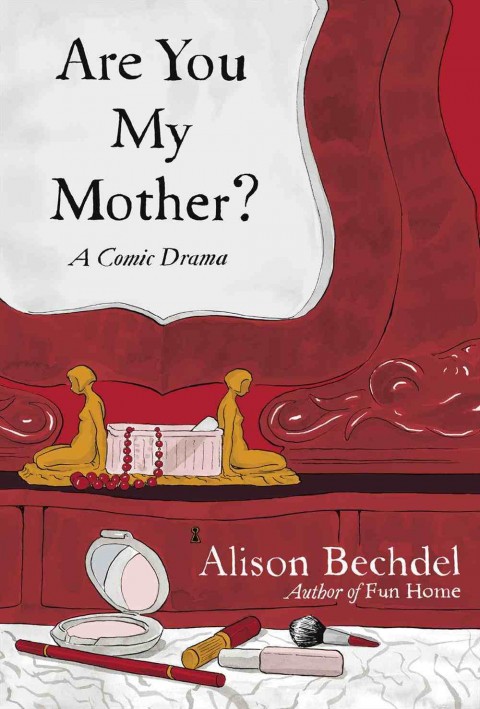
This Precarious Balancing Act — Maud Newton talks to Alison Bechdel, author of (the astonishingly good) Fun Home, about her new graphic novel Are You My Mother?. Fascinating stuff:

I feel like cartooning for me has been like a way to be a crypto-writer. I couldn’t ever say I wanted to be a writer because my mother was a writer, and even now I’ve had to find this alternative way of expressing myself as a writer. I don’t want to diminish the drawing. I think it’s integral to what I do. But I’m kind of a secret writer… I’m very wordy for a cartoonist. I’m always struggling against that, because the more space your words take up the less room you have for pictures. So it’s always this precarious balancing act.

School Disco — Mark Medley’s latest National Post piece on House of Anansi Press follows the publisher to the London Book Fair:

The London Book Fair, now in its 41st year, is one of the biggest, and most important, in the world — though it is dwarfed by Frankfurt, which takes place in October. This year, the fair hosted more than 1,500 exhibitors from 57 countries and expected more than 25,000 attendees, almost half from overseas. During the festival’s three days, MacLachlan describes it variously as “a meeting of the tribe,” “highly social,” and “like [a] school dance. The cool kids are in one corner, the nerds are somewhere else.”

Confused By the eBook Lawsuit? So Is Everyone else” — Peter Osnos, founder of Public Affairs Books, writing at The Atlantic.

And finally…

With the Bauhaus: Art as Life exhibition opening at the Barbican tomorrow, author Fiona MacCarthy (William Morris: A Life for Our Time)  looks back at the revolutionary design school at The Guardian:

Gropius’s idea for the Bauhaus emerged from his experience of the first world war in which he served as a cavalry officer on the western front for almost the whole four years. His response to the devastating scenes he lived through was a stark determination to “start again from zero”. Only a new outlook on design and architecture could provide the means for a shattered civilisation literally to rebuild itself… Gropius’s vision was for the “unification of the arts under the wings of great architecture”. It was a democratic concept of art for the people, art for social betterment in which everyone would share. The Bauhaus aesthetic replaced bourgeois furbelows with a geometry of clarity, sharp angles and straight lines.

The Guardian’s art critic Adrian Searle reviews the show here.

2 Comments

Midweek Miscellany

Insufficiently Bored — An essay by author Toby Litt on technology and reading (and writing) at Granta:

Proposition: ‘The human race is no longer sufficiently bored with life to be distracted by an art form as boring as the novel.’

Perhaps novels will continue, but instead of the machine it will be the connectivity that stops, or becomes secondary.

What we’re going to see more and more of is the pseudo-contemporary novel – in which characters are, for some reason, cut off from one another, technologically cut off. Already, many contemporary novels avoid the truly contemporary (which is hyperconnectivity).

Rereading All Over Again — Bharat Tandon reviews On Rereading by Patricia Meyer Spacks and Second Reading by Jonathan Yardley for the TLS:

[If] rereading… teaches us anything, it is that the conjunctions between readerly and textual lives will always be unpredictable and promiscuous ones. “What did you make of that book?”, runs the conventional phrase. As we revisit the objects of our reading, like recognizable but weathered landmarks, there can be no full going back, because we are not exactly the same people we were; but the consolation of rereading is the knowledge that we are these different people in part because of what those books have made of us.

Artwork Confidential — An interview with Daniel Clowes about the first retrospective museum exhibition of his work, “Modern Cartoonist: The Art of Daniel Clowes, and the accompanying monograph at Publishers Weekly:

[T]he work wasn’t created to be seen on a wall. The final artwork is the book. But I collect original artwork. It has a meaning to me that goes beyond the printed page. It’s the only [kind of] artwork you can see on a wall that you may already have a personal relationship with. If you read the story that that artwork comes from, you have a connection to it in a way you don’t have with a painting or something that’s only intended to be seen in that context. That made it interesting to me. There’s something about that final piece as an artifact of the printed work that gives it a certain value and magic. My goal with both [the exhibition and the book] is to get people interested in the work and then to read the books. If that is achieved, then both of these will have been a success.

And finally…

Six Degrees of Aggregation — A really fascinating history of the Huffington Post at the CJR:

Huffington Post, they understood, was not an enterprise whose core purpose was the creation of works of journalism—as significant or mundane as that can be. It was in the content business, which created all sorts of possibilities of what it could gather and, with a new headline and assorted tags, send back out, HuffPost’s logo affixed. Content would come to mean original reporting by Sam Stein or Ryan Grim from Washington, as well as Alec Baldwin’s blog, Robert Reich’s rants about the forsaking of the American worker, a “Best Retro Bathing Suits” slide show, “Why Women Gladly Date Ugly Men,” David Wood’s Pulitzer Prize-winning 10-part series on wounded veterans, “Nine Year Old Girl’s Twin Found Inside Her Stomach,” campaign dispatches from the Off The Bus citizen journalists, “Angelina and Brad Wow at Cannes,” and “Multitasking Wilts Your Results and Relationships”—as well as Nico Pitney’s blogging on the violence after the disputed 2009 Iranian presidential elections and the 111,000 comments it generated. Because comment was content, too.

Comments closed