Skip to content

Tag: Comics

Monday Miscellany

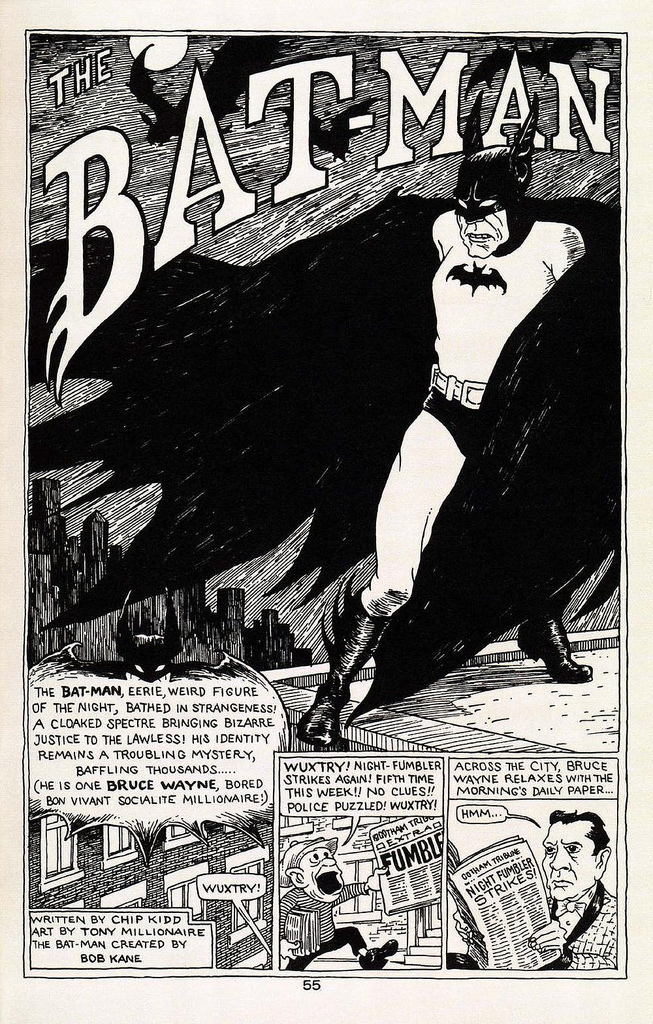
“The Bat-Man” by Chip Kidd and Tony Millionaire from Bizarro Comics #1. I can’t quite believe I haven’t seen this before… (via Martin Klasch)

Could Have Been Something — José da Silva interviews Billy Childish for The White Review:

Critics want you to get in your box and shut up. That’s why they don’t like it that I’m a writer, musician and painter. That’s totally unacceptable to their small minds… I’m looking for freedom from being categorised or identified with aspects of myself. But at the same time I use this very strong biographical information to negotiate a world – a world which I find quite mental, by the way. So I still refuse to identify myself as Billy Childish the artist,  painter, writer or musician, because in my estimation only an idiot would want to be something.

Accommodating the Mess — Tim Martin on B S Johnson,  ‘Britain’s one-man literary avant-garde’, for The Telegraph:

In principle, at least, Johnson’s declared mission echoed the great Modernist cry to make it new. Politically socialist and from a working-class London background, he cultivated pithy distrust for the complacency of his novelist peers, “neo-Dickensian” writers, as he called them, who were using a 19th-century form to gratify the “primitive, vulgar and idle curiosity of the reader to know ‘what happens next’”. A truly modern novel would seek, in Beckett’s phrase, a form to accommodate the mess, stripping readers of their escapist illusions while remaining ruthlessly true to the writer’s experience.

This obsession with so-called narrative truth runs through Johnson’s work, accounting for its most unorthodox experiments as well as its greatest flaws.

See also: Juliet Jacques review of Well Done God! Selected Prose and Drama of B S Johnson for The New Statesman.

And finally…

The mild-mannered Richard Hell in the New York Times:

After running away to New York in 1967, at the age of 17, with dreams of becoming a writer, Mr. Hell collected some good editions of favorite books. Then, in the 1970s, when he became a drug addict, he traded them for cash.

“Those were pretty much my only liquid resource,” he said. “So I sold them all over the years.”

Since getting his health and career back on track in the ’80s, he has replaced most of the ones that got away. Given the number of books now neatly stacked into the East Village apartment where he has lived for the last 38 years, he has more than made up for lost time.

Hell’s memoir, I Dreamed I Was a Very Clean Tramp, is out this week. The cover was designed by Steven Attardo.


Comments closed

Midweek Miscellany

‘The Art of Harvey Kurtzman’ curated by Monte Beauchamp and Denis Kitchen opens at the Museum of American Illustration in New York on March 6th. Boing Boing has more (via Drawger).

On a related note: Steven Heller on Al Capp at The Atlantic:

[Denis] Kitchen…loved Capp’s unpredictable plots, his sexy women, and his uncouth, often grotesque cast. But as a college student, Kitchen told me, he witnessed Capp’s transformation “from a progressive figure to a student-hating, pro-Vietnam War pal of Richard Nixon and Spiro Agnew. And not long afterward saw sex scandal headlines gut his fame. Almost overnight he lost everything.” This intense love-hate feeling toward Capp and his work is what led Kitchen to want to understand the man better.

And: Kitchen talks to Michael Dooley about the new book Al Capp: A Life to the Contrary, at Imprint:

“I thought Al Capp was a flat-out genius. That said, I had also known for many years that he had quite a dark side. I’d been collecting every article and scrap for years and interviewing any associate I could find, so I fully expected our biography to depict a deeply flawed and even tortured man…  The ‘monster’ we discussed earlier was also a devoted son and father, an often generous man with assistants and strangers, a man capable of great charity, a man who wouldn’t tolerate a racist or homophobic joke.”

(To be honest, Capp still sounds kind of irredeemable.)

Every day. Onwards. — A. L. Kennedy on writing for love (and money), at The Guardian:

The first novel was treated gently and coddled probably more than it deserved to be. This wouldn’t happen now. The short story anthology as a first book is rarer than unicorn pie. (May contain traces of horse.) The hope of making even 50% of your income as a published author any more in the UK has probably also gone – unless you are lucky enough to produce a bestseller, preferably involving porn. This may change when UK publishers discover that the production of ebooks reduces overheads as well as cover prices. Who knows – it does tend to take a while for UK publishers to notice most things. I worry in case, for example, their offices catch fire and they all burn to death over a period of weeks, coming and going, sadly unable to realise that their coffees are boiling away to nothing in their melting cups. And this is, of course, a hard time for all industries, from the sprightly to the moribund.

Kennedy’s new book On Writing has just been published in the UK by Jonathan Cape.

See also: a short interview with Kennedy in Metro.

Comments closed

Nancy and the Messy Shelves

Who doesn’t like tidy shelves?

I do have a strange and peculiar love of Ernie Bushmiller’s ‘Nancy’ comic strips, especially when odd panels are taken out of context, but Fantagraphics are doing a great job of collecting them properly into books (designed by Jacob Covey). Two volumes — Nancy is Happy and Nancy Likes Christmas — are currently available, with surely more to come (?).

(via Nancy Is Happy)

Comments closed

Something for the Weekend

Impressionable Minds — Edward Tenner on Al Capp: A Life to the Contrary and the legacy of the controversial cartoonist, at The Atlantic:

I still think of Fosdick as Capp’s masterpiece, running postmodern-style as a comic strip within a strip and accepted good-naturedly by Chester Gould, creator of its target Dick Tracy, for whom Capp always professed the highest regard. Its greatness exists even if Capp bowed to 1950s social conservatism in marrying Li’l Abner and Daisy Mae (which his emerging rival Charles Shultz called the worst comic-strip decision ever) in 1952. Even Disney didn’t hitch Mickey and Minnie Mouse.

Yet Fosdick, who had been introduced a decade earlier, was a pivotal character, probably the most subversive of authority of any of the comic personalities, but presented with such engaging absurdity that even Dr. Fredric Wertham’s anti-comic crusade could not stop him. As Shumacher and Kitchen say, it was an adult strip—and yet it was one acceptable on a Sunday morning around the family dining table, whatever its effects on impressionable young minds.

Friends Electric — Nicholas Carr, author of The Shallows, on the difference between online and offline experiences:

The reason people struggle with the tension between online experience and offline experience is because there is a tension between online experience and offline experience, and people are smart enough to understand, to feel, that the tension does not evaporate as the online intrudes ever further into the offline. In fact, the growing interpenetration between the two modes of experience—the two states of being—actually ratchets up the tension. We sense a threat in the hegemony of the online because there’s something in the offline that we’re not eager to sacrifice.

And finally…

Who says publishing is full of over-caffeinated alcoholics?Prospero on the future of bookstores:

For a bookstore to remain successful, it must improve “the experience of buying books,” says Alex Lifschutz, an architect whose London-based practice is designing the new Foyles. He suggests an array of approaches: “small, quiet spaces cocooned with books; larger spaces where one can dwell and read; other larger but still intimate spaces where one can hear talks from authors about books, literature, science, travel and cookery.” The atmosphere is vital, he adds. Exteriors must buzz with activity, entrances must be full of eye-catching presentations and a bar and café is essential.

Comments closed

Midweek Miscellany

The Importance of the Unimportant — Dwight Garner interviews Clive James for The New Republic:

I was the first person to take unserious television seriously. There were plenty of people who were writing profoundly about profound stuff. I was first to spot the importance of stuff that was unimportant: the stuff in between the shows, the link material, the sports commentators, the trivia. I started writing about that. It was illustrative, and you could be funny about it. You start describing a culture by taking that approach. That was my contribution.

Savage Satire — Samuel Carlisle considers whether American Psycho would be better without the violence, at The Believer:

Ellis… had trouble with American Psycho’s violence while writing it: the murder scenes remained unwritten until the rest of the book was completed, at which point Ellis read FBI criminology textbooks detailing actual serial killings and returned to insert the scenes that would be most unsettling to author, reader, and public alike. “I didn’t really want to write them,” he told an interviewer later, “but I knew they had to be there.”

What this leaves us with is violence that is mostly self-contained in a handful of brief chapters. To remove that violence would more or less be a clean excision, leaving the rest of the savagely insouciant satire intact.

And on a related note: The LA Times theatre critice Charles McNulty on depictions of violence on stage:

What is the line between acceptable and unacceptable violence in art? If gruesomeness is the criterion, much of Jacobean drama would have to be banned, including Shakespeare’s “King Lear,” with its graphic scene of Gloucester’s eyes being mercilessly plucked out. Some may believe they can identify pornography at a glance, but violence places keener demands on our sensibilities. Its artistic validity isn’t a function of how many liters of blood are spilled or how many limbs are dismembered. The question is one of gratuitousness. Or to put it another way: How does the brutality fit into a work’s larger vision?

And finally…

Ahab — New research suggests that Fredric Wertham misrepresented his research and falsified his results for his controversial book on the corrupting influence of comic books The Seduction of the Innocent, published in 1954:

Michael Chabon, who researched the early history of comics for his Pulitzer Prize-winning novel, “The Amazing Adventures of Kavalier & Clay,” said that while Wertham had been viewed as “this almost McCarthyite witch hunter,” he was actually “an extremely well-intentioned liberal, progressive man in many ways,” providing mental health services to minorities and the poor.

But of “Seduction of the Innocent,” Mr. Chabon said: “You read the book, it just smells wrong. It’s clear he got completely carried away with his obsession, in an almost Ahab-like way.”

(pictured above: The Phantom Lady drawn by Matt Baker was one the comics cited in Seduction of the Innocent. A reappraisal of Baker, one of the earliest African American comic book artists, has just been published by TwoMorrows Publishing.)

Comments closed

Midweek Miscellany

A great post on designer Josef Müller-Brockmann at I Love Typography:

A student from the back of the room shouted out a wish to see JMB’s business card. As JMB casually pulled the business card out of his coat pocket, there was a frenzy like fish at a pond when the morsels are tossed in. He was taken aback as we scurried around to take a peak at the card revealed; novice typographers eager to see his miniature piece of art. I still remember the card clearly. It was on light gray paper stock printed with a solitary color of cool gray ink. All content was in a singular sans serif face, all lowercase, and no punctuation to speak of other than the umlaut and hyphen in his distinguished name. No commas, no periods, no colons. All the elements on the card were restricted to the purest of necessary elements. In that small space he proved the mastery of minimalism; communication clearly achieved without the use of a period or a comma.

Thumbnails — An interview with book cover designer Isaac Tobin at the University of Chicago Magazine:

His approach to cover designs… hasn’t changed even as Kindles have sparked an ink and paper bonfire. Book covers always have had to work at reduced size, to be appealing from afar on a bookshelf or to make attractive catalog displays. “Things like color and shape,” Tobin says, “can do a lot to work from a distance or in a thumbnail.”

My 2009 interview with Isaac is here.

Tom Waits and Anton Corbijn are going to publish a limited edition book of their photographs.

And finally…

Holy Offset Press, Batman! — My favourite thing on the internet this week so far…  Marvel and DC superheroes printing comics (with art by Joe Kubert):


(thx Jacob!)

Comments closed

Something for the Weekend

Flavorwire asked a number of prominent designers — including Coralie Bickford-Smith, John Gall, Peter Mendelsund and Barbara deWilde —  to choose their favourite book covers designs from the previous year. I feel a slight tinge of regret that the cover for R.J. Palacio’s Wonder designed by Tad Carpenter didn’t make it on to my list

Mind-Boggling — Tom Spurgeon interviews Sean Howe, author of Marvel Comics: The Untold Story, at The Comics Reporter:

I worried that it would seem like the world’s longest wikipedia entry. There were so many things I wanted to include. I had a very good sense of what the narrative arc was. There’s a rise and fall, rise and fall, rise and fall structure here. If I were writing a play, I’d be failing miserably. But you can’t allay that stuff, you can’t recraft the narrative, without fictionalizing it. Having to get into everything that was going on as Marvel was commercially ascending, like in the early 1980s, I guess that I felt a responsibility to not over-summarize. I constantly worried that I was reciting too many facts as I went. Then I hear from people who are like, “Wow, that was a quick read. I wish you’d done more descriptions.”… Which boggles my mind.

From Psychopaths Lairs to Superhero Mansions — Charlotte Neilson on modern architecture in film, at ArchDaily:

We all know that psychopaths prefer contemporary design. Hollywood has told us so for decades. From the minimal lairs of Bond adversaries to the cold homes of dysfunctional families, modernist interiors scream emotional detachment and warped perspectives.The classic film connection between modern buildings and subversive values is well documented and, for the architectural community, quite regrettable. The modernist philosophy of getting to the essence of a building was intended to be liberating and enriching for the lives of occupants. Hardly fair then that these buildings are routinely portrayed with villainous associations.

And finally…

A (very) long review of Ryszard Kapuściński: A Life by Artur Domosławski at Dissent magazine:

Kapuściński’s genius was his dissection of comportments, his insight into politics that derived from conversations and observations of regular people. Clearly, his books were something other than traditional journalism, and he never claimed otherwise. Indeed, he was acclaimed in both Poland and the West precisely for offering a new kind of journalism. Domosławski relates the various criticisms, but suggests that the Catalan critic Luis Albert Chillón probably had it best when he wrote of Kapuściński creating a “formerly unknown symbiosis” combining “the information-gathering techniques that belong to investigative journalism, the art of observation that is typical of reportage, and a quest for a kind of poetic truth, which through a narrative mode that is closer to myths, legends and folk tales than to realistic novels, transcends the boundaries inherent in simple documentary truth.”


Comments closed

Happy New Year

Apologies for two Nancy  posts in a row, but if you’re a parent of small children and you spent the holidays at home, you will probably be able to relate:

Normal service will resume shortly (once I’ve dug myself out of toys, craft materials and dress-up clothes). Happy New Year.

(image via the fabulous Nancy is Happy)

Comments closed

Something for the Weekend

Minimal Realism — The first part of a Charley Harper retrospective at Codex99 (via Coudal):

Commercial ad work proved difficult for Harper. He was frustrated illustrating the “happy housewife” and began to tire of realism altogether, stating that it “revealed nothing new about the subject, never challenged viewers to expand their awareness, (and) denied me the freedom of editorializing.”

He began to experiment with a new style where perspective was replaced with hard-edged two-dimensional shapes reduced to only straight lines and curves and where shading and depth were replaced by overlapping color. To caricature and simplify at the same time. The idea was “…to push simplification as far as possible without losing identification.” He would eventually call it “minimal realism.” It was a style that would take him 30 years to perfect.

Magic Pencil — A lovely profile of illustrator Quentin Blake by Jenny Uglow, at The Guardian:

He was among a new wave of British illustrators who began work in the 1950s and 60s, an extraordinary flowering, benefiting from the greater availability of four-colour half-tone printing. The brilliant artists of that generation, each with their distinctive signature, still seem fresh. It’s extraordinary to find that Shirley Hughes, Judith Kerr and Peter Firmin are in their 80s, while Raymond Briggs, Helen Oxenbury, David McKee and Tony Ross were all born, like Blake, in the 1930s. A galaxy of later stars have followed and authors and illustrators have often formed notable partnerships: Oliver Postgate and Peter Firmin, Allan and Janet Ahlberg, Julia Donaldson and Axel Scheffler, and, of course, Dahl and Blake.

credit: Phil Fisk

Also at The Guardian: Alan Moore on Hollywood and his low-budget film Jimmy’s End (available for free online), at The Guardian:

“My main experiences in the past had been of the Hollywood variety, which was on many levels repulsive to me. Every film is a remake of a previous film, or a remake of a television series that everyone loved in the 1960s, or a remake of a television series that everyone hated in the 1960s. Or it’s a theme park ride; it will soon come to breakfast cereal mascots.

“But I’d always thought I liked the idea of a really cheap, little film. If you want to be a writer or an artist, all you need is a Biro and a Woolworths jotter; it’s a democratic medium. I love films that are made with almost no budget.”

And on a related note:

The Shit We Hate — Artist and illustrator Jamie Hewlett on a possible return to Tank Girl:

I started looking at [Tank Girl] and realised that, apart from the last three or four strips I drew in that 10 year period, pretty much 90% of it was shit. Really, it was. I spoke to [Tank Girl writer] Alan Martin, and he remarked on how it had been so successful, yet the execution on our part was so bad. I said that “now we’re in our forties, and I can draw much better, and you’re a much better writer, wouldn’t it be great to revisit Tank Girl, do a one-off graphic novel, but do a really good one, and really knock it out of the ball park?’ So we might do that next year. It’s a great character, so anarchic; just a tool for us to rant about all the shit we hate.

And finally…

Stranger than Science Fiction — History professor Michael Saler on Alan Turing, at the TLS:

Recent histories charting the intertwined origins of the nuclear age and the “digital universe” provoke the queasy feeling that our species is positioned precariously between atomic night and transhuman dawn. Ironically – and reassuringly – the principal instigators of this new era, such as Alan Turing and John von Neumann, showed themselves to be human, all too human, their fallibilities and resiliencies restoring a more grounded perspective about our future. The triumph of a Dr Strangelove or a Hal 9000 remains a possibility, but either scenario pales before the lived reality of their flesh-and-blood progenitors.

Comments closed

Midweek Miscellany

Thrills — As part of British Comics Week, Colin Smith looks at the success of science fiction comic 2000AD, for The New Statesman:

The past year has been a remarkable success for 2000AD and its publisher Rebellion Press. The transformation of the entertainment landscape means it’s no longer able to rely on a mass audience of young readers inculcated with the habit of reading comics. But Rebellion has responded by nurturing new markets for its huge library of characters and stories through book collections, digital distribution, films, gaming, audio plays, and more… The content itself is typically a touch more measured now, aimed at an older audience. But the comic’s never lost its signature fusion of out-there excitement, ever-ambitious craftsmanship and smart, challenging content.

And if science fiction art is your thing, take a look at the 2000AD Covers Uncovered blog. The ABC Warriors cover above is by artist Clint Langley.

Also at The New Statesman: Alex Hearn on comics journalism; Seb Patrick on British football comics; and Laura Sneddon on kids comics.

And on a somewhat related note… Ian Jack’s memories of the The Dandy at The Guardian are interesting (if you can get passed his ridiculously prim “get off my lawn” dismissal of modern comics):

Nearly 40 years ago, the writer George Rosie compared Desperate Dan to the works of Magritte and appeared in Pseuds Corner for it, and yet, as Rosie pointed out, what could be more surreal than a town, Cactusville, which combined hitching rails and wild west saloons with tramcars and pillar boxes, and where a cow pie with two horns poking through pastry could be bought from a corner shop that looked suspiciously like a Scottish bakery.

And finally… an interview with Tony Fletcher, author of A Light That Never Goes Out: The Enduring Saga of The Smiths, at Salon:

 Part of Morrissey’s personality that I found liberating was growing up in Britain — and I’m sure it’s true in America — at 19 years old and you don’t have a girlfriend, people are going to say to you, “What’s wrong with you, mate? You a poof?” And maybe you are, but you can’t come out and say it because you’ll get beaten up. And maybe you aren’t, but it’s just not working out in your life. And maybe you just want someone to say, “It doesn’t matter.” I think that that was a genius element. So whether or not he didn’t have the confidence to come out, I think there was also a sense of, “No, I refuse to let you identify me.”

Quite.

Comments closed

Something for the Weekend

Down the River — An interview with Sean Howe, author of Marvel Comics: The Untold Story, at The Phoenix:

Marvel is this narrative tapestry that all of these people have worked on and passed on. It’s sort of like television soap operas, but there’s something about that creative ownership that somebody has that’s not lasting, and the proprietary feeling that they have when something that they are a collaborator on doesn’t belong to them at all. It’s due to the way that Marvel ’s storytelling worked — Marvel Comics was this river that rushed by all these people, and they would throw their ideas into this river, and the river would just keep going on without them, it was bigger than any of them. And I think that Marvel is just an extreme example of that kind of thing which exists in the comic book industry.

See also: Sean Howe interviewed at Publishers Weekly; a review of the book at the A.V. Club; and for the (even) nerdier among you, a more critical review at The Hooded Utilitarian.

And on a semi-related note… Chris Ware interviewed by Tavi Gevinson for Rookie Magazine. It’s a little different from all the other interviews I’ve read with Ware recently:

Our memories are all we have, and even those we think of as “real” are made up. Art can condense experience into something greater than reality, and it can also give us permission to do or think certain things that otherwise we’ve avoided or felt ashamed of. The imagination is where reality lives; it’s the instant lie of backwash from the prow of that boat that we think of as cutting the present moment, everything following it becoming less and less “factual” but no less real than what we think of as having actually occurred.

Dead Comrades — D. J. Taylor on the writer Julian Mclaren-Ross, for The Guardian:

In strict category terms, the author of Bitten by the Tarantula (Maclaren-Ross’s titles nearly always leap up at you from the library catalogue) is a classic English literary bohemian in a tradition that goes back at least as far as Marlowe: one of those people who really do live their lives out of suitcases, whose books are ground out in a procession of rented rooms with the landlord’s boots resounding on the carpetless stair and whose best work appears in a brief window of opportunity before the milieu in which they operate rises up and drowns them. Certainly the form of Maclaren-Ross’s fiction seems intimately connected to the circumstances in which it was composed: written at night, Benzedrine tablets (“My pills”) to hand, in seedy west London hotels after a day spent bar-propping in the Soho drinking dens.

And finally…

Little SunJon Gray on his cover design for The Yellow World by Albert Espinosa, at Design Week:

The brief was: ‘read this amazing book and please give it an interesting cover’. I’m really lucky in that Jim Stoddart, the art director, gave me pretty much free-reign.
.. I thought that there was something appealing in the big yellow ball. Rather like Olafur Eliasson’s giant sun at Tate Modern a few years back. It’s warming and comforting on the eye. I also thought it would stand out against other books and without type would make you want to pick it up and find out more.

(via Theo Inglis)

Comments closed

Midweek Miscellany

It’s Complicated — Gabriel Winslow-Yost surveys the work of Chris Ware for the New York Review of Books:

Ware’s drawings are meticulous, even chilly, with flat, muted colors and the straight lines and perfect curves of an architectural rendering. The panels follow an orderly horizontal grid, but have a discomfiting tendency to occasionally shrink to near illegibility; or they might suddenly demand to be read from right to left, or even disappear entirely, to be replaced by pretty but unhelpful typography (“Thus,” “And so”), complicated diagrams, or plans for a paper model of one of the stories’ locations. Dreams and fantasies invade the story without warning—when Jimmy [Corrigan] first meets his father, we see him brutally murdering the sheepishly friendly man, while their desultory small talk struggles on.

Also at the NYRB: Zoë Heller’s review of Salman Rushdie’s preening new book Joseph Anton: A Memoir.

Chance Art — Rick Poynor on the photography of designer Herbert Spencer, at Design Observer:

As a photographer, Spencer seemed to delight in unraveling the order he spent his days as a designer attempting to create. His most telling and memorable images, those that seem most fully his own, show a world in which things fall apart, signs of official communication fray into visual poetry, and ordinary people assert their presence by inscribing streets, buildings and land with unofficial messages and marks.

And finally…

The Shadow Line — Sean O’Hagan interviews avant-garde filmmaker and founder of Film Culture magazine Jonas Mekas for The Guardian:

At the end of our talk, I ask him what he thinks of contemporary culture and how it compares to the creative iconoclasm that he was part of in 50s and 60s New York. He thinks about his answer for some time. “When the old forms began collapsing and falling away though exhaustion and repetition, a new sensibility is born. That is what happened back then and may be happening now.” He tells me how taken he is with the Joseph Conrad notion of the shadow line: a moment of great cultural change that occurs every so often, sweeping all that is old and exhausted out of the way. “It is overdue.”

Comments closed