Skip to content

Tag: Comics

Society is Nix: The Quotidian Chaos of the Urban Scene

J. Hoberman reviews the oversize comics collection Society is Nix: Gleeful Anarchy at the Dawn of the American Comic Strip, 1895–1915, edited by Peter Maresca and published by Sunday Press Books, for the New York Review of Books:

Society is Nix focuses on the depiction of then-contemporary metropolitan life. In addition to Hogan’s Alley and other metropolitan jungles, the comics reveled in the quotidian chaos of the urban scene: the pushcart madness of “Familiar Sights of a Great City—No. 1, The Cop is Coming” is rendered as a mock-classical frieze. Genuine monuments are regarded with derision; several strips in Society is Nix satirize the rapid transit system then under construction in New York. As the twentieth century approached, cartoonists extrapolated a city of the future, replete with snow-capped office buildings, floating real-estate agents, and colliding single-person dirigibles, or ponder “the possibilities of wireless telegraphy” which, save for predicting communication with Mars, seems much like the Internet…

…In his introduction, Maresca refers to these comic strips as “the birth of modern popular culture”—perhaps “mass media” would be a better term. These strips were not only all over the page, they were in big cities all over the country—the most successful supplements reached hundreds of thousands of readers in New York alone. Yet at the same time, they were wildly experimental… [The] first newspaper comic strips were not so much an extension of vaudeville as precursors of the equally déclassé and temperamentally anti-authoritarian motion picture. The early strips thrived on choreographed violence, including runaway horse carts, baroque streetcar collisions, and a panoply of what Hearst might have termed polychromous explosions.

Comments closed

Happy New Year!

Happy  New Year!

(It may be 2014, but Nancy is Happy is still one of my favourite Tumblrs. Some things will never change…)

Comments closed

Art Spiegelman: The Horror of the Blank Page

Artist Molly Crabapple interviews (and draws!) Art Spiegelman for Vice magazine:

Because of Photoshop we all know that photographs lie every second that they open up their mouths. You can’t really trust a photograph. It could have just as easily been a photoshopped collage. So, it’s probably more plausible to trust an artist. You get to feel whether you trust them or not… Artists tend to have to reveal more of themselves even when they try to be as scrupulous as Joe Sacco. It has a place insofar as concentrating on something has a place. We’re living in an ADD universe. The computer encourages that second-to-second dopamine rush as you go from click to click. What’s valuable about comics and print is they actually are a venue where you end up spending time.

Art Spiegelman’s Co-Mix: A Retrospective runs November 8th – March 23rd at the Jewish Museum in New York City.

1 Comment

Joe Sacco and Journalism

In this bonus footage from the W.W. Norton’s documentary short on The Great War, Joe Sacco explains his relationship to journalism:

1 Comment

Tom Gauld: Four Obstacles to Writing


Nothing in the bank. Yep.

Comments closed

Emily Carroll Through the Woods

I really like Emily Carroll‘s online horror comics, so I’m really pleased that a collection of her work is going to be published by Simon & Schuster next July. Through the Woods will include comics like His Face All Red as well as some new, but similarly dark and folkloric, short stories Carroll has been working on.

(via Robot 6)

Comments closed

Beyond a Man’s Machines: The Art of Rube Goldberg

All else aside, though, it’s his Rube Goldberg inventions that made him a lasting cultural presence. Goldberg once said his machines — which he drafted with strict but rollicking precision — were a “symbol of man’s capacity for exerting maximum effort to achieve minimal results.” It sometimes took him as long as 30 hours to execute one single-panel piece.


The New York Times takes a look at The Art of Rube Goldberg by Jennifer George:

1 Comment

Joe Sacco: Putting the Reader in the Picture

Cartoonist Joe Sacco discusses his new illustration/book The Great War in an interview at Salon:

I think every medium has its strengths. But I think illustrated work puts the reader directly into a picture. You open up, let’s say, a comic book, and I’ve drawn a Palestinian refugee camp — you’re inside it, and with the multiple images, you’ll hopefully get an idea of the atmosphere. As a cartoonist, you’re concentrating on giving visual information — especially in the background — that can be conveyed by multiple images. And things follow the reader around. You know, the architecture will follow the reader from one panel to another, so it becomes part of the atmosphere that the reader is imbibing. With the written word, you can describe the architecture, but you’re not going to keep mentioning it as a figure is walking down the street, you’re not going to keep mentioning what the background is. With comics you can do that.

Comments closed

Françoise Mouly and the One-Image Narrative

R. Fiore reviews In Love With Art, Jeet Heer’s shory book on Françoise Mouly, for The Comics Journal:

At this point is there any more important editor in periodical illustration than Françoise Mouly? With so many erstwhile venues for illustration being driven online, where any illustration is rendered into spot illustration, The New Yorker could be the big time all by itself. Unless Spiegelman comes into the office with her we have to assume this is an adventure without him. The New Yorker cover of the William Shawn era was essentially wallpaper, the perfect decoration for the better kind of dentist’s office. (Not least because it didn’t matter how old the magazine was.) The New Yorker cover of the Mouly era is not only more topical than it used to be, but is also frequently a one-image narrative. The ultimate Mouly-era narrative cover is Adrian Tomine’s November 8, 2004 cover: A young man and woman spot each other reading the same book in subway trains going in opposite directions, and not only have not encountered but will lose each other in a second’s time. (Though it would have been a hell of an advertisement for Chance Encounters classifieds if they had them.) The effect is to put the cartoonist at the center of the world of illustration.

Comments closed

The Great War by Joe Sacco

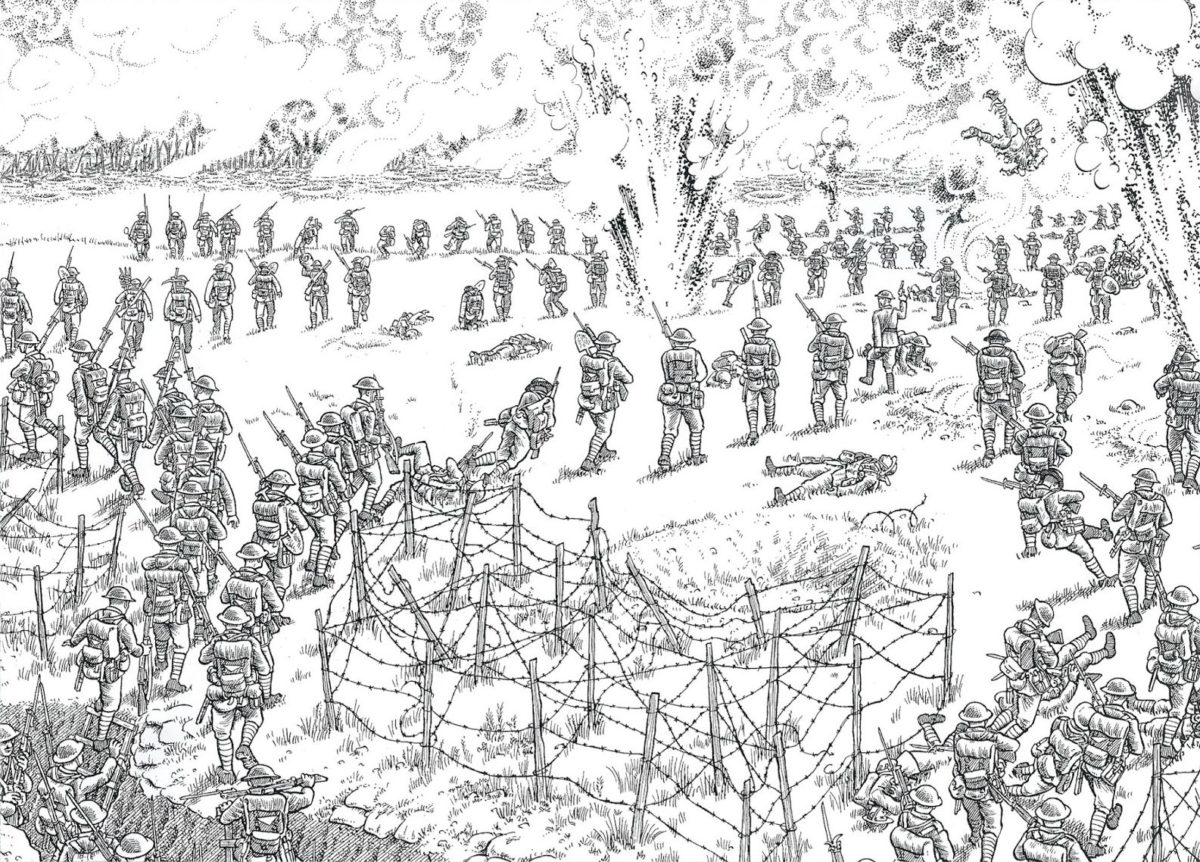
Joe Sacco talks to The New Yorker about his new accordion book The Great War, which folds out to create a twenty-four-foot-long panorama of the Battle of the Somme:

When we first talked about my drawing a panorama of the Western front, the idea seemed static. But immediately I thought of the Bayeux Tapestry… which has a narrative. William the Conqueror in France is getting ready for the invasion; they’re building the boats; they’re crossing the English Channel; then there’s the Battle of Hastings, and you basically read it left to right. It just came to my mind that I could show soldiers marching up to the front, going to the trenches, going over the top, and then returning after they’ve been wounded, back through the lines to the casualty-clearing station behind the front. So it seemed like a very simple idea, and to be honest, I just wanted to draw. On a visceral level, it was just a pleasure to think only in terms of drawing.

It was a relief not to think about words, and to do a different kind of research. I did a lot of image research and I actually had to read a lot of books, because sometimes prose takes you where photography never went. I would read and get images in my head, and it was just a matter of putting them down. I’ve spent a lot of time doing journalism, and I still am interested in it, but I think the artist side of me wants to sort of come out now. And that’s what the Great War was to me, letting myself go in that direction.

Sacco talks more about the work in this video for publisher W. W. Norton:

1 Comment

Art Spiegelman: The Antibodies of Satire

Art Spiegelman talks to Tablet Magazine’s literary editor David Samuels about the retrospective currently at the Jewish Museum in New York, Mad magazine, and, inevitably, Maus.

While not exactly critical of Spiegelman, it’s one of the feistier interviews I’ve read with him recently:

Now, if you’re talking about nationalism, then you have to get to Duck Soup within a couple of seconds. And that impulse predates WWII, and it’s an outsider’s perspective on a culture, and there are still plenty of outsiders to this culture, and things will come from that still, I believe. That’s one point.

The other point, which is more to the point perhaps, is the impulse—I see it through Mad, because it’s the one that’s imprinted on me. Mad made the resistance to the Vietnam War even possible. And that seems really, deeply true, not just some kind of wise-crack true. Because the ’50s felt incredibly monolithic. The early ’50s was an incredibly oppressive place in America, very iconically represented by a decent-enough liberal chap named Norman Rockwell. It’s when we got this ‘In God We Trust’ on our money, it’s when we had our crazy McCarthy moments, we had all of these things happening, and yet there was room for a very effective antibody, which was this kind of self-reflexive, self-deprecating, angry response to the homogeneity from people who weren’t thoroughly homogenized in our culture, i.e., Jews. It led to something very fruitful, and we still have the aftermath of it, both positively and negatively.

Comments closed

Gene Luen Yang: The In-Between World of the Graphic Novelist

The New Yorker‘s book blog Page-Turner have posted a wonderful interview with cartoonist Gene Yang:

I grew up reading comics, and I just have this deep attachment to the medium. I think a lot of the things in my life that I become most passionate about, and most excited about, are all from comics…  In traditional Asian arts, the word and the picture always sit next to each other. I have an aunt, a Chinese brush painter, who told me that when you do a Chinese brush painting, you have to pair the image up with some poetry. A complete work is not masterful unless both of those elements are masterful. So maybe there’s some sort of attachment there—the idea of words and pictures working together is part of my family history.

You can read my interview with Gene, posted yesterday, here.

1 Comment