Skip to content

Tag: Bookselling

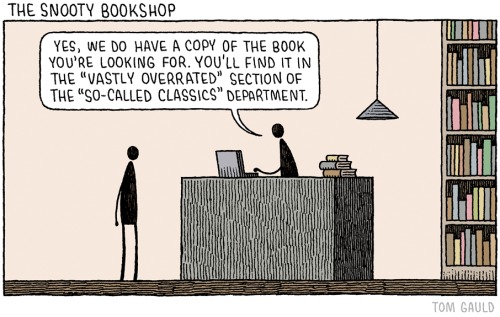
The Snooty Bookshop

snooty-bookshop

We’ve all been there….

(by Tom Gauld, of course)

Comments closed

How The Strand Keeps Standing

the-strand
Over at New York Magazine, Christopher Bonanos (author of Instant: The Story of Polaroid amongst other things), profiles New York new and used bookstore The Strand:

When you visit Amazon or AbeBooks (which is owned by Amazon) and search for an out-of-print title, your results are usually listed from cheapest to most expensive. The first “store” on the list often turns out to be a barn full of books in rural Minnesota or Vermont. Some are charity stores, selling donated books—no acquisition costs at all. They certainly aren’t paying Manhattan overhead. Yet here, too, the Strand is holding on, owing mostly to that churning turnover and the quality of its stock. That barn isn’t going to have many of last year’s $75 art books for $40, and the Strand always does. Plus there are the only–in–New York surprises that come through the store’s front door. Opening a box can reveal a Warhol monograph that will sell for more than $1,000, or an editor’s library full of warm inscriptions from authors… Surely operating out of one of those barns would be cheaper. “Not with our formula,” says [owner Fred] Bass firmly. “We need the store. This business requires a lot of cash flow to operate,” and much of it comes in with the tourists. That funds the book-buying, which supplies the next cycle of inventory. Which requires this expensive retail space, and the renovation of 2003 did not just come from a desire to spiff up. It happened because of a specific event, one that probably saved the Strand: In 1996, after four decades of renting, the Basses bought the building.

Comments closed

The War of Words

Keith Gessen, writer and author of All the Sad Young Literary Men, has a long article in the December issue of Vanity Fair on the ongoing hostilities between Amazon and Hachette. Essentially it’s a timely primer on how the retailer’s relationship with publishers sank to its current low, but it is worth reading for literary agent Andrew Wylie’s thoughts on the matter alone:

The issues at the heart of the conflict are both margin and price, according to Wylie. Publishers have been slow to recognize the danger of percentage creep, he told me. “There was a European publisher in here recently who proudly sat on that sofa and said, ‘I’ve worked everything out with Amazon. I’ve given them 45 percent.’ I said, ‘Really?’ He said, ‘But they wanted 50 percent.’ ” The European publisher thought he had won. Wylie stared incredulously at the memory of this encounter. “He’s a moron!”

Losing the fight over margins would be an immediate blow to the publishers’ profits, but losing control over pricing could be fatal. “If Amazon succeeds,” said Wylie, “they will lower the retail price—$9.99, $6.99, $3.99, $1.99. And instead of making $4 on your hardcover, you’ll be making 10 cents a copy on all editions. And, Keith, you will not be able to afford to write a book.… No one, unless they have inherited $50 million, will be able to afford to write a serious work of history, of poetry, of biography, a novel—anything. The stakes are Western culture.”

Western culture I could take or leave, but the part about me sent a chill down my spine. This is not what you want to hear from your literary agent. Surely we’ll think of something, I said to Wylie, if Amazon does win?

“You think?”

Wylie was not in the mood for a pep talk.

If you don’t have the strength to wade through the whole thing (and who can blame you?), Gessen discussed the piece with Leonard Lopate on WNYC today:

 WNYC Leonard Lopate: Why the Amazon-Hachette Fight Matters and What it Means for Publishing mp3

But for more Wylisms, the man himself was in Toronto recently and Mike Doherty interviewed him for the National Post:

Wylie readily admits, in his Massachusetts drawl, that he was once a big supporter of [Amazon], going so far as to call up CEO and founder Jeff Bezos and offer to help him expand into Europe. He praised the idea that, unlike in a bookstore, backlist and literary titles could be on equal footing with bestsellers — the industry dependence on which he calls a “coked-up, crazy, wild weekend-in-Vegas approach to publishing.” Amazon’s dedication to the long tail, he thought, was key, but then with the introduction of the Kindle, he says, “the dark side of their intention began to be visible.”

Wylie was in town to deliver the keynote address at the International Festival of Authors.

Comments closed

“A Literary Octopus with an Insatiable Appetite for Print”

In November’s Vanity Fair, Bruce Handy profiles George Whitman, the late owner of Shakespeare & Company — “the most famous independent bookstore in the world” — and his daughter Sylvia, the current owner of the shop:

It is not true, as the store’s workers have sometimes overheard passing tour guides proclaim, that James Joyce lies buried in the cellar. (If only. He was laid to rest at a conventional, non-bookselling cemetery in Zurich.) But the store’s roots do indeed reach back to the Shakespeare and Company that Sylvia Beach, an American expatriate, owned in Paris in the 1920s and 30s. As every English major knows, her bookshop and lending library became a hangout for Lost Generation writers such as Ernest Hemingway, F. Scott Fitzgerald, Ezra Pound, and Joyce, whose Ulysses was first published in its complete form by Beach because authorities in Britain and America deemed it obscene. She closed up shop during the Nazi occupation and never reopened. But her mantle was taken up by another American, George Whitman, who opened the present-day store in 1951, just as Beat Generation writers were finding their way to the Left Bank. (The so-called Beat Hotel, which would become a Parisian equivalent to New York’s Chelsea Hotel as a flophouse for writers, artists, and musicians, was only a few blocks away.) Writers who logged time at the current Shakespeare and Company, sometimes even sleeping there—Whitman was possibly keener on extending hospitality to authors, lauded or not, than on selling their books—include Allen Ginsberg, Henry Miller, Richard Wright, Langston Hughes, Lawrence Durrell, Anaïs Nin, James Jones, William Styron, Ray Bradbury, Julio Cortázar, James Baldwin, and Gregory Corso. Another early visitor, Lawrence Ferlinghetti, co-founded his City Lights Bookstore, in San Francisco, as a sister institution two years after Shakespeare’s opened. William S. Burroughs pored over Whitman’s collection of medical textbooks to research portions of Naked Lunch; he also gave what may have been the first public reading from his novel-in-progress at the store. (“Nobody was quite sure what to make of it, whether to laugh or be sick,” Whitman later said.)

Comments closed

Mourning Local Bookstores

Writing for the New York Times, Julie Bosman recently looked at how surging rents are forcing bookstores from Manhattan:

The closings have alarmed preservationists, publishers and authors, who said the fading away of bookstores amounted to a crisis that called for intervention from the newly minted mayor of New York City, Bill de Blasio, who has vowed to offer greater support to small businesses.

[Author Robert] Caro said in an interview that he is heartbroken by the loss of bookstores from Manhattan, calling it “a profoundly significant and depressing indication of where our culture is.”

“How can Manhattan be a cultural or literary center of the world when the number of bookstores has become so insignificant?” he asked. “You really say, has nobody in city government ever considered this and what can be done about it?”

There has, of course, been a similar trend in Toronto with the Cookbook store, the Annex location of Book City, and the Bloor West Village Chapters all closing (or about to) in recent months.

On a happier note though, Bosman notes that some stores are thriving by locating to other, more affordable neighbourhoods in New York (and beyond):

just as many writers have fled to Brooklyn or Queens in search of more affordable housing, some bookstore owners have followed. Greenlight Bookstore in Fort Greene opened in 2009 to robust business and year-over-year increases in sales.

In December, Christine Onorati, the co-owner of Word bookstore in Greenpoint, Brooklyn, opened a second store in Jersey City. Ms. Onorati said she never looked seriously at Manhattan because the rents were so unaffordable…

…After spending years scouring Manhattan for a second location, Ms. McNally of McNally Jackson abandoned her search. At the urging of a former employee, she began looking in Brooklyn and settled on Williamsburg, where she found a “magnificent,” loftlike space with a 20-foot ceiling.

I hope this will be true of Toronto too even though it is much smaller than New York (New York has more than twice the population of Toronto). But here, despite some well-defined neighbourhoods, bookstores seem to have been slow to follow their customers (and their families) to more affordable areas of the city. My neighbourhood, where I’ve lived for 8 years, is filling up with young families and yet many store fronts remain stubbornly empty. And while I consider myself lucky to still have a bookstore, Book City’s Danforth location, only four subway stops away, it feel like a very different neighbourhood. I would love to be able to walk to a bookstore with my kids, or stop in to browse on my way home.

Perhaps the bookstores further afield, in communities like Burlington and Hamilton, are doing better? I hope so.

Still, I will leave the final word to Rebecca Mead, author of My Life in Middlemarch, who has written a sharp response to the New York Times article for  The New Yorker:

Those of us who cherish our local bookstores do so not simply because they are convenient—how great to be able to run out for milk and also pick up the new Karl Ove Knausgaard!—but also because we feel a duty to support them, because we believe in their mission. When books can be bought so cheaply online, or at one of the dwindling number of discount retailers, paying more to shop at a local bookstore feels virtuous, like buying locally sourced organic vegetables, or checking to see if a T-shirt is made in the U.S.A. It can be gratifying to the point of smugness to feel that one is being pluralistic, liberal, and humane; shopping at an independent bookstore may be one of the diminishing opportunities to experience that feeling in first-class New York City. Still, when I consider the vanished bookstores of Manhattan, I mourn not just their passing but the loss of a certain kind of book-buying innocence—a time when where one bought a book did not constitute a political statement, and reading it did not feel like participating in a requiem.

Comments closed

Worse than Wal-Mart?

In an excerpt from his new book, Mindless: Why Smarter Machines Are Making Dumber Humans, Simon Head compares the labour practices of Amazon and Walmart:

Amazon equals Walmart in the use of monitoring technologies to track the minute-by-minute movements and performance of employees and in settings that go beyond the assembly line to include their movement between loading and unloading docks, between packing and unpacking stations, and to and from the miles of shelving at what Amazon calls its “fulfillment centers”—gigantic warehouses where goods ordered by Amazon’s online customers are sent by manufacturers and wholesalers, there to be shelved, packaged, and sent out again to the Amazon customer…

…With Walmart’s and Amazon’s business model, the workplace practices that raise employee productivity to very high levels also keep employees off balance and thus ill placed to secure wage increases that match their increased output. The “cult of the customer” preached by both corporations is a scented smoke screen thrown up to hide this fact. Apart from the model’s intensive use of IT, there is not much to distinguish its methods from those of the primitive American and European capitalism of the late nineteenth and early twentieth centuries.

UPDATE: George Packer, continuing his series about Amazon, touches upon a similar topic in a new post for The New Yorker:

[T]hese companies are everywhere and nowhere, ubiquitous in our lives but with no physical presence or human face. They are regarded by many users as public resources, not private corporations—there for us—and their own rhetoric furthers this misperception: Facebook’s quest for a “more open and connected world”; Google’s motto, “Don’t be evil,” and its stated mission to “organize the world’s information and make it universally accessible and useful”; Amazon’s ambition to become “Earth’s most customer-centric company.” Because these endeavors seem to involve no human beings, no workers, other than ourselves—the supposed recipients of all the benefits—it takes an effort to realize that the tech economy is man-made, and that, as with the economies that preceded it, human beings have the capacity to shape and reform it for the public good. It would be easier to remember this if every time you clicked “BUY,” searched for an article, or texted a friend your screen flashed the face of a worker who once held a job that made way for your seamless online experience.

Comments closed

Cheap Words: George Packer on Amazon

The book folks have surely seen this already, but at The New Yorker George Packer takes a long hard look at Amazon:

Before Google, and long before Facebook, Bezos had realized that the greatest value of an online company lay in the consumer data it collected. Two decades later, Amazon sells a bewildering array of products: lawnmowers, iPods, art work, toys, diapers, dildos, shoes, bike racks, gun safes, 3-D printers. Amazon’s code of corporate secrecy is extreme—it won’t confirm how many Seattle employees it has, or how many Kindle e-readers have been sold—so it’s impossible to know for sure, but, according to one publisher’s estimate, book sales in the U.S. now make up no more than seven per cent of the company’s roughly seventy-five billion dollars in annual revenue.

Origins, though, leave lasting marks, and Amazon remains intimately tangled up in books. Few notice if Amazon prices an electronics store out of business (except its staff); but, in the influential, self-conscious world of people who care about reading, Amazon’s unparalleled power generates endless discussion, along with paranoia, resentment, confusion, and yearning. For its part, Amazon continues to expend considerable effort both to dominate this small, fragile market and to win the hearts and minds of readers. To many book professionals, Amazon is a ruthless predator. The company claims to want a more literate world—and it came along when the book world was in distress, offering a vital new source of sales. But then it started asking a lot of personal questions, and it created dependency and harshly exploited its leverage; eventually, the book world realized that Amazon had its house keys and its bank-account number, and wondered if that had been the intention all along.

It’s very comprehensive piece and well worth taking the time to read all the way through. At the LA Times Jacket Copy blog, Carolyn Kellog spoke to Packer about how the article came about:

Packer… included a suggestion from super-agent Andrew Wylie that publishers stop selling their books to Amazon altogether. Does Packer think that’s viable? “It’s a pretty radical solution, if you think about what it would do to their sales” he said. “I don’t know enough to agree or disagree.”

But in terms of telling the story, it was helpful. “It seemed like a way to jolt the picture productively. When you’re been an industry for a long time, you can’t imagine things differently. Maybe publishers need to think disruptively and not be victims.”

UPDATE: Packer has posted a short, but interesting, follow-up essay, ‘Amazon and the Perils of Non-Disclosure, at The New Yorker:

To Amazon, any piece of information could give its competitors an advantage. But what if those competitors’ main advantage is the walled-off, impenetrable nature of the company? If Amazon were just selling clothes, this might not be a potentially fatal flaw. But, as I wrote, the company has become a book publisher and a production company, and its owner has bought a major newspaper. Amazon is up to its neck in the world of culture, where nothing good can be done without a little light and air. The fact that Bezos visited his newspaper last month with more stealth than George W. Bush flying into Baghdad—a visit that was so well hidden even from people at the famously wide-open Post that I managed to break the story in these pages—struck me as particularly bizarre. Why not just show up? Because secrecy is in Amazon’s marrow. I’m certain that, sooner or later, this is going to create problems for Bezos’s newspaper, and I’m fairly sure that one reason for the failure of Amazon’s trade-publishing arm has to do with its isolation from the larger publishing world. If editors can’t gossip, speak to reporters, and pick up intel, they’re less likely to spot new talent and incubate ideas. They’re also less likely to be trusted by writers. Book culture and non-disclosure agreements are inimical.


1 Comment

New Republic: Who Said the Book Industry is Dying?

The latest issue of the New Republic looks at the book publishing industry and it includes an article by Evan Hughes on the relative health of the book business:

At the individual level, everyone in the trade—whether executive, editor, agent, author, or bookseller—faces threats to his or her livelihood: self-publishing, mergers and “efficiencies,” and, yes, the suspicious motives of Amazon executives. But the book itself is hanging on and even thriving. More than any major cultural product, it has retained its essential worth.Of course, publishers think that $9.99 is still too low for popular e-books, an assessment that drove their ill-fated effort to work with Apple to take control of what they cost… It may be that a higher price would be more equitable. But other media still have reason to look at the relative economic health of the book with envy.

There is also includes a much-tweeted  interview with literary agent Andrew Wylie. Wylie is, of course, eminently quotable (I think my favourite line from the interview is this: “We’re selling books. It’s a tiny little business. It doesn’t have to be Walmartized.”) and interviewer Laura Bennett has posted some choice outtakes from her print piece.

Comments closed

Midweek Miscellany

Patchwork — Artist Lilli Carré talks about her story collection Heads or Tails with Robot 6:

I wanted to include the majority of the short stories I’ve produced over the past five years, and so I went through all my stuff and arranged them not chronologically, but by how they each fed into each other. The book contains stories collected from anthologies, some new work, and a few pieces that I reformatted from small run mini-comics, artists books, and drawings that I’ve made over the years. My style changes quite a bit from project to project, so the book has a kind of patchwork quilt feel to it, but I wanted to make sure there was a solid thread between how one story feeds into the next.

The Activists — An interview with Dennis Johnson and Valerie Merians, founders of Melville House, at The Rumpus:

A lot of our early work was activist books… We were always kind of motivated in that way. When you have your own publishing house, you have to follow your own tastes, so we were publishing whatever we liked. We were also publishing a lot of translated fiction, because we felt that something that was important in the United States that was important then and still now, to combat that sort of insular feeling that we are all there is. To bring other writers and voices into the language, and get them exposed to new readers.

Nice — A lovely profile of Ben McFall who manages The Strand’s fiction section, in the New York Times:

 Mr. McFall grew up in Detroit, the only child of two schoolteachers, and he studied literature and music in college. He worked at a bookstore in Connecticut after graduation and then moved to New York in the mid-1970s to flourish as an actor, singer, poet and openly gay man. He took a job at the Strand in 1978.

“Back then, it was a cruel place; I was the first nice person to work here,” Mr. McFall said.

And finally…

Learn New Old Skills — An interview with type designer and calligrapher Seb Lester at Salon:

I’ve gone back to basics in recent years and placed a lot of emphasis on traditional tools… I have realized that calligraphy makes me a better type designer with digital tools and vice versa. There is a beautiful synergy between the two. There is also something very satisfying about making expressive marks and calligraphy has a humanity and expressive quality hard to capture with a computer. A personal motto at the moment is learn new old skills.


Comments closed

The Book Monger

A charming interview with Patrick Kelly, the owner of a second-hand bookshop in Brixton called Book Mongers. The shop celebrated its 20 year anniversary in May:

(via Simon Armstrong)

Comments closed

Something for the Weekend

The brilliant Jon Gray and Jamie Keenan reveal the 20 irrefutable theories of book cover design. All of them are great.

Also at The Guardian: Ahdaf Soueif, author most recently of Cairo: My City, Our Revolution, on fiction and the revolution in Egypt:

Attempts at fiction right now would be too simple. The immediate truth is too glaring to allow a more subtle truth to take form. For reality has to take time to be processed, to transform into fiction. So it’s no use a story presenting itself, tempting, asking to be written, because another story will – in the next minute – come roaring over it, making the same demand. And you, the novelist, can’t grab one of them and run away and lock yourself up with it and surrender to it and wait and work for the transformation to happen – because you, the citizen, need to be present, there, on the ground, marching, supporting, talking, instigating, articulating.

The Last Book Sale — A charming piece for the NYRB by Larry McMurty, book dealer and author of The Last Picture Show, on an auction of his books in Archer City:

Everything sold but the fiction. Everyone who deals in fiction has plenty, and more is spilling onto the market from the sale of the Serendipity Bookshop stock now being dispersed on the West Coast. Many people asked me if I was sad to see so many books go. I wasn’t—mainly I was irritated to discover that I still had 30,000 novels to sell.

And finally…

 Put A Bird On It — The New York Times on the city’s boutique art bookstores:

perhaps because the physical book is coming to seem more like an object than ever before, the current landscape of shops blurs the line between bookstore and gallery in rollicking, unpredictable fashion. And because the shops are not nearly as tethered to high-end economics as art galleries, the mélange of stuff that results, some for sale and some not, can be strange and wonderful, like highly personalized cross sections cut from the culture at large.

1 Comment

Midweek Miscellany

Kate Beaton’s Wonder Woman returns.

Five-Pointed Stars of Pain — An excellent post on Dan Clowes and his latest book The Death- Ray at The Brooklyn Rail:

Clowes engaged themes consistent with those of literary fiction in visual terms and in bookstore-friendly formats, and he was not alone. By the turn of the millennium there emerged a critical mass of graphic novels ready to join Maus on the shelves of bookstores and libraries, and some far-sighted publishing insiders took notice. Chief among them was Chip Kidd, the acclaimed book designer for Knopf who also consulted on a handful of comics projects at Pantheon… Kidd perceptively encouraged Pantheon to make a stronger commitment to the comics form, and in late 2000 the publisher debuted two books: Chris Ware’s Jimmy Corrigan: The Smartest Kid on Earth and Clowes’s David Boring.

Ware’s critically lauded book, originally serialized in his Acme Novelty Library series, somewhat overshadowed Clowes’s deadpan investigation into lust and obsession. But the simultaneous publication of these two works by a major publisher made an unmistakable statement: a generation of cartoonists laboring in obscurity had come of age.

A Complicated Life — Los Angeles Times television critic Robert Lloyd on Tintin creator Hergé:

Hergé had left orders that, after his death, Tintin would go no more a-roving. That is not how it is with many fictional characters — or “properties” as they are sometimes called, perpetually prey to the whims of whoever holds the deed. James Bond has long outlived every thing Ian Fleming ever thought to do with him; a single comic-book hero may be the work of any number of cooks, prepared for a range of readers in a variety of flavors, from plain vanilla to something laced with rum, coke or Lithium. But Tintin without Hergé is as unthinkable — or if thinkable, still as wrong — as Charlie Brown without Charles Schulz.

Good Manners — Lorien Kite, the Financial Times’s books editor, has lunch with bookseller (and now managing director of Waterstone’s) James Daunt:

He was recently quoted as having referred to Amazon as “a ruthless money-making devil” that did not operate in the consumer’s interest – comments that generated an angry response in some quarters. Playing devil’s advocate, I ask: isn’t it up to consumers to decide what is more important, the price or a congenial experience? “I wouldn’t disagree with that at all,” he says. “Oddly enough, completely contrary to that headline, I genuinely don’t feel sorry for myself. As long as I deliver something that people enjoy, I’ll be fine.”

And finally…

Alice Rawsthorn on graphic designer Robert Brownjohn for The New York Times:

Talented though he was, Brownjohn’s contemporaries knew him as much for his decadent lifestyle as for his work. Charming and gregarious with a flair for grand gestures, he was haunted by drug addiction. As his friend, the British graphic designer Alan Fletcher, once wrote: “He had real charisma rather than character. You always knew he was about five jumps ahead of whatever you were thinking…”

A few years after his arrival in London, Fletcher arranged for him to talk to a group of designers. Brownjohn spoke lucidly but looked fragile and, at times, struggled to stay awake. An architect in the audience asked: “What is graphic design?” Brownjohn replied: “I am.”

(NB: Posting will probably be a bit sparse here from now until mid-January, so just reminder that there’s also The Accidental Optimist, The Casual Optimist Tumblr and Facebook which will be updated more frequently).

Comments closed