Skip to content

Tag: Bookselling

Midweek Miscellany


Flaunt it — Designer Armin Vit discusses the UnderConsideration book Flaunt: Designing Effective, Compelling and Memorable Portfolios of Creative Work at For Print Only.

How Art Became the Media — Lewis Lapham, editor of Lapham’s Quarterly (formerly editor of Harper’s Magazine), at Guernica magazine (via Bookslut on Twitter):

It isn’t that the country now lacks for painters painting pictures or poets writing poems, nor is it to say that stores of human energy and hope aren’t to be found in the novels of Elmore Leonard or the songs of Bruce Springsteen. It is to say that with the dawn of Reagan’s bright new morning in America, the notion of art as the way into a redemptive future had withered on the vine. Once again, as had been customary throughout most of the country’s history, art was seen as an embodiment of the good, the true, and the beautiful only to the extent that it could be exchanged for money.

George Lois on the iPad in the New York Observer (no, I’m not entirely sure how I missed this last week either):

“magazines will never die because there is a visceral feeling of having that thing in your hands and turning the pages. It’s so different on the screen. It’s the difference between looking at a woman and having sex with her.”

Flying the Coop — Another interesting installment of the National Post‘s ‘Ecology of Books’ series, this time on authors moving from small presses to big publishing. And there’s an interesting follow up from Daniel Wells, the publisher of Biblioasis one of the aforementioned Canadian small/independent presses (via Steven Beattie).

Microdistribution — This is fascinating… The Boulder Bookstore (Colorado) is experimenting with charging self-published authors for shelf-space and promotion (via Sarah Weinman on Twitter):

“Most people will come in at one of the higher fee amounts,” Arsen Kashkashian, the store’s head buyer and the architect of the program, told me. “That surprised us.” In fact, when the store first began charging its consignment authors back in 2007 (the fee-structure idea emerged when the store’s employees found themselves “inundated with self-published books, and there was a lot of work involved and not much reward”), its staff “thought people would grumble and complain” about the charges. But authors, Kashkashian says, have been generally grateful for the opportunity to sell and promote work that might otherwise be seen and appreciated only by their friends/spouses/moms: “‘I want the marketing, I want the exposure. I worked so hard on this project, and you guys are the only ones who could help me with it.’”

And finally…

Four Ways to Combines Fonts by H&FJ, built around a beautifully simple principle: “keep one thing consistent, and let one thing vary.”

2 Comments

Something for the Weekend

Circulation and the City design by David Drummond

New from David Drummond

The Original Spirit — Toronto indie institution This Ain’t The Rosedale Library (one of the 10 best bookshops in the world according to The Guardian) featured at Books@Torontoist, with some nice quotes from owner Charlie Huisken:

“creative knowledge [is] accumulative and comes from many sources… Being an autodidact has served me well”

Books in the Age of the iPad — Craig Mod’s article on printed books and digital publishing caused much of a flutter on Twitter yesterday. I’m not sure that I entirely agree with his thesis — which seems to imply that some kinds of content can be completely divorced from their media — but his website is beautifully designed, and more importantly he makes some interesting points. I especially like his conclusion:

I propose the following to be considered whenever we think of printing a book:

  • The Books We Make embrace their physicality — working in concert with the content to illuminate the narrative.
  • The Books We Make are confident in form and usage of material.
  • The Books We Make exploit the advantages of print.
  • The Books We Make are built to last

In that vein, more on David Pearson‘s beautiful book cover designs for Cormac McCarthy at We Made This. I love that he used rubber stamps…

And finally… Jaron Lanier, author of You Are Not A Gadget, talks about the failure of Web2.0 with Aleks Krotoski of The Guardian:

3 Comments

Something for the Weekend, June 12th, 2009

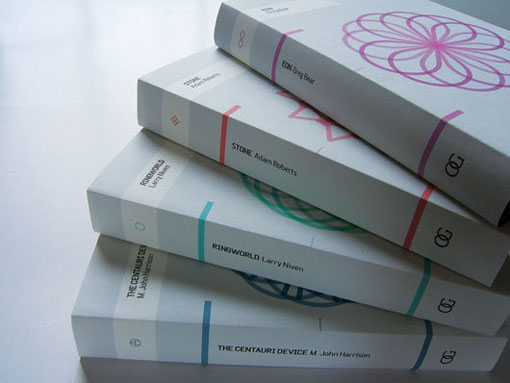
Jamie Conkleton‘s book cover designs for Gollancz’s Space Opera series, as featured in the D&AD Student Annual 2008. Great stuff. (via designworklife).

Are any other publishers pursuing similar initiatives with student designers to repackage their backlist?

Wordnik — More curious word information than dictionary, Wordnik provides definitions, examples, related words, pronunciation, related images, statistics, and tweets for the word searched.  Neat.

The Curse of Maus — cartoonist Art Spiegelman profiled in The Guardian:

Will he ever escape the shadow of Maus? “It’s even worse than that,” he says, lighting a cigarette. “Most other cartoonists are afraid of the same thing.” He means that every graphic novel is compared to Maus. “As a result, it’s sort of a curse on me and all other cartoonists I know.”

Toothy Uncoated Stock — The chaps at The Book Cover Archive pointed me to the design:related portfolio of Alex Camlin, Creative Director at Da Capo Press. His design’s for the Harvard Review are beautiful.

2 Comments

Midweek Miscellany, May 20th, 2009

Cut It Out — Dioramas made from the covers of pulp novels by Thomas Allen, seen at We Made This (via Ingrid Paulson on Twitter).

You Can’t Be SeriousThe Guardian takes a gloomy look at fate of  non-fiction and bookselling in the UK, managing to summon up  some half-hearted optimism towards the end:

Despite decades of predictions to the contrary, the appetite for demanding non-fiction has survived the advent of newspapers, radio and television – and, in Britain, a popular culture with a particular ability to absorb talent and themes that in other countries would be channelled into grand state-of-the-nation volumes. In fact, many publishers think the noise and immediacy of the web will make slow, quiet immersion in a book seem more, not less, appealing. And books, unlike most digital media, are not directly dependent on recession-affected advertising revenues.

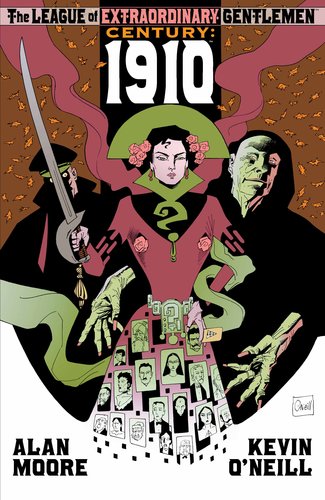
Boy’s Own Misadventure3:AM Magazine’s Mat Colgate gets to the heart of why volume 3 of The League of Extraordinary Gentleman Century: 1910 (published by Top Shelf)  is mildly disappointing (by Alan Moore standards). Could it really be that Moore writes better when subverting restrictions of form and genre than when he has free reign?

It’s Not Just Your Type — Priya Ganapati talks to designers, including Henry Sene Yee, about the problems of  e-book design at Gadget Lab.  (And Joshua Tallent’s commentary at TeleRead about the problems of formatting for ePub is also worth reading).

Restraint — I mentioned Marian Bantjes’ gorgeous new typeface at the weekend, and now you can download a rather lovely Restraint desktop from the folks at Typenuts (via I Love Typography on Twitter).

1 Comment

Something for the Weekend, March 6th, 2009

Abecediary — Steven Heller on alphabet books (Die Flucht Nach ABECEDERIA by the French comic artist Blexbolex pictured above).

Imprints in the 21st Century — Admittedly HarperCollins new Imprint It Books is an easy target (NB use of “tap into the zeitgeist” in a sentence = fail), but Mike Shatzkin does a good job of explaining why their strategy is past its sell by date (and beginning to smell):

General trade publishers need to see, and apparently don’t,  that their legacy brands are B2B [business-to-business]. They should be exploited that way. They need brands that can work B2C [business-to-consumer], but it will require discipline, focus, and an audience-first picture of what to publish to accomplish that.

Writing for a Living — Luminaries such as Will Self, Joyce Carol Oates, and AL Kennedy (quoted below) discuss whether writing is a joy or a chore in The Guardian:

“The joy of writing for a living is that you get to do it all the time. The misery is that you have to, whether you’re in the mood or not.”

Hugh at BookOven is angry this week.  He wants to know why publishers are not selling directly to customers from their website and why they make e-books so complicated. I think Hugh underestimates the time/money/skill-deficit obstacles publishers face in regard to both problems. I suspect Hugh thinks I’m an apologist and will be first up against the wall when the revolution comes.


Book Design Made Easy — cartoonist Tom Gauld is making his genius cartoons from The Guardian available on Flickr (via Drawn!, source of so many life-improving things).

4 Comments

Cautious Optimism

Books a better buy in Canada? After all the problems caused by the high Canadian dollar in 2007, Canadian publishers and booksellers are “cautiously optimistic” at the start of this year’s holidays according to Vit Wagner in the Toronto Star:

“The climate is much better this year,” says [Nancy] Frater, proprietor of the Orangeville store BookLore. “My reason for optimism is that in challenging economic times, people do turn to books. As gifts, books have long-lasting value and they’re reasonably priced.”

It’s all relative though:

“I can’t look into the future and say everything’s going to be sanguine,” says Random House of Canada’s [Brad] Martin. “We’re doing a lot of cost cutting, but it’s more discretionary, like cutting the number of sales conferences from two to one. But we believe that the organization that we have now is what we need to successfully publish books in this country at the level that we have been publishing them.

“What I can’t tell you is what is going to happen to the market over the first six months of next year. It’s concerning for all of us. But certainly right now we seem to be performing better in a difficult market than the two other major English-language markets.”

And I’m not sure how this all sits with the recently reported “belt-tightening” in Canadian publishing — including staff changes at KidsCan Press and Thomas Allen postponing most of  their spring 2009 list — and all the grim news coming out of the US.

Is there worse to come? Any Thoughts?

1 Comment

Monday Miscellany

“I have always enjoyed photographing loners” — A lovely BBC audio slideshow of “Writers’ Rooms” narrated by award winning photographer Eamonn McCabe. The project, appearing weekly in The Guardian and currently on show Madison Contemporary Art in London, captures the working environments of novelists, biographers and poets.

Book Industry Enters Shaky Chapter: NPR’s Lynn Neary looks at last week’s horrorshow.

The 10 Best Books of 2008 according to The New York Times Book Review. Interesting that they’ve also created a mini-site which has promotional material for the top 10 books, including shelf talkers, bookmarks, and posters for bookstores to download . There are also web banners and a video with author Toni Morrison. This is has to be a good idea.

“The news is still big. It’s the newspapers that got small”: A spectacular Roger Ebert rant about the death of criticism :

The celebrity culture is infantilizing us. We are being trained not to think. It is not about the disappearance of film critics. We are the canaries. It is about the death of an intelligent and curious, readership, interested in significant things and able to think critically. It is about the failure of our educational system. It is not about dumbing-down. It is about snuffing out.

Spot. On.  I actually met Roger Ebert a few years back in Pages bookstore. The Toronto International Film Festival must have been on. I had no idea who he was at the time (a colleague told me later), but he was very nice about it.

“The Most Dangerous Man in Publishing”:  A profile of publisher Barney Rosset in Newsweek:

Before Rosset challenged federal and state obscenity laws, censorship (and self-censorship) was an accepted feature of publishing. His victories in high courts helped to change that. Rosset believed that it was impossible to represent life in the streets and in the dark recesses of the heart and mind honestly without using language that in the mid-20th century was considered “obscene”—and therefore illegal to sell or mail. To a significant extent, the books he published convinced others that this was true.

The Well-Tended Bookshelf— Laura Miller on culling one’s book collection:

There are two general schools of thought on which books to keep, as I learned once I began swapping stories with friends and acquaintances. The first views the bookshelf as a self-portrait, a reflection of the owner’s intellect, imagination, taste and accomplishments… The other approach views a book collection less as a testimony to the past than as a repository for the future; it’s where you put the books you intend to read.

Which leads me rather nicely to…

Books At Home: A blog about bookshelves. It is possible that this just too nerdy. Even for me.

Relevance: Brian at daxle.net interviews author Tim Manners , editor and publisher of The Hub and Reveries.com. It’s a fascinating discussion that covers innovation, brands, and the consequences of overabundant advertising (amongst other things).

3 Comments

Bracing for the Worst

“[E]veryone in publishing is bracing for a difficult holiday season while trying to remain optimistic about the enduring allure of books.”

Motoko Rich looks at the recent spate of publishing lay-offs, and what holiday season holds for the book industry, in today’s New York Times:

“I think that people have not been reading for the past year because they’ve been checking political blogs every 20 minutes,” said Larry Weissman, a literary agent. “At some point I think people are going to say, ‘You know what, this is not nourishing.’ I think and I hope — and maybe it’s just blind hope — I think there is a yearning for authenticity out there, and people are going to go back to the things that really matter, and one of those things, I hope, will be reading books.”

Link

Comments closed

Monday Miscellany, Nov 3rd, 2008

The extraordinarily cool binding for Alfred Jarry’s Ubu Roi (Ubu the King), a collaboration between bookbinder Mary Reynolds and Marcel Duchamp, as seen at blog.rightreading (pictured).

Editor Chuck Adams interviewed in the November Poets & Writers Magazine. A very interesting–albeit very commercial–perspective:

“For too long, in New York, we’ve been in this culture of publishing what we like and not what readers want. Hopefully, we’ll come around to trying to understand what people really want to read so we can interest them in reading in the first place.

He also makes a very telling point about the problem of homogeneity of publishing:

“We don’t encourage a diversity of people in the business. We don’t. We just want more of the same because they’re the ones who can afford to work in it.”

I couldn’t agree more…

Not content with Bastards With Bookshops , Bastards With Bookshops 2,  and Yet More Bastards With Bookshops , Bookride has gleefully provided guidelines to help aspiring bastard-booksellers achieve their dream. Like they need the help… My personal favourite:

“Greet the customer with a glower, a scowl or a look of deep mistrust. If you are feeling generous a frosty ‘Good Morning! will suffice.”

Following Chapters-Indigo in Canada, Barnes and Noble have launched a social networking site ‘My B&N’ in the US.

Agent Kate Lee interviewed at HarperStudio’s 26th Story:

“I think the building or seeding of buzz online is important–as with film, music or TV, word of mouth is invaluable.  That buzz can come through building relationships with bloggers, writing posts that you then try to get linked to, starting up a social network or “fan” group, and/or creating original online content.  The main thing is just to be out there–be writing, be posting, be Twittering, be engaging in conversation with other people in the blogosphere.”

A fascinating half-hour interview with novelist John Le Carre from BBC Radio 4’s Front Row.

Comments closed

On Being Skipped

GalleyCat pointed me in the direction of  a refreshingly frank essay by Andrew Wheeler, Marketing Manager for John Wiley & Sons, about books that are passed over, or  skipped’,  by a bookstore:

“bookstores are businesses, not public conveniences. No store has the responsibility to carry every book published… I market books for a living, so I can tell you an unpleasant truth: the order for any book, from any account, starts at zero. The publisher’s sales rep walks in the door with tipsheets and covers, past sales figures and promotional plans, to convince that bookseller’s buyer to buy that book. In many categories… the chain buyers say “yes” the overwhelming majority of the time. But not all the time. Sometimes, that buyer is not convinced, and the order stays at zero.”

None of what Andrew says will be news to any one working in publishing — skips are an accepted, if unpleasant, part of the business — but, as Andrew notes, authors on the receiving end of skips are outraged by them, and I’m sure more than a few debut authors will be shocked to discover that there is such a thing and that it happens frequently enough to have its own terminology.

In most cases agents or publishers don’t discuss the possibility of skips with their authors before they actually happen — no one wants to be that pessimistic about a book’s chances! But that is not to say we should be less than forthright about the realities of business, or pretend that this doesn’t happen.

I recently had an exchange with a freelance publicist who told me with all confidence that he was going to book his client-author on national radio and television. Knowing the book, and having had some experience of the challenges of book publicity, I just about spat out my coffee. Charitably he was naively optimistic. Uncharitably, he was bullshitting me, and probably his client, to justify his hourly rate.

A publicist, however good he or she is, cannot guarantee an author publicity any more than the greatest sales rep can guarantee sales or prevent the dreaded ‘skip’. You can charm and you can twist arms,  but ultimately the decision lies with someone else — a producer, a book review editor, or a buyer — with a set of priorities different to your own. To pretend otherwise, leaving things unspoken  or offering overconfident assurances is a disservice to your author, and will probably bite you in the ass in the long run as a publisher (or freelance publicist).

Authors, unsurprisingly, have a tendency to be smart people. By and large they don’t want to be left in the dark, or have their hopes unrealistically raised. Sure they should take some responsibility — ask questions and educate themselves  — but we should  be honest and upfront about how the book business works, putting books in their proper context and giving an author a realistic sense of what is possible.

Comments closed

Monday Miscellany, Oct 13th, 2008

A belated Happy (Canadian) Thanksgiving and a belated Monday Miscellany (on Tuesday)…

An interesting  Q & A with George Jones, President and Chief Executive Officer of Borders Group, on HarperStudio’s The 26th Story Blog:

“I do not agree that it’s all doom and gloom in the book business… I think people are always going to want books…they will always want to be entertained and informed by books and I do not see that changing.  It’s true that the format books take may change over time and evolve, and the places where people buy books and how they access them have changed over time and will change further, but books themselves will always be part of our culture and our world in my opinion.”

Marketing in Tough Times. The American Booksellers Association ask successful booksellers to share their advice on marketing  during the economic downturn.

Book-lined stairs (pictured) designed by Levitate Architects for a space-challenged London apartment, as seen on the lovely Apartment Therapy (via image bookmarking site FFFFound).

50 of your favourite words on the BBC online magazine (as inspired by Ammon Shea’s book READING THE OED). I’m rather partial to ‘metanoia’ – “the act or process of changing one’s mind or way of life” – myself…

Comments closed

Megalisters

“What fun is there in clicking… compared to the pleasure of handling a fine copy of a rare book?”

Mick Sussman examines used-book selling in the internet age for the New York Times:

[T]he state of the art in used-book selling these days seems to be less about connoisseurship than about database management. With the help of software tools, so-called megalisters stock millions of books and sell tens of thousands a week through Amazon, AbeBooks and other online marketplaces.

But, it’s not all bad news for the small dealer:

“Though the rise of the megalisters has hurt many mom-and-pop operations, the toll has been less than catastrophic. A database maintained by Susan Siegel of Book Hunter Press lists 3,968 “open shops” — as brick-and-mortar outlets are known — across the United States today, down from 4,119 in 2002. A 4 percent drop over six years might not be something to cheer about, but it would seem downright enviable to record or video store owners.”

What are smaller used-book sellers doing to survive? Using their experience, sharing “alchemical trade wisdom” in online forums, focusing on books that are rare–if not exactly collectible–and combining labour-intensive hand-selling with the selective use of e-commerce:

After the great wave of creative destruction set off by e-commerce, the more adaptable breed of used-book seller seems to have survived… Chris Volk, a store owner and the vice president of the Independent Online Booksellers Association, says her colleagues are frustrated but undaunted by the megalisters. “In the long run,” she said, “people who know what they’re doing will win out.”

Comments closed