Skip to content

Tag: Bookselling

The Booksellers Official Trailer

Well, this looks like fun!

Antiquarian booksellers are part scholar, part detective and part businessperson, and their personalities and knowledge are as broad as the material they handle. They also play an underappreciated yet essential role in preserving history. THE BOOKSELLERS takes viewers inside their small but fascinating world, populated by an assortment of obsessives, intellects, eccentrics and dreamers.

According to their Facebook page, the film is in theatres next month.

(via Kottke and others)

Comments closed

Find Your Place in the Market

Tom Gauld for The Guardian.

Comments closed

Bookstores Embrace Protest

At the New York Times, Julie Bosman looks at how American bookstores have become hubs of resistance: 

Political organizing is perhaps a natural extension of what bookstores have done for centuries: foster discussion, provide access to history and literature, host writers and intellectuals.

“All bookstores are mission-driven to some degree — their mission is to inspire and inform, and educate if possible,” said Elaine Katzenberger, publisher and executive director of City Lights in San Francisco, a store with a long history of left-wing activism.

“When Trump was elected, everyone was just walking around saying: ‘What do I do. What do we do?’” she added. “One of the places you might find some answers is in books, in histories, in current events, even poetry.”

Comments closed

The Neighborhood Bookstore’s Unlikely Ally

The New York Times on the small independent bookstores making the most of social media and online sales:

Undoubtedly, the bookselling industry is still digging out of a deep trough. Sales of physical books in physical stores were just $11 billion in 2015, compared with $17 billion in 2007.

But owners like Mr. Makin are finding ways to gain customer loyalty with the aid of technology. He knew he could not compete with Amazon on price, but he believed that online buyers would flock to Brilliant Books if they experienced the same customer service that shoppers in his physical store do.

“I say, ‘We are your long-distance local bookstore,’” Mr. Makin said.

He began offering free shipping anywhere in the United States and hired a full-time social media manager, who promotes the store and has used Twitter and Facebook to talk to readers who would never find themselves near Traverse City.

One of his most successful ways of getting repeat business is his store’s version of a book-of-the-month program, which makes personalized recommendations for each of its nearly 2,000 subscribers every 30 days. Rather than use an online form to track preferences, Brilliant sends each new subscriber a customer card to fill out by hand and mail back.

Employees then scan the card into the system so that when it is book-selection time, they can see what the customers said they liked and how they said it.

“How we might write something might show an entirely different taste in books,” Mr. Malkin said. “People scribble things out. They draw arrows. We get a feel for who they are.”


Comments closed

Welcome to The Last Bookstore

Welcome to The Last Bookstore is a short, inspiring documentary about Josh Spencer, owner and operator of The Last Bookstore in downtown Los Angeles:

Comments closed

On the Media: Print is Back, Back Again

In a special report, WNYC’s On the Media recently took a look at the publishing industry and print books. It covers a lot of ground — including the subversive history of adult colouring books, Amazon’s bricks-and-mortar bookstore, and South Korea’s quest for a Nobel Prize in Literature — but the opening segment, ‘Why the Publishing Industry Isn’t in Peril‘, with LA Times books editor Carolyn Kellogg is an excellent overview of the current state of US publishing:

Comments closed

Brooklyn’s Most Cluttered Bookstore

The New Yorker visits the Community Bookstore in Brooklyn as owner John Scioli begins to clean out his “cavern of books” in preparation of the store’s closing in May:

Comments closed

Why McNally Jackson Books Thrives

The New York Business Journal looks why McNally Jackson is thriving, while other the city’s other independent bookstores are disappearing:

most literati agree that independent book stores are an endangered species in high-rent New York. See what’s happening right now with the St. Mark’s Bookshop, which was forced to move once and now is preparing to close for good. Or look at what’s already happened to Gotham Book Mart, Biography Bookshop, Bank Street Bookshop and even the chain store Borders Books. All are shuttered. Even Barnes & Noble has closed three large outlets in Manhattan (Astor Place, Chelsea, Lincoln Center).

But something special is brewing on Prince Street in NoLita because McNally Jackson is packed. The café is booming, the self-publishing arm is prospering, and the nightly literary events, are popular. McNally Jackson is the prime example of what it takes for an independent bookstore to succeed: operating as a triple threat of bookstore, café and publisher.


Comments closed

Where Pilgrims Arrive in Bewilderment

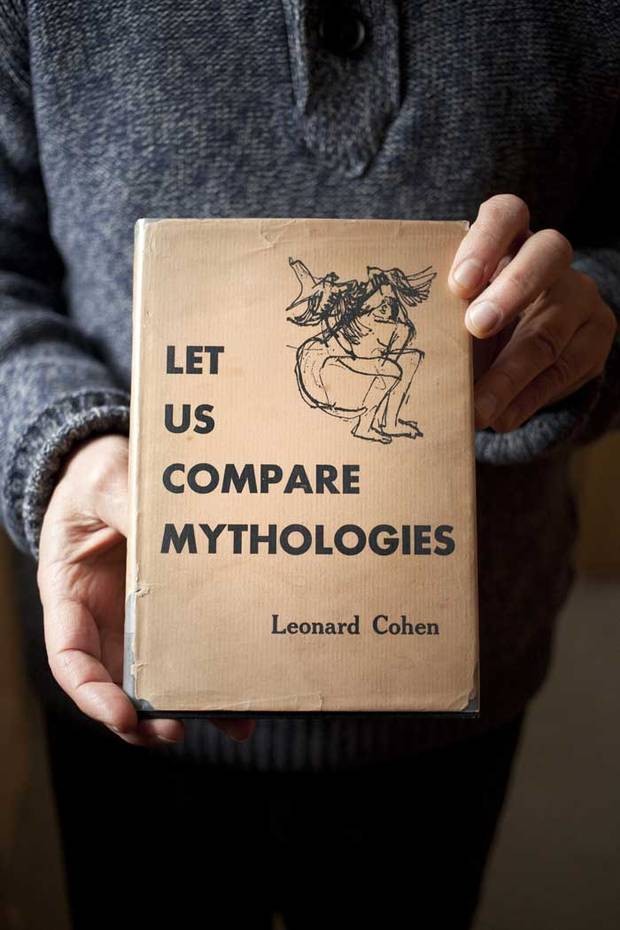
let us compare

In a long profile for the Globe and Mail, book review editor Mark Medley visits Nicky Drumbolis owner of the singular Letters Bookshop in Thunder Bay:

Walking through the store is an overwhelming experience. Everywhere I look I spot something I’ve never seen before and will probably never see again. I could have picked a single shelf of a single bookcase and spent my entire visit studying its contents. Not that Mr. Drumbolis would have let me do that. As we amble up and down the aisles, he is constantly narrating, constantly picking out items at random and telling their story – how he acquired it, or who published it, or whatever happened to its author – which often leads into another, entirely different story, and another book, and so on, until I can’t remember which book started the conversation in the first place.

He throws around words like “shit kicker” or “heavyweight” to describe books he particularly loves, his voice growing progressively louder and more animated, the longer he talks. He pulls out a first edition of Leonard Cohen’s 1956 debut Let Us Compare Mythologies, part of what is probably the most extensive sampling in existence of Montreal’s legendary Contact Press, which helped to launch Margaret Atwood, Irving Layton, Raymond Souster and others. Now here’s his Franz Kafka collection, and over here Ezra Pound, and Charles Bukowski, and a few remaining titles from his collection of William S. Burroughs, most of which he sold years ago to David Cronenberg around the time the director was adapting the Burroughs novel, Naked Lunch.

“Henry James,” he says, tapping a shelf filled with first editions of the American master. “The guy I wanted to read cover to cover before I died. I don’t think I’ll get to it now.”

Comments closed

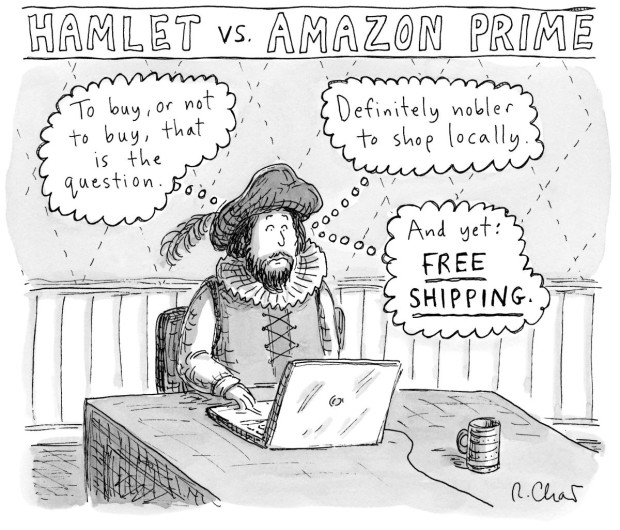
Hamlet vs. Amazon Prime

hamlet vs amazon roz chast

Roz Chast for The New Yorker.

Comments closed

Amazon: Pass This Letter To My Wife and Kids

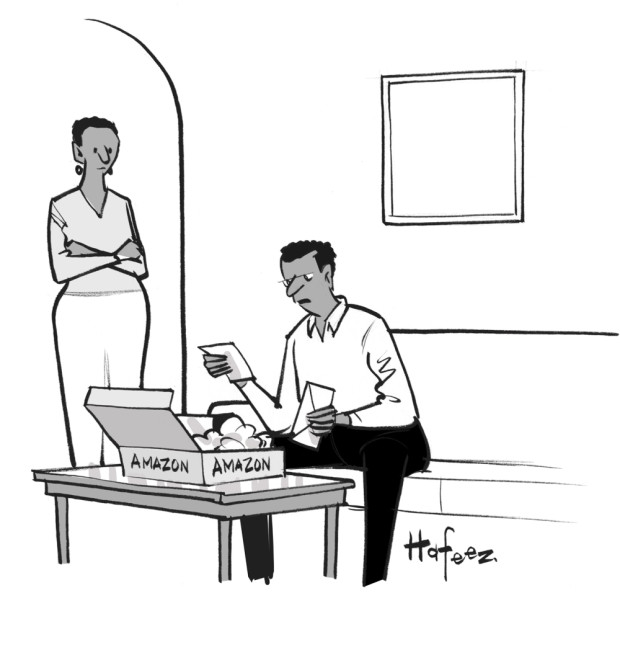
I wasn’t going to mention that New York Times article about Amazon. We already know the company treats its workers poorly (there are almost too many articles to link to at this point),1 it’s just that some people rather admire this kind of ruthlessness (or simply don’t care if they’re getting a good deal). Nevertheless, I did quite like this cartoon by Kaamran Hafeez for The New Yorker on the subject:

Amazon.con1_-1000
“It’s from Aaron, the Amazon employee who packed my headphones. He’s asked me to pass this letter on to his wife and kids.”

Comments closed

A Secret History of Manhattan’s Book Trade

Don’t miss Dwight Garner’s New York Times review of Martial Bliss.: The Story of the Military Bookman, Margaretta Barton Colt’s account of running an antiquarian bookstore in Manhattan that sold only military titles. If you ever worked in an independent bookstore, you’ll probably relate…

Historians and journalists were devoted to the store, and leaned on it for their research. No one is lonelier than the author of a forgotten book. Ms. Colt speaks for many writers who walked into the Military Bookman when she says of one, “He loved to come to a place where the denizens knew what he had done”…

…Ms. Colt, who had previously worked in publishing, didn’t suffer fools — or ghouls. Here she is on one customer: “Lean and mean, with a crew cut, he was a real right-winger, collecting Holocaust memorabilia while being a Holocaust denier: a misanthrope with a sour sense of humor and guns in a secret closet.”

The store kept sometimes mischievous notes on its customers. These had observations like “tire-kicker, quote-dropper, reservation-dropper (particularly heinous), unredeemed check-bouncer (even worse). Also: cheapskate, picky, SS tendencies, questionable dealings, edition or d/j freak, and other sins and misdemeanors.” (The “d/j” refers to dust jackets.)

If it sounds as if the patrons were a band of brothers, yes, they were mostly men. The store maintained a comfortable chair for wives and girlfriends. Ms. Colt, who loved her work, writes terrifically about trying to maintain her sang-froid in this testicular environment.

Comments closed