Skip to content

Tag: Books

Midweek Miscellany, September 9th, 2009

Getting Paid by the Joke — Roy Hattersley on Keith Waterhouse, author of Billy Liar, who died last week aged 80:

One of the great lines, spoken in the subsequent film version by Wilfred Pickles playing Billy’s father, combined fury and bewilderment. Why, he demanded to know, had his son told the neighbours that he had only one leg. Billy worked in a dismal office – an ironic tribute to Waterhouse’s first job as clerk to an undertaker. It seemed a step up for the son of a door-to-door vegetable salesmen and a cleaner who had left Osmondthorpe Council School at 15 with an interest in books but no qualifications and few prospects.

When’s That Book Coming Out? — A nice breakdown of the production process by Shelby Peak which explains why it seems to take a long time for books to be released after an author has turned in their final manuscript. Every time I read something like this, I wonder why we don’t hear from publishing professionals more often. It would be great to see publishers explain this kind of thing on their own blogs. (via blog.rightreading)

Spine Out — John Gall has started a blog. Holy fuck.

And — on a related note — there is a nice conversation on Vintage’s The Sun & Anchor blog between designer Peter Buchanan-Smith and photographer Todd Hido about the new Raymond Carver covers (commissioned by John Gall).

Doing the Work — A fascinating interview with Australian book designer Tony Palmer at Caustic Cover Critic:

Sometimes you hear the bigger book publishers described as being like factories – where the work is churned out in a mechanical and unthinking way. It’s never been like that for me at Penguin. The editors, production staff and designers all love their work. But love can be wild and unpredictable. So I’ve dreamt of being a plumber. I like the way water moves on surfaces. I like the fact that there are only four different ways to plumb a house. But book design? Gawd, maybe there’s about 120 right ways to do a good book cover, and there are probably millions of ways to make a bad one.

And finally…

A Master of ReinventionBrad Mackay, director and co-founder of the Doug Wright Awards, reviews David Mazzucchelli’s remarkable Asterios Polyp for The Globe & Mail. The Comics Reporter has a critical reading guide.

6 Comments

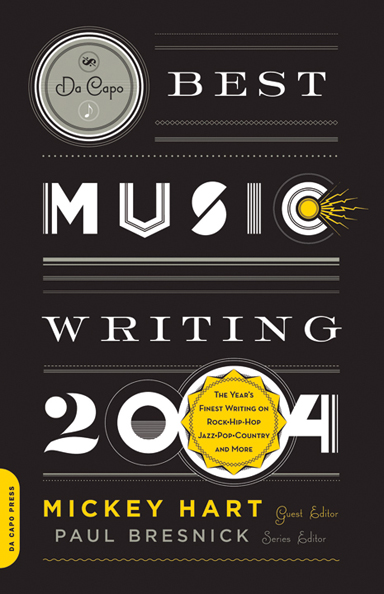
Q & A with Alex Camlin, Da Capo Press

Even though I first noticed the chunky Eisner-esque cover design for Douglas Wolk’s Reading Comics at The Book Design Review, it wasn’t until much, much later — when Ben Pieratt posted about the elegant redesign of The Harvard Review at  The Book Cover Archive blog back in June — that I registered that it was the work of designer Alex Camlin.

Both Reading Comics and The Harvard Review demonstrate Alex’s incredible attention to typography, his range of his influences, and the amazing diversity of his portfolio. Currently Creative Director for Da Capo Press, I caught with Alex via email earlier this month.

Briefly, could you tell me about Da Capo Press?

By most accounts, Da Capo started as a New York based trade paperback reprint house in 1975. At the time, many mid-to-large-sized publishers licensed paperback rights to reprint operations, rather than publishing their own paperbacks. In the beginning, Da Capo focused on licensing nonfiction, concentrating on music (jazz and blues/roots mostly), military history, and biographies. This continued through the late 90s, until Da Capo was purchased by the Perseus Books Group, who added the imprint to a growing portfolio that included Basic Books, Public Affairs and Running Press, among others. Da Capo was relocated to Cambridge, Massachusetts in 1999 to set up shop alongside another member of the Perseus group, the former trade division of Addison Wesley, renamed Perseus Publishing. Since then, Da Capo has evolved to publish its front list in hardcover and paperback originals, in many more categories. In the process, we managed to spin off a sister imprint—Lifelong Books—with a list focused on self help, childbirth, parenting, cooking, nutrition, and relationships. My first day on the job was also Da Capo’s first day in Cambridge, and we’ve been hacking away ever since on a shadowy fringe of the MIT campus. It will be 10 years in September!

How would you describe the role of Creative Director?

I’m basically just a glorified art director. My ‘staff’ has taken different forms over the years. Currently, it’s myself and one in-house art director who handle the entire list by either collaborating with freelance designers/photographers/illustrators, or engaging in some good old-fashioned DIY.

Approximately how many titles do you work on a season?

50-60 titles per season has been the norm for a while now. We publish two lists per year, Spring and Fall. Due to the changing market and current economic climate (stop me if you’ve heard this one before) our list is down-sizing a bit, and we will be closer to 90 titles per year by next Fall.

What are your favourites to work on?

I really enjoy working on books that are a bit off-beat or quirky. Recently, I’ve worked covers for a Karaoke memoir, a history of jetpacks, and a fake autobiography of Steve Jobs. I find that the books with moderate-to-low sales expectations (usually due to their niche subject matter) are the best to work on. Very few people bother to deconstruct what I’ve done, and the off-beat content usually leads to some interesting visuals.

What are the most challenging?

Believe it or not, it’s the parenting, pregnancy, and self-help books. Visually, these categories are so narrowly defined that it’s a real struggle to develop a unique look for a cover. Plus, the editors and authors who are publishing in these categories tend to favour literal interpretations, which can be quite limiting. So you will rarely ever see any of these in my portfolio, because the goal is usually to make them look the same as—but different than—all of the other books on the same subject. One up-side is that I’m intimately familiar with the range of pregnant-lady stock art that’s currently available, so if anyone out there needs some, just let me know!

How are final covers decided upon at Da Capo?

Initial comps are shown to and discussed by a ‘committee’ comprised of the publisher, marketing director, the book’s editor, and myself. We meet as needed, with greater frequency as the catalogue deadline approaches. I try to address all major concerns and present as many revisions as possible before the catalogue is printed. Covers are finalized somewhere between their appearance in the catalogue and their press date, after we field the reactions of the authors, our sales force and—in some cases—booksellers. Our overall process is probably a bit less formalized compared to other publishers.

Could you describe the design process for the Winnie and Wolf cover for Picador?

A.N. Wilson’s Winnie and Wolf is a historical fiction based on a relationship between Adolf Hitler and Winifred Wagner, the heiress of composer Richard Wagner. Their real-life friendship is well-documented, but the book builds on this to imagine a complicated love affair with Hitler’s rise to power and eventual demise as a backdrop. The themes of Wagner’s operas—primarily Parsifal—are referenced, and echo throughout the book. Picador wanted a new cover for their paperback edition, and I was hired by (the eminent and talented) Henry Yee to work on it. I knew immediately that the novel’s quirky-but-dark premise plus historical setting would offer a good range of possible imagery. I submitted four comps:

COMP 1: The first was my take on an interwar-era German poster, using a photograph of Winifred Wagner as the basis for the illustration. My only reasoning for this direction was that it sort of placed “Winnie” on a pedestal, which the narrator seems to do throughout the entire book. Mostly, it was just fun to create.

A series of propaganda photographs, by Adolf Hitler’s personal photographer, of the German dictator meeting ordinary Germans in 1932 and 1933 – around the time he came to power. (Photo by Heinrich Hoffmann/Hulton Archive/Getty Images)

COMP 2: I was ambivalent about this direction, mostly because I really wanted to avoid using Hitler’s image on the cover. The beautiful ornamental border comes from the cover to a playbill for a performance of Wagner’s Parsifal. The photograph is a piece of Nazi propaganda which is somewhere between symbolic and metaphoric representation of the love affair (the normally fierce and confident Winnie is observed as being girlish and entranced in the presence of Hitler). It also doubles as a literal representation of a scene near the end of the book. Ultimately, this direction was chosen for the final cover. I made a few adjustments and re-drew the title type for the final version. The photo was a black-and-white image which I tinted using some hand-tinted photos from an old Nazi book as a color guide.

COMP 3: I loved this one, mostly because of the way the illustration (a detail from an interwar-era festival poster) worked with the title. Also, in the book, Hitler is known to the Wagner children as “Uncle Wolf”, and spends a lot of time telling fairy tales and staging puppet shows for them. With the design, I was shooting for the look of a German children’s book from the 30s. Both direction and comp #1 were influenced by posters and other design featured in a great exhibition I saw several years ago at the RISD museum: Graphic Design In Germany 1890-1945, curated by Jeremy Aynsley.

COMP 4: The art depicts a scene in Wagner’s The Twilight of the Gods from a group of fantastic children’s book illustrations by Arthur Rackham. I thought that several themes from the book could be interpreted in this.

In the end, I was happy with comp #2 being selected. I guess it has the best of both worlds: fanciful Wagnerian themes—that are true to the story, coupled with Nazis—that sell books.

How did you become involved in the redesign of the Harvard Review?

The Review’s editor, Christina Thompson, asked me to speak to a class she was teaching at Harvard back in 2000 or 2001. She had recently been appointed editor of the Review and was planning on repackaging it, and agreed to let me submit some ideas for the cover. I started designing the covers at that time, and we finally had the opportunity to reconsider the entire package (cover and text) last year, for issue #35. It was great timing, because #35 featured the work of Kara Walker and Chuck Close (in addition to the usual selection of great writers)—not bad company.

Do you see any recent trends in book design?

Blogs by book cover designers like David Drummond, Kimberly Glyder, Henry Yee and The Design Works Group offer insight into the thought processes and mechanics involved in cover design, and I think this sort of journal-keeping is really validating for the profession. As for visual trends, I’m really enjoying the resurgence of hand-lettering on covers that has been happening for a while now. There’s something very pure, expressive and organic in handmade letterforms that can somehow be infused with style and attitude, but also timeless.

Who else do you think is doing interesting work right now?

Peter Mendelsund, Julia Hasting, Paul Buckley. Gray318 always does great work. Charlotte Strick’s design for FSG’s paperback edition of 2666 raises a bar (if not the bar)—other publishers should take note. One of the most inspiring covers I have seen lately is Carol Carson’s design for My Father’s Tears by John Updike. Peter Mendelsund discusses it here. It is deceptively simple, beautiful and timeless. Carson seems to have made a point of designing all-type jackets recently, which I totally admire. There is a purist inside of me that believes ALL covers should be all-type.

Where do look for inspiration and who are some of your design heroes?

I read eye and baseline magazines regularly. The Book Cover Archive is also a great resource, it’s been fun watching it grow as a sort of visual database. As for design heroes: W. A. Dwiggins, Jan Tschichold, Alvin Lustig, Massin, Sister Corita Kent, Alexey Brodovitch, Virginia Lee Burton, Wim Crouwel, Buckminster Fuller, Karl Gerstner, Josef Albers, my mom…the list goes on, but that’s a good cross-section.

What does the future hold for book cover design?

I don’t know. For the most part, people have stopped asking me to “make sure the title can be read in that thumbnail image on Amazon”—probably because someone told them that a 3-D, 3G full-color latte-brewing Kindle is going to be the next big thing. Sadly, too many trade publishers—under pressure from mega-store retailers—are focused on ‘packaging’, and are largely concerned with making covers that fit a certain category, rather than those that offer true insight or interpretation of what’s between the covers. On the other hand, the industry is saturated with brilliant designers who flocked to publishing because of people like Chip Kidd, Louise Fili, John Gall, Paul Bacon, etc. This keeps the practice of cover design highly competitive, and we are all better because of the current standard. When you look at some of the amazing stuff that actually makes it to press in spite of the modern publishing process, it’s encouraging and quite inspirational and hints at a future full of possibilities.

Thanks Alex!

Next week: Coralie Bickford-Smith, Penguin Press

9 Comments

Midweek Miscellany, September 2nd, 2009

Watching Gideon — A nice new cover design with some great typography from Nate Salciccioli. Read my Q & A with Nate here.

A Manifesto for Slow Communication — An excerpt from The Tyranny of E-Mail by John Freeman, AKA acting editor of Granta, in the Wall Street Journal:

Slow communication will preserve these threads and our ability to sensibly choose to use faster modes when necessary. It will also preserve our sanity, our families, our relationships and our ability to find happiness in a world where, in spite of the Internet, saying what we mean is as hard as it ever was. It starts with a simple instruction: Don’t send.

And on the topic of slow communication…

On Feeding — an older, but lovely, post from A Working Library on the difference between unread books and an unread RSS reader (via booktwo.org):

those two sights—the stack of books and the unread count in my feed reader—evoke dramatically different responses. To the books, I feel excitement, eagerness… The act of reading is always unfinished…

Yet my feed reader—also always unfinished—evokes within me a dread… I grow weary as the unread count increases, as it fills up with new articles before I can skim the old ones. In it’s timeliness—most blog posts have short half-lives and so must be read now—and the mathematical precision with which the reader measures its contents, I am stripped of my eagerness to read and filled, instead, with despair. Instead of a thing to enjoy, it makes reading a thing to get done with… It’s reading made efficient.

The minimal design of the A Working Library site is really nice too by the way.

Book Cover Design in India 1964-1984 at A Journey Round My Skull.

Prix Fixe — Arnaud Nourry, chief executive of French publishing group Hachette Livre, makes some interesting comments on e-book pricing in the Financial Times, notably that publishers are “very hostile” to Amazon’s pricing strategy:

“On the one hand, you have millions of books for free where there is no longer an author to pay and, on the other hand, there are very recent books, bestsellers at $9.99, which means that all the rest will have to be sold at between zero and $9.99,” Mr Nourry said…

There was a “muscular” debate in the industry in the US, he added. Retailers were paying publishers more than $9.99 for each e-book, so were selling them at a loss: “That cannot last . . . Amazon is not in the business of losing money. So, one day, they are going to come to the publishers and say: ‘by the way, we are cutting the price we pay’. If that happens, after paying the authors, there will be nothing left for the publishers.”

Mike Shatzkin has written an interesting follow-up piece about pricing.

Noury also makes more interesting observations about consolidation in the industry in a separate article in the FT, which seem very prescient in light of Disney’s acquisition of Marvel this week.

And finally…

46 Essential Rock Reads — A list to argue over on the LA Times‘ Jacket Copy blog.

2 Comments

Something for the Weekend, August 28th, 2009

Now, About That Cover — Ted Striphas, an assistant professor in the Department of Communication and Culture at Indiana University, discusses the cover of his new book The Late Age of Print, which uses a dramatic photograph by artist Cara Barer:

The Late Age of Print is a book about the past, present, and future of book publishing, and so I knew early on that I wanted some type of cover image that would represent the themes of permanence and change.  Much later, as I looked at the books about books appearing on my bookshelf at home, I decided that I wanted a more abstract type of design, since many titles in my opinion overly-literalized their subject matter.

Another other Cara Barer’s images can also be seen on the cover Michael Greenberg’s  Beg, Borrow, Steal: A Writer’s Life released in September.

You can download a PDF of Striphas’ book under a Creative Commons license from his site, cunningly called The Late Age of Print.

Why Are Artists Poor? — Author and professional  contrarian Andrew Keen (The Cult of the Amateur),  looks at how the creative class make a living in the “new digital economy” for The Telegraph.

Keen is as provocative as ever, but his conclusions — that self-promotion is a requirement for all artists and that being paid for content can be replaced by getting paid to perform in person — are a little underwhelming.  Ernesto Priego offers more thoughts on Keen’s article in his blog post “Portrait of the Artist as a Digital Native”.

And finally…

Having mentioned the  Richie Fahey illustrations that adorn the covers of  Megan Abbott‘s crime novels earlier this week, it would be remiss of me not mention the remarkable R.A. Maguire Cover Art site, which includes an amazing collection of the artist’s book covers, paintings, and source photos from the 1950’s and 60’s:


(And if you can’t get enough of pulp covers and vintage paperbacks, you probably should check out the slightly potty-mouthed Pop Sensation.)

Self promotion and making money in the new digital economy

2 Comments

Midweek Miscellany, August 19th, 2009

‘The 100 Best Comic Book Covers’ Part 1, Part 2, Part 3, and Part 4 at Kelly Thompson’s 1979 Semi-Finalist blog. I am not a comics nerd (believe that if you will), but there’s some great stuff (new and old) in this epic list…

Open to QuestionThe New York Times reports on Sony’s decision adopt the “open standard” ePub format for all their digital books. This means that “books bought from Sony’s online store will be readable not just on its own device but on the growing constellation of other readers that support ePub”. Progress of sorts I would say, but before you break out the bunting, David Rothman questions how “open” this format actually is at TeleRead.

Book Design on Twitter — Ben at the Book Cover Archive has posted a list of book designers who Tweet.

Ben’s list was also a nice reminder to mention  Jennifer Tribe‘s amazing directory of book industry people on Twitter.

Book Worship —  Shawn Hazen’s blog cataloging “graphically interesting, but otherwise uncollectible, books that entered and exited bookstores quietly in the 50s, 60s, and 70s.” Lovely (via Book Cover Archive blog).

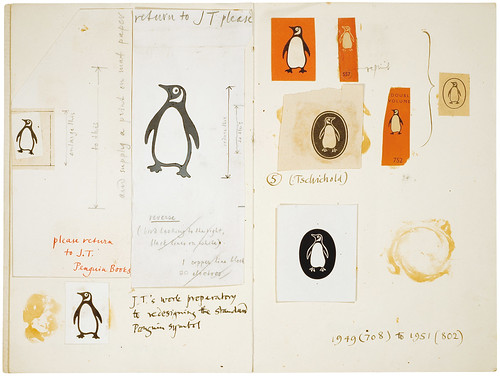
Penguin Symbols — I know I just mentioned designer David Pearson’s Flickr the other day, but how fantastic is this? “An investigation by Production Manager Hans Schmoller into the origins and usage of Penguin devices”

And speaking of Penguin…

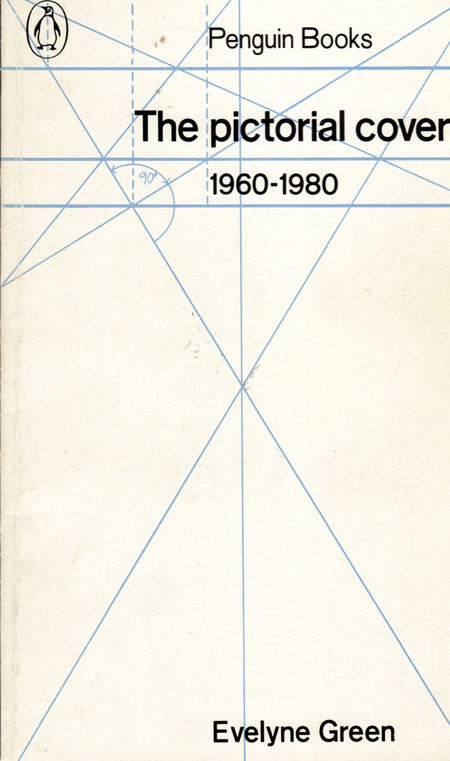
Covers And That — Jim Stoddart, Art Director of Penguin Press, discusses their book cover process and looks at some of the new covers for book released this month:

Each cover may face a wide range of hurdles and conflicting opinions, this is the very nature of book covers. Good designers tend to be very focussed and resiliant, and the value of a good sense of humour cannot be underestimated. As with most design jobs there is a balance of concept, craftsmanship and time dexterity required. Any number of changes to the brief may occur even once the design is finished. But in Penguin Press it is widely appreciated that the more a cover is ‘tweaked’ by a committee the less chance there is of retaining that original spark that we all know helps a book stand out in a world where thousands of books are vying for attention.

Comments closed

David Pearson’s Flickr

Print designer David Pearson‘s Flickr stream has all the new additions to Penguin’s Great Ideas series, but also his abstract covers for Éditions Zulma, including this one for Pierre Albert-Birot’s Mon Ami Kronos (via the BCA).

Comments closed

Q & A with Ingrid Paulson, Ingrid Paulson Design

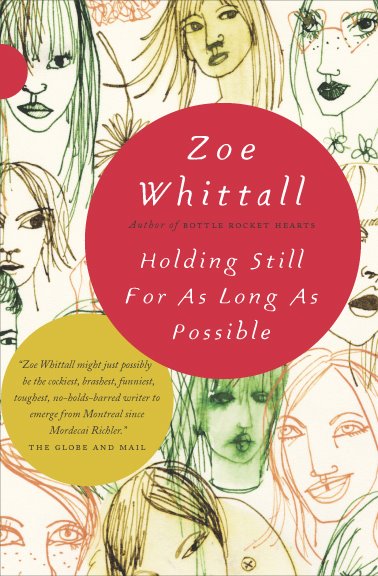
Holding Still cover

Before setting up her own design studio in Toronto, award-winning Canadian designer Ingrid Paulson was senior designer at McClelland & Stewart, and art director for Key Porter and Raincoast Books.

Although Ingrid worked at Raincoast, we didn’t actually meet until BookCamp Toronto earlier this year. We only had a brief a conversation, but it was just about long enough for me to blurt out that I wanted to interview her, and for the apparently unflappable Ingrid to say “OK” (and sound like she might mean it).

And so I do want to say a big thank you to Ingrid for coming through with such grace and patience, and for providing such wonderful answers to my not-so-wonderful questions.

Could you describe your design process for book covers?

In terms of workflow? The publisher gives me a title information sheet and/or a creative brief, plus (fingers crossed) either a few chapters or the entire manuscript for the book. I always ask to read the fiction, but for non-fiction I can manage well with a concise book description and perhaps the introduction. I submit a minimum of three cover concepts to my contact at the publishing house, and wait for feedback. Then I either redesign and resubmit, or, if I was ‘on to something,’ I tweak one of the concepts until we get it right.

In terms of creative process? Um. Well.

Some cover concepts appear in my head, fully formed, by the end of my first conversation with my publishing contact. Other get dragged out of me kicking and screaming, begging to stay in the dark void of my head. Sometimes I sketch out the covers — wee thumbnails in my moleskine — whereas other times I play a Google Images lotto search using various vague terms that would describe a feeling I want to associate with the book. Sometimes the font is the first thing chosen, or I envision the type at certain sizes and placed in specific places. Other times, the image is driving the cover and the type just has to play catch-up. I’ll envision a book as predominantly red, or dark, or punchy — and that all comes from what the author has written. I’ll respond to textured sentences with textured visuals (perhaps collage?) and bleak will meet bleak. (But not so bleak as to discourage someone picking it up. The bookbuyer is in my thoughts as well, as I try to envision them and their habits, quirks, and book needs.) Needless to say, my brain gets crowded.

And then there are the days when I just stare at a wall and hope against hope I’ll figure out something clever. I haunt a lot of bookstores.
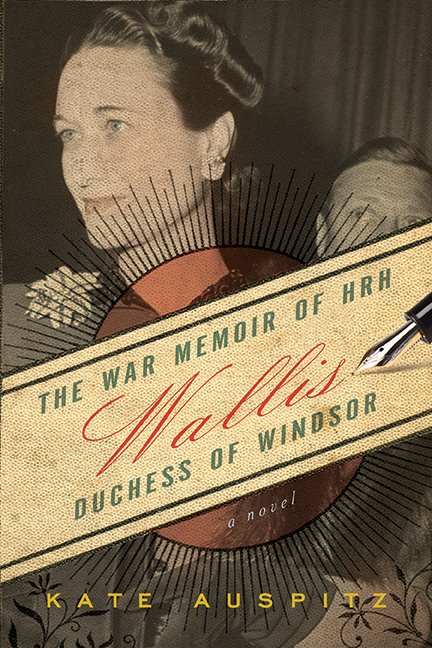
wallis

What are your favourite projects to work on?

The ones I get right on the first try.

I love working on fiction, but it takes the most concentration and, because fiction is so subjective, so evocative of the human condition (both funny and sad), designing a fiction cover can drive me nuts. There is never one absolute visual solution for fiction. Nonfiction, on the other hand, can get formulaic, but I love the simplicity of thought — punchline design, in many ways. So, for sanity’s sake, I prefer to keep a balance of fiction and nonfiction going. Cookbooks can be a blast to design, but I (sheepishly) think that comes from the photo shoot where we all end up eating most of the props (the ones that have flavour, or haven’t been sprayed with any shellac). And then there are the special projects where I’m asked to work on the cover and interior, and I am part of the planning and layout process, where I get to research the images, discuss things with the editors on a page-by-page basis. Those projects are rare, but they keep me happy for a few years at a time.

What do you think makes a good cover design?

Being able to lure someone into picking up the book and reading the back, which takes about 1.5 seconds of their time. Job done. How to do that? If we in publishing knew, we’d also be able to predict bestsellers. The best I’ve figured out is to keep it a simple visual package — don’t let the type look out of place with the image, don’t use the same colours as everyone else is using that season, stay away from looking too much like any of the other books, but make it look like a book. I dunno. The cover should evoke an emotional pull from the bookbuyer, that moment of ‘yes, that’s interesting and looks like what I want to read.’ That solution changes from book to book.

What are some of the common mistakes publishers and designers make with covers?

For publishers, they’ll try to make their book look similar to someone else’s (bestselling) book, as if to catch the wave. This is not clever, it just means the publisher is out of ideas or is feeling the year-end coming and needs to hook on to a sales-winner. It’s the publisher that took a design chance on a different look — and came out the winner in terms of sales — that is the ultimate winner. The rest end up on the remainder table eventually. Daunting. They don’t call it a ‘gentleman’s profession’ for nothing. (Or ‘gentlewoman’s’. I’m just citing the old, old adage.)

For designers, it is not being able to pitch their cover effectively. If a designer can articulate the reasons for their choices of colour, type, and image, then they have a fighting chance of getting that design through. Otherwise they are leaving it to speculation. I’ve worked both sides of the table — inhouse art director, freelance designer — and I know that it is ten times harder for a freelancer to get that voice heard in the meetings. But inhouse staff can get asked to revise designs far more often than the freelancer, as the perceived economies behind a salaried staff versus a per-project contractor sometimes give the publisher too much leeway on revisions. I’ve been inhouse with a book cover that I simply didn’t ‘get,’ but there was no way to contract out the job, as, due to costs, the publisher refused. It was a painful, long design process for all involved (not just me), and they ended up with something inferior to what they would have gotten with a designer who understood the book. As an Art Director, I could’ve just handed it to a specialist designer and, with a few good notes, gotten something much more suitable for the book.

I guess that leads to a codicil: know when to walk away. Yes, we all want to try new book categories. Just know when to draw the line, so to speak.

British and American book design styles are often seen as quite distinct (with critics and proponents of both!). Is there a Canadian style of book design?

What there is known of Canadian book design is an amalgam of quiet, well-crafted literary press style — usually hand in hand with DIY letterpress style — smashed against a desperate need for full-bleed sepia landscapes (or sleeping sepia people) and egregiously large title type. We err on the side of poetic, which can look like a wash in the stores (or worse — too literary, which could alienate those poor readers still recovering from their English high school reading list). We avoid edgy.

There is some astonishing design coming out of the cracks across the nation — David Drummond comes to mind, as does the brain trust under Peter Cocking at Douglas & McIntyre — and I hope that will win out. Clear, slightly subversive, more in tune with our world-famous sense of humour. Intelligent is the word that comes to mind.

Do Canadian book designers have unique opportunities? Are they accompanied by particular challenges?

Figuring out new and exciting ways to design both hockey and ‘whither Canada’ books, which are a yearly staple on publishers’ lists. We are handy and imaginative with maple leaf imagery and the colour red.

You’re an artist as well as a book designer. Is there a tension between your artistic sensibility and the commercial design process?

Every day, and the design wins. I’ve tried to avoid overlaps, but words are images to me, so lately I’ve been working on art based around words. I try to keep it as three dimensional as possible (since my day work is two-dimensional), but then font choices become a factor and I run screaming. It helps to know that both Jenny Holzer and Barbara Kruger worked in designer/typesetter jobs early in their artistic careers.

The challenge lies in accepting and separating out design and art from their ultimate goals: design is created to communicate a product; art is created to communicate the world, in whatever form, or whatever scope, the artist chooses. There is no client in art.

How is designing book interiors different from designing their covers?

Interiors are, in many ways, a much more detailed exercise in communication. For a text-only book, I have to make sure that the reader never really sees the design, else it distract from their involvement with the text. For a picture book, the pictures stand tall, so the design should just assist the pictures. But a cover is a marketing tool, and the cover must try, in no uncertain terms, to woo the reader. It must stand out.
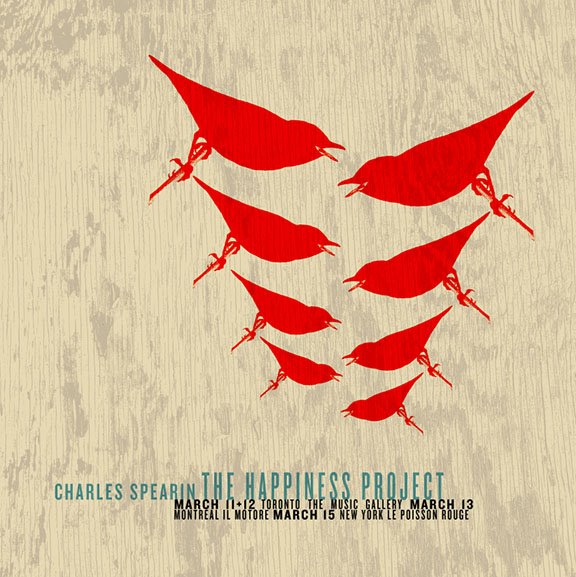
poster

Where do you look for inspiration?

Currently? Other designers (book and non-book), as well as music poster design. There is a great revival (when did it go away?) of one-off poster designs for gigs. They are all silkscreened or letterpressed limited-edition beauties. I used to look at rave fliers all the time (when raves were the thing). I look online. I remember stuff my mom — who was an antiquer in the 1970s — used to show me, old ads and magazines. I read a lot (beyond manuscripts), so I end up with this polymathic knowledge of, say, alchemical symbols and Greek demigods. We used to be such a visual culture, pre-literacy, and I think in many ways we’re heading back there. My job is to connect the shorthand symbols of the culture, both old and new. It can fascinate me for hours, why LOLCats is the thing (and then not the thing, but what did the visual say of us?), or looking at, say, a Dutch design student’s incredibly cool/obscure website.

Who else is doing interesting work right now?

I love designers with latitute — ones that aren’t just one-trick (or one-look). Who comes to mind? Coralie Bickford-Smith, Jason Gabbert, Terri Nimmo, David Gee, Gabriele Wilson, Peter Mendulsund… They all have style that can bend to the project. I could go on, but that’s today’s list. It will change and expand tomorrow.

You’re very active with your website, blog, and Twitter etc. Is it important for a designer to engage with people online?

You know, every time I blog (or answer nice questions like yours), I sit back afterward and fear that my opinion is going to lose me a client. There is this balance one must keep when designing, as the client is always right (or deserves the design they get, depending on the outcome), yet what designers put out there does contribute to our visual worldscape. So, I try to contribute.

But I work from home (or, in Toronto parlance, I have a ‘live/work situation’). Blogging keeps me from talking to the wall too much, or thinking that the cat cares when I’m sweating to find the right sans-serif. It has been fascinating to watch how many book designers have joined Twitter lately — we all seem to find each other, this odd subgenre of designers, and I think in the future, that will result in some mind-blowing design (or a great convention in Bend, Oregon). My purpose online is to build community, to share ideas, to groan when needed, and if other non-designers join the conversation, well, then it just becomes this great party.

With the growing popularity of e-books, what is next for book cover design?

Ack! I don’t know. I really don’t. We’ll see what happens. What I do know is that there will always be a role for design, but what that role takes is anyone’s guess.

Thanks Ingrid!

Comments closed

Something For The Weekend, August 7th, 2009

Winnie and Wolf — cover design by Alex Camlin (the chap behind that rather wonderful Harvard Review overhaul). I’m hoping to speak to Alex for the designer Q & A series later this month.

And just while were on the subject, Caustic Cover Critic looks at the new designs for the Penguin World War II Collection.

In Search of Lost Time — David L. Ulin, Book Editor of the LA Times, on the lost art of reading:

Today, it seems it is not contemplation we seek but an odd sort of distraction masquerading as being in the know. Why? Because of the illusion that illumination is based on speed, that it is more important to react than to think, that we live in a culture in which something is attached to every bit of time.

Here we have my reading problem in a nutshell, for books insist we take the opposite position, that we immerse, slow down… Yet there is time, if we want it. Contemplation is not only possible but necessary, especially in light of all the overload.

But, if you sympathize with this perspective be warned: you are weak and you just don’t love books enough (and you’re probably a calcified narcissist).

Talking Books — I don’t agree with everything here (OK I actually disagree with a lot of it and, I’m sorry, describing the Globe & Mail as “daring” is just  delusional), but Ian Brown, writer, arts journalist and broadcaster has some interesting things to say about Canadian literature and culture in a sprawling interview over at Conversations in the Book Trade:

[T]he novel is no longer the prime example of literature. Nor does it need to be. Too much attention can ossify a genre. If anything is in trouble, it’s literary fiction–but again, only because there are so many alternative ways to consume good writing these days. The book itself is a fantastic technology, but literary fiction has some serious competition for my attention.

And as this has been something of slow week, and because I was chatting about it with book designer Jason Gabbert on Twitter (who is responsible for the lovely C.S. Lewis redesigns above), I’m just going to take this opportunity to (re)plug my image library on Image Spark and (while I’m at it) my slightly stream-of-consciousness inspiration blog The Accidental Optimist.

4 Comments

Hunger

At the risk of this turning into W.W. Norton Week on The Casual Optimist, I wanted to re-post this gorgeous cover for Hunger by Lan Samantha Chang designed by High Design, with art direction by Albert Tang. It was originally included with my Q & A with Norton’s Ingsu Liu earlier this week, but removed when I updated the post.

W.W. Norton Book Design Archive on Flickr

Comments closed

Midweek Miscellany, August 5th, 2009

Foucault — A nice new cover design from David Drummond (approval pending).

(And apparently I like photos of the backs of people’s heads)

Kill Your DarlingsPrint asks book designers Carol Devine Carson, John Gall, Paul Buckley, Rodrigo Corral, John Gray, Gabriele Wilson, Paul Sahre, and Peter Mendelsund about the covers that didn’t quite make it:

every book jacket designer has at least one that got away—a fresh, inventive cover that was shot down en route to the bookstore shelf. These “lost” covers form a parallel universe in which the books we read and love exist in entirely different skins.

Re-typing History — The Financial Times reports on typographer Mike Parker’s challenge to the accepted history of the ubiquitous Times New Roman:

The… evidence for his version of history is a brass pattern plate bearing a large capital letter B. He holds the plate up to show the familiar form of the letter, its characteristic curves and serifs. The point, he says, is that such pattern plates represent a technology that was not used after 1915. The creation of Times New Roman was announced in 1932.

Bite-Size Edits — Baking books with the Book Oven chefs.

Forgotten Bookmarks — the “personal, funny, heartbreaking and weird things” found in books at a rare and used bookstore.

The Book Depository launches in the US. There are details at The Book Depository blog.

And finally…

Trial and Error — Author Matthew Pearl discusses the evolution of the cover for his novel The Dante Club. It’s nice to read about an author not having a hideous experience with a publisher for a change, and I actually think that the cover design for The Dante Club, while not flashy, gives a lot of great visual cues to readers about the nature of the book (which is really what it is about isn’t it?).

1 Comment

Q & A with Ingsu Liu, W.W. Norton

Having spent a lot of my life in the UK, I wasn’t particularly familiar with venerable New York independent publisher  W.W. Norton and Co. until my stint at Toronto’s (now doomed) Pages Books and Magazines where their books were frequently on tables.

Although I left Pages a few years ago, I was recently reminded of the breadth and quality of Norton’s books — and, of course, their covers — by their decision to archive their book cover designs on Flickr.

In a roundabout way, the launch of the design archive also put me in touch with Steve Colca, Norton’s online marketing manager. He in turn, hooked me up with Ingsu Liu who kindly agreed to talk about the design process at Norton for this week’s Q&A.

Currently V.P. art director at W.W. Norton, Ingsu Liu graduated from the graphic design program at Pratt Institute in 1988 and began her career at Penguin, William Morrow and Vintage Books before accepting a position at Norton in 1997.

Briefly, describe your role at Norton

I oversee the hardcover jacket imprint.

How many designers are on your team?

I oversee two in-house art directors; together we collaborate with various outside freelance designers, illustrators, art researchers and photographers.

Approximately how many covers does Norton require each season?

About 55 to 75 books each season. We do 2 seasons, for a total of roughly 125 books a year.

Is there a ‘house’ style?

I certainly hope not. I believe it’s most beneficial to be diverse, so that each book jacket can have it’s own voice. This helps to keep the list fresh and my job more fun.

Do you approach fiction and non-fiction differently?

It really depends on what the book requires, but the basic process is the same. First I talk to the editor, publisher, and marketing… then drawing from those conversations, the book brief, the author’s writing, the current market place, the comparative titles and what the book is about, I then decide which direction the jacket should go and set out to assign the best designer or artists for that title. My focus is on what’s best for the particular title, everything else comes naturally after.

Which books provide the biggest challenges?

The titles that no one can agree how best to market the book and therefore what sort of jacket it should have. Also, big print runs where there is more at stake. Then, there’s the occasional book where the author’s 6 year old daughter gets to dictate the jacket design.

What do you look for in a cover design?

Craftsmanship, mood… but a strong concept will always rule the day. Also, the surprise factor is pure gold; nothing is worse than the “same design, different day” effect. A design should, at the very least, have its own point of view.

How are final covers decided upon?

After I have decided on who is best to work on the cover design, I start presenting the designs at our jacket committee meetings. There we narrow it down to one final choice. Then — when there is not a six year old involved — the author, the author’s agent, the editor, the marketing and the publisher all have to sign off on one final jacket design. Sometimes, after we finally get all these diverse interests on the same boat, a single book buyer can kill our jacket and we start the whole process all over again.

Do you think there’s a tension between producing creative covers and what will play in the market?

See the last sentence in my answer above. That said, we are constantly being subjected to various subjective opinions. It is my job, when I can, to filter through it all and to use the good advice and to discard the bad… and unfortunately, the folks with the bad advice often have the loudest voice. See Dick Cheney.

Have you any recent favourites?

Obsession: A History by Isaac Tobin (University of Chicago)

Milk by Barbara deWilde (A.A. Knopf)

Pride and Prejudice and Mansfield Park by Leigh-Anne Mullock

Metamorphosis and Other Stories by Mother (Penguin Classics)

Waiting For The Barbarians by Paul Buckley (Penguin)

Sedaris by David Drummond (University Of Minnesota Press)

The Paranoid Style by Brett Yasko (Vintage)

The list goes on and on, and on….

Do you discern any current trends in American book cover design?

Most obvious is the rebirth of interest in comic artists. Whether it is a whole book or just a jacket image, I never get tired of seeing great comic art. Growing up in Taiwan, I spent countless hours lost in thousands of comic books, it is what inspired my interest in art and has kept my fascination to this day.

Also it’s nice to see so many designers and artists collaborating so that hand-done art is being combined beautifully with all these hi-tech designs and applications. This mix of raw and slick often creates the most interesting packages.

Are they any designers whose work you particularly admire?

Sagmeister, Will Staehle, Evan Gaffney, Louise Fili, Peter Mendelsund, John Gall, Paul Buckley, David Drummond, Patti Ratchford, David High and Gabriele Wilson. The fact is there are too many to list…

Are there any book or design blogs you read regularly?

I mostly still enjoy going to the book stores to be inspired, but Eye Magazine, the annuals from Print, Communication Art, AIGA, and the Type Directors Club are the good old standby’s for me. For blogs, I like FaceOut Books, The Book Design Review, Design: RelatedThe Book Cover Archive, and most recently The Casual Optimist. And now that you’ve interviewed me, your blog is totally awesome!

With the growth in e-books, do you think cover design will continue to be important?

I very much hope so. I love holding a beautifully produced book in my hands. But the fact is that one must embrace the future — for it’s coming whether you want it to or not.

Thanks Ingsu!

With special thanks to Steve Colca, Manager of Internet Marketing at W. W. Norton & Co. for arranging the interview

UPDATE:

Since originally posted on August 4th, 2009, some of the images accompanying this interview have been changed. The previous images were my selections from the W.W. Norton Design Archive on Flickr chosen to illustrate the work of some of the designers mentioned in the Q & A and to reflect the diversity of books designed and published by the team at W.W. Norton. To avoid confusion, all the current images were art directed by Ingsu Liu.

Design credit for the individual covers included in this post:

Flash Fiction Forward Design by Rodrigo Corral
The Meaning Of Night Design by Patti Ratchford
Busted Design by Jon Grey
What Can I Do When Everything’s On Fire? Design by Evan Gaffney
Stitches Design by Paul Buckley

4 Comments

Midweek Miscellany, July 29th, 2009

Geometric books covers at Design Daily.

The Debate That Will Not Die — Mike Shatkin weighs in on DRM and tries to find that elusive middle-ground. The discussion continues into the comments (of course)…

Unputdownable — A nice ad campaign by Saatchi & Saatchi for Penguin Books in Malaysia (via The 26th Story).

Great Ideas — The Caustic Cover Critic looks at the covers for all 20 of the new additions to Penguin’s Great Ideas series. Some fantastic typographic stuff here as you might imagine, although — to be honest — I think there are one or two weaker entries in this round and the purple motif works better for some books than others…

A New Page — (Much linked to elsewhere, but in case you missed it) Nicholson Baker’s meticulous vivisection (or “epic takedown” if you prefer) of the Kindle in The New Yorker:

The problem was not that the screen was in black-and-white; if it had really been black-and-white, that would have been fine. The problem was that the screen was gray. And it wasn’t just gray; it was a greenish, sickly gray. A postmortem gray. The resizable typeface, Monotype Caecilia, appeared as a darker gray. Dark gray on paler greenish gray was the palette of the Amazon Kindle.

This was what they were calling e-paper?

And if you can’t get enough of that Kindlenfreude feeling…

David L. Ulin, book editor  The LA Times, weighs in on Amazon’s troubling reach.

Niches — Richard Nash, formerly of Soft Skull Press, talks about his new community-based venture, tentatively called ‘Cursor’, in Publishers Weekly.

And finally…

A Journey Round My Skull has a nice post of vintage Swedish books covers from collected from the excellent  Martin Klasch. I particularly like this vampiric cover for Raymond Chandler’s The Big Sleep by Martin Gavler from 1963 (above).

Comments closed