Skip to content

Tag: Design

Mendelsund vs. Kafka

Amerika | Peter Mendelsund

Peter Mendelsund on his remarkable (and unexpectedly Paul Rand-like) Kafka redesigns for Knopf imprint Schocken:

After all, what is it that makes Kafka, Kafka? The economy; the dark humor; the teasing inscrutability; the brilliance of the thought-experiments; the hieratic and esoteric flavor of the constructions; the disorienting cadence of the prose; the impeccable, internal, magical logic that drives the mechanical toy theaters of his work; the much discussed Jewishness (as if this was easy to parse); the “concrete abstractions” (in the words of Zadie Smith)…. I suppose what some find most relevant and compelling in Kafka is his ability to inspire in them that paradoxical feeling that great literature always aspires to arouse in readers—the feeling of the universality of their own alienation. Kafka is the ne plus ultra of alienation– alienation being arguably the defining emotional condition of the 20th century.

There is more at Peter’s blog JACKET MECHANICAL.

4 Comments

Midweek Miscellany

A shiny new (and somewhat unsettling) cover for Joyland’s next e-book, How I Came to Haunt My Parents by Natalee Caple, designed by the shiny (and somewhat unsettling) David A Gee.

Holden Caulfield’s Goddam WarVanity Fair excerpts J. D. Salinger: A Life by Kenneth Slawenski:

Tuesday, June 6, 1944, was the turning point of J. D. Salinger’s life. It is difficult to overstate the impact of D-day and the 11 months of combat that followed. The war, its horrors and lessons, would brand itself upon every aspect of Salinger’s personality and reverberate through his work. As a young writer before entering the army, Salinger had had stories published in various magazines, including Collier’s and Story, and he had begun to conjure members of the Caulfield family, including the famous Holden. On D-day he had six unpublished Caulfield stories in his possession, stories that would form the spine of The Catcher in the Rye. The experience of war gave his writing a depth and maturity it had lacked; the legacy of that experience is present even in work that is not about war at all. In later life, Salinger frequently mentioned Normandy, but he never spoke of the details—“as if,” his daughter later recalled, “I understood the implications, the unspoken.”

An excerpt from Jason Epstein’s review Merchants of Culture: The Publishing Business in the Twenty-First Century by John B. Thompson for the latest NYRB:

Digital enthusiasts should… consider that as the embrace of other electronic media has widened, the average quality of their product has declined: from Masterpiece Theatre to Jersey Shore, from Franklin Roosevelt and Adlai Stevenson to Sarah Palin, from Julia Child to Rachael Ray. My own guess is that the digital future in which anyone can become a published writer will separate along the usual two paths, a narrow path toward more multilingual variety, specificity, and higher average quality and a broader path downward toward greater banality and incoherence, while the collective wisdom of the species, the infallible critic, will continue to preserve what is essential and over time discard the rest.

(The full review requires a subscription)

Best Online Comics Criticism 2010 chosen by contributors to The Comics Journal. And from that list, film scholar David Bordwell on Tintin (via Robot6):

Most commentators on Hergé mention that he was a film fan and drew many situations from movies of the 1920s and 1930s. Like Hollywood studio cinema, his tales put striking technique in the service of fluent storytelling. Pause to study the narrative and you’ll find a surprising richness to the imagery; start by looking at the pictures as pictures, and you’ll see how composition, color, and detail smoothly advance the action. Hergé was well aware that his polished imagery could stand scrutiny in its own right, but he saw it as serving a larger narrative dynamic.

(Out of curiosity, does anyone compile annual list of the best online literary criticism?)

Montaigne and Monkeys — Saul Frampton, author of the ridiculously titled  When I Am Playing With My Cat, How Do I Know She Is Not Playing With Me?: Montaigne and Being in Touch With Life, on 16th Century French philosopher Michel-de-Montaigne and neuroscience in The Guardian:

For Montaigne, as for contemporary neuroscientists, humans… have an inbuilt imitative, sympathetic capacity. Moreover, he does not see it as species-dependent… In one of his most famous aphorisms he asks: “When I am playing with my cat, how do I know she is not playing with me?” And he tells how animals themselves form “a certain acquaintance with one another” and greet each other “with joy and demonstrations of goodwill”. Then, in a lengthy comment added to the final edition of his essays, he completes the circle from animal-to-human to human-to-human again, concluding that we cannot help but communicate ourselves in some way… even if it is something to which we are habitually blind…

And finally  (in the unlikely case anyone missed it)…

Caustic Cover Critic interviews Christopher King, the new Art Director at Melville House Publishing.

1 Comment

Midweek Miscellany

Just to continue the Gatsby theme this week, Penguin UK have been adding more recent and vintage book designs to their Flickr, including this Fitzgerald cover from 1998 (Thanks Alan! Can we get design credits please?).

Running Out of Room — Will Schofield, the chap behind the awesome A Journey Round My Skull, at From The Desk Of…

I love records and books equally, and have collected both with abandon since my teenage years. Luckily I never had a strong vinyl fetish so last year sold a bunch of records and now mainly listen to mp3s. I say luckily because I ran out of room for my books and records around 2003.

“The boxes have now changed, but they are still boxes” — Marshall Poe, author of A History of Communications, on how the internet changes nothing (via Rough Type):

We knew the revolution wouldn’t be televised, but many of us really hoped it might be on the Internet.  Now we know these hopes were false.  There was no Internet Revolution and there will be no Internet Revolution.  We will stumble on in more or less exactly the way we did before massive computer networks infiltrated our daily lives.  Just look around and you will see that the Singularity is not near.  For some reason we don’t want to admit this fact.  Media experts still talk as if the Internet is new, as if it is still evolving, as if it will shortly “change everything.”

And finally…

Fonts in Use — A catalogue of type in use. Like the Book Cover Archive for fonts. Brilliant.

5 Comments

Q & A’s of 2010

This week’s Q & A with The Heads of State is my last interview of 2010. There are more Q & A’s with book designers and other book folk planned for 2011, but in the meantime, here’s a round-up of this past year’s interviews:

4 Comments

Pigskin Over Wood

CBS News looks at the past, present, and future of book covers, and talk to Knopf’s Associate Art Director Peter Mendelsund and some guy called Chip Kidd:

Comments closed

Peter Mendelsund: Stieg Larsson Boxed Set

Peter Mendelsund, Associate Art Director at A.A. Knopf, talking about the design of The Millennium Trilogy boxed set:

Comments closed

Something for the Weekend

Limits and Boundaries — Peter Mendelsund, associate art director at Knopf, discusses his cover design for Jo Nesbø’s The Snowman with The New Yorker’s ‘The Book Bench’:

[O]ften my favorite jackets are the ones done after repeated rounds of failure and rejection. There’s something to be said for the desperation that rejection engenders in me. Sometimes, when the process feels most intractable and hopeless, a kind of last-ditch clarity appears. That being said, it’s also nice when you get it on the first stab.

And on the subject of super-talented book designers… A short Q &A with Coralie Bickford-Smith, Penguin senior cover designer, at 10 Answers.

I, Reader — Alexander Chee on e-books and life spent reading for The Morning News:

Many ponderables remain regarding the e-book. At a personal level, I am someone who has read books in poor light for decades without hurting my vision (despite what my mother claimed), and I’m keeping, well, an eye on that—the iPad gives me headaches in ways reading on paper never did. As a writer and former bookseller, I understand the e-book’s imperfections and limits, and monitor the arguments that it will end publishing or save it, and potentially kill bookstores, which would kill something in me, if it were to happen. But I also believe that the book as we know it was only a delivery system, and that much of what I love about books, and about the novel in particular, exists no matter the format. I’ve lately been against what I see as the useless, overly expensive hardcover, and I admit I enjoy the e-book pricing over hardcover pricing. Still, I’ll never replace the books on those shelves, and there’ll always be books I want only as books, not as e-books, like the new Chris Ware, for example, which would be pointless on an e-reader. This really is just a way for me to have more.

Rage Against the Machine — Onnesha Roychoudhuri’s long and much talked about article on Amazon for the Boston Review:

What happens when an industry concerned with the production of culture is beholden to a company with the sole goal of underselling competitors?…

The conceit is that that $9.99 price tag is what the market demands. But in this case Amazon is the market, having—with no input from its suppliers—already dictated the price and preempted the standard fluctuations that competition and improved efficiency impose on prices…

Cheap books are easy on our wallets, but behind the scenes publishers large and small have been deeply undercut by the rise of large retailers and predatory pricing schemes. Unless publishers push back, Amazon will take the logic of the chains to its conclusion. Then publishers and readers will finally know what happens when you sell a book like it’s a can of soup.

Talking About My Generation — The LA Times’ David L. Ulin on Gary Trudeau’s 40: A Doonesbury Retrospective:

[T]he trick, the secret of “Doonesbury,” that, in its topicality, its ongoing dailiness, it is really about something more profound. Trudeau highlights that in his introduction: “It’s not about Watergate,” he writes of the collection, “gas lines, cardigans, Reaganomics, a thousand points of light, Monica, New Orleans, or even Dubya.” No, indeed, although such elements do show up here, more important are the people, the dance of generations, their humanity. This is where “Doonesbury” is at its most compelling…

And finally…

Andrew Kuo, who creates off-beat music infographics for The New York Times,  talks about his new book of personal work,  What Me Worry (published by The Standard), at Interview Magazine (thx PMac!).

2 Comments

Midweek Miscellany

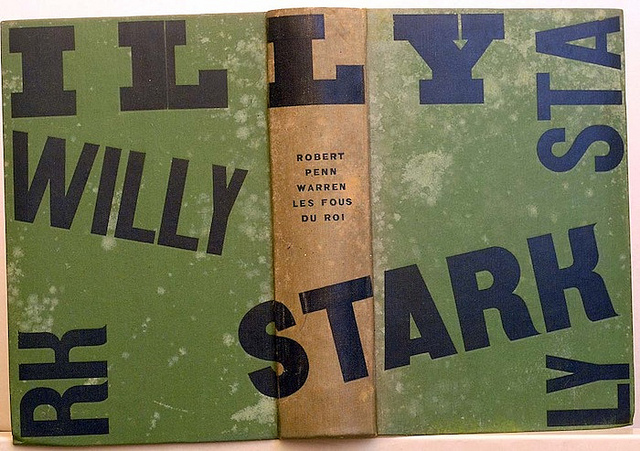
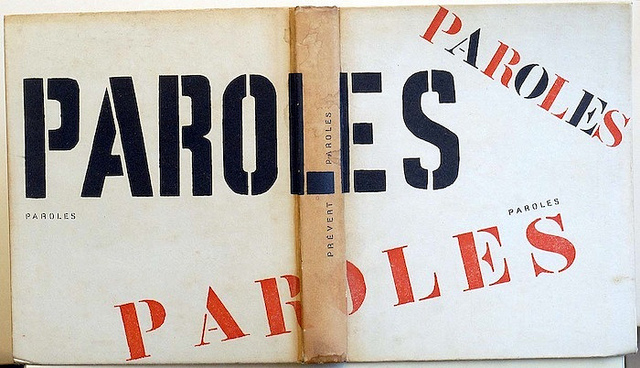
Some lovely vintage French book covers on Flickr, courtesy of Alexis Orloff (via Words & Eggs).

Cultural Change — A really interesting analysis of the current state of publishing by John B. Thompson, author of Merchants of Culture, at The Brooklyn Rail:

Readers and consumers have many different values, and beliefs, and preferences and you will see some be very happy to read on electronic devices of one kind or another. Others will remain wedded to print on paper and will want books in that form. There are deeply embedded cultural practices around writing and reading and these are not going to change quickly and easily. There are people who believe that technology sweeps all before it, and that technology is really the driving force of social change. I don’t take that view. I regard that as a technological fallacy—the view that technology is a driving force of social change. I think technologies are always embedded in social, cultural context and what technologies get taken up depends on a variety of factors that shape people’s practices and beliefs. There are many examples of technologies that went nowhere…

Getting Paid — Cartoonist and illustrator Colleen Doran on the pirating of her comics (via Richard Curtis):

Creators and publishers can’t compete with free and the frightening reality is that even free isn’t good enough.   Pirates aggregate content in ways creators and legit publishers can’t. Why go to dozens of web pages for entertainment when you can go to a pirate and get everything you want? There’s no connection to creators as human beings who work hard and make money from that work, and who need income from past work to finance future work.

Distribution is the only concern. Readers care about the gadget that gives them the goods, and have no connection to the goods at all, or who made them.  But without desirable content, there’s nothing to distribute.

Everyone gets paid — manufacturers of computers, iPads, electricity, bandwidth — everyone except the creators of content.

And finally…

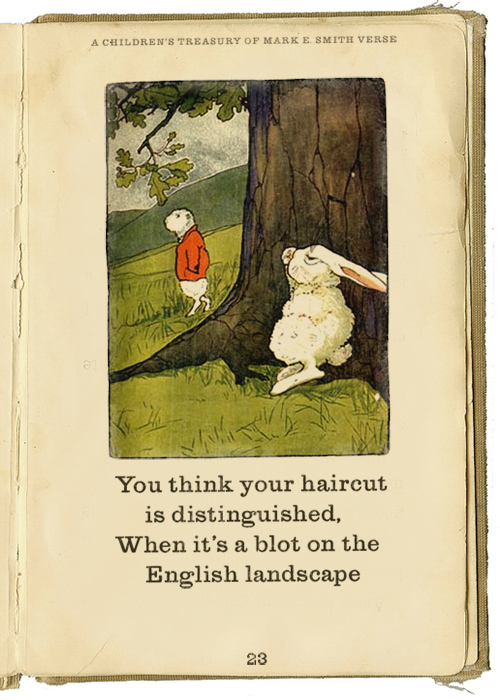
A Children’s Treasury of Mark E. Smith Verse (via the awesome A Journey Round My Skull):

Comments closed

Something for the Weekend

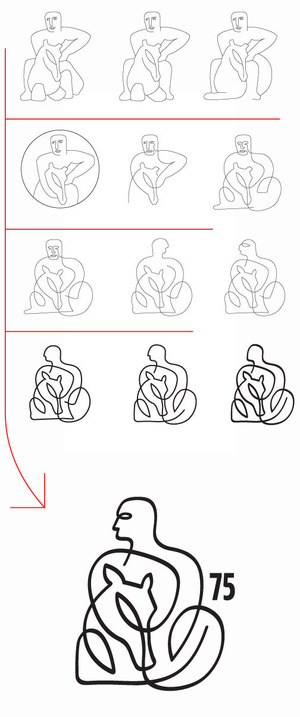
New Directions celebrates its 75th anniversary in 2011 and to mark the occasion, creative director at large Rodrigo Corral commissioned illustrator Felix Sockwell to redesign their iconic colophon by Heinz Henghes.  Sockwell writes about the redesign process (and vomiting!) here (via MobyLives).

Drowned in Sound — You have a few days left to listen to the BBC Radio adaptation of J.G. Ballard’s The Drowned World.

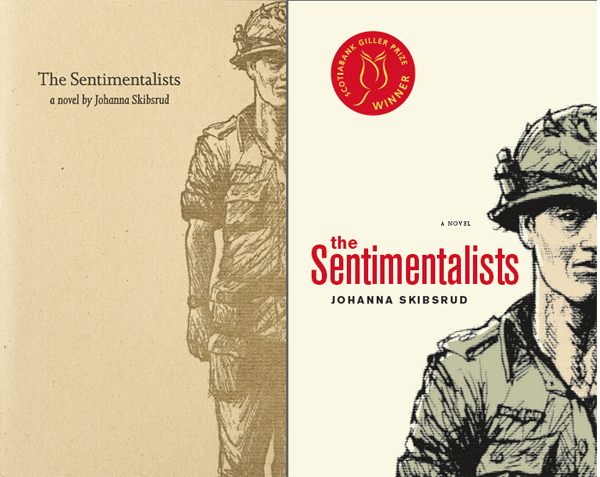
Rewiring — Peter Cocking, art director at Douglas & McIntyre, on designing a new cover for Johanna Skibsrud’s debut novel The Sentimentalists, winner of the Giller Prize and first published by artisan publisher Gaspereau Press:

I felt that the existing cover was to some extent a brand for the book — it appeared in the media quite a bit. It’s different from what we would do in that it’s — and I mean no disrespect to Andrew [Steeves, co-publisher of Gaspereau Press] — but it’s a more literary small-press treatment. It’s very appropriate to the way they publish the book, but it was clear, of course, that we were going to try and push this out into the marketplace in a much wider way. So it seemed to me that the idea was to take what they had, because people might remember this as the cream-yellow book with the solider, and make it a little more contemporary, trade-friendly, a little more aggressive as it were. It wasn’t so much a design from scratch, the way I would normally approach a novel. The way I would describe it is I didn’t build the house, I repainted it, did some new wiring.

And finally…

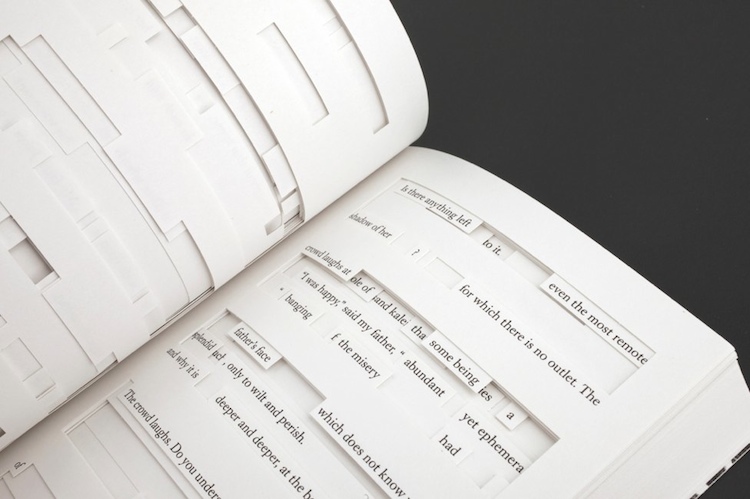
Jonathan Safran Foer’s “unmakeable” book Tree of Codes published by Visual Editions and printed by Belgian publisher and printer Die Keure, seen at Fast Company.
Comments closed

Something for the Weekend

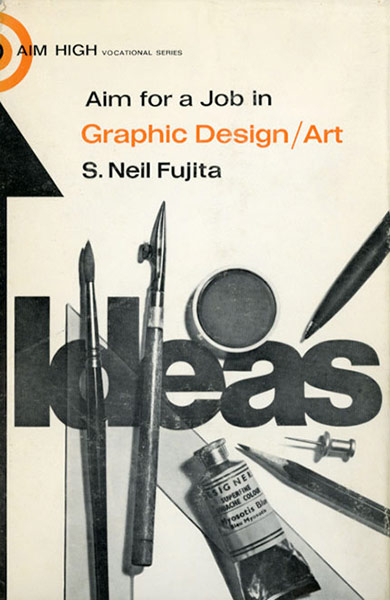
The Guardian‘s obituary for graphic designer S. Neil Fujita, who died last month aged 89, and a slideshow of his work, which included album covers for artists Dave Brubeck and Miles Davis, and book covers for John Updike, Truman Capote, and Mario Puzo.

The New York Times obituary, which ran in October, is here.

And a 2007 Steven Heller interview with S. Neil Fujita for AIGA is here.

Dead AirMike Doherty talks to Tom McCarthy about his most recent novel C for the CBC:

While researching the project, McCarthy was struck by the fact that Guglielmo Marconi and Alexander Graham Bell, the inventors of the radio and telephone, respectively, had originally sought to contact the dead. McCarthy dreamed up a character whose sister dies in early age; working as a radio operator later in life, he finds coded messages everywhere around him, perhaps from his sibling. McCarthy viewed this story as a Trojan Horse into which he could “smuggle” his “philosophical and avant-garde preoccupations,” in a “conventional Dickensian trajectory from birth to death in a historical setting. I thought, This is a winner. Surely some f—er’s going to publish this one!'”

You can find my conversation with Tom and book designer Peter Mendelsund about C here.

Pass NotesMobyLives talks to John Williams founder of online literary journal The Second Pass:

I found after leaving publishing that I was reading a lot of older books, some classics and some that I had just happened upon foraging at the Strand and other places. I thought there was room online to treat reading the way a lot of big readers actually do it, which is not to simply go straight through all the new releases but to haphazardly combine some new books with some old ones, some very popular books with some that have been out of print for decades. Plus, I was hearing a lot of moaning about the fate of books coverage in the age of the dying newspaper, and I thought trying to do something about it would be much more fun than talking about it (and much, much more fun than listening to other people talk about it). And it has been.

It just so happens that I will be chatting with John soon as well… Fingers crossed.

Comments closed

Just My Type

Journalist Simon Garfield talks about book design, typography and his new book Just My Type in this video for The Guardian:

The Guardian also has an excerpt from the book here.

Comments closed

Something for the Weekend

More Than Words — Yves Peters takes a typographical look at the winners of British Book Design and Production Awards 2010 for FontFeed. The winners all look wonderful, but, as Peters notes, it is a shame that only the publishers are credited, not the designers of the books.

An Archaeology of Business Cards — Penguin book designer Coralie Bickford-Smith discusses her workspace and her work with From the Desk Of…:

Right now I’m in the middle of designing a 20-book series, as well as sundry standalone titles, and my desk is usually a mess of ideas and scribbles on innumerable scraps of paper. There’s a whole archaeology of business cards, post-it notes and other treasures under there. I like to be surrounded by the current proofs to make sure the designs are working and that any tweaks are made in time for the final print. I like my desk – it’s my own tiny world in a big office.

My Q & A with Coralie is here.

Reading the ProcessThe New Yorker’s Book Bench interviews book designer Rodrigo Corral:

Reading is always part of the process when we’re working on a book jacket or cover for fiction. I read, I take notes, I take breaks. I’ll stop on the title, re-read it, and think about how it plays into the book and its overall message and intent. It’s rare to be able to illustrate the tone of the entire story by only depicting one moment from the book, so I prefer using a new image or design that I feel represents the story accurately.

The Rejection of Literalism — Steven Heller talks about his biography of designer Alvin Lustig Born Modern* with Imprint:

I did not get the impression that Lustig went into the book jacket biz with a literary bent. He did, however, have the temerity to try just about anything. And since, as a kid, he was interested in designing his way, he just, well, designed his way. So, I guess “confidence” is the right word. It was ballsiness. He had a vision—wherever it came from—and he pursued it. He was largely self-taught.
And, also via Imprint

Design Dossier: Graphic Design for Kids by Pamela Pease published by Paintbox Press, seen at The Daily Heller.

12 Reasons to be Excited About Publishing’s Future — Following up an earlier post about the love of books, Digital Book World‘s Guy LeCharles Gonzalez asks book industry folks why they’re excited about publishing.

And finally…

Help Me Destroy Public Radio” — Alec Baldwin channels Jack Donaghy for his “Do Not Pledge To Public Radio” pledge drive promo for NPR.

* Born Modern is published by Chronicle Books, who are distributed in Canada by my employer Raincoast Books.

1 Comment