Skip to content

Category: Writing

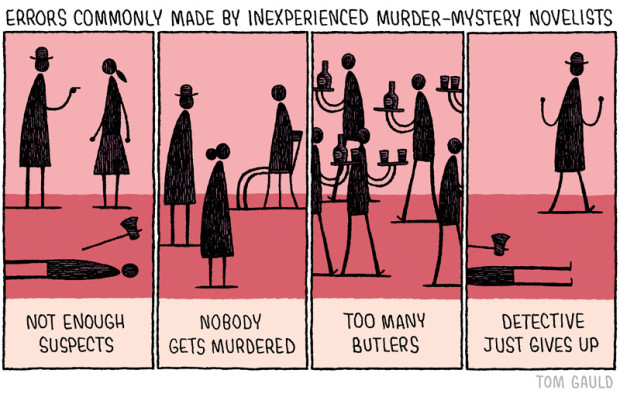
Errors Commonly Made by Inexperienced Murder-Mystery Novelists

errors-commonly-made

Tom Gauld.

Comments closed

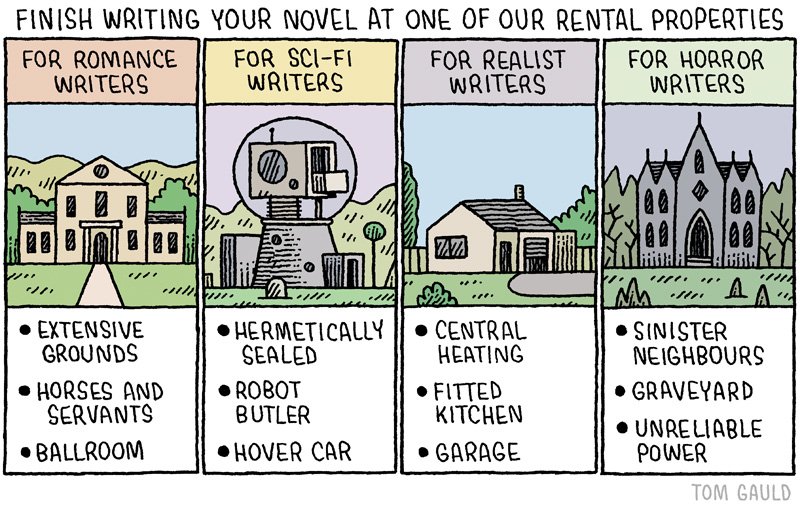
Finish Writing Your Novel…

finish writing tom gauld

Tom Gauld.

Comments closed

Olivia Laing on the Future of Loneliness

Gail-Albert-Halaban

Olivia Laing whose new book The Lonely City is out in 2016, has a personal essay on loneliness and technology in The Guardian that, like her books To the River and The Trip to Echo Spring, weaves a lot of surprisingly disparate threads together into fascinating meditation on art, literature and place:

At the end of last winter, a gigantic billboard advertising Android, Google’s operating system, appeared over Times Square in New York. In a lower-case sans serif font – corporate code for friendly – it declared: “be together. not the same.” This erratically punctuated mantra sums up the web’s most magical proposition – its existence as a space in which no one need ever suffer the pang of loneliness, in which friendship, sex and love are never more than a click away, and difference is a source of glamour, not of shame.

As with the city itself, the promise of the internet is contact. It seems to offer an antidote to loneliness, trumping even the most utopian urban environment by enabling strangers to develop relationships along shared lines of interest, no matter how shy or isolated they might be in their own physical lives.

But proximity, as city dwellers know, does not necessarily mean intimacy. Access to other people is not by itself enough to dispel the gloom of internal isolation. Loneliness can be most acute in a crowd.

Coincidentally, Laing’s piece is illustrated with photographs from Gail Albert Halaban‘s series Out My Window — one of which was used on the cover of My Salinger Year by Joanna Rackoff, designed by Peter Mendelsund and Oliver Munday.

Comments closed

Comma Queen: Possessed

In the second episode of The New Yorker‘s Comma Queen video series, copy editor Mary Norris tackles using an apostrophe to form the possessive:


I am one of those people who annoy Norris by dropping the ‘s’ after the apostrophe when a name ends in ‘s’. I’m sure she is right — I’m certainly not going to argue with her! — but the exceptions seem completely infuriatingly arbitrary to me!

UPDATE: Mary Norris, whose memoir Between You & Me is out next week, is profiled in today’s New York Times:

Ms. Norris says she tries not to bring her work home with her. But she often has to restrain herself. Bad punctuation leaps out at her. Sloppy diction and grammatical errors in conversation register as minor assaults on her ear, as if her headphones had suddenly erupted into high-pitched feedback.

Her pet peeves include poorly punctuated signs; people who call the serial comma the Oxford comma; the wrong sort of pencil; the misuse of “who” and “whom” and other crimes against the accusative; book introductions by writers other than the author; incorrectly deployed apostrophes; people she meets on vacation who harass her about The New Yorker’s style; and grammatical errors in popular songs. She is particularly irked, she said, by the line “Till the stars fall from the sky for you and I” from “Touch Me” by the Doors.

Me, I’m just irked by The Doors.


Comments closed

Comma Queen

The New Yorker has launched a new video series “devoted to language in all its facets” called Comma Queen. In the first episode, copy editor Mary Norris talks about commas, the “little squiggle” with “a history rich in controversy”:


On a related note, Julia Holmes reviews Mary Norris’ book, Between You & Me: Confessions of a Comma Queen, for the New Republic:

copy-editing can also be a soul-crushing enterprise. Not the work itself, which is perfectly pleasant and definitely necessary, but the surprising and strictly enforced class system that almost always accompanies it. Magazines are rigidly hierarchical places, no matter how outwardly easygoing and free-spirited and ad hoc they may endeavor to look on a visit to the office. A funny thing about publishing is that it’s populated almost exclusively by frustrated writers. It’s a kind of slow-burn Stanford Prison Experiment, in which former English majors are randomly assigned the roles of language guard and word prisoner, affirming once more how quickly and insanely people will adapt to new, relative states of power and powerlessness.

Mary Norris’s very funny, lucid, and lively new book, Between You & Me: Confessions of a Comma Queen, illuminates this shadow world at last. It’s part memoir, part language guide, and part personal account of life at The New Yorker (where Norris has worked as a copy editor since 1978). “One of the things I like about my job,” she writes, “is that it draws on the entire person: not just your knowledge of grammar and punctuation and usage and foreign languages and literature but also your experience of travel, gardening, shipping, singing, plumbing, Catholicism, midwesternism, mozzarella, the A train, New Jersey.”

Norris exemplifies what David Foster Wallace observed in “Authority and American Usage”: “We tend to like and trust experts whose expertise is born of a real love for their specialty instead of just a desire to be expert at something.”

Comments closed

Learning to Love the House Style

In a long and charming essay for The New Yorker, the magazine’s query proofreader Mary Norris muses on her career, and the history and uses of the comma:

Then I was allowed to work on the copydesk. It changed the way I read prose—I was paid to find mistakes, and it was a long time before I could once again read for pleasure. I spontaneously copy-edited everything I laid eyes on. I had a paperback edition of Faulkner’s “The Hamlet” that was so riddled with typos that it almost ruined Flem Snopes for me. But, as I relaxed on the copydesk, I was sometimes even able to enjoy myself. There were writers who weren’t very good and yet were impossible to improve, like figure skaters who hit all the technical marks but have a limited artistic appeal and sport unflattering costumes. There were competent writers on interesting subjects who were just careless enough in their spelling and punctuation to keep a girl occupied. And there were writers whose prose came in so highly polished that I couldn’t believe I was getting paid to read them: John Updike, Pauline Kael, Mark Singer, Ian Frazier! In a way, these were the hardest, because the prose lulled me into complacency. They transcended the office of the copy editor. It was hard to stay alert for opportunities to meddle in an immaculate manuscript, yet if you missed something you couldn’t use that as an excuse.

Norris’s book, Between You & Me: Confessions of a Comma Queen, will be published by W. W. Norton in April.

Comments closed

Mac Barnett: Why a good book is a secret door

I’m all about the charming videos today… In this recent TED Talk, Mac Barnett, award-winning author of Billy Twitters and His Blue Whale ProblemExtra Yarn, Telephone and the forthcoming Sam and Dave Dig a Hole, talks about childhood and making stories come alive:

Comments closed

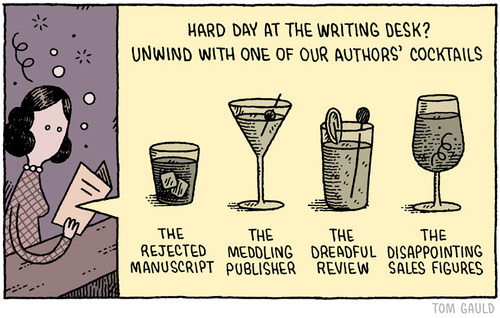
Authors’ Cocktails

hard-day

I didn’t see this weekend’s Guardian, but I assume Tom‘s cartoon is in reference to Olivia Laing’s article about 20th century female writers who drank, a follow-up to her excellent book The Trip to Echo Spring, which examines the link between creativity and alcohol through the lives F. Scott Fitzgerald, Ernest Hemingway, Tennessee Williams, John Berryman, John Cheever, and Raymond Carver:

Female writers haven’t been immune to the lure of the bottle, nor to getting into the kinds of trouble – the fights and arrests, the humiliating escapades, the slow poisoning of friendships and familial relations – that have dogged their male colleagues. Jean Rhys was briefly in Holloway prison for assault; Elizabeth Bishop more than once drank eau de cologne, having exhausted the possibilities of the liquor cabinet. But are their reasons for drinking different? And how about society’s responses, particularly in the lubricated, tipsy 20th century; the golden age, if one can call it that, of alcohol and the writer?

Comments closed

Procrastination for Writers…


…a 10-Week Course.

Tom Gauld.

1 Comment

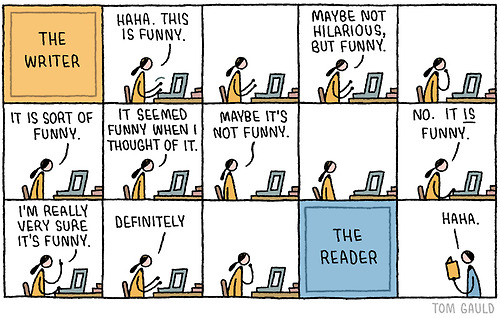
It Seemed Funny When I Thought of It

Haha This is Funny
Haha.

Tom Gauld.

Comments closed

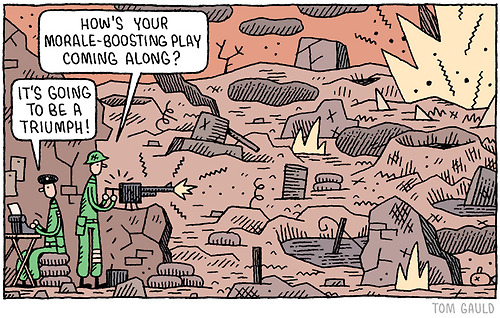
Morale

morale
In light of my previous post about how awful being a writer is, Tom Gauld‘s latest cartoon for The Guardian seems strangely appropriate…

Comments closed

Writing and the Cost of Living

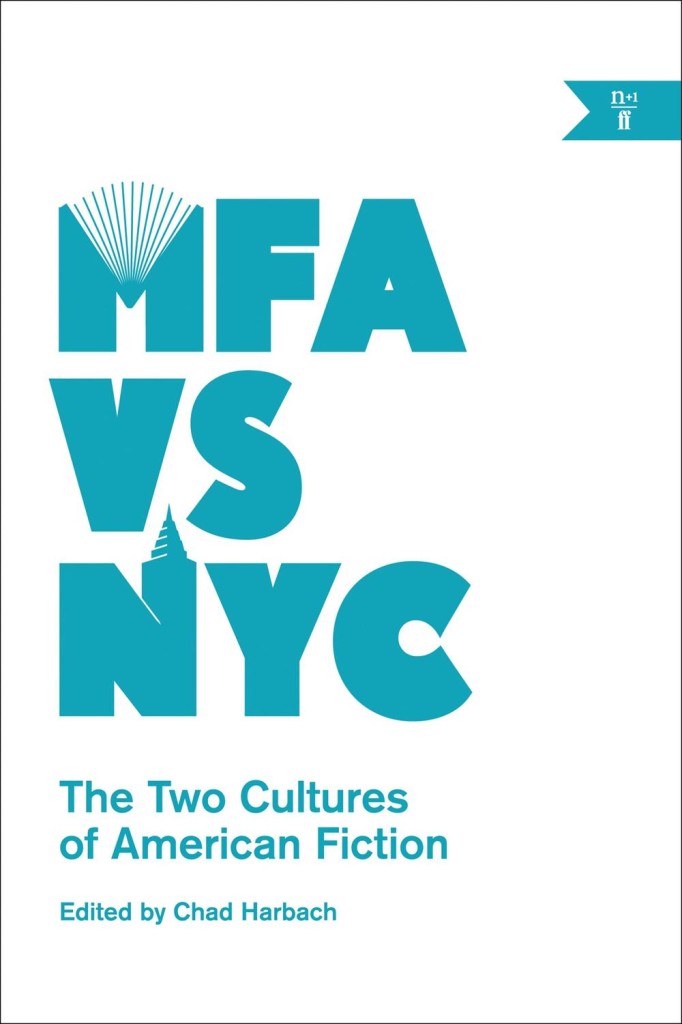
mfc_vs-nyc

I finally just got around to reading Emily Gould‘s spiralling essay on writing and debt ‘How much my novel cost me‘ over the weekend. It’s an excerpt from the new n+1 book MFA vs NYC edited by Chad Harbach (author of The Art of Fielding), which seems like it could be essential reading for idealistic folks wishing to pursue writing as a career:

IT’S HARD TO WRITE ABOUT BEING BROKE because brokeness is so relative; “broke” people run the gamut from the trust-funded jerk whose drinks you buy because she’s “so broke right now” to the people who sleep outside the bar where she’s whining. But by summer 2012 I was broke, and in debt, and it was no one’s fault but mine. Besides a couple of freelance writing assignments, my only source of income for more than a year had come from teaching yoga, for which I got paid $40 a class. In 2011 I made $7,000.

During that $7,000 year I also routinely read from my work in front of crowds of people, spoke on panels and at colleges, and got hit up for advice by young people who were interested in emulating my career path, whose coffee I usually ended up buying after they made a halfhearted feint toward their tote bag–purses. I felt some weird obligation to them and to anyone else who might be paying attention to pretend that I wasn’t poor. Keeping up appearances, of course, only made me poorer. I’m not sure what the point of admitting all this might be, because I know that anyone who experiences a career peak in his mid-twenties will likely make the same mistakes I did, and it’s not even clear to me that they were all mistakes, unless writing a book is always a mistake, which in some sense it must be.

Interestingly, Robert McCrum touches on the financial difficulties of older authors in an article for this weekend’s The Observer

To writers of my generation, who grew up in the age of Penguin books, vinyl records and the BBC, it’s as if a cultural ecology has been wiped out. For as long as most of us can remember, every would-be writer knew the landscape of the printed word. This Georgian square was home to publishing grandees (now retired). On that high street were the booksellers (now out of business). In those twisting back streets, you could expect to find literary agents working the margins with the injured innocence of pickpockets at a synod. It was a mutually dependent ecosystem.

Publishers were toffs, booksellers trade and printers the artisan champions of liberty. Like the class system, we thought, nothing would change. The most urgent deadline was lunch. How wrong we were. The years 2007-2010 are pivotal: first… came the credit crunch. And it occurred at the very moment that the IT revolution was wrecking the livelihoods of those creative classes – film-makers, musicians and writers of all sorts – who had previously lived on their copyrights.

Gould is self-recriminating. McCrum — a former editor-in-chief at Faber and Faber — is nostalgic for a time I don’t remember (things were always better in the ‘old days’ in publishing circles). For Gould the internet is a double-edged sword — a platform and a distraction — for McCrum it has brought nothing but woe. Both seem to agree, however, that nobody is making any money, “marketing types” are awful (aren’t they though?), and being a writer is not all it’s cracked up to be…
friendship_gould

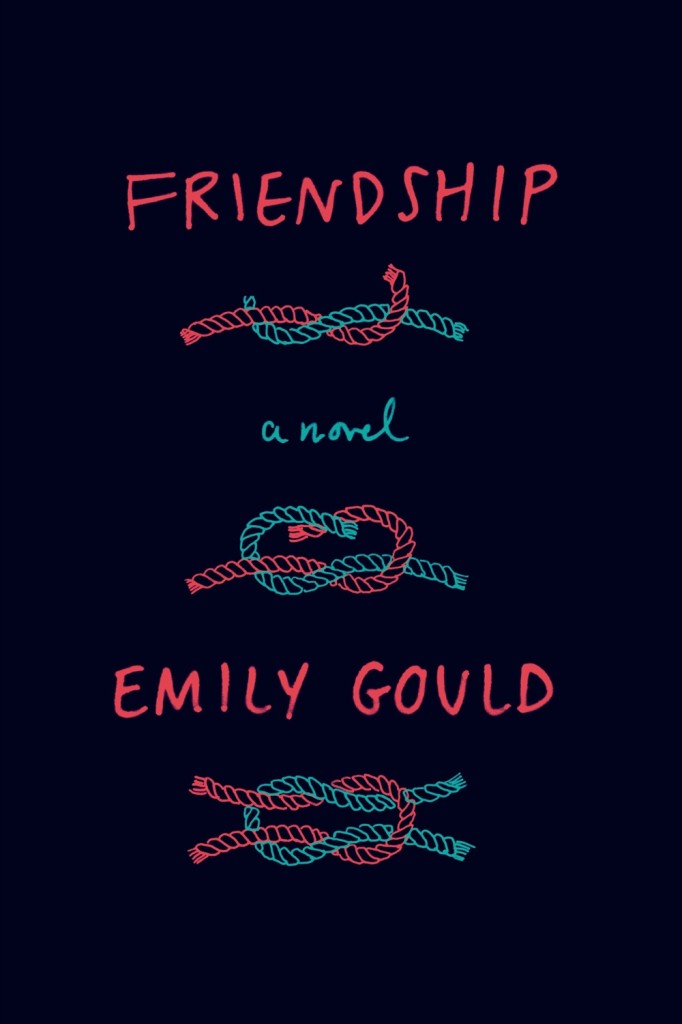
Coincidently, Emily Gould’s new novel Friendship will be published in the US and Canada by Farrar, Straus & Giroux on July 1 (and a couple of days later in the UK by Virago). I’m not sure who designed the cover, but it is rather nice.

(NB: FSG, and n+1 / Faber & Faber are distributed in Canada by my employer Raincoast Books)

UPDATE: Leslie Jamison, author of the forthcoming essay collection The Empathy Exams (published by Graywolf Press, also distributed in Canada by Raincoast — sorry), reviews MFA vs NYC  for The New Republic:

Writers throughout these essays face the shame of privilege and the specter of poverty: They join magazine mastheads to keep from going broke, or they teach to keep from going broke, or else they actually do go broke—they’re broke in Brooklyn and broke in Los Angeles. Eli Evans evokes his years living in a “warehouse on Pico and Fourth” in one perfect image, one of the most remarkable moments in the entire collection: “I once found a baby rattlesnake strangled with electrical wire and tied to a signpost.” This baby rattlesnake, apparently, is what dreams become…
1 Comment