Skip to content

Category: Miscellany

Something for the Weekend

Commercial Indifference — Geoff Dyer’s Zona reviewed at the LA Review of Books:

[Dyer] followed a book of eccentric travel writing with a book on photography, and then in 2009 served up a couple of loosely-linked novellas under the, let’s face it, terrible title of Jeff In Venice, Death in Varanasi. Add in Dyer’s pre-2000 offerings on jazz, D.H. Lawrence, and World War I, along with several novels, and you have an oeuvre that resembles a messy and ever-expanding Venn diagram of the author’s obsessions. Even so, a 200-page book about a Russian film from 1979 takes commercial indifference to heroic lengths.

(And much as I love you and your recent redesign LARB, could we get simple RSS feed please?)

The Great Unwashed — Julia Kingsford, writing at The Bookseller, on the cultural snobbery and clichés surrounding Fifty Shades of Grey  (h/t Don Linn):

Surely they can’t be ‘real’ readers whose papery passions have traditionally been our bread and butter and who shop in ‘real’ bookshops? No, these must be a different sort of reader, new and not as good, ‘silly’ and to be only temporarily humoured and nervously served before we gladly see them off as they return to whatever form of entertainment they normally enjoy. Far from intellectual snobbery about readers being the preserve of the book trade, it runs rife through everyday media and culture, constantly perpetuating the view that books are for the few.

Medium-Rare — Author Lev Grossman (The Magician King) on almost being a rare book collector, at Time:

My specialty as a collector is books that almost have value. When I love a book, I don’t buy the first edition, because those have become incredibly expensive. But I might buy a beat-up copy of the second edition, third printing, which looks almost exactly the same as the first edition except that a couple of typos have been fixed. (In the rare book trade the little details that definitively identify a first edition are called “points.” My books are not strong on points.) It’s not glamorous, but it’s still satisfying, and it’s a hell of a lot cheaper.

And finally…

“New” — An archive interview with art director and pioneer of modern advertising Helmut Krone. There is so much good stuff in this… (via Coudal, naturally):

“New” is when you’ve never seen before what you’ve just put on a piece of paper. You haven’t seen it before and nobody else in the world has ever seen that thing that you’ve just put down on a piece of paper. And when a thing is new all you know about it is that it is brand new. It’s not related to anything that you’ve seen before in your life. And it’s very hard to judge the value of it. You distrust it, and everybody distrusts it. And very often it’s somebody else who has to tell you that that thing has merit, because you have no frame of reference, and you can’t relate it to anything that you or anybody else has ever done before.

(The going rate for Helmut Krone: The Book appears to be upwards of $80 on Abebooks. Time for a reprint?)

Comments closed

Midweek Miscellany

An interview with award-winning Toronto-based illustrator Gary Taxali at GrainEdit.

How Disappointing — Book designer Peter Mendelsund on what we picture in our minds when we read literary works:

“Call me Ishmael.” What happens when you read this line? You are being addressed, but by whom? Chances are you hear the line (in your mind’s ear) before you picture the speaker. I can hear Ishmael’s words more clearly than I can see his face. (Audition requires different neurological processes than vision, or smell. And I would submit that we hear more when we read than we see). Picturing Ishmael requires a strong resolve.

But if you indeed took the trouble to summon an image of Ishmael what did you come up with? A sea-faring man of some sort? Is this a picture or a category? Do you picture Richard Basehart, the actor in the John Huston adaptation? How disappointing.

(All I can say is that the follow-up essay had better be about comic books, Peter!)

The Secret Detectives — An interview with Patti Smith in The Telegraph:

“When I was young I knew William Burroughs really well. And William’s secret desire, which he never quite did, was to write a straightforward detective novel. How good would that have been! And I used to say, ‘you have to do it William!’ And he’d say” – Smith gives a passable impersonation of the Burroughsian growl – “‘Oh, I don’t know, one of these days.’ William was like the embodiment of a detective, I just loved him so much.”

Our Greatest Creation — Jonathan Glancey, The Guardian‘s former architecture and design correspondent, reviews City: A Guidebook for the Urban Age by P.D. Smith:

The stuff of lofty intentions and grubby backstreet life, the city represents much of our restless and contradictory natures. “In this dynamic, cosmopolitan space,” Smith writes, “lies the wellspring of our creativity as a species. The greatest cities nurture and stimulate ideas in science and the arts that are the very heart of human civilisation. For this reason, sustainable, humane and well-governed cities are our best hope for the future.”

Amen.

Hiding in Plain Sight — Type designer Ramiro Espinoza on ‘Amsterdamse Krulletter’, the curly lettering painted on the windows of traditional pubs in Amsterdam, and his only typographic revival Krul:

The fact that such gorgeous and original letters have largely been ignored in a country with such a rich type- and letter-making tradition reminds me of the plot of Edgar Allan Poe’s famous story “The Purloined Letter”. In the story, an important document cannot be found because it is lying in plain sight. Sometimes things can become invisible to us because of their very familiarity.

Avant Garde — Adrian Shaughnessy on life and work of designer Herb Lubalin at Imprint:

I have a pet theory about why Lubalin is currently popular: In the eyes of many designers, he offers a way of designing—and of communicating—that doesn’t require expensive art direction, over-manicured photography, or grandiose presentation. Lubalin proved that to be effective, all you need is a typeface and a good idea. In other words, he is a designer for the age of austerity.

Unit Editions’ forthcoming limited edition monograph, Herb Lubalin: American Graphic Designer, 1918–81, will be available in August.

And finally (and also at Imprint)…

An interview with designer and collage artist Graham Moore, who incorporates mid-century modern ephemera and fragments from billboard posters into his work.

Comments closed

Something for the Weekend

A stunning jacket design by the great Isaac Tobin for After Freud Left, published by University of Chicago Press.

You can read my interview with Isaac from 2009 here.

Bauhütte to Bauhaus — A fascinating overview of the Bauhaus by Frank Whitford, author of the Thames & Hudson ‘World of Art’ book Bauhaus,  for the TLS:

The structure of the Bauhaus… followed, as Gropius thought, medieval principles. He coined the school’s name so as to echo the word Bauhütte, in the Middle Ages the German for a guild of masons, builders and decorators. And the teaching was based on specialist workshops where you learned your trade by carrying out actual projects, graduating from apprentice to journeyman and master. The teachers were at first called Masters and not Professors, a revolution in a country where academic snobbery was the norm.

Calligraphica — A new tumblr devoted to calligraphy and hand drawn type (pictured above: ‘One Hope One Quest’, by Greg Papagrigoriou).

Persuasion — Michael Bierut talks to Designers & Books about his collection 79 Short Essays on Design:

Even the best designers have to persuade people all the time. They have to persuade people to hire them; then they have to persuade people to go with the recommended solution; then they have to persuade people to realize that solution in the best possible way. Simply showing someone a nice design is almost never enough. This constant effort—and all the rejection that inevitably ensues—obviously requires healthy confidence and nerves of steel, if not a strong ego.

And finally…

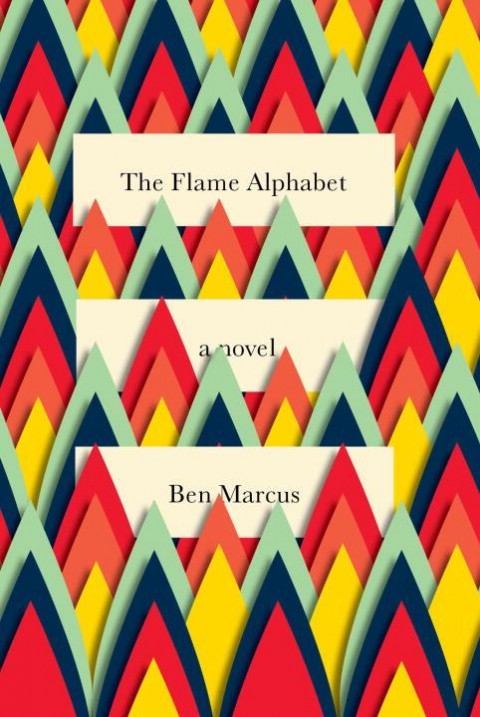
Critic James Lasdun reviews The Flame Alphabet by Ben Marcus for The Guardian:

Language, the debasement, banality and ultimate toxicity thereof, is his subject. It’s a staple topic of avant garde literature, from the Prenzlauer Berg writers of the former East Germany to the Language poets of the American academy. All proceed, more or less, on the basis that verbal communication has been fatally corrupted by political or literary abuse and can be rescued only by a total dismantling and reassembly. Results vary (I’ve yet to read a Language poem that didn’t make me want to dissolve it in acid), but Marcus’s own, especially in The Age of Wire and String, have been haunting and inventive.

Comments closed

Midweek Miscellany

I really enjoyed Naïve: Modernism and Folklore in Contemporary Graphic Design, so I really think I have to pick up  Echoes of the Future: Rational Graphic Design and Illustration, also published by Gestalten. A “compilation of recent graphic design and illustration that is inspired by our collective visual memory”,  the book includes work by Gianmarco Magnani, AKA Silence Television, who (calling all enterprising art directors) ought to be doing book covers (if he isn’t already):

But moving on…

“The only thing left on the high street that doesn’t want either your soul or your wallet” — Zadie Smith on libraries at the NYRB:

What kind of a problem is a library? It’s clear that for many people it is not a problem at all, only a kind of obsolescence. At the extreme pole of this view is the technocrat’s total faith: with every book in the world online, what need could there be for the physical reality? This kind of argument thinks of the library as a function rather than a plurality of individual spaces. But each library is a different kind of problem and “the Internet” is no more a solution for all of them than it is their universal death knell.

And on a sort of related note…

The Disease-Carrying Book — John Sutherland reviews How To Do Things With Books in Victorian Britain by Leah Price for the Literary Review:

The public library, introduced in Manchester with much municipal self-congratulation in the early 1850s, was ‘free’, unlike ‘leviathan’ circulating libraries such as Mudie’s and W H Smith’s that catered to the middle classes. The lower classes lick their index fingers to turn the page. A quaint ‘fumigator’ in which Victorian public libraries could decontaminate their stock is illustrated in Leah Price’s discussion of the disease-carrying book. Victorians were wedded to the ‘miasmic’ theory of disease. Yet it wasn’t air but spittle that was the vector of the dreaded consumption.

Reality is Elsewhere — Steve Wasserman on Amazon at The Nation:

For many of us, the notion that bricks-and-mortar bookstores might one day disappear was unthinkable. Jason Epstein put it best in Book Business, his incisive 2001 book on publishing’s past, present and future, when he offered what now looks to be, given his characteristic unsentimental sobriety, an atypical dollop of unwarranted optimism: “A civilization without retail bookstores is unimaginable. Like shrines and other sacred meeting places, bookstores are essential artifacts of human nature. The feel of a book taken from the shelf and held in the hand is a magical experience, linking writer to reader.” That sentiment is likely to strike today’s younger readers as nostalgia bordering on fetish. Reality is elsewhere.

Also at The Nation Michael Naumann on Germany’s bookstores and literary culture:

Since the late 1840s in Germany, the ambiguous character of books—simultaneously a commodity and a cultural work—has defined internal discussions in the publishing business. Putting aside the implicit hubris of German nationalism, the country’s self-aggrandizement as a veritable Kulturnation, the fact remains that in Germany the cultural definition of the “book” as a major source of intellectual, scientific, economic and aesthetic self-improvement has carried the day over the capitalist notion that a book is a commodity and therefore deserving of no special considerations. The book as such is sacred. One does not throw books away.

And finally…

The Graphic Modern: USA, Italy and Switzerland 1934–66 exhibition curated by Patricia Belen and Greg D’Onofrio of Kind Co. is on display at Fordham University at Lincoln Center, should you happen to be in New York between now and July 26th.

Comments closed

Something for the Weekend

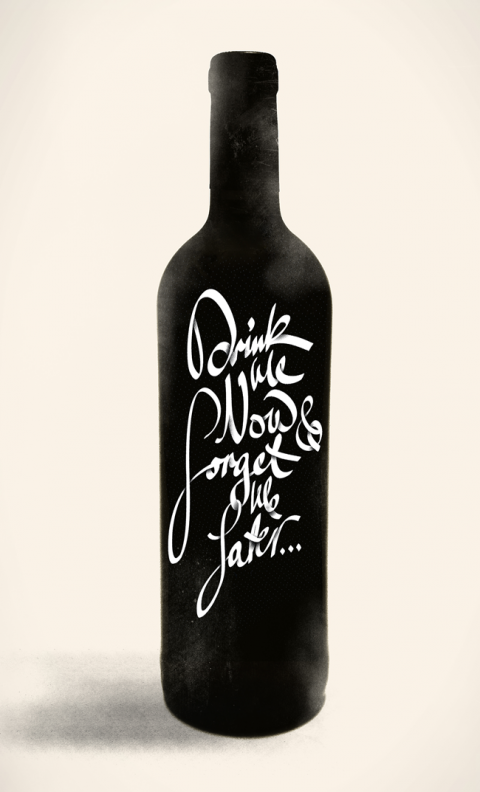
Letter Cult’s epic selection of the best custom lettering of 2011 (don’t click on the link if you have things to do today — and this is only part one!). Pictured above ‘Drink Me Now, Forget Me Later…’ by Michael Spitz.

Rank Amateurs — Design critic Justin McGuirk reviews Home-Made Europe: Contemporary Folk Artifacts for The Guardian:

The makers’ motives are not always need or thrift; sometimes it’s pleasure or obstinacy, or serendipity – a road sign that happens to make a perfect tabletop. This kind of uncelebrated creativity brings to mind artist Jeremy Deller’s Folk Archive, which catalogues everything from protest banners to pizza kiosks. Deller has written a short foreword here, in which he makes a distinction between these objects and DIY, “a hobby that seems so pleased with itself”. The difference is that the DIYer seeks to emulate the professional, whereas these objects all share the nonchalance of the amateur.

Also in The Guardian, Anthony Quinn on cricket and the novel:

Sport in novels is seldom just sport. It’s a way of talking about something else – fellowship, ambition, jealousy, honour. With cricket it’s clearly a way of writing about failure. Lately we’ve been hearing a lot about players who, at the end of their careers, succumb to insecurity and depression; some cannot handle the post-career blues and choose to end it all. As David Frith’s excellent book Silence of the Heart (2001) made clear, cricket has the highest proportion of suicides in any sport. Why? It might be because it is, of all sports, the loneliest.

Repressed Energy — An interview with Daniel Clowes about The Art of Daniel Clowes: Modern Cartoonist at the A.V. Club:

I can look at my early work and see what a pained struggle it was to draw what I was drawing. I was trying so hard to get this specific look that was in my head, and always falling short. I could see the frustration in the lines, and I remember my hand being tensed and redrawing things a thousand times until I finally inked it, and just having this general tense anxiety about every drawing. I think that comes through in the artwork, and gives it this certain kind of manic energy, this kind of repressed energy, so you feel like it’s sort of bursting at the seams or something.

And finally…

Sara Goldsmith on the history of the paper clip at Slate magazine:

The paper clip we think of most readily is an elegant loop within a loop of springy steel wire. In 1899, a patent was issued to William Middlebrook for the design, not of the clip, but of the machinery that made it. He sold the patent to the American office-supply manufacturer Cushman & Denison, who trademarked it as the Gem clip, in 1904. Middlebrook’s rather beautiful patent drawing shows the clip not as an invention but as the outcome of an invention: the best solution to an old problem, using a new material and new manufacturing processes. Coiled in this form, the steel wire was pliant enough to open, allowing papers to nestle between its loops, but springy enough to press those papers back together. When the loops part too far from each other and the steel reaches its elastic limit, the clip breaks.


Comments closed

Midweek Miscellany

Survival Training — Colson Whitehead, author of Zone One, on watching horror flicks and b-movies, in science fiction edition of The New Yorker:

It was survival training. “A Clockwork Orange,” which I saw several times on HBO before I was ten, taught me more about not opening my door to strangers than a hundred school-assembly lectures. I never talked much in educational settings, so it is unlikely that I asked my mother, “What are they doing to that woman?” during my introduction to Stanley Kubrick, but, had I inquired, I’m sure she would have said, “It’s a comment on society, son.”

See also: Laura Miller on the first fictional space aliens, William Gibson on science fiction and Tomorrow, and cover illustration by Daniel Clowes (pictured above).

And on a related note: Nobel Prize-winning economist Paul Krugman talks science fiction at Wired.com:

I read Foundation back when I was in high school, when I was a teenager, and thought about the psychohistorians, who save galactic civilization through their understanding of the laws of society, and said “I want to be one of those guys.” And economics was as close as I could get. Those are pretty unique novels — they really are structured nothing like even the great bulk of science fiction, because they are about how social science can be used to save humanity.

Terrifying French children’s books.

And finally… An interesting interview with The New York Times media columnist David Carr (and star of the documentary Page One) at Talking Points Memo:

The tools of production are at hand for everyone. I used to hire a lot of young people when I was the editor of Washington City Paper, and you used to have them show you the clips and see where else you worked. Show me what you’ve made with your own bare little hands. That, I think, is super important. People say, “You should’ve been here for the good old days.” I think that’s crazy. Yeah, it’s a little harder, but you have so many more tools at your disposal to story-tell. It’s cool to be in a business where you still learn. You don’t have to be able to code yourself, but you have to know what coding is. You should be able to work in Final Cut Pro. WordPress should be second-nature. I think, in generational terms, being able to produce and consume content at the same time.

Comments closed

RSA Animate: The Power of Networks

In this new RSA Animate, Manuel Lima, senior UX design lead at Microsoft Bing and author of Visual Complexity, talks about networks and the challenges of mapping a complex world:

Comments closed

Something for the Weekend

You’re All Just Jealous of My Jetpack — Tom Gauld has a Tumblr (The title is a reference to this of course).

Legacy Issues — Stephen Page, chief executive of Faber & Faber, writing at The Guardian:

Let’s deal with technological obsolescence. Media businesses are not technology businesses, but they can be particularly affected by technology shifts. I run a so-called legacy publishing house, Faber & Faber. Most of our business is based on licensing copyrights from writers and pursuing every avenue to find readers and create value for those writers. We are agnostic about how we do this. For our first 80 years, we could only do it through print formats (books); now we can do it through books, ebooks, online learning (through our Academy courses), digital publishing (such as the Waste Land app) and the web. Technology shifts have tended to result in greater opportunity, not less.

Bibliophiles in London — The Economist on The London International Antiquarian Book Fair:

Most interesting, perhaps, is the air of optimism—there is not the slightest whiff of gloom at the state of the book world. The internet, paradoxically, has made books “à la mode”, says Claude Blaizot of the Librarie August Blaizot in Paris, purveyor of first editions of “Tintin” and fantastically bound livres d’artiste. “It has brought people to books, and shown them booksellers they never would have known existed before,” he says. Clive Farahar, the Antiques Roadshow’s book specialist, agrees that technology has opened up the book trade, and made the world of books much more accessible to all. “It’s not just the dim little shop on the high street anymore,” he said. “We can learn so much now we never would have known before.”

Simplicity — A two-part interview with Apple designer Jonathan Ive at The Telegraph:

“Simplicity is not the absence of clutter, that’s a consequence of simplicity. Simplicity is somehow essentially describing the purpose and place of an object and product. The absence of clutter is just a clutter-free product. That’s not simple.”

(part two)

And finally…

Daniel Clowes at wired.com:

“Digital seems like such a step back from a printed book… For me, the whole process involves envisioning this book in my head as I’m working. That is what I’m trying to create. That’s the work of art. That’s the sculpture I’m chipping away at, and when I’m finally done, I will arrive at that perfect 3-D object. The iPad version would be like a picture of the book, which doesn’t hold any interest at all for me. Even if I only had 10 readers, I’d rather do the book for them than for a million readers online.”

Comments closed

Midweek Miscellany

Krazy Kriticism — Sarah Boxer on George Herriman’s long-running newspaper comic strip Krazy Kat, at the LA Review of Books:

[E]ven 95 years ago the truth was as loud and clear as a pair of clapping mitten rocks rising up out of the mesa encantada: Krazy Kat is perfect and Herriman is a genius — linguistically, graphically, poetically, onomatopoetically, every which way. Confronted with such perfection, most of Herriman’s critics, once they finish reciting plot, affecting accents, and making comparisons to classics, have always thrown up their hands and said, “Behold!” But does it have to be that way? The genius label, after all, has never kept Shakespeare or Picasso scholars from finding something to say.

A Natural End — An interview with Tom Gauld at The Comics Journal:

I never draw things big. Even if something needs to be big, I’d still draw it small and scale it up. I like to draw small (my drawings are not much bigger than the finished, printed comics) as it reigns in perfectionism, and I get a bit of natural wobble and error into the drawings. One problem with digital is that you can zoom in and in forever: but with a pen, the width of the line gives a natural end.

Canaries — Nick Harkaway, author of The Blind Giant, talks about books on the digital age at The Browser:

Our environment seems to be constantly filled with moral panics. When you open the newspaper, there’s always a piece about how the digital environment is making us stupid or paranoid, but so little of it has any basis. There was a piece in The Guardian the other day about how behaviour on Facebook was linked to socially aggressive narcissism. You had to go six paragraphs into the story to find out that the link wasn’t causal. It was just as possible that Facebook was the canary in our coal mine, telling us that our society was aggressively narcissistic in general – which I don’t find terribly difficult to believe.

And finally…

Little Glories —  Sam Taylor, who translated HHhH by Laurent Binet, on the art (and perils) of translation, at the Financial Times:

There is… something else slightly troubling about the relationship between authors and translators. It can, I suppose, be reduced almost to a hierarchical relationship: the author is primary, the translator secondary. We notice when a translation is bad, but when it is good we forget that what we are reading is a trans­lation at all. However, while there is little glory in translation, and although I began doing it only for financial reasons, I wouldn’t want to give it up now – even were I able to make a living from writing novels.

Comments closed

Radiolab: Colors

On the latest episode of Radiolab, Jad Abumrad and Robert Krulwich explore the science of colour (in their own inimitable and meandering style):

Radiolab: Colors mp3 

(pictured above: Interaction of Color by Josef Albers. Not mentioned in the show, but somewhat appropriate…? Any excuse for a bit Albers really…)

Comments closed
Something for the Weekend

Chris Ware’s astonishing cover for Crockett Johnson and Ruth Krauss: How an Unlikely Couple Found Love, Dodged the FBI, and Transformed Children’s Literature by Philip Nel. See the full thing in detail here.

A free interactive e-book about British artist Francis Bacon created by the estate of the artist and Katharina Günther is available from iTunes (via A Piece of Monologue).

Page 1: Great Expectations, the first book by GraphicDesign&, “collects the responses of 70 international graphic designers when posed with the same brief – to design and lay out the first page of Great Expectations by Charles Dickens.” The Creative Review and We Made This have more on the project.

And finally…

Jon Contino’s beautiful cover  illustration for The Marlowe Papers by Ros Barber. You can’t really tell from the image above, but the apple is actually brown foil, the grub and stalk in are in gold on finished book. You can see better in these pictures Contino posted to Instagram:

Comments closed

Midweek Miscellany

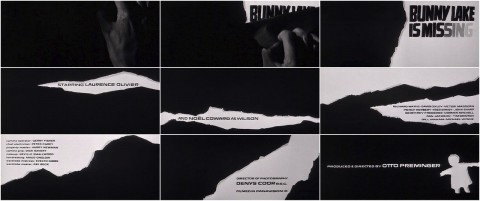
The excellent Art of the Title looks at the opening sequences to Anatomy of a Murder and Bunny Lake is Missing by Saul Bass.

Just Getting Started — Bill Moran on the Hamilton Wood Type and Printing Museum in Two Rivers, Wisconsin, for Design Observer:

When you hold a piece of wood type in your hands this deceptively simple piece of mass communication rewards you with its grace but also surprises with its weight. End grain maple is cut from the cross section of a tree yielding a harder and heavier piece of wood. Using the end grain of the wood improves durability with most wood type that was made in the nineteenth century still fully functional a century after its date of manufacture.

Leading the Blind — Nick Harkaway, author of The Blind Giant: Being Human in a Digital World, on book publishers and technology at The Guardian:

There’s a willingness to think: we’ll let everyone else figure out how the market should work, and then we’ll just supply books in the same way that we did to bookshops to electronic sellers like Amazon, Apple and Google. But booksellers are tied to publishing – they need conventional publishing models to continue – but for those companies that’s not the case. Amazon is an infrastructure company; Apple sells hardware; Google is really an advertising company. You can’t afford as a publisher to have those companies control your route to market.

Creative Paralysis — Michelle Dean on the future of ‘serious’ publishing at The Rumpus:

I don’t think there is anyone out there who has recently looked at the state of book publishing, I mean really looked, and not tightened her grip on her wineglass… I don’t work inside or report on publishing, but what limited exposure I do have suggests that there is indeed a crisis on the horizon. Anyone who’s ever wanted to see their name in print on the cover of a book — biography or novel, chapbook or memoir — ought to be thinking about that, about how to sustain the world of books. But the focus on the internet as the death of culture, which drones on in tired refrain on certain book sites, strikes me as bizarre, and overstated, not to mention creatively paralyzing.

And finally…

Eleanor Wachtel interviews composer Philip Glass for CBC Radio:

CBC Radio Ideas: Wachtel on the Arts with Philip Glass mp3

Comments closed