Skip to content

Category: Miscellany

Midweek Miscellany Feb 18th, 2009


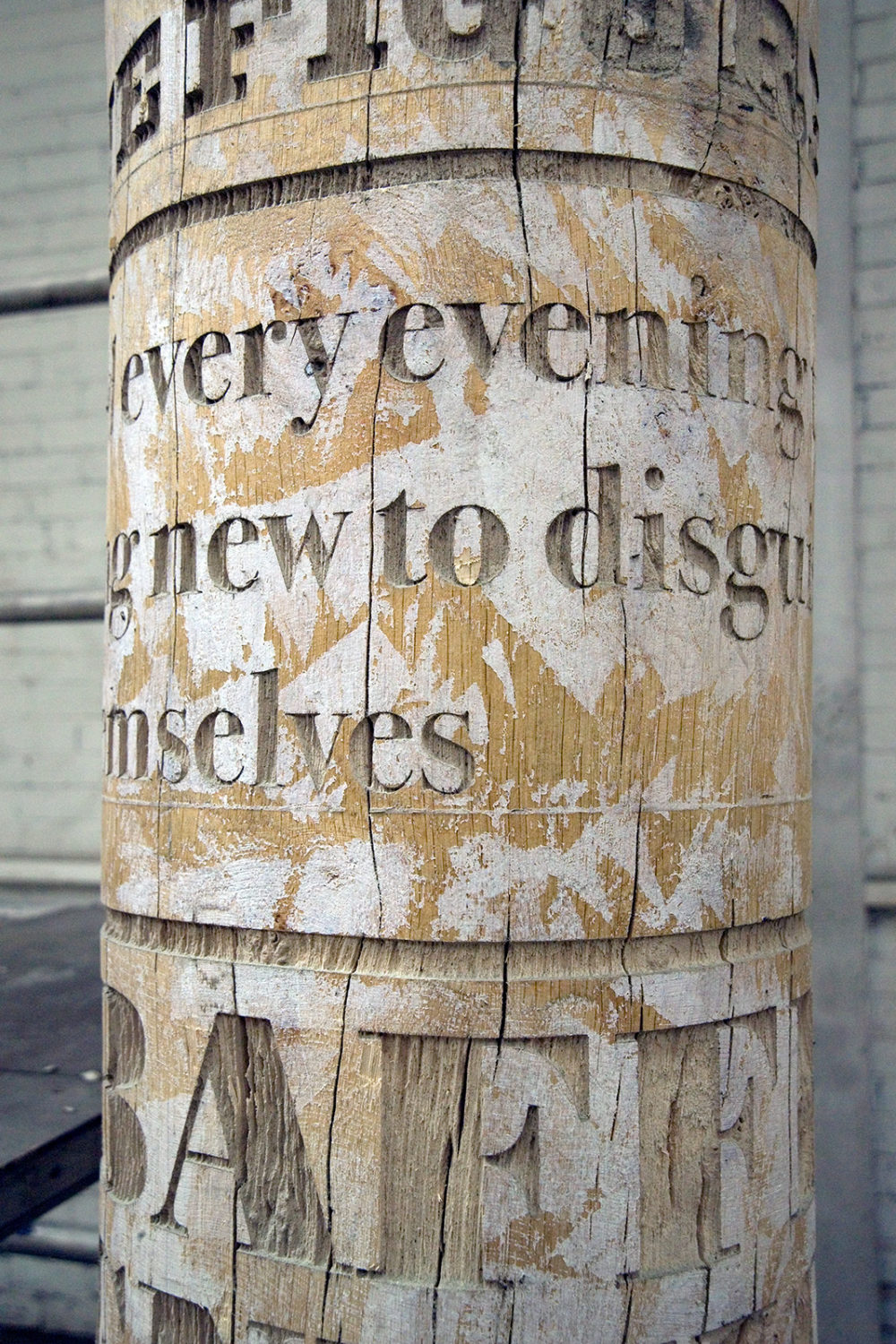
Typographic Trees — I saw pictures of the latest collaboration between artist Gordon Young and design studio why not associates a while back, but a mention in the latest issue of Creative Review is the perfect excuse to post a couple of images of these lovely sculptures for Crawley Library in West Sussex. It’s probably worth mentioning that (unsurprisingly) why not also do a nice line book design.

An interview with Allan Kornblum, publisher at nonprofit literary publisher Coffee House Press, is the latest installment in Scott Esposito’s How to Publish in a Recession series  at Conversational Reading:

Now with Borders on the brink, and former readers becoming would-be writers and self-publishing books instead of reading books, a major shake-up was inevitable… The recession isn’t the only factor driving changes in writing and publishing. Writers on the one hand, and book and magazine publishers on the other, are both trying to figure out what the changes in information technology will mean. Will books get shorter, so they can be read on a cell phone? Will nonfiction migrate to ebooks, while literature stays on the printed page? Will backlist titles become downloadable PDFs? Will future desktop printers include binding equipment?

Funeral in Berlin — Possibly the most badass cover ever (pictured above) and part of the amazing collection in the Penguin Paperback Spotters’ Guild Flickr pool (first seen at FFFFound). And funnily enough it is apparently Len Deighton’s 80th Birthday.

30 Novels Worth Buying for the Cover Alone — “A book must stand out on the bookstore bookshelf yet cover designers rarely receive the recognition that authors do.” And  in “appreciation of these unsung artists”, Beth Carswell chooses her 30 favourite fiction covers for AbeBooks.

MinuteMen — a retro-Nintendo-style-arcade-kung-fu-kick-punch-jump-game promoting the new Watchmen movie. Smartass viral marketing if you like that kind of thing. And if you listen closely, that sound you hear is Alan Moore’s teeth grinding away in Northampton. Buy the book.  (via GalleyCat).

How do you define good design? Gary Hustwit, director of Helvetica, interviewed about his new film Objectified at the Dwell Magazine blog:

If it didn’t exist, would anyone really miss it? Would it leave a hole in anyone’s life?

If we asked ourselves this question in publishing more often, how many books would actually get published? And would publishers be in the mess they’re in now? Answers on a postcard please.

And finally, Spy Vibe — a blog dedicated to 1960’s spy style! This is so cool I can’t even be bothered to find a tenuous link to books or publishing (although there surely is one)…

2 Comments

Something for the Weekend, Feb 13th, 2008

Apologies for the rant about the Globe and Mail this morning (note to self: don’t blog without coffee). Hopefully a highly-caffeinated design-heavy post for the weekend will make up for it…

First off, Jenny Griggs’ gorgeous typographic designs for Peter Carey’s backlist (pictured above) described by the great man himself as “A triumph!!!!!! Fucking fantastic!!” (Jenny talks about her more recent papercut designs at FaceOut Books)

M.S. Corley re-images the Lemony Snicket (pictured above) and Harry Potter series as Penguin Classics (via the BDR)

Metacovers — Joseph at the BDR looks at books on book covers (see above!).


The Way Through Doors — written by Jesse Ball; stunning minimal cover design by Helen Yentus for Vintage. Not quite a ‘metacover’ but I still love it (pictured above — seen at the Book Cover Archive of course)

Holey Font! – “How much of a letter can be removed while maintaining readability?” EcoFont has tiny holes and uses up to 20% less ink. Based on Verdana, and developed by SPRANQ in the Netherlands, it’s free to download, and free to use. And it seems to work.

And lastly, The Book Depository Live — Watch what books people buy from The Book Depository around the world in real time. Very cool. (via @paperbackjack)

1 Comment

Monday Miscellany, February 9th, 2009

“Books exist because we want and need them” — A slide show of pages from Robert Bringhurst’s new book The Surface of Meaning: Books And Book Design In Canada (pictured) published by CCSP Press in The Globe and Mail. (Disclosure: The Surface of Meaning is distributed by Raincoast in Canada).

A bookshop is a dynamite-shed — Bookride have posted a splendid John Cowper Powys rant about second-hand bookshops:

[A] bookshop — especially a second-hand bookshop — is an arsenal of explosives, an armoury of revolutions, an opium den of reactions. And just because books are the repository of all the redemptions and damnations, all the sanities and insanities, of the divine anarchy of the soul, they are still, as they have always been, an object of suspicion to every kind of ruling authority.

Pessimism Porn — Hugo Lindgren explains his addiction to nightmarish economic news  in New York Magazine:

“[E]cono-porn… feeds a powerful sense of intellectual vanity. You walk the streets feeling superior to all these heedless knaves who have no clue what’s coming down the pike. By making yourself miserable about the frightful hell that awaits us, you feel better. Pessimism can be bliss too.”

Publishing certainly has its fair share of addicts…

Visionary locations — Toby Litt on J.G. Ballard in the Guardian:

“Plenty of other writers now fictionally venture into multistorey carparks, airport hospital wards, decaying hotels, but they do so in the knowledge that they’re trespassing on Ballard’s territory. He was here first; he was the pioneer – back when these places were seen as totally unliterary. What could possibly happen on a motorway embankment that was of interest?”

Finding alternative best sellers — Toronto bookshop This Is Ain’t The Rosedale Library profiled by Brian Joseph Davis in the Globe and Mail.

Is CondéNet Dead? — Slate’s The Big Money examine how “a publishing giant failed to get the Web”. Lessons (if more were needed) for book publishers (via @jafurtado):

“To say that we’re just a magazine company in this day and age is like saying that we’re a buggy company.”

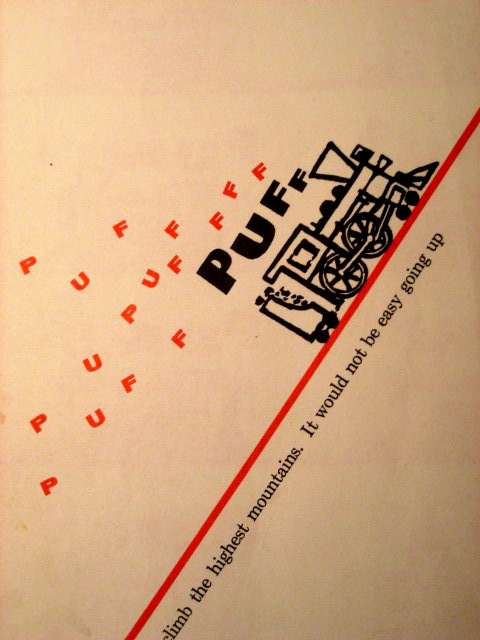
PUFF — lovely pictures of PUFF by William Wondriska (published in 1960 by Pantheon Books Inc.) at the wonderful Grain Edit (pictured above).

Image Spark— A neat image bookmarking tool. V. excited about this as you can probably imagine… (via @michaelSurtees/DesignNotes) .

1 Comment

Midweek Miscellany, February 4th, 2009

Slow Burner (above) — a rather awesome — if slightly racy — cover seen at the Bookkake Blog.

How to Publish in a Recession Part 3 — The always interesting Richard Nash, the editorial director of Soft Skull Press and the executive editor of Counterpoint, talks to Scott Esposito at Conversational Reading.

The Once and Future e-book: On Reading in the Digital Age — A fascinating article on the past, present, and future of e-books and e-book readers by John Siracusa at Ars Technica.  I think — like many —  he underestimates the challenges (such as rights issues and, on a really basic level, a lack of expertise and human resources) publishers face making their titles available as e-books, but this really is a must-read.

Book Expo Canada is officially dead. It is an ex-trade show– Surprising precisely no one. The Globe and Mail has publisher reactions and a postmortem interview with Tom Best, vice president, marketing, at H.B. Fenn. What troubles me is the belief that we need something to replace it…

There’s so much written about how publishers don’t know what they’re doing… But how do you know what to do?”The New York Observer talks to former PW editor Sara Nelson:

You’re making a bet on who’s gonna like something a year and a half from now. That’s without even getting into the economy or anything—just, ‘What’s the mood of a number of people going to be a year and a half from now?’ If you thought too much about that, you’d shoot yourself.”

“We are on the verge of an explosion in independent book publishing” — Hugh McGuire of Librivox and The Book Oven chats to Allentrepreneur.

The Google Paradox — Andrew Keen, author of The Cult of the Amateur, on two new books published (in the conventional way) about Google:

“the more Google does to kill the traditional publishing industry with the free online content from its search engine, the more books will get written about the central role of Google in our new digital economy… The irony of Elsewhere USA and What Would Google Do? is that both books rely on the five hundred year-old technology of Johannes Gutenberg’s moveable type to explain the wrenching digital transformation of the 21st century.”

Who is on twitter? — I think I fall into the cateogory of “people who are concerned about the collapse of the publishing industry.” (Thanks Sio!)

Comments closed

Midweek Miscellany, Jan 28th 2009


John Updike (pictured) has died at 76The Guardian and the New York Times look back at his life and career in pictures. Designer Observer points to ‘Deceptively Conceptual’ Updike’s astute 2005 essay on book covers for the New Yorker:

Publishing forms a minor branch of the entertainment industry, and book design is increasingly a matter of fashion—that is, of attention-getting. In the visual clamor of a bookstore, the important thing is to be different; a whisper becomes a shout, and the ugly becomes beautiful if it attracts attention. Yet an utter flaunting of conventional expectations may baffle and repel the public; when the title and the author’s name are left off the front of the book… it sends a subliminal message of contempt for the written word, the product being packaged.

Batman as jazz– Brad Mackay wins top prize for funniest headline of the week for his look at the reinvention of the Dark Knight and the genius of BatManga! in the Globe and Mail.

“Content is Free… But Curation is Sacred” — Peter Collingridge at Times Emit considers the implications of the Google settlement and what happens if/when we are flooded with unmediated free “stuff”:

[A]s the amount of content we are exposed to increases, without any discernible gauge of quality, it is the trusted curators of that content to whom we will choose to give our attention, time or money, rather then trying to filter it all out personally… the curator may be the bloke in the record shop who knows my music collection and recommends something new, the staff in my local wine merchant, or a particularly good blog I follow, my newspaper – anything. However, it is not Amazon’s recommendation algorithm; it is decidedly human, and, over time, a relationship of trust is built up. If it works, that trust leads to action, purchase, attention, refinement and more trust.

See the Web Site, Buy the Book: J. Courtney Sullivan looks at author web sites and book trailers for the New York Times.

Sara Nelson, editor in chief of Publisher Weekly has been fired is “leaving as part of a companywide restructuring”. The indefatigable Sarah Weiman has a extensive round-up of the reactions in the blogosphere.

The fabulous Book Cover Archive have recently add a couple of lovely minimalist cover designs by Gabriele Wilson (pictured above). Nice.

Comments closed

Something for the Weekend, Jan 23rd, 2009

Big Mouth Strikes Again — The Friday Project’s charming Scott Pack interviewed at North Meadow Media:

people who have dealt with me directly are pleasantly surprised that I am not the complete cunt I am sometimes made out to be. I am a bit of an arse but not quite as bad as my press would suggest.

Books Unbound — author Lev Grossman’s (much linked to) thoughts on the evolution of publishing for Time magazine. Meh.

Unhappily ever afterThe Guardian’s Nick Laird  reviews Richard Yates’ Revolutionary Road, and asks is it “too good a novel to make a great film”?:

It is a solid and noble effort that succumbs to what should be a moral of literary adaptation: bad books can make great movies, but a great book hardly ever does. And though you can see what tempted the movie men – that great dialogue! those poignant characters! – with Yates it’s the sentences themselves that are truly panoramic, and no matter what you do, they’re going to get left behind.

That may all be true, but to be honest, the wayward casting in Sam Mendes film adaptation is so catastrophically contrary to the characters in my mind that I can’t bring myself to see it anyway.

BlogTO profile one of Toronto’s best independent bookshops Ben McNally Books. Lovely bloke that Ben McNally . BlogTO have profiles of other Toronto bookstores here.

Toronto gets another new literary festival. I can hardly contain myself.

The message is the subject — Jenny Tondera interviews Dutch designer Wim Crouwel, creator of the ‘New Alphabet’ (pictured above and famously tea-leafed by Peter Saville for the album cover of Joy Division’s Substance), about the Bauhaus for Geotypografika. Jenny also interviews Michael Bierut, Experimental Jetset, Steven Heller, Paula Scher, Ellen Lupton, and Jessica Helfland.

2 Comments

Midweek Miscellany, Jan 21st, 2009

The Books are alright — Montreal’s Hugh McGuire (of LibriVox and Book Oven) on the Penguin-sponsored BookCamp in London:

If the amount of thought and enthusiasm generated that day — and evening — is any indication, I think we’re going to be OK. The book is alive and well, even if defining “book” is becoming more complicated; and the publishing business, bracing itself for the biggest shake-up since the paperback, will come out the other end, transformed certainly, but alive nonetheless.

Cuts Were Necessary — The New York Observer on Marcus Dohle the new CEO of Random House (previously described as “dapper, but mildly off-putting”):

Now, the feeling among both literary agents and executives who used to work at Random House seems to be that Mr. Dohle inherited a rotten, bloated thing when he took over last May, and though one can wish it hadn’t gone the way it did, there simply was no reversing the damage done by his predecessor, Peter Olson, without forcing the publishers who’d survived his thoughtless 10-year reign to make some hard calls.

Rotten and bloated. Nice.

How to Publish in a Recession — a wide-ranging interview with Declan Spring, senior editor at New Directions, at Conversational Reading (via Ready Steady Blog):

We’re not beholden to stock owners, our overhead is pretty small, and we always count on just a pretty small profit every year anyway. Our staff has worked here for many years, mostly the same folks for twenty years, who are devoting much of their lives to the mission of ND. We see it as a profit-making business, but we are also realistic and dedicated to the cause. That makes it easier in this climate.

And speaking of New Directions… Any excuse (really) to post another book jacket by Alvin Lustig (pictured).

Comments closed

Something for the Weekend, Jan 16th, 2009

David Mirvish Books, the best fine art bookstore in Toronto, is to close. Damn. At least the Art Gallery of Ontario’s bookstore has re-opened with a decent selection of art books.

“It’s not something you should really do unless you feel really compelled to do it” — An interesting interview with Doug Seibold about founding Chicago-based publisher Agate over at Slate’s Bizbox:

As in a lot of other businesses, there’s a bunch of giant multinational conglomerates that are the big players, and they leave a lot of waste behind them. My feeling was a company that functioned efficiently at the appropriate scale could do a lot of business by being cost-effective and opportunistic. Not too little, but not too grandiose: growing at a careful, natural pace.

Attack of the “renegade cybergeeks”: New York magazine meets the team behind the New York Times’ online operation:

[T]here is something exhilarating about watching web innovation finally explode at the Times, with its KICK ME sign and burden of authority… Despite the effectiveness of blogs, the majority still mainly provide links and commentary. The Times Online suggests what might happen when technology fuels in-depth reportage

A little up it’s own arse and not short on hyperbole (“the New York Times is less a newspaper and more an informative virus”? Really?), it’s still definitely worth a read. Gawker’s predictably acerbic response can be found here.

“Poetry is both flourishing and floundering” — Neil Astley, editor of Bloodaxe Books, argues poetry must be responsive to readers not academic cliques, in the New Statesman:

The producers of poetry aren’t in tune with the lovers of poetry. Many poets and publishers are actually hostile to the promotion of poetry… They see marketing as a dirty word instead of simply the means by which their books are made available to more readers.

“Publishers… lost control of their industry” — a somewhat melodramatic (and therefore much-linked to) “autopsy” of the book business by Jason Epstein in the Daily Beast. I have a lot respect for Epstein, who is indeed a “publishing legend”, but it is worth keeping in mind that he said most of this in Book Business, published in 2001, and in an article for  Technology Review from January 2005. He’s also the man behind the futuristic-yet-seemingly-redundant (is there a word for that? Apart from ‘segway’?) Espresso Book Machine, so he’s not an entirely dispassionate observer.

Grant Morrison talks Batman with Publishers Weekly:

I wanted to assemble all the classical tropes of the pulp noir crime genre: the diabolical mastermind, the femme fatale, the inescapable traps, the secret societies of evil…and push them beyond all reasonable limits to a kind of screaming Death Metal crescendo.

Nice.

The Pelican Project: A collection of Pelican Book covers from the 1930’s through to the 1980’s (pictured). (I was reminded of this wonderful project by the eclectically brilliant FFFFound)

1 Comment

Something for the Weekend Jan. 9th, 2009

Curation, Appeciation, Organization: The Book Cover Archive goes live with “cross-indexed meta data” (and blog)! LOVE this. Nice work fellas. (via SwissMiss)

Skinny tight jeans and mild panic: The Scotsman profiles Canongate’s Jamie Byng.

Almost half of Canadians can’t name a single Canadian author according to the hand-wringing National Post… Or to put it another way, over half of Canadians CAN actually name a Canadian author? It could be worse (really)…

Canadian booksellers manage a “late holiday rally” in December reports PW:

Retailers large and small were unanimous in their opinion that books proved to be an excellent recession gift, with the value proposition of books being improved in part by fact that the actual price of books have fallen relative to U.S. prices.

A .38 shell for independent bookshops: The Guardian‘s Stuart Evers considers consumer apathy and the imminent closure of the Murder One bookshop on Charing Cross Road in London:

These kinds of shops are facing a long, bloody battle – and one which, without significant reinforcements, they are likely to lose. As we hear of the travesty of another brilliant independent going down, we’ll mourn the loss, wring our hands and damn Amazon and the supermarkets and Waterstone’s. Yet perhaps the most important detail we’ll probably keep under wraps: the last time we actually spent any money there.

Hapless Houghton Mifflin Harcourt reinstate editor Drenka Willen after Noble prize-winner Günter Grass intervenes.

Nostalgic book covers a hit for Penguin in Australia— 50 titles released with covers in the original orange-and-cream designs are selling strongly:

“They are instantly recognisable and have an emotional pull… Most people or their parents have got second-hand or old Penguins at home that have the same livery. But it’s not only pulling on that nostalgic lever, it’s also got that retro coolness. We’ve found that younger readers have been really drawn to them.”

“To say his work was inspirational is an understatement”: The New York Times profiles the late Barney Bubbles  whose iconic album cover designs (for the likes of Elvis Costello, Ian Dury, and The Damned) are celebrated in Paul Gorman’s new book “Reasons to Be Cheerful: The Life and Work of Barney Bubbles” published by Adelita (pictured).

Comments closed

Something for the Weekend, Dec. 12th, 2008

The 10 Commandments of Book Giving by Michael Dirda, Pulitzer Prize-winning critic and Senior Editor of the Washington Post‘s Book World (via Right-Reading):

Over the years I’ve gone through all kinds of Christmas presents, and nearly all of them quickly broke or have been long forgotten. Not so the gift books, whether Edgar Rice Burroughs’s Tarzan and the Golden Lion, a paperback copy of Ovid’s Metamorphoses or the Pléiade edition of Stendhal’s Oeuvres Intimes. Given to me by relatives, teachers and friends, they helped to make the season bright — and they also helped to make me who I am.

“Book apps for the iPhone keep getting better” according to Maud Newton (via DesignNotes)

Lying Liars: “Nearly half of all men and one-third of women have lied about what they have read to try to impress friends or potential partners”, the BBC reports.

Nintendo launches ‘great books’ package:

The creator of Donkey Kong and Super Mario is hoping that Austen and Dickens will prove as great a pull to computer game fanatics. It has worked with HarperCollins to select 100 titles – from 20,000 Leagues Under the Sea to Gulliver’s Travels, Pride and Prejudice, A Tale of Two Cities and Treasure Island – which will be available in a single software package for the Nintendo DS

Mwa ha ha! Chip Kidd discusses Bat-Manga! (via Books Covered)

The Age of Mass Intelligence — Are we actually smarter than we think we are? John Parker thinks so (via kottke):

One of the commonest complaints by cultural doomsayers is that nobody reads good books any more. Yet in the past two years, the Oprah Book Club in America recommended Tolstoy’s “Anna Karenina” and three novels by William Faulkner–good by any standard, and they all made the bestseller lists. This year, Waterstone’s, which owns over 300 bookshops in Britain, asked two celebrated novelists, Sebastian Faulks and Philip Pullman, each to choose 40 titles and write a few words of recommendation. The chain then piled copies of the books on tables next to the entrances of its main shops and waited to see what would happen. Faulks and Pullman hardly dumbed down their choices: they included Fernando Pessoa’s “Book of Disquiet”, Rudyard Kipling’s “Kim”, and Raymond Queneau’s “Exercises in Style”. The sales increases for these books over the same period the year before were, respectively, 1,350%, 1,420% and 1,800%–clear evidence of latent demand. If you offer it, they will come.

In this brief interview at inFrame.tv, award-winning Australian artist and author Shaun Tan discusses his work and the adaptation of his book The Lost Thing into an animated movie (via drawn):

And on a similar note, stills of the 25 minute animated adaptation of Oliver Jeffers’ book Lost and Found (to be broadcast on Channel 4 in the UK on Christmas Eve) can be seen on the STUDIOaka website. Looks lovely.

And this is probably my last regular post for the next couple of weeks. In the extremely unlikely instance you get withdrawal symptoms, you can always check out the links in the sidebar and/or send me an email!

See you in the New Year!

1 Comment

Midweek Miscellany, Dec. 10th, 2008

NPR’s Best Graphic Novels of 2008 include Josh Cotter’s Skyscrapers of the Midwest, Local by Brian Wood and Ryan Kelly, Yoshihiro Tatsumi’s Goodbye, and Alan’s War by Emmanuel Guibert (pictured). There’s an excerpt available of each book selected. Nice. (Thanks Ehren!)

A new way to express an old idea – An interesting interview with Canadian designer David Drummond at Books Covered (via Design Observer):

I tend to start with a list of words. For example I am working on a cover now that is about a dog but can’t show the dog on the cover. I like those kind of problems. How do you show this without showing it?

Amazon’s Jeff Bezo is PW‘s Person of the Year.

“Suburban surrender”: James Wood revisits Richard Yates’ blistering novel Revolutionary Road in the latest The New Yorker.

Little to do with booksThe New York Times looks at the infighting and the politics of book groups:

Yes, it’s a nice, high-minded idea to join a book group, a way to make friends and read books that might otherwise sit untouched. But what happens when you wind up hating all the literary selections — or the other members? Breaking up isn’t so hard to do when it means freedom from inane critical commentary, political maneuvering, hurt feelings, bad chick lit and even worse chardonnay.

Russell Davies on “analogue natives”:

So much joyful digital stuff is only a pleasure because it’s hugely convenient; quick, free, indoors, no heavy lifting. That’s enabled lovely little thoughts to get out there. But as ‘digital natives’ get more interested in the real world; embedding in it, augmenting it, connecting it, weaponising it, arduinoing it, printing it out, then those thoughts/things need to get better. And we might all need to acquire some analogue native skills.

Comments closed

Monday Miscellany

“I have always enjoyed photographing loners” — A lovely BBC audio slideshow of “Writers’ Rooms” narrated by award winning photographer Eamonn McCabe. The project, appearing weekly in The Guardian and currently on show Madison Contemporary Art in London, captures the working environments of novelists, biographers and poets.

Book Industry Enters Shaky Chapter: NPR’s Lynn Neary looks at last week’s horrorshow.

The 10 Best Books of 2008 according to The New York Times Book Review. Interesting that they’ve also created a mini-site which has promotional material for the top 10 books, including shelf talkers, bookmarks, and posters for bookstores to download . There are also web banners and a video with author Toni Morrison. This is has to be a good idea.

“The news is still big. It’s the newspapers that got small”: A spectacular Roger Ebert rant about the death of criticism :

The celebrity culture is infantilizing us. We are being trained not to think. It is not about the disappearance of film critics. We are the canaries. It is about the death of an intelligent and curious, readership, interested in significant things and able to think critically. It is about the failure of our educational system. It is not about dumbing-down. It is about snuffing out.

Spot. On.  I actually met Roger Ebert a few years back in Pages bookstore. The Toronto International Film Festival must have been on. I had no idea who he was at the time (a colleague told me later), but he was very nice about it.

“The Most Dangerous Man in Publishing”:  A profile of publisher Barney Rosset in Newsweek:

Before Rosset challenged federal and state obscenity laws, censorship (and self-censorship) was an accepted feature of publishing. His victories in high courts helped to change that. Rosset believed that it was impossible to represent life in the streets and in the dark recesses of the heart and mind honestly without using language that in the mid-20th century was considered “obscene”—and therefore illegal to sell or mail. To a significant extent, the books he published convinced others that this was true.

The Well-Tended Bookshelf— Laura Miller on culling one’s book collection:

There are two general schools of thought on which books to keep, as I learned once I began swapping stories with friends and acquaintances. The first views the bookshelf as a self-portrait, a reflection of the owner’s intellect, imagination, taste and accomplishments… The other approach views a book collection less as a testimony to the past than as a repository for the future; it’s where you put the books you intend to read.

Which leads me rather nicely to…

Books At Home: A blog about bookshelves. It is possible that this just too nerdy. Even for me.

Relevance: Brian at daxle.net interviews author Tim Manners , editor and publisher of The Hub and Reveries.com. It’s a fascinating discussion that covers innovation, brands, and the consequences of overabundant advertising (amongst other things).

3 Comments