Skip to content

Category: Miscellany

Something for the Weekend, September 25th, 2009

Great Ideas — Art director and designer David Pearson discusses his publishing venture White’s Books with Peter Terzian in Print Magazine (above: cover for Emma, published by White’s Books; illustrated by Amy Gibson):

Due to the arrival of eBooks, many prophesied the death of the printed word, but we see it as an opportunity to turn the spotlight back on the traditional methods of book production and to luxuriate in the craft and tactility of the physical book and the printed page. It’s lovely to be designing with longevity in mind as we aim to create objects that will be retained and cherished by their readers.

David Pearson also discusses his work for Éditions Zulma and Penguin. I’m hoping to post a Q & A with David on The Casual Optimist later this fall.

Questions Should Be Answered — Dutch type designer Jos Buivenga, whose quality free typefaces (including personal favourite Fontin Sans) are available from his one-man font foundry exljbris, interviewed in the MyFonts newsletter. Jos’ new typeface Calluna (shown above) looks rather lovely.

The Future of Publishing? — Patrick at the Vroman’s Bookstore blog looks at what publishers do and how they might do it (or something different) in the future. While there is nothing especially new here, it’s an interesting post in part because it’s written from the perspective of a bookstore. The comments are worth reading too, if only for Ann Kingman‘s contributions and hilarity of a certain self-styled “agent of change” having the audacity to accuse someone else of oversimplifying (pot introducing kettle). All of which is a good, solid reminder that I have a related post in my drafts folder than needs dusting off… *Sigh*

And on a related note…

Reimagining the Book — Mark of index//mb is looking for people to help organise a conference on authorship in Toronto.

And just FYI: There is a good chance that this will be the last post for a couple of weeks. Work stuff + Life Stuff + Internet Fatigue means that I need a break from even the gentle rigours of irregularly posting here. Hopefully normal service will resume in October (for what it’s worth…).

Out.

2 Comments

Midweek Miscellany, September 23rd 2009

It’s funny how topics of conversation sometimes repeat themselves for no apparent reason. This week Romek Marber and his designs for Penguin have come up with sufficient frequency for me to take it as a sign I should post some links about about him:

Eye Magazine has a great article about his classic design of Penguin Crime Series:

Marber’s grid allows for different placements of title and author’s name depending on the length of the title and the needs of the design as a whole. There are small inconsistencies in some of the vertical measurements on a few of the books, probably due to printer’s error, but the basic design is sufficiently robust that it does not matter… With the typographic structure in place, Marber could concentrate on producing images that reflected the atmosphere of the books, which he read with relish from cover to cover. He was a graphic image-maker of great versatility, able to sum up the stories with motifs and ciphers that contrived to be both playful and threatening. Many of these whodunnits were decades old, but his interpretations gave them a contemporary allure.

The Ministry of Type shows you how to construct the famous Marber grid.

Apt Studio have a Marber WordPress theme (demo). Are any literary blogs using this I wonder?

And there’s this great Flickr set of Romek Marber Crime Covers.

Please let me know if you have any other good Marber links…

In other news…

The Electro-Plasmic Hydrocephalic Genre-Fiction Generator 2000 by David Malki (via INDEX // mb).

The Awesomeness Manifesto — I’m a little skeptical about these kinds of manifestos simply because they’re not terribly useful, but Umair Haque’s list is as interesting for its criticism about the chimera that is ‘innovation’ as for what is says about the warm and fuzzy  ‘awesomeness’.

1 Comment

Something for the Weekend, September 18th, 2009


Bring the Noise — Toronto illustrator Michael Cho (known locally for his much-loved signage for the now defunct Pages Books & Magazines on Queen Street) discusses his jacket art for the Penguin Graphic Classics edition of Don Delillo’s White Noise.

I ‘m very happy to hear that D+Q are publishing a ‘petit livre’, Backalley Drawings, by Michael next year.

And watch this space for an awesome Q & A with Paul Buckley, the art director of the Penguin Graphic Classics series (coming soon!)…

But Is It Type? — Design educator Ellen Lupton on the difference between lettering and typography for Print Magazine:

I subscribe to the rather rigid theory that typography is about readymade, reproducible families of letterforms. Vernacular hot-dog signs, handwritten wedding invitations, and space-age logos aren’t typography…

Perhaps my quibble is an old one: you just can’t view real typography online. Beautifully printed books and magazines are still the best resource for designers who want to know what’s happening in their field. Yet the design discourse is unfolding in real time on the web, and this is where students and young designers go to participate and be inspired.

And while were on the subject of typography, I thought — as a bungling amateur — that Brian Hoff’s post 10 Common Typography Mistakes was useful. Although I like to think I was surprising good at Cheese or Font (for what it’s worth).

Publish Local — An interesting list from The Task Newsletter (via REFERENCE LIBRARY). Would this work for book publishing?:

  1. Find what’s missing
  2. Work in the gaps
  3. Figure it out together
  4. Make it visible
  5. Make it viable
  6. Research and plan
  7. Expand existing systems
  8. Plan transparently
  9. Start small
  10. Commit to it
  11. Learn about your local flora
  12. Don’t get permission
  13. Print what you’ve got
  14. Make positive spaces.
  15. Find funding

And lastly, I just had to post this…

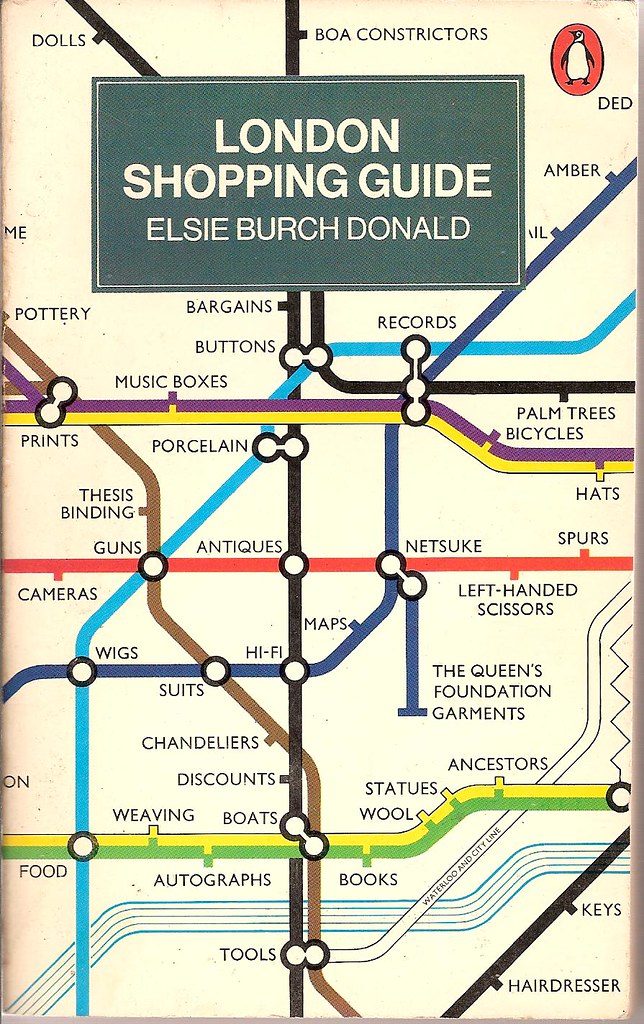
London Shopping Guide — Revised second edition from 1977, cover design by John Carrod, seen at Covers etc on Flickr.

Two design classics in one: Penguin paperbacks and Harry Beck’s tube map. What more could you ask for?

Comments closed

Midweek Miscellany September 16th, 2009

Rejected Covers by Klas Ernflo — Typography to make you weep (with either joy or envy). (via ISO50)

Poet of Desolate Landscapes — Author Jonathan Lethem on J.G. Ballard in the New York Times:

[V]ery few writers I’ve encountered, even those I’ve devoted myself to, have burrowed so deeply in my outlook, and in my work, where I find myself recapitulating Ballardian patterns not for their beauty (though they are beautiful) but for their tremendous aptness in attempting to confront the dying world before me, and inside me.

Ira Glass on the Internet and Public Radio — The host of NPR’s This American Life talks to Jesse Brown for a TVO Search Engine podcast (is it just me, or is there something gently life affirming about the fact Ira Glass doesn’t know who Chris Anderson is?)

“Well, it’s still more fun than a lot of other jobs” — Over at The Barnes & Noble Review, Daniel Menaker, author and former Executive Editor-in-Chief of Random House and fiction editor of The New Yorker, discusses — with bracing candour I might add — publishing and the role of book editors (don’t read if you are even slightly depressed):

[T]he tectonically opposing demands on publishing — that it simultaneously make money and serve the tradition of literature — and its highly unpredictable outcomes and its prominence in the attention of the media have made it a kind of poster adult for capitalism and the arts in crisis.

All awfully close to bone, and yet somehow Menaker also misses something vital about publishing and the opportunities that are arising…

Slovakian Book Covers — More amazing stuff from the genius A Journey Round My Skull (above: Binding illustration for Moji přátelé milionáři by Bernt Engelmann, 1968)

No-Man’s Land — A little late to the party, but over at  The Atlantic, technology journalist Kevin Maney looks at why the future might not be so bright for the Kindle (and he doesn’t even mention the iPhone):

Life, it turns out, is a series of tradeoffs between great experience and high convenience... Most successful products and services aim for one or the other, but not both. Products and services that offer neither tend to fail.

That’s why, despite all the great press it’s gotten, Amazon.com’s Kindle may be in trouble: in aiming to provide both a great experience and supreme convenience, it has achieved neither.

And lastly…

Words on Film — Designer Ed Cornish discusses his fantastic, but unused, cover designs for the 2009 D&AD student award brief for typography (sponsored by Faber and Faber) at FaceOut Books (because I haven’t linked to FaceOut for about 5 minutes right?).

1968, binding illustration for Moji přátelé milionáři by Bernt Engelmann
Comments closed

Midweek Miscellany, September 9th, 2009

Getting Paid by the Joke — Roy Hattersley on Keith Waterhouse, author of Billy Liar, who died last week aged 80:

One of the great lines, spoken in the subsequent film version by Wilfred Pickles playing Billy’s father, combined fury and bewilderment. Why, he demanded to know, had his son told the neighbours that he had only one leg. Billy worked in a dismal office – an ironic tribute to Waterhouse’s first job as clerk to an undertaker. It seemed a step up for the son of a door-to-door vegetable salesmen and a cleaner who had left Osmondthorpe Council School at 15 with an interest in books but no qualifications and few prospects.

When’s That Book Coming Out? — A nice breakdown of the production process by Shelby Peak which explains why it seems to take a long time for books to be released after an author has turned in their final manuscript. Every time I read something like this, I wonder why we don’t hear from publishing professionals more often. It would be great to see publishers explain this kind of thing on their own blogs. (via blog.rightreading)

Spine Out — John Gall has started a blog. Holy fuck.

And — on a related note — there is a nice conversation on Vintage’s The Sun & Anchor blog between designer Peter Buchanan-Smith and photographer Todd Hido about the new Raymond Carver covers (commissioned by John Gall).

Doing the Work — A fascinating interview with Australian book designer Tony Palmer at Caustic Cover Critic:

Sometimes you hear the bigger book publishers described as being like factories – where the work is churned out in a mechanical and unthinking way. It’s never been like that for me at Penguin. The editors, production staff and designers all love their work. But love can be wild and unpredictable. So I’ve dreamt of being a plumber. I like the way water moves on surfaces. I like the fact that there are only four different ways to plumb a house. But book design? Gawd, maybe there’s about 120 right ways to do a good book cover, and there are probably millions of ways to make a bad one.

And finally…

A Master of ReinventionBrad Mackay, director and co-founder of the Doug Wright Awards, reviews David Mazzucchelli’s remarkable Asterios Polyp for The Globe & Mail. The Comics Reporter has a critical reading guide.

6 Comments

Midweek Miscellany, September 2nd, 2009

Watching Gideon — A nice new cover design with some great typography from Nate Salciccioli. Read my Q & A with Nate here.

A Manifesto for Slow Communication — An excerpt from The Tyranny of E-Mail by John Freeman, AKA acting editor of Granta, in the Wall Street Journal:

Slow communication will preserve these threads and our ability to sensibly choose to use faster modes when necessary. It will also preserve our sanity, our families, our relationships and our ability to find happiness in a world where, in spite of the Internet, saying what we mean is as hard as it ever was. It starts with a simple instruction: Don’t send.

And on the topic of slow communication…

On Feeding — an older, but lovely, post from A Working Library on the difference between unread books and an unread RSS reader (via booktwo.org):

those two sights—the stack of books and the unread count in my feed reader—evoke dramatically different responses. To the books, I feel excitement, eagerness… The act of reading is always unfinished…

Yet my feed reader—also always unfinished—evokes within me a dread… I grow weary as the unread count increases, as it fills up with new articles before I can skim the old ones. In it’s timeliness—most blog posts have short half-lives and so must be read now—and the mathematical precision with which the reader measures its contents, I am stripped of my eagerness to read and filled, instead, with despair. Instead of a thing to enjoy, it makes reading a thing to get done with… It’s reading made efficient.

The minimal design of the A Working Library site is really nice too by the way.

Book Cover Design in India 1964-1984 at A Journey Round My Skull.

Prix Fixe — Arnaud Nourry, chief executive of French publishing group Hachette Livre, makes some interesting comments on e-book pricing in the Financial Times, notably that publishers are “very hostile” to Amazon’s pricing strategy:

“On the one hand, you have millions of books for free where there is no longer an author to pay and, on the other hand, there are very recent books, bestsellers at $9.99, which means that all the rest will have to be sold at between zero and $9.99,” Mr Nourry said…

There was a “muscular” debate in the industry in the US, he added. Retailers were paying publishers more than $9.99 for each e-book, so were selling them at a loss: “That cannot last . . . Amazon is not in the business of losing money. So, one day, they are going to come to the publishers and say: ‘by the way, we are cutting the price we pay’. If that happens, after paying the authors, there will be nothing left for the publishers.”

Mike Shatzkin has written an interesting follow-up piece about pricing.

Noury also makes more interesting observations about consolidation in the industry in a separate article in the FT, which seem very prescient in light of Disney’s acquisition of Marvel this week.

And finally…

46 Essential Rock Reads — A list to argue over on the LA Times‘ Jacket Copy blog.

2 Comments

Something for the Weekend, August 28th, 2009

Now, About That Cover — Ted Striphas, an assistant professor in the Department of Communication and Culture at Indiana University, discusses the cover of his new book The Late Age of Print, which uses a dramatic photograph by artist Cara Barer:

The Late Age of Print is a book about the past, present, and future of book publishing, and so I knew early on that I wanted some type of cover image that would represent the themes of permanence and change.  Much later, as I looked at the books about books appearing on my bookshelf at home, I decided that I wanted a more abstract type of design, since many titles in my opinion overly-literalized their subject matter.

Another other Cara Barer’s images can also be seen on the cover Michael Greenberg’s  Beg, Borrow, Steal: A Writer’s Life released in September.

You can download a PDF of Striphas’ book under a Creative Commons license from his site, cunningly called The Late Age of Print.

Why Are Artists Poor? — Author and professional  contrarian Andrew Keen (The Cult of the Amateur),  looks at how the creative class make a living in the “new digital economy” for The Telegraph.

Keen is as provocative as ever, but his conclusions — that self-promotion is a requirement for all artists and that being paid for content can be replaced by getting paid to perform in person — are a little underwhelming.  Ernesto Priego offers more thoughts on Keen’s article in his blog post “Portrait of the Artist as a Digital Native”.

And finally…

Having mentioned the  Richie Fahey illustrations that adorn the covers of  Megan Abbott‘s crime novels earlier this week, it would be remiss of me not mention the remarkable R.A. Maguire Cover Art site, which includes an amazing collection of the artist’s book covers, paintings, and source photos from the 1950’s and 60’s:


(And if you can’t get enough of pulp covers and vintage paperbacks, you probably should check out the slightly potty-mouthed Pop Sensation.)

Self promotion and making money in the new digital economy

2 Comments

Midweek Miscellany, August 26th, 2009

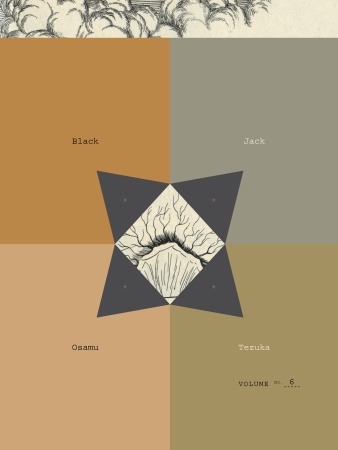
Black Jackets — The mighty Peter Mendelsund is giving away all of Osamu Tezuka’s Black Jack manga series in return for some assistance designing the next cover.

Take That! And That! And That! — Sony, having recently announced a pocket-sized reader and their switch to the ePub format, have now unveiled a new wireless electronic book reader with a 7-inch touch screen.

And on a related note, E-Reads tries to unpack some of the complex issues around Sony, ePub, and DRM.

Typedia — much linked to elsewhere (causing a severe strain on their servers earlier this week), Typedia is “a community website to classify typefaces and educate people about them.” I have no idea what I might use it for, but it looks pretty neat. You can also follow them on Twitter.

On the subject of typography, check out The Alphabetography Project, a photography blog cataloging found letters of the alphabet.

And hell, why not take a look June Corley’s charming typographic sculptures while you’re at it (via The Daily Heller and pictured below)…

Board — Also much linked to elsewhere, the New York Observer‘s Leon Neyfakh looks at three new hardcover books designed without dust jackets. It’s not exactly “the new thing” — more a case of the mainstream catching up with indies perhaps (and a light news day) — but there are still some interesting comments about book design:

Most of the publishers experimenting with jacketless hardcovers, including Viking, FSG, and Graywolf, are consciously taking their cues from the folks at McSweeney’s, who have been putting out beautiful books designed in this style for years. For Eli Horowitz, the managing editor at McSweeney’s, the method is a means of restoring some of the permanence and singularity to the book as object.

From the Design Desk — Designer Suzanne LaGasa talks about the cover design process at Chronicle Books.  (Full disclosure: Chronicle are distributed in Canada by Raincoast Books, my employer).

Big Comics — reviewsnthings asks notable comic artists, writers, publishers, editors and the like “what’s your opinion of the term ‘Graphic Novel’?” stirring up some interesting reactions. Here’s Leigh Walton, comics editor, and Top Shelf’s marketing coordinator, for example:

I find it intensely frustrating, in the sense that I can’t fully support it and I can’t fully dismiss it. Great minds have worked for ages to invent a better term, and they’ve failed. Its shortcomings are obvious — it’s based on a term, ‘novel,’ which has specific requirements of length and content, and it can never replace ‘comics’ as a general term for the medium… Yet ‘comic book’ was reserved ages ago for a format that isn’t really very booklike at all.

Mixtape — Robin McConnell is compiling cartoonists’ playlists for Inkstuds (the radio show about comic books), including Love and Rockets legend Jaime Hernandez.

And lastly, something for the fanboys to argue over: The Top 70 Most Iconic Marvel Comic Panels. (via LinkMachineGo)

1 Comment

Something for the Weekend, August 21st, 2009

Picador Paperback have posted their fall catalogue to Facebook. Apparently they also did this with their spring list too . Needless to say, I think this is  a great idea. Is any one else doing it? (via Arthur’s Design)

Control — An interview with Alan Rapp, former senior editor of art, design, and photography at Chronicle Books and the new Associate Director of Hey, Hot Shot!:

for all the possible flaws in the trade publishing model, one thing I always liked about it is the collaborative process. It defies the auteur model; the author is almost never the sole creator. I suppose that this could sound like the ex-editor making a case for the value of his role in an industry that is really undergoing massive and fundamental changes, but I stand by the principle: all content benefits from editing. The author, whether a verbal or visual one, is almost always too involved with the material to see how it can be best adapted to another form. And the design and production processes are also critical to making the best book possible; one thing [that] I think is in danger of getting lost in self-publishing is the production potential. The physical aspects of books make important, and often subliminal, effects on the reader, but we are getting a much more homogenized offering through the current self-publishing models.

Final Crisis — A short Q & A with Chip Kidd about designing comic book covers at the NY TImes‘ ‘The Moment’ blog.

And finally, thinking of comics, Will Kane (The World of Kane) recently posted some mind-blowing pop-art pages from French comic “La Vie Privée de Dyane” drawn by Michel Quarez, published in 1968 (pictured below). Also check out Will’s post on Quarez’s 1967 Mod Love.

Comments closed

Midweek Miscellany, August 19th, 2009

‘The 100 Best Comic Book Covers’ Part 1, Part 2, Part 3, and Part 4 at Kelly Thompson’s 1979 Semi-Finalist blog. I am not a comics nerd (believe that if you will), but there’s some great stuff (new and old) in this epic list…

Open to QuestionThe New York Times reports on Sony’s decision adopt the “open standard” ePub format for all their digital books. This means that “books bought from Sony’s online store will be readable not just on its own device but on the growing constellation of other readers that support ePub”. Progress of sorts I would say, but before you break out the bunting, David Rothman questions how “open” this format actually is at TeleRead.

Book Design on Twitter — Ben at the Book Cover Archive has posted a list of book designers who Tweet.

Ben’s list was also a nice reminder to mention  Jennifer Tribe‘s amazing directory of book industry people on Twitter.

Book Worship —  Shawn Hazen’s blog cataloging “graphically interesting, but otherwise uncollectible, books that entered and exited bookstores quietly in the 50s, 60s, and 70s.” Lovely (via Book Cover Archive blog).

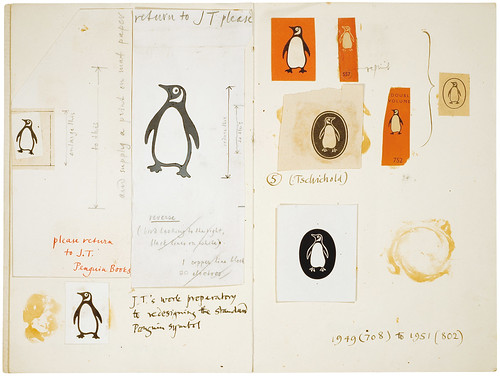
Penguin Symbols — I know I just mentioned designer David Pearson’s Flickr the other day, but how fantastic is this? “An investigation by Production Manager Hans Schmoller into the origins and usage of Penguin devices”

And speaking of Penguin…

Covers And That — Jim Stoddart, Art Director of Penguin Press, discusses their book cover process and looks at some of the new covers for book released this month:

Each cover may face a wide range of hurdles and conflicting opinions, this is the very nature of book covers. Good designers tend to be very focussed and resiliant, and the value of a good sense of humour cannot be underestimated. As with most design jobs there is a balance of concept, craftsmanship and time dexterity required. Any number of changes to the brief may occur even once the design is finished. But in Penguin Press it is widely appreciated that the more a cover is ‘tweaked’ by a committee the less chance there is of retaining that original spark that we all know helps a book stand out in a world where thousands of books are vying for attention.

Comments closed

Midweek Miscellany, August 12th, 2009

Typographic book covers by Ed Cornish for the 2009 D&AD student award brief for typography (via We Made This).

Tools of the TradeThe Montreal Gazette talks to Hugh McGuire about Book Oven and the new self-publishing landscape:

Call it Self-publishing 2.0. And it’s one of the fastest-growing sectors of the book world, which is itself enjoying a nice growth period despite the recession and the glut of competing media choices.

“Like in any other media, when you the make tools of publishing easy, people will take advantage of it,” said Hugh McGuire, founder of Montreal self-publishing start-up Book Oven. “It’s just now coming into public consciousness.”

It is troubling however that the photograph accompanying the article suggests that Hugh only rents the top-half of his office space!

Richard Green’s redesigns for ten of Penguin’s classic romance thrillers seen at Noisy Decent Graphics.

Dirty Stories — Eric Reynolds, Marketing Director for the Seattle-based art comics publisher Fantagraphics, interviewed in PW:

The book industry has been in a state of flux for at least a year or two years. I think that’s going to continue as everyone adapts to the larger challenges that print media is facing, and that’s going to affect anybody that publishes in print. It comes down to electronic delivery and the shrinking book market in general and just how you navigate these sorts of things… Without making it sounds like we’re totally awesome, we face the same problems that any understaffed, under-funded company does, but we’re streamlined, and there’s not a lot of fat to be cut.

Ornament — Doug Clouse and Angela Voulangas, authors of The Handy Book of Artistic Printing (published by Princeton Architectural Press), have created a nice website and blog for their book about letterpress type.

(I do love this book, but for the sake of full disclosure I should stress that PAPress are distributed in Canada by my employer Raincoast Books).

1 Comment

Something For The Weekend, August 7th, 2009

Winnie and Wolf — cover design by Alex Camlin (the chap behind that rather wonderful Harvard Review overhaul). I’m hoping to speak to Alex for the designer Q & A series later this month.

And just while were on the subject, Caustic Cover Critic looks at the new designs for the Penguin World War II Collection.

In Search of Lost Time — David L. Ulin, Book Editor of the LA Times, on the lost art of reading:

Today, it seems it is not contemplation we seek but an odd sort of distraction masquerading as being in the know. Why? Because of the illusion that illumination is based on speed, that it is more important to react than to think, that we live in a culture in which something is attached to every bit of time.

Here we have my reading problem in a nutshell, for books insist we take the opposite position, that we immerse, slow down… Yet there is time, if we want it. Contemplation is not only possible but necessary, especially in light of all the overload.

But, if you sympathize with this perspective be warned: you are weak and you just don’t love books enough (and you’re probably a calcified narcissist).

Talking Books — I don’t agree with everything here (OK I actually disagree with a lot of it and, I’m sorry, describing the Globe & Mail as “daring” is just  delusional), but Ian Brown, writer, arts journalist and broadcaster has some interesting things to say about Canadian literature and culture in a sprawling interview over at Conversations in the Book Trade:

[T]he novel is no longer the prime example of literature. Nor does it need to be. Too much attention can ossify a genre. If anything is in trouble, it’s literary fiction–but again, only because there are so many alternative ways to consume good writing these days. The book itself is a fantastic technology, but literary fiction has some serious competition for my attention.

And as this has been something of slow week, and because I was chatting about it with book designer Jason Gabbert on Twitter (who is responsible for the lovely C.S. Lewis redesigns above), I’m just going to take this opportunity to (re)plug my image library on Image Spark and (while I’m at it) my slightly stream-of-consciousness inspiration blog The Accidental Optimist.

4 Comments