Skip to content

Category: Miscellany

Something for the Weekend

It Looks Pretty Cool” — Chip Kidd on his design for Haruki Murakami’s new novel 1Q84:

logistically the title is a book designer’s dream, because its unique four characters so easily adapt it to a very strong, iconic treatment.

F**ked — Author Dale Peck on founding  Mischief + Mayhem, a new publishing collective, in The Financial Times:

“The whole point of writing literature was that in exchange for not getting paid a lot of money, you could say whatever you wanted; now, you don’t get a lot of money and you don’t get to say what you want. All of which segues to why writing is f***ed.”

The Last of the Old-Style Hollywood Actresses — A Ballardian Primer to Elizabeth Taylor:

What did Taylor represent to Ballard? Less a sex symbol and more an emblem of the parallel landscape that celebrity culture in the 1960s and 70s inhabited, a virtual reality colonising the private lives of ‘ordinary’ people exposed, through mass communications and on a hitherto unprecedented scale, to a world as strange as an alien planet yet paradoxically erotic and near – a synthetic substitute for reality itself.

(images: cropped photograph of Elizabeth Taylor by Bert Stern via Dan Shepelavy (top). Cover of Crash by J.G. Ballard designed by David Wardle).

Too Much InformationThe New York Times of the meaning and the use of the word “information”:

The use of the word “information” itself… seems to have exploded since its earliest recorded appearance in 1387. (“Fyve bookes com doun from heven for informacioun of mankynde.”) As Michael Proffitt, the managing editor of the Oxford English Dictionary, notes in an essay written for the recent relaunch of the O.E.D.’s digital edition, “information” is the 486th most frequently occurring word in Project Gutenberg’s searchable corpus of mostly pre-1900 literature. A 1967 survey of contemporary American English ranked it 346th. And the rise of digital technology seems only to have speeded its ascent. One recent survey of online usage lists “information” as the 22nd most common word.

And finally… It seems unlikely that you haven’t seen these already, but still…

New Vintage paperback designs for James M. Cain “conceived by Megan Wilson, executed by Evan Gaffney.” Stunning stuff.

Comments closed

Jason Fried on Rework

In a recent interview for CBC Radio show Spark, Jason Fried, the founder of 37signals, talked with Nora Young about his book Rework:

CBC RADIO SPARK: JASON FRIED | REWORK

Also doing the rounds is Fried’s article ‘How to Get Good at Making Money’:

People are happy to pay for things that work well. Never be afraid to put a price on something. If you pour your heart into something and make it great, sell it. For real money. Even if there are free options, even if the market is flooded with free. People will pay for things they love.

This lesson is at the core of 37signals. There are plenty of free project management tools. There are plenty of free contact managers and customer relationship management tools. There are plenty of free chat tools and organization tools. There are plenty of free conferences and workshops. Free is everywhere. But we charge for our products. And our customers are happy to pay for them… Charging for something makes you want to make it better. I’ve found this to be really important. It’s a great lesson if you want to learn how to make money.

What I didn’t know, but learnt today, was that Jeff Bezos is the sole investor in 37Signals. Make of that what you will.

Comments closed

Midweek Miscellany

Pharmaceutical Sincerity — Michael Bourne on Fear and Loathing in Las Vegas 40 years on for The Millions:

I can still remember sitting in the basement of my parents’ house in Northern California, practically whizzing myself with delight at that dizzying list of pharmaceuticals. I was fourteen and I’d read Catcher in the Rye and A Separate Peace and all the other books about and for nice, well-heeled boys whose lives have gone a little off the rails, but Fear and Loathing in Las Vegas was different. It wasn’t just the mind-blowing drug use or the lusty middle finger Thompson seemed to be giving straight America; no, what was so startling, so riveting to my fourteen-year-old’s mind was how sincere the whole thing seemed.

Base Camp — Levi Stahl compares J.G. Ballard to Joseph Conrad (via The Second Pass):

Ballard’s scientists, marooned on far-flung outposts throughout the galaxy, are merely Conrad’s company agents and traders thrown into the future.

Like Conrad’s characters, Ballard’s have been nominally put in charge of places that are only barely understood back home–and whose history, culture, traditions, and dangers are almost entirely a secret. Their knowledge is limited where it isn’t totally useless; their true dominion extends no farther than the walls of their base camp; and the culture they represent is utterly unwanted, even insignificant when set against against the inescapable age of the universe around them.

Disrupting Molecules — Apple designer Jonathan Ive profiled in the Daily Mail (of all places):

Ive is not like other product designers, who too often trade in slick superficialities and press releases. Ive prefers to be engrossed in fundamentals and has very little interest in personal publicity. To him, the way a thing is made is fundamental to its character: his mind occupies a workshop, not an artist’s atelier.

With an Ive product, it is impossible to say where the engineering ends and the ‘design’ begins. It’s a continuum. He thinks and thinks about what a product should be and then worries it into existence. It’s what Ive calls ‘effort and care beyond the usual’. He has very few distractions…

…With the MacBook Air, he told me it’s, metallurgically speaking, about as far as you can actually go with aluminium before you start disrupting molecules. A calm and engaging personal manner becomes almost excitable when he describes the outer limits of transforming stainless steel. This Zen-like obsession with materials, with getting to what he calls the ‘local maximum’, is what gives Apple products their extreme appearance.

Semantic Slippage — The Information by James Gleick reviewed in The New York Times:

[In] its ordinary usage, “information” is a hard word to get a handle on (even after a recent revision, the Oxford English Dictionary still makes a hash of its history). It’s one of those words, like “objectivity” and “literacy,” that enable us to slip from one meaning to the next without letting on, even to ourselves, that we’ve changed the subject.

That elusiveness is epitomized in the phrase “information age,” which caught on in the 1970s, about the same time we started to refer to computers and the like as “information technology.” Computers clearly are that, if you think of information in terms of bits and bandwidth. But the phrases give us license to assume that the stuff sitting on our hard drives is the same as the stuff that we feel overwhelmed by, that everybody ought to have access to, and that wants to be free.

Kick Out the Jams — Wired Magazine profiles everyone’s favourite funding platform Kickstarter (via Waxy):

While plenty of people are willing to extol Kickstarter’s earth-shattering potential, its founders are not among them. “We never had change-the-world aspirations,” says cofounder Yancey Strickler, who insists he just wanted to help artists get stuff made. (Strickler’s team approves every project before it’s posted, and Strickler has personally funded 340 of them, making him the site’s greatest patron.) But the world may have other plans for the site. The Kickstarter guys may have kick-started something bigger than they ever intended…[J]ust as Twitter outgrew its beginnings as a humble messaging system, Kickstarter may not be able to maintain its low profile much longer. “The most interesting companies demonstrate emergent behavior,” says Fred Wilson, a venture capitalist at Union Square Ventures, which invested in Kickstarter. “People’s use of the service is never what the creators intended.”

And finally… Just in case you’ve been in a dark room with the lights off for the last 24 hours (and who could blame you?),  a US federal judge has rejected Google’s legal settlement with authors and publishers reached in 2008. Read about at The Guardian, The New York Times, or the media outlet of your choice.  MobyLives stops just short of dancing on it’s grave, and Jacket Copy looks at what might come next.

Comments closed

Something for the Weekend

Pushing Paper — Ben Kafka asks why is there no Norton Anthology of Paperwork?:

My Norton Anthology of Paperwork would include some of the finest historical examples of boilerplate, alongside selections of letterhead, fill-in-the-blank forms, fine print, and the history of that wonderfully poetic instruction, “last name, first.” Indeed, the boilerplate metaphor could itself be a metaphor for a larger transformation, two centuries in the making, that has taken many of us away from extracting coal and forging iron and assembling boilers toward waiting for an inspector to come sign off on a certificate that needs to be filed with the local Department of Buildings. Paperwork occupies us and preoccupies us, whether we are maritime lawyers or nail-salon owners, congressional aides or human-resource managers, college professors or freelance web designers.

Hard Times Sam Jordison on the EU investigation into the agency model of e-book pricing and what it means for publishers in The Guardian:

The customer may be unpleasant, but he or she is always right. It’s clear that publishers do need to up their game to accommodate the new demands. There’s also the fact that they’ve been pretty dreadful at digitising the backlists of their living authors, while those of dead authors are widely — and often freely — available. Publishers have to do something to win over…pretty much everyone.

The trouble is that… digital editions still cost money to produce (and indeed that the physical costs of a printed book are only a small percentage of their price), that rights are hellishly complicated, and that authors fear losing out hugely if publishers start putting up their backlist digitally (since they would never go out of print and so never be able to escape their contracts).

And on a related note…

Tearing Their Hair Out — Margaret Atwood discusses e-books with Rosalind Porter in The Globe & Mail:

[P]eople sit there putting words on the page, and some of them make a lot of money for their publishers and others create huge losses because the publishers placed their bets wrong. When people say publishing is a business – actually it’s not quite a business. It’s part gambling and part arts and crafts, with a business component. It’s not like any other business, and that’s why when standard businessmen go into publishing and think, “Right, I’m going to clean this up, rationalize it and make it work like a real business,” two years later you find they’re bald because they’ve torn out all their hair. And then you say to them, “It’s not like selling beer. It’s not like selling a case of this and a case of that and doing a campaign that works for all of the beer.” You’re selling one book – not even one author any more. Those days are gone, when you sold, let’s say, “Graham Greene” almost like a brand. You’re selling one book, and each copy of that book has to be bought by one reader and each reading of that book is by one unique individual. It’s very specific.

See also: Margaret Atwood’s keynote speech at TOC.

Comments closed

Midweek Miscellany

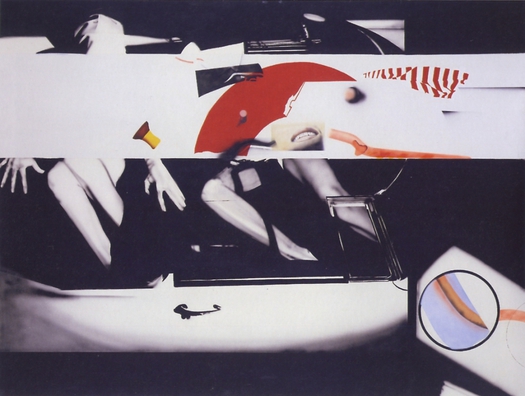
The Analytical Eye — Rick Poyner’s second essay for Design Observer on the visual interpretation of J.G. Ballard examines the work of French artist Peter Klasen:

What both Ballard and Klasen share… is a cold, appraising, analytical eye. It’s impossible to tell how they feel about what they show, or to know what they want us to feel, if anything at all. Their findings are disturbing and perhaps even repellent from a humanist perspective, yet the new aesthetic forms they use to embody them are, even today, exciting, provocative and tantalizingly difficult to resolve.

Any Colour — So Long As It Is Black — The WSJ profiles Massimo Vignelli:

“The greatest design has to provide a little pleasure,” he explained, producing the straightforward black bag he carries; Mr. Vignelli wears nothing but black. Proudly reporting that he’d bought the bag from a local street vendor, he pulled out a black Leica camera…, a pair of black Ray Bans and a tape measure—alas, bright yellow, not black.

“This is my dictionary,” Mr. Vignelli said of the tape measure. He explained that even as a child he had such fascination with the dimensions of things that he would challenge his friends to guess their size. He believes that subtleties of shape conjure emotion. “Is that three centimeters or four centimeters?”

All Forest, No Trees — David L. Ulin reviews The Information by James Gleick for The LA Times:

Over the course of human culture, there have been a number of significant transformations, beginning with the alphabet, which Gleick calls “a founding technology of information. The telephone, the fax machine, the calculator, and, ultimately, the computer are only the latest innovations devised for saving, manipulating, and communicating knowledge.” It is his idea that all these technologies exist as part of a continuum, with each developing from the last.

The key to such an argument is perspective, which is often in short supply when it comes to the information culture, with its tendency to inspire either paeans or jeremiads. Gleick, however, is too smart for that; he’s all about the forest, not the trees.

And finally…

Breaking Machines — Richard Conniff, author of The Species Seekers, on what the Luddites really fought against:

Despite their modern reputation, the original Luddites were neither opposed to technology nor inept at using it. Many were highly skilled machine operators in the textile industry. Nor was the technology they attacked particularly new. Moreover, the idea of smashing machines as a form of industrial protest did not begin or end with them. In truth, the secret of their enduring reputation depends less on what they did than on the name under which they did it. You could say they were good at branding.

Comments closed

Something for the Weekend

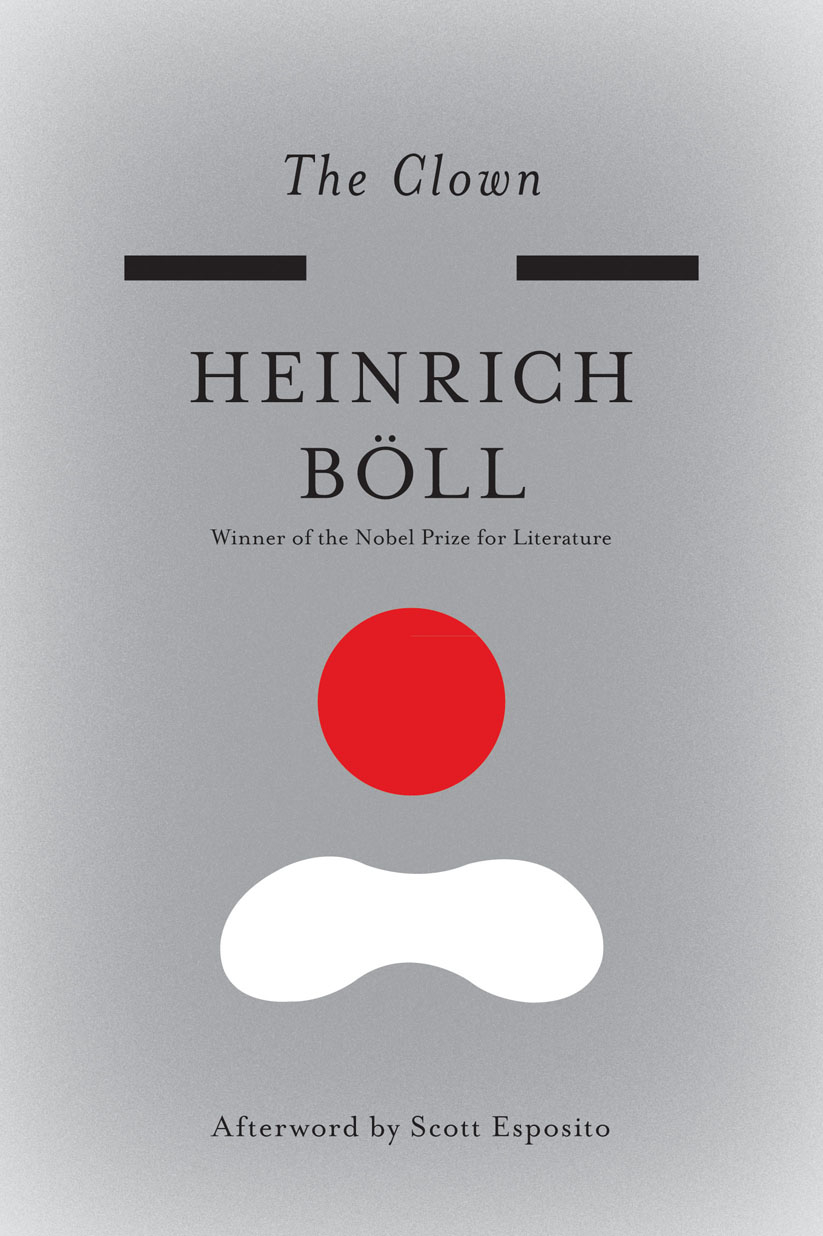
The Book Bench interviews designer Kelly Blair about her work and her Heinrich Böll redesigns for Melville House:

There are so many amazing and striking book covers out there, yet I am most often drawn to the simplest thing on the shelf. Perhaps it’s because I am so immersed in book design day-to-day, but sometimes going into the bookstore can feel visually overwhelming, like the cereal aisle at the grocery store. To that end, David Knopka’s series design for the Melville House novellas still stands as one of my favorites. For the same reason, walking into the Persephone book shop in London feels like a breath of fresh air.

And on the subject of book covers, I’ve been loving designer Andrew Henderson‘s Lovely Book Covers Tumblr.

You can find The Casual Optimist Tumblr here.

Cabaret — Author Hanif Kureishi on the art of writing for The Independent:

There’s no connection between being able to write and being able to explain your work in a rain-swept tent to an audience staring at you like hungry animals contemplating a suspect steak. Listening and reading are different experiences. Reading, writing for a reader, and being read, are intimate acts, and there’s something about trying to articulate what you’ve done that can flatten and reduce it, horrifyingly so.

Some writers choose the written word because they find it difficult to speak directly; many writers are in love with solitude. Whichever it is, good writing should resist interpretation, summary and the need for applause.

The Information — Michael Dirda reviews Too Much To Know: Managing Scholarly Information Before the Modern Age by Ann M. Blair for The Washington Post:

Just how to present information for easy use was a constant vexation. In late antiquity, one might simply find a list of authorities cited. Gradually, though, compilers began to employ categorical headings or to arrange entries alphabetically or according to elaborate branching diagrams of knowledge. “One historian has counted nineteen different systematic orders present in early modern encyclopedic works, including the order of creation, of the Decalogue, of the biblical narrative,” and various “chronological and geographical orders,” as well as others that follow “the chain of being.”

While people during the Middle Ages and later drew much of their learning from dictionaries and digests, the more ambitious also took extensive notes from whatever classics came their way. By the Renaissance one could even purchase the equivalent of “Reading for Dummies”: Francesco Sacchini’s 1614 “De ratione libros cum profectu legendi libellus,” i.e.,”A Little Book on How to Read With Profit.”

The Science of Making Decisions — Sharon Begley on how too much information impairs our ability to make decisions:

The problem has been creeping up on us for a long time. In the 17th century Leibniz bemoaned the “horrible mass of books which keeps on growing,” and in 1729 Alexander Pope warned of “a deluge of authors cover[ing] the land,” as James Gleick describes in his new book, The Information. But the consequences were thought to be emotional and psychological, chiefly anxiety about being unable to absorb even a small fraction of what’s out there. Indeed, the Oxford English Dictionary added “information fatigue” in 2009. But as information finds more ways to reach us, more often, more insistently than ever before, another consequence is becoming alarmingly clear: trying to drink from a firehose of information has harmful cognitive effects. And nowhere are those effects clearer, and more worrying, than in our ability to make smart, creative, successful decisions.

And related… Jonah Lehrer, contributing editor at Wired and the author of How We Decide and Proust Was a Neuroscientist, on why easy decisions seem so hard:

The problem, of course, is that the modern marketplace is a conspiracy to confuse, to trick the mind into believing that our most banal choices are actually extremely significant. Companies spend a fortune trying to convince us that only their toothpaste will clean our teeth, or that only their detergent will remove the stains from our clothes, or that every other cereal tastes like cardboard. And then there is the surreal abundance of the store shelf… While all these products are designed to cater to particular consumer niches, they end up duping the brain into believing that picking a floss is a high-stakes game, since it’s so damn hard. And so we get mired in decision-making quicksand.

Comments closed

Midweek Miscellany

Two stunningly minimal designs by Rodrigo Corral for New Directions.

Faceout Books is back after a hiatus. First up, an interview with Jennifer Heuer about her design for Down and Delirious in Mexico City by Daniel Hernandez.

Haystacks of Needles — Nicholas Carr, author of The Shallows, on situational overload versus ambient overload:

Situational overload is not the problem. When we complain about information overload, what we’re usually complaining about is ambient overload. This is an altogether different beast. Ambient overload doesn’t involve needles in haystacks. It involves haystack-sized piles of needles. We experience ambient overload when we’re surrounded by so much information that is of immediate interest to us that we feel overwhelmed by the neverending pressure of trying to keep up with it all. We keep clicking links, keep hitting the refresh key, keep opening new tabs, keep checking email in-boxes and RSS feeds, keep scanning Amazon and Netflix recommendations – and yet the pile of interesting information never shrinks.

The cause of situational overload is too much noise. The cause of ambient overload is too much signal.

The Case for the NovellaThe New York Times Magazine has an excerpt from “The Three-Day Weekend Plan,” an essay by John Brandon from the new book The Late American Novel: Writers on the Future of Books (Soft Skull):

Bluntly, the novella is in its Golden Age as a form right now because no one is beating it with a stick until nickels fall out. So my plan for the novella is — drum roll: Do nothing. Or do whatever little is required to steward the status quo. Let’s agree, shall we, to keep throwing around the inane term Great American Novel, and to never, ever utter the phrase Great American Novella.

And on the subject of The New York Times Magazine…

The Speed of Change — Former Design Director for NYTimes.com Khoi Vinh on the new design of the New York Times Magazine:

Digital publishing is supposed to be much quicker than print publishing, but this… suggests that more important than the speed of medium is the nimbleness of the business behind it. The print side of The New York Times takes a lot of good natured ribbing for being slow to publish news, but it’s still very, very good at what it does. Which is to say that few organizations can publish on a weekly basis and still effect the kind of major change that this redesign represents.

In some ways, the digital side of the business is not as nimble as that. To be sure, few companies can execute digital publishing as well as The New York Times… But partly because the medium is much younger and constantly changing, partly because best practices are less well-defined, and partly because the mission is more diffuse, execution is a more intricate, protracted and, often, inefficient affair on the digital side.

Comments closed

Something for the Weekend

Beep Beep — Nicholas Carr (The Shallows) reviews The Information by James Gleick:

As a celebration of human ingenuity, The Information is a deeply hopeful book. But it ends on an ambivalent note. The mathematical analysis of information, Gleick points out, entails the “ruthless sacrifice” of meaning, the very thing that “gives information its value and its purpose.” To the number-crunchers and code-wranglers who design our world-engirdling information networks, a message’s meaning is beside the point. A bit is a bit is a bit. As Shannon himself dryly noted, meaning is “irrelevant to the engineering problem.”

And yes, that cover was designed by Peter Mendelsund.

Beginners Edited — The original draft of Beginners by Raymond Carver compared with the final version of the story, retitled and published as What We Talk About When We Talk About Love, edited by Gordon Lish. It’s from a couple of years ago, but still fascinating if you’ve never seen it (via Biblioklept).

Collector’s Items — The Guardian on the renaissance of chapbooks:

The 16th century merriments that became the chapman’s stock in trade were historically cheap, crudely made and illustrated using recycled woodcuts.

Today’s chapbooks, which are enjoying a revival along with independent regional publishing, bear little resemblance to the roughly produced books of the past. They are objects of beauty in their own right, with emphasis on original design as well as being a showcase for original writing. Pamphlet-sized but glossy, and more book than leaflet, they are highly covetable, which partly explains their appeal.

And finally…

A Curious Journey— The story of Margret and H.A. Rey, the creators of Curious George, at More Intelligent Life:

On June 12th 1940, the couple left Paris. The Nazis arrived less than two days later.

The Reys made their way to the south of France, and spent several weeks in a makeshift refugee camp in a high-school gymnasium before proceeding to Lisbon. From there they arranged passage to Brazil, and months later to New York. They carried with them the first drawings for the Curious George books, and showed them to police as proof of their occupation. The first book, “Curious George”, was published in 1941. The little monkey arrives in New York and strolls off of the ship with a smile, holding his papers in one hand and a little red valise in the other. A policeman salutes in welcome.

An exhibition of art by the Reys is on display at the Contemporary Jewish Museum in San Francisco until March 13th.

1 Comment

Midweek Miscellany

The Death Ray by Daniel Clowes

The new cover for Daniel Clowes’ The Death Ray available this fall from Drawn + Quarterly. (The usual disclosure: D+Q is distributed in Canada by my employer Raincoast Books).

The Enemy of Creativity — Jim Holt reviews Nicholas Carr’s The Shallows for London Review of Books:

It’s not that the web is making us less intelligent; if anything, the evidence suggests it sharpens more cognitive skills than it dulls. It’s not that the web is making us less happy, although there are certainly those who, like Carr, feel enslaved by its rhythms and cheated by the quality of its pleasures. It’s that the web may be an enemy of creativity. Which is why Woody Allen might be wise in avoiding it altogether.

A Machine To Think With — Paul Duguid reviews Merchants of Culture by John B. Thompson, Publishing as a Vocation by Irving Louis Horowitz and The Phantoms on the Bookshelves by Jacques Bonnet  for the TLS:

I. A. Richards called the book “a machine to think with”, yet it is curiously resistant to technological standardization. That point escapes many digitizing technologists, who are not perhaps the anti-book boors as sometimes portrayed… Rather they may be the last romantics, idealizing the book as a simple carrier of information and so one that submits unproblematically to their computer algorithms.

Unsolving the City — BLDGBLOG talks to author China Miéville about architecture and his recent novels The City and The City and Kraken. Fantastic stuff:

My intent with The City and The City was… to derive something hyperbolic and fictional through an exaggeration of the logic of borders, rather than to invent my own magical logic of how borders could be. It was an extrapolation of really quite everyday, quite quotidian, juridical and social aspects of nation-state borders… But I’m always slightly nervous when people make analogies to things like Palestine because I think there can be a danger of a kind of sympathetic magic: you see two things that are about divided cities and so you think that they must therefore be similar in some way.

The new covers for Miéville’s forthcoming book Embassytown, and his entire back catalogue with Pan Macmillan UK, were designed by Crush Creative.

And finally…

Handsome Boy Modeling School — A profile Lorin Stein, editor of The Paris Review, in The New York Times’ Fashion and Style section:

Mr. Stein, an unabashed bon vivant who favors bespoke shirts and tailor-made suits by Kirk Miller, appears indifferent to accusations of pretension or dandyism… He has already cemented his status as a somewhat unlikely sex symbol (though among New York’s literary crowd, being pale, thin and occasionally bespectacled doesn’t count against you) with a practiced charm and habit of leaning in close and locking eyes intensely in conversation.

There is hope for us all yet… I just wish I could afford the bespoke shirts and tailor-made suits…

Comments closed

Something for the Weekend

Luc Sante, author of Low Life: Lures and Snares of Old New York, has posted an amazing selection of vintage French photographic noir book covers at John Gall’s blog Spine Out.

On the Defensive — Sam Lipsyte, author of The Ask, on teaching creative writing in The Financial Times:

When you teach creative writing, you are already on the defensive. People love to poke you in the chest and cry, “But you can’t teach writing!” This is precisely what I think about automobile driving but I let them rant while I rub the sore part where they poked me. I don’t know why people get so worked up about this subject. Nobody has asked them to teach creative writing or even to learn it. Apprenticeship, the sharing of history and technique, has always been a central feature of art-making. Yet people cling to a romantic idea of the self-made genius toiling away in a garret or napping undisturbed in a sleep module.

Books on Wheels — A really lovely article about bookmobiles from the Smithsonian Magazine:

Bookmobiles, the man said, had been a fundamental inspiration while growing up in rural Mississippi in the mid-1960s. The public library had been closed to blacks—but the bookmobile stopped right on his street, a portal into the world of literature.

The gentleman was W. Ralph Eubanks: today an acclaimed author, and Director of Publishing for the Library of Congress… “The librarians did not care that I was barefoot, and wearing a pair of raggedy shorts. All they cared about was that I wanted to read—and to help me find something I would enjoy reading.”

Eubanks’ story is just one example of the pivotal role bookmobiles have played in literary culture, and individual lives, for more than 150 years.

Strides at The Strand — Nancy Bass Wyden, co-owner of The Strand bookstore in New York, interviewed in The Daily Beast:

We have taken strides to grow with our customers and listen to their needs. When customers started requesting New York Times bestsellers, we started carrying new books and featuring them on tables in the front of the store; when customers started talking about the Internet, we got online; when Amazon and B&N.com became “competitors,” we partnered with them.

And finally…

The Trial — Judith Butler in the LRB on the implications of the ongoing and complex legal battle in Tel Aviv over several boxes of Kafka’s original writings:

Had the works been destroyed, perhaps the ghosts would not be fed – though Kafka could not have anticipated how limitlessly parasitic the forces of nationalism and profit would be, even as he knew those spectral forces were waiting.

Comments closed

Midweek Miscellany

The reluctant Daniel Clowes has a website. What the hell?

The Day The Movies Died — Mark Harris, author of the fantastic Pictures at the Revolution, on Hollywood blockbusters and the death of the great American movie. A really good read:

Which brings us to the embarrassing part. Blaming the studios for everything lets another culprit off too easily: us. We can complain until we’re hoarse that Hollywood abandoned us by ceasing to make the kinds of movies we want to see, but it’s just as true that we abandoned Hollywood. Studios make movies for people who go to the movies, and the fact is, we don’t go anymore—and by we, I mean the complaining class, of which, if you’ve read this far, you are absolutely a member. We stay home, and we do it for countless reasons… The urgency of seeing movies the way they’re presumably intended to be seen has given way to the primacy of privacy and the security of knowing that there’s really almost no risk of missing a movie you want to see and never having another opportunity to see it. Put simply, we’d rather stay home, and movies are made for people who’d rather go out.

You Can’t Learn Taste — A profile of Richard Russell, boss of London-based independent record label XL Recordings,  in The Guardian:

This, after all, is a label that is thriving in an industry that is supposed to be dying.

“It’s not dying . . . it’s changing,” says Russell. “But then it always has been, as is the whole world. I just don’t think about the future at all. It’s not my responsibility.”

Really? He doesn’t have a strategy?

“Yeah – put good records out. That’s it. I’m sure there are people thinking about stuff like copyright and downloading, but . . . you don’t want an author to be thinking about Kindles and shit like that, do you? I mean, we do our best, but we definitely don’t offer any solutions for the music industry.”

And there’s the problem. You can’t learn taste.

Also in The Guardian, Barry Miles, author of London Calling: A Countercultural History of London Since 1945, chooses his top 10 books about London’s counterculture.

And finally…

Alan Arkin’s video for his new book, An Improvised Life, published next month by Da Capo:

Nice.

(via Jacket Copy)

Comments closed

Something for the Weekend

Punching Through the Din — designer Jim Northover on the exhibition of Saul Bass movie posters at Kemistry in London.

This is the End — Sarah Weinman on chronicling the end of the chain bookstore era:

But maybe what really happened was as simple as this: chain bookstores were never supposed to last as long as they did, and have reached their natural end point after twenty years. Publishing in general has enough struggle with scale, either being too small and prone to great risk and failure, or too big and beholden to larger entities who want greater and greater annual profits. Whatever possessed us to think bookstores could operate this way? Why is the art of bookselling supposed to be conflagrated with abundance, with excess and with millions of square feet?

And on a somewhat related note…

The Cost of Keeping Authors Alive –Boyd Tonkin for The Independent (via MobyLives):

Dirt-cheap e-books benefit the very rich – and the very dead. They might also help new authors to find a foothold and win an audience – although, on that logic, newcomers should think about showcasing their work for nothing. Many do. But the almost-free digital novel hammers another nail into the coffin of a long-term literary career. Who cares? Readers should, if they cherish full-time authors who craft not safe genre pieces but distinctive book after distinctive book that build into a unique body of work.

(see also: Margaret Atwood at TOC)

Kick Ass Annie — An interview with Anne Koyama, the founder and operator of Toronto-based Koyama Press, at Design Feaster:

I look at all kinds of artwork, films, architecture, photography and typography. I subscribe to a lot of art/artist’s blogs. I like to walk around cities and try to really see the details of things around me (which is more difficult than you may think for someone possessed of a short attention span). I carry a little point-and-shoot camera often. Of course, all of the artists I work with inspire me and I seem to find a few artists each week that I’d like to work with if I had the funds.

And lastly…

Meet the Classics — A Brazilian ad campaign to promote Penguin Classic Books (via This Isn’t Happiness).

1 Comment