Skip to content

Category: Books

Midweek Miscellany

The Creative Review interviews Richard Littler, the man behind the absolutely bloody terrifying Scarfolk:

For me, the desired effect can only be achieved if the images are visually authentic. The seriousness of presentation and form is absolutely crucial. It lulls the viewer into a false sense of security so that the gap between expectation and reality – the juxtaposition of staidness and absurdity – is as wide as it can be.

The fictional authors, designers and archivists of Scarfolk’s public information material must sincerely believe in the gravity of the message that the subject matter wants to convey and deserves, such as rabies. In addition, the whole concept of Scarfolk has to be internally consistent. There has to be a credible, believable identity.

Greatly Exaggerated — Salon’s Laura Miller on technology, self-publishing, and why publishers and bookstores are still matter:

If print could talk, it would surely be telling the world, Mark Twain-style, that reports of its demise have been greatly exaggerated… New self-publishing enterprises are a godsend for traditional publishers because they can take much of the uncertainty out of signing a new author. By the time a self-published author has made a success of his or her book, all the hard stuff is done, not just writing the manuscript but editing and the all-important marketing. Instead of investing their money in unknown authors, then collaborating to make their books better and find them an audience, publishers can swoop in and pluck the juiciest fruits at the moment of maximum ripeness…. [That’s] exactly what happened with erotica blockbuster E.L. James.

Epitaph — A smart take on the end of Google Reader by Paul Ford for The Financial Times:

This is the downside to apps: when everything is online your ability to labour along in familiar ways is contingent upon money coming to the app provider. This works when we remain consumers, for example of media objects such as paywalled newspapers, Netflix and Spotify. We lease access to the databases, own nothing, and the access makes it worthwhile. But when we work inside these systems we increase our levels of risk. When Google Reader goes away, it will not be like a television show being cancelled – much work is lost, and the ability to access that work is also lost.

The Exploded Mind — A big interview with artist, illustrator and picture book maker Oliver Jeffers at The Great Discontent:

Balancing integrity versus income is tricky; when I make decisions, sometimes I know that I might not be as well off the next year, but I’ll certainly be making the best work. I figured out early on that there are certain things I don’t want to do when it comes to how I’m perceived. I try to stay away from advertising, even though that’s where the big money is. In the visual arts, you are often only as good as your reputation and associations, so you have to think ahead and be smart. As far as commercial commissions, I’m not just a gun for hire; I actually have something I’m trying to accomplish and a way of making work that I want to continue and be known for. Although some lucrative offers came in for illustration work, I realized that taking them would be shortsighted and could possibly stunt other aspects of my practice.

See also: ‘Maurice Sendak’s Jumper and Me‘ by Jeffers at The Guardian:

Sendak was trying to satisfy himself. He was telling these stories, as much a way to make sense of the world around him as anything else. He was using them as a poet uses poetry and a painter uses paint. He was making art that ultimately transcended himself and neat classification. Perhaps as a result he was one of the first contemporary picture-book makers to discover the power of picture book as a way of storytelling for everyone. Perhaps this might go some way to explain why his books have won over so many, regardless of geography or decade – because he is putting himself, and the way he views the world on paper, darkness and all.

And finally…

Dr. Jazz — James Hughes on Stanley Kubrick’s unmade film about jazz in the Third Reich, at The Atlantic:

Kubrick’s interest in jazz-loving Nazis… represents his most fascinating unrealized war film. The book that Kubrick was handed, and one he considered adapting soon after wrapping Full Metal Jacket, was Swing Under the Nazis, published in 1985 and written by Mike Zwerin, a trombonist from Queens who had performed with Miles Davis and Eric Dolphy before turning to journalism. The officer in that Strangelovian snapshot was Dietrich Schulz-Koehn, a fanatic for “hot swing” and other variations of jazz outlawed as “jungle music” by his superiors. Schulz-Koehn published an illegal underground newsletter, euphemistically referred to as “travel letters,” which flaunted his unique ability to jaunt across Western Europe and report back on the jazz scenes in cities conquered by the Fatherland. Kubrick’s title for the project was derived from the pen name Schulz-Koehn published under: Dr. Jazz.

Comments closed

Something (Late) for the Weekend

Enjoy Your Cigarette — Tom Cox reviews Penguin’s Underground Lines boxed set for The Guardian:

Underground Lines often matches its writers to its tracks very well, in terms of temperament as well as personal history. The Jubilee line, so often associated with capitalism and the Docklands development, is a good match for John O’Farrell, a writer whose wit was marinated in the political 1980s. The nervy prose of William Leith could not be more apt for the rather fraught Northern line, and his manic, anxious account of being evacuated from a train that was filling with smoke is probably the most addictively readable thing here. “People never tell you to have a pleasant journey on the underground, just as people will say, ‘Enjoy your meal,’ but never ‘Enjoy your cigarette,'” he writes.

Dirty Lit — Edward Jay Epstein at the NYRB Blog on being taught literature by Nabokov:

He made it clear from the first lecture that he had little interest in fraternizing with students, who would be known not by their name but by their seat number. Mine was 121. He said his only rule was that we could not leave his lecture, even to use the bathroom, without a doctor’s note.

He then described his requisites for reading the assigned books. He said we did not need to know anything about their historical context, and that we should under no circumstance identify with any of the characters in them, since novels are works of pure invention. The authors, he continued, had one and only one purpose: to enchant the reader. So all we needed to appreciate them, aside from a pocket dictionary and a good memory, was our own spines. He assured us that the authors he had selected—Leo Tolstoy, Nikolai Gogol, Marcel Proust, James Joyce, Jane Austen, Franz Kafka, Gustave Flaubert, and Robert Louis Stevenson—would produce tingling we could detect in our spines.

Exploded Hearts — Melville House’s Christopher King on his cover design for How to Keep Your Volkswagen Alive by Christopher Boucher, at Talking Covers:

In the end, I did what I usually do, which is to steal an idea for the cover directly from the manuscript. In this case, the narrator’s son—who, again, is a car—has a heart in place of an engine, so I printed off an image I found online and showed it to our publishers:

“It’ll be like this exploded diagram of a car, but with a heart in place of the engine.”

“OK!”

And finally…

The Wall Street Journal looks at ‘The Improbable Rise of NPR Music‘ which, for all of the WSJ’s obvious churlishness, manages to be fascinating despite itself:

NPR Music’s breadth, depth and ability to break new material are its main strengths. The site offers music that appeals to rock, jazz and classical lovers—all under one roof. Still another advantage is NPR Music’s ties to “All Things Considered” and “Morning Edition,” which, even if Washington-centric, have music woven into their fabric and provide news for the site as well as a familiar storytelling style.

NPR Music in its present form just turned five. “It’s the closest thing we have to a pure startup inside what is now a 40-plus-year-old institution,” says Kinsey Wilson, NPR’s executive vice president and chief content officer. “This group of now roughly 20 people has had an opportunity to invent something from scratch.”

(via Largehearted Boy)

Comments closed

Books Are Amazing, Guys


Books. Will. Never. Be. Cool.

The latest Supermutant Magic Academy webcomic by Jillian Tamaki.

Between this, Richard Nash, Evan Hughes, and Mike Shatkin, books have been having a rough time this week. (But I’m still keeping the faith).

Comments closed

Midweek Miscellany

WHAAM! — Comics historian Paul Gravett on Roy Lichtenstein’s appropriation from comics:

Lichtenstein’s… success, his getting away with turning supposedly anonymous ‘found’ comic art into high-priced paintings, continues to directly encourage others to do the same. But there is a difference—comics are no longer uncredited, trashy mass culture, and what worked as a lucrative schtick back in the Sixties art world is now largely drained and devoid of any shock value or irony… Five decades on… it is high time for the comics world and the art world to properly debate these issues, and to celebrate these hugely talented but still largely ignored visual storytellers.

(Pictured above: a page from ‘The Star Jockey’ drawn by Irv Novick, from All-American Men of War #89 February 1962)

See also: David Barsalou’s Deconstructing Lichtenstein project

(If Gravett underestimate’s Lichtenstein’s ingenuity in recontextualizing comic book panels, and his lasting influence on art AND comics, it is truly astonishing to see how poor Lichtenstein’s paintings are in direct comparison to the work he borrowed from.)

Blowing Shit Up — A long essay by Richard Nash on the business of literature at the VQR:

Selling a book, print or digital, turns out to be far from the only way to generate revenue from all the remarkable cultural activity that goes into the creation and dissemination of literature and ideas. Recall again all the schmoozing, learning, practice, hustling, reading upon reading upon reading that goes into the various editorial components of publishing; the pattern recognition; the storytelling that editors do, that sales reps do, that publicists do, that the bookstore staff does. Recall the average feted poet who makes more money at a weekend visiting-writer gig than her royalties are likely to earn her in an entire year. You begin to realize that the business of literature is the business of making culture, not just the business of manufacturing bound books. This, in turn, means that the increased difficulty of selling bound books in a traditional manner (and the lower price point in selling digital books) is not going to be a significant challenge over the long run, except to free the business of literature from the limitations imposed when one is producing things rather than ideas and stories. Book culture is not print fetishism; it is the swirl and gurgle of idea and style in the expression of stories and concepts—the conversation, polemic, narrative force that goes on within and between texts, within and between people as they write, revise, discover, and respond to those texts.

See Also: Book Publishers Scramble to Rewrite Their Future by Evan Hughes for Wired.

And finally…

The New Statesman has posted five classic book reviews from their archive, including V. S. Pritchett’s review of 1984 by George Orwell:

Nineteen Eighty-Four is a book that goes through the reader like an east wind, cracking the skin, opening the sores; hope has died in Mr Orwell’s wintry mind, and only pain is known. I do not think I have ever read a novel more frightening and depressing; and yet, such are the originality, the suspense, the speed of writing and withering indignation that it is impossible to put the book down. The faults of Orwell as a writer – monotony, nagging, the lonely schoolboy shambling down the one dispiriting track – are transformed now he rises to a large subject. He is the most devastating pamphleteer alive because he is the plainest and most individual…


Comments closed

Something for the Weekend

Typgraphica’s favourite typefaces of 2012. There’s a lot to love about Balkan Sans by Nikola Djurek and Marija Juza. But check out the ligatures on Levato by Felix Bonge:


Chasing the White Rabbit — Francine Prose on dreams and literature, at the New York Review of Books blog:

Literature is full of dreams that we remember more clearly than our own. Jacob’s ladder of angels. Joseph saving Egypt and himself by interpreting the Pharoah’s vision of the seven fat and lean cows. The dreams in Shakespeare’s plays range as widely as our own, and the evil are often punished in their sleep before they pay for their crimes in life. Kafka never tells us what Gregor Samsa was dreaming when he awakens as a giant insect, except that the dreams were “uneasy.” Likely they were not as uneasy as the morning he wakes into. By the end of the first paragraph of “The Metamorphosis,” Gregor has noticed his arched, dome-like brown belly, his numerous waving legs. “What has happened to me? he thought. It was no dream.”

Krautrock on the Underground — An excerpt from Earthbound by Paul Morley, part of the Penguin Lines series for the 50th anniversary of the London Underground, at The New Statesman:

“Krautrock” was the convenient collective name given in a slightly jokey, slightly wary and affectionately patronising way to an eclectic collection of radicalised German groups from very different parts of the country that contained musicians who were born in the few years before, during or just after the Second World War. Another collective name for these groups, still frivolous but more descriptive of their mission to create sound never heard before on our planet and invent music that could make you feel you were leaving the earth behind, was “kosmische”. As well as Can, these groups included Kraftwerk, Tangerine Dream, Amon Düül II, Cluster, Popol Vuh, Harmonia, Neu! and Faust, and they were looking for ways to repair their traumatic recent history, remove the crippling infection of fascism, break free of totalitarian artistic repression, negotiate turbulent social and emotional currents, and radically, romantically reinstate the positive, progressive elements of their mortified national psyche.

See also: Jonathan Gibbs looks at the design of the Penguin Lines series at The Independent.

And finally…

Fact-Checking at the New Yorker, an excerpt from a new book called The Art of Making Magazines:

When the new, remade The New Yorker of the last decade was gearing up and we started getting all these late-breaking stories, issues such as logic and fairness and balance—which previously had been the responsibility of the editors—began to fall on the checkers. This wasn’t by anybody’s design. It was because the editors were really busy putting these stories together and they wanted us to look at things from the outside and see how they were framed, and look at them from the inside and look at the logic and the way they were reported and the way quotes were used and many other such things.

That responsibility came to us not in the way of anybody saying suddenly, “You’re doing that.” It just became that when a problem arose, they would come to us and say, “Why didn’t you warn us?” And so it just became clear that there was this gap between editing and checking that had opened up under the pressure of later-breaking stories, and it just seemed logical that we should fill it. It made our job more challenging, and more fun.

(via Kottke)

1 Comment

Q & A with Misha Beletsky, Part Two

In part one of our conversationMisha Beletsky, art director at Abbeville Press, discussed his interest in the work of German-born designer and calligrapher Ismar David, the subject his recent book The Book Jackets of Ismar David, published by RIT Press. In this second and final part of our interview, Misha and talks about his own work as a designer and an art director:

How did you become interested in design?

The father of a boyhood friend in Russia was a book designer. He had a photo lab set up in his closet, took pictures of letters, and pasted them up with rubber cement. Having access to creation of the book, that holy of the holies of the bookish world I grew up in seemed like magic. I thought it was the coolest thing in the world. One day I tagged along with this friend to take night classes at the Moscow Printing Institute. Suddenly, I felt it was no longer a world I could enjoy as a guest, but a world I could be a part of. I felt it was not only something I liked doing, but an area where I could make a real difference. When I arrived in the US, one particular image from a RISD catalog influenced my decision to choose this school over others: a photograph of a calligraphy class. The unassuming black-and-white image spoke to me more than all lavish and clever full-color catalogs of other schools not because I wanted to become a calligrapher, but because I knew this was a place that based its design education on a solid ground. The essential training in typography I received at RISD laid the ground for my summer internship with David R. Godine, Publisher in Boston. This small press started out as a letterpress printing shop in a barn and over the years has been responsible for more important books on book design and typography than any single publisher in this country. There I caught the bug of fine printing. I began appreciating printer’s ink, impression, and paper, and there I was indoctrinated about the proper use of old style figures and small caps. I learned to consider all elements of the book as a part of one system where the whole is more than a sum of its parts and each part is integrally related to each other. Empowered by my discovery of the letterpress, I went back to school to spend my Senior year hand-setting metal type, carving woodcuts, and printing my own limited-edition books. My first job after school designing book interiors for Alfred A. Knopf was the best way to apply the ideals of fine printing to real-life trade publishing. Knopf house style had changed little since the heady days of W.A. Dwiggins, George Salter, and Warren Chappell. I explored every nook in the corporate library, taking in every book designed by the best designers of the 30s, 40s, and 50s. Their lessons are still with me today.

Could you describe your book cover design process?

Most of the books I design are art books, which usually implies I am responsible for both the cover and the interior design. This means I have a rare privilege of making sure the cover and the interior design agree. I usually start from the inside out: I decide on the interior typography first, and then move on to the jacket. Unlike most trade books, where cover designers are only limited by their imagination and their budget in the choice of the artwork, the cover image for illustrated books usually comes from within the book. I select an image, crop it, and design the typography. This limitation made me keenly aware of how much you can do with type alone and sympathetic to the designers of the past who were able to achieve great results with limited tools.

What do you look for in a designer’s portfolio?

I look for understanding of and an eye for traditional book typography. Only a handful of portfolios out of hundreds I reviewed had it.

Do you see any prevalent trends in contemporary book design?

There is a relatively new trend of purely decorative covers and bindings by Coralie Bickford-Smith and others that seems to be a reaction to the overwhelming number of clever designs. As far as interiors go, by and large, I see a lot of unexciting work of decent quality and very little great work. I keep waiting for a resurgence of good typography, but it has not arrived yet.

What advice would you give a designer starting their career?

Read Ben Shahn’s The Shape of Content. Learn calligraphy, drawing, and printmaking. Learn letterpress printing from metal type. Manual skills cannot be emphasized enough.

Who are some of your design heroes?

Bruce Rogers, the subject of my new book. He had an almost unfathomable sensitivity to typography. In his lifetime he was famous to a point of embarrassment. Today he is hardly ever talked about. Yet, to me he remains the most versatile and the most accomplished practitioner of our craft.

Another name is Vladimir Favorsky, a towering genius of Russian graphic arts, completely forgotten outside of Russia. For many years he taught at VKhuTeMas, the Russian sister-school of the Bauhaus (which evolved into the design department of Moscow Printing Institute where I briefly studied), yet he was in opposition to the Constructivist ideas espoused by most professors there. He developed an original design philosophy of his own that integrated Avant-garde ideas with the traditional craft of wood engraving. Ironically, his fusion of the old and the new may prove more relevant today than the radical rejection of the old by his famous modernist colleagues.

What does the future hold for book cover design?

Who knows? What does the future hold for visual art or for our culture at large? It seems we’ve been living in a cultural twilight zone. We’ve tried Modernism and we came to a logical dead end, we’ve tried revolting against Modernism, and we’ve become tired of that, too. What’s next? I hope we can learn to build on top of what the previous generations learned instead of rejecting whatever the last fashion was and trying to outdo it. In the words of Goethe that Ismar David loved to quote, “What you inherited from your fathers, acquire it to make it your own.”

Thanks Misha! (And I couldn’t resist including this…)

Read part one.

Comments closed

Q & A with Misha Beletsky, Art Director Abbeville Press, Part One

Misha Beletsky is the art director of New York’s Abbeville Press, an independent publisher of fine art and illustrated books.

Towards the end of last year, Misha was kind enough to send me a copy of his recent book, The Book Jackets of Ismar David, published by RIT Press.

A German-born graphic artist, David worked in Germany and then Jerusalem before moving permanently to the United States to become part of a group of accomplished calligraphers who also worked as book jacket designers in New York in the 1950s. David’s bold and expressive style was informed by a mastery of the typographic tradition (he designed a calligraphic Hebrew typeface called David Hebrew), and he worked for many of leading publishers of the day including Alfred A. Knopf, Harper and Row, Houghton Mifflin, Random House and others.

In this post, the first of a two-part interview, Misha discusses the book and his interest in the work of Ismar David.

When did you first come across the work of Ismar David?

Anyone who reads Hebrew is familiar with David’s work, whether they are aware of it or not: David Hebrew, a font he designed happens to be one of the most ubiquitous Hebrew typefaces for text setting. I was first exposed to his work outside of type design as I researched my article on the history of Hebrew typography around twelve years ago.

What interested you about him?

David’s work is powerful and beautiful, yet little known. He had a rare ability of using traditional skills and historical knowledge to arrive at strikingly contemporary results.

Did David’s work change when he moved to the US?

His work matured and became more diverse, as he grew in his craftsmanship and absorbed many exciting influences of 1950s’ New York design scene. He was working alongside other accomplished calligrapher jacket designers like George Salter, Warren Chappell, Arnold Bank, Phil Grushkin, Charles Skaggs, Oscar Ogg, Jeanyee Wong, and Lili Wronker, among others. They all knew each other and learned from each other’s work.

Do you consider David to be primarily a book designer or a calligrapher?

He was a graphic artist who used calligraphy as a primary means of expression. He was equally comfortable designing book jackets, architectural interiors, logos, advertisements, and monumental inscriptions, depending on the project at hand.

What was special about his Hebrew typeface ‘David’?

It was the first 20th c. Hebrew text type, whose letterforms were not based on an existing typographic model, but found inspiration in historic calligraphic hands. David distilled the idea of the Hebrew letter to its purest form.

How did David’s work differ from his contemporaries Paul Rand and Alvin Lustig?

His work could not be called clever or conceptual. He relied on the sheer power of the letter, shape, and color to create stunning jackets that told the book’s story through a primary visual vocabulary.

Is David’s work still relevant today?

I believe it is. Twenty years into the “conceptual revolution” in our book cover design, the Modernist idiom is getting a bit tired. We are ready for something different. There is a renewed interest in traditional typography and design craftsmanship, and it is here that we could learn a thing or two from David.

Do you think we’re seeing a revival of calligraphy, lettering and hand-drawn type?

Somewhat: if Pinterest stats are any indication, lettering compositions are trending along with pictures of fashionable outfits, cute puppies, and expensive home interiors. It’s not a complete comeback, though. On one hand, a few talented designers like Marian Bantjes and Jessica Hische are enjoying a tremendous degree of success with their decorative lettering work. On the other hand, the work of traditionally trained calligraphers is still in relatively low demand. What seems encouraging, though, is a renewed interest in, and appreciation of, calligraphy as a craft. I would attribute the interest in this and other handicrafts to the backlash against the proliferation of the computer that has left the hand out of the creative process. At the same token, the plethora of visual resources now available on the Internet provides unprecedented access to the rare historical calligraphic books and manuscripts. In this case the same computer is actually helping to make the handicraft popular again.

Thanks Misha.

You can find more images from The Book Jackets of Ismar David on Facebook. Part two of my converation with Misha will be available tomorrow.

Comments closed

Monday Miscellany

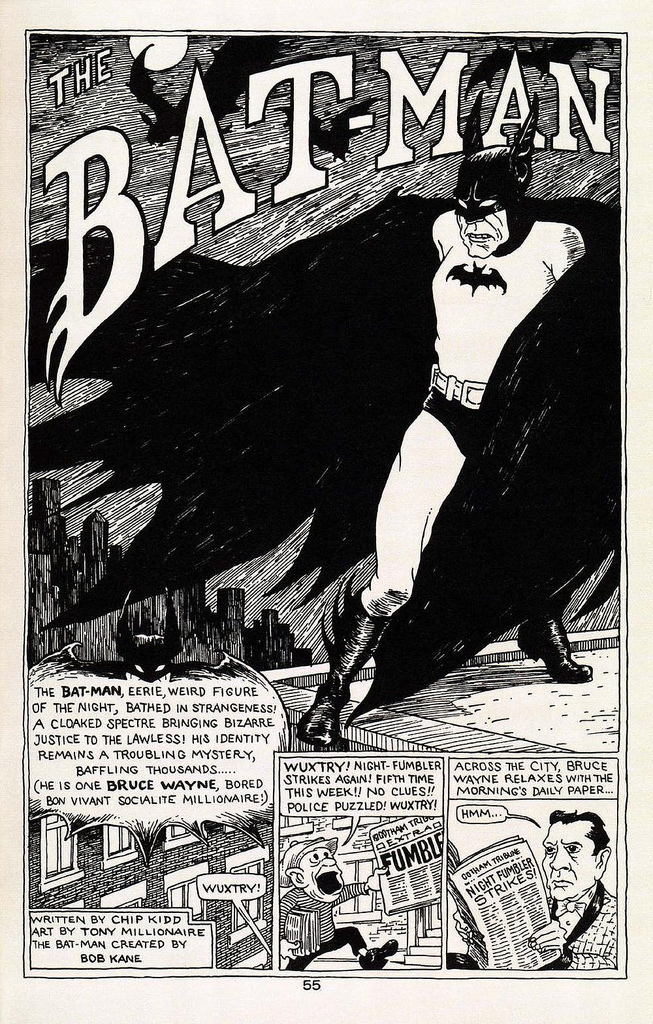
“The Bat-Man” by Chip Kidd and Tony Millionaire from Bizarro Comics #1. I can’t quite believe I haven’t seen this before… (via Martin Klasch)

Could Have Been Something — José da Silva interviews Billy Childish for The White Review:

Critics want you to get in your box and shut up. That’s why they don’t like it that I’m a writer, musician and painter. That’s totally unacceptable to their small minds… I’m looking for freedom from being categorised or identified with aspects of myself. But at the same time I use this very strong biographical information to negotiate a world – a world which I find quite mental, by the way. So I still refuse to identify myself as Billy Childish the artist,  painter, writer or musician, because in my estimation only an idiot would want to be something.

Accommodating the Mess — Tim Martin on B S Johnson,  ‘Britain’s one-man literary avant-garde’, for The Telegraph:

In principle, at least, Johnson’s declared mission echoed the great Modernist cry to make it new. Politically socialist and from a working-class London background, he cultivated pithy distrust for the complacency of his novelist peers, “neo-Dickensian” writers, as he called them, who were using a 19th-century form to gratify the “primitive, vulgar and idle curiosity of the reader to know ‘what happens next’”. A truly modern novel would seek, in Beckett’s phrase, a form to accommodate the mess, stripping readers of their escapist illusions while remaining ruthlessly true to the writer’s experience.

This obsession with so-called narrative truth runs through Johnson’s work, accounting for its most unorthodox experiments as well as its greatest flaws.

See also: Juliet Jacques review of Well Done God! Selected Prose and Drama of B S Johnson for The New Statesman.

And finally…

The mild-mannered Richard Hell in the New York Times:

After running away to New York in 1967, at the age of 17, with dreams of becoming a writer, Mr. Hell collected some good editions of favorite books. Then, in the 1970s, when he became a drug addict, he traded them for cash.

“Those were pretty much my only liquid resource,” he said. “So I sold them all over the years.”

Since getting his health and career back on track in the ’80s, he has replaced most of the ones that got away. Given the number of books now neatly stacked into the East Village apartment where he has lived for the last 38 years, he has more than made up for lost time.

Hell’s memoir, I Dreamed I Was a Very Clean Tramp, is out this week. The cover was designed by Steven Attardo.


Comments closed

Midweek Miscellany

‘The Art of Harvey Kurtzman’ curated by Monte Beauchamp and Denis Kitchen opens at the Museum of American Illustration in New York on March 6th. Boing Boing has more (via Drawger).

On a related note: Steven Heller on Al Capp at The Atlantic:

[Denis] Kitchen…loved Capp’s unpredictable plots, his sexy women, and his uncouth, often grotesque cast. But as a college student, Kitchen told me, he witnessed Capp’s transformation “from a progressive figure to a student-hating, pro-Vietnam War pal of Richard Nixon and Spiro Agnew. And not long afterward saw sex scandal headlines gut his fame. Almost overnight he lost everything.” This intense love-hate feeling toward Capp and his work is what led Kitchen to want to understand the man better.

And: Kitchen talks to Michael Dooley about the new book Al Capp: A Life to the Contrary, at Imprint:

“I thought Al Capp was a flat-out genius. That said, I had also known for many years that he had quite a dark side. I’d been collecting every article and scrap for years and interviewing any associate I could find, so I fully expected our biography to depict a deeply flawed and even tortured man…  The ‘monster’ we discussed earlier was also a devoted son and father, an often generous man with assistants and strangers, a man capable of great charity, a man who wouldn’t tolerate a racist or homophobic joke.”

(To be honest, Capp still sounds kind of irredeemable.)

Every day. Onwards. — A. L. Kennedy on writing for love (and money), at The Guardian:

The first novel was treated gently and coddled probably more than it deserved to be. This wouldn’t happen now. The short story anthology as a first book is rarer than unicorn pie. (May contain traces of horse.) The hope of making even 50% of your income as a published author any more in the UK has probably also gone – unless you are lucky enough to produce a bestseller, preferably involving porn. This may change when UK publishers discover that the production of ebooks reduces overheads as well as cover prices. Who knows – it does tend to take a while for UK publishers to notice most things. I worry in case, for example, their offices catch fire and they all burn to death over a period of weeks, coming and going, sadly unable to realise that their coffees are boiling away to nothing in their melting cups. And this is, of course, a hard time for all industries, from the sprightly to the moribund.

Kennedy’s new book On Writing has just been published in the UK by Jonathan Cape.

See also: a short interview with Kennedy in Metro.

Comments closed

Flying Eye Books

The folks behind the amazing  Nobrow Press have just launched a childrens imprint called Flying Eye Books. Their first book is Welcome To Your Awesome Robot by Viviane Schwarz.
This short film created for the launch of the imprint was storyboarded and animated by Jambonbon (James D Wilson), using the original illustrations of Ben Newman. The music was composed by Lloyd Evans.


Comments closed

Something for the Weekend

Impressionable Minds — Edward Tenner on Al Capp: A Life to the Contrary and the legacy of the controversial cartoonist, at The Atlantic:

I still think of Fosdick as Capp’s masterpiece, running postmodern-style as a comic strip within a strip and accepted good-naturedly by Chester Gould, creator of its target Dick Tracy, for whom Capp always professed the highest regard. Its greatness exists even if Capp bowed to 1950s social conservatism in marrying Li’l Abner and Daisy Mae (which his emerging rival Charles Shultz called the worst comic-strip decision ever) in 1952. Even Disney didn’t hitch Mickey and Minnie Mouse.

Yet Fosdick, who had been introduced a decade earlier, was a pivotal character, probably the most subversive of authority of any of the comic personalities, but presented with such engaging absurdity that even Dr. Fredric Wertham’s anti-comic crusade could not stop him. As Shumacher and Kitchen say, it was an adult strip—and yet it was one acceptable on a Sunday morning around the family dining table, whatever its effects on impressionable young minds.

Friends Electric — Nicholas Carr, author of The Shallows, on the difference between online and offline experiences:

The reason people struggle with the tension between online experience and offline experience is because there is a tension between online experience and offline experience, and people are smart enough to understand, to feel, that the tension does not evaporate as the online intrudes ever further into the offline. In fact, the growing interpenetration between the two modes of experience—the two states of being—actually ratchets up the tension. We sense a threat in the hegemony of the online because there’s something in the offline that we’re not eager to sacrifice.

And finally…

Who says publishing is full of over-caffeinated alcoholics?Prospero on the future of bookstores:

For a bookstore to remain successful, it must improve “the experience of buying books,” says Alex Lifschutz, an architect whose London-based practice is designing the new Foyles. He suggests an array of approaches: “small, quiet spaces cocooned with books; larger spaces where one can dwell and read; other larger but still intimate spaces where one can hear talks from authors about books, literature, science, travel and cookery.” The atmosphere is vital, he adds. Exteriors must buzz with activity, entrances must be full of eye-catching presentations and a bar and café is essential.

Comments closed

Midweek Miscellany

Toy Monkeys — Steven Heller interviews Canadian artist and illustrator Gary Taxali for Imprint:

Illustration is in rapid flux. How pictures are being used defies what we traditionally knew about illustration. Many artists are empowered by new digital media. Yet I sense a fear about the continued life of a still picture. People were talking about how illustrations needed to “move” two years ago. That’s not illustration, that’s animation. Most illustrators can’t animate. The timeless power of a still image will never leave the human psyche despite what new gadgets can accomplish.

(pictured above: I Love You, OK? by Gary Taxali, published by teNeues)

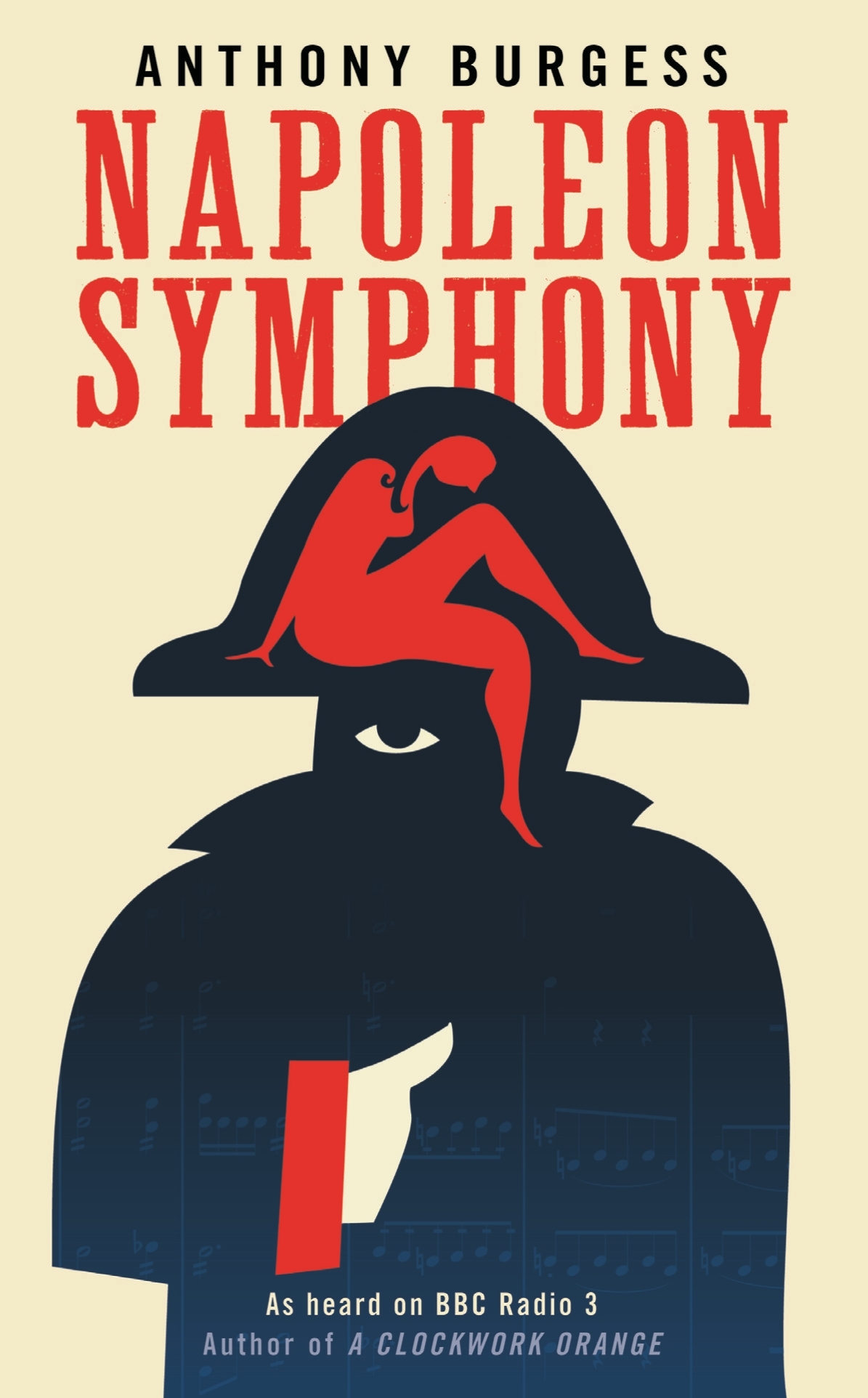
Stanley Kubrick’s 1972 rejection letter to Anthony Burgess, at Letters of Note:

I earnestly hope that our all too brief friendship will survive me telling you that the MS is not a work that can help me make a film about the life of Napoleon. Despite its considerable accomplishments, it does not, in my view, help solve either of the two major problems: that of considerably editing the events (and possibly restructuring the time sequence) so as to make a good story, without trivializing history or character, nor does it provide much realistic dialogue, unburdened with easily noticeable exposition or historical fact.

As Shaun Usher, editor of Letters of Note, points out: “Burgess was undeterred, and Napoleon Symphony was published as a novel in 1974. Kubrick’s movie, however, failed to materialise.”

Strange Places — Owen Hatherley reviews Museum without Walls by Jonathan Meades, for the London Review of Books:

What Meades does most often is praise things, especially things that are habitually ignored: he is surely our greatest exponent of what the Russian Formalists called ostranenie, ‘making-strange’. Architecture, as an art form, isn’t quite mundane enough to be made strange, and for that reason Meades would seldom recognise his writing as being about ‘architecture’ as such. Rather, it is about Place, somewhere architecture happens, at times in a very dramatic way, but doesn’t necessarily have the leading role. Architects take non-art, ‘the rich oddness of what we take for granted’, the mutability, detritus and accident that define truly worthwhile Place, and replace them with something static and unchangeable. However, unlike Iain Sinclair or the London ‘psychogeographers’… Meades does not fetishise the spaces between. ‘I have to admit to a fondness for pitted former rolling stock dumped in fields and for abandoned filling stations,’ he writes. ‘But man cannot live by oxidisation alone. It’s not a question of either atmospheric scrappiness or gleaming newbuild. It’s a question of both/and. It’s a question of the quality of the atmospheric scrappiness, the quality of the newbuild.’

And finally…

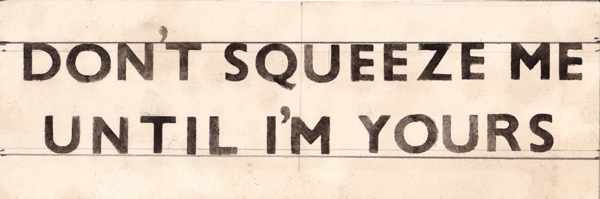
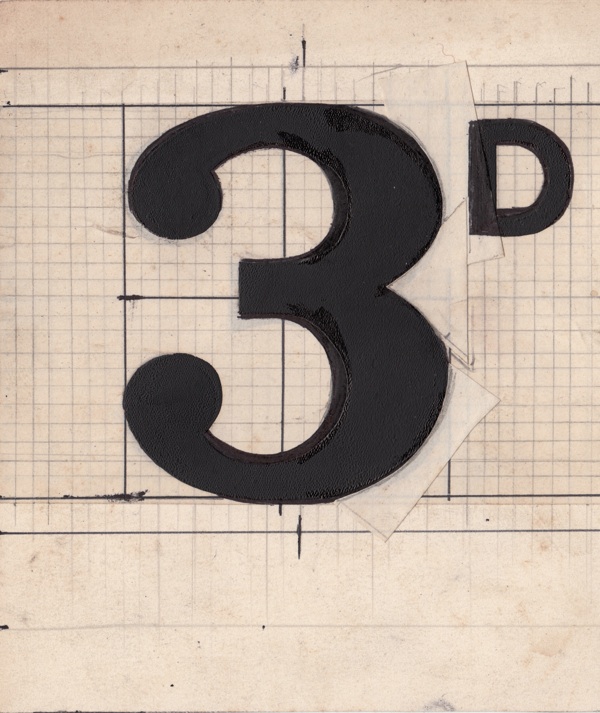
The best thing I’ve seen in ages… Roy Gardner’s designs for the sales tickets in his store Gardners’ Market Sundriesmen on Commercial St in Spitalfields, London:

No doubt knocking up these sales tickets was all in day’s work to Roy Gardner – just one of the myriad skills required by a Market Sundriesman – yet a close examination of his elegant graphic designs reveals he was also a discriminating and creative typographer.

Comments closed