
Following on from my post yesterday, Joe Sacco talks about his new book The Great War with Michael Silverblatt on Bookworm:
KCRW Bookworm: Joe Sacco The Great War mp3
Comments closedBooks, Design and Culture
Following on from my post yesterday, Joe Sacco talks about his new book The Great War with Michael Silverblatt on Bookworm:
KCRW Bookworm: Joe Sacco The Great War mp3
Comments closed
In this bonus footage from the W.W. Norton’s documentary short on The Great War, Joe Sacco explains his relationship to journalism:
1 Comment
The excellent Luc Sante reviews Inside Llewyn Davis, the Coen Brother’s movie about a Greenwich Village folk singer, for the New York Review Books:
Then again, it could be said that historical fiction, like science fiction, is really always about the present. Llewyn Davis is a creature of the here and now, not of 1961. He has none of the communitarian goodwill, the erudite passion, or the optimistic idealism that marked the period. He is a confused, irascible striver who isn’t sure what he is striving for, apparently seeking a career when folk music was about the last place you’d look for one. It is suggested that he has been flopping on friends’ floors for months, when, at the time, people generally only did that when they first hit town, since it wasn’t hard to scratch up the twenty or thirty bucks a month it took to rent a tenement flat fifty years ago.
But if you excise the period details, he makes sense. Whereas in a better time he would spend five or ten years woodshedding and developing a soul, he has no choice but to enter some kind of race right away or die on the vine. He is consistently crass because he feels threatened by people and ideas he can’t dominate—and he can’t dominate very much because he feels threatened. (How else to explain his heckling an Appalachian singer, complete with autoharp and authentically awkward?) Somehow he has made a connection to something that is genuine and profound—the haunting music—but circumstances force him to treat it as a card to play rather than as a path to explore.

As Sante notes in the review, while the film is based on musician Dave Van Ronk’s memoir The Mayor of MacDougal Street, it isn’t really about Van Ronk at all:
The impression is that of a young man who has a great many more mistakes to make in life before he wises up, if indeed such a thing is ever to happen, but who channels the accrued wisdom of the ages when he enters the folk-lyric continuum, becoming an entirely different person. This suggests a description not so much of Van Ronk—or Paxton, or Ochs, or Elliott—as of the man who upset the apple cart: Bob Dylan.
I can’t wait to see this movie.
Comments closed

Music critic Carl Wilson, author of the 33⅓ title Let’s Talk About Love: A Journey to the End of Taste, on small books for The Globe & Mail:
The little book that abounds in much: It’s a goal widely aspired to these days. The wish is that a short book can navigate both print and digital with buoyant grace, where a bigger one might capsize. “Somewhere between a long magazine article and a book” is the sweet spot that many publishers describe. They picture customers polishing off a volume on a short plane ride or a round-trip transit commute, on a tablet or in an easy-to-hold compact volume.
Such books can bring the urgency of a manifesto. They can provide literary sustenance without the commitment a thick tome demands. And, properly designed, they stoke a fetish for tiny, perfect, collectible objects.
What could be better? It’s an in-between form for transitional times. It’s a nod to collective attention-deficit and the Internet’s “too long; didn’t read” syndrome. Whether it succeeds in practice is another question: Is the little book as unsinkable a prospect as its advocates hope? Or is it a pursuit as vexed as the one in Melville’s following novel, for the great white whale?
I like short books as much as the next guy, but I’m yet to be convinced that they’re going to save publishing. And, as if prove the point, Wilson’s own short book is becoming a longer one. (On the plus side, the article was accompanied by a rather lovely illustration by Drew Shannon)
Comments closed
Boris Kachka (Hothouse) profiles Rachel Kushner, author of The Flamethrowers, for New York magazine:
It’s tempting to ask just how transgressive a novel, especially a best-selling novel, can be—and whether taking a stand against mainstream values makes you subversive or just modern. In other words: Is Kushner the flamethrower for real?
The answer is, basically, yes, in both senses of the phrase: She knows what she writes about, and she’s dead serious about her ideals. There’s plenty of room in The Flamethrowers for the dark side of that idealism—murdered businessmen, casually discarded girlfriends, movements warped by violence. In many ways it’s the subject of the book. But if something ardent and glamorizing blazes through, like the flashy World War I brigade of the title, that’s because Kushner herself is a believer, a genuine and unself-conscious exponent of what she might call the radical gesture—even if those gestures are more common now among academics and art stars than any genuine underclass. In a forthcoming interview with Tin House, she calls her shimmering mosaic of a second novel a “paean, maybe, to things that have long interested me. Nothing is in the book that I had to learn about. Instead, it is filled with things I already knew … drawn from my taste, my life, my sensibility.”
The paperback edition of The Flamethrowers is out in February 2014.
Comments closed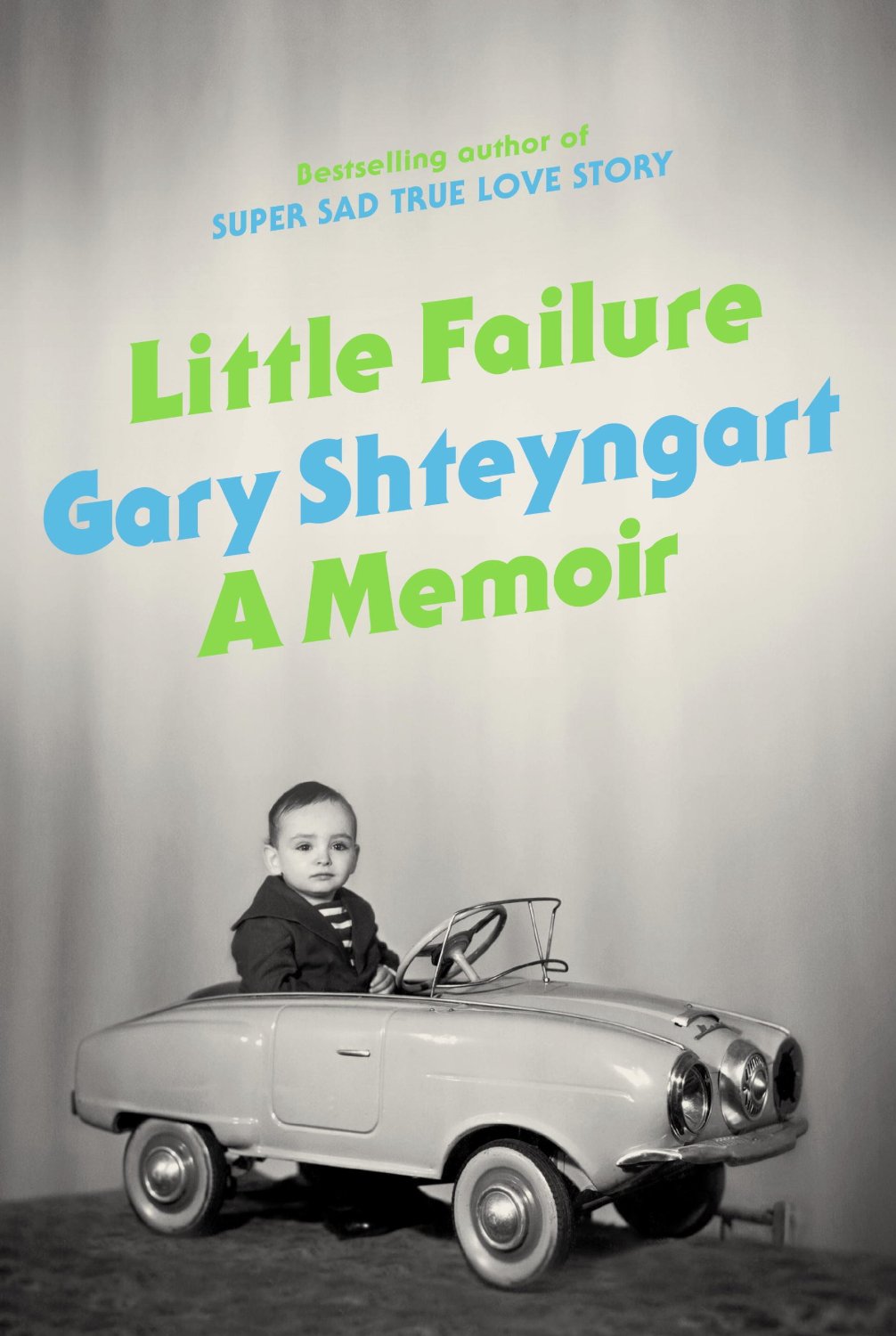
Surely just about everyone has seen this already, but in case you missed it, the new video for Gary Shteyngart’s forthcoming memoir Little Failure, which features James Franco as his husband and Jonathan Franzen as his therapist, is pretty great:
The video also stars David Ebershoff, Rashida Jones, Sloane Crosley, and Alex Karpovsky.
2 Comments
The great book designer George Salter once said that a good jacket “must be in perfect accord with the literary quality of the book. It must be even more if it is to function as an important sales factor, if it is to ‘stop’ the eye of the person passing by.” Of the thousands of books that come through the offices of the Book Review each year, these are the covers and jackets that caught my eye, that compelled me to flip them over to check the back flap to see who designed them.
If you weren’t satisfied with my 2013 covers list (and why would you be?), then the infinitely more qualified Nicholas Blechman, art director at New York Times Book Review, has selected his best book covers of the year.
Ulysses, redesigned by Peter Mendelsund for Vintage, is on Nicholas’s list, and I also liked Paul Sahre‘s design for the cover of That Smell and Notes From Prison by Sonallah Ibrahim, and the cover of Without Their Permission by Alex Ohanian designed by Oliver Munday:


We agreed on Gabriele Wilson‘s beautiful cover for Middle C by William Gass, but I think I should compile a list of all the great covers from 2013 that I’ve seen since I posted my list on Tuesday. (I’m kidding. Sort of).
Comments closed
Christopher Benfey reviews American Mirror, Deborah Solomon’s recently published biography of artist Norman Rockwell, for the New York Review of Books:
Solomon spends more time than Rockwell did worrying about his status in comparison with what she calls the “Abstract Expressionist ilk,” who “glamorized direct and unmediated gestures” and dominated highbrow taste during the 1950s. Rockwell, who was remarkably uncompetitive and nonterritorial, said, disarmingly, “If I were young, I would paint that way myself.” The Connoisseur of 1962, a painting now in the collection of Steven Spielberg that Solomon considers a “masterpiece,” depicts a balding man seen from behind, in a gray suit with hat and umbrella in hand, contemplating what seems to be a Pollock painting. The floor, bluish-gray and white squares and triangles, constitutes a contrapuntal abstraction. Rockwell had fun making his own drip painting, canvas on the floor, and had a photographer record the event just as Hans Namuth, in 1950, had famously documented Pollock wielding a can of paint over the canvas. It’s charming to learn that Willem de Kooning, a longtime admirer of Rockwell, claimed to think that Rockwell’s Pollock was better than the real thing. “Square inch by square inch,” he said, “it’s better than Jackson!”
(American Mirror: The Life and Art of Norman Rockwell is published by Farrah, Straus & Giroux, and is distributed in Canada by my employer Raincoast Books)
Comments closedI decided to go in a slightly different direction with my covers list this year (see my lists for 2012, 2011, and 2010). It’s just a straight up list of the fifty covers designs with a few annotations and links a long the way. I’m sorry for woeful under-representation of Australian and NZ designers, and for completely ignoring the entire non-English-speaking world. I will try and do better in 2014. But until then, here, in alphabetical order, are my fifty covers of 2013:
33 Comments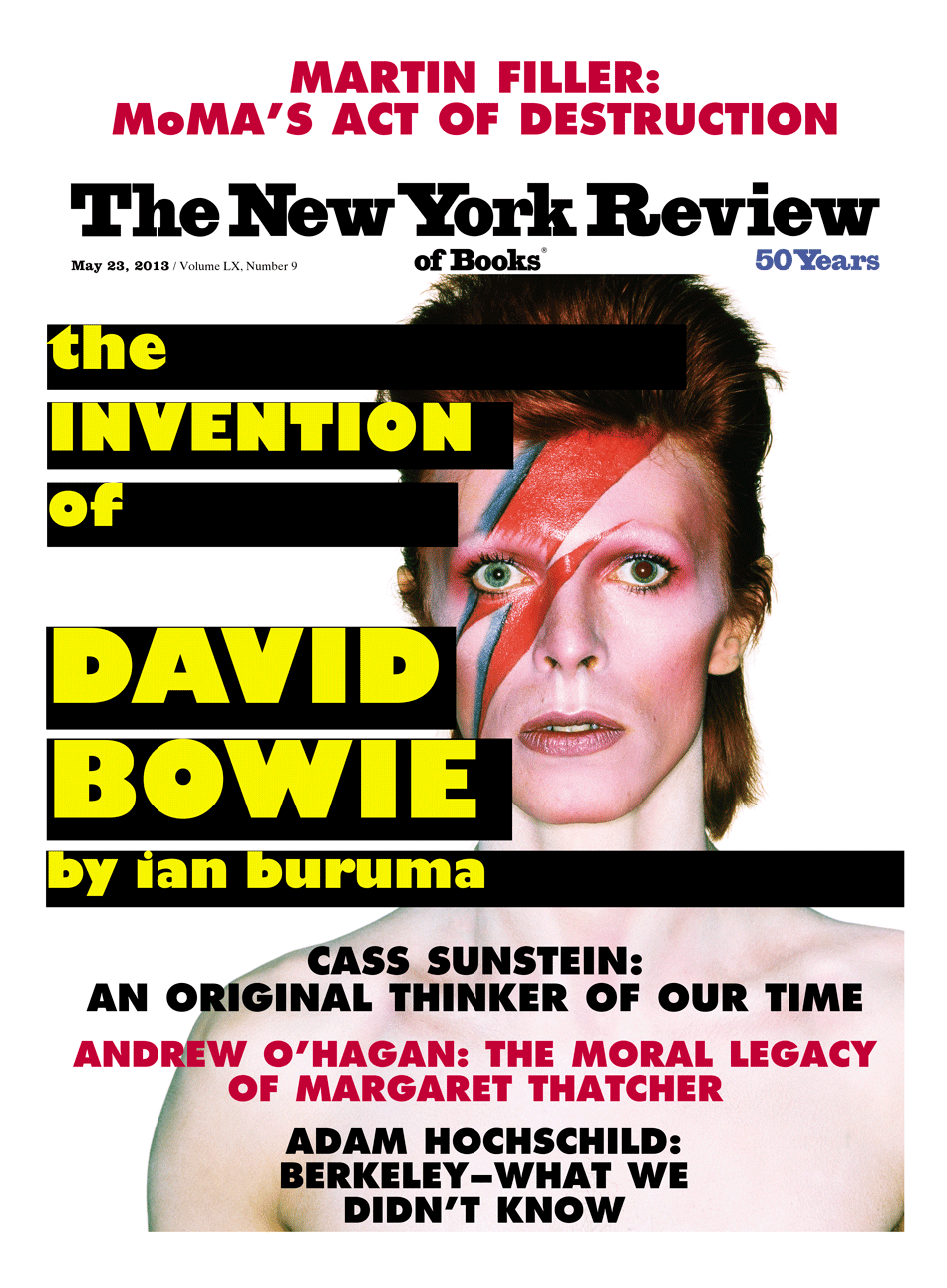
Monday’s edition of CBC Radio show Ideas featured Michael Enright in conversation with the New York Review of Book‘s co-founder Barbara Epstein, caricaturist David Levine, and long-time Vanity Fair editor Graydon Carter:
CBC Radio IDEAS: Barbara Epstein/David Levine/Graydon Carter mp3
Comments closed
Tim Parks on literature and bureaucracy for the New York Review of Books blog:
So could it be—and this is the question I really want to ask—that however much literature may appear to be opposed to bureaucracy and procrastination, it actually partakes of the same aberration? Balzac’s Comedie humaine with his declared ambition to “compete with the civil registry”; Proust’s monstrous, magnificent Recherche, which he likened to a cathedral, tediously extending the analogy to every section of the work; Joyce’s encyclopaedic aspirations in Ulysses, his claim that Finnegans Wake would be a history of the entire world. Or go back to Dante, if you like, and his need to find a pigeonhole in hell for every sinner of every category from every sphere of society. Or fast forward again to Bouvard and Pécuchet, Flaubert’s two incompetents who react to practical failure by becoming obsessive copiers of literary snippets. This without mentioning the contenders for the Great-American-Novel slot, so eager to give the impression that their minds have encompassed and interrelated everything across that enormous continent (one thinks of the interminable lists of contemporary paraphernalia in Franzen’s writing). In each case, however different in tone and content the texts, life is transformed into a series of categories, made more mental, more a matter of words and intellect; we revel in the mind’s ability to possess the world in language, rather than to inhabit it or change it.
(pictured above: Gustave Doré: Canto VII—Hoarders and Wasters, from Dante’s Inferno)
Comments closed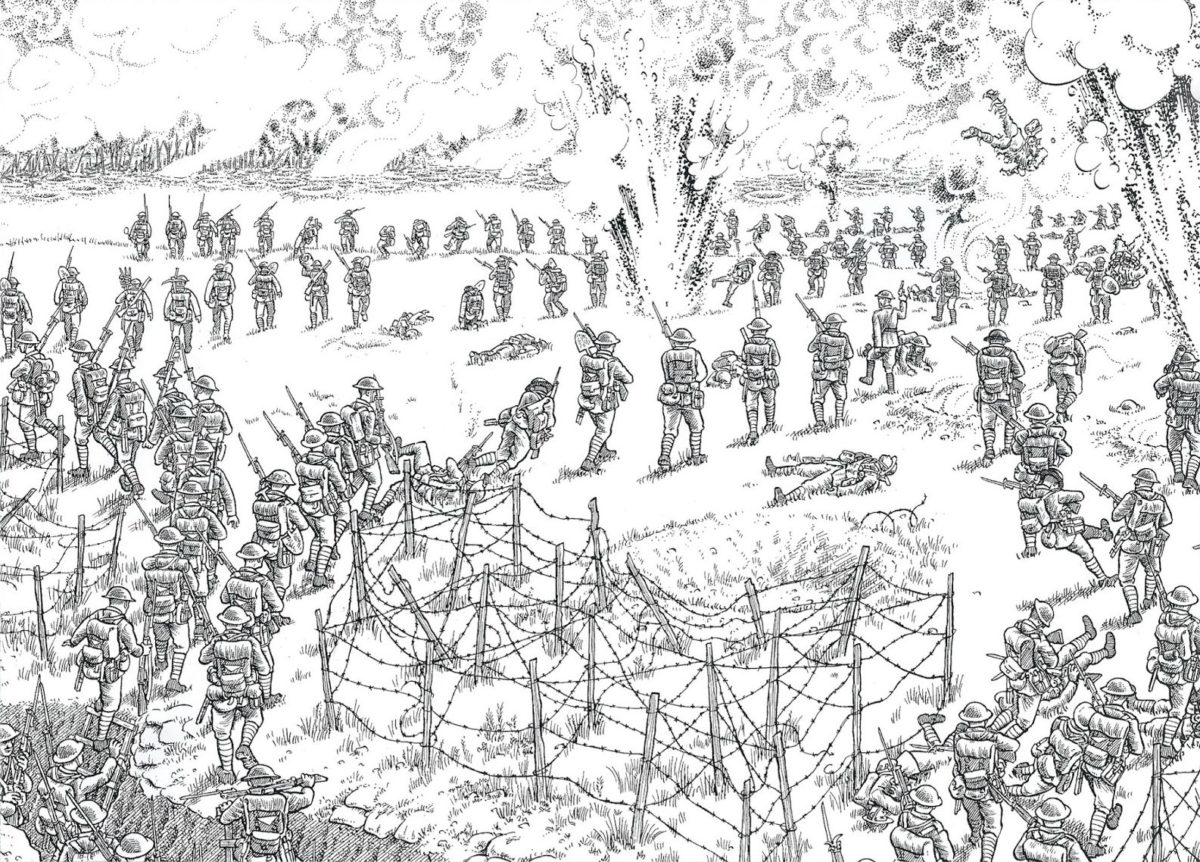
Cartoonist Joe Sacco discusses his new illustration/book The Great War in an interview at Salon:
Comments closedI think every medium has its strengths. But I think illustrated work puts the reader directly into a picture. You open up, let’s say, a comic book, and I’ve drawn a Palestinian refugee camp — you’re inside it, and with the multiple images, you’ll hopefully get an idea of the atmosphere. As a cartoonist, you’re concentrating on giving visual information — especially in the background — that can be conveyed by multiple images. And things follow the reader around. You know, the architecture will follow the reader from one panel to another, so it becomes part of the atmosphere that the reader is imbibing. With the written word, you can describe the architecture, but you’re not going to keep mentioning it as a figure is walking down the street, you’re not going to keep mentioning what the background is. With comics you can do that.