Skip to content

The Casual Optimist Posts

Auteurmatic for the People

At the New Yorker, film critic Richard Brody, author of Everything Is Cinema: The Working Life of Jean-Luc Godard (and a man with prodigious beard), offers some interesting thoughts on ‘Vulgar Auteurism’ (a new term to me, if not exactly a new idea) and the legacy of the New Wave:

In opposition to the constipated naturalism of the art-house consensus—whether the one that prevailed sixty years ago or that of today—crudeness has an intrinsic merit, and it’s easy to detect the same impulse behind [Vulgar Auteurism] and Godard’s decision to dedicate “Breathless” to the B-movie studio Monogram Pictures. Getting rid of prejudices—acknowledging that there’s no such thing as intrinsically good acting or cinematography or direction, but only the evidence of artistic inspiration—is as great a discovery for critics as for filmmakers. From the start, Godard repudiated the false merits of so-called production values, but he invested the film not with the elements of the usual Monogram movie but with a rich and complex collection of high-art references, intellectual divagations, and documentary-based techniques, all held together by an aesthetic philosophy that owed more to Sartre than to Hawks. His praise of cheapness and scruffiness wasn’t in the service of those qualities but of the virtues of the grandest, greatest art and ideas he knew. The hat tip to the gangster genre served to embody his most intimate emotions and personal experiences—and, for that matter, to suggest the way that those very intimacies had become tied up, for better or worse, with the experience of moviegoing.

New Yorker

Comments closed

Ryu Murakami Cover Designs by David Pearson

I’ve already posted a couple of David Pearson‘s cover designs for the new Pushkin Press editions of Ryu Murakami’s novels, so I thought I might as well put them all in one place:


 Popular Hits of the Showa Era by Ryu Murakami; design by David Pearson


 Sixty-Nine by Ryu Murakami; design by David Pearson


From the Fatherland, with Love by Ryu Murakami; design by David Pearson


Coin Locker Babies by Ryu Murakami; design by David Pearson

Comments closed

Beauty in Danger


The rather lovely experimental animated short Beauty in Danger is collaboration between MK12 and New York-based artist Brian Alfred, with a score by Ian Williams from Battles. I don’t know what it means, but I’m not sure it matters…

And if liked that (and why wouldn’t you?) now would seem like a good time to remind you about MK12’s short experimental film TELEPHONEME from a couple of years ago.

Comments closed

Found: Photographs from the National Geographic Archive

If you’re not following the National Geographic‘s Tumblr Found, you really should be — it’s terrific. More than a few of the photographs, especially those of 1950’s and 60’s America, have a quietly Ballardian, drinking at the edge-of-darkness, Cold War chill:


Sightseers park to watch a Stratocruiser taxi across an underpass in Queens, New York, March 1951.
PHOTOGRAPH BY B. ANTHONY STEWART, NATIONAL GEOGRAPHIC


The glow of an atomic bomb test draws Las Vegas casino workers, March 1953.
PHOTOGRAPH BY VOLKMAR K. WENZTEL, NATIONAL GEOGRAPHIC


People on steep slope overlook western headland of Martha’s Vineyard, August 1950.
PHOTOGRAPH BY ROBERT SISSON, NATIONAL GEOGRAPHIC


A couple inspects a beach house destroyed after a storm in March 1962.
PHOTOGRAPH BY B. ANTHONY STEWART, NATIONAL GEOGRAPHIC


Fifty-two stories high, city noises fade and vistas expand. Chicago, June 1967.
PHOTOGRAPH BY JAMES L. STANFIELD, NATIONAL GEOGRAPHIC

1 Comment

Cartoon College


Following a group of aspiring indie cartoonists struggling through two gruelling years at the Center for Cartoon Studies in White River Junction, Vermont, and featuring candid interviews with the likes Chris Ware, Scott McCloud, Lynda Barry, Charles Burns, Françoise Mouly, Art Spiegelman and Jules Feiffer, Cartoon College looks like a fascinating documentary about “one of the world’s most tedious artistic disciplines:”

The film was released on iTunes this week, with the DVD available in July.

Comments closed

Ryu Murakami: Against the Mainstream


Pushkin Press have posted an interesting Q & A with author Ryu Murakami, whose new novel, From the Fatherland, with Love, was published last month:

For me, there’s nothing ordinary or routine about writing novels, though I’ve been doing it for thirty-seven years. When I write, even now, my brain is in a mode that’s different to everyday consciousness. So the words always come; I never find myself unable to write. Perhaps the fact that I consider myself a “cult novelist” helps. Though I’m famous in Japan and have achieved some status as an author, my works are by no means mainstream. They aren’t really accepted by the majority, and I don’t imagine that most people here understand them. And that motivates me to keep on writing.

The rather splendid cover is by David Pearson, I believe.

Comments closed

Tim Parks: The Romance of Train Stations

Taken from his new book, Italian Ways: On and Off the Rails from Milan to Palermo, Tim Parks considers the emotional drama of the Italian train station:

The train station is the ideal scenario for greetings and farewells. The car is too banal. What does it mean to set off in a car? Nothing. The airport is too exhausting and impersonal, the plane itself remote, unseen, the barriers and security disturbing. Here the powerful beast of the locomotive thrusts its nose under the great arch of the station. The lines straighten from the last bend. Clanking and squealing, the train slows. The last moments of waiting begin. Eyes focus on the platform, keen to possess their loved ones; in the train corridor, meanwhile, the long-awaited beloved is jostling and jostled, luggage at his heels. The train slows, slows, slows, teasing everyone on both sides of the divide, making them wait, making them savor the tension between absence and presence.

The cover design is by the talented Jaya Miceli by the way…

Comments closed

Art Shay: The Sporting Life and Times

A short film about writer and photographer Art Shay, who shot pictures regularly for Sports Illustrated, Time, Life, Fortune, the Saturday Evening Post, Forbes, Business Week, Parade and the New York Times Magazine:

An exhibition of Shay’s photographs, ‘Art Shay: The Sporting Life & Times,’ will run from June 20 through September 30 at the HDC studios in Milwaukee.

(pictured above: Art Shay with Nelson Algren, author of The Man With the Golden Arm)

Comments closed

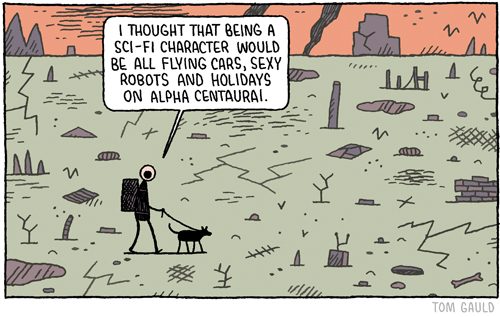
Flying Cars, Sexy Robots and Holidays on Alpha Centaurai


Didn’t we all… (Tom’s new collection of comics, You’re All Just Jealous of My Jetpack, is out now.)

Comments closed

Boards of Canada: Electronica By Hand

The New York Times interviews Mike Sandison and Marcus Eoin of the Boards of Canada:

I think the digital world suffers from being just so literal, so deliberate and sober. As with digital photography, people have gotten used to applying simulated filters onto their pictures just to inject a bit of romance into the thing, because the raw pictures are so flat. But in the analog realm these beautiful things just happen by themselves without your conscious effort. You could say the wobbles and flutters in our music are equivalent to something like weeds overgrowing an old building. Nobody puts the weeds there, but nature comes along and makes the scene very tragic and beautiful.

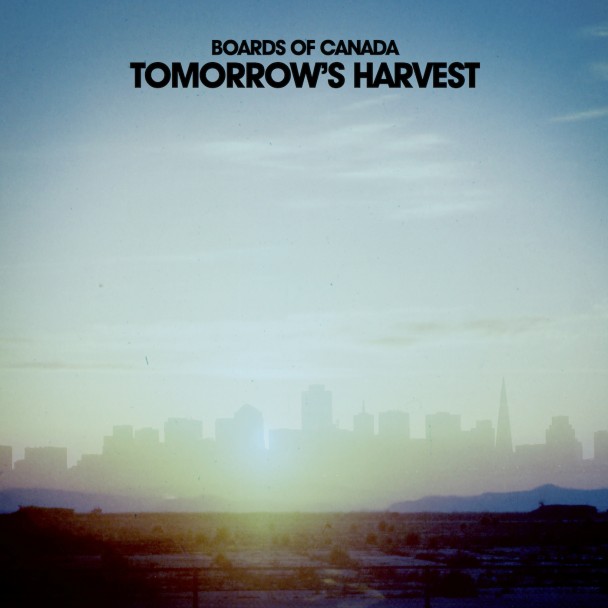
Dorian Lynskey (who wrote 33 Revolutions Per Minute: A History of Protest Songs from Billie Holiday to Green Day) reviews the new Boards of Canada album, Tomorrow’s Harvest, for The Guardian:

Tomorrow’s Harvest is their most cinematic and vast-sounding album yet, suggestive of barren plains and burning skies, wonder and dread, watching and being watched… It’s the kind of music that gives rise to strange notions. Boards of Canada sow a few clues as to their own intentions while leaving space for each listener’s pet theories. The title of the loping, suspenseful Jacquard Causeway seemingly indicates French geneticist Albert Jacquard, a proponent of “degrowth”: the idea of increasing happiness by working and consuming less. Alongside such titles as Sick Times and Collapse, it implies a concern with dwindling resources which infects the album title with apocalyptic menace akin to John Christopher’s 1956 eco-horror novel The Death of Grass.

Certainly this track, ‘Reach for the Dead’, sounds like music from a lost dystopian science fiction movie:

Comments closed

Garry Winogrand: The Photographer as Addict

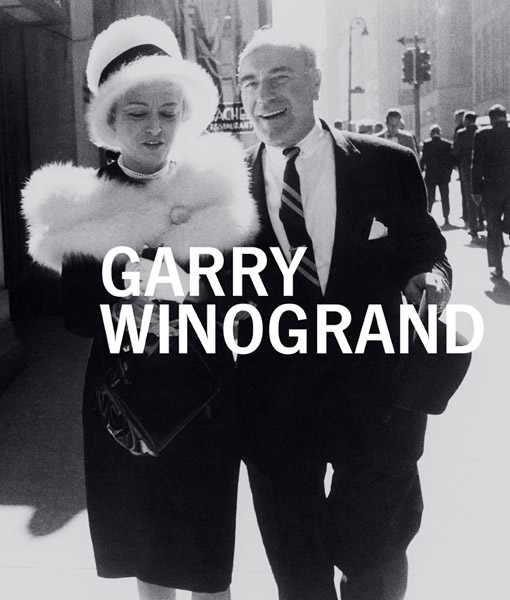
Geoff Dyer reflects on the recent Garry Winogrand exhibition at the San Francisco Museum of Modern Art (or its catalogue, at least) at the London Review of Books:

The more you feed the Winogrand habit the more Winogrand you crave. Partly this is because of the sheer quantity of data amassed by Winogrand, the mind-blowing amount of information he provided about the social landscape of America in the 1960s and 1970s: suits, dresses, jackets, lapel widths, hairstyles, body shapes, faces, drinks, food, cigarettes, architecture, airports, pets, cars – everything. But it’s far more than the thoroughness and extent of this animate inventory that makes Winogrand so important. Taking his lead from Georg Lukács, George Steiner wrote of Balzac that when he ‘describes a hat, he does so because a man is wearing it.’ Granted, in photography hats are forever being verbed – worn, carried, tipped – but it’s helpful to see Winogrand as a visual novelist whose work was a sprawling human comedy. Or perhaps as a dance to the stilled music of photographic time, with a cast of thousands, that stood no chance of ever being completed. (Winogrand admired Norman Mailer, rivalled him in scope, energy, ambition – and in a disdain for any internal system of brakes. As it happens, he photographed Mailer at his fiftieth birthday party in 1973, on the receiving end of a finger-wagging lecture from a guest, so that the picture seems silently captioned by the Winograndian imperative: ‘Look!’)

Is there a word for something that is very much of Geoff Dyer? Dyerian? Geoffian? Anyway, this is that.

London Review of Books

Comments closed

Janet Malcolm: The Messiness of Truth

Zoë Heller reviews Janet Malcolm’s new book, Forty-One False Starts: Essays on Artists and Writersfor the New York Review of Books:

Mess has always inspired fervent emotions in Janet Malcolm. It agitates her. It depresses her. She considers it her enemy. The job of a writer, she likes to remind us, is to vanquish mess—to wade onto the seething porch of actuality, pick out a few elements with which to make a story, and consign the rest to the garbage dump. Images of clutter and panic-inducing domestic chaos crop up frequently in her work, not just as metaphors for the failure or absence of art, but as advertisements for her own narrative discipline. This is what real life looks like, they tell us. This is the tedium and confusion that Malcolm’s elegant rendering of things has spared you. 

But if literal messes appall Malcolm, they also fascinate and attract her… Malcolm has a secret, writerly sympathy for the hoarder. She understands the mad desire to hold on to every piece of accumulated material, the fear of throwing out something precious. Art, she is fretfully aware, can be too ruthless in its cleaning operations… There is something awe-inspiring and at the same time a little barren about an environment from which all trace of “disorderly actuality” has been removed.

New York Review of Books

Comments closed