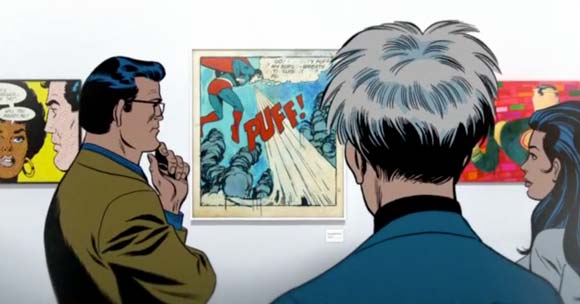
Superman through the years in two minutes:
There’s a list of annotations on the DC Comics blog.
Comments closedBooks, Design and Culture
Superman through the years in two minutes:
There’s a list of annotations on the DC Comics blog.
Comments closed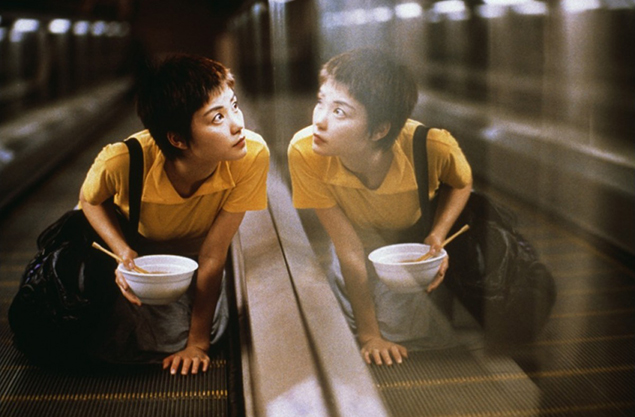
Kevin Phipps on Wong Kar-wai’s hypnotic 1994 film Chungking Express at The Dissolve:
Much of the melancholy beauty of Chungking Express—and later Wong films, for that matter—comes from missed connections, mad love, and soured romances, pairings with little chance of working out, however much heat they might generate in the moment. In many of his later films, the bitterness started to overwhelm the sweetness. (There are few movies more romantic than In The Mood For Love, but also few as inescapably sad.) Shot quickly and loosely in the middle of a place staring down enormous change, Chungking Express ultimately feels more sweet than bitter, defined by a tone of long-shot hopefulness and a sense that maybe it might all work out for those heartbroken young people—the ones whose beautiful faces and sad eyes Wong casts in the neon glow of a terrible, wonderful, forever-changing city, as they watch the first acts of their youth draw to a close.
I loved Chungking Express the first time I watched it. I had never seen anything like it, and was probably the perfect age too. It’s hard to believe it was nearly 20 years ago.
And now you too can have California Dreamin’ stuck in your head for the rest of the day:
Comments closed
I missed this during Banned Books Week, but with Halloween and Bonfire Night around the corner, it still seems somewhat timely…
At Print magazine Michael Dooley looks back at the comic books featured in Fredric Wertham’s infamous 1954 book The Seduction of the Innocent: The Influence of Comic Books on Today’s Youth.
Part one deals with “subliminal nudity, women’s ‘headlights,’ and the fascism and homosexuality of DC superheroes.” Part two, as Dooley gleefully notes, delivers “pages of eye injuries, Nazi vampires and teenage dope fiends.”


Dooley makes it clear he wants to “bury Dr. Fredric Wertham,” so don’t expect a lot of context (if you want more to read more about it, pick up The Ten Cent Plague by David Hadju), but hell, it’s fun anyway.
‘An Uncensored Look at Banned Comics’, a full-length story on banned comics, will appear in Print‘s February 2014 issue.
Comments closed
After illustrating the special sex issue of the New York Times Book Review last week, cartoonist Grant Snider has turned his cover illustration and two unused sketches into a series of posters titled The Joy of Reading. The posters are available from Grant’s shop.


Design is One, the new documentary film by Kathy Brew and Roberto Guerra about designers Lella and Massimo Vignelli, opened at the IFC in New York yesterday:

Dear Mr. Watterson is a documentary film about the impact of Bill Watterson’s beloved comic strip Calvin & Hobbes:
The film was funded by Kickstarter, and will be in theatres and available ‘on demand’ on November 15th, 2013.
(via Coudal)
Comments closed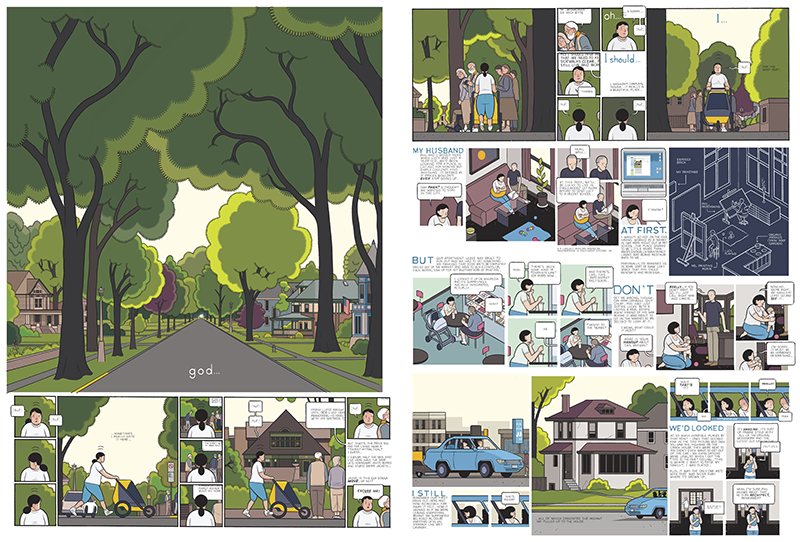
Following his appearance at the Edinburgh international book fair, Cartoonist Chris Ware spoke with Stuart Kelly of The Guardian about his recent work Building Stories:
Comments closed“As soon as a screen can produce something that can move, it becomes a passive medium, whereas I feel that comics are a very active medium. The appeal is they masquerade as a passive medium, but they’re not at all. It takes a lot of effort to read comics, even though it seems like they’re easy. It seems like they need to be fixed on paper to have a certain power – my wife always tells me never to use the word magic, but I can’t help it, there is no other word: there is a magic when you read an image that you know doesn’t move but you have a sense that something is moving, if not on the page then in your mind.”

The latest issue of the New Republic looks at the book publishing industry and it includes an article by Evan Hughes on the relative health of the book business:
At the individual level, everyone in the trade—whether executive, editor, agent, author, or bookseller—faces threats to his or her livelihood: self-publishing, mergers and “efficiencies,” and, yes, the suspicious motives of Amazon executives. But the book itself is hanging on and even thriving. More than any major cultural product, it has retained its essential worth.Of course, publishers think that $9.99 is still too low for popular e-books, an assessment that drove their ill-fated effort to work with Apple to take control of what they cost… It may be that a higher price would be more equitable. But other media still have reason to look at the relative economic health of the book with envy.
There is also includes a much-tweeted interview with literary agent Andrew Wylie. Wylie is, of course, eminently quotable (I think my favourite line from the interview is this: “We’re selling books. It’s a tiny little business. It doesn’t have to be Walmartized.”) and interviewer Laura Bennett has posted some choice outtakes from her print piece.
Comments closed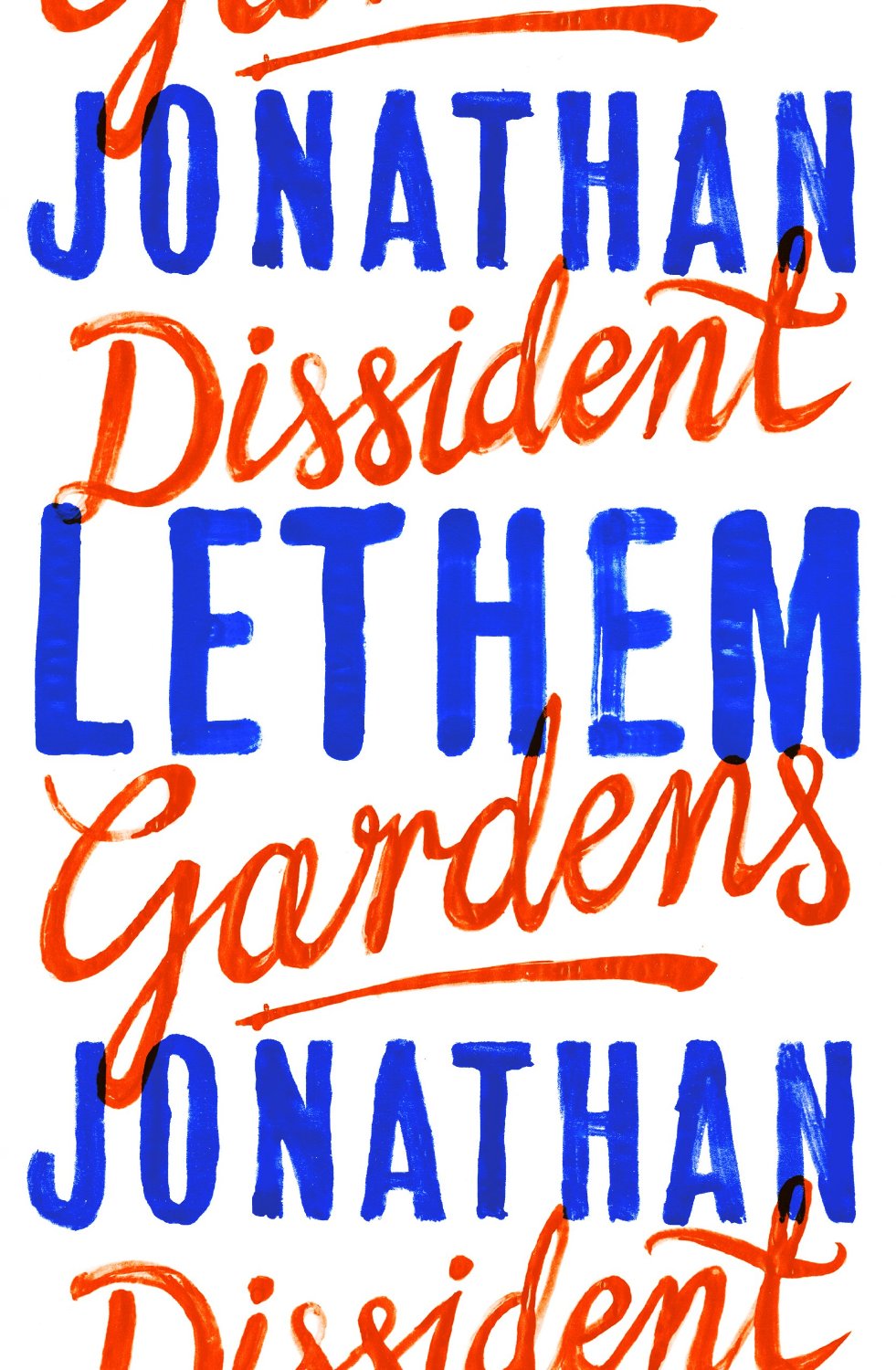
Jonathan Lethem discusses science fiction, comics and his new novel Dissident Gardens with Jesse Hicks at The Verge:
Comments closedI like that Philip K. Dick and the science fiction writers that I fell in love with were intrinsically in this termite role, nibbling around the edges of the culture. I know it was uncomfortable for them, and it certainly didn’t pay as well as they might have liked, but it meant that their work had a relevance and vitality and disreputable energy that, for me as a younger reader, hands-down won over the official literary product of the same time period.
Though one of the things that’s wrong with marginal identities is that you tend to act as though the big hegemonic center is all one thing itself. “The mainstream” doesn’t agree with itself or make any kind of sense or have a coherent position, except in the very small matter of believing itself to be the only action. That’s the only thing it agrees about. [laughter] The rest of it, if you really pay any attention and care, and I started to care about all kinds of novels and all kinds of literary ventures, and possibilities — different kinds of lives that writers led — the rest of the mainstream is pretty much at one another’s throats over various matters of style and politics, minor grudges and so forth. But it looks like one big thing if you’re in exile from it.

(This has been doing the rounds, but it is kind of great…)
Letters of Note has published the letter Steve Albini sent to the band Nirvana, prior to recording their final album In Utero, laying out his methodology:
Comments closedI like to leave room for accidents or chaos. Making a seamless record, where every note and syllable is in place and every bass drum is identical, is no trick. Any idiot with the patience and the budget to allow such foolishness can do it. I prefer to work on records that aspire to greater things, like originality, personality and enthusiasm. If every element of the music and dynamics of a band is controlled by click tracks, computers, automated mixes, gates, samplers and sequencers, then the record may not be incompetent, but it certainly won’t be exceptional.

I’ve been a fan of Luke Pearson‘s work since picking up a copy of Hilda and the Midnight Giant from Nobrow Press a year or so ago. The beautiful illustrations, quality printing and oversize format gave it the exotic feel of the comics albums British school kids used to sneak back from vacations in France (and maybe still do?). Despite my immediate sense of nostalgia, the comic itself was fresh, different and delightfully free of cynicism. I read it over and over with my kids, and then savoured it on my own after they were asleep.
Happy to find a kids comic that adults could also love, I quickly went back and found a copy of Hildafolk (recently reissued in hardcover as Hilda and the Troll) and bought Hilda and the Bird Parade as soon as it was published. While seemingly drawing inspiration from Northern European stories and Tove Jansson’s magical Moomin books, Hilda’s world has it’s own, unique mythology — a strange wood man, truculent elves, troll rocks, sea spirits, salt lions, flying furballs, and lonely, ancient giants. The wide-eyed and blue-haired child and her mother are a curious and reassuring modern presence in this old and magical world. The fantastical is everyday to them — something to be fitted around work and school. Their problems are the problems of the real world — where to live, how to make friends with the neighbours, how to do the right thing…

This juxtaposition of the modern and the magical is also evident in Luke’s comics for adults. But where the Hilda comics are unabashedly bright and joyful, the adult comics are filled with melancholy and sadness. Like Kevin Huizenga‘s Glenn Ganges comics, the fantastical in Luke’s adult comics is shadowy, nightmarish, and all the more unsettling for its appearance in mundane, familiar settings. The monsters and ghosts in stories like like You Mustn’t Be Afraid (included in the anthology Nobrow 7: Brave New Worlds), and the full-length graphic novel Everything We Miss, are the personal demons (sometimes scary, sometimes familiar) of the world weary, not the new friends of a child in unexplored territory. But for all their apparent differences, at their heart the Hilda stories and Luke’s adult comics are fundamentally about the same things: people, relationships, and about understanding one’s place in the world.
I recently spoke to Luke for the Raincoast Blog about ‘The Boy Who Drew Cats,’ his wonderful contribution to the newly published kids anthology Fairy Tale Comics. Here, we talk about his influences, his comics and his book cover illustrations. We corresponded by email.

When did you first start drawing comics?
When I was very young. I think I probably started drawing speech bubbles as soon as I figured out how to draw people. I used to draw comics about a character called Super Rabbit and show it to my grandparents.
Did you always want to be a professional cartoonist?
I probably did at some point when I was a child. It was obviously something I always thought about, but I was only really familiar with the smallest selection of comics and was entirely ignorant to how the industry worked, so it seemed like a crazy, unachievable dream to ever expect to get to that point. I eventually wound up going to university to study illustration and going into that I was prepared to basically just try and be an illustrator and it was only through the process of that that I remembered that comics were something that I still liked doing and that it was actually weird that I wouldn’t be doing them.

What was the inspiration for the Hilda books?
I draw really heavily on Scandinavian folklore (particularly Icelandic and Norwegian) for the Hilda comics. I got hooked on that initially from researching Icelandic folktales for a map project we were set at university. I really liked how strange and low-key they were. Not much happens and then the weirdest thing will happen, but it’s described really plainly and matter-of-factly and then it will end really abruptly. I tried to fuse some of the stuff I’d read for that with memories from an earlier family holiday to Norway which had a big effect on me and set a bunch of ideas in motion that for a long time I had nothing to do with.

The series has drawn comparisons to Tove Jansson beloved Moomin stories. Has Jansson been an influence on your work?
The 1990 tv series was my first exposure and I always felt like it was key in the shaping of my psyche somehow. I came relatively late to discovering the full breadth of what she did. If I had to choose to have an idol, I guess she would be it, maybe. So obviously she is a big influence on me, as a cartoonist, illustrator and a writer. I always feel a bit weird about any comparison though, because I can’t tell if it’s meant kindly or if it’s more like ‘I can see where you steal your ideas’. Hilda was designed very self consciously, at least initially, to resemble a kinder Little My.

Your contribution to Fairy Tale Comics, ‘The Boy Who Drew Cats’, has a similar magical quality to Hilda. What attracted you to the story?
It was actually one of a couple of stories suggested to me by Chris Duffy, who edited the book. I liked how far removed it felt from the kind of Brothers Grimm stories that I generally think of when I think ‘fairytales’. It’s more like a horror story with a lot of weird details that seemed fun to me. I liked the Japanese setting. I was also completely unfamiliar with it so I didn’t have to feel the weight of past interpretations on me as I adapted it.

I love that the child at the centre of ‘The Boy Who Drew Cats’ looks a lot like Harold from ‘Harold and the Purple’ Crayon. Has Crockett Johnson been an influence on your work?
Actually no! I’m not super familiar with Crockett Johnson’s work at all. He actually started off as Charlie Brown and then I pulled his features around a bit.

Do you approach your comics for kids differently from your adult comics?
I think this is the only kids comic I’ve done that isn’t a Hilda comic. Usually I’d point out that I draw my kids comics (Hilda) in a different style to how I tend to draw my adult stuff. I guess really I’m just talking eyes here. Hilda is full colour with big eyes and my other comics tend to be limited colour with dot eyes. This is full colour with dot eyes so I guess it sits in the middle. Less superficially, I’d say I try to be really clear in regards to storytelling and try and wrap things up neatly with my children’s work.
Briefly, could you describe your working process?
I generally draw and ink on paper, scan, colour in photoshop. I switch between brush pens, brushes, fineliners and dip pens. I don’t have any particular paper that I always use. I’m starting to enjoy occasionally inking in photoshop now, which I’m just using a wacom tablet for.

How is illustrating a book cover different from drawing comics?
Other than involving the same technical skills, it’s different in every way. I guess you are kind of trying to ‘tell a story’ with a cover, but really you just want to create an image that’s striking, intriguing, aesthetically pleasing and somehow captures the tone of the book. I’d say it feels a lot easier than a comics page, because you can just spend all your time fine tuning and perfecting this one thing until it’s ready, rather than having to worry about fifteen different images and making sure they all look good and all fit on the page and make sense when read one after the other. That said, it’s a totally different thing and requires different skills.

Are there any books you would love to illustrate?
Watership Down or something by Franz Kafka. I wouldn’t want to do them in the style I draw my comics though. My taste in book covers is not quite in sync with the ones I’ve actually drawn.
What have you read recently?
I just finished reading Tenth of December by George Saunders. I just bought a couple of collections of Michael Dougan comics which I really like.
How did you get involved with Adventure Time?
I got an email asking if I wanted to take a storyboard test, which I took and I guess they liked it. There’s no interesting story there really. I’ve boarded on two episodes so far, ‘Candy Streets’ and ‘Frost & Fire’ and should be doing some more some time soon.

Where do you look for inspiration, and who are some of your cartooning heroes?
I try to just pay attention to things and take everything in as inspiration in some way or another. But you know, I also just look at tumblr and stuff like every one else does. Some of my heroes are Tove Jansson, Chris Ware, Osamu Tezuka, Gene Deitch and Philippa Rice.
Who else do you think is doing interesting work right now?
Loads of people, but the more I list the more I feel like I’m missing out. My favourite cartoonist right now is Anatola Howard.
Have you thought about creating web-comics?
Yes, but I can’t see myself ever having a dedicated site for a specific regularly updated comic. I usually put my shorter comics online if I can and I wish I could do that more often. I can definitely see myself doing a regularly updated thing for a limited period of time at some point.
Do you worry about the future of books and print?
I can’t say it’s ever kept me up at night.
Thanks Luke!
2 Comments