Skip to content

The Casual Optimist Posts

Gene Luen Yang: The In-Between World of the Graphic Novelist

The New Yorker‘s book blog Page-Turner have posted a wonderful interview with cartoonist Gene Yang:

I grew up reading comics, and I just have this deep attachment to the medium. I think a lot of the things in my life that I become most passionate about, and most excited about, are all from comics…  In traditional Asian arts, the word and the picture always sit next to each other. I have an aunt, a Chinese brush painter, who told me that when you do a Chinese brush painting, you have to pair the image up with some poetry. A complete work is not masterful unless both of those elements are masterful. So maybe there’s some sort of attachment there—the idea of words and pictures working together is part of my family history.

You can read my interview with Gene, posted yesterday, here.

1 Comment

Q & A with Gene Luen Yang

I wouldn’t be surprised if you were feeling a little disillusioned with comics right now — frictionless superhero movies that deliver ever-diminishing emotional returns; ham-fisted editorial decisions; disputes over rights, compensation and artwork; violence; stupidity; institutional misogyny and racism; and generic blandness will do that.

Beyond the multiplexes and controversies, however, it is actually a quite an exciting time to be reading comics.

There are signs — Brian K. Vaughan and Fiona Staples‘ space opera Saga, Hawkeye by Matt Fraction, David Aja and Javier Pulido, and Scott Snyder and Greg Capullo‘s horror-driven Batman spring to mind — that genre comics may still have some life in them.

Classic series and newspaper strips are being properly curated and are more available than before. Under-appreciated artists are being rediscovered.

Alternative cartoonists such as Peter Bagge, Alison Bechdel, Chester Brown, Jaime and Gilbert Hernandez, Rutu Modan, and Chris Ware are producing some of the best work of their careers. The art of Daniel Clowes and Art Spiegelman is being recognised with gallery exhibitions.

And sitting somewhere between in the alt. auteurs and the superheroes, cartoonists like Emily Carroll, Becky Cloonan, Tom Gauld, Faith Erin Hicks, Hope Larson, Bryan Lee O’Malley, Luke Pearson, Noelle Stevenson — artists who have absorbed a diverse range of influences — are carving out niches for themselves, often combining and subverting genres and styles to produce uniquely personal visions.

It’s in this last, loose group of cartoonists1 — the one between the experimental and the mainstream — that I’d put artist and writer Gene Luen Yang.

Best known for his work on the Avatar: The Last Airbender graphic novels, and the critically acclaimed American Born Chinese, Gene’s most recent work is Boxers & Saints, an ambitious two-volume historical graphical novel telling parallel stories of two young on the opposite sides of the Boxer Rebellion. Already shortlisted for the National Book Award for Young People’s Literature and listed amongst Publishers Weekly‘s best books of the year — it is a remarkably mature, compassionate, and accomplished work that is at times funny, at times tragic, but always very human.

I recently met Gene while he was in Toronto to promote Boxers & Saints. I was impressed by his thoughts on being a cartoonist and on the medium itself, and we spent a good couple of hours talking books, comics, and movies. We have since corresponded by email for this Q & A.

American Born Chinese and Boxers & Saints are distributed in Canada by my employer Raincoast Books, and parts of this interview have appeared previously on the Raincoast blog.

  1. These are, admittedly, all very arbitrary, untidy and personal lists and categorizations — nobody who’s interesting fits exactly.
2 Comments

Nabokov’s 1964 Playboy Interview


Longform has posted a Playboy interview with Vladimir Nabokov from January 1964:

When I remember afterwards the force that made me jot down the correct names of things, or the inches and tints of things, even before I actually needed the information, I am inclined to assume that what I call, for want of a better term, inspiration, had been already at work, mutely pointing at this or that, having me accumulate the known materials for an unknown structure. After the first shock of recognition—a sudden sense of “this is what I’m going to write”—the novel starts to breed by itself; the process goes on solely in the mind, not on paper; and to be aware of the stage it has reached at any given moment, I do not have to be conscious of every exact phrase. I feel a kind of gentle development, an uncurling inside, and I know that the details are there already, that in fact I would see them plainly if I looked closer, if I stopped the machine and opened its inner compartment; but I prefer to wait until what is loosely called inspiration has completed the task for me.

(read the full interview)

Comments closed

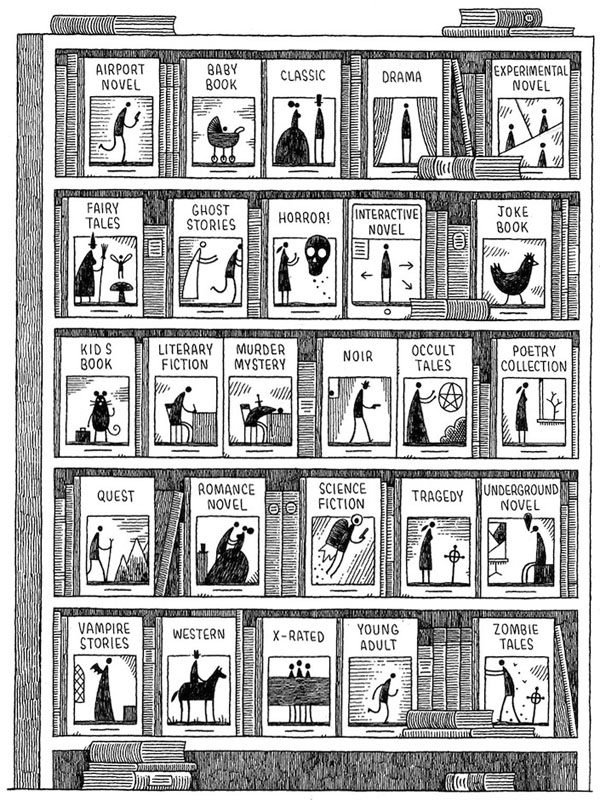
An Alphabet of Books by Tom Gauld

Tom currently also has a new ‘A Noisy Alphabet‘ print for sale.

Comments closed

Jeet Heer: In Love With Art and The Superhero Reader


At the Comics Reporter, Jeet Heer discusses his two recent books on comics, The Superhero Reader edited with Charles Hatfield and Kent Worcester, and In Love With Art: Françoise Mouly’s Adventures in Comics with Art Spiegelman, with Tom Spurgeon: 

Strange to say, when I work on a biographical essay, I’m also often writing a type of disguised autobiography. The introduction to the first volume of the Walt and Skeezix books deals with father/son relationships. I wrote it not long after my father died. The introduction of first volume of the Orphan Annie series touches on the fact that Harold Gray never had kids and examines the theme of infertility in the strip. It was written while my partner and I were struggling with our own fertility problems. In the case of Mouly, yes, it’s true that she, like me, learned English as a second language, aided by comics. And in general, Mouly’s experiences as an immigrant speak to my own history (and perhaps even more, the lives of my parents). Mouly’s cultural interests are another commonality. One of the nicest compliments I’ve received is from Mouly herself, who told my publisher that she was happy that I wrote this book because I was someone who not only knew about comics but had a wider cultural frame of reference. One of the attractive things about Mouly is that she understands comics but has a horizon that is wider than comics culture. It might be a form of pernicious self-flattery, but I like to think the same is true of me.

The fact that Mouly is such an anomalous figure in comics makes her story interesting to me since I also feel like I’m an odd duck in the comics world. Even when I was a kid first reading comics, I paid attention to the credits to see if there were other outsiders in the field. I got a secret thrill whenever I saw Ben Oda (hey, he doesn’t sound like he’s white!) listed as letterer. And I took note of the few women in comics as well, not just Mouly but also Marie Severin, or Glynis Wein. Even as a kid, I noticed that the few women in comics were almost invariably colorists. I often wondered why. I wasn’t a particularly politically astute kid but I did notice a few things.

3 Comments

Out of Skin by Emily Carroll


Just in time for Halloween and clocks going back, Canadian artist Emily Carroll has posted a chilling new webcomic called Out of Skin. Although it can be read a standalone story,  Carroll says on her blog that she considers it “part of a trilogy in terms of setting & theme” with her earlier comics His Face All Red and Margot’s Room, both of which are well worth reading if you haven’t doesn’t already.

Happy Halloween!

Comments closed

Luc Sante on Lou Reed (1942 – 2013)

I wasn’t going to say anything about the death of Lou Reed — what is there to say? Like so many people, I discovered his music in my teens and was just as thrilled and confused by The Velvet Underground as anyone else — but I did want to post a link to a short New Yorker essay by Low Life author Luc Sante that seems to capture something of the man’s complexity, and the dark, ambiguous appeal of the VU:

The least you could say about Reed is that he was complicated. He was lyrical and crass, empathetic and narcissistic, feminine and masculine, a gawky adolescent and an old soak, a regular guy and a willful deviant, an artisan and a vandal. As a teen-ager he was administered electroshock, intended to cure him of either homosexuality or generalized waywardness, depending on which interviews you read. He studied poetry with Delmore Schwartz and songcraft in the teen-pop-counterfeiting ateliers of Pickwick Records, then absorbed the avant-garde trance state from La Monte Young via John Cale and Angus MacLise—but since he was already tuning his guitar strings all to one note when he met them maybe he’d absorbed it on his own.

The Velvet Underground, fruit of all those disparate lessons, encompassed so many contradictions it initially weirded out nearly everybody. Reed employed the marble-voiced Nico—foisted on the band by Svengali pro tem Andy Warhol—as a Brechtian device to spike his tender ballads, while pushing a wall of noise and lyrics about dope and queer sex directly in your face. That first record (“The Velvet Underground & Nico”) travelled by word of mouth for years, going from zero to classic entirely behind the industry’s back. It was among other things an aggressive declaration of New York gutter realism in a time of rising California pie-eyed bliss. It may well have launched fifty thousand bands, and it may also have launched a hundred thousand chippy dope habits. And at length it spoke to a million teen-agers, one by one, in the existential darkness of their bedrooms.

The first VU song I ever heard was I’m Waiting for the Man. It was a staple on Annie Nightingale‘s Sunday evening request show on BBC Radio 1 in the late 1980s and it sounded, if not exactly dangerous, then certainly wayward, grubby and glamorous in a way that only New York rock ‘n’ roll can. It sparked an unhealthy interest in the band that’s never quite gone away. The VU track that captures all their brilliant contradictions is probably the epic Sister Ray. But I couldn’t find the full 17:27 version (15 minutes might be enough anyway), and I’m not sure I want to end on that note, so here is Some Kinda Love from the VU’s eponymous 1969 album instead:


Comments closed

Horror Story by Grant Snider

Grant Snider’s new Halloween horror story will chill the hearts of writers everywhere: 


Comments closed

Chaos and Order: A Clockwork Orange and THX-1138

The latest installment of ‘The Laser Age’, Keith Phipps series for The Dissolve on science fiction films of the 1960s, 70s and 80s, considers A Clockwork Orange and THX-1138:

Though released in 1971, THX 1138 plays at times like the last science-fiction film of the 1960s, while the downbeat A Clockwork Orange feels like the first of the 1970s. While superficially, they have little in common, in many respects, both films puzzle over the same obsessions. THX 1138 offers a dour, laconic vision that ends on an up note—THX escapes and stands against one of the biggest, boldest sunrises ever filmed—in contrast to A Clockwork Orange, which keeps a perversely peppy pace, up to an ending that’s happy for its hero, and chilling in its implications for everyone else. And even if, of the two, only Lucas seems fully invested in the argument, and even if both come up short, both make the effort. Both feel driven by a sense that, in the years to come, humanity would need a defense against the dehumanizing forces at work, whatever form they might take.

Last month, in the previous essay in the series, Phipps discussed Soylent Green, Z.P.G., No Blade Of Grass, and Silent Running.

Comments closed

Design Matters with Chip Kidd

Kicking off a new season Design Matters, designer and art director Chip Kidd in conversation with Debbie Millman:

1 Comment

The Sprawling, Obsessive Career of Fritz Lang

As part of the The Dissolve’s ‘Career View‘ series,  Noel Murray surveys the work of German-American film director Fritz Lang:

Over his first two decades as a movie director, Lang was responsible for some of the most memorable images in cinema’s early history, but he’d never filmed anything as shocking as one shot at the start of his 1941 thriller Man Hunt. As renowned hunter Alan Thorndike (Walter Pidgeon) settles into a shooting position on a brushy hill, he looks through his telescopic sight at his target: Adolf Hitler. Given that the United States wasn’t yet involved in World War II when Man Hunt was made (or even when it was released), even the implication that a movie hero might assassinate Hitler was a major provocation, which put Lang in a bit of hot water with the U.S. government and the gatekeepers of the industry’s production code. But Lang held firm, and Man Hunt set the tone for all the war movies he’d make in the 1940s. Even after America entered the war—and even after the war was over—Lang made action movies where the enemy wasn’t some vague antagonist in a different-colored uniform. In Lang’s war films, the villains frequently looked and talked a lot like the heroes, and posed a real, specific threat to ordinary citizens, not just soldiers.

It’s a long post — it spans a 40-year career! — but a really great read if you are interested in film history. I really hope The Dissolve publish more of these.

Comments closed

Chip Kidd: Obsessed with Batman


In this interview from the AGI Open in London earlier this year, Chip Kidd talks about his work designing books covers, his involvement with comics and, of course, his obsession with Batman:


You can read recent interviews with Chip discussing his new book Go: A Kidd’s Guide to Graphic Design at Publishers Weekly and The New York Times.

Comments closed