Skip to content

The Casual Optimist Posts

Midweek Miscellany Feb 18th, 2009


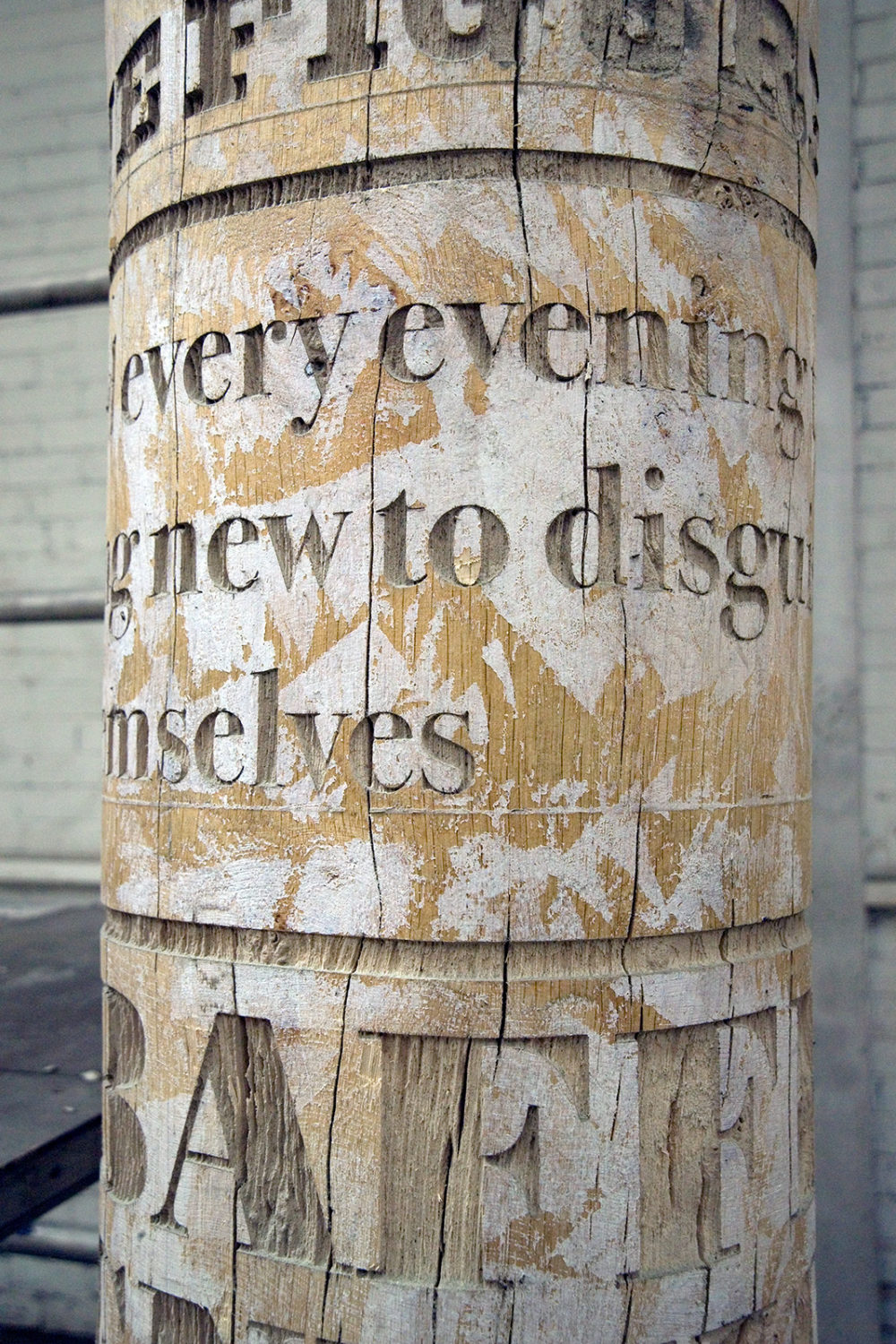
Typographic Trees — I saw pictures of the latest collaboration between artist Gordon Young and design studio why not associates a while back, but a mention in the latest issue of Creative Review is the perfect excuse to post a couple of images of these lovely sculptures for Crawley Library in West Sussex. It’s probably worth mentioning that (unsurprisingly) why not also do a nice line book design.

An interview with Allan Kornblum, publisher at nonprofit literary publisher Coffee House Press, is the latest installment in Scott Esposito’s How to Publish in a Recession series  at Conversational Reading:

Now with Borders on the brink, and former readers becoming would-be writers and self-publishing books instead of reading books, a major shake-up was inevitable… The recession isn’t the only factor driving changes in writing and publishing. Writers on the one hand, and book and magazine publishers on the other, are both trying to figure out what the changes in information technology will mean. Will books get shorter, so they can be read on a cell phone? Will nonfiction migrate to ebooks, while literature stays on the printed page? Will backlist titles become downloadable PDFs? Will future desktop printers include binding equipment?

Funeral in Berlin — Possibly the most badass cover ever (pictured above) and part of the amazing collection in the Penguin Paperback Spotters’ Guild Flickr pool (first seen at FFFFound). And funnily enough it is apparently Len Deighton’s 80th Birthday.

30 Novels Worth Buying for the Cover Alone — “A book must stand out on the bookstore bookshelf yet cover designers rarely receive the recognition that authors do.” And  in “appreciation of these unsung artists”, Beth Carswell chooses her 30 favourite fiction covers for AbeBooks.

MinuteMen — a retro-Nintendo-style-arcade-kung-fu-kick-punch-jump-game promoting the new Watchmen movie. Smartass viral marketing if you like that kind of thing. And if you listen closely, that sound you hear is Alan Moore’s teeth grinding away in Northampton. Buy the book.  (via GalleyCat).

How do you define good design? Gary Hustwit, director of Helvetica, interviewed about his new film Objectified at the Dwell Magazine blog:

If it didn’t exist, would anyone really miss it? Would it leave a hole in anyone’s life?

If we asked ourselves this question in publishing more often, how many books would actually get published? And would publishers be in the mess they’re in now? Answers on a postcard please.

And finally, Spy Vibe — a blog dedicated to 1960’s spy style! This is so cool I can’t even be bothered to find a tenuous link to books or publishing (although there surely is one)…

2 Comments

H.N. Werkman

Every day,  Eric Baker,  of Manhattan-based design firm Eric Baker Design Associates,  spends 30 minutes before work looking for “images that are beautiful, funny, absurd and inspiring”, and each Saturday he posts his selections to the Design Observer.

Eric’s selections for  14th February were all drawn from a great collection of images that Miguel Oks has posted to Flickr,  including  some amazing sets of 20th Century avant-garde books.

The covers pictured here are by the brilliant Hendrik Werkman (H.N. Werkman)  for the literary typographic journal Next Call , and are taken from the Dutch Books set.

Yale University Press published a lovely book by Alston W. Purvis on Werkman in 2004 as part of their Monographics series.

Comments closed

Something for the Weekend, Feb 13th, 2008

Apologies for the rant about the Globe and Mail this morning (note to self: don’t blog without coffee). Hopefully a highly-caffeinated design-heavy post for the weekend will make up for it…

First off, Jenny Griggs’ gorgeous typographic designs for Peter Carey’s backlist (pictured above) described by the great man himself as “A triumph!!!!!! Fucking fantastic!!” (Jenny talks about her more recent papercut designs at FaceOut Books)

M.S. Corley re-images the Lemony Snicket (pictured above) and Harry Potter series as Penguin Classics (via the BDR)

Metacovers — Joseph at the BDR looks at books on book covers (see above!).


The Way Through Doors — written by Jesse Ball; stunning minimal cover design by Helen Yentus for Vintage. Not quite a ‘metacover’ but I still love it (pictured above — seen at the Book Cover Archive of course)

Holey Font! – “How much of a letter can be removed while maintaining readability?” EcoFont has tiny holes and uses up to 20% less ink. Based on Verdana, and developed by SPRANQ in the Netherlands, it’s free to download, and free to use. And it seems to work.

And lastly, The Book Depository Live — Watch what books people buy from The Book Depository around the world in real time. Very cool. (via @paperbackjack)

1 Comment

Goodbye, Globe (no really)

I finally cancelled our subscription to the Globe & Mail yesterday. But not, as you might imagine, because I can read it for free online. No. I cancelled our subscription because they are unable to deliver it before we leave for work in the morning.

I am actually willing to pay for the convenience of having a newspaper delivered to my door by 6am (even if I am subsidizing that newspaper’s free website) — just like I’m willing to pay music and movies I like (and for books without ads inserted into them FYI) — because I think that service and quality have a value, and that journalists, artists, and writers should be able to make a living.

I’m less willing to pay for a newspaper that is delivered late and is out-of-date — and largely uninteresting — by the time I look it 12 hours later.

Now, I appreciate that losing one newspaper subscriber is not going to keep the CEO of CTVGlobalMedia awake at night. He’s too busy worrying about the internet. But, newspapers, and publishers for that matter, are mising the point. The internet, e-books, social media — they really are not your problem.  Taking your readers for granted – THAT is your problem.

Newspapers and publishers have been able to get away with being so utterly complacent about their consumers because, for years, readers had  no alternative. But now they do. And too often the newspapers that are printed and the books that are published — and way they are delivered — are not good enough for people to want to pay for them because there is more interesting and convenient stuff elsewhere.

Newspapers and publishers: If you want to survive, stop wringing your hands about digital content — That debate is over bar the shouting. Start respecting your readers. Provide them with something they’re willing to pay for. Delivering my newspaper on time would’ve been a start.

4 Comments

The Back of My Head

The Caustic Cover Critic has posted some amazing book covers by the legendary Saul Bass that are just too good not to share:

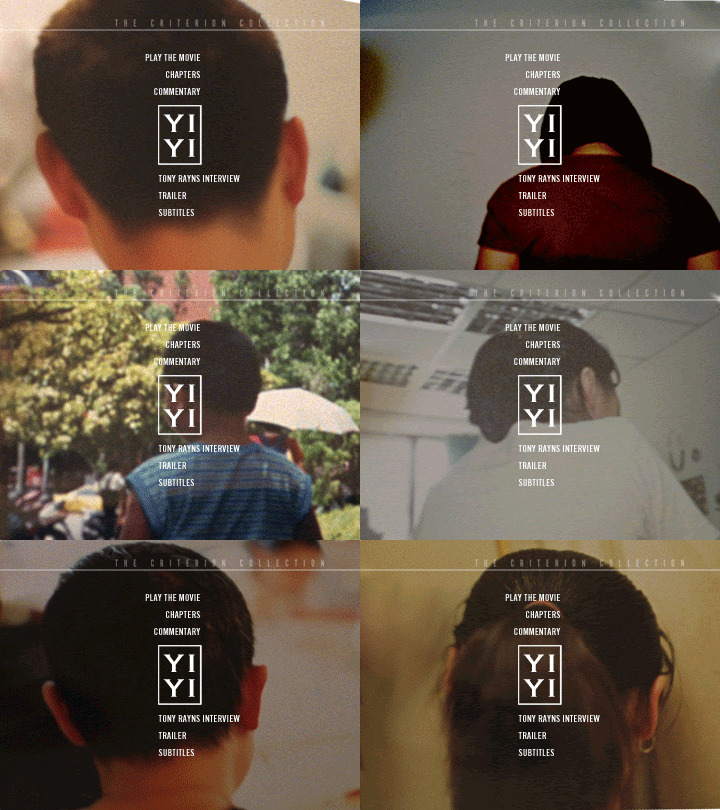
I love the covers adapted from Bass’ movie posters for the Penguin editions of Saint Joan and Anatomy of a Murder, but this cover of Preminger: An Autobiography (pictured) is less well known. And it was nice to be reminded of the movie Yi Yi in which 8-year-old Yang-Yang makes it his mission to lovingly photograph the back of people’s heads…

…And in looking an image for Yi Yi, I came across a rather lovely post by designer Eric Skillman about creating the DVD edition for Criterion Collection:

The actor who played Yang Yang was obviously no longer available, so we had find a back-of-head double. We found a photographer (the talented Andre Constantini), who led us to a young model named Brian, the back of whose head was a fine match for Yang Yang.

Eric also designs books as it turns out. His blog looks great! A day of nice finds.

3 Comments

Monday Miscellany, February 9th, 2009

“Books exist because we want and need them” — A slide show of pages from Robert Bringhurst’s new book The Surface of Meaning: Books And Book Design In Canada (pictured) published by CCSP Press in The Globe and Mail. (Disclosure: The Surface of Meaning is distributed by Raincoast in Canada).

A bookshop is a dynamite-shed — Bookride have posted a splendid John Cowper Powys rant about second-hand bookshops:

[A] bookshop — especially a second-hand bookshop — is an arsenal of explosives, an armoury of revolutions, an opium den of reactions. And just because books are the repository of all the redemptions and damnations, all the sanities and insanities, of the divine anarchy of the soul, they are still, as they have always been, an object of suspicion to every kind of ruling authority.

Pessimism Porn — Hugo Lindgren explains his addiction to nightmarish economic news  in New York Magazine:

“[E]cono-porn… feeds a powerful sense of intellectual vanity. You walk the streets feeling superior to all these heedless knaves who have no clue what’s coming down the pike. By making yourself miserable about the frightful hell that awaits us, you feel better. Pessimism can be bliss too.”

Publishing certainly has its fair share of addicts…

Visionary locations — Toby Litt on J.G. Ballard in the Guardian:

“Plenty of other writers now fictionally venture into multistorey carparks, airport hospital wards, decaying hotels, but they do so in the knowledge that they’re trespassing on Ballard’s territory. He was here first; he was the pioneer – back when these places were seen as totally unliterary. What could possibly happen on a motorway embankment that was of interest?”

Finding alternative best sellers — Toronto bookshop This Is Ain’t The Rosedale Library profiled by Brian Joseph Davis in the Globe and Mail.

Is CondéNet Dead? — Slate’s The Big Money examine how “a publishing giant failed to get the Web”. Lessons (if more were needed) for book publishers (via @jafurtado):

“To say that we’re just a magazine company in this day and age is like saying that we’re a buggy company.”

PUFF — lovely pictures of PUFF by William Wondriska (published in 1960 by Pantheon Books Inc.) at the wonderful Grain Edit (pictured above).

Image Spark— A neat image bookmarking tool. V. excited about this as you can probably imagine… (via @michaelSurtees/DesignNotes) .

1 Comment

What Are You Looking At?

This book just arrived in our office and it’s staring right at me!

There’s more than a little something of  the late, great Paul Rand about the transfixing cover for Essentials of Visual Communication by Bo Bergstrom (published by Laurence King)  wouldn’t you say?

…which is about all the excuse I need  to post this great video:

(Full disclosure: Raincoast Books distribute Laurence King, and therefore Essentials of Visual Communication, in Canada)

3 Comments

Midweek Miscellany, February 4th, 2009

Slow Burner (above) — a rather awesome — if slightly racy — cover seen at the Bookkake Blog.

How to Publish in a Recession Part 3 — The always interesting Richard Nash, the editorial director of Soft Skull Press and the executive editor of Counterpoint, talks to Scott Esposito at Conversational Reading.

The Once and Future e-book: On Reading in the Digital Age — A fascinating article on the past, present, and future of e-books and e-book readers by John Siracusa at Ars Technica.  I think — like many —  he underestimates the challenges (such as rights issues and, on a really basic level, a lack of expertise and human resources) publishers face making their titles available as e-books, but this really is a must-read.

Book Expo Canada is officially dead. It is an ex-trade show– Surprising precisely no one. The Globe and Mail has publisher reactions and a postmortem interview with Tom Best, vice president, marketing, at H.B. Fenn. What troubles me is the belief that we need something to replace it…

There’s so much written about how publishers don’t know what they’re doing… But how do you know what to do?”The New York Observer talks to former PW editor Sara Nelson:

You’re making a bet on who’s gonna like something a year and a half from now. That’s without even getting into the economy or anything—just, ‘What’s the mood of a number of people going to be a year and a half from now?’ If you thought too much about that, you’d shoot yourself.”

“We are on the verge of an explosion in independent book publishing” — Hugh McGuire of Librivox and The Book Oven chats to Allentrepreneur.

The Google Paradox — Andrew Keen, author of The Cult of the Amateur, on two new books published (in the conventional way) about Google:

“the more Google does to kill the traditional publishing industry with the free online content from its search engine, the more books will get written about the central role of Google in our new digital economy… The irony of Elsewhere USA and What Would Google Do? is that both books rely on the five hundred year-old technology of Johannes Gutenberg’s moveable type to explain the wrenching digital transformation of the 21st century.”

Who is on twitter? — I think I fall into the cateogory of “people who are concerned about the collapse of the publishing industry.” (Thanks Sio!)

Comments closed

The e-book Revolution Favours the Agile (But Deep Pockets Help)

The publishing industry is finally turning toward “mass digitization”, Matthew Shaer reports in The Christian Science Monitor .

But “it’s not the bigger houses, such as Macmillan or HarperCollins, that are moving the fastest” he says. It is agile independent presses — who can make decisions quickly  and are “more open-minded when it comes to distribution and marketing” — that are “making the most extensive restructuring efforts” according to Schaer.

Independent presses are undoubtedly innovating — necessity is the mother of invention after all — and I would really love to believe that they can steal a march on the big publishers in the “e-book revolution”. Unfortunately I just don’t think it’s true. Or, at least, that simple.

Even if you ignore the Schaer’s assertion that the “typical” independent press can make quick decisions “without much internal friction” (in theory yes, in practice I’m not so sure), the ability to adapt is not just about a “fast and light ethos”, it is also about resources. It actually takes a great deal of time and expertise — often in short supply at small presses — to put a digital program in place. And although the cost of creating, marketing, and selling e-books may be low once the infrastructure is there, getting to that point requires a lot investment.

Soft Skull’s ambitious aim to have its entire list available digitally by the end of the year is a huge step for an independent publisher. But the two publishers Schaer specifically identifies as being behind the times are, in fact, already on this track. In November last year, Pan Macmillan made books available for the Stanza e-book reader for iPhones, and they currently offer a large, large number of downloads in different formats from their  web site, as do  HarperCollins .

In fact, ALL of the other major publishers — Random House, Penguin, and Simon & Schuster — offer e-books to download from their web sites in the US. Not that you would know from Schaer’s article.

And HarperCollins has been trailblazing with creative online initiatives in the past year. They set up Authonomy, a community site for writers, and are launching BookArmy, which Victoria Barnsley, chief executive of HarperCollins UK, describes as a “social networking site organised around books and authors.” . They’ve collaborated with if:book London and Apt to create an online, annotated version of Doris Lessing’s The Golden Notebook , and in December they released a charming online video, This Is Where We Live, to celebrate the 25th anniversary of their 4th Estate imprint, that quickly went viral.

In April 2008, HarperCollins also acquired The Friday Project — originally set up to find  web based material and turn it into books — as an “incubator for fostering new talent, and finding new markets.”

And let us not forget HarperStudio who may not be offering e-books yet, but have firmly established themselves on online.

Penguin have not been idle either. In December, Penguin US launched Penguin 2.0 to boost their web presence with an iPhone app and other downloads. Penguin in the UK — who sponsored in the recent BookCamp on technology and the future of the book — not only offer over 1,000 e-books on their website, they have an online dating service (no, really), and have created SpineBreakers, a web site with teenage contributors. And there is, of course, the ever-popular Penguin Blog.

The same day as Penguin 2.0 was announced, PW also reported that Random House would be partnering with Stanza and making select titles available for iPhones, and in January, Simon & Schuster relaunched their website with all the whistles-and-bells — such as blogs and author videos (outlined by PW here) — that one would expect from a publisher who knows their audience is online.

Of course none of  these strategies is perfect and the major publishers still have work to do on their e-books programs (there have been complaints about the  pricing in particular), but this is a period of experimentation and, with the best will in the world, it’s simply absurd to suggest, that the big publishers are “dinosaurs” who “think people are just sitting down in leather chairs and reading hardcopy books.”

Independent publishers may have “the most to gain from electronic publishing” as Richard Nash of Soft Skull says, and I genuinely hope that e-books usher in a renaissance of independent publishing. But the big publishers are not blind to the possibilities that technology is opening up and they have the resources to move quickly and boldly, and, in some cases at least, they are doing so. Let’s just give credit where it is due.

1 Comment

BEC DOA

Book Expo Canada is in trouble.

The Canadian publishing trade show has been dogged by industry apathy and persistent complaints about high costs, low attendance, and a lack of paying customers for years. But the immediate need to cut costs in the face of the economic downturn — or, at least, see some kind of measurable return on investment —  has been the final straw for dissatisfied publishers.

Random House, Canada’s largest trade publisher, unilaterally withdrew from the event in November, and last week HarperCollins and Penguin — closely followed by  Scholastic Canada and H.B. Fenn & Co.  — announced that they would not be attending BEC in 2009 either.

Scheduled for June 19th-22nd at the Metro Toronto Convention Centre, organizers Reed Exhibitions initially said that it was still their intention to hold the annual convention even though Simon & Schuster was the only one of the “Big Four” multinational publishers committed to the ailing event.

Now it seems Reed may be reconsidering that decision after Random House’s recent announcement that they would be launching a new Toronto “literary and cultural” festival with the Globe and Mail in May —  one month before BEC.

With a high-profile media sponsor, and including events with crowd-pleasing luminaries such as Naomi Klein, Margaret MacMillan, Richard Florida, Pulitzer Prize nominee Ha Jin, and New Yorker columnist Adam Gopnik, the two day “Open House Festival” is clearly aimed at doing precisely what BEC has seemed so incapable of – bringing in paying customers and driving book sales.

More troubling for Reed is that the new festival means their latest initiative, the Toronto Book Fair, planned for the first weekend in October, will almost certainly be stillborn.

Details of the fair were unveiled earlier this month by John McGeary, Reed’s general manager for Canada.

Hoping to win over critics of Book Expo, McGeary outlined an “inclusive celebration of reading and literacy” akin to Salon du Livre. But hampered by a venue (the Direct Energy Centre) on the fringes of public transit, and scheduled for one of the busiest months in the publishing calendar, Reed’s plans disappointed the vast majority of the invited audience of independent booksellers and industry-types.

McGeary, relying heavily on his PowerPoint slides, struggled to articulate a coherent vision for a fair that nobody seemed to want, and was unable to substantially differentiate it from Word on the Street, the popular not-for-profit book festival taking place in downtown Toronto one week before the Reed event.

“We consider ourselves extremely different” was about the best McGeary could manage. “Yes”, a wag in the audience said, “Word on the Street is free and in Queen’s Park!” Touché .

The poor timing and location, combined with a breath-taking dearth of both imagination and logistical detail, makes it unsurprising that Random House and Penguin have already announced they will not be attending the new fair. And more publishers are sure to follow suit.

Reed — who are now, according to PW, reviewing all their dealings with the book industry in Canada — will no doubt blame the combined failure of BEC and the Toronto Book Fair on the crumbling economy and the mixed messages sent by fickle, selfish and duplicitous book industry players.

But Reed cannot entirely escape responsibility for their situation. They have consistently put the cart before the horse, planning events before they have identified a real need or purpose. This ‘build it and they will come’ attitude may have worked in the past, or perhaps elsewhere. Unfortunately Reed’s abortive attempt to make BEC more inclusive two years ago, the now infamous the Booked!, and the shortcomings of the trade show itself have seriously damaged their credibility in Toronto.

And Reed is guilty of simply trying too hard. Their efforts to be inclusive are laudable, and yet in trying please everyone, they inevitably please no one.

The book community in Toronto consists of authors, publishers, distributors, bookstores, libraries, readers, publicists, journalists, bloggers and more. Their interests conflict at least as often as they overlap, and one only needs to look at the finger-pointing and handbag-swinging caused by the high Canadian dollar last year to see that relations between publishers and booksellers, and booksellers and their customers, (not to mention the industry and the media), are fragile at best. People get upset. And they get over it. Reed has never quite seemed to grasp that to organise an effective event they will need to risk offending some people.

It is simply not fair to expect Reed to organise an event like BookCamp, or even Word on the Street. It would be impossible. But Reed could – and probably should – have organised an event like the Open House Festival. It should’ve been possible to work, initially at least, with one or all of the Big Four and a single retailer to kickstart something bigger and more inclusive. Random House’s understandable impatience has slammed that door  in Reed’s face, and, to be honest, it is hard now to see where they have left to turn.

Comments closed

Midweek Miscellany, Jan 28th 2009


John Updike (pictured) has died at 76The Guardian and the New York Times look back at his life and career in pictures. Designer Observer points to ‘Deceptively Conceptual’ Updike’s astute 2005 essay on book covers for the New Yorker:

Publishing forms a minor branch of the entertainment industry, and book design is increasingly a matter of fashion—that is, of attention-getting. In the visual clamor of a bookstore, the important thing is to be different; a whisper becomes a shout, and the ugly becomes beautiful if it attracts attention. Yet an utter flaunting of conventional expectations may baffle and repel the public; when the title and the author’s name are left off the front of the book… it sends a subliminal message of contempt for the written word, the product being packaged.

Batman as jazz– Brad Mackay wins top prize for funniest headline of the week for his look at the reinvention of the Dark Knight and the genius of BatManga! in the Globe and Mail.

“Content is Free… But Curation is Sacred” — Peter Collingridge at Times Emit considers the implications of the Google settlement and what happens if/when we are flooded with unmediated free “stuff”:

[A]s the amount of content we are exposed to increases, without any discernible gauge of quality, it is the trusted curators of that content to whom we will choose to give our attention, time or money, rather then trying to filter it all out personally… the curator may be the bloke in the record shop who knows my music collection and recommends something new, the staff in my local wine merchant, or a particularly good blog I follow, my newspaper – anything. However, it is not Amazon’s recommendation algorithm; it is decidedly human, and, over time, a relationship of trust is built up. If it works, that trust leads to action, purchase, attention, refinement and more trust.

See the Web Site, Buy the Book: J. Courtney Sullivan looks at author web sites and book trailers for the New York Times.

Sara Nelson, editor in chief of Publisher Weekly has been fired is “leaving as part of a companywide restructuring”. The indefatigable Sarah Weiman has a extensive round-up of the reactions in the blogosphere.

The fabulous Book Cover Archive have recently add a couple of lovely minimalist cover designs by Gabriele Wilson (pictured above). Nice.

Comments closed

Things We Didn’t See Coming

Love this simple, elegant cover solution for Things We Didn’t See Coming by Steve Amsterdam (seen at JACKET MECHANICAL):

Comments closed