Skip to content

The Casual Optimist Posts

Midweek Miscellany, November 11th 2009

The Nabokov Collection — Art Director John Gall on the Vintage Nabokov redesign at Design Observer:

Nabokov was a passionate butterfly collector, a theme that has cropped up on some of his past covers. My idea was also a play on this concept. Each cover consists of a photograph of a specimen box, the kind used by collectors like Nabokov to display insects. Each box would be filled with paper, ephemera, and insect pins, selected to somehow evoke the book’s content. And to make it more interesting… I thought it would be fun to ask a group of talented designers to help create the boxes.

John’s short essay is accompanied by a great slide show of the specimen boxes (above: The Luzhin Defense by Paul Sahre; below Speak, Memory by Michael Bierut).

And Joseph at The BDR has a nice follow up post, with a couple of nice vintage Nabokov covers.

So, do the specimen boxes (lovely as they are) work as covers? You tell me…

Amazon releases a Kindle app for PCs. But who cares? Hmm… I don’t know if I ‘care’ as such, but I do think it’s significant. Is it one more nail in the plastic coffin of single use devices? There’s more on the app at the Washington Post

And while we’re on the subject of e-books…

The Internet Isn’t Killing Anything — From Russell Davies:

Something That’s Growing Is Not The Same As Something That’s Big.

Something That’s Declining Is Not The Same As Something That’s Small.

…Worth remembering I think.

Best Illustrated Children’s Books of 2009 — The New York Times choose their favourites (accompanied with a lovely slide show). The New Yorker‘s Adam Gopnik talks about the selection process with Sam Tanenhaus on the Book Review Podcast (pictured above: Tales From Outer Surburbia written and illustrated by the awesome Shaun Tan).

And finally…

A sneak peak at the new Krazy & Ignatz cover by Chris Ware for Fantagraphics.

1 Comment

Q & A with David Pearson, Type As Image

Penguin Great Ideas

Does British designer David Pearson really need an introduction?

Even if you don’t recognise the name immediately — and perhaps it is less familiar on this side of the Atlantic — then you will almost certainly recognise David’s type-driven design work: Penguin by Design by Phil Baines, Pocket Penguins, Penguin Great Loves, Penguin Great Journeys, Penguin Reference, and, of course, the astonishing Penguin Great Ideas series.

When the first set of Great Ideas titles arrived they looked like nothing else in the bookstore. Each cover was unique and yet they all fitted perfectly within the series. Their thick paper covers, limited colour palette and bold typography were clearly a wink to the design history of Penguin books (and perhaps the Arts & Craft movement) but also imaginative, playful, and starkly modern.

Since then, there have been three more sets in the Great Ideas series with a fifth on the way. David still works with Penguin, but has set up his own firm. He has designed covers for Éditions Zulma, and somehow found the time to help launch White’s Books.

David and I chatted over email…

Illustration by Michael Kirkham; design by David Pearson

How did you get into book design?

Whilst at college I was lucky enough to be offered a work placement by my Typography tutor, Phil Baines. The job was to design a large-scale art monograph for Phaidon Press and Phil walked me through every stage of the book’s production, from styling the edited manuscript through to the final layouts. I even got to run my designs past Alan Fletcher, who at the time was responsible for overseeing Phaidon’s visual output. This seemed like an absurdly privileged position for a student to be in. The first time I went to Phil’s studio he told me off for not aligning the letters on his hot and cold taps so you can imagine how fastidiously constructed my pages became under his tutelage. Before long I began to laugh at Phil’s funny ways and he in turn mocked my special design slippers. A friendship was born, nicknames were awarded and my first experience with books turned out to be an entirely lovely one. Moving into my third year, I knew that book design was for me and began to check Penguin’s website every week for job vacancies. For all sorts of obvious reasons I knew that I wanted to work for the company and made sure that I checked throughout my final year at college, desperate as I was to remain in London afterwards. I got lucky and landed a job as text designer (setting the insides of books) the day after I graduated.

This is a terrible question, but I’m curious: Which came first, your interest in Penguin’s design history, or designing books about Penguin’s design history?

Oh, absolutely the former. I was already an avid collector and the idea for a design retrospective was one that I’d run past my Art Director before it was eventually tagged onto the company’s 70-year anniversary celebrations. I’d always wanted to get into the archives and have a really good poke around and fortunately for me, this gave me the perfect excuse. If I was unaware of the magnitude of the company’s past achievements they very quickly became apparent as I worked my way through the vast isles of books.

The Penguin archive
Experimental layout from the Penguin archive
What was it like working with designer and typographer Phil Baines on Penguin By Design?

Having been given an enormous amount of freedom by the company (to personally manage the project) I found myself in a position where I could enlist an author. Phil seemed like the perfect choice because of his analytical and objective writing style. The last thing I wanted was a blinkered, frothing account of the company’s history because even a cursory glance round the archive revealed some decidedly dark periods. Phil and I keep very similar hours so the book took shape very naturally and it felt strangely normal to work through the night before heading to a pub together the following morning. Indeed, because there was no framework in place for our department to produce books of this kind, I had to rely on the goodwill of my Art Director, Jim Stoddart as I would design covers during the day and then the design book at night. The lines often became blurred and I was once asked to be escorted from the building as it was judged that I had not left for over two days. Phil is currently working on Puffin by Design, a partnering edition to Penguin by Design and as much as I would’ve liked to have been asked to work on it I suspect that we’re both better off that I wasn’t!

Artwork by Phil Baines; design by David Pearson
Your work on Penguin’s Great Ideas series won you a D&AD Yellow Pencil. What was the design brief for books?

Like all the good ones it was a happy blend of strict parameters (most notably in terms of budget) and creative freedom (there being no existing blueprint to adhere to or living authors to appease). The series’ success should be attributed to many different factors: Editor Simon Winder’s original idea was a great one, implying that world-changing thought and writing equates to Penguin, while the finished books seemed to fit a model of what people wanted from the company, a reaffirmation of Allen Lane’s original philosophy; but above all the publisher displayed an unfaltering level of confidence in the project and allowed us to break some fairly established rules in the process.

Artwork and design by David Pearson

The fourth series of Great Ideas has just been released. Was it difficult to create interesting new designs that were consistent with the previous two series?

Speaking from my own perspective I’d say that I’ve loosened up as a designer. Looking at my earlier efforts I think I was rather inhibited and it wasn’t until I brought in Phil that I could see the true size of the project’s potential. Phil added pace and variety through his very bold, expressive cover designs and this made me realise that I too could let my hair down a little.

Artwork by Joe McLaren; design David Pearson
Artwork and design by David Pearson
How is running your own studio different from working at Penguin?

There are certainly negative sides to being ‘out of house’. For example, I am no longer in a position to affect the approval of my work. Instead it has to very much stand up for itself, without the highly-sensitive designer attached. That said, I feel much calmer as a result. I may well still be in a honeymoon period but I’m enjoying managing every facet of my business – from doing the accounts to cleaning the windows. The rewards seem so much more tangible as a result.

Could you describe your design process for book covers?

Since the vast majority of what I do is type-driven, a fair amount of time is given over to researching letterforms. I am lucky enough to work just down the road from one of the world’s best typographic resources and thankfully they don’t mind me popping over to waste their time. Typophiles – in particular – can be a particularly unforgiving bunch and so time spent researching is never wasted.


Design by David Pearson

Design by David Pearson
What are your favourite books to work on?

Working within tight constraints is a blessing. There’s nothing quite so daunting as a completely open brief as you never get the feeling that you’re solving a problem, rather just satisfying your own whims. I always feel much more creative when my palette has been limited, either by the client or by myself.

Illustration and design by David Pearson
What are the most challenging?

Very simply, the ones that attempt to house more than one idea or repeat a sentiment. I think that book covers communicate quicker if they are boiled down to their most essential elements or rather, they have the best chance to communicate if they do one thing and do one thing purposefully. Confidence and a clarity of purpose are not found in abundance in trade publishing.

Illustration by Victoria Sawdon; design by David Pearson
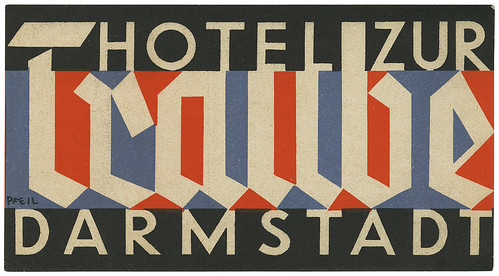
Massimo Vignelli says that designers just need 6 typefaces. Should designers limit the number of typefaces they use?

Not at all. I am completely opposed to this view. While I appreciate that it takes time to fully understand and competently utilise a typeface I suspect that they all have a use for something. And doesn’t the use of such a limited palette suggest an unwillingness to shift from a preconceived agenda? This is all well and good if the client is buying into your look and trading from it but I would question whether this is a healthy starting point for someone working in the communications industry. Or, perhaps I’m just not enough of a Modernist to understand such an approach.

What are your favourite typefaces to work with?

I absolutely love Vendôme by François Ganeau and Roger Excoffon. Its over-emphasised, angular serifs brilliantly support its sensuous, bulking forms. I wasn’t in Paris in the Fifties, but Vendôme feels to me very much like Paris in the Fifties. Anything by the peerless Matthew Carter is a joy to use and I recently saved up to buy Martin Majoor’s Nexus family which I seem to be consistently delighted with.

From David Pearson's ephemera collection
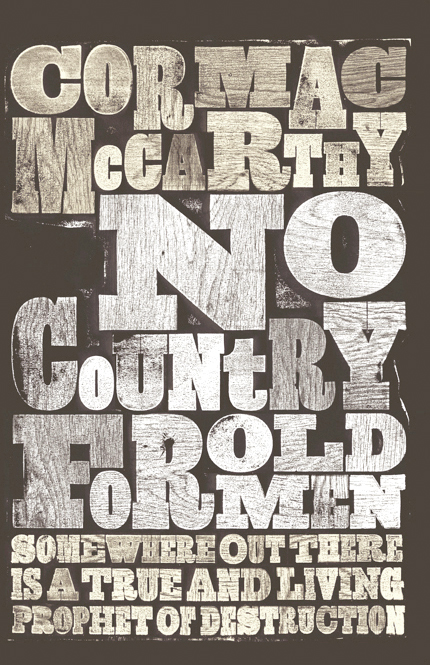
Where do look for inspiration and who are some of your design heroes?

Like most book designers I have a healthy collection of ephemera; matchbox and travel labels being my favourite, and a huge chunk of my salary is redirected towards book buying. My design heroes are rather predictable, but for good reason I think. Jamie Keenan’s covers always seem so fresh and live long in the memory because they require a level of decoding. Jamie is also one of those rare designers whose work is just as effective on either side of the Atlantic. Hans Schmoller’s meticulous and elegant typography reassures me on a great many levels and I can’t quite manufacture enough situations where I am working with the immensely talented Joe McLaren. Then there’s the Penguin roll call: Curtis, Miles, Gentleman, Games, Marber, Birdsall, Robertson, Aldridge, Pelham and of course, Tschichold.

Design by David Pearson (not yet published/work in progress)
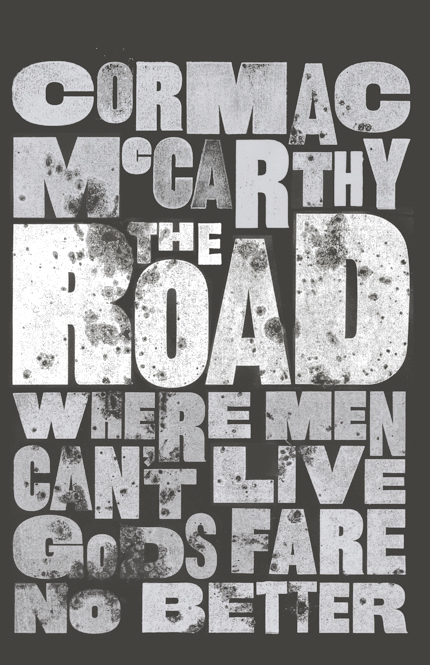
What does the future hold for book cover design?

It feels like this has been pretty well covered by people who are much more future literate than myself. All I can do, as a simple print designer, is live from day-to-day.

Design by David Pearson (not yet published/work in progress)

Thanks David!

You can see more of David’s work at his Flickr page and the David Pearson Design site.

27 Comments

Something for the Weekend, November 6th, 2009

Wild WoodbinesThe Creative Review profiles illustrator Tony Meeuwissen who designed the brilliant cover — based on a pack of cigarettes — for Keith Waterhouse’s Billy Liar pictured above (NB: David the Designer has more on this wonderful cover if you’re interested).

There is an exhibition, Tony Meeuwissen: 50 Years in Illustration and Graphic Art at the Subscriptions Rooms, George Street, Stroud (UK) from December 5th – 19th if you’re in the neighbourhood.

The Wonderful Wizards of Lodz — Vintage Polish kid’s books at A Journey Round My Skull.

In Praise of Chapbooks — Bryce Milligan, publisher/editor of Wings Press, at Publishing Perspectives:

I do not think that the average reader—no matter how happy he or she is with their voluminous digital libraries on their diminutive screens—will be satisfied to never have access to a true literary artifact, something tangible that connects them to a favorite author. It makes perfect sense that larger printed works violate both our economic and our evolving green sensibilities, but small artifacts of the author may remain a necessity, if only a psychological one.

He’s Just Like Me But >choke< EVIL! — Comics Alliance list their favorite comic book clichés.

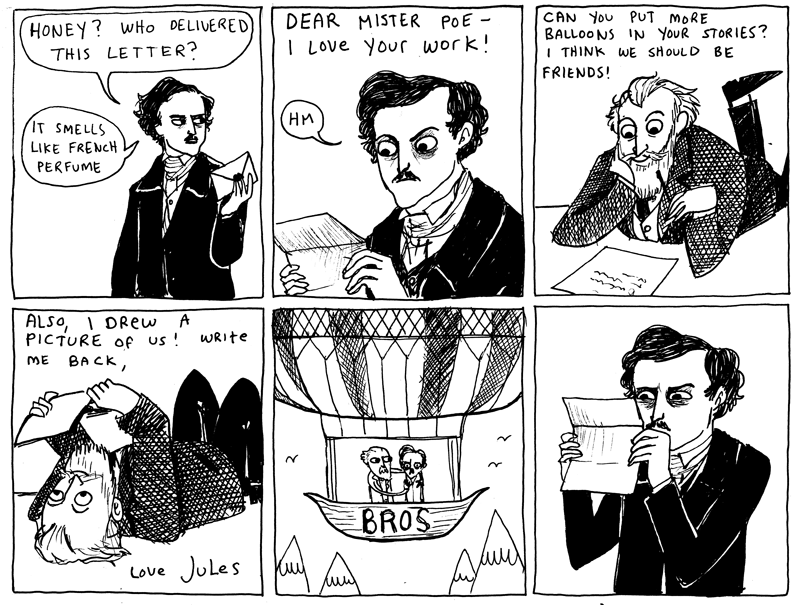
Can you put more balloons in your stories?Hark! A Vagrant: comics by K. Beaton (thx Sio):

And also in comics news… 70 Things You Didn’t Know About Marvel in The Times (via largehearted boy‘s Twitter).

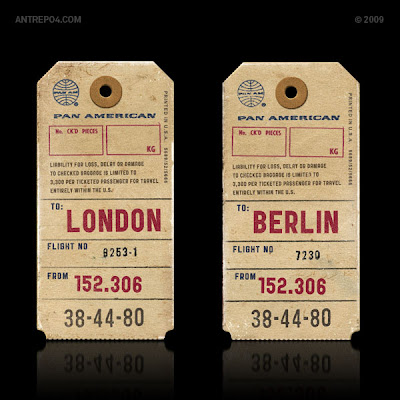
Public Gothic — Having already ‘fessed up to slab-serif obsession earlier this week, I might as well tell you that I’m also slightly obsessed with vintage ephemera — especially luggage tags — so I’m very intrigued by this new typeface from Antrepo even though I’ve no idea how I’d use it or been able to download it!

And speaking of typography, ephemera, and luggage tags, take a look at Alistair Hall’s (We Made This) Flickr Set while you’re at it:

And finally…

Barack Obama Names Alan Moore Official White House Biographer:

“As evidenced by his epic run on Swamp Thing #21–64, Moore’s deft hand with both sociopolitical commentary and metaphysical violence makes him an ideal choice to chronicle my time in office”

Oh come on…. It would be awesome.

2 Comments

Keep Calm and Carry On?

There is nothing quite like pricing to get book people’s pulses racing and the recent price war in the US — and the American Booksellers Association’s open letter to the Department of Justice — certainly has everyone and their mother all aflutter.

We have plenty of pricing issues of own in Canada. The unique challenges of publishing here (big geography + small population) and the fluctuating US dollar make Canadian pricing particularly fraught. But we haven’t really seen the same kind of problems as the US or the supermarket price wars that have plagued the UK.

As The Toronto Star helpfully points out, Canada is different. But it is not simply a matter of being more polite than Americans (or nicer than the British) — what makes us different is that we are a small book market dominated by a single retailer. Dropping the gloves with Canada’s Chief Booklover hardly seems worth the effort.

Nevertheless, Canadian consumers keep a keen eye on the US and a sustained price war south of the border would inevitably put pressure on bookstores in Canada (including Chapters-Indigo). It would be foolish to ignore what is going on.

The most emotive issue is, of course, the detrimental impact of price wars on already struggling independent bookstores. As HarperStudio’s Bob Miller notes:

The short-term results of this price war are some losses for Wal-Mart and Amazon, and some brisk sales for the publishers whose books have been chosen. But the “road kill” here are the accounts who can’t afford to participate in the race—traditional booksellers.

Clearly though, publishers like Miller are worried too. It has been a particularly difficult 18 months in US publishing, and the thought of additional pressure on prices and discounts is, for many, terrifying. We seem to be lurching from one crisis to the next.

But, is this really anything more than another storm in the tempestuous book industry teacup?

To some extent I agree with Mark and The New Yorker that twitchy book people are exaggerating the effects of this price war. We are, after all, only talking about ten books. This isn’t going to wreck publishing just yet. In the short term it will be good for sales, and as long as Amazon, Wal-Mart and Target are willing to take the losses, the publishers will be laughing all the way to the bank.

But there will clearly be problems down the road if this continues, and I think Michael Hyatt, CEO of Thomas Nelson, is on to something when he suggests that the strategy behind the price war is actually damaging for everyone publishers, authors, booksellers, mass retailers, and consumers (although Dennis Johnson at Moby Lives isn’t totally convinced by Hyatt’s solutions).

If there are going to be ‘winners’ in this, it is only going to be the big retailers and it will not be long before they demand more books and deeper discounts. Publishers will have to run the risk of crippling returns if the discounted books don’t sell, and will be increasingly reluctant to bet on creative projects. Corners will be cut in the effort to produce cheaper books that are short-term ‘sure things’.

Without over-stating it, I am also troubled that such discounts set the expectation that all books should be less than $10 (and if you’re skeptical about setting expectations with arbitrary numbers, you might want to read Nudge).

In the end, you get what you pay for. Books — good books — take time and they take money, whether they are printed or distributed digitally. If a book costs less than $10, then you can expect publishers  — and self-publishers for that matter — to churn out a lot of poorly researched, quickly written, hurriedly edited, badly designed and cheaply produced books. And, as Don Linn, former Senior VP and Publisher at Taunton Books, points out, this will certainly hurt authors first:

When content’s price and value is pushed below a sustainable level for publishers… writers will suffer. They will be forced to make the economic choice to write less to finance their careers. It’s not enough to say glibly that ‘writers have to write so they will’ or that self-publishing will be their salvation. When content’s value drops, self-published content’s value drops as well.

Of course, publishers need to take responsibility here. Too often publishers dump bad books into stores in pursuit of a fast-buck, and they only have themselves to blame when stores demand big discounts up front and readers don’t actually want to pay full price for them.

And I think it is too easy to say that books (paper or digital) need to be cheaper and more ‘timely’. Sure. But I’m willing to bet that readers are also willing to seek out and to pay for books that surprise and delight (and that format isn’t the real issue).

It is difficult for publishers to think about the long-term (especially if shareholders are involved), but if we are seriously worried about pricing, then perhaps the place to start is publish books that are worth the price tag?

2 Comments

Midweek Miscellany, November 4th, 2009

Fluid — John Gall discusses his brilliant cover design for the Vintage edition of Tom McCarthy’s Remainder, which is still one of my favourite novels of the last few years.

Hamilton Wood Type Catalog No.14 (1899-1900) at Unicorn Graphics’ Wood Type Museum. I quietly obsessed with slab-serifs right now so this is like crack (via Draplin Design Co.).

And The Beat Goes On — Sarah Weinman (much missed at GalleyCat) is writing about publishing for AOL’s money and finance news blog DailyFinance.

Gigantic Robot — Awesome cartoonist and illustrator Tom Gauld has a new website (to accompany his excellent Flickr photostream).

BOOM! — PW talks to Mark Waid, Editor-In-Chief of independent comics publisher BOOM! Studios:

We’re great at getting a focused message out. Because we don’t publish eighty comics a month, our inestimable marketing department does a great job of making every title important in the marketplace and every launch an event. We’re also better than the big guys at taking risks because we don’t have stockholders to answer to, or lenders who would call us crazy… We’re very much a writer-driven, idea-driven company. We start with the story first (with a talented writer) and focus on getting that right.

30 Conversations on Design — Designers, including luminaries such as Massimo Vignelli, Erik Spiekermann, Ellen Lupton and Paula Scher, answer two questions: “What single example of design inspires you most?” and “What problem should design solve next?”

Unheimlich — Sam Leith argues for scary kids books in The Guardian (confession: I’m mostly linking to this story so I could type “unheimlich” which — rather disappointingly — means “unhomely” rather than “the act of undoing the heimlich manoeuver”).

And finally…

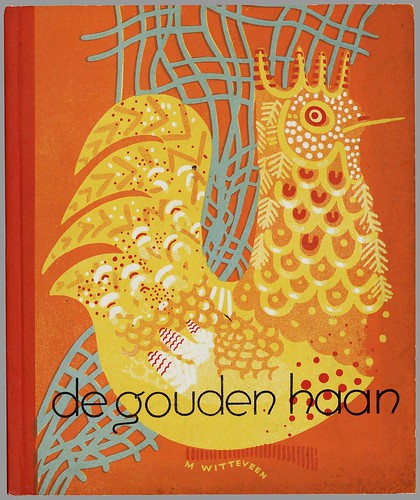
Dutch Picture Books 1810 – 1950 at BibliOdyssey (above: ‘De Gouden Haan’ by Marietje Witteveen, 1940).

‘De Gouden Haan’ by Marietje Witteveen, 1940
Comments closed

Monday Miscellany, November 2nd, 2009

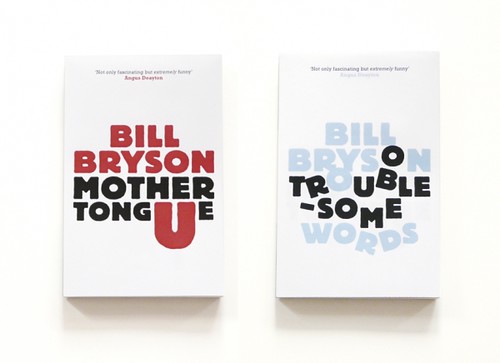
Unpublished concept jacket designs by London-based print designer Allan Sommerville for the Penguin’s Bill Bryson books (via Cosas Visuales).

Fonts — This is AWESOME: Wisconsin Public Radio’s To The Best of Our Knowledge talk fonts with Jonathan Hoefler and Tobias Frere-Jones, designers of Gotham, Matthew Carter, designer of Verdana, author Nicholson Baker, Tracy Honn, director of the Silver Buckle Press, and Kitty Burns Florey, author of Script and Scribble: The Rise and Fall of Handwriting. Listen NOW.

Many Happy Returns — Author, academic and newspaper columnist John Sutherland (The Boy Who Loved Books) on 30 years of The London Review of Books for The Financial Times:

The LRB front cover logo was “THE LONDON REVIEW of Books” – the last two words being smaller. As the typography signalled, it was the review that mattered as much as the book under review. Articles in the LRB were, and are, long: anything between 2,000 and 5,000 words. On special occasions they can run into the tens of thousands. Rates of pay seemed to me startlingly high: three or four times, in the early years at least, what the TLS paid. Miller personally appeared austerely indifferent to money. I suspect he worked for little or nothing. Nor did rises or falls in circulation appear to trouble him overmuch. Quality was all.

(There’s also a rather lovely addendum about the LRB’s personal columns, so read to the end!).

Somewhere Towards The End — A wonderful essay on editor and author Diana Athill by Ian Jack,former editor of Granta, in The Guardian:

[W]hat held me about the writing was its candour. The quality has since become an Athill trademark, though in itself candour is no guarantee of literary pleasure or interest: frank books aren’t always good books and can often be tedious by boasting of their frankness. Athill’s way of being candid is more subtle and its effect more persuasive… Part of this comes from her considerable gift as a maker of sentences, which are so lucid and direct; some of it is owed to the breaking of taboos that then surrounded female sexual behaviour; most of it, though, stems from her triumphant struggle to “get it right”, a lesson she learned from two of the writers she edited. Rhys told her that the trick of good writing was “to get it as it was, as it really was”. Naipaul said that “provided you really get it right, the reader will understand”.

The Internationalist — An all too short interview with Penguin Canada’s David Davidar, who was recently appointed CEO of Penguin’s new division Penguin International, in the Globe and Mail.

And finally… I do love Tom Gauld:

eric gills busy day

(More on Eric Gill)

Comments closed

Something for the Halloween Weekend, 2009

Dawn of the Dreadfuls — not normally my kind of book cover, but hey it’s Hallowe’en and I think Quirk Books knocked this out of the park (full disclosure: Quirk are distributed by Raincoast Books in Canada).

And continuing the spooky theme…

Hallorave — Fantagraphics have been posting previews of the first volume of Mezzo and Pirus’ “extraordinary suburban horror trilogy”, King of the Flies, on their blog all this week. Pages 1, 2, 3, 4, 5, 6. It looks intense:

Devices and Contraptions Extraordinaire — “The world’s first exhibition of steampunk art” at the  Museum of the History of Science in Oxford, England. There is a blog accompanying the exhibition by curator Art Donovan (via ReadySteadyBlog).

Dark Star — Michael Dirda’s review of The Complete Short Stories of J.G. Ballard, published by W.W. Norton, in the Washington Post:

In “The Complete Short Stories of J.G. Ballard” devastated worlds are matched with even more devastated psyches. But these aren’t simply “myths of the near future,” they are probes sent down into the desolate heart of the here and now. As Ballard knew, reality has become just a subgenre of science fiction.

And finally…just for Hallowe’en, here’s a great vintage cover for Bram Stoker’s Dracula seen at the Golden Age Comic Stories blog (via the awesome, but not entirely safe for work, This Isn’t Happiness):

Normal, non-spooky, service will resume next week…

Comments closed

Midweek Miscellany, October 28th, 2009

(The always awesome) FaceOut Books talks to Argentinian designer Juan Pablo Cambariere.

In the interview Juan Pablo mentions Alejandro Ros, “probably the greatest contemporary Argentinean designer”.

Alejandro Ros’ website — like his book design — is lovely, but it’s all Flash so you’re just going have to take a look for yourself

The Creative Review‘s second extract from Penguin by Illustrators is the text of the presentation made by artist, engraver, illustrator and designer David Gentleman.

The first extract (mentioned here) was the text of a presentation given by Romek Marber.

It’s in the Retelling — Booker winner Hilary Mantel, author of Wolf Hall, on historical fiction in The Guardian:

A novelist doesn’t sit at the keyboard sucking her thumb, thinking “what next?” A novel arrives whether you want it or not. After months or years of silent travel by night, it squats like an illegal immigrant at Calais, glowering and plotting, thinking of a thousand ways to gain a foothold. It’s useless to try to keep it out. It’s smarter than you are. It’s upon you before you’ve seen its face, and has set up in business and bought a house.

And finally…

Some lovely identity design for the McNally Jackson in NYC by Christine Celic Strohl and Eric Janssen Strohl (via DesignWorkLife). Interesting enough Eric Janssen Strohl also designs books and beautiful colophons (and again, Eric’s site is Flash and so you’re going to have take look yourself)…

Comments closed

Monday Miscellany, October 26th, 2009

The brilliant Helen Yentus has redesigned the covers of Chinua Achebe’s books for Anchor with illustrations and hand lettering by Edel Rodriguez who has some amazing sketches of her work on the series at her portfolio site.  (Covers first seen at wonderful Caustic Cover Critic blog, with additional details and links from estimable John Gall.)

Pixellated Penguin — Anna Rafferty, Managing Director of Penguin Digital (UK), profiled in The Marketer Magazine:

Although volume sales of books has dropped 9.2 per cent this year… and the onset of digital publishing means a reassessment of how content is provided, Rafferty says the recession has not affected the way she markets Penguin. “We’ve always been against paying for things. We are a content company with access to the words and opinions of the funniest, most intelligent and entertaining authors in the world.”

Difficult Women — Mary-Kay Wilmers, editor of the London Review of Books (which celebrates it’s 30th anniversary this year), profiled by Nicholas Wroe for The Guardian.

Anti-Ironic — Product designer Joey Roth (designer of the beautiful Sorapot teapot) interviewed at Boing Boing:

I see designers and companies whose work represents a disposable, ironic, trend-driven view of product design as my ideological enemies. Irony was the dominant approach a few years ago, and it’s still popular. I think it has no place in design, since physical resources are consumed when something is mass-produced, and a joke is only witty for so long. My desire to design objects that represent a more thoughtful, sustainable view grew partially from the ironic, anti-design trend I encountered as I was getting into design.

I sort of feel the same way about books…

All Cover Archive — Ben Pieratt has posted some of his early design’s for the Book Cover Archive logo at his new General Projects Blog.

Ben also had a nice post about books and logos at the BCA blog last week…

And speaking of the BCA blog, Ben recently posted about James Le Beau-Morley‘s cover design and layout concepts for 1984:

3 Comments

5 Secrets from 86 Notebooks

“If you do what you love and you find other people who do what they love, you’ll be successful, you’ll do great work, [and] chances are you’ll actually make money miraculously enough. If you combine that with a bit of egotism and a taste for the spotlight you could also become famous, but definitely I promise you’ll be happy.”

Michael Bierut, partner at Pentagram and author of the truly excellent 79 Short Essays About Design (yes, yes, full disclosure: distributed by Raincoast Books in Canada), shares five simple secrets for doing great creative work at the 99% Conference in New York earlier this year:

.

And what does this have to do with books specifically? Well, the final thing Michael talks about is a really cool school libraries project…

2 Comments

Something for the Weekend, October 23rd, 2009

Illustrator Jay Ryan has a new book, Animals and Objects In and Out of Water (published by Akashic Books), coming in December. Literary types might remember Jay’s cover and illustrations for Michael Chabon’s novella The Final Solution.

Jay is also touring the US in November and December with Paul Hornschemeier whose new book All and Sundry (published by Fantagraphics) is now available (via Jacob Covey).

(Un)selling — Independent sales rep John Mesjak on building trust with bookstores and readers in the Huffington Post:

I’m able to act as a guide for my bookstore buyers because they trust me. That trust comes both from recommending great books that have ended up being staff favorites and, maybe more importantly, sometimes telling a buyer, “You don’t need this book.”…Good booksellers earn trust with their own customers the same way — by providing honest suggestions and reliable advice… Booksellers shouldn’t be afraid to say, ‘I didn’t like the book.’

Small Acts of Defiance — Novelist Jonathan Lethem, interviewed in Time about his new book Chronic City, on owning a small used-book store in Maine (via Shelf Awareness):

I don’t really own the building. I guess I sort of own the books until someone comes along and buys them. I’m like the junior partner in a very funky clubhouse of a used-book store. It’s something that makes me very happy… it never crossed my mind that it was an expression of defiance. If it’s taken as that, that’s great. I did it for the pleasure. It didn’t have to do anything with my career or the Internet or the publishing world. It was just to be handling the books. I worked in used-book stores for 15 years on and off. That was the only work I ever had before becoming a full-time writer. I have a lot of osmotic book knowledge just from handling books I didn’t ever read. Turning them over in my hands, trying to figure out where they came from and why they exist and whether they should be priced at $4 or $6.

Plus ça change — Literary agent and prolific blogger Nathan Bransford summarizes (with the requisite amount hyperbole) a week that saw another wave of e-readers and an ugly price war in the US:

This was, quite simply, a massively huge week in the publishing industry. All of the various pressures on the industry seemingly came to a head: the steady rise of e-books, downward pressure on book prices… the rising clout of e-tailers, an increasingly difficult landscape for independent bookstores, and the industry’s creeping dependence on a small handful of mega-bestselling authors.

AND speaking of the pricing wars, the American Booksellers Association has asked the  Department of Justice to investigate the practices of Amazon.com, Wal-Mart, and Target.

And finally…

Co-existence — Steven Fry on on why books and the web go together in an interesting piece for the BBC earlier this year:

Very often people oddly put books against the internet… You don’t throw away your books when you buy a computer. You keep both. The beauty of living in the present day is you don’t abandon the past. The past co-exists.

ABA Asks Department of Justice to Investigate Bestseller Price Wars
3 Comments

The World’s Most Advanced E-Reader or the Worst Product Name Ever?

Despite being lumbered with “the worst product name in recorded history”, Barnes & Noble‘s new dual screen e-reader the ‘Nook’ is getting a lot of favourable reviews.

An appallingly kept secret, the Nook was officially unveiled earlier this week and is being widely touted as a ‘Kindle Killer’ (whatever that actually means).

Direct comparisons with Amazon’s e-reader are inevitable of course — especially given the Nook will go on sale for $259, the same price as the Kindle 2.  And, if nothing else, US publishers seem relieved that Amazon finally has some serious competition from the country’s largest bookstore chain.

As reported in Publishers Weekly and the New York Times, part of what is attractive to publishers (aside from the simple fact it is not owned by the Amazon) is that the Nook is relatively flexible and supports formats, including ePub. and — perhaps more crucially in the short term — PDFs, that can be read on other devices.

Of course, that B&N has 1,300 stores and already understands books (and the publishers that publish them) doesn’t hurt.

Much is also being made of the Nook’s promising ‘LendMe’ feature, which will let readers share their books (within limits) with others, even though some people aren’t entirely happy about it.

Unsurprisingly, B&N are describing the Nook as “The World’s Most Advanced eBook Reader”, although it is unclear whether the Nook will be available outside the US, which could be problematic in the long run (especially as Amazon and Sony both have global reach). The Guardian Technology Blog does point out, however, that the Nook’s 3G wireless is provided by AT&T, “one of the GSM [Global System for Mobile Communications] providers in the US, so from a technical standpoint, it should be easy to launch the reader internationally.”

But does B&N really have the will or the way to make the Nook available beyond its US home base? And could it do so successfully?

Ultimately perhaps, the real question though is whether there is actually a mass market — either in the US or internationally — for single purpose e-readers. Some smart people clearly think so, but given that non-proprietary formats like ePub can be read on more useful, convenient and competitively priced multi-purpose devices such as laptops and cellphones (and whatever else Apple are currently cooking up), and that books still look like the most robust, simple and elegant format — I’m not so sure…

Comments closed