Skip to content

The Casual Optimist Posts

Something for the Weekend

John Squire‘s 1980’s covers for the Penguin Decades Series at The Creative Review. The art direction was by Penguin’s Jim Stoddart, but yes, it is THAT John Squire (i.e. awesome).

Fine Independent Publishing — An interesting interview with Barbara Epler, Editor-in-Chief at literary publisher New Directions, at KCRW’s Bookworm (although I could do without the decline of literature being blamed squarely on sales and marketing people. Again):

Permanent Crisis — A post by Rebecca Smart, Managing Director of military history publisher Osprey Publishing, at Digital Book World:

If you perceive that your only environment is that encompassed by your current supply chain then you’re only going to adapt to changes in that environment – so the response to the digital challenge viewed in this way would be to create and sell e-books. If you put the consumer at the heart of your thinking you can consider instead each group of customers you serve and what they might want on top of what you already provide, how they might want you to serve them differently in the future. More to the point, you can ASK them, listen and respond.

Proletarian Erotica — Lorin Stein, former senior editor at Farrar, Straus and Giroux and new editor of the Paris Review, interviewed at The Economist‘s ‘More Intelligent Life’ blog. The National Post also ran a nice interview with Stern last month.

Going Deutsch — Tom McCarthy, whose new book “C” I’m reading right now,  interviewed at the New York Times ‘Paper Cuts’ blog:

One critic described “Remainder” as a French novel written in English; well, by that token, “C” is my German novel. What the next one will be is anyone’s guess. Swedish, maybe…

More from Tom on The Casual Optimist soon (if I can twist his arm)…

Print Junkies — An interview at The Second Pass with the publisher and editor of Stop Smiling magazine J. C. Gabel on the launch if the Stop Smiling book imprint:

We’re still operating with the same mentality… but have adopted a Less Is More mindset — and a production schedule to match. It does feel nice to know that what we spend months or years working on is now being released in a permanent format. We’re really trying to reinvent the DIY aesthetic of the magazine to apply it to editing, publishing, and promoting books. The book-making process itself, of course, is much slower and drawn out, which is refreshing as we all get older.

And finally, I give you Oliver Jeffers’ moustache (via Tragic Right Hip)…

3 Comments

Midweek Miscellany

McGraw-Hill paperbacks designed by Rudolph De Harak — A nice Flickr set of vintage covers from Joe Kral, who apparently has an amazing book collection (via Words & Eggs).

Free Libraries Are Full of Books That No One Reads — Author Paul Theroux talks to The Atlantic about e-books (via The Second Pass):

I don’t think people will read more fiction than they have in the past… but something certainly is lost—the physicality of a book, how one makes a book one’s own by reading it (scribbling in it, dog-earing pages, spilling coffee on it) and living with it as an object… I can’t predict how reading habits will change. But I will say that the greatest loss is the paper archive—no more a great stack of manuscripts, letters, and notebooks from a writer’s life, but only a tiny pile of disks, little plastic cookies where once were calligraphic marvels.

Not Dead Yet — An interesting post at Personanondata on what the resilience of the CD format means for books:

Many believe the physical book will disappear within in the next ten years yet the example of the music CD suggests the future of the book may be more nuanced. The availability of electronic versions of trade content will approach 100% in less than ten years… Despite the availability however, electronic content is likely to represent only one of a number of ways consumers will engage with book content…  Rather than disappear, the lowly print book may retain a position of wide distribution… and become the focal point of a facilitated interaction with numerous content acquisition options for consumers.

The information on CD sales in the post comes from a recent report in The Economist, which also ran an interesting article about the future of copyright on the same day:

The lawmakers intended… to balance the incentive to create with the interest that society has in free access to knowledge and art… Over the past 50 years, however, that balance has shifted. Largely thanks to the entertainment industry’s lawyers and lobbyists, copyright’s scope and duration have vastly increased… They are now calling for even greater protection, and there have been efforts to introduce similar terms in Europe. Such arguments should be resisted: it is time to tip the balance back.

The New York Times obituary for publishing executive and copywriter Nina Bourne:

The campaign she created for “Catch-22” is now regarded as a classic. Ms. Bourne was the most passionate in-house champion of the book, a darkly comic tale of World War II by a first-time novelist. Pleading for an increase in the initial print run, she turned to her colleagues during a production meeting, tears in her eyes, and asked, “If I can’t get this, why am I here?”

And finally…

Architecture Under Construction — a beautiful set of photographs by Stanley Greenberg from a new book published by the University of Chicago Press. Pictured: Untitled, Toronto, Ontario, 2005 — Royal Ontario Museum, Studio Daniel Libeskind (via PD Smith).

Comments closed

Something for the Weekend

A couple of quick links…

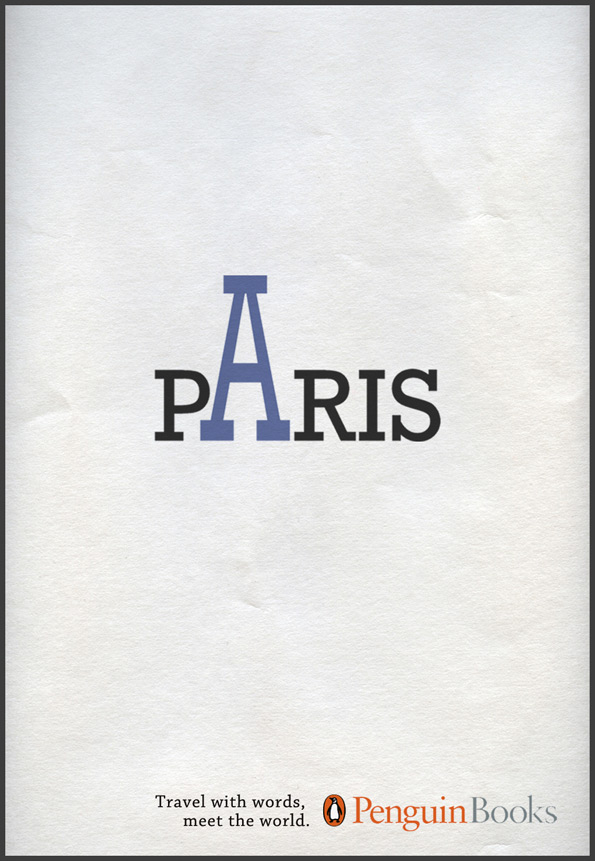
‘Travel with words, meet the world’ — A nice typographic ad campaign from Penguin Books seen at Ads of the World (via This Isn’t Happiness).

No-Fi — Cartoonist James Sturm, founder of the Center for Cartoon Studies, is giving up the internet and documenting for Slate:

Over the last several years, the Internet has evolved from being a distraction to something that feels more sinister. Even when I am away from the computer I am aware that I AM AWAY FROM MY COMPUTER and am scheming about how to GET BACK ON THE COMPUTER. I’ve tried various strategies to limit my time online: leaving my laptop at my studio when I go home, leaving it at home when I go to my studio, a Saturday moratorium on usage. But nothing has worked for long. More and more hours of my life evaporate in front of YouTube. Supposedly addiction isn’t a moral failing, but it feels as if it is.

(For the sake of full disclosure, James Sturm’s new book Market Day is published by D+Q who are distributed in Canada by my employer Raincoast)

Jonathan Turner (AKA Insect54) has posted a few photos of Herbert Spencer’s book Pioneers of Modern Typography on his (amazing) Flickr photostream (via Inspire Me).

2 Comments

#Failure

It probably hasn’t escaped your notice that following the departure of founder and publisher Bob Miller to Workman Publishing last month, HarperCollins imprint HarperStudio is going to close after just 2 years in business.

As a publisher, HarperStudio garnered a remarkable amount of media attention for offering authors lower advances in exchange for a greater share of profits, their plans to sell book to booksellers on a non-returnable basis, and an early and comprehensive embrace of social media.

There was, however, a general feeling — particularly within the industry itself — that despite (or because of) their marketing-savvy, the imprint didn’t quite live up to the hype (even if not everyone felt quite as strongly about it as Dennis Johnson).

In the end they unable to keep author advances down, or their books non-returnable. Yet, as writer Mark Barrett who blogs at Ditchwalk notes, these problems are hardly unique to HarperStudio and, in a sense, their failure is a collective one for publishing.

Perhaps we simply expected (or hoped for) too much?

Nevertheless, I was disappointed by HarperStudio for the more basic reason that their books always seemed to be less innovative than the company itself. When people talked about HarperStudio it was rarely about what they actually published. The books were — for all their audacious marketing — eminently forgettable. They were kind of things that traditional small-to-medium sized trade publishers have a tendency to churn out with alarming regularity (with perhaps the notable exception of Crush It! for which HarperStudio reputedly paid a rather large advance), and it was never clear to me who their core readership was intended to be. Their innovations seemed to do little to improve the kind of books being the published.

In this sense, HarperStudio’s closure has echoes of Quartet Press.

Like many people, I had unrealistically high expectations for Quartet, and I still admire the fact that the people involved put their money where their mouths were (and mostly still are). But my heart sank when it became clear that for all their innovative plans for e-books, they launched with nothing ready to publish. The eventual announcement that they would be publishing romance fiction meant that, unlike HarperStudio, they at least planned to publish to a recognised (and potentially profitable) niche, but somehow this felt like an afterthought. The digital medium was more important than the message.

I was reminded of all this by Brett Sandusky‘s recent announcement that his project Publishr is soliciting for material to publish:

Publishr is proud to announce a new project: Publishr will bring an eBook, which has yet to be created, to market. We will do this in an atmosphere of complete transparency.

Publishr currently seeks proposals from motivated authors (particularly those with works of unpublished fiction and narrative non-fiction) as well as support from contributors who are interested in innovation and building a superior native-digital eBook product or suite of products that will be sold in the real world.

In many ways this is great idea, and there are definitely lessons to be learnt from this kind of experimentation. But Publishr seems to be following in the footsteps of HarperStudio and Quartet (albeit on a smaller scale). Based on the erroneous belief that there is a large reservoir of quality material that can be easily and quickly tapped, the focus is on revolutionizing how to publish rather than what or who to publish.

There is, of course, wisdom to innovating the process rather than the product. Toyota’s success was built on innovative factories, not innovative and original products (at least until the Prius came along). And yet the Toyota process was geared (again until recently) to producing certain kinds of consistently good, inexpensive cars (which, I would guess, was all the consumer actually cared about).

My point is not that we should not stop experimenting with new author contracts, transparency, formats, trade terms, or marketing — we need to try new things and be allowed to fail. But this should not come at the expense of consistently good, interesting (and inexpensive) books.

Perhaps a model for start-ups is to be found in James Bridle’s modestly immodest print-on-demand publishing effort Bookkake. Although Bookkake is not publishing new material (and who knows whether it is making money), it seems a more sustainable kind of venture, not least because James has published books that he cares about. They have an sense of coherence and quality that one might expect from a successful small press.

Another alternative is demonstrated by Toronto small press ChiZine Publications (CZP) who established a ‘dark genre’ webzine long before they moved into print. Founders Brett Alexander Savory and Sandra Kasturi knew what the kind of stories they liked — “weird, subtle, surreal, disturbing dark fiction and fantasy” — and built a community around it. The books (available in multiple formats) came later.

The CZP story in particular seems to be the polar opposite of HarperStudio, Quartet, and Publishr. CZP was launched because they had stories they wanted to publish, not because they wanted to ‘fix’ the system. I’m not saying that improving the process isn’t important, it’s just that we need to find new, interesting, consistently good content as wellmeaningful stuff that matters (if only to us). If we don’t, the new books will just be glowing versions of the old books (with better PR)… Plus ça change…

8 Comments

Midweek Miscellany

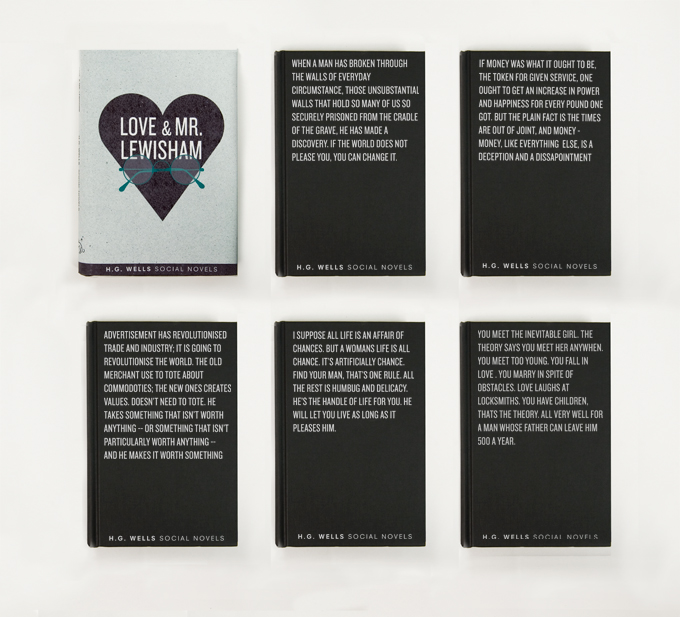
Some nice book design from graphic design student Tom Pollard, spotted at FormFiftyFive

And speaking of FFF…

Some beautiful print design work by FormFiftyFive contributor Daniel Gray (via Cosas Visuales).

The Dramatist — A great profile of David Simon, creator of HBO series The Wire and Treme, in New York Magazine (via Mark Athitakis’ American Fiction Notes):

“Fuck the exposition,” he says gleefully as we go back into the bar. “Just be. The exposition can come later.” He describes a theory of television narrative. “If I can make you curious enough, there’s this thing called Google. If you’re curious about the New Orleans Indians, or ‘second-line’ musicians—you can look it up.” The Internet, he suggests, can provide its own creative freedom, releasing writers from having to overexplain, allowing history to light the characters from within.

Sympathy for the Librarian — A lovely quote from Keith Richards in The Times (via MobyLives):

“When you are growing up there are two institutional places that affect you most powerfully: the church, which belongs to God, and the public library, which belongs to you. The public library is a great equaliser.”

Amen.

And finally…

After posting about the big man earlier this week, I would be remiss if I didn’t mention The Ten Commandments of George Lois t-shirts available from TypographyShop:

“Great ideas can’t be tested. Only mediocre ideas can be tested.” Awesome.

Comments closed

The Greatest

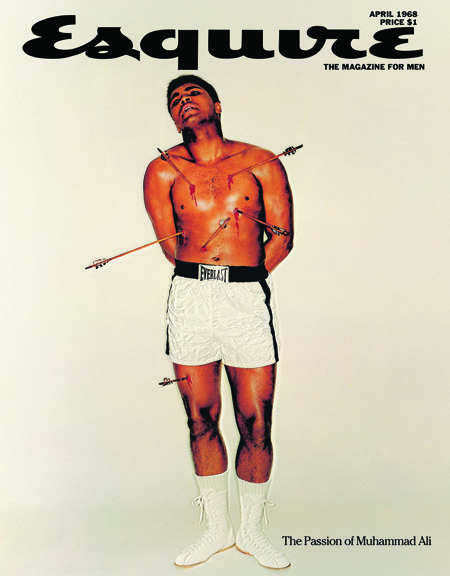
Like Dieter Rams, George Lois seems to be a recurrent theme here and I was wondering why that was. Sure, he has a new book out (published by Assouline), but why is he still relevant? Thinking about this, I kept coming back to his April 1968 Muhammad Ali cover for Esquire.

George Lois Esquire: Ali as St SebastianIn 1964 Muhammad Ali, the heavyweight champion of the world, had controversially joined The Nation of Islam and changed his name from Cassius Clay. Three years later he refused to be drafted into the U.S. army because of his religious beliefs and opposition to the Vietnam War. He was stripped of his world title and had his professional boxing license suspended.

At a time of racial tension in the US (there were race riots and civil rights protests across the country in 1967 as well as protests against the Vietnam war) Ali was a successful, outspoken, controversial and self-confident black man refusing to fight for his country. He was reviled and, one suspects, feared by white conservative America.

By 1968, Ali was on bail awaiting his appeal to the Supreme Court. He was still unable to fight and the magazine was planning a story on his exile from the ring.

Putting the boxer on the cover was certainly controversial. But Lois did not make the fighter ‘respectable’ (one doubts the thought even entered his head). Instead, in a photograph taken by Carl Fischer, he presented Ali bare-chested and pierced with arrows.

It is a striking, bloody, and shocking image — especially given the context.

Yet it is also witty, irreverent and surprising: a complex “big idea” rendered with beautiful simplicity.

Lois posed Ali as Saint Sebastian, a 3rd Century Christian soldier and martyr who was bound to a post and shot full of arrows for his beliefs (the arrows, incidentally, didn’t kill him — a subsequent beating took care of that).

The reference was a postcard of a 15th Century painting by attributed to Castagno in the Metropolitan Museum in New York (the Met have since re-attributed the painting to Francesco Botticini).

Like so many of Lois’ other covers for Esquire — this is unquestionably an attack on the establishment. But ‘Ali as St. Sebastian’ is also just about the most elegant and incisive “fuck you” imaginable. It is not the shocking irreverence that makes it resonate — it’s the lacerating wit.

From race to sex to Vietnam — this stuff mattered to Lois. And that never, ever gets old.

Links:
George Lois

George Lois AIGA Medalist
The Passion of George Lois, Design Observer
George Lois 12 Favourite Classic Esquire Covers, New York Magazine
George Lois, Wikipedia

Trailer for the documentary Art & Copy featuring a movie-stealing George Lois (just guess which one he is):

1 Comment

Doctorow at Bloomsbury

Whether you agree with him or not, this is an interesting — if scatter-gun — talk by Cory Doctorow on publishing, e-books, pricing, and DRM (and more) at UK publisher Bloomsbury:

There are some additional notes (and a couple of corrections!) at Cory Doctorow’s website.

(via Ted Striphas’ The Late Age of Print)

1 Comment

The Abolition of Built-In Obsolescence

A nice short video about Dieter Rams’ design philosophy and the recent exhibition of his work at the Design Museum London:

What has this got to do with books? Well, it’s a timely reminder to care about what we make…

(video via Coudal Partners’ Fresh Signals)

1 Comment

Something for the Weekend

Sorry (again) for the late (and lack of) posting recently. This week, the BookNet Tech Forum in Toronto kept me out of the office and away from the blog. If you’re interested in the conference, the ACP‘s Sarah Labrie has a great round up of the main day here.

But on to the links…

Alexander S. Budnitz’s INCREDIBLE ASB Cover Archive. This site should definitely be added to this list (via Karen Horton’s ace Daily Design Discoveries).

Thick and Thin — Umair Haque on social media at The Harvard Business Review:

The social isn’t about beauty contests and popularity contests. They’re a distortion, a caricature of the real thing. It’s about trust, connection, and community. That’s what there’s too little of in today’s mediascape, despite all the hoopla surrounding social tools. The promise of the Internet wasn’t merely to inflate relationships, without adding depth, resonance, and meaning. It was to fundamentally rewire people, communities, civil society, business, and the state — through thicker, stronger, more meaningful relationships.

I don’t entirely agree with everything in this post (and I wonder how much of it has to do with Haque’s recent Twitter mauling as SXSW?) but it’s a timely reminder that quality is more important than quantity.

Fine Hypertext Products — A podcast interview at The Pipeline with Jason Kottke founder of one of the most consistently interesting blogs out there (and a big influence on this one) kottke.org. There is also an interesting earlier interview with Jim Coudal president of design studio Coudal Partners.

Straight-Talking — The Book Oven’s Hugh MacGuire interviews Don Linn, former CEO of Consortium Book Sales & Distribution and publisher at The Taunton Press:

Too many titles now are bought (often at way too high a price), produced sloppily and just tossed into the market without adequate support. This benefits no one. Second, I’d like to see all publishers implement workflows (using XML or other flexible tools) and production processes that make their content more agile… Finally, I’d just encourage more intelligent experimentation and attempts at innovation. I sense paralysis on the part of a large number of publishers based on a (not irrational) fear of making the wrong bet during this chaotic time.

(NB: It’s also interesting to read why Don felt digital publishing venture Quartet failed, although I kind of think some of that stuff should have been obvious to them before they started).

And finally…

The Rise of the “Paper-Bounds” — Leif Peng excerpts a 1953 Fortune magazine article on mass-market paper-bounds at the always brilliant Today’s Inspiration. There’s more here, here, and here

Comments closed

Midweek Miscellany

How To Live Safely in a Science Fictional Universe

A new cover from John Gall, seen at Peter Mendelsund’s JACKET MECHANICAL. Am I the only one who wants to hear these two in conversation? Dear NPR, could you get on that please?

Soft in the Middle — James Surowiecki looks at how midrange companies are being pressured by both high-end products at one end and ‘just good enough’ products at the other in the New Yorker (via Kottke):

The products made by midrange companies are neither exceptional enough to justify premium prices nor cheap enough to win over value-conscious consumers. Furthermore, the squeeze is getting tighter every day… This doesn’t mean that companies are going to abandon the idea of being all things to all people. If you’re already in the middle of the market, it’s hard to shift focus—as G.M. has discovered. And the allure of a big market share is often hard to resist, even if it doesn’t translate into profits.

I think we going to see this more in publishing with the midlist losing out to quick, cheap and ‘just good enough’ e-books and expensive, beautifully packaged hardcovers.

Somewhere Between Skeptic and Proselytizer — John Williams founder of The Second Pass interviewed at The Virginia Quarterly Review blog:

I think the way books are written about has been opened up in healthy ways. I like that there are more amateur (and semi-pro and pro) voices on the Internet, in the sense that it’s not just the unimaginative circle wherein writers of a certain kind of book review another example of that kind of book written by someone else. I’m not the first (or even the hundredth) to think that can lead to a lot of back-scratching or dry summation rather than forcefully argued opinion. It’s also true that the Internet has been great for, say, literature in translation, where entire sites (like Three Percent) can be devoted to a subject that gets less attention than it should in mainstream outlets. But as for how literary careers are made, I don’t think that’s changed as much as the tech apostles would like to believe.

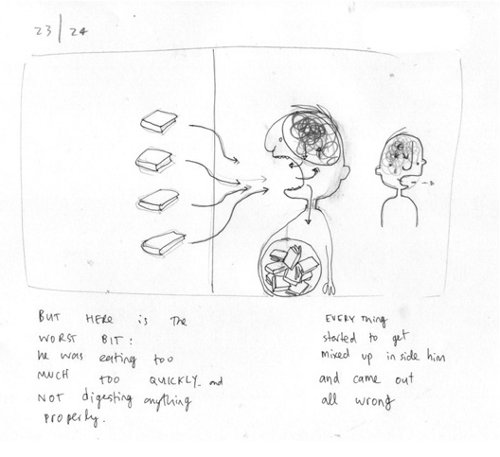
The Incredible Book-Making Boy — Super talented author and illustrator Oliver Jeffers, whose new book The Heart and the Bottle was published earlier this month, interviewed at Seven Impossible Things Before Breakfast:

I begin with a single idea… and then tease that out in my sketchbook with hundreds of other drawings and pieces of writing that explore how the narrative can grow and extend into something that is satisfying. Once I’ve got a basic plot, I work with my editor in streamlining everything down to fit the thirty-two-page format…  Getting the story to flow between those thirty-two pages is probably the most difficult part. It’s like directing a film, where the pace needs to be set and decisions made of what goes where. It’s at this point that many of the compositions get cut. There is a careful balance between what the pictures are showing and what the words are saying, and if something is shown, it often doesn’t need to be said.

And finally…

Contemporaries, He Yanming

Chinese Book Covers seen at the excellent Ephemera Assemblyman.

5 Comments

Something for the Weekend

An illustration by Pascal Blanchet, author of the charming White Rapids*, for the National Post’s Spring Books Quarterly.

Text Without Context An interesting article on reading and the web by Michiko Kakutani in the New York Times, which discusses books by David Shields, Jaron Lanier, Cass Sunstein, Farhad Manjoo and others (and yes, I appreciate the irony of me of linking an article about the fragmentary nature of reading online and only quoting one paragraph):

THESE NEW BOOKS share a concern with how digital media are reshaping our political and social landscape, molding art and entertainment, even affecting the methodology of scholarship and research. They examine the consequences of the fragmentation of data that the Web produces, as news articles, novels and record albums are broken down into bits and bytes; the growing emphasis on immediacy and real-time responses; the rising tide of data and information that permeates our lives; and the emphasis that blogging and partisan political Web sites place on subjectivity.

The Bkkeepr — Book Oven’s Hugh McGuire interviews James Bridle of BookTwo and Bookkake:

We can berate publishers for making what we think are bad decisions about digital, but to accuse them of cluelessness just inflates a very dangerous animosity. Publishers love books as much, if not more, than most readers. It’s one of the very few industries where this is true almost all the way up. And we should be working together for the best of all possible futures for books and authors and readers.

(And you can read Hugh’s response to the Michiko Kakutani article — which he takes issue with — here)

Route One — Sarah Weinman at Daily Finance looks at indie publishers experimenting subscription models that reach readers directly.

And finally…

Designer Matt Avery talks about his beautiful design for Chicago by Dominic Pacyga (University of Chicago Press) at Faceout Books.

* White Rapids is published by D+Q and distributed in Canada by my employer, Raincoast Books.

Comments closed