Skip to content

The Casual Optimist Posts

Something for the Weekend

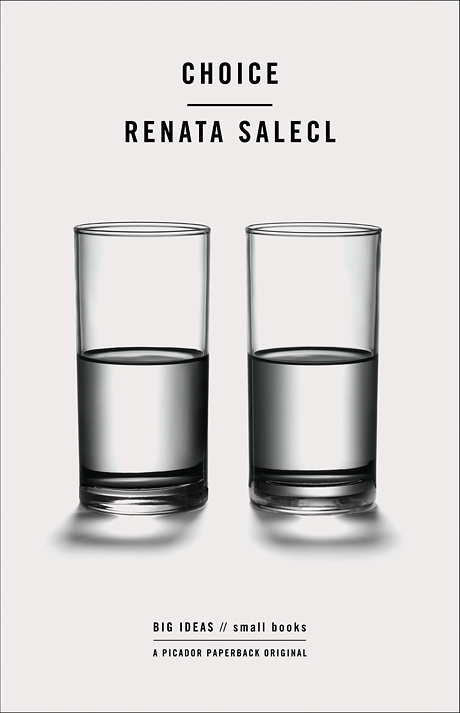
Two stunningly beautiful, and sadly unused, designs by Henry Sene Yene with photographs by Jon Shireman for Picador’s BIG IDEAS // small books series. Picador decided not to publish the book. You can see Henry’s other designs for the series here.

A Meaningful Publisher — Forbes profiles the fantastic NYRB Classics (via Sarah Weinman):

While the series hasn’t published a bestseller, and is unlikely to do so, readers care about NYRB Classics and are loyal to it. This is a monumental accomplishment at a moment when cultural loyalty is extremely fickle. Frank and Kramer did it using a frills-free, deceptively simple editorial strategy: give readers good books consistently, respect them, engage them, and they’ll stick with you.

Rough Healer — Jamie Byng, publisher at Canongate, on musician, poet, and author Gil Scott-Heron in The Guardian.

The Ultimate Online Bookclub — A little late to the party, but Viv Groskop discovers Twitter is the place to share book opinions and gossip (and stalk authors apparently) in The Telegraph (via Source Books publisher Dominique Raccah on Twitter of course!):

Twitter allows you to discuss books and authors with other fans online without having to set up a blog or invent some dodgy chat room identity. If you “follow” the right people… you soon discover that Twitter brings you compelling snippets from publicists, book fanatics, bloggers and authors themselves. With reading recommendations galore, it is the book addict’s paradise.

The New Narrative — Creative Nonfiction magazine is seeking interesting stand-alone narrative nonfiction blog posts (2000 words or less) to reprint in their next issue. Nominate something from your own blog, or from a friend’s. Closing date is this Monday (April 26, 2010).

And finally…

A Fan of the Form — Author and publisher Dave Eggers talks to On The Media about the McSweeney’s newspaper Panorama:

I like the curatorial, the calmness, the authority of a daily paper. But I do think that it’s a time to make the paper form more robust and more surprising and beautiful and expansive. People still want to read long form literary journals and nonfiction, etc., and so why can’t the print medium do that and be that home and leave the Internet to do the more quick thinking and quick reacting things?

Comments closed

The Real Jay Gatsby

Kate Beaton takes on The Great Gatsby:

More, oh, so much more, at the wonderful Hark! A Vagrant.

(Thanks Siobhan!)

Comments closed

Midweek Miscellany

In the Land of Punctuation published by Tara Books (seen at DesignWorkLife):

Written in 1905 by the German poet Christian Morgenstern, In the Land of Punctuation is a darkly comic linguistic caprice that holds a resonant mirror to our times. Situated at the crossroads of language, design, and politics, this illustrated edition is a unique picture book for adults. Translated faithfully by Sirish Rao, with typographic illustrations by Rathna Ramanathan, this is a brilliantly inventive dance of text and image.

More on the illustrations at Rathna Ramanathan’s blog.

Quality. Interest. Significance — Robert McCrum profiles literary agent Andrew ‘The Jackal’ Wylie in The Observer:

The more he talks, the more Wylie’s innate puritan zeal comes to life within the clerical black of his undertaker’s suit and tie. “I’m a books person. Yes, I have a Kindle. I used it for an hour and a half and put it in the closet. I’m not interested in mass culture. When I started out I saw nine out of 10 people heading for the door marked Money, Commerce, Trash. So I chose the door marked Quality. Interest. Significance…”

Battle Royale — In a much linked to article, Ken Auletta, author of Googled: The End of the World as We Know It, discusses the iPad, the Kindle, and, yes, Google, in The New Yorker:

Publishing exists in a continual state of forecasting its own demise; at one major house, there is a running joke that the second book published on the Gutenberg press was about the death of the publishing business.

There’s not much (if anything) new in the article and more than a few of the usual suspects (and clichés) appear, but it does cover a lot of ground and provides a decent summary of where things currently stand in the publisher-Apple-Amazon-Google pissing match.

Revolution Betrayed — Christopher Hitchens on George Orwell’s Animal Farm for The Guardian:

It is affecting to imagine battle-hardened ex-soldiers and prisoners of war, having survived all the privations of the eastern front, becoming stirred by the image of British farm animals singing their own version of the discarded “Internationale”, but this was an early instance of the hold the book was to take on its readership. The emotions of the American military authorities in Europe were not so easily touched: they rounded up all the copies of Animal Farm that they could find and turned them over to the Red Army to be burnt. The alliance between the farmers and the pigs, so hauntingly described in the final pages of the novel, was still in force.

And finally…

[space]

Massimo Vignelli says we use too many fonts.  I Love Typography has a smart response. The full 36-minute interview with Vignelli is available from Big Think.

2 Comments

Q & A with Peter Mendelsund and Tom McCarthy

In the early days of The Casual Optimist I scribbled out a short list of book designers I wanted to interview. More designers have been added since then, but a few of the original list remain un-interviewed. At the top of the list has been the name I actually wrote down first: Peter Mendelsund.

As Senior Designer at Knopf, Mendelsund’s designs feature here regularly. Much as I love his covers, however, Peter has been interviewed extensively elsewhere. I just haven’t known how to approach his work in a way that he would find interesting.

That was until I saw the shockingly subversive jacket design for Tom McCarthy‘s new novel “C”. The pairing of Mendelsund, the designer who is a musician, and McCarthy, the author who is an artist, was — it seemed to me — inspired.

A perfect opportunity…

What follows is primarily an interview with Peter about that design for “C”. But over the course of a few emails, Peter and I both decided to bring Tom into the conversation. I had met Tom shortly after the release of his debut novel Remainder and Peter had, it transpired, met Tom in New York after Knopf had signed “C”. It made sense to both of us.

It is a long, but absolutely fascinating exchange. Peter kindly answered my questions more fully than I had any right to expect and Tom, who was contributing from Stockholm, was more than gracious in less than ideal circumstances. I’m grateful to them both.

7 Comments

Something for the Weekend

John Squire‘s 1980’s covers for the Penguin Decades Series at The Creative Review. The art direction was by Penguin’s Jim Stoddart, but yes, it is THAT John Squire (i.e. awesome).

Fine Independent Publishing — An interesting interview with Barbara Epler, Editor-in-Chief at literary publisher New Directions, at KCRW’s Bookworm (although I could do without the decline of literature being blamed squarely on sales and marketing people. Again):

Permanent Crisis — A post by Rebecca Smart, Managing Director of military history publisher Osprey Publishing, at Digital Book World:

If you perceive that your only environment is that encompassed by your current supply chain then you’re only going to adapt to changes in that environment – so the response to the digital challenge viewed in this way would be to create and sell e-books. If you put the consumer at the heart of your thinking you can consider instead each group of customers you serve and what they might want on top of what you already provide, how they might want you to serve them differently in the future. More to the point, you can ASK them, listen and respond.

Proletarian Erotica — Lorin Stein, former senior editor at Farrar, Straus and Giroux and new editor of the Paris Review, interviewed at The Economist‘s ‘More Intelligent Life’ blog. The National Post also ran a nice interview with Stern last month.

Going Deutsch — Tom McCarthy, whose new book “C” I’m reading right now,  interviewed at the New York Times ‘Paper Cuts’ blog:

One critic described “Remainder” as a French novel written in English; well, by that token, “C” is my German novel. What the next one will be is anyone’s guess. Swedish, maybe…

More from Tom on The Casual Optimist soon (if I can twist his arm)…

Print Junkies — An interview at The Second Pass with the publisher and editor of Stop Smiling magazine J. C. Gabel on the launch if the Stop Smiling book imprint:

We’re still operating with the same mentality… but have adopted a Less Is More mindset — and a production schedule to match. It does feel nice to know that what we spend months or years working on is now being released in a permanent format. We’re really trying to reinvent the DIY aesthetic of the magazine to apply it to editing, publishing, and promoting books. The book-making process itself, of course, is much slower and drawn out, which is refreshing as we all get older.

And finally, I give you Oliver Jeffers’ moustache (via Tragic Right Hip)…

3 Comments

Midweek Miscellany

McGraw-Hill paperbacks designed by Rudolph De Harak — A nice Flickr set of vintage covers from Joe Kral, who apparently has an amazing book collection (via Words & Eggs).

Free Libraries Are Full of Books That No One Reads — Author Paul Theroux talks to The Atlantic about e-books (via The Second Pass):

I don’t think people will read more fiction than they have in the past… but something certainly is lost—the physicality of a book, how one makes a book one’s own by reading it (scribbling in it, dog-earing pages, spilling coffee on it) and living with it as an object… I can’t predict how reading habits will change. But I will say that the greatest loss is the paper archive—no more a great stack of manuscripts, letters, and notebooks from a writer’s life, but only a tiny pile of disks, little plastic cookies where once were calligraphic marvels.

Not Dead Yet — An interesting post at Personanondata on what the resilience of the CD format means for books:

Many believe the physical book will disappear within in the next ten years yet the example of the music CD suggests the future of the book may be more nuanced. The availability of electronic versions of trade content will approach 100% in less than ten years… Despite the availability however, electronic content is likely to represent only one of a number of ways consumers will engage with book content…  Rather than disappear, the lowly print book may retain a position of wide distribution… and become the focal point of a facilitated interaction with numerous content acquisition options for consumers.

The information on CD sales in the post comes from a recent report in The Economist, which also ran an interesting article about the future of copyright on the same day:

The lawmakers intended… to balance the incentive to create with the interest that society has in free access to knowledge and art… Over the past 50 years, however, that balance has shifted. Largely thanks to the entertainment industry’s lawyers and lobbyists, copyright’s scope and duration have vastly increased… They are now calling for even greater protection, and there have been efforts to introduce similar terms in Europe. Such arguments should be resisted: it is time to tip the balance back.

The New York Times obituary for publishing executive and copywriter Nina Bourne:

The campaign she created for “Catch-22” is now regarded as a classic. Ms. Bourne was the most passionate in-house champion of the book, a darkly comic tale of World War II by a first-time novelist. Pleading for an increase in the initial print run, she turned to her colleagues during a production meeting, tears in her eyes, and asked, “If I can’t get this, why am I here?”

And finally…

Architecture Under Construction — a beautiful set of photographs by Stanley Greenberg from a new book published by the University of Chicago Press. Pictured: Untitled, Toronto, Ontario, 2005 — Royal Ontario Museum, Studio Daniel Libeskind (via PD Smith).

Comments closed

Something for the Weekend

A couple of quick links…

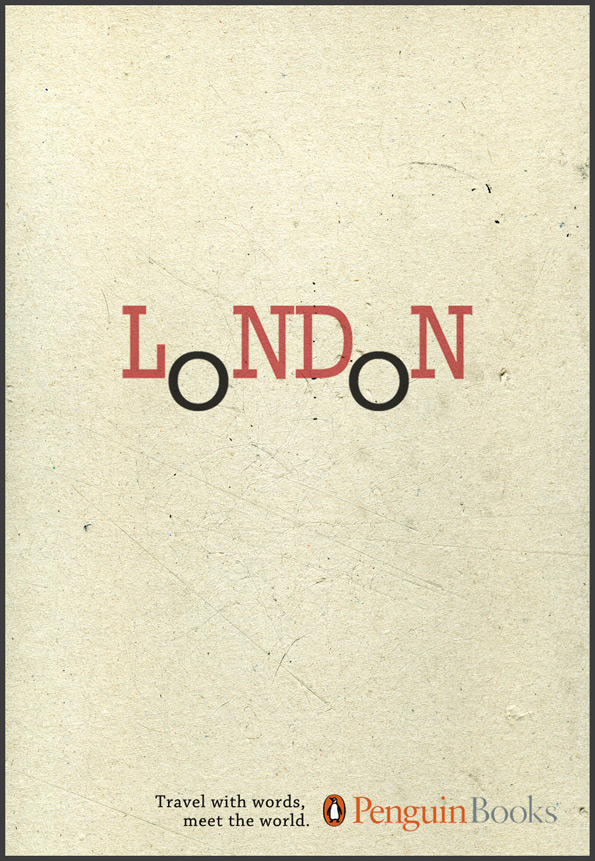
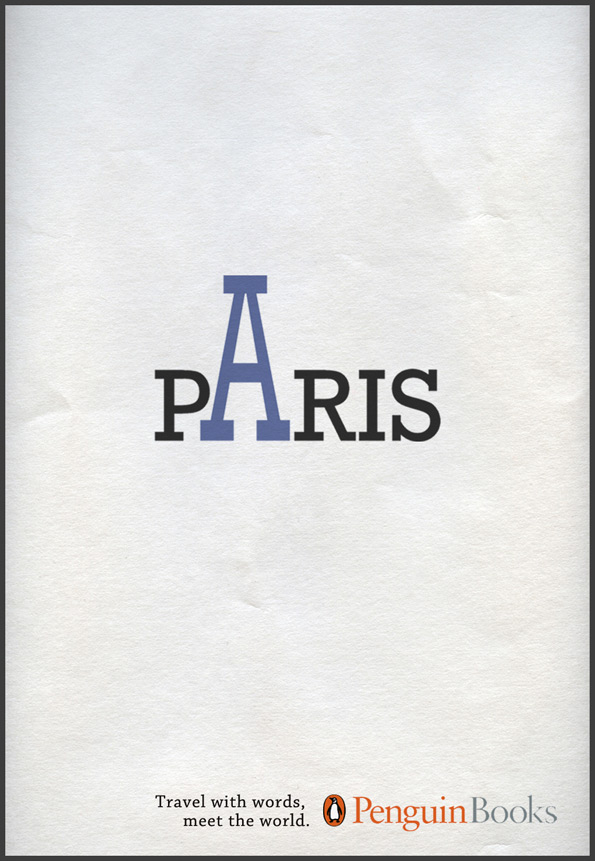
‘Travel with words, meet the world’ — A nice typographic ad campaign from Penguin Books seen at Ads of the World (via This Isn’t Happiness).

No-Fi — Cartoonist James Sturm, founder of the Center for Cartoon Studies, is giving up the internet and documenting for Slate:

Over the last several years, the Internet has evolved from being a distraction to something that feels more sinister. Even when I am away from the computer I am aware that I AM AWAY FROM MY COMPUTER and am scheming about how to GET BACK ON THE COMPUTER. I’ve tried various strategies to limit my time online: leaving my laptop at my studio when I go home, leaving it at home when I go to my studio, a Saturday moratorium on usage. But nothing has worked for long. More and more hours of my life evaporate in front of YouTube. Supposedly addiction isn’t a moral failing, but it feels as if it is.

(For the sake of full disclosure, James Sturm’s new book Market Day is published by D+Q who are distributed in Canada by my employer Raincoast)

Jonathan Turner (AKA Insect54) has posted a few photos of Herbert Spencer’s book Pioneers of Modern Typography on his (amazing) Flickr photostream (via Inspire Me).

2 Comments

#Failure

It probably hasn’t escaped your notice that following the departure of founder and publisher Bob Miller to Workman Publishing last month, HarperCollins imprint HarperStudio is going to close after just 2 years in business.

As a publisher, HarperStudio garnered a remarkable amount of media attention for offering authors lower advances in exchange for a greater share of profits, their plans to sell book to booksellers on a non-returnable basis, and an early and comprehensive embrace of social media.

There was, however, a general feeling — particularly within the industry itself — that despite (or because of) their marketing-savvy, the imprint didn’t quite live up to the hype (even if not everyone felt quite as strongly about it as Dennis Johnson).

In the end they unable to keep author advances down, or their books non-returnable. Yet, as writer Mark Barrett who blogs at Ditchwalk notes, these problems are hardly unique to HarperStudio and, in a sense, their failure is a collective one for publishing.

Perhaps we simply expected (or hoped for) too much?

Nevertheless, I was disappointed by HarperStudio for the more basic reason that their books always seemed to be less innovative than the company itself. When people talked about HarperStudio it was rarely about what they actually published. The books were — for all their audacious marketing — eminently forgettable. They were kind of things that traditional small-to-medium sized trade publishers have a tendency to churn out with alarming regularity (with perhaps the notable exception of Crush It! for which HarperStudio reputedly paid a rather large advance), and it was never clear to me who their core readership was intended to be. Their innovations seemed to do little to improve the kind of books being the published.

In this sense, HarperStudio’s closure has echoes of Quartet Press.

Like many people, I had unrealistically high expectations for Quartet, and I still admire the fact that the people involved put their money where their mouths were (and mostly still are). But my heart sank when it became clear that for all their innovative plans for e-books, they launched with nothing ready to publish. The eventual announcement that they would be publishing romance fiction meant that, unlike HarperStudio, they at least planned to publish to a recognised (and potentially profitable) niche, but somehow this felt like an afterthought. The digital medium was more important than the message.

I was reminded of all this by Brett Sandusky‘s recent announcement that his project Publishr is soliciting for material to publish:

Publishr is proud to announce a new project: Publishr will bring an eBook, which has yet to be created, to market. We will do this in an atmosphere of complete transparency.

Publishr currently seeks proposals from motivated authors (particularly those with works of unpublished fiction and narrative non-fiction) as well as support from contributors who are interested in innovation and building a superior native-digital eBook product or suite of products that will be sold in the real world.

In many ways this is great idea, and there are definitely lessons to be learnt from this kind of experimentation. But Publishr seems to be following in the footsteps of HarperStudio and Quartet (albeit on a smaller scale). Based on the erroneous belief that there is a large reservoir of quality material that can be easily and quickly tapped, the focus is on revolutionizing how to publish rather than what or who to publish.

There is, of course, wisdom to innovating the process rather than the product. Toyota’s success was built on innovative factories, not innovative and original products (at least until the Prius came along). And yet the Toyota process was geared (again until recently) to producing certain kinds of consistently good, inexpensive cars (which, I would guess, was all the consumer actually cared about).

My point is not that we should not stop experimenting with new author contracts, transparency, formats, trade terms, or marketing — we need to try new things and be allowed to fail. But this should not come at the expense of consistently good, interesting (and inexpensive) books.

Perhaps a model for start-ups is to be found in James Bridle’s modestly immodest print-on-demand publishing effort Bookkake. Although Bookkake is not publishing new material (and who knows whether it is making money), it seems a more sustainable kind of venture, not least because James has published books that he cares about. They have an sense of coherence and quality that one might expect from a successful small press.

Another alternative is demonstrated by Toronto small press ChiZine Publications (CZP) who established a ‘dark genre’ webzine long before they moved into print. Founders Brett Alexander Savory and Sandra Kasturi knew what the kind of stories they liked — “weird, subtle, surreal, disturbing dark fiction and fantasy” — and built a community around it. The books (available in multiple formats) came later.

The CZP story in particular seems to be the polar opposite of HarperStudio, Quartet, and Publishr. CZP was launched because they had stories they wanted to publish, not because they wanted to ‘fix’ the system. I’m not saying that improving the process isn’t important, it’s just that we need to find new, interesting, consistently good content as wellmeaningful stuff that matters (if only to us). If we don’t, the new books will just be glowing versions of the old books (with better PR)… Plus ça change…

8 Comments

Midweek Miscellany

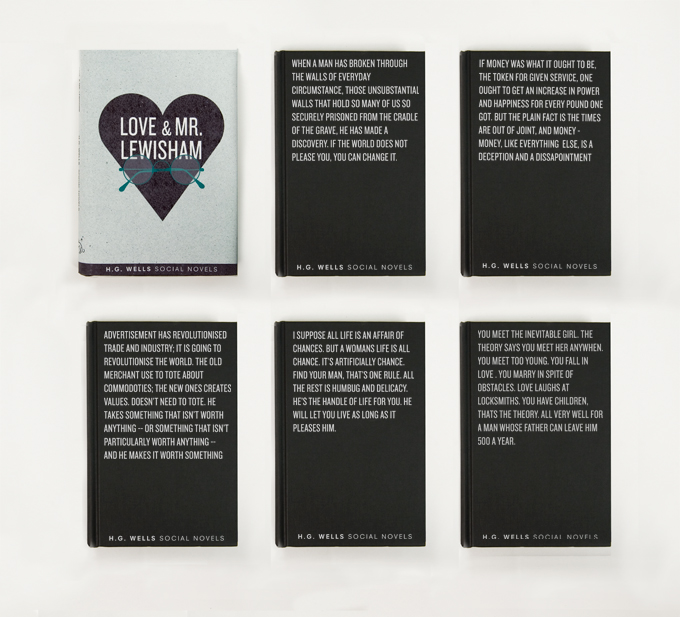
Some nice book design from graphic design student Tom Pollard, spotted at FormFiftyFive

And speaking of FFF…

Some beautiful print design work by FormFiftyFive contributor Daniel Gray (via Cosas Visuales).

The Dramatist — A great profile of David Simon, creator of HBO series The Wire and Treme, in New York Magazine (via Mark Athitakis’ American Fiction Notes):

“Fuck the exposition,” he says gleefully as we go back into the bar. “Just be. The exposition can come later.” He describes a theory of television narrative. “If I can make you curious enough, there’s this thing called Google. If you’re curious about the New Orleans Indians, or ‘second-line’ musicians—you can look it up.” The Internet, he suggests, can provide its own creative freedom, releasing writers from having to overexplain, allowing history to light the characters from within.

Sympathy for the Librarian — A lovely quote from Keith Richards in The Times (via MobyLives):

“When you are growing up there are two institutional places that affect you most powerfully: the church, which belongs to God, and the public library, which belongs to you. The public library is a great equaliser.”

Amen.

And finally…

After posting about the big man earlier this week, I would be remiss if I didn’t mention The Ten Commandments of George Lois t-shirts available from TypographyShop:

“Great ideas can’t be tested. Only mediocre ideas can be tested.” Awesome.

Comments closed

The Greatest

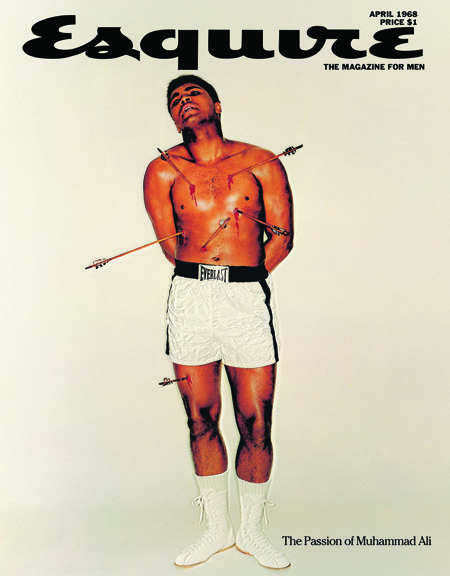
Like Dieter Rams, George Lois seems to be a recurrent theme here and I was wondering why that was. Sure, he has a new book out (published by Assouline), but why is he still relevant? Thinking about this, I kept coming back to his April 1968 Muhammad Ali cover for Esquire.

George Lois Esquire: Ali as St SebastianIn 1964 Muhammad Ali, the heavyweight champion of the world, had controversially joined The Nation of Islam and changed his name from Cassius Clay. Three years later he refused to be drafted into the U.S. army because of his religious beliefs and opposition to the Vietnam War. He was stripped of his world title and had his professional boxing license suspended.

At a time of racial tension in the US (there were race riots and civil rights protests across the country in 1967 as well as protests against the Vietnam war) Ali was a successful, outspoken, controversial and self-confident black man refusing to fight for his country. He was reviled and, one suspects, feared by white conservative America.

By 1968, Ali was on bail awaiting his appeal to the Supreme Court. He was still unable to fight and the magazine was planning a story on his exile from the ring.

Putting the boxer on the cover was certainly controversial. But Lois did not make the fighter ‘respectable’ (one doubts the thought even entered his head). Instead, in a photograph taken by Carl Fischer, he presented Ali bare-chested and pierced with arrows.

It is a striking, bloody, and shocking image — especially given the context.

Yet it is also witty, irreverent and surprising: a complex “big idea” rendered with beautiful simplicity.

Lois posed Ali as Saint Sebastian, a 3rd Century Christian soldier and martyr who was bound to a post and shot full of arrows for his beliefs (the arrows, incidentally, didn’t kill him — a subsequent beating took care of that).

The reference was a postcard of a 15th Century painting by attributed to Castagno in the Metropolitan Museum in New York (the Met have since re-attributed the painting to Francesco Botticini).

Like so many of Lois’ other covers for Esquire — this is unquestionably an attack on the establishment. But ‘Ali as St. Sebastian’ is also just about the most elegant and incisive “fuck you” imaginable. It is not the shocking irreverence that makes it resonate — it’s the lacerating wit.

From race to sex to Vietnam — this stuff mattered to Lois. And that never, ever gets old.

Links:
George Lois

George Lois AIGA Medalist
The Passion of George Lois, Design Observer
George Lois 12 Favourite Classic Esquire Covers, New York Magazine
George Lois, Wikipedia

Trailer for the documentary Art & Copy featuring a movie-stealing George Lois (just guess which one he is):

1 Comment

Doctorow at Bloomsbury

Whether you agree with him or not, this is an interesting — if scatter-gun — talk by Cory Doctorow on publishing, e-books, pricing, and DRM (and more) at UK publisher Bloomsbury:

There are some additional notes (and a couple of corrections!) at Cory Doctorow’s website.

(via Ted Striphas’ The Late Age of Print)

1 Comment