Skip to content

The Casual Optimist Posts

Tintin and the Secret of Literature

A neat animated digital book cover by Charlie Orr for Tom McCarthy’s Tintin and the Secret of Literature:

[I have removed the video — for the time being at least — at the request of my web hosting service due to a complaint from Citel Video. The video is still available at Vimeo]

Does anyone have any more information on this? There’s more information about Charlie’s digital book cover project at The Hypothetical Library.

(via @HughMcGuire)

Comments closed

Kickstart

Craig Mod’s fascinating essay on re-publishing his book Art Space Tokyo using fund-raising website Kickstarter has been much linked to elsewhere, but I’ve only just found time to actually read it and it is definitely worth your time if you have hadn’t had chance to read it yourself yet:

I had one chief consideration in defining the goals for the Kickstarter project: make enough books to generate substantial returns. Then use those returns to further expand this or similar publishing endeavors.

I never intended to just sell a few books. The last thing I wanted was for this Kickstarter project to be nothing more than the start and end of Art Space Tokyo’s new print run. Instead, I wanted it to be the jumping point for exploring more projects in a similar spirit to Art Space Tokyo; a means to explore digital books and to fund the startup of a publishing venture that could make this happen.

(link)

Comments closed

Something for the Weekend

Today is Penguin’s 75th Birthday! Happy Birthday Penguin.

Tony Lacey, Publishing Director of Penguin, discusses the Penguin Decades series:

And The Guardian interviews Penguin Chief Executive John Makinson, who sounds pretty pleased with himself (Penguin just announced record-breaking half year results):

“[E-books] redefine what we do as publishers and I feel, compared with most of my counterparts, more optimistic about what this means for us,” he says. “Of course there are issues around copyright protection and there are worries around pricing and around piracy, royalty rates and so on, but there is also this huge opportunity to do more as publishers.” Publishing, he says, must embrace innovation: “I am keen on the idea that every book that we put on to an iPad has an author interview, a video interview, at the beginning. I have no idea whether this is a good idea or not. There has to be a culture of experimentation, which doesn’t come naturally to book publishers.

In other news…

Copy Writer from the Dark Side — Author Will Self (Liver) discusses advertising with Gordon Comstock for an interview the Creative Review:

I straighten my dog collar and point out some of the things we might have in common, the novelist and the adman. The love of epigrams, the twisting of cliché, the use of animals behaving uncannily – all Self tropes, all things that a copywriter might well have in his book.

It’s a notion I can imagine certain writers would bridle at, but Self only nods philosophically, “Well, maybe I am a copywriter that’s gone to the dark side, I don’t know.”

Wonder Woman Returns — Kate Beaton goes all superhero and shit at Hark! A Vagrant. Kate is now also selling prints directly from her site and from TopatoCo.

And finally, on a related note and because it’s Friday,…

Lady Gaga Kidnaps Commissioner Gordon:

Supervillain Lady Gaga brazenly abducted Commissioner James Gordon from a charity fundraiser Tuesday, leaving police baffled and the citizens of Gotham fearing for their safety. Known for her outlandish costumes and geometric polygon hair, the criminal madwoman made a daring escape from Arkham Asylum last week and has been taunting authorities by interrupting television broadcasts ever since… While the kidnapping occurred at stately Wayne Manor, home of playboy jet-setter Bruce Wayne, the eccentric billionaire was not available for comment.

Comments closed

The Diary of a Disappointed Book

A whimsical short film by Studiocanoe about a disappointing year in the life of a book:

Comments closed

Rework

Co-founder of 37 Signals and author of Rework Jason Fried talks to Peter Hopkins, co-founder of Big Think, in this hour-long interview for HP’s Input| Output series:

It all seems like good advice, especially if you run a small business (or thinking of starting one), and while it’s hard to pin down any specific relevance for the book industry,  it got me thinking about this post again, and the idea we should always focus on making stuff.

1 Comment

Midweek Miscellany

The elegant new cover design for The Secret of Contentment by William B. Barclay, designed by Christopher Tobias.

Melancholy Technology — Tom McCarthy, whose novel C is on the long-list for the Man Booker Prize, on technology and the novel:

Technology and melancholia: an odd coupling, you might think. Yet it’s one that has deep conceptual roots. For Freud, all technology is a prosthesis: the telephone (originally conceived as a hearing aid) an artificial ear, the camera an artificial eye, and so on. Strapping his prosthetic organs on, as Freud writes in Civilisation and its Discontents, man becomes magnificent, “a kind of god with artificial limbs” – “but” (he continues) “those organs have not grown on to him and they still give him much trouble at times”. To put it another way: each technological appendage, to a large degree, embodies an absence, a loss.

There Might Be Typos On The Internet — Lori Fradkin on life as a copy editor for The Awl :

Once you train yourself to spot errors, you can’t not spot them. You can’t simply shut off the careful reading when you leave the office. You notice typos in novels, missing words in other magazines, incorrect punctuation on billboards… Another downside of the job is that only your mistakes are apparent. The catches are basically invisible. No one will look at an edited article and think, I am certain that, once upon a time, there was a double quote where there should have been a single, and a wise person fixed the issue for my benefit. But if you let a “their” slip through in the place of a “there,” you are a complete moron. And if you are working online, commenters will let you know so.

For Sur — The folks at We Made This on their contribution to the Penguin Great Ideas V series:

We did a bit of research into Borges’ writings, and learnt that he’d been one of the founding contributors to the Argentine literary journal Sur, which was published regularly from 1931 until around 1966… he magazine has a very distinctive (and typographically bonkers) masthead, and fortunately the name ‘Sur’ isn’t a million miles from the name ‘Borges’, so basing our design on it felt like a rather tasty solution.

Design Space — Design consultant Theo Rosendorf, author of  The Typographic Desk Reference, talks about his work and his office space with Herman Miller:

Typography plays a major role in the practice beyond simply picking a font or knowing a particular brand’s guidelines. Every typeface has unique requirements in that it has to be set just so. It’s up to the graphic designer to understand what a particular typeface wants. We work within those bounds to let type communicate as it was intended. Everything else follows.

And speaking of typography…

Brockmann in Motion —  Vít Zemčík animates a print design masterpiece. Zemčík made this beautiful 12 second short during the International Typography Workshop in Czieszyn.

Comments closed

Eggs and Sausage

A student project for a class at New York’s School of Visual ArtsJackie Lay’s neat typographic video is set to Tom Waits’ Eggs and Sausage:

In a recent interview with Jeffrey Hyatt at DesignCrave, Lay said:

“I didn’t want to be too literal with the imagery… but I did follow the loose narrative arc in the song of a man going to a late-night diner, ordering his meal off the menu and then lamenting over his unrequited love on napkins, finished off with the waitress bringing the check.”

The video was awarded a Certificate of Typographic Excellence by the Type Directors Club.

Comments closed

TypoElements 2010

A motion graphics tribute to Robert Bringhurst’s book The Elements of Typographic Style by Toronto-based Chris Kim, who is currently studying Radio & Television Arts at Ryerson University:

TypoElements 2010 won an Applied Arts 2010 Student Award.

4 Comments

Something for the Weekend

The cover for The Disappearing Spoon designed by the amazing Will Staehle. To quote Tal Goretsky at Book Covers Anonymous:  “Holy Mother God!”. Apparently it’s printed on uncoated paper.

You can see some of Tal’s own rather nice design work here.

And speaking of designer’s blogs… Designer Joanna Rieke has started a new blog called UnCovered about book and magazine covers. She recently interviewed illustrator (and Casual Op. hero) Tom Gauld:

I think most literature works perfectly well without illustrations and I have seen some truly awful images put on the cover (used as illustrations) of great books. As for comics, I’m more often frustrated by comics which are too wordy than too visual. I think the balance between words and pictures is very important in a comic and though the ratio doesn’t always have to be the same, my heart sinks when I see a page which is filled with writing.

Taking a summer break from his regular illustration gig at The Guardian, Tom is currently producing a weekly comic and posting it to Flickr:
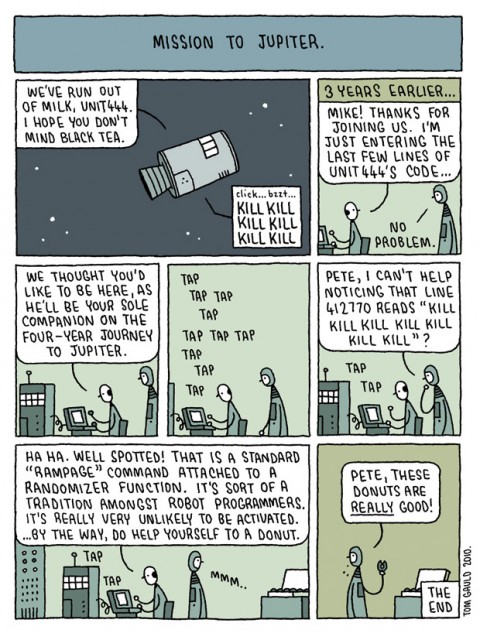
Real Editors Ship — I linked this on Twitter already, but it’s kind of great so what the hell… Paul Ford on getting stuff out the door and the value of editors (and I would suggest Production Managers):

People often think that editors are there to read things and tell people “no.” Saying “no” is a tiny part of the job. Editors are first and foremost there to ship the product without getting sued… This is not to imply that you hit every sub-deadline, that certain projects don’t fail, that things don’t suck. I failed plenty, myself. It just means that you ship…

Editors are really valuable, and, the way things are going, undervalued. These are people who are good at process. They think about calendars, schedules, checklists, and get freaked out when schedules slip. Their jobs are to aggregate information, parse it, restructure it, and make sure it meets standards. They are basically QA for language and meaning.

The Fine art of Recommending Books — Laura Miller at Salon:

Amazon and other online merchants have harnessed mighty algorithms to run their “If you enjoyed that, you might like this…” suggestion engines, but these are still crude instruments. Practically any novel you plug into Amazon’s search engines at the moment returns the robotic announcement that people who bought it also bought one of Stieg Larsson’s “Girl” thrillers — because seemingly everybody in America is buying those books. It’s not like you need the world’s most sophisticate e-commerce servers to tell you that.

And finally…

Steranko! — Jonathan Ross interviews comics legend Jim Steranko, inspiration for Josef Kavalier in Michael Chabon’s The Amazing Adventures of Kavalier and Clay,  for The Guardian:

Spend an hour with Jim Steranko and, if he’s in the mood, he’ll regale you with the most extraordinary tales. Are they true, I have asked myself more than once, or is he a fantasist? Has his love of storytelling and the creation of modern myths bled into his own life story until he can no longer tell the two apart? Well, now that I’ve met him, I believe them all to be true, just as I believe it when he tells me he still runs miles every day, pumps iron, and fornicates blissfully like a man a third his age. He is unique. He is Steranko. He is the greatest.

A slideshow of Steranko’s work is here.

Have a good weekend…

1 Comment

Great Ideas Volume V

Penguin Great Ideas V David Pearson is posting the covers for the new Penguin Great Ideas series to Flickr. As you can see, they are stunning.

You can read my interview with David Pearson here.

1 Comment

Pass the Gestalt, Please

An interesting post by the whip-smart Evan Schnittman, Managing Director of Group Sales and Marketing at Bloomsbury, about e-book rights and royalties at his blog Black Plastic Glasses:

[A] successful and coherent publishing is not the sum of individual publishing rights, but rather the gestalt work presented coherently to a global audience. Viewing the ebook out of the context of the rest of the work gets us nowhere. We must understand how ebooks fit into the publishing ecosphere and only then can we determine what the right royalty should be… The whole work has FAR greater value than the sum of the individual rights. Allowing each individual part, or right, to be disaggregated and auctioned to the highest bidder serves only those who make profit from short-term gain.

(via MobyLives)

Comments closed

What Is There In Life If You Do Not Work?

A winsome post by William Zinsser, author of On Writing Well, on work and writing for The American Scholar:

I’ve never defined myself as a writer, or, God forbid, an author. I’m a person–someone who goes to work every morning, like the plumber or the television repairman, and who goes home at the end of the day to think about other things. I can’t imagine not going to work as long as I can…

…It may seem perverse that I compare my writing to plumbing, an occupation not regarded as high-end. But to me all work is equally honorable, all crafts an astonishment when they are performed with skill and self-respect. Just as I go to work every day with my tools, which are words, the plumber arrives with his kit of wrenches and washers, and afterward the pipes have been so adroitly fitted together that they don’t leak. I don’t want any of my sentences to leak. The fact that someone can make water come out of a faucet on the 10th floor strikes me as a feat no less remarkable than the construction of a clear declarative sentence.

(via  Coudal)

2 Comments