Skip to content

The Casual Optimist Posts

The Evolution of Music Online | Off Book

Related to the previous, the latest PBS Arts Off Book documentary short is about the massive changes that have occurred in the music industry in the last twenty years as a result of new technology and the Internet:

Comments closed

PressPausePlay

The full-length documentary PressPausePlay is now available to watch on Vimeo. The film, which somehow manages to be simultaneously both inspiring and melancholic, looks at the effects of digital technology and the Internet on the creative economy. Worth watching if you have a spare hour (although depending on your attitude to these things it might make you smile in joyful validation or retreat to your bed for about a week to weep quietly to yourself:

PressPausePlay was made by creative agency House of Radon.

Comments closed

Midweek Miscellany

An interview with Jason Cohn, director of the documentary Eames: The Architect and The Painter, at Imprint:

Charles was extremely ambitious and maybe a little bit cut throat in his career. I do think that it was important to him to build a strong brand. The way that he used the image of them as a couple to publicize and self-promote was far thinking. I think that he and Ray intuited that when you are selling a mass-produced item like a chair or an iPod, it’s not quite enough to have something that is beautiful, works well and at the right price point. It helps when you can buy a tiny piece of the designer as well. Just like Steve Jobs did that with Apple, Ray and Charles did that with their furniture. When you were buying a piece of Eames furniture, you were buying a little bit of that joie de vivre, the free and easy California lifestyle, that Charles and Ray represented to a generation of people.

Jason Epstein reviews Richard Seaver’s memoir The Tender Hour of Twilight: Paris in the ’50s, New York in the ’60s: A Memoir of Publishing’s Golden Age for The New York Times:

In the spring of 1953 Seaver opened a letter from Barney Rosset, who had just acquired for a few thousand dollars the assets of Grove Press, a stillborn Greenwich Village publishing firm. Rosset said he was coming to France, and could Mr. Sea­ver introduce him to Beckett? Dick replied that Beckett was reclusive, but he should approach Beckett’s publisher, M. Jérôme Lindon at Les Éditions de Minuit. Rosset replied that he was now in touch with Minuit and had made an offer for Beckett in America. Rosset later asked Seaver to join him at Grove, and Dick, now married to the beautiful Jeannette Medina, a concert violinist who had recently won a scholarship to Juilliard, accepted. The ’60s would be a time of triumph and tragedy for Dick and Barney.

And on a not entirely unrelated note…

An obituary for George Whitman, owner of Shakespeare & Company, in The Telegraph:

Whitman displayed a blithe disregard for money, often informing customers that the book they were perusing was not for sale and remaining philosophical when the cash box disappeared — a regular occurrence. Yet while more commercially minded bookshops were being taken over or going to the wall, Whitman weathered the depredations of beat poets and hippies, and survived the 1968 student riots and numerous tax audits by the French authorities. Quite how he did it remained something of a mystery.

See also: The Guardian, The New York TimesThe Economist and many more…

And finally…

Outsider Art — Alexander Chee interviews cartoonist Daniel Clowes for the BOMBlog:

I think the so-called acceptance of comics is all in the minds of journalists and desperate booksellers. My comics sold fairly well when it was a completely unknown underground thing and they seem to sell vaguely the same numbers now as they did then, it’s just a different audience. Back then it was only people involved in the underground culture and now it’s a general audience at bookstores… If you looked at the number of people who buy books there it would be a very small percentage of the population, far less than those who’d buy an indie movie. I mean, probably several million people saw the Ghost World movie, for example, but it’s in the hundreds of thousands for the book—a small percentage.

Comments closed

RDInsights: Michael Wolff in Conversation

Mike Dempsey interviews renowned British designer Michael Wolff,  co-founder of the Wolff Olins Agency, for the RSA’s RDinsights series:

RSA Insights: Michael Wolff Interview mp3

Comments closed

The Joy of Books

After organizing their bookcase at home, Sean Ohlenkamp and his wife Lisa Blonder Ohlenkamp have now done a beautiful job of ‘organizing’ the shelves of Toronto independent bookstore Type Books on Queen Street West:

Lovely.

Comments closed

Ink & Paper

‘Ink & Paper’ is a bitter-sweet short film directed by Ben Proudfoot about Los Angeles paper company McManus & Morgan Paper and their next-door neighbour Aardvark Letterpress:

(Happy New Year)

Comments closed

Happy Holidays

It’s been a stupidly busy December, but before I take a break from the blog for a couple of weeks, I want to thank everyone for supporting The Casual Optimist this year — it means a lot. Really.

Happy Holidays.

The amazing book cover above is from Maraid Design’s incredible, incredible Flickr photostream. Go take a look.

Comments closed

Burton Kramer Film Trailer

A trailer for a short film by Greg Durrell about Canadian graphic designer and painter Burton Kramer to be released in Spring 2012:

Durrell has also published a book about Kramer’s design work called Burton Kramer Identities.

(via Swiss Legacy)

Comments closed

Midweek Miscellany

Kate Beaton’s Wonder Woman returns.

Five-Pointed Stars of Pain — An excellent post on Dan Clowes and his latest book The Death- Ray at The Brooklyn Rail:

Clowes engaged themes consistent with those of literary fiction in visual terms and in bookstore-friendly formats, and he was not alone. By the turn of the millennium there emerged a critical mass of graphic novels ready to join Maus on the shelves of bookstores and libraries, and some far-sighted publishing insiders took notice. Chief among them was Chip Kidd, the acclaimed book designer for Knopf who also consulted on a handful of comics projects at Pantheon… Kidd perceptively encouraged Pantheon to make a stronger commitment to the comics form, and in late 2000 the publisher debuted two books: Chris Ware’s Jimmy Corrigan: The Smartest Kid on Earth and Clowes’s David Boring.

Ware’s critically lauded book, originally serialized in his Acme Novelty Library series, somewhat overshadowed Clowes’s deadpan investigation into lust and obsession. But the simultaneous publication of these two works by a major publisher made an unmistakable statement: a generation of cartoonists laboring in obscurity had come of age.

A Complicated Life — Los Angeles Times television critic Robert Lloyd on Tintin creator Hergé:

Hergé had left orders that, after his death, Tintin would go no more a-roving. That is not how it is with many fictional characters — or “properties” as they are sometimes called, perpetually prey to the whims of whoever holds the deed. James Bond has long outlived every thing Ian Fleming ever thought to do with him; a single comic-book hero may be the work of any number of cooks, prepared for a range of readers in a variety of flavors, from plain vanilla to something laced with rum, coke or Lithium. But Tintin without Hergé is as unthinkable — or if thinkable, still as wrong — as Charlie Brown without Charles Schulz.

Good Manners — Lorien Kite, the Financial Times’s books editor, has lunch with bookseller (and now managing director of Waterstone’s) James Daunt:

He was recently quoted as having referred to Amazon as “a ruthless money-making devil” that did not operate in the consumer’s interest – comments that generated an angry response in some quarters. Playing devil’s advocate, I ask: isn’t it up to consumers to decide what is more important, the price or a congenial experience? “I wouldn’t disagree with that at all,” he says. “Oddly enough, completely contrary to that headline, I genuinely don’t feel sorry for myself. As long as I deliver something that people enjoy, I’ll be fine.”

And finally…

Alice Rawsthorn on graphic designer Robert Brownjohn for The New York Times:

Talented though he was, Brownjohn’s contemporaries knew him as much for his decadent lifestyle as for his work. Charming and gregarious with a flair for grand gestures, he was haunted by drug addiction. As his friend, the British graphic designer Alan Fletcher, once wrote: “He had real charisma rather than character. You always knew he was about five jumps ahead of whatever you were thinking…”

A few years after his arrival in London, Fletcher arranged for him to talk to a group of designers. Brownjohn spoke lucidly but looked fragile and, at times, struggled to stay awake. An architect in the audience asked: “What is graphic design?” Brownjohn replied: “I am.”

(NB: Posting will probably be a bit sparse here from now until mid-January, so just reminder that there’s also The Accidental Optimist, The Casual Optimist Tumblr and Facebook which will be updated more frequently).

Comments closed

Jeet Heer on Tintin

Canadian cultural critic Jeet Heer had a great piece on Tintin in Saturday’s  Globe and Mail:

Hergé belongs to the noble line of boys’ books and thrillers that includes Robert Louis Stevenson’s Treasure Island, John Buchan’s The 39 Steps, Rudyard Kipling’s Kim and Anthony Hope’s The Prisoner of Zenda… This is largely a literary tradition, but Hergé brought to it his special skill set as a visual artist. More than any other cartoonist of his era, he was attuned to the modernist revolution in the arts. Once he was wealthy, he became a discriminating collector, buying works from Joan Miró, Serge Poliakoff and other painters. Trained to see by the great modernists, Hergé applied to his cartooning an aesthetic of purification: He struggled to distill each image to the bare minimum of lines needed to convey physical information.

Comments closed

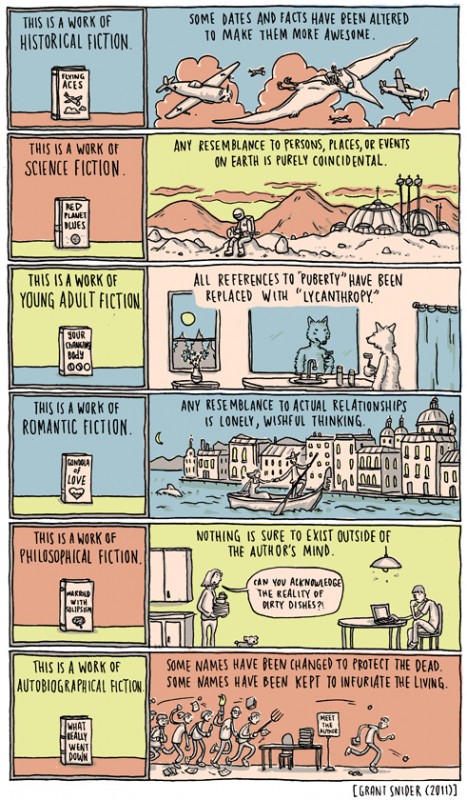
Works of Fiction by Grant Snider

Here’s a nice way to follow my post about covers:  a new literary comic by Grant Snider:

Comments closed

Favourite Covers of 2011

After posting my long overdue picks for 2010 last week, here are my selections for my favourite book covers of 2011.

I’m currently reading Where The Stress Falls a collection of writing by Susan Sontag published in 2001. In an essay about art she quotes Paul Valéry on the painter Corot. “One must always apologize for talking about painting” he says. I know just what he means. I feel the same way about book design. Perhaps even more than a painting, what you see is what you get with a book jacket. If you have to explain why it works, it probably doesn’t. Or you’re talking to the wrong crowd. But there’s something else too. I also feel like I need to apologize for not knowing more; for producing reductive lists like this one; for being, well, so presumptuous…

The 2011 list has changed a few times in the last few days and would likely be different again if you asked me tomorrow — not for lack of quality you understand, but simply because narrowing the list down to a manageable number and deciding which should be in the final ‘top 10’ was just plain hard. This isn’t a definitive survey of book covers in 2011 by any means (sorry!) it’s simply a list of the book jackets that caught my eye this year — designs I thought that were beautiful, a bit different, audacious, a bit out of the ordinary, a bit worthwhile…  I’m grateful to all the designers who created these covers, who gave me suggestions and helped me source the images. Once again, I’ve been struck by their generosity. Nevertheless I have surely I’ve missed some great covers. Tell me what they are in the comments.

10 Comments