Skip to content

Tag: Penguin

Interview with Coralie Bickford-Smith

Penguin Books award-winning book cover designer Coralie Bickford-Smith (mentioned previously here and here) discusses her experiences, influences, book cover designs, and more, in a great interview over at design:related :

When I feel intimidated I just start making stuff so that before I can get frozen, something interesting is already grabbing my attention and keeping my mind occupied. As every designer has a different approach to a title, I try not to think “what would so-and-so do” and instead remind myself that my own approach is what I should be aiming for. Books are rich, wonderful things – there’s always something new you can bring out of them. Some people have to keep finding ways to package soap powder – I’ve got a lot more to go on with Crime and Punishment.

Link

(via The Book Design Review)

Comments closed

“A hint of optimism”

Publishers Weekly is reporting that following “one of publishing’s bleakest weeks” in living memory, there’s a reason for us to keep on living in the form of two recent digital announcements from Penguin and Random House.

Penguin have launched Penguin 2.0 which includes more online content, e-books and POD, as well as an app imaginatively called ‘Penguin Mobile’ which makes the features from Penguin’s website available on the iPhone.

In the meantime, Random House have announced a partnership with Stanza “the popular iPhone e-book reader from Lexcycle” that will make e-books by several RH authors available for free on the platform. According to the press release, the books available “will be drawn from each author’s backlist and will include excerpts for any new hardcovers coming in 2009.”

I have to say I was really surprised how much I like e-books on the iPhone. But what does this mean for single-purpose devices like Sony’s e-Reader and Amazon’s Kindle?

Comments closed

Tschichold: Titan of Typography

The Brillance of Jan Tschichold — Richard Hollis at The Guardian looks at the career of the man who perfected Penguin’s classic paperback:

Tschichold tidied up the horizontally banded covers of the standard Penguins and refined the Penguin emblem. Each of these adjustments hardly changed what we now think of as the “classic” Penguin designs, but the effect was to set new standards for book production in England.

The Guardian also has a slide show of Tschichold’s poster and paperback designs

If you’d like to know more about Tschichold, Thames and Hudson have just  published Jan Tschichold Master Typographer by Cees W. de Jong,  and Raincoast are distributing Hyphen’s Active Literature: Jan Tschichold and New Typography by Christopher Burke — published in March 2008 — here in Canada.

Comments closed

Whiskey Tango Foxtrot?*

There has been relentless torrent of grim publishing news coming out of New York the last few days.

It has, at times, been hard to keep up with it all, and I don’t know the people involved well enough or understand the machinations sufficiently to offer much in the way of trenchant analysis. I hope that a summary of ‘Black Wednesday’ and the rest of this week’s events — with appropriate links — will, at least, offer some kind of context.

The details are sketchy, but Houghton Mifflin Harcourt acknowledged that there would be further changes at the company, including job-cuts. According to Publishers Weekly, at least eight people have been let go including executive editor Ann Patty, senior editor Anjali Singh and legendary editor Drenka Willen. GalleyCat has spokesman Josef Blumenfeld’s full statement about the changes.

Personally I’m stunned that the recipient of the 2007 Maxwell E. Perkins Award Drenka Willen, the US editor of Günter Grass, José Saramago and Umberto Eco, has been let go by HMH. PW profiled Willen in 2002, and, after pointing out that she has edited four Nobel Prize winners, MobyLives asked, pertinently, “do the proprietors of Houghton Mifflin Harcourt really know what they’re doing?”

I think my favourite quote, however, came from an unnamed ‘publishing veteran’ who told GalleyCat:

“Those fuckers have destroyed two venerable publishing houses in less than a fucking year.”

Elsewhere things are not much better.

Earlier in the week, Christian publisher Thomas Nelson announced it would be laying off 54 employees, or about 10% of its workforce. CEO Michael Hyatt said in a statement on his corporate blog From Where I Sit :

This was the second round of reductions this year. Unfortunately, this one was no less painful. We did the first round after significantly cutting our SKU count. However, this second round was purely a result of the slowdown in the economy.

According to GalleyCat , Hyatt apparently first made the announcement by Twitter. Stay classy Michael, stay classy…

After Doubleday cut 16 jobs in October, the “long anticipated” restructuring of Random House was announced on Wednesday. Maud Newton offered some bleak analysis and reprinted the full memo from Random House CEO Markus Dohle. Sarah Weinman has questions. Kassia Krozser at BookSquare thinks it’s all irrelevant:

“Who really cares if Crown or Knopf or Ballantine or Bantam Dell survives? I’m serious. Who. Cares… Focusing on imprints is focusing on the wrong problem.

The hyperbole-prone New York Observer called it “The End of an Era”.

In addition to the upheaval at Random House, Simon & Schuster announced it was eliminating 35 positions on Wednesday. Publishers Weekly reported that the Rick Richter, the president of the company’s children’s book division, and Rubin Pfeffer, senior v-p and publisher of the children’s group, would also be leaving.

On Thursday, Penguin Group chairman and CEO John Makinson announced the company will not give pay raises to anyone earning more than $50,000 in the new year. PW quoted Makinson as saying: “I cannot of course guarantee that there will be no job losses in Penguin in 2009. In this financial climate that would be plain foolhardy.”

And, according to a recent wire story from the AP on this week’s events in publishing, pay raises at HarperCollins have been delayed until next July. Spokeswoman Erin Crum says that “no decisions had been made” on job cuts, whatever that means…

All in all, it’s been quite a week. Thursday’s New York Times had a thorough summary and postmortem, and Andrew Wheeler has been keeping a running tab of the changes on his blog if you want more details.

Do I see a silver lining? Well, my hope is that all the talented, smart people who got unceremously dumped this week will stay in publishing (but who could blame them if they don’t?) and take their brilliance and vast experience to smaller more flexible companies and deliver a resurgence of creativity in New York. That would be nice wouldn’t it?

UPDATE:

Ron Hogan has posted some that trenchant analysis that I was talking about over at GalleyCat.

Also, what are the implications of all this, if any, for Canadian publishers? Anyone…?

*Thanks to Pete for the best blog post title ever.

Comments closed

Midweek Miscellany, Nov 26th, 2008

The Royal Mail British Design Classics: A set of first class stamps issued in January 2009 will commemorate ten icons of British design  including the Penguin paperback (pictured above).

“I wanted to put my money where my mouth is”booktwo’s James Bridle discusses Bookkake at 3:AM Magazine:

“I’m a huge fan of ebooks, and read this way regularly, but I don’t feel the reading experience they offer is yet on a sufficient par with traditional books to offer them at any great price, and I also don’t feel there’s much overlap between those looking for ebooks and those who’d pay for the paper edition.”

Risk has its rewards: Barney Rosset — US publisher of Beckett and Chekhov — discusses Grove Press and his struggles against censorship in a rebroadcast interview from 1991 on NPR’s Fresh Air. Rosset received the Literarian Award for his service to the literary community at the National Book Awards ceremony last week.

“The Best Business Books of 2008” — A slideshow of Fast Company‘s picks of the year:

“The titles that follow run the gamut of what Fast Company covers: Innovation, creativity, design, sustainability, technology, advertising and marketing, global business, and entertainment.”

It’s a cutely eclectic list for sure — including travel books and a novel (and mercifully there’s no Godin or Gladwell) — but it’s not, perhaps, quite as imaginative as they think it is…

30 Inspiring Flickr Groups on Typography: A wonderful list for type geeks compiled by designer David Airey (pictured: “Big Yellow Bookshop” by ultrasparky seen in the Typography and Lettering Flickr pool).

Comments closed

Waterstone’s Hardback Classics

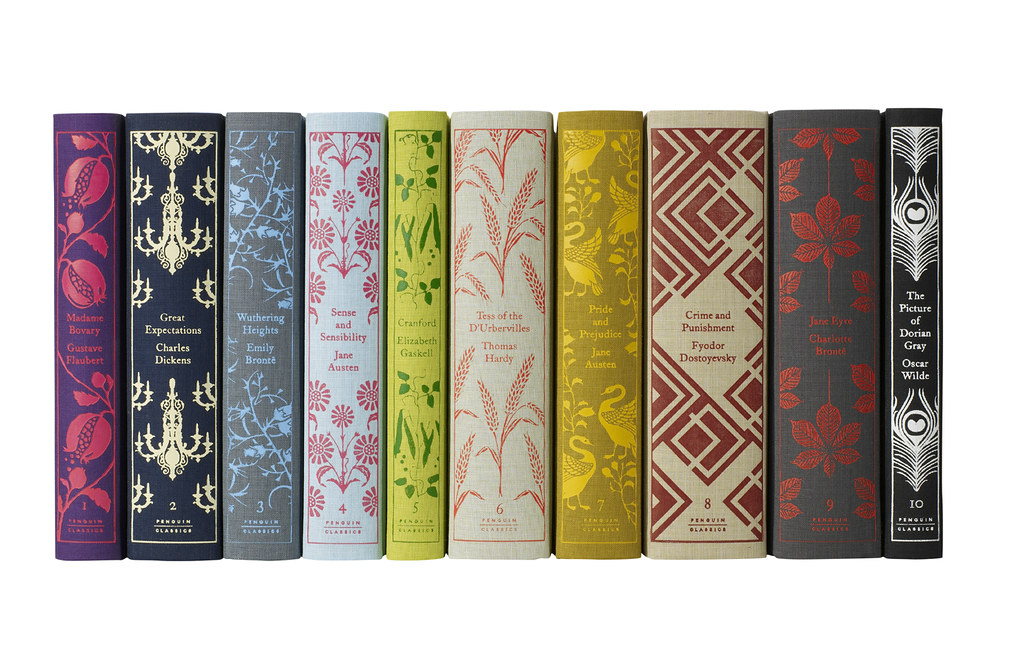
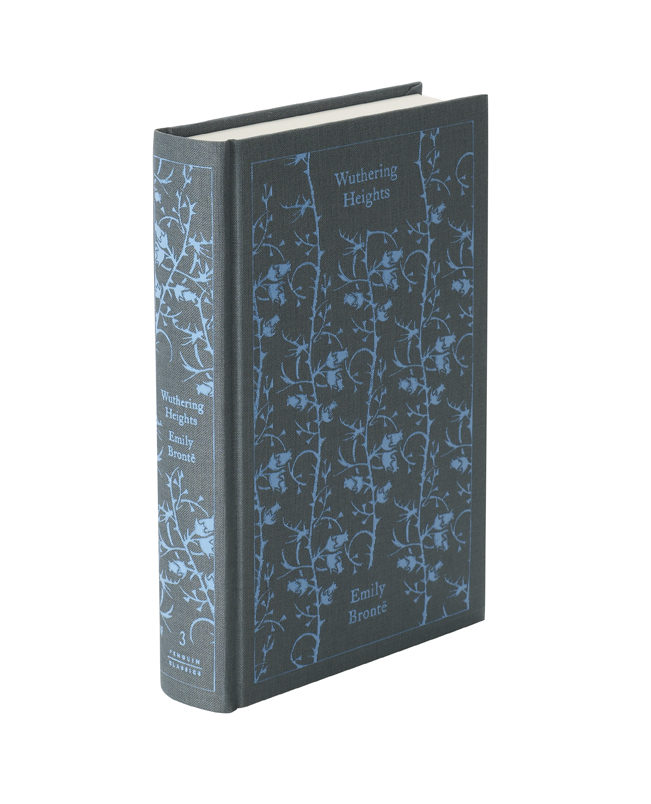
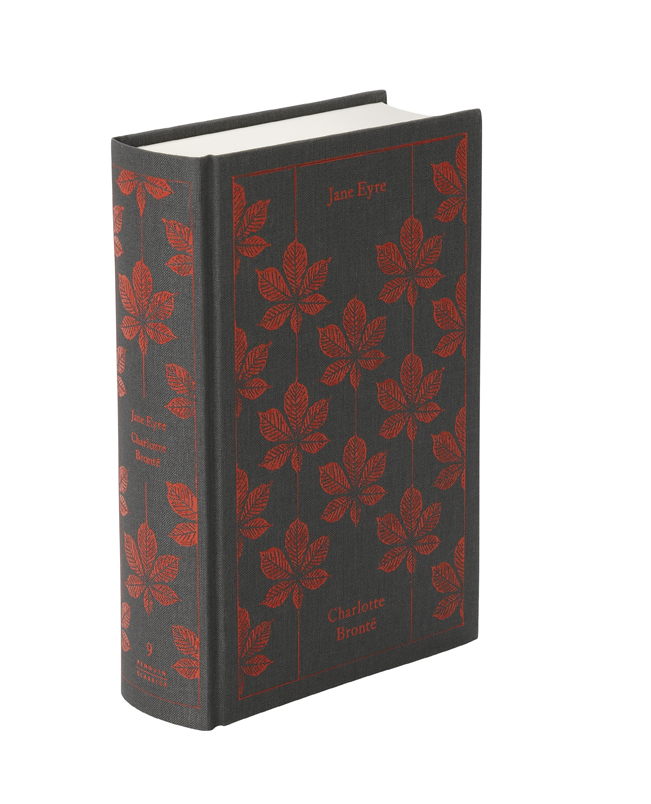
More lovely book designs by the very talented Coralie Bickford-Smith at Penguin UK (mentioned here previously for her work on the Gothic Reds series) for a collection of classics available at British book retailer,  Waterstone’s:

“All the books in this series have patterns that adhere to a strict grid… I have a real enthusiasm for pattern design so I was obsessed with this project. I wanted to create sumptuous books for people to enjoy, cherish and pass on.”


Penguin have very kindly put all of the covers for the Waterstone’s Hardback Classics on their Flickr photostream. It really is a beautiful set.

Coralie recently won an award for best ‘Brand or Series Identity’ at the British Book Design and Production Awards, for her work on the Classic Boys’ Adventures series, which is brilliant too.

Link

2 Comments

Penguin on Design

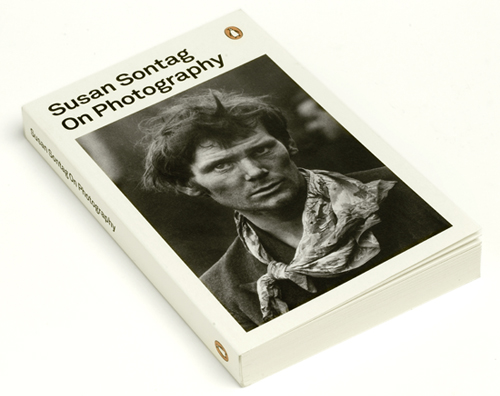
Refreshing classic creative texts: Creative Review talks to Penguin’s art director Jim Stoddart about the redesigned and reissued books in the ‘Penguin on Design’ series. The books include Bruno Munari’s 1965 book, Design As Art; Marshall McLuhan’s 1967 The Medium is the Massage; John Berger’s Ways Of Seeing from 1972; and Susan Sontag’s 1977 essay, On Photography.

I do like these covers — Susan Sontag’s On Photography (pictured) is particularly striking — but, again, what is with all the white? Surely someone at Penguin has  worked in a bookshop. I mean these are clearly meant to be looked at and not touched.

Link

Comments closed

Wide-Eyed Horror

Is it just me, or is Penguin raising the bar for book cover design right now?

Inspired by the two-tone crime covers produced by Romek Marber for Penguin in the 60s, senior designer Coralie Bickford-Smith  has created some remarkable designs for 10 gothic horror novels – including books by Edgar Allan Poe, H. P. Lovecraft and M. R. James –  to be released by Penguin in their Red Classics series on October 2nd.

In this video from the Penguin Blog, Coralie discusses the genesis of the covers:

The whole set can be seen on the Penguin Blog.

Link

4 Comments