Journalist Simon Garfield talks about book design, typography and his new book Just My Type in this video for The Guardian:
The Guardian also has an excerpt from the book here.
Comments closedBooks, Design and Culture
Journalist Simon Garfield talks about book design, typography and his new book Just My Type in this video for The Guardian:
The Guardian also has an excerpt from the book here.
Comments closed A new monograph on Japanese un-brand MUJI to be published by Rizzoli later this month (via Swiss Legacy).
Finishing Touches — Type foundry Hoefler & Frere-Jones on the little details that make their typefaces:
In the middle of Gotham, our family of 66 sans serifs, there is a hushed but surprising moment: a fraction whose numerator has a serif. So important was this detail that we decided to offer it as an option for all the other fractions, a decision that ultimately required more than 400 new drawings. Why?…[I]t’s something that we added because we felt it mattered. Even if it helped only a small number of designers solve a subtle and esoteric problem, we couldn’t rest knowing that an unsettling typographic moment might otherwise lie in wait.
And on the subject of typography… A handy PDF chart for mixing typefaces (via Smashing Magazine)
Blade Runner Will Prove Invincible — Philip K. Dick on Blade Runner, the film adaptation of Do Androids Dream of Electric Sheep, in a letter to the production company (via Coudal):
The impact of BLADE RUNNER is simply going to be overwhelming, both on the public and on creative people — and, I believe, on science fiction as a field… Science fiction has slowly and ineluctably settled into a monotonous death: it has become inbred, derivative, stale. Suddenly you people have come in, some of the greatest talents currently in existence, and now we have a new life, a new start… My life and creative work are justified and completed by BLADE RUNNER. Thank you… It will prove invincible.

And by coincidence, not only did I just watch the director’s cut of Blade Runner again just the other day (for approximately the bazillionth time), it was recently announced that Blade Runner director Ridley Scott would be producing a 4-part TV adaptation of The Man in the High Castle for the BBC. Awesome.
Deceptively Simple — Three Percent’s Chad W. Post on OR Books innovative publishing model:
The OR Books business model is deceptive in its simplicity. In many ways, it’s a throwback to a time before supply-chain intermediaries permanently altered the bookselling business—a time when publishers were also printers and bookstores. It’s a model that—if successful in the long run—thrives on both satisfying the needs of customers and maximizing the publisher’s return.
And finally…
Part One of Eleanor Wachtel’s interview with John le Carré about his new book Our Kind of Traitor for CBC Radio’s Writers & Co.:
Writers and Co. John Le Carre Interview
Comments closed
Twenty-nine year old Brazilian designer Daniel Justi graduated in graphic design and art direction from centro universitário belas artes de são paulo, and has been working in editorial design and type design in São Paulo for the last 6 years.
Regular readers of Caustic Cover Critic and Design Work Life will already be familiar with his distinctive book jackets and typography, but I’m happy to post a new interview with Daniel here.
Daniel and I corresponded by email, and he was good enough to answer all my questions in English.
 How did you get into book design?
When I was finishing university, I received a proposal for an internship job at an publish house called Editora Manole. So I started working as an editorial assistant. After a while, I started to get very interested in the various methods of making books, so I started studying typography, grids, proportions and many things about Fibonacci, Villard and the golden ratio more deeply. Today, I think that designing the interiors of books is one of the most technical fields of graphic design.
What is your current role in the industry?
Fortunately, I got a position that is rather rare nowadays, which is working with both the cover design and the interiors of books. Sometimes there isn’t enough time so I need to hire freelancers and, in these cases, I need to act as art director. Besides, I run my small type foundry and also do freelance work for some publishers.
Are there a lot of opportunities for book designers in São Paulo?
Yes and no. The publishing field in São Paulo is quite busy. There are many publishers and most of them hire freelancers. At the same time is unusual to work for several publishers. It is more common to do work for only one or two. The editors don’t seem to like to vary their freelancers. So when an editor trusts you, you usually get a lot of work.
Could you describe your design process?
My design process is often not linear. Of course I always start with basics like color, shape and typography, but I think its important not to have total control of the process. The accidents, incidents and coincidences are important in my process. For books, I usually say, “let the text control.” The content is what sets the decisions like to using or making illustrations, pictures, collages, textures, typography, etc..
There is nothing better than content to define the shape.
What are your favourite books to work on?
Definitely literature and art.
I believe that literature books are the best. They don’t need obvious solutions. You can be daring, try something new or maybe weird, since that has something to do with the content and, most important, makes the reader think.
I think the main function of a book cover is to create a communication with the reader and not just give you all the obvious way. It is important never to underestimate the reader.
I also enjoy working on academic books, containing information graphics, charts and timelines. I like to find the visual solutions for these kind of books.
 What are the most challenging?
Medical books.
The publishing company where I work is well known for his books on medicine. It’s always a great challenge to make good design books on this topic. Currently I think it’s a fun challenge, but a few years ago, it was terrifying!
 When did you become interested in type design?
In my last year of university, I had an extra course of a project called Tipocracia.
Tipocracia is a project of a graphic designer and professor called Henrique Nardi. The purpose of this project is to disseminate the typography and type design in Brazil. It is a very important initiative and encourages students to engage in the field.
I’ve always had a great interest in typography, but contact with Tipocracia was what motivated me to start my own type foundry.
Does working so closely with type inform your book design?
Absolutely! Work with type design completely changes your view of typography.
Currently, my attention is more focused on covers, but I never want to stop designing the interiors of the books, which is where all your technical knowledge is put to the test. So, for me, doing both (cover and interior) will always be enjoyable.
 What are some of the current design trends in Brazil?
Hard to say. Brazil is a very big country and many things happen outside of São Paulo.
In São Paulo, for example, I don’t think there’s a specific local trend. I think it’s more like trends that exist in other large cities and urban centers, like London or New York.
Trends end up becoming more global. This year, for example, designers from Pentagram (including Paula Scher and DJ Stout ) came to São Paulo to promote workshops. At the end of the year Stefan Sagmeister is coming. Maybe it’s all about a global trends.
Who are some of the Brazilian designers we should look out for?
There are so many names, but I’ll try to summarize my favorites by area:
Book covers: Retina_78
Graphic Design: Rico Lins
Type design: Fabio Haag
Illustration: Thiago Queiroz
Photo: Cia de Foto

Where do you look for inspiration and who are some of your design heroes?
I try not to look for inspiration in graphic design field. I think it’s necessary to have other interests to inspire you. Things that inspire me are simple like skateboarding on a Saturday afternoon, reading a book, listening to some music, photography and going to the movies or art exhibitions.
Some of my heroes are Paul Rand, Alvin Lustig, Neville Brody, László Moholy-Nagy, Josef Müller-Brockmann, Jan Tschichold and so many others…

What does the future hold for book cover design?
I believe that things tend to increasingly professionalize. The market is saturated of free stock images. It’s important to create customized solutions so we don’t repeat what has already been done.
My central philosophy is to never underestimate the consumer. Design is communication, and for it to exist, you must not deliver everything and let people think for themselves. There must be an interaction.
I really like Massimo Vignelli’‘s phrase:
“I disagree with people who think the word dog should look like a dog. Even worse are people who think the word dog should bark.”
Thanks Daniel!
1 Comment
More Than Words — Yves Peters takes a typographical look at the winners of British Book Design and Production Awards 2010 for FontFeed. The winners all look wonderful, but, as Peters notes, it is a shame that only the publishers are credited, not the designers of the books.
An Archaeology of Business Cards — Penguin book designer Coralie Bickford-Smith discusses her workspace and her work with From the Desk Of…:
Right now I’m in the middle of designing a 20-book series, as well as sundry standalone titles, and my desk is usually a mess of ideas and scribbles on innumerable scraps of paper. There’s a whole archaeology of business cards, post-it notes and other treasures under there. I like to be surrounded by the current proofs to make sure the designs are working and that any tweaks are made in time for the final print. I like my desk – it’s my own tiny world in a big office.
My Q & A with Coralie is here.
Reading the Process — The New Yorker’s Book Bench interviews book designer Rodrigo Corral:
Reading is always part of the process when we’re working on a book jacket or cover for fiction. I read, I take notes, I take breaks. I’ll stop on the title, re-read it, and think about how it plays into the book and its overall message and intent. It’s rare to be able to illustrate the tone of the entire story by only depicting one moment from the book, so I prefer using a new image or design that I feel represents the story accurately.
 The Rejection of Literalism — Steven Heller talks about his biography of designer Alvin Lustig Born Modern* with Imprint:
I did not get the impression that Lustig went into the book jacket biz with a literary bent. He did, however, have the temerity to try just about anything. And since, as a kid, he was interested in designing his way, he just, well, designed his way. So, I guess “confidence” is the right word. It was ballsiness. He had a vision—wherever it came from—and he pursued it. He was largely self-taught.

 Design Dossier: Graphic Design for Kids by Pamela Pease published by Paintbox Press, seen at The Daily Heller.
12 Reasons to be Excited About Publishing’s Future — Following up an earlier post about the love of books, Digital Book World‘s Guy LeCharles Gonzalez asks book industry folks why they’re excited about publishing.
And finally…
“Help Me Destroy Public Radio” — Alec Baldwin channels Jack Donaghy for his “Do Not Pledge To Public Radio” pledge drive promo for NPR.
* Born Modern is published by Chronicle Books, who are distributed in Canada by my employer Raincoast Books.
1 CommentLost Libraries — With the personal book collection of David Markson ending up at The Strand bookstore in New York, Craig Fehrman examines the fate authors’ libraries for The Boston Globe (via The Second Pass):
Most people might imagine that authors’ libraries matter — that scholars and readers should care what books authors read, what they thought about them, what they scribbled in the margins. But far more libraries get dispersed than saved. In fact, David Markson can now take his place in a long and distinguished line of writers whose personal libraries were quickly, casually broken down. Herman Melville’s books? One bookstore bought an assortment for $120, then scrapped the theological titles for paper. Stephen Crane’s? His widow died a brothel madam, and her estate (and his books) were auctioned off on the steps of a Florida courthouse. Ernest Hemingway’s? To this day, all 9,000 titles remain trapped in his Cuban villa.
Fehrman expands on this article — and the reasons we should not have been surprised that Markson’s books found their way to The Strand — at his blog.
Eating Each Other is Wrong — Evan Scnittman, Managing and Director of Sales and Marketing at Bloomsbury, argues that e-books don’t cannibalize print:
The most important lesson I can convey to book publishing professionals is that they must understand that those of us who have made the transition to ebooks, buy ebooks, not print books. Ebook reading device users don’t shop in bookstores and then decide what edition they want; ebook device readers buy what is available in ebookstores. Search an ebookstore for a title and if it doesn’t come up, it doesn’t exist – no matter how many versions are available in print.
Ebooks aren’t a better value, ebooks aren’t more attractive nor are they a threat to the print version of any immersive reading book. This isn’t the same as paperback versions vs hardcover – where the platform and convenience are the same – the timing and pricing are the key ingredients. Books that aren’t in ebook form are do not exist to ebook reading consumers. There is no cannibalization if in the mind of the buyer if there is no version available to them.
The Forgotten Mimics — In the 11th installment of The National Post’s ‘Ecology of Books’ series, Mark Medley talks to to some of Canada’s foremost literary translators:
“We’re not robots,” says [Lazer] Lederhendler, 59, who won the Governor General’s Literary Award for his translation of Dickner’s last novel, Nikolski. “We have a way of reading a book. We have a way of using the language. We have our own vocabulary, our likes and dislikes in terms of this phrase or that phrase. It’s a kind of balancing act between observing the fact that you’re at the service of someone else’s work, but at the same time it’s an artistic mission.”
Four Decades of Art — A mini-documentary about illustration in The New York Times Op-Ed page, featuring interviews with art directors and illustrators.
And finally…
Type designer Matthew Carter and writer David Simon (creator of The Wire) were recently named MacArthur Fellows. The Fellowship is a $500,000 (US), no-strings-attached grant for people who have shown exceptional creativity in their work and promise to do more (via How Magazine):
Comments closed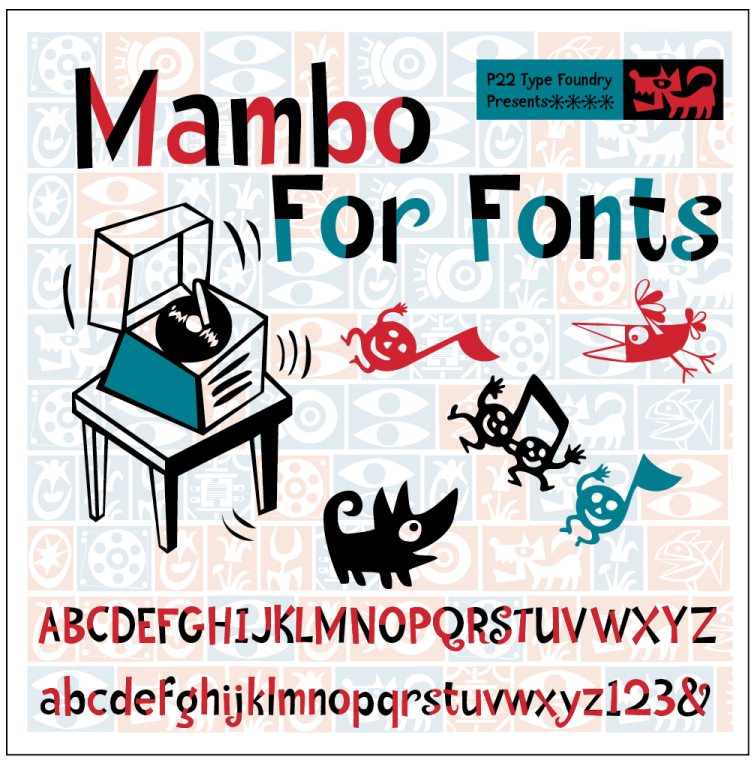 Mambo for Fonts — Flora Mambo is a new font from the P22 Type Foundry based on Jim Flora’s hand-lettering for the 1955 Mambo For Cats RCA Victor album cover.
Character — Type designer Matthew Carter profiled in The Boston Globe:
Around 1994, he started developing Verdana, a revolutionary font for having prevailed over technical constraints of that time, like coarse computer screen resolution. To hear Carter recall it, it was a pivotal moment: People were on the brink of reading as much — or more — on screen than on paper. And that transition has had a profound effect on the design process.
Carter also talks about his work in this short video for the Globe (via Eightface):
The Paris Review has made it’s entire interview archive — from the 1950’s to the present — available online (via The NY Observer).
An Education — James Bridle of BookTwo and Bookkake interviewed at Publishing Perspectives:
“There’s still a reluctance in the industry to give [e-books] their own space. They are still subsidiary to the traditional book forms… There still an incredible lack of understanding about them and the people who are doing the educating are Apple and Amazon, which means they are taking the market very quickly and we’re kind of letting them do that.”
The Likely Lads — Authors Lee Rourke (Canal) and Tom McCarthy (Remainder, C) in conversation at The Guardian.
And finally…
Writers from The Guardian and Observer newspapers talk about the books that sparked their passion for literature:
Comments closedThanks for the CBC Books blog for including The Casual Optimist in their list of 10 ‘Book Blogs We Appreciate’ earlier this week. It is always nice to be appreciated — I only hope I can live up to the billing… :-)


 The Story of Eames Furniture — Written and designed by Marilyn Neuhart together with her husband John, who both worked with the Eames Office from the 1950’s until 1978, the year Charles Eames’s died. Published later this month by Gestalten, the book comes in two full-colour volumes with a slipcase.
The Future of the Future — William Gibson interviewed in The Atlantic:
I think that our future has lost that capital F we used to spell it with. The science fiction future of my childhood has had a capital F—it was assumed to be an American Future because America was the future. The Future was assumed to be inherently heroic, and a lot of other things, as well… I’m not going all Sex Pistols, shouting No Future!—I’m suggesting that we’re becoming more like Europeans, who have always retrofitted their ruins, who’ve always known that everyone lives in someone else’s future and someone else’s past.
Respect for the Users — Jay Rosen‘s inaugural lecture to incoming students at Sciences Po école du journalisme in Paris earlier this month:
The Web effortlessly records what people do with it. Therefore it is easy to measure user behavior: what people are interested in, what they are searching for, clicking on, turning to… right now. What should a smart journalists do with this “live” information?… [Y]ou should listen to demand, but also give people what they have no way to demand because they don’t know about it yet. In fact, there is a relationship between these things. The better you are at listening to demand, the more likely it is that the users will listen to you when you say to them: you may not think this is important or interesting, but trust me… it matters. Or: “this is good.” Ignoring what the users want is dumb in one way; editing by click rate is dumb in a different way. Respect for the users lies in between these two.
And finally…
Graphic designer James Patrick Gibson talks to Babelgum about his photoblog New Type York , an archive of images of typographic artifacts — signs, directions and building inscriptions — around New York City (via DesignRelated):
Comments closedA great new Wondermark comic by David Malki. You really need to see it full size to appreciate the horror…

Inspired by The Alphabet Conspiracy and other educational films from the 1950’s and 1960’s, TELEPHONEME is a hybrid live-action and animated short created by design collective MK12 about the science of the alphabet and sinister hidden messages carried by language:
MK12 also developed a special typeface for the film that can be downloaded from the TELEPHONEME website.
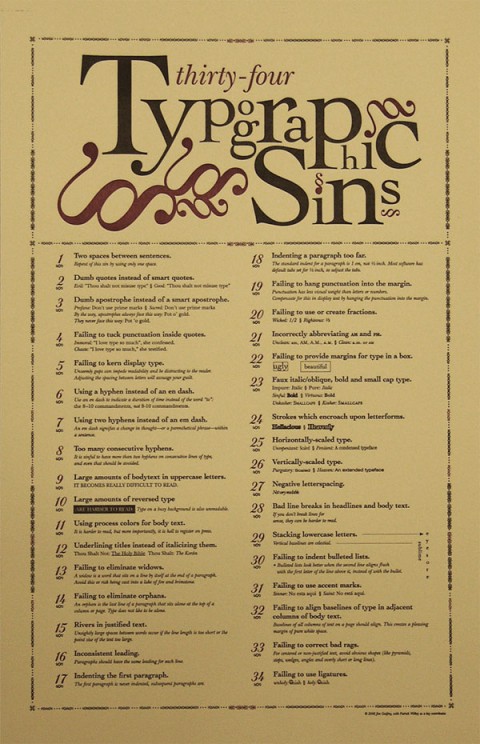
Comments closed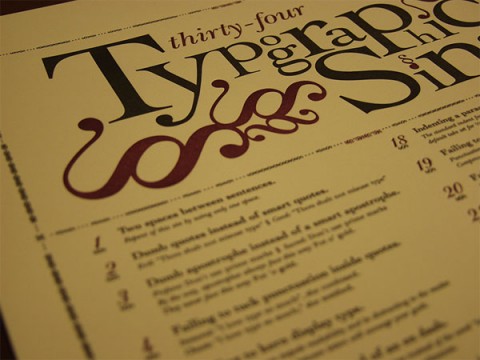 Typographic Sins Poster designed by Jim Godfrey (seen at For Print Only).
And on the subject of graphic design crimes…
Angry Paul Rand on Twitter (via @thebookdesigner):
My advice for designers & design students: fuck the rules, if your work is good enough to get away with it.
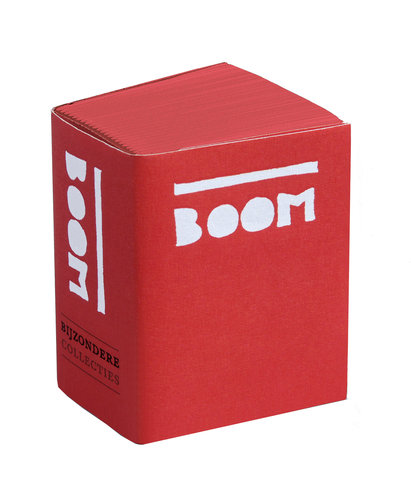 Boom — Alice Rawsthorn profiles Dutch book designer Irma Boom for the New York Times:
Ms. Boom, 49, has designed most of her books just as she has wanted. Typically, a book designer works with the text and images selected by the editor and art director, but Ms. Boom prefers to combine all three roles by deciding on the book’s structure and choosing the themes and visual material herself. She then obsesses over every element — not just how the book will look, but how it will feel and smell — and invents ingenious ways of achieving the desired effects.
One of her books was printed on coffee filter paper. Another was scented to smell of soup. A monograph of the work of the Dutch artist Steven Aalders was made in the exact dimensions of one of his paintings. The page edges of a book on the American textile designer Sheila Hicks were hacked with a circular saw to evoke the fraying edges of her work. The title on the white linen cover of a history of the Dutch company SHV only becomes visible after frequent use. There are 2,136 pages in that book, but no page numbers, to encourage readers to dip in and out.
An exhibition of Boom’s work, ‘Irma Boom: Biography in Books’ runs until Oct. 3 at the University of Amsterdam Library. The book accompanying the exhibition, designed by Boom and pictured above, is only 2 inches high, 1.5 inches wide and 1 inch thick.
And finally…
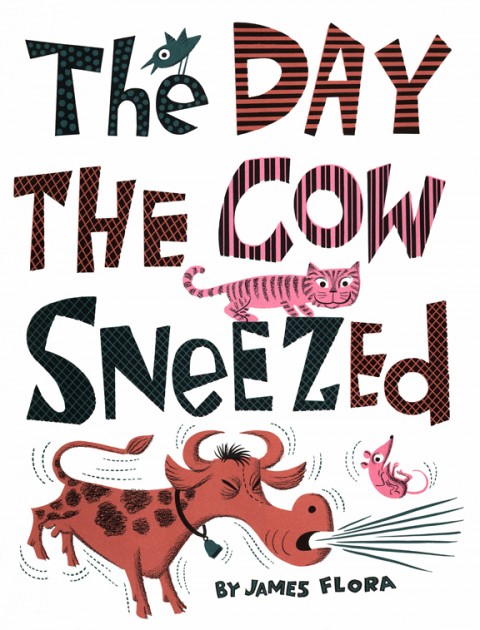 Enchanted Lion are reprinting Jim Flora’s kids books starting with The Day The Cow Sneezed in Fall 2010. Flora was best known his incredible jazz and classical album covers for Columbia Records and RCA Victor, and is officially awesome.
Patrick Cramsie, author of The Story of Graphic Design, chooses his top 10 graphic design books for The Guardian. The list includes Notes on Book Design by Derek Birdsall.
Type Education — FontShop have released a handful of free typography primers designed for downloading and printing, including ‘Seven Rules for Better Typography’ by Erik Spiekermann.
Frost — Sifting through the Penguin archive in Bristol, writer Gaby Wood profiles the late Eunice Frost, who became an editor at Penguin in the 1930’s and went on to become its first female director, for The Telegraph:
Frost was sharp and, for all her youth and inexperience, in many ways more culturally engaged than the Lane brothers… It was to a large extent thanks to her that Penguin began to publish original work – not just reprinted fiction but the Pelican series of new non-fiction, and the Penguin ‘Specials’ series – quickly produced tracts on various subjects of urgent import. Three weeks after war was declared, for instance, Harold Nicolson was commissioned to write a 50,000-word book entitled Why Britain Is at War, which he delivered two weeks later and which was published a fortnight after that.

Secrets of Life and Death — Artist Jaime Hernandez, co-creator of Love & Rockets, and comics scholar Todd Hignite discuss their new book The Art of Jaime Hernandez with Eric J. Lawrence on KCRW.
Comments closed