Tom McCarthy, author of C, interviewed by Eleanor Wachtel for CBC Radio’s Writers & Company:
Writers & Co Interview with Tom McCarthy Mp3
Comments closedBooks, Design and Culture
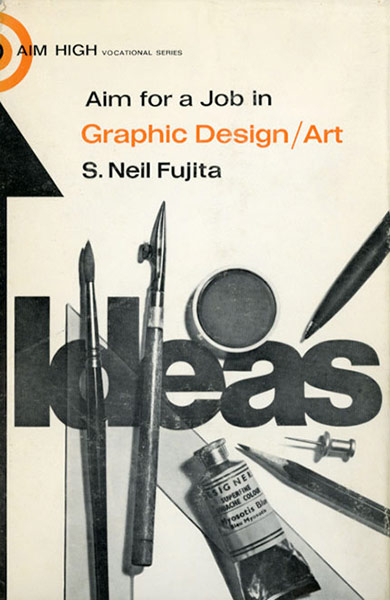
The Guardian‘s obituary for graphic designer S. Neil Fujita, who died last month aged 89, and a slideshow of his work, which included album covers for artists Dave Brubeck and Miles Davis, and book covers for John Updike, Truman Capote, and Mario Puzo.
The New York Times obituary, which ran in October, is here.
And a 2007 Steven Heller interview with S. Neil Fujita for AIGA is here.
Dead Air — Mike Doherty talks to Tom McCarthy about his most recent novel C for the CBC:
While researching the project, McCarthy was struck by the fact that Guglielmo Marconi and Alexander Graham Bell, the inventors of the radio and telephone, respectively, had originally sought to contact the dead. McCarthy dreamed up a character whose sister dies in early age; working as a radio operator later in life, he finds coded messages everywhere around him, perhaps from his sibling. McCarthy viewed this story as a Trojan Horse into which he could “smuggle” his “philosophical and avant-garde preoccupations,” in a “conventional Dickensian trajectory from birth to death in a historical setting. I thought, This is a winner. Surely some f—er’s going to publish this one!'”
You can find my conversation with Tom and book designer Peter Mendelsund about C here.
Pass Notes — MobyLives talks to John Williams founder of online literary journal The Second Pass:
I found after leaving publishing that I was reading a lot of older books, some classics and some that I had just happened upon foraging at the Strand and other places. I thought there was room online to treat reading the way a lot of big readers actually do it, which is not to simply go straight through all the new releases but to haphazardly combine some new books with some old ones, some very popular books with some that have been out of print for decades. Plus, I was hearing a lot of moaning about the fate of books coverage in the age of the dying newspaper, and I thought trying to do something about it would be much more fun than talking about it (and much, much more fun than listening to other people talk about it). And it has been.
It just so happens that I will be chatting with John soon as well… Fingers crossed.
Comments closed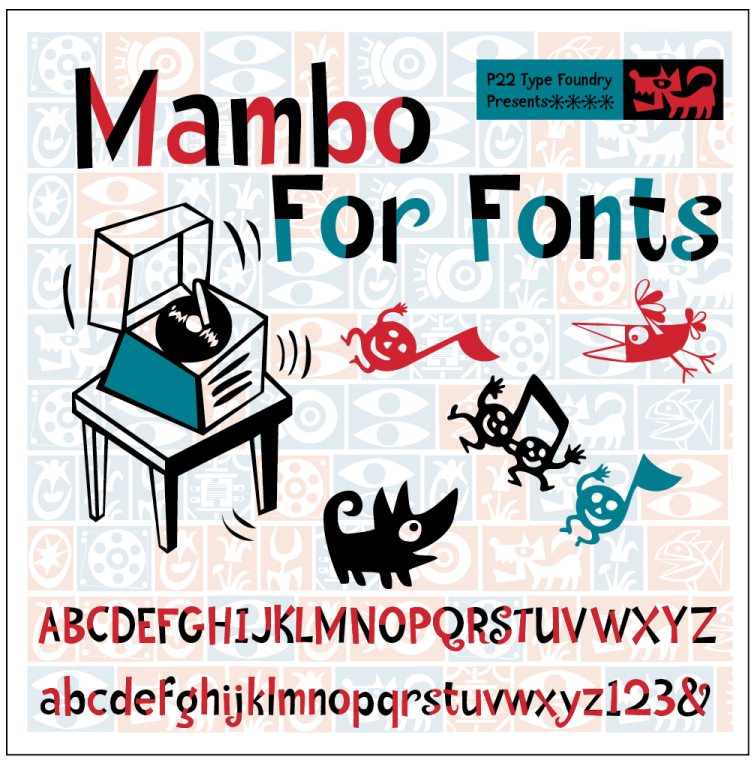 Mambo for Fonts — Flora Mambo is a new font from the P22 Type Foundry based on Jim Flora’s hand-lettering for the 1955 Mambo For Cats RCA Victor album cover.
Character — Type designer Matthew Carter profiled in The Boston Globe:
Around 1994, he started developing Verdana, a revolutionary font for having prevailed over technical constraints of that time, like coarse computer screen resolution. To hear Carter recall it, it was a pivotal moment: People were on the brink of reading as much — or more — on screen than on paper. And that transition has had a profound effect on the design process.
Carter also talks about his work in this short video for the Globe (via Eightface):
The Paris Review has made it’s entire interview archive — from the 1950’s to the present — available online (via The NY Observer).
An Education — James Bridle of BookTwo and Bookkake interviewed at Publishing Perspectives:
“There’s still a reluctance in the industry to give [e-books] their own space. They are still subsidiary to the traditional book forms… There still an incredible lack of understanding about them and the people who are doing the educating are Apple and Amazon, which means they are taking the market very quickly and we’re kind of letting them do that.”
The Likely Lads — Authors Lee Rourke (Canal) and Tom McCarthy (Remainder, C) in conversation at The Guardian.
And finally…
Writers from The Guardian and Observer newspapers talk about the books that sparked their passion for literature:
Comments closed
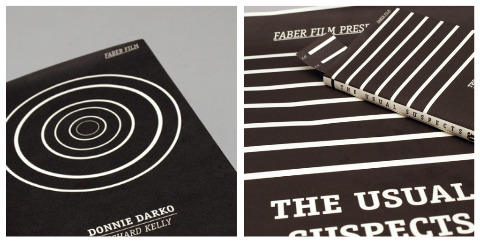
Another great set of designs for the 2009 D&AD student award brief for typography sponsored by Faber and Faber, this time by Rinse Design (via Cosa Visuales). See also: Ed Cornish’s designs for the brief.
Phaidon have relaunched their website and it is really rather nice (via FormFiftyFive).
The Imaginary Present — Mike Doherty interviews William Gibson about his new novel Zero History for The National Post:
In his earlier books, Gibson says, he aimed to devise “futures that felt as though they were filled with designed artifacts, as indeed they would be. I can’t think of too many science fiction writers who’d bother trying to do that.” In the [new] series, his devotion to design has gone into overdrive, reflecting the idea that “everything is ‘designer,’ ” even though “with most things, you’ll never know the name of a designer.”
PopMatters also spoke to the author about the new book.
Code — Jennifer Egan, author of A Visit From the Goon Squad, reviews Tom McCarthy’s C for The New York Times:
[McCarthy] aligns disparate things into larger patterns full of recurring images: analogies between the human body and earth, and machinery; hums and whirs; film screens; bowels and tunnels; electric circuits; cauls and other silken membranes. These repetitions come to feel like the articulation of a larger code — as if, were readers to plot their exact positions throughout the novel, they would discover a hidden message.
What Ever Happened to Reading Properly? — ReadySteadyBlog’s Mark Thwaite on critics misreading of Gabriel Josipovici’s What Ever Happened to Modernism?:
It’s interesting that Josipovici’s book which, in many ways, is both a call to read more carefully and an enquiry into why reading carefully is beyond so many cultural gatekeepers, has been read so sloppily by so many of its critics… Josipovici doesn’t invoke marginal or avant-garde writers, nor praise typographical or narrative playfulness over stale traditionalism, but rather brings us back to canonical writers (a good part of his essay is taken up with Wordsworth) and allows us to see what was at stake for those artists in their work, and what is at stake for us as readers.
And finally… It’s Vignelli week at Design Observer:
 Debbie Millman’s 2007 interview with Massimo Vignelli (excerpted from her book How To Think Like a Graphic Designer):
I’m interested in “essence” — my major aim is really to get to the essence of the problem. And just throw away everything that’s not pertinent to it. At the end of a project, my work should be the projection of that experience, the essence of effect. It’s a habit that you get into… The essence is what is left when there’s nothing else that you can throw away.
Michel Bierut profiles Lella Vignelli:
Massimo has often defined their working relationship like this: “I’m the engine, and Lella is the brakes.” The first time I heard this as a young designer, it was clear to me which was more important. If you were a designer, wouldn’t you want to be the engine, powerful, propulsive, driving forward? It was only years later that I remembered something my high school driving instructor once said: “You don’t get killed in a car accident because the car won’t start. You get killed because the breaks fail.”
And, there is an interesting, beautifully shot, video interview with Massimo Vignelli by photographer John Madere here.
There will surely be more good stuff as the week progresses…
Comments closed
Tom McCarthy reads from his his new novel C and discusses the book with Sarah Crown, online editor of The Guardian‘s book page:
My interview with book designer Peter Mendelsund and Tom about C is here.
2 Comments The mighty George Lois at home in New York City at The Selby.
Start the Press — Robert Pinsky reviews The Book in the Renaissance by Andrew Pettegree for the New York Times:
The story begins with money. Johannes Gutenberg did not find a way to profit from his technical achievements. The Gutenberg Bible, a gigantic project, required large amounts of capital that needed replenishing over time, long before there was any hope of profit. The finished product inspired awe, but the print run was 180 copies. Gutenberg “died bankrupt and disappointed.”
Nor was he alone. Apparently, it took decades before some people figured out how to make money from this remarkable invention. For decades after Gutenberg, it was not even clear that print would become a success. How do you market books? How many should you run off at one time? Piracy was a problem, as were texts changed, mutilated or combined in unauthorized editions. Many printers were ruined, trying to exploit the new medium.
And at the other end of the spectrum (or, at least, the other side of the Atlantic)…
Seeing Things Flat — Jenny Turner reviews Tom McCarthy’s C for the London Review of Books:
Remainder works as an allegory of a certain flâneurish model of artistic production, in which a gentleman’s independence of income and education loom pretty big. That, we might say, is Remainder’s material remainder; and it is that of C also, though C moves the argument on a little, investigating the conditions, as it were, of its own existence: family inheritance, war, imperialism, technology; spreading information, spreading death. It’s this core of historical and philosophical seriousness that separates McCarthy’s work completely from the current fashion for baroque narratological cleverness in fiction… There are differences between cleverness and intellect. McCarthy has many things he’s trying to do in his novels, none of which have much to do with pleasing producers or publishers or even an audience, unless by pleasing one means leaving purged.
The Googleable Future — Author William Gibson, whose new novel Zero History is published next week, on Google for the New York Times (via MDash):
We never imagined that artificial intelligence would be like this. We imagined discrete entities. Genies. We also seldom imagined (in spite of ample evidence) that emergent technologies would leave legislation in the dust, yet they do. In a world characterized by technologically driven change, we necessarily legislate after the fact, perpetually scrambling to catch up, while the core architectures of the future, increasingly, are erected by entities like Google.
Cyberspace, not so long ago, was a specific elsewhere, one we visited periodically, peering into it from the familiar physical world. Now cyberspace has everted. Turned itself inside out. Colonized the physical. Making Google a central and evolving structural unit not only of the architecture of cyberspace, but of the world.
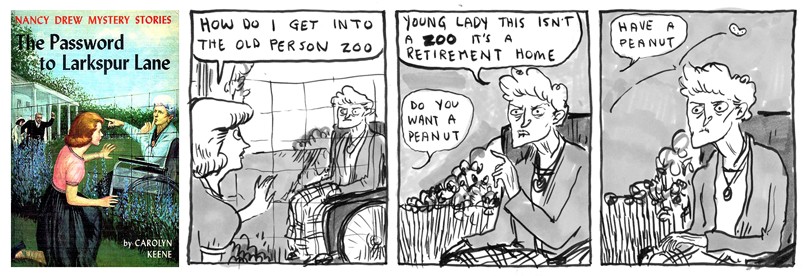 Kate Beaton interprets Nancy Drew book covers in her own unique way at Hark! A Vagrant.
And finally…
 Kevin Huizenga has posted his head-spinning Glenn Ganges comic ‘Time Travelling’ at What Things Do.

Best known previously for his art-house novel Remainder and saving literature from itself, author Tom McCarthy has been pretty much everywhere since the somewhat surprising inclusion of his new novel C on the Booker long-list. Tom may not actually be bigger than Jesus — or the bookies favourite — but he certainly does give good interview…
To James Purdon for The Observer :
“The avant garde can’t be ignored, so to ignore it – as most humanist British novelists do – is the equivalent of ignoring Darwin. Then you’re just a creationist. It’s ostrich-like. It needs to be worked through – which is not the same thing as imitation…
People use [‘experimental’] when what they actually mean is ‘not conforming to a certain type of realism’, and that’s just as much a literary convention as anything else. Burroughs said his ‘cut-up’ writing was more realistic than Jane Austen. I think he was right. You’re being assailed by associations and networks. Everything is a code…”
To Tim Robey for The Telegraph :
“We exist because we are awash in a sea of transmission, with language and technology rushing through us…”
And to Stuart Evers for The New Statesman:
“Commentators and critics seem to want fiction either to be blatantly avant-garde and postmodern, or to be realist and 19th century; but really most literature is neither nor… ‘The avant-garde’ describes a specific historical moment that belongs to the early part of the 20th century. Certainly in C there is a huge amount of that moment behind the writing; the avant-garde is definitely embedded in it. But at the same time I think it gets used as catch-all term now for something that isn’t retrograde, anything that’s not a kind of nostalgic, kitsch version of the 19th-century novel, which is what much of middlebrow fiction right now is.”
C has been reviewed by Christopher Taylor at The Guardian and by John Self at Asylum, and you can keep track of Tom various comings and goings at Surplus Matter.
My interview with Tom McCarthy and book designer Peter Mendelsund is here.
Update: The fine folks at 3:AM Magazine have also posted an interview with Tom about C.
A neat animated digital book cover by Charlie Orr for Tom McCarthy’s Tintin and the Secret of Literature:
[I have removed the video — for the time being at least — at the request of my web hosting service due to a complaint from Citel Video. The video is still available at Vimeo]
Does anyone have any more information on this? There’s more information about Charlie’s digital book cover project at The Hypothetical Library.
(via @HughMcGuire)
Comments closed The elegant new cover design for The Secret of Contentment by William B. Barclay, designed by Christopher Tobias.
Melancholy Technology — Tom McCarthy, whose novel C is on the long-list for the Man Booker Prize, on technology and the novel:
Technology and melancholia: an odd coupling, you might think. Yet it’s one that has deep conceptual roots. For Freud, all technology is a prosthesis: the telephone (originally conceived as a hearing aid) an artificial ear, the camera an artificial eye, and so on. Strapping his prosthetic organs on, as Freud writes in Civilisation and its Discontents, man becomes magnificent, “a kind of god with artificial limbs” – “but” (he continues) “those organs have not grown on to him and they still give him much trouble at times”. To put it another way: each technological appendage, to a large degree, embodies an absence, a loss.
There Might Be Typos On The Internet — Lori Fradkin on life as a copy editor for The Awl :
Once you train yourself to spot errors, you can’t not spot them. You can’t simply shut off the careful reading when you leave the office. You notice typos in novels, missing words in other magazines, incorrect punctuation on billboards… Another downside of the job is that only your mistakes are apparent. The catches are basically invisible. No one will look at an edited article and think, I am certain that, once upon a time, there was a double quote where there should have been a single, and a wise person fixed the issue for my benefit. But if you let a “their” slip through in the place of a “there,” you are a complete moron. And if you are working online, commenters will let you know so.
 For Sur — The folks at We Made This on their contribution to the Penguin Great Ideas V series:
We did a bit of research into Borges’ writings, and learnt that he’d been one of the founding contributors to the Argentine literary journal Sur, which was published regularly from 1931 until around 1966… he magazine has a very distinctive (and typographically bonkers) masthead, and fortunately the name ‘Sur’ isn’t a million miles from the name ‘Borges’, so basing our design on it felt like a rather tasty solution.
Design Space — Design consultant Theo Rosendorf, author of The Typographic Desk Reference, talks about his work and his office space with Herman Miller:
Typography plays a major role in the practice beyond simply picking a font or knowing a particular brand’s guidelines. Every typeface has unique requirements in that it has to be set just so. It’s up to the graphic designer to understand what a particular typeface wants. We work within those bounds to let type communicate as it was intended. Everything else follows.
And speaking of typography…
Brockmann in Motion — Vít Zemčík animates a print design masterpiece. Zemčík made this beautiful 12 second short during the International Typography Workshop in Czieszyn.
Comments closedThe Trouble With Amazon — Colin Robinson, co-publisher at OR Books (so perhaps not entirely neutral), on the internet retailer for The Nation:
The accumulated effect of Amazon’s pricing policy, its massive volume and its metric-based recommendations system is, in fact, to diminish real choice for the consumer. Though the overall number of titles published each year has risen sharply, the under-resourcing of mid-list books is producing a pattern that joins an enormously attenuated tail (a tiny number of customers buying from a huge range of titles) to a Brobdingnagian head (an increasing number of purchasers buying the same few lead titles), with less and less in between.
And, on a not unrelated note…
What’s Wrong With Music Business — A fascinating interview with Tom Silverman, founder of Tommy Boy Records, at Wired. I’m usually really skeptical about comparisons between the music industry and book publishing, but there’s lots of good stuff here for book folks:
[T]he premise of technology being the great democratizer and allowing more artists to break through than before — actually, we’ve seen the opposite effect. Fewer artists are breaking than ever before, and fewer artists who are doing it themselves are breaking through than ever before. Back in the early ’80s, when the cellphone was first invented, there were more artists breaking on their own, with no technology, than they are now, with technology. Why is that the case? And what can change to open the gates again, to allow artists to break through, whether on their own or with help?… [S]ocial networks have been a really big disappointment in terms of moving the needle in either exposure or sales in any meaningful way. There are a lot of myths in technology that everybody wants to believe, because everybody wants things to get better.
The Little Coincidence That Haunt Your Life — An interview with Alan Moore, author of From Hell, V for Vendetta, Watchmen et al, at The Quietus:
One of the academics at this conference was saying that he was working on a book which was about Watchmen as a post-9/11 text. I can see what he means to a degree. One of my friends over there… said he’d been talking to some people on Ground Zero on September 12, 2001 and he was asking them if they were alright and what it had been like. Two of them, independently of each other, said that they were just waiting for the authorities to find a giant alien sticking half way out of a wall…
…There was that atmosphere of a cataclysmic event happening in New York, which I don’t think had been depicted previously… even in science fiction terms it was perhaps unimaginable! Yes, you do find that a lot of odd, little coincidences like that haunt your life.
Double Take — Tom McCarthy, author of Remainder, Tintin and the Secret of Literature, and C, discusses Hitchcock, his preoccupation with doubles and the exact meaning of “MacGuffin”, with BBC Radio 4’s The Film Programme (via Lee Rourke).
And finally…
Blogs are dying says The Economist. Oh no they’re not, says Cory Doctorow in The Guardian.
The real question, however, is whether Publishers Weekly starting their own blog, PWxyz, is evidence for the prosecution or the defense… (Sorry, that’s a little mean-spirited. It’s great PW have started a blog even if it feels a somewhat belated)…
Have a great weekend.
2 Comments