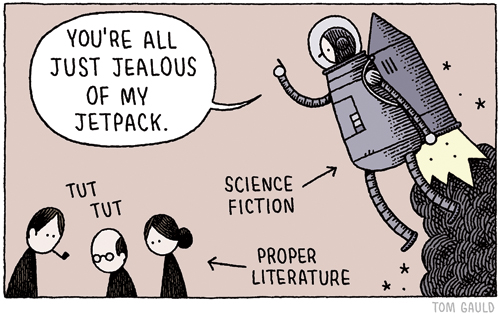
I love these new illustrations by the super-talented Tom Gauld for an article in The Washington Post Book Review about genre fiction:


You can see more of Tom’s work and his regular literary cartoons for The Guardian on Flickr.
Comments closedBooks, Design and Culture
I love these new illustrations by the super-talented Tom Gauld for an article in The Washington Post Book Review about genre fiction:
You can see more of Tom’s work and his regular literary cartoons for The Guardian on Flickr.
Comments closedWith library closures threatening in the UK, here’s Tom Gauld’s comic ‘Withdrawn‘ for The Guardian‘s Saturday Review:

 The cover for The Disappearing Spoon designed by the amazing Will Staehle. To quote Tal Goretsky at Book Covers Anonymous: “Holy Mother God!”. Apparently it’s printed on uncoated paper.
You can see some of Tal’s own rather nice design work here.
And speaking of designer’s blogs… Designer Joanna Rieke has started a new blog called UnCovered about book and magazine covers. She recently interviewed illustrator (and Casual Op. hero) Tom Gauld:
I think most literature works perfectly well without illustrations and I have seen some truly awful images put on the cover (used as illustrations) of great books. As for comics, I’m more often frustrated by comics which are too wordy than too visual. I think the balance between words and pictures is very important in a comic and though the ratio doesn’t always have to be the same, my heart sinks when I see a page which is filled with writing.
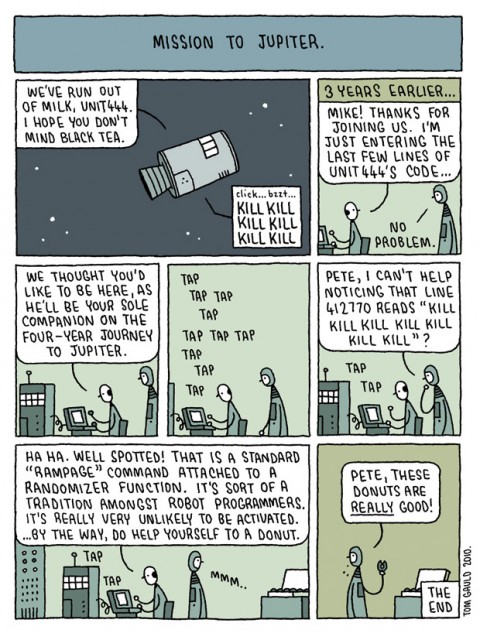
Taking a summer break from his regular illustration gig at The Guardian, Tom is currently producing a weekly comic and posting it to Flickr:
 Real Editors Ship — I linked this on Twitter already, but it’s kind of great so what the hell… Paul Ford on getting stuff out the door and the value of editors (and I would suggest Production Managers):
People often think that editors are there to read things and tell people “no.” Saying “no” is a tiny part of the job. Editors are first and foremost there to ship the product without getting sued… This is not to imply that you hit every sub-deadline, that certain projects don’t fail, that things don’t suck. I failed plenty, myself. It just means that you ship…
Editors are really valuable, and, the way things are going, undervalued. These are people who are good at process. They think about calendars, schedules, checklists, and get freaked out when schedules slip. Their jobs are to aggregate information, parse it, restructure it, and make sure it meets standards. They are basically QA for language and meaning.
The Fine art of Recommending Books — Laura Miller at Salon:
Amazon and other online merchants have harnessed mighty algorithms to run their “If you enjoyed that, you might like this…” suggestion engines, but these are still crude instruments. Practically any novel you plug into Amazon’s search engines at the moment returns the robotic announcement that people who bought it also bought one of Stieg Larsson’s “Girl” thrillers — because seemingly everybody in America is buying those books. It’s not like you need the world’s most sophisticate e-commerce servers to tell you that.
And finally…
Steranko! — Jonathan Ross interviews comics legend Jim Steranko, inspiration for Josef Kavalier in Michael Chabon’s The Amazing Adventures of Kavalier and Clay, for The Guardian:
Spend an hour with Jim Steranko and, if he’s in the mood, he’ll regale you with the most extraordinary tales. Are they true, I have asked myself more than once, or is he a fantasist? Has his love of storytelling and the creation of modern myths bled into his own life story until he can no longer tell the two apart? Well, now that I’ve met him, I believe them all to be true, just as I believe it when he tells me he still runs miles every day, pumps iron, and fornicates blissfully like a man a third his age. He is unique. He is Steranko. He is the greatest.
A slideshow of Steranko’s work is here.
Have a good weekend…
1 Comment
Tom Gauld‘s cover illustration for Death at Intervals by José Saramago, who died last week, aged 87. From The New York Times obituary:
[T]he critic James Wood wrote: “José Saramago was both an avant-gardist and a traditionalist. His long blocks of unbroken prose, lacking conventional markers like paragraph breaks and quotation marks, could look forbidding and modernist; but his frequent habit of handing over the narration in his novels to a kind of ‘village chorus’ and what seem like peasant simplicities allowed Saramago great flexibility.”
On the one hand, Mr. Wood wrote, it allowed the writer to “revel in sheer storytelling,” and on the other to “undermine, ironically, the very ‘truths’ and simplicities his apparently unsophisticated narrators traded in.”
Also: Maya Jaggi on Saramago in The Guardian.
On the Record — Jamie Byng has signed a deal to create a “living archive” of Canongate Book’s records at Dundee University:
For Byng, the attraction of the project is that it will be rooted in the present as much as the past. While Canongate promises to respect the privacy of those with whom it is in contact, the overall dream is to create an archive “that will show the company as a living, organic thing. I hope it won’t just give people insights into one publishing house but publishing in general. Or even how – because I want to give access to all the financial stuff – how an independent business can grow. This business is constantly evolving, never sitting still: every day there’s a huge amount going on not just within Canongate but with all the writers we’re dealing with.”
Alphabet Soup — Author Susan Orlean‘s editorial A to Z in The New Yorker:
I could go on, about how I left Publishing House X for Publishing House Y because I was still scared of Editor F, and how at Publishing House Y I managed to get three books written there working with Editor G—who assured me that he would never leave, and this was almost true, except for a brief period when he did, in fact, leave, but then he came back—and then the head of Publisher Y got fired, and eventually I left and then Editor F left, and then I was working with Publisher Z, and then the head of Publisher Z left, and then I left Publisher Z to go back to Publisher W, because the person now running it was an old friend from the magazine world, who I knew would never leave, but you might think I was exaggerating. But I’m not.
[Mimes being on the Internet] — James Murphy of LCD Soundsystem interviewed at Pitchfork. This gives me hope (via The Awl):
I just think it takes a couple decades to kind of clear your brain now. So it makes more sense to me that I could find my footing when I was 30 instead of when I was 19. It seems a little more clear. You know, novelists are older now. Things are happening later in people’s lives. They’re kind of living lives and then creating things about the lives they’ve lived. Rather than being an artiste at an early age and coming out with a ball of fire. That energy has been co-opted because you haven’t immunized yourself yet against media. It’s easier to get swept up things then take a couple of years to get over your, like, indie rock hangover.

 The Backwards Novel Seen Backwards by Tom Gauld.
I also love Tom’s Lost Fairy Tales for a promotional concertina booklet made by his agent Heart (surely there’s a full length book to be had here?).
Ways of Reading from A Working Library:
Every book alights a path to other books. Follow these paths as far as you can.
Lovely.
Back to Basics — Booktwo.org‘s James Bridle on the Apple tablet (what else?):
I’ve spent several years urging publishers to get on board with new technologies and try new things, but equally I hope there’s space for a lot of publishers to get back to concentrating on what they do best: acquiring, editing, producing and publishing books… [W]e should probably stop scrambling to get on the latest bandwagon (vanilla Books-as-Apps, I’m looking at you), and concentrate on the basics: ebook production, metadata, integrated marketing, quality and consideration. There is a lot to be done, but this or that device will never be the be-all-and-end-all of the future of publishing.
I think James has a point. But honestly, no one I know (and that is an admittedly limited sample) believes “this-or-that device” will magically “save” publishing. Surely it is only bloggers in need of straw men and ‘journalists’ paid to hyperventilate who say that kind of shit?
Moving (swiftly) on…

Modern Myths — Will Self on H. G. Well’s The War of the Worlds in The Times:
The War of the Worlds is one of those books that demonstrates our culture’s surprising ability to continue the manufacture of myth. I say surprising, because one would think, with all the technological reproducibility of art now at our disposal — from raw print, to film, to digitisation — that there would be no room left for that hazy instability within which myth thrives.
(Pictured above: The NYRB edition of The War of the Worlds with illustrations by Edward Gorey)
And finally, completely unrelated to books…

Dear Coffee I Love You… Yes, yes, I do. (Pictured above: What I’d Rather Be Doing)
2 Comments

Lusting After Lustig — Designers Charles Brock and Tim Green share their collection at FaceOut Books.
While Amazon announced the Kindle will be available in Canada this week, The New York Times looks at reading on phones:
Many people who want to read electronic books are discovering that they can do so on the smartphones that are already in their pockets — bringing a whole new meaning to “phone book.” And they like that they can save the $250 to $350 that they would otherwise spend on yet another gadget.
No. Shit.
But, on the subject of e-books… Steve Haber, the president of Sony’s digital reading division, talks to TechFlash (via TeleRead).

A History of 16 Science Fiction Classics, Told In Book Covers at i09 (including the brilliant cover for A Clockwork Orange pictured above and yet more covers for 1984).
A Winter’s Tale — Ali Smith (The Accidental) on The True Deceiver by Finnish author Tove Jannson, creator of the Moomins:
If the Moomins are Jansson’s most celebrated legacy – a community of inventive, big-nosed, good-natured beings who survive, again and again, the storms and existentialism of a dark Scandinavian winter through simply being mild, kind, inclusive and philosophical – what will happen when a real community is put in its place? What will the outcome be when Jansson tackles, naturalistically, the life of a tiny hamlet in a dark, wintry landscape – and in a book so close to real local life that the original Swedish publication carried a disclaimer saying it was in no way based on any real place, nor its characters on anybody living?
You had me at “existentialism of a dark Scandinavian winter.”

The Genius — The awesome Tom Gauld interviewed at It’s Nice That. Limited edition letterpress prints of Tom’s Characters for an Epic Tale are available now.
And finally…

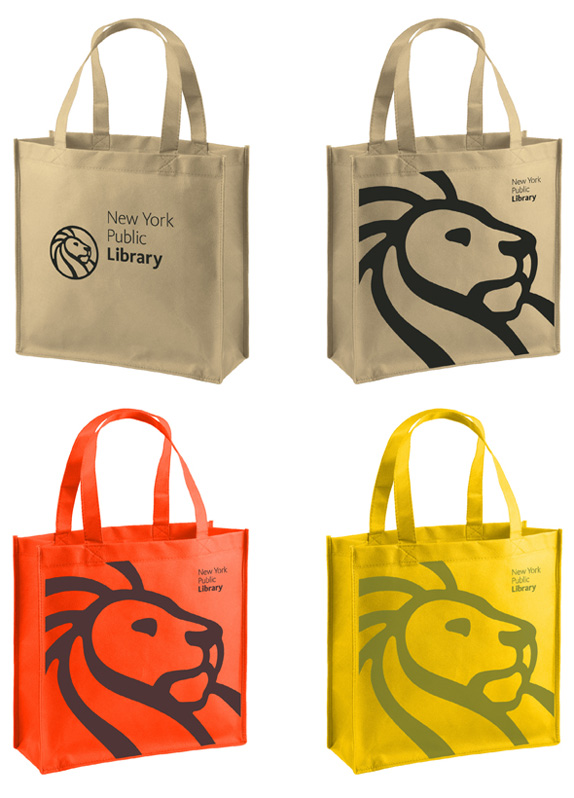
UnderConsideration’s Brand New looks at the new logo for The New York Public Library (via Daily Discoveries on Design)
Comments closed
Fluid — John Gall discusses his brilliant cover design for the Vintage edition of Tom McCarthy’s Remainder, which is still one of my favourite novels of the last few years.

Hamilton Wood Type Catalog No.14 (1899-1900) at Unicorn Graphics’ Wood Type Museum. I quietly obsessed with slab-serifs right now so this is like crack (via Draplin Design Co.).
And The Beat Goes On — Sarah Weinman (much missed at GalleyCat) is writing about publishing for AOL’s money and finance news blog DailyFinance.

Gigantic Robot — Awesome cartoonist and illustrator Tom Gauld has a new website (to accompany his excellent Flickr photostream).
BOOM! — PW talks to Mark Waid, Editor-In-Chief of independent comics publisher BOOM! Studios:
We’re great at getting a focused message out. Because we don’t publish eighty comics a month, our inestimable marketing department does a great job of making every title important in the marketplace and every launch an event. We’re also better than the big guys at taking risks because we don’t have stockholders to answer to, or lenders who would call us crazy… We’re very much a writer-driven, idea-driven company. We start with the story first (with a talented writer) and focus on getting that right.
30 Conversations on Design — Designers, including luminaries such as Massimo Vignelli, Erik Spiekermann, Ellen Lupton and Paula Scher, answer two questions: “What single example of design inspires you most?” and “What problem should design solve next?”
Unheimlich — Sam Leith argues for scary kids books in The Guardian (confession: I’m mostly linking to this story so I could type “unheimlich” which — rather disappointingly — means “unhomely” rather than “the act of undoing the heimlich manoeuver”).
And finally…
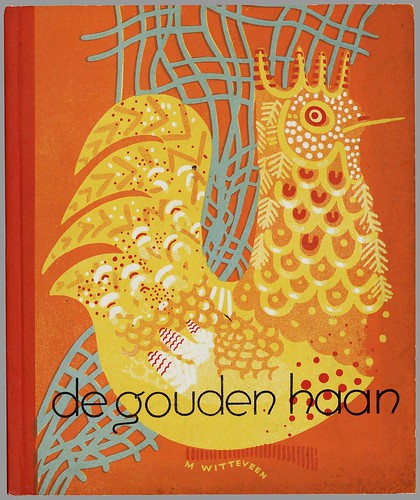
Dutch Picture Books 1810 – 1950 at BibliOdyssey (above: ‘De Gouden Haan’ by Marietje Witteveen, 1940).
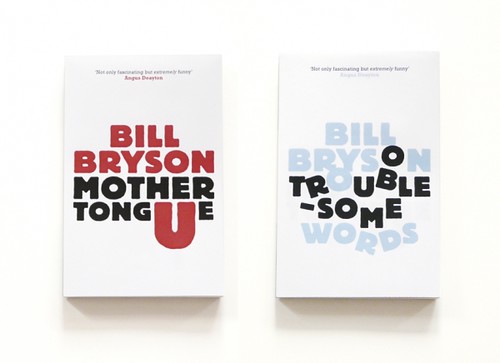 Unpublished concept jacket designs by London-based print designer Allan Sommerville for the Penguin’s Bill Bryson books (via Cosas Visuales).
Fonts — This is AWESOME: Wisconsin Public Radio’s To The Best of Our Knowledge talk fonts with Jonathan Hoefler and Tobias Frere-Jones, designers of Gotham, Matthew Carter, designer of Verdana, author Nicholson Baker, Tracy Honn, director of the Silver Buckle Press, and Kitty Burns Florey, author of Script and Scribble: The Rise and Fall of Handwriting. Listen NOW.
Many Happy Returns — Author, academic and newspaper columnist John Sutherland (The Boy Who Loved Books) on 30 years of The London Review of Books for The Financial Times:
The LRB front cover logo was “THE LONDON REVIEW of Books” – the last two words being smaller. As the typography signalled, it was the review that mattered as much as the book under review. Articles in the LRB were, and are, long: anything between 2,000 and 5,000 words. On special occasions they can run into the tens of thousands. Rates of pay seemed to me startlingly high: three or four times, in the early years at least, what the TLS paid. Miller personally appeared austerely indifferent to money. I suspect he worked for little or nothing. Nor did rises or falls in circulation appear to trouble him overmuch. Quality was all.
(There’s also a rather lovely addendum about the LRB’s personal columns, so read to the end!).
Somewhere Towards The End — A wonderful essay on editor and author Diana Athill by Ian Jack,former editor of Granta, in The Guardian:
[W]hat held me about the writing was its candour. The quality has since become an Athill trademark, though in itself candour is no guarantee of literary pleasure or interest: frank books aren’t always good books and can often be tedious by boasting of their frankness. Athill’s way of being candid is more subtle and its effect more persuasive… Part of this comes from her considerable gift as a maker of sentences, which are so lucid and direct; some of it is owed to the breaking of taboos that then surrounded female sexual behaviour; most of it, though, stems from her triumphant struggle to “get it right”, a lesson she learned from two of the writers she edited. Rhys told her that the trick of good writing was “to get it as it was, as it really was”. Naipaul said that “provided you really get it right, the reader will understand”.
The Internationalist — An all too short interview with Penguin Canada’s David Davidar, who was recently appointed CEO of Penguin’s new division Penguin International, in the Globe and Mail.
And finally… I do love Tom Gauld:
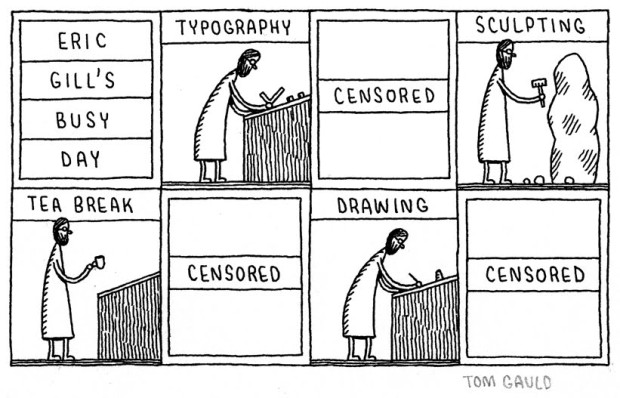
(More on Eric Gill)
Comments closed
Das Boot — David Drummond’s cover for Canadian Water Politics Edited by Mark Sproule-Jones, Carolyn Johns, and B. Timothy Heinmiller has been selected for the AIGA 50 Books/50 Covers this year. The book is published by McGill-Queens University Press who clearly take pride in the look of their books and have some other rather nice cover designs on their site.
The Long Goodbye — Another long, hard — and somewhat cynical look — at the state of the book industry. This time it’s the turn of Elisabeth Sifton, senior vice president of Farrar, Straus & Giroux, in The Nation.

W. W. Norton Book Design Archive — Publisher W. W. Norton have started posting their book cover designs to designated Flickr set (Crime by Irvine Welsh, designed by Darren Haggar pictured above) . I’d love to see more publishers do this (via The Book Cover Archive Blog).
Bird Brained or Brilliant — The contentious issue live-tweeting conferences. I only mention this because it tallies with my own recent experience of live-tweeting Raincoast’s Fall 09 Sales Conference. And because I’m a nerd (via Kate Trgovac on Twitter).
Gigantic Robot — the awesome Tom Gauld is publishing a new 32-page comic called The Gigantic Robot this summer. According to the Creative Review blog it’s “a fable concerning the production of a secret weapon whose promise apparently goes unfulfilled”. Can’t wait.
And finally (on a completely un-book related note)…
Redux — Muxtape is dead! Long live Muxtape! Whereas the late, lamented Muxtape was a place to upload mp3 ‘mixtapes’ (that fell foul of the music industry lawyers), Justin Ouellette’s new site is a platform for bands to share their music. Nice (via ISO50).
Comments closed
Alternative Manga — Eric Skillman on designing a template for Top Shelf’s AX: Alternative Manga series at his blog Cozy Lummox.
FiledBy — a social network for authors and their readers, co-founded by Peter Clifton and Mike Shatzkin.

Extended Grey Skies — Henry Sene Yee on designing the cover of David Cullen’s Columbine:
In the end, I didn’t want to say anything or felt the need to frame the book in any Point-of-View. What really needs to be said? The Publisher had already set the tone for me. As far as the cover copy, there was no author’s name, no descriptive subtitle, no high school, just the word COLUMBINE on the front cover. That said it all.
Router — Jeremy Mickel on the year-and-a-half process of designing his first typeface at I Love Typography:
Several designers have told me how important it is to have a specific use and point size in mind. The idea is that if you try and design a font that’s good for everything, it might not be REALLY good at anything. But if the font works really well for one specific use, then it can probably work well for lots of others.
In search of Chandler — Editorial Assistant Anna Kelly recounts her search for the original jackets of Raymond Chandler’s The Big Sleep, Farewell, My Lovely, The Little Sister, The Lady in the Lake, and The Long Good-bye for Hamish Hamilton’s new reissued editions. Chandler died 50 years ago this week.
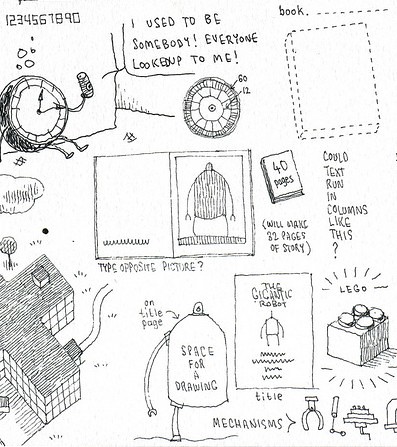
And finally, I’ve mentioned Tom Gauld’s Flickr page previously but, honestly, it’s so good who cares? Tom’s just uploaded some of his sketchbooks and needless to say they’re genius. You can see Tom’s books at Cabanon Press.
2 Comments