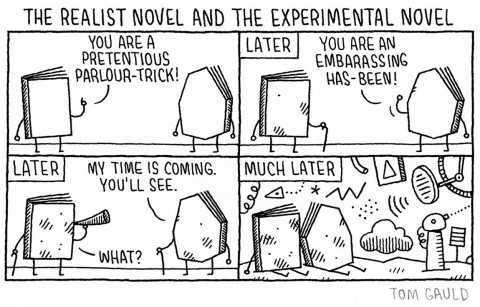
One day, I might stop posting everything Tom Gauld does. But that day is not today…
(via The Guardian)
Comments closedBooks, Design and Culture
One day, I might stop posting everything Tom Gauld does. But that day is not today…
(via The Guardian)
Comments closedIn lieu of any real posting around these parts of late, here’s a recent Tom Gauld cartoon to keep you quiet:

You can find my interview with Tom here if you haven’t read it already.
Comments closed
…just about covers it. Sigh.
Comments closed
You’re All Just Jealous of My Jetpack — Tom Gauld has a Tumblr (The title is a reference to this of course).
Legacy Issues — Stephen Page, chief executive of Faber & Faber, writing at The Guardian:
Let’s deal with technological obsolescence. Media businesses are not technology businesses, but they can be particularly affected by technology shifts. I run a so-called legacy publishing house, Faber & Faber. Most of our business is based on licensing copyrights from writers and pursuing every avenue to find readers and create value for those writers. We are agnostic about how we do this. For our first 80 years, we could only do it through print formats (books); now we can do it through books, ebooks, online learning (through our Academy courses), digital publishing (such as the Waste Land app) and the web. Technology shifts have tended to result in greater opportunity, not less.
Bibliophiles in London — The Economist on The London International Antiquarian Book Fair:
Most interesting, perhaps, is the air of optimism—there is not the slightest whiff of gloom at the state of the book world. The internet, paradoxically, has made books “à la mode”, says Claude Blaizot of the Librarie August Blaizot in Paris, purveyor of first editions of “Tintin” and fantastically bound livres d’artiste. “It has brought people to books, and shown them booksellers they never would have known existed before,” he says. Clive Farahar, the Antiques Roadshow’s book specialist, agrees that technology has opened up the book trade, and made the world of books much more accessible to all. “It’s not just the dim little shop on the high street anymore,” he said. “We can learn so much now we never would have known before.”
Simplicity — A two-part interview with Apple designer Jonathan Ive at The Telegraph:
“Simplicity is not the absence of clutter, that’s a consequence of simplicity. Simplicity is somehow essentially describing the purpose and place of an object and product. The absence of clutter is just a clutter-free product. That’s not simple.”
(part two)
And finally…

Daniel Clowes at wired.com:
Comments closed“Digital seems like such a step back from a printed book… For me, the whole process involves envisioning this book in my head as I’m working. That is what I’m trying to create. That’s the work of art. That’s the sculpture I’m chipping away at, and when I’m finally done, I will arrive at that perfect 3-D object. The iPad version would be like a picture of the book, which doesn’t hold any interest at all for me. Even if I only had 10 readers, I’d rather do the book for them than for a million readers online.”

Krazy Kriticism — Sarah Boxer on George Herriman’s long-running newspaper comic strip Krazy Kat, at the LA Review of Books:
[E]ven 95 years ago the truth was as loud and clear as a pair of clapping mitten rocks rising up out of the mesa encantada: Krazy Kat is perfect and Herriman is a genius — linguistically, graphically, poetically, onomatopoetically, every which way. Confronted with such perfection, most of Herriman’s critics, once they finish reciting plot, affecting accents, and making comparisons to classics, have always thrown up their hands and said, “Behold!” But does it have to be that way? The genius label, after all, has never kept Shakespeare or Picasso scholars from finding something to say.

A Natural End — An interview with Tom Gauld at The Comics Journal:
I never draw things big. Even if something needs to be big, I’d still draw it small and scale it up. I like to draw small (my drawings are not much bigger than the finished, printed comics) as it reigns in perfectionism, and I get a bit of natural wobble and error into the drawings. One problem with digital is that you can zoom in and in forever: but with a pen, the width of the line gives a natural end.
Canaries — Nick Harkaway, author of The Blind Giant, talks about books on the digital age at The Browser:
Our environment seems to be constantly filled with moral panics. When you open the newspaper, there’s always a piece about how the digital environment is making us stupid or paranoid, but so little of it has any basis. There was a piece in The Guardian the other day about how behaviour on Facebook was linked to socially aggressive narcissism. You had to go six paragraphs into the story to find out that the link wasn’t causal. It was just as possible that Facebook was the canary in our coal mine, telling us that our society was aggressively narcissistic in general – which I don’t find terribly difficult to believe.
And finally…
Little Glories — Sam Taylor, who translated HHhH by Laurent Binet, on the art (and perils) of translation, at the Financial Times:
Comments closedThere is… something else slightly troubling about the relationship between authors and translators. It can, I suppose, be reduced almost to a hierarchical relationship: the author is primary, the translator secondary. We notice when a translation is bad, but when it is good we forget that what we are reading is a translation at all. However, while there is little glory in translation, and although I began doing it only for financial reasons, I wouldn’t want to give it up now – even were I able to make a living from writing novels.

Everyday Epic — Tom Spurgeon interviews Tom Gauld at The Comics Reporter:
I find that when I’m drawing I’m quite happy to come up with larger than life, epic things but when I write things tend to be more down to earth. The contrast between greatness and everyday reality is something which interests me.
You can find my interview with Tom here. His new book Goliath is out in March.
I Am Lousy Copywriter — A list by legendary adman David Ogilvy, author of Confessions of an Advertising Man, at Letter of Note:
If all else fails, I drink half a bottle of rum and play a Handel oratorio on the gramophone. This generally produces an uncontrollable gush of copy.
My Name is Tyranny — Mike Doherty interviews William Gibson about his new book, Distrust That Particular Flavor, for Salon:
I very seldom compose anything in my head which later finds its way into text, except character names sometimes – I’m often very much inspired by things that I misunderstand. Have you ever seen Brian Eno’s deck of Oblique Strategies? One of them is “Honor thy error as a hidden intention.” That’s my favorite. [At a] hotel in New York a couple of days ago, the young woman who checked me in said what sounded to me like, “Thank you, sir; my name is Tyranny. If there’s anything you need …” For the rest of the day, I was thinking of young, benevolent female characters with the first name “Tyranny.”
And finally…
Tiptoeing Through a Sickroom — Luc Sante on Patti Smith for The New York Review of Books:
Her memoir Just Kids (2010), the account of her friendship with the photographer Robert Mapplethorpe, has been justly celebrated. It is delicate and affectionate as it tells of their adventures in a New York City bohemia that now seems a century removed, of the endurance of their relationship despite his realization that he was gay, of their separate pursuits of fame, of his illness and death. It is almost too literary for its own good, since her choices of word and phrase always come down on the genteel side of the ledger: “perhaps” rather than “maybe,” “rise” rather than “stand,” “yet” rather than “but,” “one” rather than “you.” There’s hardly a contraction, outside the dialogue, in the entire book. But despite the fact that this sort of talk is patently not the way she expressed herself at the time, and that it sounds more effortful than natural on the page, it does cover the book with an appropriate hush—it sounds like someone tiptoeing through a sickroom.
Comments closed
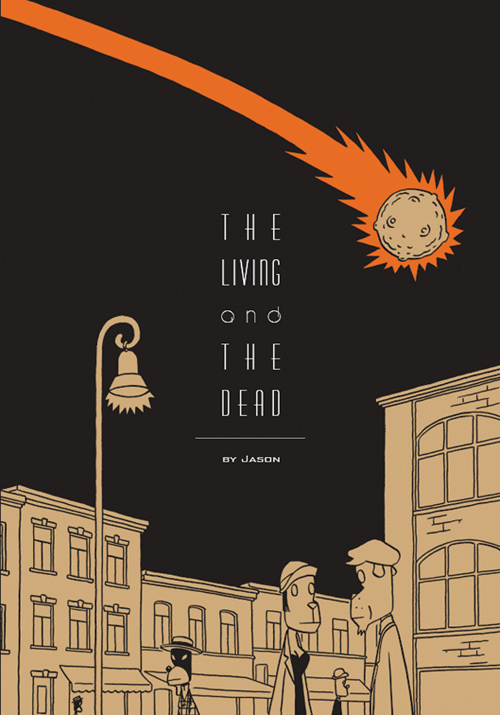
I’ve written about Norwegian cartoonist Jason for The Casual Optimist before and his work appears here with unerring regularity — if you are a frequent reader you are no doubt already familiar with it.
Like British cartoonist Tom Gauld who I interviewed early this year, Jason’s comics are immediately identifiable. You cannot mistake them for the work of someone else. And again, like Tom, Jason’s work references both the pop and the high-brow: zombies and werewolves on the one hand; Hemingway and the Beats on the other. The result is both original and off-beat. His protagonists are like renegades from a Max Fleischer cartoon who’ve inadvertently wandered into a Jim Jarmusch movie… Anthropomorphic animals smoking cigarettes, drinking coffee, talking about French actresses. Action and slapstick wrestle with ennui and loneliness.
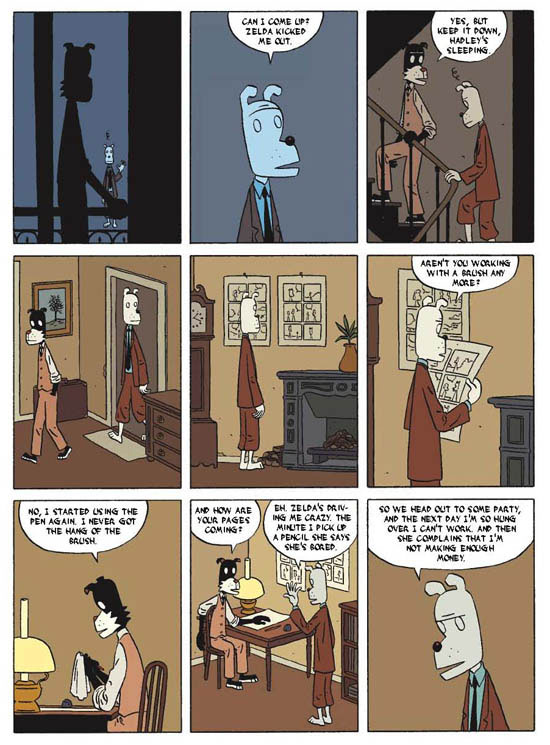
Jason, whose work has been translated into Swedish, Spanish, German, Italian and French, currently lives in Montpellier, France. He was kind enough to talk to me in English. His new short story collection Athos in America will be published in December by Fantagraphics.
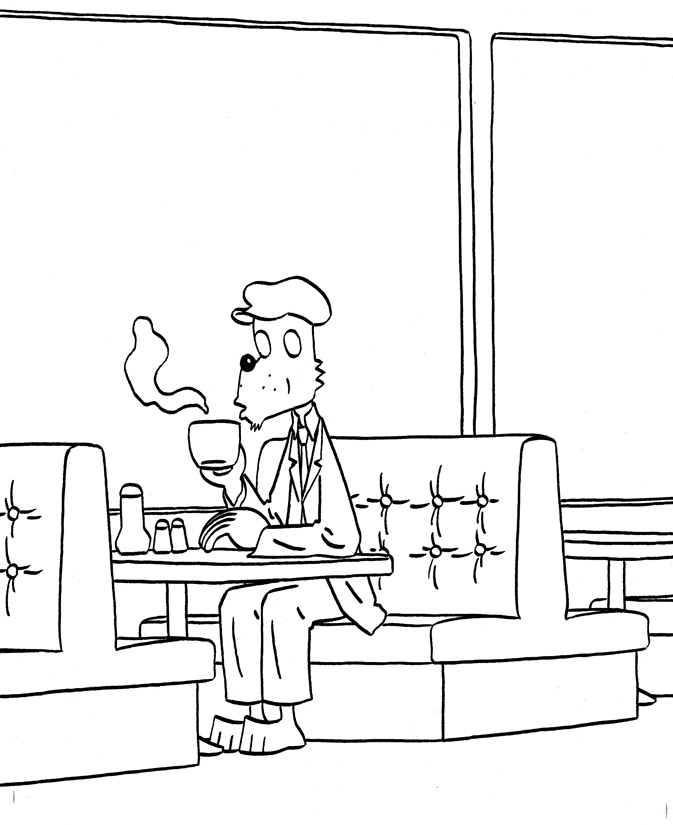
When did you first start drawing cartoons?
Around age 13, I guess. And then at age 16 I started selling cartoons and one page strips to a Norwegian humour magazine. I did that through high school.
Did you always want to be a professional cartoonist?
No, it was a hobby. To become a cartoonist in Norway was not much of an option. I went to art school to become an illustrator, but my career never took off, so I kept doing comics. I met other cartoonists in Oslo, there was sort of a little scene. And then I moved to France to be closer to the French comic book industry. I did books that were translated into English, French plus some other languages, and the last seven or eight years I’ve been able to have an income almost exclusively from doing comics.
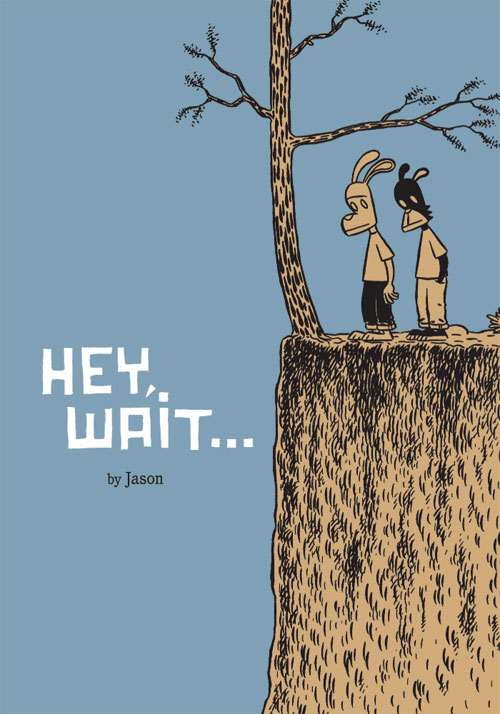
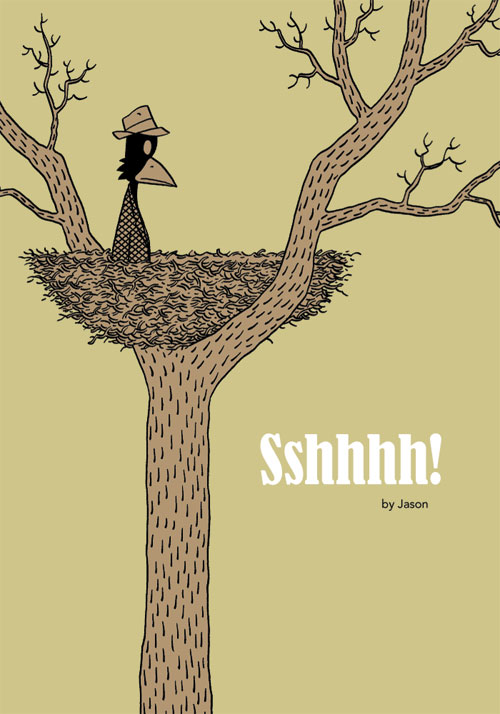
How did you become involved with your US publisher Fantagraphics?
We sent — that is me and my Norwegian publisher, Jippi — we sent Hey, Wait… to Fantagraphics. I’m still not quite sure if Kim Thompson read our submission or if he had already read the French version, but anyhow, they decided to publish the book, and then later Shhh! And The Iron Wagon. And for some strange reason, the books seem to sell okay, so I’m still published by them. [Hey, Wait…, Shhh! and The Iron Wagon are collected in the book What I Did]
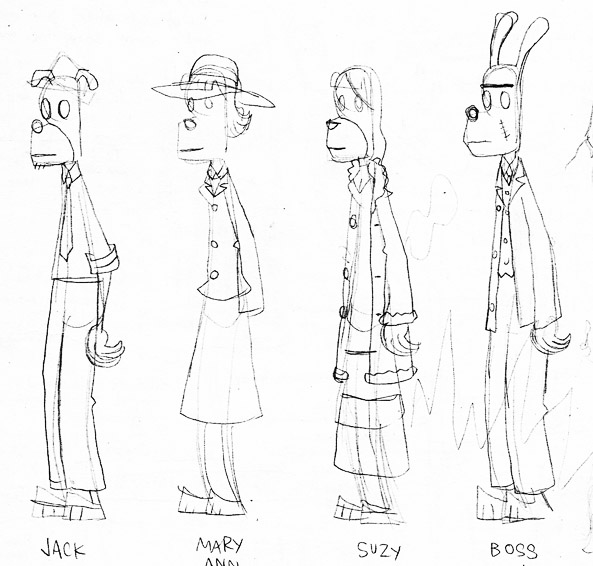
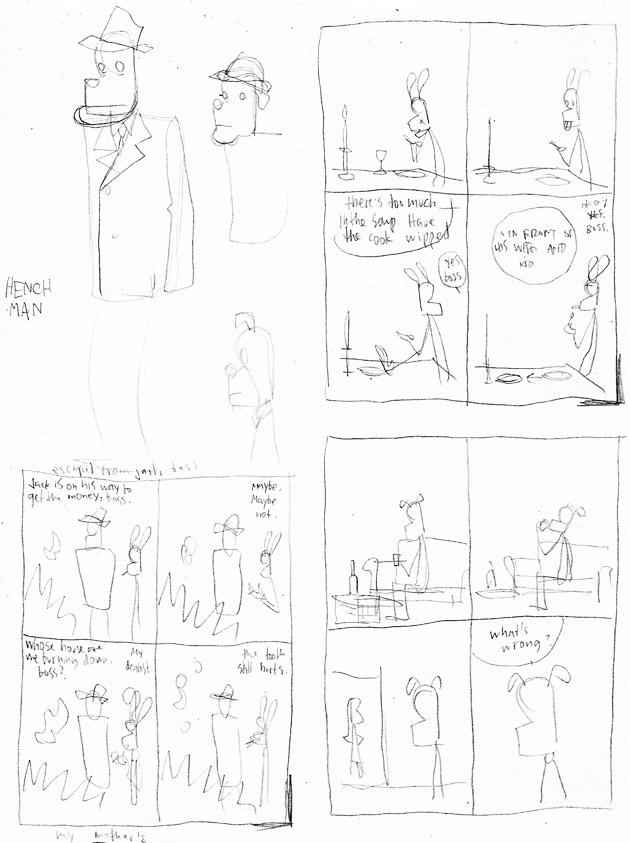
Briefly, could you describe your working process?
I have ideas in my brain, just lying there, that I sometimes think about. This can last years. Then suddenly I can get ideas for dialogues. I write this down. It’s maybe four or five pages. I can start working on those, and at the same time think about what’s going to happen next. I don’t write a full script. It’s based on improvisation. I write pieces of dialogue. Or sometimes I sketch out the pages first, the images, and write the dialogue after. I usually work on nine or ten pages at the same time, pencil a bit here , then ink it, and then pencil a bit there and ink that. It’s the completely wrong way of doing it, by the way, but it seems to be the only way I can work.
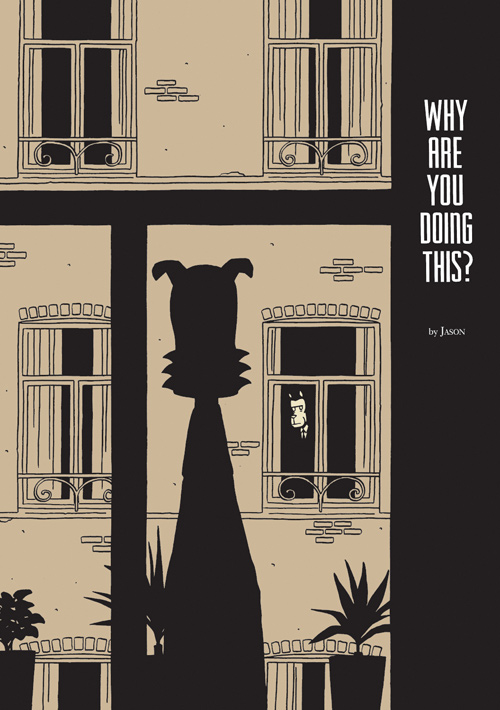
Your work often references classic movies. What are some of your favourite films?
How much room do you have? I like Fred Astaire and Ginger Rogers films, film noir, Brian De Palma, John Ford, especially The Searchers and Howard Hawks, especially Rio Bravo, Buster Keaton, Laurel and Hardy. Paris, Texas, Down by Law, Animal House, Blues Brothers, Fanny and Alexander, Five Easy Pieces, The Last Picture Show, Miller’s Crossing, Roman Holiday, On The Waterfront, Life of Brian. Days of Heaven by Terrence Malick is probably my favourite film.
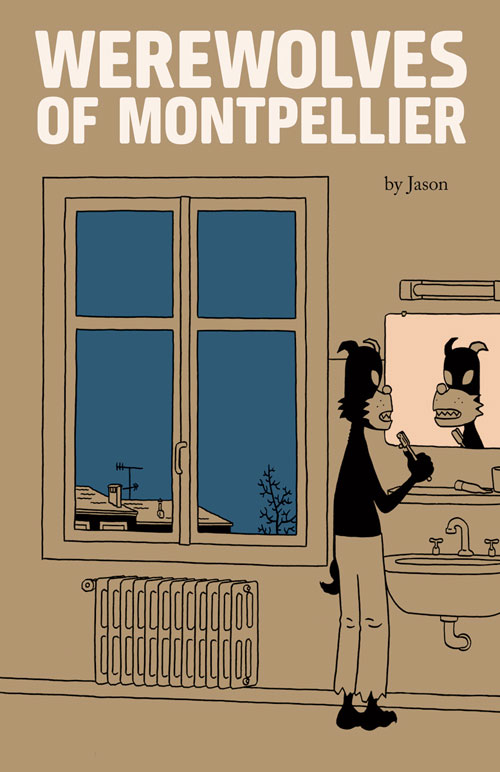
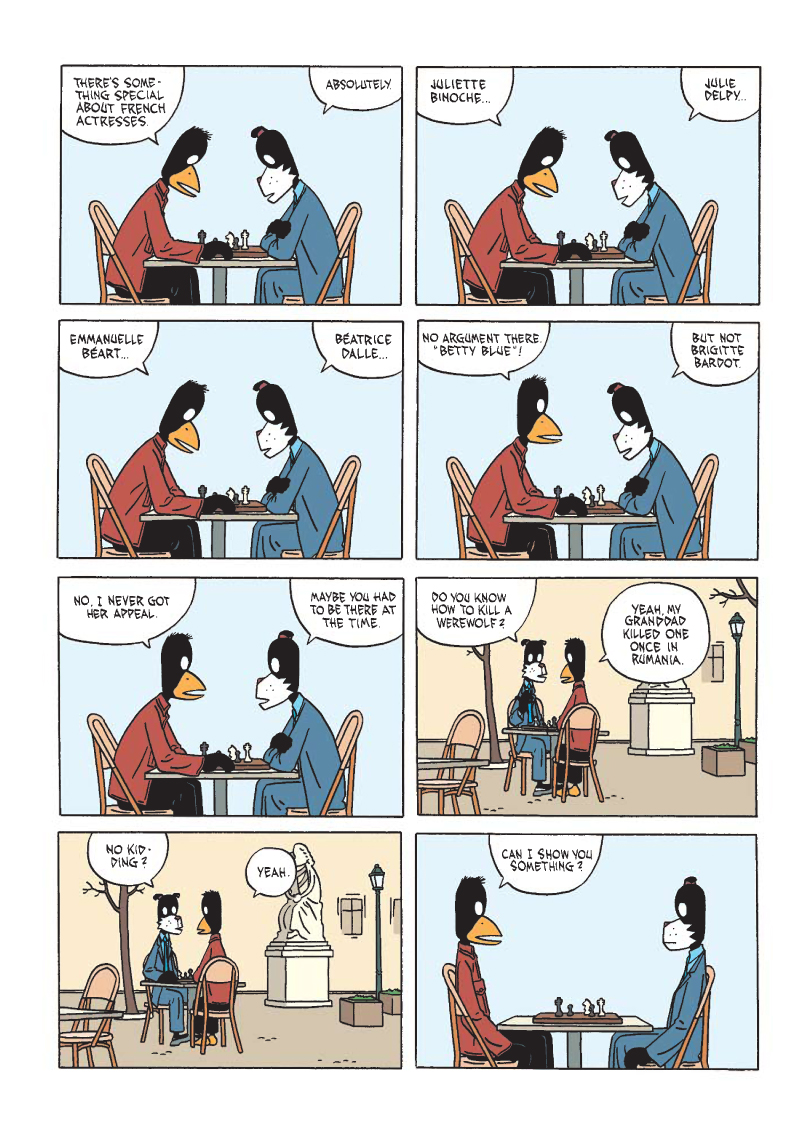
In your recent book Werewolves of Montpellier, one of the characters says they don’t understand the appeal of Brigitte Bardot. Really?
Yes, really! What, you like her? She just looked a little stupid to me. I find Catherine Deneuve a lot more appealing, or Emmanuelle Beart and Julie Delpy to stick with French actresses.
You recently post a list of your 5 favourite Tintin books. Has Hergé been an influence on your work?
Yes, very much so. It was one of the first cartoonists that appealed to me. I borrowed his albums at the library as a kid. I started drawing my own cartoons. And I think you can have a much worse teacher than Hergé. It’s not really the clear line that is the most important thing, even if that is part of what I like with him, it’s more the very clear storytelling that you find in his books. On page three you’re hooked. I think you can read his books in a foreign language, in Russian, and still understand the story and enjoy it. I don’t re-read the books that often, but I often take them out, my favourite albums like The Broken Ear and The Shooting Star, and just look at the drawings.
What do think about the new Steven Spielberg adaptation?
I’ve only seen the trailer. It doesn’t look that bad. I don’t want to just completely rule it out, like its a sacrilege and that Spielberg has no right to adapt Hergé. Not sure about the computer animation, but the original plan was apparently live action with a computer animated Terry [Milou/Snowy], and I think I really would have hated that. And the European animation films, based on each album, are just terrible. Everything that is exciting and funny in the albums are completely lost in the animation films. So I don’t think the Spielberg film can be any worse.
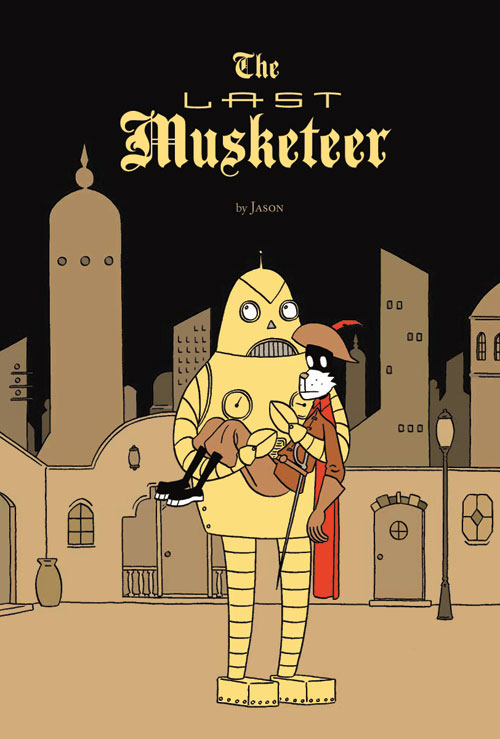
Who are some of your other creative heroes?
Jim Jarmusch, Hal Hartley, Wes Anderson, Aki Kaurismäki. Jaime Hernandez, Jim Woodring, Daniel Clowes, Chester Brown.
Who else do you think is doing interesting work right now?
There are two Argentinian cartoonists I like, Liniers and Pablo Holmberg. The French cartoonist Christophe Blain. Calef Brown’s children books. I like the Mutts books by Patrick McDonnell. I’m not sure if it’s necessarily «interesting», but I find them appealing. It’s like the last, good newspaper strip. I like the old newspaper strip collections: Captain Easy, Prince Valiant, Little Orphan Annie, Gasoline Alley.
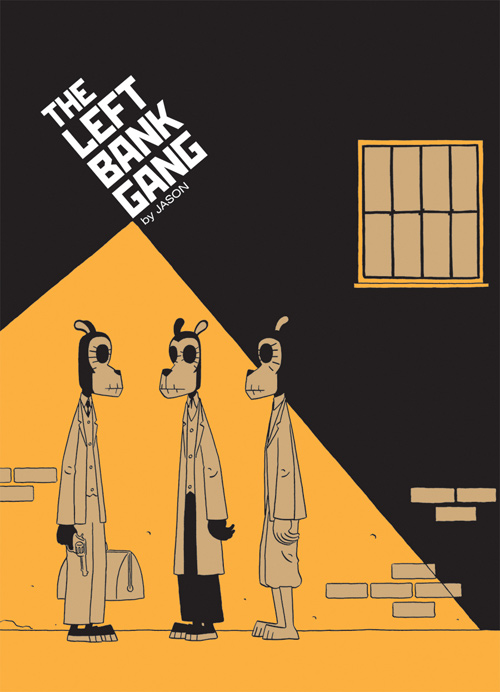
What books have you read recently?
This summer I read The Selected Letters by Jack Kerouac, Off The Road by Carolyn Cassady. I tried to read The Subterraneans by Kerouac, but gave up. I read Chronicles by Bob Dylan, Positively 4th Street by David Hadju and A Freewheelin’ Time by Suze Rotolo. I also read Dave Van Ronk’s memoirs, The Mayor of MacDougal Street, so I look forward to the new film by the Coen brothers, based on his life. What else? Blood Meridian by Cormac McCarthy, Last Night in Twisted River by John Irving and Freedom by Jonathan Franzen. I’m currently reading Volume 1 in The Letters of Ernest Hemingway.
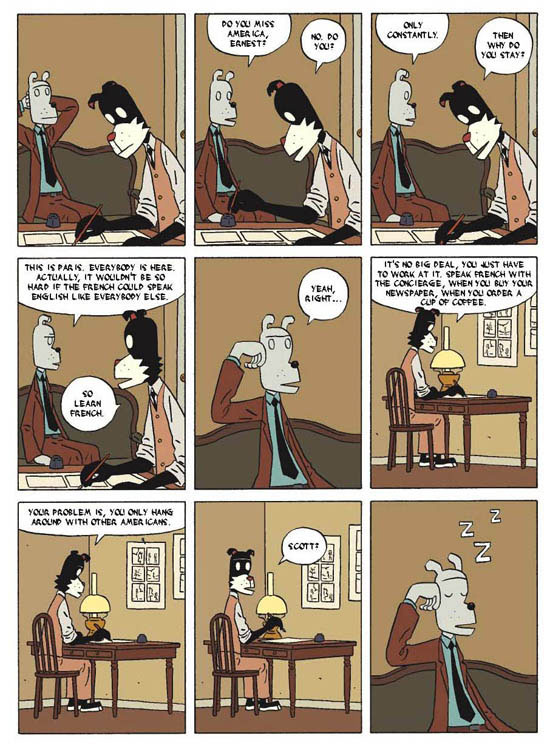
What are a few of your favourites books?
Well, Hemingway. The Sun Also Rises and A Farewell to Arms, his short stories. Bukowski, mostly his novels, but I’ve also started reading his poetry. Raymond Carver and Tobias Wolff. Lorrie Moore, her short stories. Kelly Link. There’s a British writer I like, Rupert Thomson. John Fante, especially Ask The Dust, John Steinbeck, especially East of Eden and Grapes of Wrath, Cormac McCarthy, especially The Road and No Country for Old Men. Raymond Chandler and other old pulp writers like Charles Willeford and David Goodis. I like Elmore Leonard. Paul Auster. John Irving. Every four or five years I re-read Cider House Rules, Garp and Hotel New Hampshire.

Are there any stories you would like to illustrate?
Yes, there are one or two books I’d like to adapt to comics. But I’ll probably wait until I’ve run out of ideas myself.
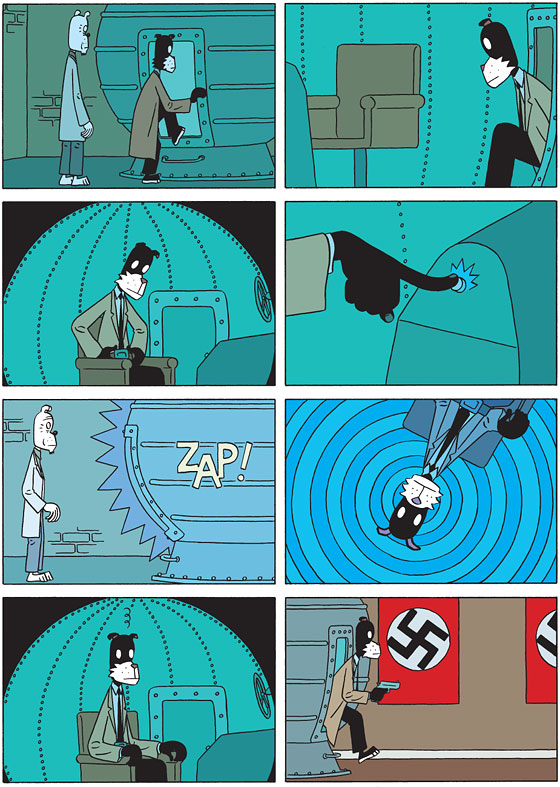
Do you worry about the future of books and print?
No. I don’t know. The bike didn’t disappear when the car came. There are hopefully room for both books and electronic media. Personally I’ll stick with paper. I’ve no interest in reading on a screen. And I’ll be dead in 40 years anyhow. How much can they screw it up by then?
Thanks Jason!
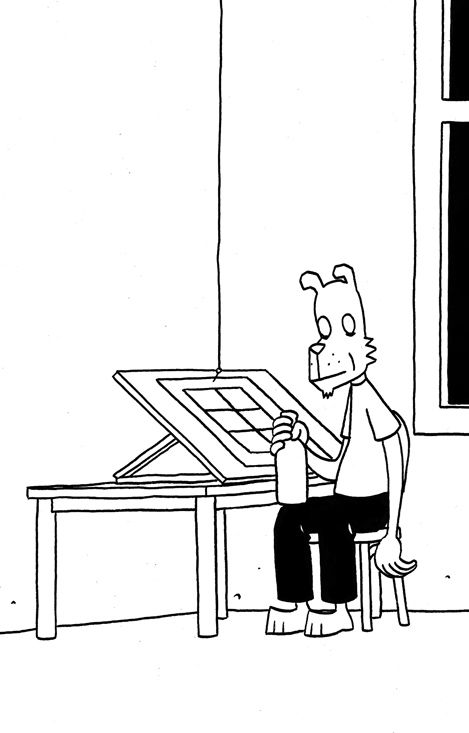
6 Comments

Words and Pictures — An interview with cartoonist Tom Gauld at The Rumpus:
Format, words and pictures all work together to make a good comic. I started at college doing pure illustration and only gradually got into making stories and using words. I’m still more comfortable with pictures than words: I’m happy doodling away on drawings for hours, but putting words together is always more of a struggle. I usually like to keep things as simple as I can so it’s interesting seeing what I can remove and still keep the story: you don’t want to say something in words which is better said in the pictures (and vice versa).

There is also a preview of Tom’s new book, Goliath, on the D+Q blog and you can read my interview with Tom here.*
A General Contempt for Small Talk — Edward Docx, author most recently of The Devil’s Garden, on Tolstoy, Russia, and literary prizes. So much good stuff here:
[I]f there’s one thing that novelists love to talk about, it’s how to make things real when, obviously, they are not. This in turn leads naturally into something novelists like to talk about even more: the terrible struggle of writing itself. (My favourite line about writers: “Writers are people who find writing more difficult than other people.”)… Metaphors rise from the table like disturbed lepidoptera. Writing a novel is like attempting to solve an extremely complicated maths equation, which seeks to represent reality, and through which you are trying to lead the public without them ever getting wind that said equation is, in fact, impossible to solve or that, actually, it might not represent reality at all. We are getting carried away. Deciding to write a novel is like visiting an obscure, half-forgotten and slowly-evaporating planet entirely comprised of swimming pools and deciding that what is needed is… yes, another swimming pool! But, for obscure reasons, a swimming pool that must be built single-handedly from scratch and then filled using only a syringe.
And finally…
Critical Authority — New York Times film critics A. O. Scott and Manohla Dargis discuss Brian Kellow’s new book Pauline Kael: A Life in the Dark and the ongoing legacy of the (in)famous New Yorker film critic. Here’s A.O. Scott:
[T]he idea of critical authority has always struck me as slippery, even chimerical. Authority over whom? Power to do what? The importance of particular critics can’t be quantified in lumens of fame, circulation numbers or box office returns, though by all of these measures Kael, in her heyday, certainly enjoyed unusual prominence. But like every other critic, she was above all a writer, and a writer only really ever has — or cares about — one kind of power, which is the power to engage readers.
I think Kael is remembered not for her particular judgments or ideas, but rather for her voice, for an outsized literary personality that could be enthralling and infuriating, often both. A lot of people read her for the pleasure of disagreement, and the resentment she was able to provoke — in critical targets and rival critics — is surely evidence of power. An awful lot of our colleagues are still, in both senses, mad about her. To reread her is to understand why.
*Just so you know: D+Q are distributed in Canada by my employer Raincoast Books.
Comments closed
Tom Gauld is a cartoonist and illustrator based in London. I first came across his work a few years ago in a book called Both published by Bloomsbury in 2003. Both (sadly now out of print) collected comics by Tom and Simone Lia originally self-published as First and Second under their imprint Cabanon Press.
Since then Tom’s book cover illustrations and literary cartoons have featured regularly here and on The Accidental Optimist. His work is funny (oh so funny) — silly even — but it combines pathos with the farcical. His heroes are unlikely or put-upon; his robots lonely, mundane or murderous; detectives are clueless; scientists baffled. Everyone (including the robots), it seems, would rather have stayed at home with a cup of tea and a good book. There is a gentle subversiveness to it all, although it is never mean-spirited. I hesitate to describe it as Pythonesque, but it is in a way. Tom’s machines all look as if they go ‘ping’. Other references include superheroes (less than you might think), adventure serials, mysteries, literary fiction, 1970’s science-fiction, Stanley Kubrick, fairy tales, and old Open University TV shows. It’s eccentric to say the least, but wonderful nonetheless.
Tom and I corresponded by email.

When did you first start drawing cartoons?
I’ve drawn for as long as I can remember and I drew a lot of cartoons when I was at school, but I suppose it was when I was studying at Edinburgh College of Art (around 1998) that I really began drawing comics and cartoons seriously.
Why did you start self-publishing your work?
I first self-published a comic called First with my friend Simone Lia in 2001 when we were studying at the Royal college of Art in London. I’d say we did it partly because we didn’t know anyone else who would publish it, but also because I was interested in the business of designing and hand making the whole object. I had bought a self-published comic called OAF by Mat Brinkman a few years earlier and it inspired me to self-publish: it was small and hand-made and quite rough, but really unique and lovely. I suppose I’d seen self-published stuff before, but OAF really excited me.

Was the design of your books always important to you?
Yes, definitely. I think with any book, but particularly with a picture book of some kind, the experience for the reader begins before they even pick up the book. So I try to make every aspect of my own books contribute towards the story or idea. When I started, I was as much interested in designing, making and publishing a book as I was in the actual stories within.
Is Cabanon Press on permanent hiatus?
I wouldn’t want to say that Simone and I won’t ever start it up again. But we don’t have any plans to do anything with it for the moment. I’m still self-publishing things, but for Cabanon to work I think it has to be something Simone and I do together and we’re too busy with other things.

Where are your cartoons published now?
I do a weekly cartoon for The Guardian which appears in the (art and books) Review every Saturday, some of these cartoons also appear in The Believer’s comics section. I do something to accompany the The New York Times “Riff” essay every Sunday but that’s usually more an illustration than a cartoon. I also regularly put my work on my Flickr photostream.

Briefly, could you describe your working process?
I sit and think and doodle in my sketchbook until I have a good idea. Then I’ll make rough pencil sketches on copier paper till I have things worked out visually. Then I hone these sketches on paper and in photoshop till I have a rough version of the image which I can send to anyone who needs to approve it. Then I will print out the image and use a lightbox to trace an ink version which I crosshatch then scan back into the computer where I can clean it up, tweak bits and add any colour. I love using the computer but I try to stay away from it till I’ve done most of the thinking for an idea, looked at it from all sides, because I feel that once the computer is involved things are on an inevitable path to being finished. Whereas in my sketchbook the possibilities are endless.

How is illustrating a book cover different from your weekly cartoons?
It’s very different. I feel more pressure doing a book cover than almost anything else, I think “This author has probably spent years writing this book: I mustn’t mess it all up with a crap cover”. So I have to try and find a way to react to the book and make something which is suitable, but is also strong and interesting in its own way.

Are you planning any more full-length comics?
My forthcoming book Goliath is really the first time I’ve written a book-length narrative (albeit quite a short book) and I found it much harder than writing short pieces, but I’m happy with the result now. I will probably write another one, but not straight away. I’ve got a couple of shortish things I want to do, then after that I don’t know what I’ll do.

Where do you look for inspiration, and who are some of your cartooning heroes?
I listen to the radio, watch TV and films, go to museums and most of all read.
Cartooning heroes: William Heath-Robinson, Gary Larson, Roz Chast, Richard McGuire, Ben Katchor, Daniel Clowes, Chris Ware, Jochen Gerner.

How has Edward Gorey influenced your work?
I’m a big fan of Edward Gorey. I discovered his work when I was at college and immediately wanted to seek out everything he’d ever produced. I like that what he makes is unclassifiable: he makes picture books for adults which aren’t comics, many are self-published but they’re beautifully produced. I love his drawing, the odd narratives, the design of the books, the compositions, the hand drawn typography: everything really. The way I crosshatch (with small “patches” of short lines rather than long ones) I learned from Gorey.

Are you obsessed with robots?
I think I probably am a bit. I find they are very good props/characters for my stories and ideas. I like the inherent sadness in robots: they are sentient beings but also products which can break or be discarded (in my stories anyway). Also, they are much easier to draw than real people.

Who else do you think is doing interesting work right now?
Jon McNaught, Kate Beaton, Anders Nilson, Sammy Harkham.
What are a few of your favourite books?
Off the top of my head:
The Inheritors by William Golding
The Vinegar Works by Edward Gorey
Tinker, Tailor, Soldier, Spy by John le Carre
Teratoid Heights by Mat Brinkman
The Summer Book by Tove Jansson
The Stanley Kubrick Archives by Alison Castle

Are there any books you would love to illustrate?
I’d like to do a book of fairy-tales or folk-tales.
What have you read recently?
The Thousand Autumns of Jacob de Zoet by David Mitchell
Through the Language Glass by Guy Deutscher (A fascinating book about language and colour)
The Annotated Brothers Grimm by Maria Tatar
The Cardboard Valise by Ben Katchor

What’s next for books and print?
One thing which might happen with the rise of e-books is that the books that DO get published in paper may have to justify themselves by being better made, designed and illustrated. That would make me happy.
Thanks, Tom!
For the sake of full disclosure, I should mention that Tom’s forthcoming book Goliath, will be published by Drawn & Quarterly and distributed in Canada by my employer Raincoast Books.
7 Comments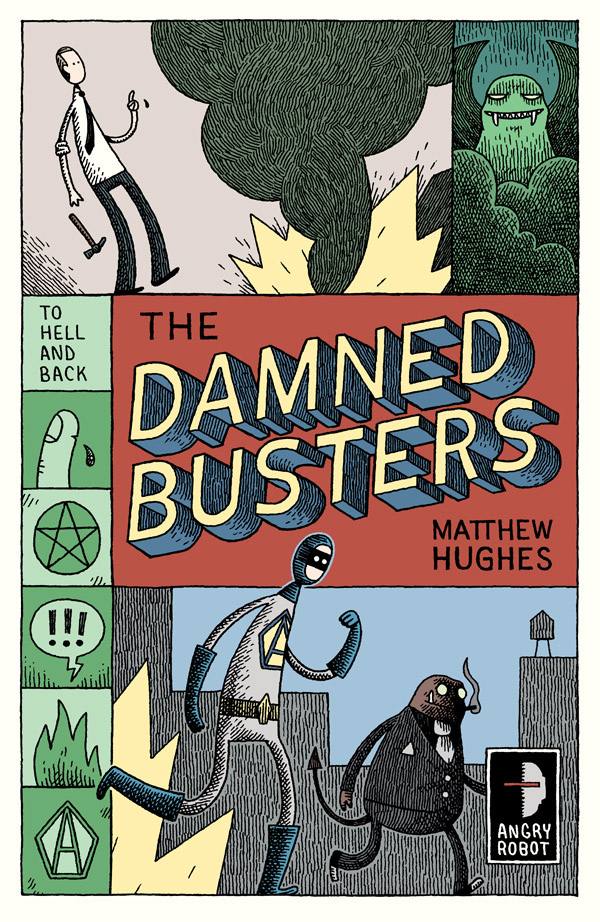 Cartoonist and illustrator Tom Gauld chats with the Angry Robot blog:
I find [robots] almost endlessly interesting. There is tragedy in their place between sentient beings and disposable products. And … they are much easier to draw than real people.
I’m hoping to interview Tom here as well sometime soon (just as soon as I think of something smart to ask him).
Hard Scenes — Actor, writer and director John Turturro talks about his work and one of my all time favourite films Miller’s Crossing at the A.V. Club (via Biblioklept):
Sometimes you think about movies, and you say, “Well, I want to try to do something that’s not exactly in a movie.” If you’ve ever been in a very dangerous situation, you know that people will do all kinds of things to keep themselves alive. It was very well-written, but you want to imagine what it’s really like to be in that kind of situation. It depends on what you’re willing to do, and in real life you would do a lot of different things. I tried to capture a little bit of that… to do something that was almost a little difficult to watch, because people aren’t trying to be heroic at those moments.
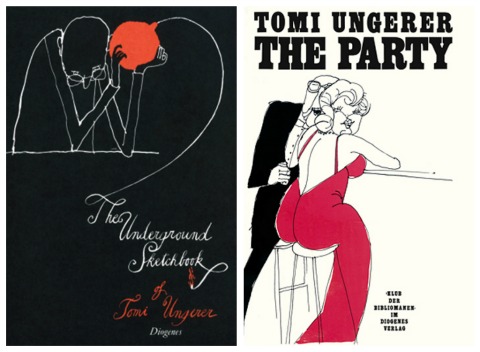
Curiosity and Collecting — Writer and illustrator Tom Ungerer in conversation with Julie Lasky at Design Observer:
One of the most important things for one’s own development is curiosity. Once you have curiosity, you just accumulate. My interests go from botany to mineralogy, geology, anatomy, history. Sometimes I’ve been bitten like bug. I buy one object and I’m so fascinated that I start collecting. And then when I finish collecting, and the collection doesn’t inspire, I give it away, like my toy collection of 6,000 pieces that I donated to my hometown museum for children.
Learning to Write — An interview with author Zadie Smith at The Literateur:
[O]ne of the things I look for in other people’s writing is the ability to confer freedom. That’s what I want to be able to do myself. I like a writer who doesn’t have to be in total control of how their readers react. More mystery, less explanation. All I can say is I’m working on it. But it’s so hard! I really feel I’m just at the base of a huge mountain called ‘learning how to write’. I’m still only 35. Learning to write is a task that takes up your whole life.
And finally…
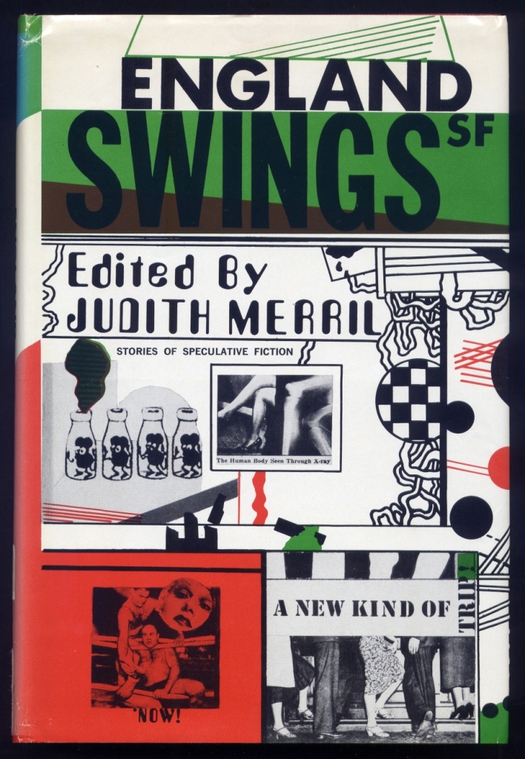
Rick Poynor on the unusual cover design for England Swings SF, published in 1968, also at Design Observer.
Comments closed