Skip to content

Tag: the new yorker

The Wall

cover-story-staake-the-wall-875x1200-1478824922

Bob Staake for The New Yorker

Comments closed

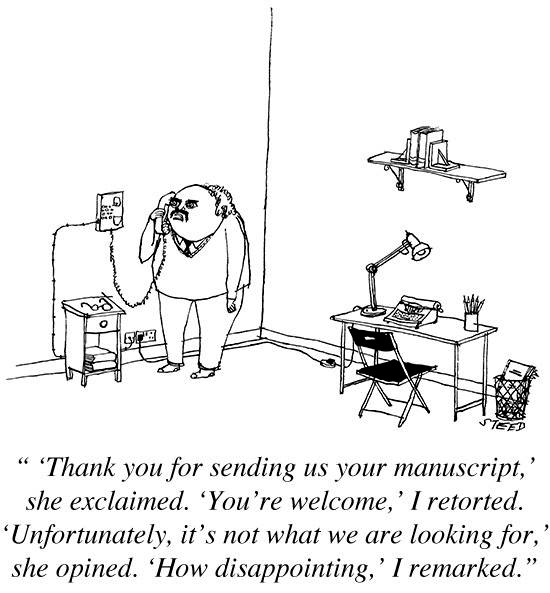
Thank You for Sending Us Your Manuscript

New Yorker Manuscript

Edward Steed for The New Yorker.

Comments closed

Comma Queen: The Illustrious Ampersand

Comma Queen Mary Norris takes a quick look at the origins of the beloved ampersand for The New Yorker:

Comments closed

Brooklyn’s Most Cluttered Bookstore

The New Yorker visits the Community Bookstore in Brooklyn as owner John Scioli begins to clean out his “cavern of books” in preparation of the store’s closing in May:

Comments closed

Mirror by Chris Ware

Cover-Story-Chris-Ware

I have to confess that I frequently find This American Life kind of irritating, but this collaboration with Chris Ware and The New Yorker to create an animated magazine cover is neat:

The animation was done by Ware and John Kuramoto. You can read more about how it came about on The New Yorker culture blog.

Comments closed

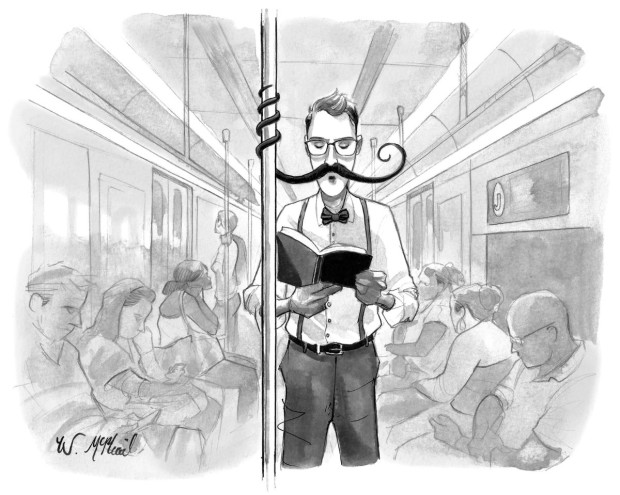
Moustache

new yorker subway reading

Will McPhail for The New Yorker.

Comments closed

Something for the Weekend

Blown Covers — The New Yorker art editor Françoise Mouly has a Tumblr (pictured above:  “Eustace at a Stoplight—Right?,” by David Urban)

Spanking — Charles McGrath remembers the late Barney Rosset in the New York Times:

Mr. Rosset was far from a highbrow. Sometimes he signed up books without having read them. He determined to publish “The Autobiography of Malcolm X,” for example, while riding in a cab and hearing on the radio that other publishers had turned it down. And he was proud of publishing a profitable line of Victorian spanking pornography. To a considerable extent the dirty books made the arty ones possible, and Mr. Rosset wasn’t the least abashed about it.

See also: WNYC has reposted two archive interviews with Rosset from 1995 and 2008, and John Gall has posted a collection of links to reminiscences about Rosset on his blog Spine Out.

Form and Fortune — A fascinating  review  of  Walter Isaacson’s biography of Steve Jobs by Evgeny Morozov, author of The Net Delusion, in The New Republic which discusses Apple’s relation to the Bauhaus and Braun:

The design philosophy of Dieter Rams, Braun’s legendary designer, has shaped the feel and the look of Apple’s latest products more than any other body of ideas. Since joining Braun in 1955, Rams—who likes to describe his approach to design as “less, but better”—began collaborating with the faculty at the Ulm School of Design, which tried to revive the creative spirit of Bauhaus with a modicum of cybernetics and systems theory. Eventually Rams produced his own manifesto for what good design should accomplish. His “ten principles of good design” encouraged budding designers to embrace innovation and make products that were useful but environmentally friendly, thorough but simple, easy to understand but long-lasting, honest but unobtrusive. Rams wanted his products to be like English butlers: always available, but invisible and discreet.

See also:  Maureen Tkacik’s on Steve Jobs and Isaacson’s biography at Reuters.

And lastly…

James Wood reviews Edward St. Aubyn’s Patrick Melrose novels for The New Yorker:

Patrick Melrose, the protagonist of what is now a quintet of novels devoted to the Melrose family, is the scion of a wealthy dynasty almost as monstrous as the dodgier Roman emperors; he has spent much of his adult life trying to kill himself with drugs and booze. St. Aubyn’s novels have an aristocratic atmosphere of tart horror, the hideousness of the material contained by a powerfully aphoristic, lucid prose style. In good and bad ways, his fiction offers a kind of deadly gossip, and feeds the reader’s curiosity like one of the mortal morsels offered up by Tacitus or Plutarch in their chatty histories.

Comments closed

Too Much Information

That the reality of machines can outpace the imagination of magic, and in so short a time, does tend to lend weight to the claim that the technological shifts in communication we’re living with are unprecedented… The scale of the transformation is such that an ever-expanding literature has emerged to censure or celebrate it. A series of books explaining why books no longer matter is a paradox that Chesterton would have found implausible, yet there they are, and they come in the typical flavors: the eulogistic, the alarmed, the sober, and the gleeful.

The New Yorker‘s critic-at-large Adam Gopnik reviews the recent spate of books about the internet and our minds — including Cognitive Surplus by Clay Shirky, The Shallows by Nicholas Carr, and Hamlet’s Blackberry by William Powers — neatly dividing them into the categories “Never-Betters”, the “Better-Nevers”, and the “Ever-Wasers”:

The Never-Betters believe that we’re on the brink of a new utopia, where information will be free and democratic, news will be made from the bottom up, love will reign, and cookies will bake themselves. The Better-Nevers think that we would have been better off if the whole thing had never happened, that the world that is coming to an end is superior to the one that is taking its place, and that, at a minimum, books and magazines create private space for minds in ways that twenty-second bursts of information don’t. The Ever-Wasers insist that at any moment in modernity something like this is going on, and that a new way of organizing data and connecting users is always thrilling to some and chilling to others—that something like this is going on is exactly what makes it a modern moment. One’s hopes rest with the Never-Betters; one’s head with the Ever-Wasers; and one’s heart? Well, twenty or so books in, one’s heart tends to move toward the Better-Nevers, and then bounce back toward someplace that looks more like home.

It is an article unlikely to satisfy either the evangelists or doom-mongers, but it sounds about right to me in a smart-alecky sort of way…
Comments closed