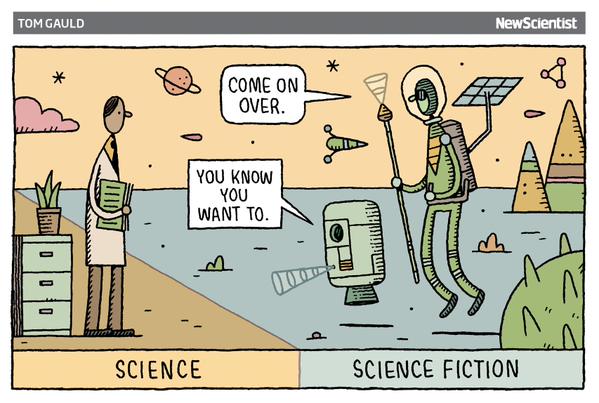
In his latest cartoon for New Scientist magazine, Tom Gauld illustrates the temptations of science fiction:
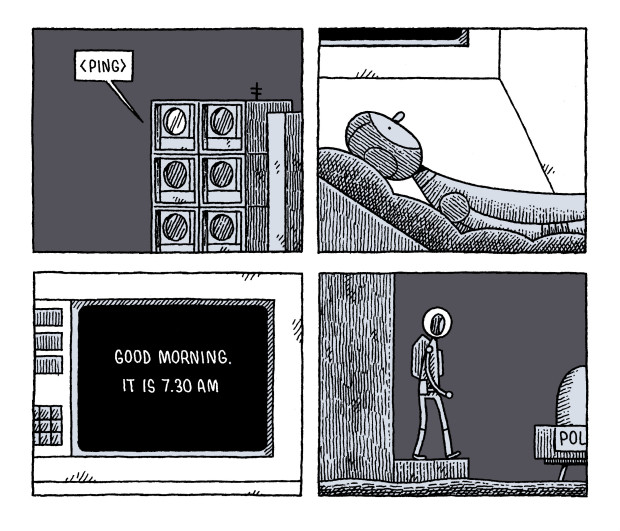
In related news, Drawn & Quarterly are going to publish Tom’s new book Mooncop next year. It looks amazing:
Books, Design and Culture
In his latest cartoon for New Scientist magazine, Tom Gauld illustrates the temptations of science fiction:
In related news, Drawn & Quarterly are going to publish Tom’s new book Mooncop next year. It looks amazing:
Somewhat related to that Keith Phipps essay Why Star Wars? (mentioned here a couple of days ago), Wired has an oral history of Industrial Light & Magic, the special effects shop founded by George Lucas to work on the movie:
Industrial Light & Magic was born in a sweltering warehouse behind the Van Nuys airport in the summer of 1975. Its first employees were recent college graduates (and dropouts) with rich imaginations and nimble fingers. They were tasked with building Star Wars’ creatures, spaceships, circuit boards, and cameras. It didn’t go smoothly or even on schedule, but the masterful work of ILM’s fledgling artists, technicians, and engineers transported audiences into galaxies far, far away.
As it turns 40 this year, ILM can claim to have played a defining role making effects for 317 movies. But that’s only part of the story: Pixar began, essentially, as an ILM internal investigation. Photoshop was invented, in part, by an ILM employee tinkering with programming in his time away from work. Billions of lines of code have been formulated there. Along the way ILM has put tentacles into pirate beards, turned a man into mercury, and dominated box office charts with computer-generated dinosaurs and superheroes.
And if you were wondering where it all went wrong, it was probably the precise moment George Lucas had this revelation:
2 CommentsI never thought I’d do the Star Wars prequels, because there was no real way I could get Yoda to fight. There was no way I could go over Coruscant, this giant city-planet. But once you had digital, there was no end to what you could do.
In the most recent installment of the Laser Age, the Dissolve’s fascinating history of science fiction films from the 1960s to the 1980s, Keith Phipps turns his attention to Superman, Star Trek, and Flash Gordon — three movies released in the immediate wake of Star Wars. It’s a great read if you are at all interested in this stuff, but it’s also a perfect excuse to revisit Phipps’s earlier — but oh, so timely — essay, ‘Why Star Wars?’:
1 CommentWhy? Of all the science-fiction films released in the long wake of 2001: A Space Odyssey and Planet Of The Apes, why did Star Wars take hold in a way no film before it had? None of the many answers are entirely satisfying. But combining a few of them lets us make some sense of the question.
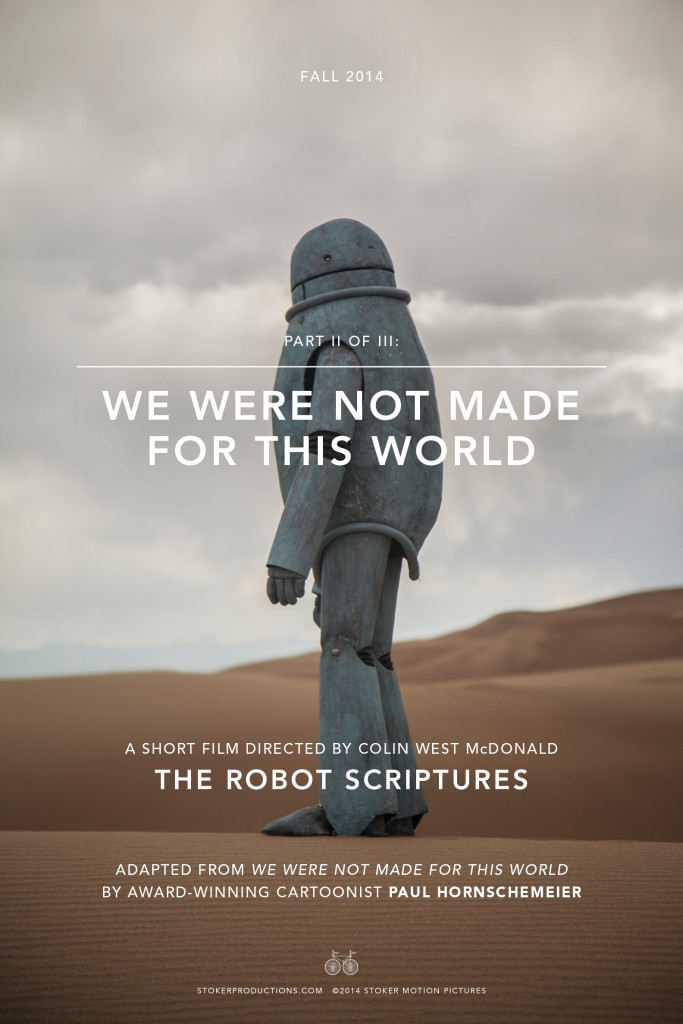
Directed by Colin West McDonald, We Were Not Made For This World is a short science fiction film based on the comic strip of the same name by cartoonist Paul Hornschemeier about a robot searching for his creator:
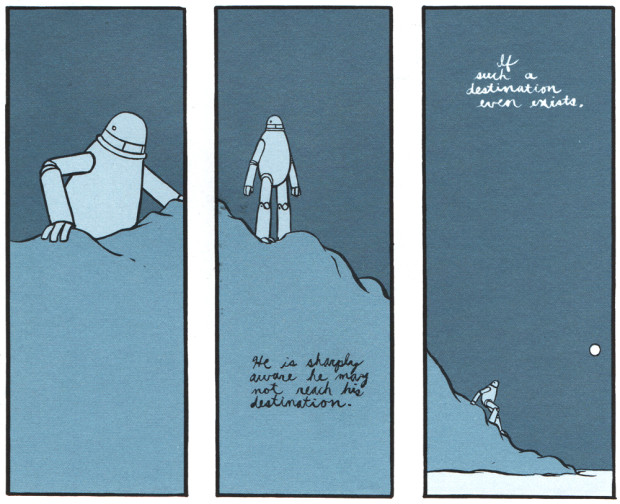
‘We Were Not Made for This World’ was first published in Project Telstar by AdHouse and later collected in Let Us Be Perfectly Clear by Fantagraphics.
2 Comments
At The Dissolve, Noel Murray considers Jack Kirby’s comic book adaptation of the movie 2001: A Space Odyssey directed by Stanley Kubrick:
It’s not essential to know how Kubrick’s fascinations with avant-garde film and music influenced 2001, or to focus on how a mid-1960s conception of computers and technology affected the character of HAL, who’s like an elaborate version of one of those early chess-playing robots. But it does recontextualize 2001 to think of it as the product of an individual, working in concert with other individuals, none of them delivering messages from on high. And for all the angry letters Marvel received (and, to its credit, published) from 2001 fans who felt Kirby was besmirching their favorite film, it helps to remember the pressures that Kirby was under at the time, internally and externally, and to see the 10 issues and one tabloid edition of his 2001 as the product of a scatterbrained genius grappling with his own relevance. Kubrick and Kirby—these were both just people, grasping at something just beyond them, while planting guideposts for others to follow.


The latest installment of ‘The Laser Age’, Keith Phipps series for The Dissolve on science fiction films of the 1960s, 70s and 80s, considers A Clockwork Orange and THX-1138:
Though released in 1971, THX 1138 plays at times like the last science-fiction film of the 1960s, while the downbeat A Clockwork Orange feels like the first of the 1970s. While superficially, they have little in common, in many respects, both films puzzle over the same obsessions. THX 1138 offers a dour, laconic vision that ends on an up note—THX escapes and stands against one of the biggest, boldest sunrises ever filmed—in contrast to A Clockwork Orange, which keeps a perversely peppy pace, up to an ending that’s happy for its hero, and chilling in its implications for everyone else. And even if, of the two, only Lucas seems fully invested in the argument, and even if both come up short, both make the effort. Both feel driven by a sense that, in the years to come, humanity would need a defense against the dehumanizing forces at work, whatever form they might take.
Last month, in the previous essay in the series, Phipps discussed Soylent Green, Z.P.G., No Blade Of Grass, and Silent Running.
Comments closed
Jonathan Lethem discusses science fiction, comics and his new novel Dissident Gardens with Jesse Hicks at The Verge:
Comments closedI like that Philip K. Dick and the science fiction writers that I fell in love with were intrinsically in this termite role, nibbling around the edges of the culture. I know it was uncomfortable for them, and it certainly didn’t pay as well as they might have liked, but it meant that their work had a relevance and vitality and disreputable energy that, for me as a younger reader, hands-down won over the official literary product of the same time period.
Though one of the things that’s wrong with marginal identities is that you tend to act as though the big hegemonic center is all one thing itself. “The mainstream” doesn’t agree with itself or make any kind of sense or have a coherent position, except in the very small matter of believing itself to be the only action. That’s the only thing it agrees about. [laughter] The rest of it, if you really pay any attention and care, and I started to care about all kinds of novels and all kinds of literary ventures, and possibilities — different kinds of lives that writers led — the rest of the mainstream is pretty much at one another’s throats over various matters of style and politics, minor grudges and so forth. But it looks like one big thing if you’re in exile from it.

Will Self on J.G. Ballard’s The Drowned World at The Telegraph:
To coincide with the 1962 publication of The Drowned World – his own post-apocalyptic novel in which men of the future also venture into a flooded London, intent on looting the city of its treasures – JG Ballard wrote an article for The Woman Journalist in which he explained the mise en scène thus: “On reflection it seems to me that the image of an immense half-submerged city overgrown by tropical vegetation, which forms the centrepiece of The Drowned World, is in some way a fusion of my childhood memories of Shanghai and those of my last 10 years in London.”
According to Ballard, “My own earliest memories are of Shanghai during the annual long summer of floods, when the streets of the city were two or three feet deep in brown silt-laden water, and where the surrounding countryside… was an almost continuous mirror of drowned paddy fields and irrigation canals stirring sluggishly in the hot sunlight.”
There seems no reason to doubt Ballard at his word on this question; one that he proposes himself rhetorically at the outset of the piece: “How far do the landscapes of one’s childhood, as much as its emotional experiences, provide an inescapable background to all one’s imaginative writing?”
The Drowned World by J.G. Ballard, with an introduction by Will Self and illustrations by James Boswell is published by the Folio Society.

A paperback edition of The Drowned World published by W.W. Norton, with a cover design by Darren Haggar (pictured above), is also available.
Comments closed
At Pitchfork’s new film site The Dissolve, Keith Phipps is writing a column about the science fiction movies of The Laser Age — a period “rich with idea-driven science fiction” that began in the late 1960s and ended in the mid-1980s with “the poor financial performance of films like Blade Runner, Tron, The Thing, and Dune.”
The first essay looks at the two films that ushered in The Laser Age, Planet Of The Apes and 2001: A Space Odyssey, while the second looks at four post-apocalyptic films of the early 1970s, Beneath The Planet Of The Apes, Glen And Randa, Gas-s-s-s, and The Omega Man:
Planet Of The Apes arrived at the beginning of a period of turmoil and dark times that made it easy to think the end was near. There’s a reason the longhaired kook appearing in Mad magazine during this era carried a sign reading just that: “The End Is Near.” Apocalyptic cults, and cults of all kinds, developed a foothold in the counterculture. Millenarianism wasn’t confined to the fringes, either. As Christian fundamentalism became a more powerful force in the American mainstream, the notion of preparing for the End Times became more common. Early Christian-rock star Larry Norman, a man with one foot in the counterculture and the other in fundamentalism, released a 1969 song titled “I Wish We’d All Been Ready.” The message is right there in the title, but the song revels in the dark imagery of dead children and a period in which “a piece of bread could buy a bag of gold.” His mind was straining to imagine unthinkable horrors just around the corner, and to turn those horrors into entertainment carrying a warning.

I haven’t seen it for years, but I’ve meaning to revisit Beneath The Planet Of Apes for some time. There’s a bleak insanity to it that makes it strangely memorable. Certainly the mutant-humans worshiping the nuclear missile at the end of the film absolutely TERRIFIED me a kid (when death by nuclear war seemed quite a real possibility). Perhaps that’s why I haven’t quite got around to watching it again?

Didn’t we all… (Tom’s new collection of comics, You’re All Just Jealous of My Jetpack, is out now.)